Showing posts with label 1942. Show all posts

Thursday, July 03, 2025

67. The Moving Finger


67. The Moving Finger. Agatha Christie. 1942/2007. Black Dog & Leventhal. 208 pages. [Source: Library] [5 stars, adult mystery, classic, romance]

First sentence: I have often recalled the morning when the first of the anonymous letters came.

Jerry Burton, our hero, has taken a house in the country with his sister, Joanna. He's recuperating from an injury, and his doctor has definitely suggested some rest and relaxation. As for Joanna, she's recuperating from a broken heart. But rural village life isn't as uneventful and peaceful as he expected. For soon after his arrival, an anonymous "poison pen" begins a nasty letter campaign. Which is unpleasant enough, he supposes, but things turn deadly after a woman's "suicide" after receiving a vile letter. The victim leaves behind two young sons, an older daughter from her first marriage, a husband, and a rather pretty governess. Megan, the daughter from the first marriage, soon becomes a major player in this Miss Marple mystery. This "suicide" becomes a bit suspicious when a second death occurs--that of a maid--within the home. The question becomes did this maid--on her day off--see something?

I loved this one. I just LOVED it. It wasn't a purely pleasant read for me. I wouldn't exactly say I was praying throughout, but I was certainly wishful with my repeated pleas, please don't let it be Megan, please don't let it be Megan, please don't let it be Megan. Never have I gotten that involved with a mystery. Who is Megan? For better or worse, she's the young woman our hero described thusly, "She looked much more like a horse than a human being. In fact, she would have been a very nice horse with a little grooming" (17). She's largely ignored not only by the village but by her family as well. But there is something about her that Jerry, our hero, can't ignore. He goes out of his way--time and time and time again--to include her. He even invites her to stay with him and his sister after her mother's death. He is the one person, she's found, willing to listen to her.

While Jerry is making friends with Megan--not always an easy task--Joanna, his sister, is trying to make friends with the local doctor. That is an uphill battle. Joanna has never, ever had to work this hard to get a guy to like her.

So this mystery has a romantic element to it which I just loved. It also stars Miss Marple, though she doesn't enter the case until after the second death occurs. Miss Marple finds Jerry Burton a great help in this one! The details he's observed through his stay, makes solving this one so much easier for her! It gives her quite the lead. But she still has to *prove* it.

The Moving Finger is very compelling! I loved it for so many different reasons.

My favorite quotes:

Emily Barton, I think, has a mental picture of men as interminably consuming whisky-and-sodas and smoking cigars, and in the intervals dropping out to do a few seductions of village maidens, or to conduct a liaison with a married woman.
When I said this to Joanna later, she replied that it was probably wishful thinking, that Emily Barton would have liked to come across such a man, but alas, had never done so. (85)

"The police are doing their best."
"If Agnes could be killed yesterday, their best isn't good enough."
"So you know better than they do?"
"Not at all. I don't know anything at all. That's why I'm going to call in an expert."
I shook my head. "You can't do that. Scotland Yard will only take over on a demand from the chief constable of the county. Actually they have sent Graves."
"I don't mean that kind of an expert. I don't mean someone who knows about anonymous letters or even about murder. I mean someone who knows people. Don't you see? We want someone who knows a great deal about wickedness!"
It was a queer point of view. But it was, somehow, stimulating. (141)

"Yes, it was dangerous, but we are not put into this world, Mr. Burton, to avoid danger when an innocent fellow creature's life is at stake. You understand me?"
I understood. (199)


© 2025 Becky Laney of Becky's Book Reviews

Tuesday, January 24, 2023

15. The Case of the Careless Kitten


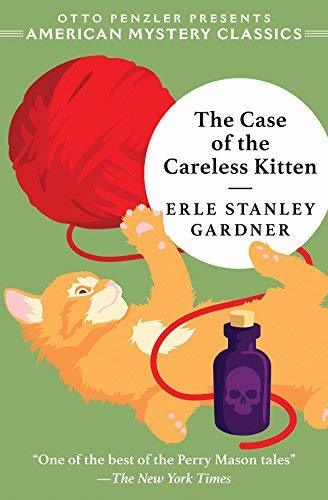
Perry Mason: The Case of the Careless Kitten (Perry Mason #21) Erle Stanley Gardner. 1942. 211 pages. [Source: Bought]

First sentence: THE KITTEN’S eyes, weaving back and forth, followed the ball of crumpled paper that Helen Kendal was waving high above the arm of the chair. The kitten was named Amber Eyes because of those yellow eyes. Helen liked to watch them.

Premise/plot: Helen Kendal's kitten, Amber Eyes, is poisoned (but survives) shortly after she receives a phone call from her missing (long thought dead) uncle. Her uncle, Frank Shore, wants her to meet with the lawyer, Perry Mason, and go to a super-shady hotel later that evening. He's arranged for someone to meet them (just them, only them) and take them to a second location where he'll be waiting. She's not to tell anyone--especially her aunt, Matilda. (She ends up talking with her (other) uncle Gerald). The meet-up does NOT go as planned. They find a NOTE not a man. And the man they were supposed to meet up with (to find the uncle) is found DEAD. And so it begins...

My thoughts: I do love Perry Mason. I am more familiar with the television series than the actual novels the show is based upon. However, I do enjoy both. It's been years since I last read a Perry Mason novel. (Or it could have been 2020-ish. Which feels like years ago).  

How does this one compare to other Perry Mason novels? Well, I can't compare it to each and every one, but, I'll do my best to compare it with your typical Mason mystery.

First, the KITTEN, Amber Eyes, truly steals the show. This kitten stars in several scenes of the book. Often her antics make for the best bits of dialogue. And literally, Mason solves the case because of the kitten! She's key to putting all the pieces together...

Second, this Perry Mason novel was written and published in 1942. One of the suspects (though not high up on the suspects list) is a "houseboy" who works for Aunt Matilda. She claims--and he claims--that he is Korean, not Japanese. Everyone--including Mason and company--are suspicious of him. Is he lying about being Korean? Is he Japanese? Is he loyal to Japan? Is he a traitor to the United States? If this was written in ANY other year/decade, it would feel definitely cringe and super-regrettable. (I'm not saying it is justifiable. Just that the context makes sense of WHY.) There are probably half a dozen scenes where characters slur his race/ethnicity (in general). Again, not justifying the behavior, but during the war, the propaganda machine was going full force. And even before the war, Americans were VERY divided on if ANYONE of Asian descent should be allowed to emigrate. There were strict immigration laws. It was UGLY. I highly recommend Days of Infamy by Lawrence Goldstone. The novel captures a moment in American history. Seen in light of actual history, I think you can understand how/why this bias, this prejudice makes its way into a mystery novel (set in California). This could be a good opportunity to take a moment or two to reflect and dig a little deeper.

Third, while there is a BIG reveal, it takes place OUTSIDE the courtroom. Perry Mason has had enough. Like he's ALL DONE. He does not solve the D.A.'s case for him. He clears his client of the so-called crime (it's complicated), but does NOT fill in the blanks for the prosecution.

Fourth, the courtroom case we do see is NOT the murder case. But I hate to spoil who his client is and what the charge is...

Quotes:

But Perry Mason had a mind which was only content when it was detouring the technicalities of legal red tape. He not only regarded each case as a venture studded with excitement, but became impatient with the delays of routine procedure. More and more, as his practice developed, he became interested in personalities. More and more, his methods became dazzlingly brilliant, increasingly dangerous, and highly unorthodox.

“A cat usually picks at its food. That kitten must have been terribly hungry to gulp down those balls of meat.” “This kitten was just careless, I guess. Hurry up.” “Very careless,” nodded Della. “I think when I open the file for this case I’ll call it ‘The Case of the Careless Kitten.’ ”
 
“It’s high time for citizens to wake up to the fact that it isn’t a question of whether a man is guilty or innocent, but whether his guilt or innocence can be proved under a procedure which leaves in the citizen the legal rights to which he is entitled under a constitutional government.
 
 Hamilton Burger said to the Court, “I am asking leading questions on some of these points which are not disputed, but which I want to get before the jury.” “No objection,” Mason said. “What did your uncle say to you over the telephone?” “Objected to,” Mason said, “as hearsay. Incompetent, irrelevant, and immaterial.”
 
“I’m going out to buy a cat so I can study him and learn about some of the important facts of life.”  

© 2023 Becky Laney of Becky's Book Reviews

Friday, February 15, 2019

The Boxcar Children

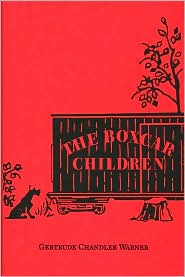
The Boxcar Children. Gertrude Chandler Warner. 1942. 160 pages.

First sentence: One warm night four children stood in front of a bakery. No one knew them. No one knew where they had come from. The baker's wife saw them first, as they stood looking in at the window of her store. The little boy was looking at the cakes, the big boy was looking at the loaves of bread, and the two girls were looking at the cookies. 

Premise/plot: Four orphan children are on the run in Gertrude Chandler Warner's classic children's novel. The children are aware that they have a grandfather; they even know the town where he lives. But...the children fear this man they've never met. They'd rather struggle to survive than risk falling into his hands. (What if he's mean? cruel? what if he doesn't want them? what if he does? what if he separates them?) The four children--Henry, Jessie, Violet, and Benny--begin their new life living in an abandoned boxcar on an abandoned track. Henry is old enough to walk into nearby towns and work for food. The others mostly scrounge around and find useful junk that they can re-purpose into a few necessities. All seems to be going well...until one of the children gets really sick....

My thoughts: I liked  The Boxcar Children. I did. I had read it more than a few times growing up, but it had been at least fifteen or twenty years since I'd last read it. It was such a treat to read it again. It's a simple book, in many ways, yet it's got its charms. I liked how these children do make a home for themselves. How they work together as a family. While I wouldn't say that I ever loved this one as much as Mandy or Anne of Green Gables or The Secret Garden, I have definitely always liked it.

© 2019 Becky Laney of Becky's Book Reviews

Monday, March 13, 2017

Runaway Bunny

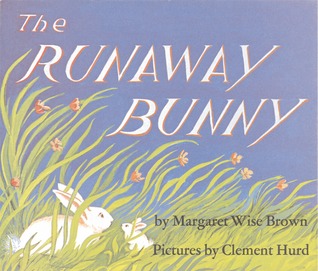
Runaway Bunny. Margaret Wise Brown. Illustrated by Clement Hurd. 1942. 48 pages. [Source: Library]

First sentence: Once there was a little bunny who wanted to run away. So he said to his mother, "I am running away." "If you run away," said his mother, "I will run after you. For you are my little bunny." "If you run after me," said the little bunny, "I will become a fish in a trout stream and I will swim away from you." "If you become a fish in a trout stream," said his mother, "I will become a fisherman and I will fish for you."

Premise/plot: Will the little bunny run away from his home? Will his mother let him go? Just how much does she love her little bunny?

My thoughts: I like this one. I don't know that I love, love, love it. But it's a very sweet story starring bunnies. It blends black and white illustrations with color illustrations. This one was first published in 1942.

Text: 4 out of 5
Illustrations: 3 out of 5
Total: 7 out of 10


© 2017 Becky Laney of Becky's Book Reviews

Thursday, March 09, 2017

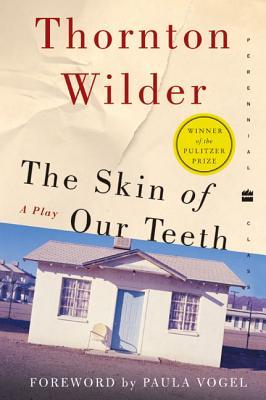
The Skin of Our Teeth

The Skin of Our Teeth. Thornton Wilder. 1942. 176 pages. [Source: Library]

First sentence: Announcer: The management takes pleasure in bringing to you--The News Events of the World:

Premise/plot: The Skin of Our Teeth is an always absurd, sometimes amusing, frequently head-scratching play that won a Pulitzer Prize for Drama in 1943. It stars Mr. and Mrs. Antrobus, a couple who've been married for 5,000+ years, their two children Henry and Gladys, and their 'maid' Sabina. Each of the three acts has its own peculiar setting. The acts do not seem--to me, at least--to be connected to one another to tell a cohesive story. Each act has its own beginning, middle, and end. So the whole play is like three little stories sharing some of the same characters, some of the same themes. The 'theme' is surviving 'by the skin of your teeth.' The running gag, of sorts, is that this couple is "Adam" and "Eve" and Henry is "Cain."

The first act is 'the end of the world' by ice. The second act is 'the end of the world' by flood. The third act is 'end of the world' by war.

My thoughts: What a strange, strange play! Sabina, the "maid," is the scene stealer. In each of the three acts, she breaks character throughout and speaks directly to the audience. She reminds everyone THIS IS A PLAY. THIS IS A PLAY THAT DOESN'T MAKE SENSE. I'M A PART OF THE PLAY. BUT I'M A REAL PERSON TOO. In the second act, for example, Sabina breaks character to "protect" the audience and "prevent" giving offense. The lines she's skipping are the ones her character says to steal Mr. Antrobus and wreck his "happy" family. Her excuse for breaking character is this: there might be people in the audience who don't need to be reminded of the reality of broken homes. Husbands cheat. Wives cheat. Spouses leave each other. Couples divorce. Homes are broken. People don't go to the theatre to see this kind of stuff. They come to be entertained. They come to laugh.

Did I like this one? Well. Not really "like." It was interesting. More astounding to me than anything is that it's a prize-winning drama. Which in a way makes sense. I think this is a case of The Emperor's New Clothes. You either see the brilliance, want others to think you see what they see, or call others out and say WHY is this wonderful?

Quotes:
"Henry Antrobus is a real, clean-cut American boy. He'll graduate from High School one of these days, if they make the alphabet any easier. Henry, when he has a stone in his hand, has a perfect aim; he can hit anything from a bird to an older brother--Oh! I didn't mean to say that!--but it certainly was an unfortunate accident, and it was very hard getting the police out of the house. Mr. and Mrs. Antrobus' daughter is named Gladys. She'll make some good man a good wife someday, if he'll just come down off the movie screen and ask her." (Sabina, monologue)
"How can you make a world for people to live in, unless you've first put order in yourself?" (Antrobus to Henry)
"How will a man choose the ruler that shall rule over him? Will he not choose a man who has first established order in himself, knowing that any decision that has its spring from anger or pride or vanity can be multiplied a thousand fold in its effects upon the citizens? (Hester) 

© 2017 Becky Laney of Becky's Book Reviews

Wednesday, May 20, 2015

Snow Treasure (1942)

Snow Treasure. Marie McSwigan. Illustrated by Mary Reardon. 1942. 208 pages. [Source: Bought]

Set in Norway in 1940, Snow Treasure is a true must-read for anyone who loves a good adventure story or a good war story. Snow Treasure is based on a true story too! It is about the smuggling of Norway's gold, smuggling it out of the country so that it doesn't fall into Nazi hands. How is it smuggled out? Who could hope to smuggle it out undetected without any Nazi being the wiser? Why, you let children do it, naturally.

The hero of Snow Treasure is a young boy named Peter Lundstrom. He isn't the only child from his Norwegian village involved. He has a lot of help from other boys and girls. The older and stronger can carry more gold on their sled. The younger take less. But all work together to help their country in need. They are one part of the process, adults also play a big role, of course. For it will be Peter's uncle who will smuggle the gold out of the country on his ship.

I loved everything about this one. I loved the characters. I loved Peter and his family. I loved the adventure aspect of it. It's a thrilling read. It isn't a simple, easy process. It's hard work. And each trip is a risk, of course. For they do see and hear a lot of Nazis as they are carrying on their most secret work.

Snow Treasure is a compelling read for children and adults. 

© 2015 Becky Laney of Becky's Book Reviews
Tuesday, January 15, 2013

Over the Moon (1947, 1942, 1949)

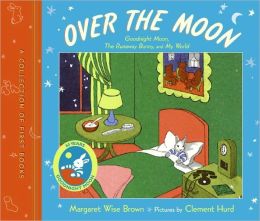
Over the Moon: Goodnight Moon, The Runaway Bunny, and My World. Margaret Wise Brown. Illustrations by Clement Hurd. 1947, 1942, 1949, 2006. HarperCollins. 108 pages.

 Goodnight Moon:
In the great green room there was a telephone and a red balloon and a picture of--
Can you complete the sentence?! Goodnight Moon was originally published in 1947 and it's been pleasing parents and children ever since. Goodnight Moon makes a great read aloud because of its rhythm and rhyme. Do you have a favorite line or two? Mine is "Goodnight comb and goodnight brush...goodnight nobody goodnight mush...and goodnight to the old lady whispering hush".

The Runaway Bunny
Once there was a little bunny who wanted to run away. So he said to his mother, "I am running away." "If you run away," said his mother, "I will run after you. For you are my little bunny."
The Runaway Bunny (1942) is an imaginative story about unconditional love. A little boy wants to run away from his mom, the mom wants to show that no matter what she'll be there for her bunny.  For example, "If you become a rock on the mountain high above me," said his mother, "I will be a mountain climber, and I will climb to where you are" and "If you become a bird and fly away from me," said his mother, "I will be a tree that you come home to." It's a lovely book, one that is easy to recommend.

My World
My book. Mother's book. In my book I only look.
The fire burns. The pages turn.
Mother's chair.
My chair.
A low chair.
A high chair.
But certainly my chair.

My World (1949) is a companion picture book to Goodnight Moon. It certainly rhymes. And some of the rhythms are quite enjoyable. But the story is lacking a little. For example, "My dog. Daddy's dog. Daddy's dog once caught a frog. My spoon. Daddy's spoon. The moon belongs to the man in the moon." The book does focus on a child's world: the day-to-day activities and objects of familiarity.


© 2013 Becky Laney of Becky's Book Reviews

Tuesday, August 02, 2011

The Boxcar Children

The Boxcar Children. Gertrude Chandler Warner. 1942. 155 pages.

One warm night four children stood in front of a bakery. No one knew them. No one knew where they had come from. The baker's wife saw them first, as they stood looking in at the window of her store. The little boy was looking at the cakes, the big boy was looking at the loaves of bread, and the two girls were looking at the cookies.

Henry, Jessie, Violet, and Benny are orphans. Scared of a grandfather they never met, these children are running away. When the novel opens, they are seeking refuge for the night, asking permission to sleep on the benches of the bakery shop. (They bought bread). After hearing the couple discuss them--on how they should "keep" the three oldest because they would be useful to have around as workers, but how the youngest one would need to go to a Children's Home--Henry and Jessie decide to wake everyone and leave while they still have a chance. They walk most of the night, sleep most of the day. Their journey takes them into the woods, and during a storm, they seek shelter in an abandoned boxcar. It doesn't take the children very long to realize that if a boxcar is good shelter from a storm, it would be a good home for always. There is a town within walking distance so that Henry can find work and buy food. And the rest of the children can do what they can to make it a real home. And that is just what they do...day by day creating a home for themselves.

I liked  The Boxcar Children. I did. I had read it more than a few times growing up, but it had been at least fifteen or twenty years since I'd last read it. It was such a treat to read it again. It's a simple book, in many ways, yet it's got its charms. I liked how these children do make a home for themselves. How they work together as a family. While I wouldn't say that I ever loved this one as much as Mandy or Anne of Green Gables or The Secret Garden, I have definitely always liked it.

© 2011 Becky Laney of Becky's Book Reviews
Wednesday, May 11, 2011

Black Orchids

Black Orchids. A Nero Wolfe Mystery. Rex Stout. 1941/1942. Random House. 208 pages.

First sentence of Black Orchids: "Monday at the Flower Show, Tuesday at the Flower Show, Wednesday at the Flower Show. Me, Archie Goodwin. How's that? I do not deny that flowers are pretty, but a million flowers are not a million times prettier than one flower. Oysters are good to eat, but who wants to eat a carload?"

First sentence of Cordially Invited to Meet Death: "That wasn't the first time I ever saw Bess Huddleston."

Black Orchids was my first introduction to Rex Stout's Nero Wolfe and Archie Goodwin. And oh how I loved them! The book was narrated by Archie Goodwin, and he had me practically at hello! (While I wouldn't say I loved him *more* than Miss Marple or Lord Peter Wimsey, I can definitely say that I love, love, love him as a narrator!)

So in this book, readers have two novellas. The first, Black Orchids, concerns a murder at a flower show. Archie has been made to go to this flower show day after day after day by his boss who is a little obsessed with orchids. And on the final day (or one of the final days of the show) they go together. And it just so happens that that is the day a dead body is found in one of the exhibits! Archie is the one who makes this discovery--that the "sleeping" man is REALLY not going to be waking up. The police are on the case, of course, as they usually are in detective stories. But Nero Wolfe with some help from Archie and a few others in his employ--may just solve the case first. This botany-themed mystery didn't wow me for its subject--but I did enjoy meeting Nero and Archie.

The second novella, Cordially Invited to Meet Death, is my favorite of the two. In this mystery, we meet Bess Huddleston, a snobbish party planner for the wealthy elite of society. She comes to Nero Wolfe looking for help. Someone is sending out nasty letters--in her name, on her stationary. This "poison-pen" must be stopped! But who is the one behind this unpleasantness? And do they want merely to embarrass her--or is her life at risk?! Archie, our narrator, begins to investigate the case by trying to get close to those who are closest to her, namely: two female assistants, a nephew, a brother, and a local doctor. Can Archie and Nero solve this one before it turns deadly?

Black Orchids is an enjoyable read! I found it very satisfying! I'm not sure how Black Orchids compares with others in the series--so I'm not going to say that this is my favorite or best, it's just too soon to say. But. I enjoyed it and would recommend it!


© 2011 Becky Laney of Becky's Book Reviews
Monday, February 14, 2011

The Moving Finger

The Moving Finger. Agatha Christie. 1942/2007. Black Dog & Leventhal. 208 pages.

I have often recalled the morning when the first of the anonymous letters came.

Jerry Burton, our hero, has taken a house in the country with his sister, Joanna. He's recuperating from an injury, and his doctor has definitely suggested some rest and relaxation. As for Joanna, she's recuperating from a broken heart. But rural village life isn't as uneventful and peaceful as he expected. For soon after his arrival, an anonymous "poison pen" begins a nasty letter campaign. Which is unpleasant enough, he supposes, but things turn deadly after a woman's "suicide" after receiving a vile letter. The victim leaves behind two young sons, an older daughter from her first marriage, a husband, and a rather pretty governess. Megan, the daughter from the first marriage, soon becomes a major player in this Miss Marple mystery. This "suicide" becomes a bit suspicious when a second death occurs--that of a maid--within the home. The question becomes did this maid--on her day off--see something?

I loved this one. I just LOVED it. It wasn't a purely pleasant read for me. I wouldn't exactly say I was praying throughout, but I was certainly wishful with my repeated pleas, please don't let it be Megan, please don't let it be Megan, please don't let it be Megan. Never have I gotten that involved with a mystery. Who is Megan? For better or worse, she's the young woman our hero described thusly, "She looked much more like a horse than a human being. In fact, she would have been a very nice horse with a little grooming" (17). She's largely ignored not only by the village but by her family as well. But there is something about her that Jerry, our hero, can't ignore. He goes out of his way--time and time and time again--to include her. He even invites her to stay with him and his sister after her mother's death. He is the one person, she's found, willing to listen to her.

While Jerry is making friends with Megan--not always an easy task--Joanna, his sister, is trying to make friends with the local doctor. That is an uphill battle. Joanna has never, ever had to work this hard to get a guy to like her.

So this mystery has a romantic element to it which I just loved. It also stars Miss Marple, though she doesn't enter the case until after the second death occurs. Miss Marple finds Jerry Burton a great help in this one! The details he's observed through his stay, makes solving this one so much easier for her! It gives her quite the lead. But she still has to *prove* it.

The Moving Finger is very compelling! I loved it for so many different reasons.

My favorite quotes:

Emily Barton, I think, has a mental picture of men as interminably consuming whisky-and-sodas and smoking cigars, and in the intervals dropping out to do a few seductions of village maidens, or to conduct a liaison with a married woman.
When I said this to Joanna later, she replied that it was probably wishful thinking, that Emily Barton would have liked to come across such a man, but alas, had never done so. (85)

"The police are doing their best."
"If Agnes could be killed yesterday, their best isn't good enough."
"So you know better than they do?"
"Not at all. I don't know anything at all. That's why I'm going to call in an expert."
I shook my head. "You can't do that. Scotland Yard will only take over on a demand from the chief constable of the county. Actually they have sent Graves."
"I don't mean that kind of an expert. I don't mean someone who knows about anonymous letters or even about murder. I mean someone who knows people. Don't you see? We want someone who knows a great deal about wickedness!"
It was a queer point of view. But it was, somehow, stimulating. (141)

"Yes, it was dangerous, but we are not put into this world, Mr. Burton, to avoid danger when an innocent fellow creature's life is at stake. You understand me?"
I understood. (199)

© 2011 Becky Laney of Becky's Book Reviews