Showing posts with label 1935. Show all posts

Friday, December 26, 2025

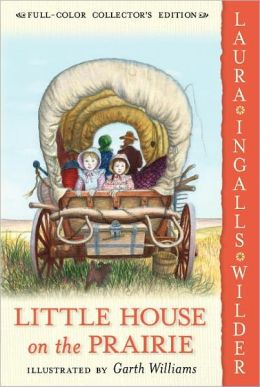
127. Little House on the Prairie


Little House on the Prairie. Laura Ingalls Wilder. 1935. 335 pages. [Source: Bought] [children's classic]

First sentence: A long time ago, when all the grandfathers and grandmothers of today were little boys and little girls or very small babies, or perhaps not even born, Pa and Ma and Mary and Laura and Baby Carrie left their little house in the Big Woods of Wisconsin. They drove away and left it lonely and empty in the clearing among the big trees, and they never saw that little house again. They were going to the Indian country.

 Premise/plot: Laura Ingalls travels with her family to Indian Territory [aka Kansas], but alas the family must move again by the end of the novel when the government forces them out. 

My thoughts: Though Little House on the Prairie is the name of the television show and seems to represent the "brand" of the "Little House" books because of that, this one--Little House on the Prairie--is not my favorite or best. I'm not sure if it's because the plot is ultimately pointless OR if it's because the content is the most problematic of the whole series. Perhaps a bit of both.

First, I don't hate Little House on the Prairie--this specific book, the series as a whole, or the television series. I am NOT part of the cancel culture that has arisen surrounding this author and series. 

Second, NEWSFLASH, Laura Ingalls Wilder is recalling and chronicling a mindset from sixty to seventy years prior. It was not her job as an author in 1935 to course-correct the "Manifest Destiny" mindset. The "go west, young man" philosophy that would colonize the entirety of the United States--from "sea to shining sea." NEWSFLASH if you were a pioneer settling in the WEST chances are you felt entitled and 'in the right' to settle and 'claim' your property with the government. 

Third, while the book has half-a-dozen (perhaps a few more) scenes that are problematic, the scenes could have been worse. That's not to justify anything. It's not. (The scenes that are there are cringe at best and extremely offensive at worst.) Laura and Pa seem more curious than hateful. That is not justification. Again, that's not my goal. It would be an uphill battle that is ultimately doomed. The fact that Laura is so curious and interested is in part because of her innocence (a small part) and a larger part in that she views the Indians as "other." She is a product of her upbringing. But she would not have been alone. It wasn't that the Ingalls were above and beyond the ultimate propagators of this mindset. They were just one of many. It is a whole culture that contemporary readers are at war with. I think the books and author are often the target. People seem to single her out as if she is solely to blame. 

Fourth, Laura usually depicts Pa as practically perfect in every way. She idealizes him in her books. This one is no different. I, as a reader, don't see Pa as perfect. I see his MUST GO WEST AT ALL COSTS and drag my family around and make their lives as difficult as humanly possible philosophy off-putting. Life can be hard no matter where you live. But Pa's "the grass is always greener on the other side" wanderlust is annoying.

© 2025 Becky Laney of Becky's Book Reviews

Sunday, February 04, 2024

15. Little House on the Prairie


Little House on the Prairie. Laura Ingalls Wilder. 1935. 335 pages. [Source: Bought] [children's classic]

First sentence: A long time ago, when all the grandfathers and grandmothers of today were little boys and little girls or very small babies, or perhaps not even born, Pa and Ma and Mary and Laura and Baby Carrie left their little house in the Big Woods of Wisconsin. They drove away and left it lonely and empty in the clearing among the big trees, and they never saw that little house again. They were going to the Indian country.

 Premise/plot: Laura Ingalls travels with her family to Indian Territory [aka Kansas], but alas the family must move again by the end of the novel when the government forces them out. 

My thoughts: Though Little House on the Prairie is the name of the television show and seems to represent the "brand" of the "Little House" books because of that, this one--Little House on the Prairie--is not my favorite or best. I'm not sure if it's because the plot is ultimately pointless OR if it's because the content is the most problematic of the whole series. Perhaps a bit of both.

First, I don't hate Little House on the Prairie--this specific book, the series as a whole, or the television series. I am NOT part of the cancel culture that has arisen surrounding this author and series. 

Second, NEWSFLASH, Laura Ingalls Wilder is recalling and chronicling a mindset from sixty to seventy years prior. It was not her job as an author in 1935 to course-correct the "Manifest Destiny" mindset. The "go west, young man" philosophy that would colonize the entirety of the United States--from "sea to shining sea." NEWSFLASH if you were a pioneer settling in the WEST chances are you felt entitled and 'in the right' to settle and 'claim' your property with the government. 

Third, while the book has half-a-dozen (perhaps a few more) scenes that are problematic, the scenes could have been worse. That's not to justify anything. It's not. (The scenes that are there are cringe at best and extremely offensive at worst.) Laura and Pa seem more curious than hateful. That is not justification. Again, that's not my goal. It would be an uphill battle that is ultimately doomed. The fact that Laura is so curious and interested is in part because of her innocence (a small part) and a larger part in that she views the Indians as "other." She is a product of her upbringing. But she would not have been alone. It wasn't that the Ingalls were above and beyond the ultimate propagators of this mindset. They were just one of many. It is a whole culture that contemporary readers are at war with. I think the books and author are often the target. People seem to single her out as if she is solely to blame. 

Fourth, Laura usually depicts Pa as practically perfect in every way. She idealizes him in her books. This one is no different. I, as a reader, don't see Pa as perfect. I see his MUST GO WEST AT ALL COSTS and drag my family around and make their lives as difficult as humanly possible philosophy off-putting. Life can be hard no matter where you live. But Pa's "the grass is always greener on the other side" wanderlust is annoying.


© 2024 Becky Laney of Becky's Book Reviews

Friday, January 25, 2019

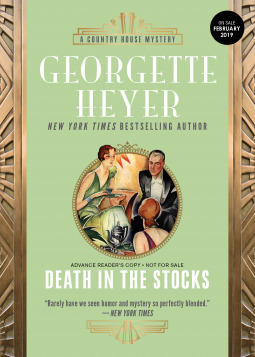
Death in the Stocks

Death in the Stocks. Inspectors Hannasyde & Hemingway #1) Georgette Heyer. 1935/2019. Sourcebooks. 384 pages. [Source: Review copy]

First sentence: It was past midnight, and the people who lived in the cottages that clustered round the triangular green had long since gone to bed and to sleep.

Premise/plot: You know how some murder mysteries seem to take forever before the body appears and the detectives arrive? Not Death in the Stocks. Within the first two pages we have a corpse: Arnold Vereker. He was found stabbed to death in the village stocks. How peculiar indeed. He only comes down to the village occasionally on weekends--usually with a woman. His family isn't surprised that he's dead. He wasn't well-loved--or even liked. It could even be likely--in terms of motive--that one of his own family did the crime.

Throughout the novel readers get a chance to know his family quite well: Antonia, "Tony," and her brother, Kenneth. Giles Carrington, their cousin and lawyer. Tony is engaged to a man who was pilfering money from Arnold Vereker's company. Kenneth is engaged to a gold digger. No doubt the inspectors soon realize this family is CRAZY ECCENTRIC. But is anyone in the family capable of murder?

My thoughts: I loved, loved, loved this one. I believe this was my second time to read this one. I love the characters. I love the dialogue. I love the pacing. It was just a delight to spend time with the characters.

Quotes:
  • And I have one of those cast-iron alibis which I understand render one instantly suspect.
  • 'People who start a sentence with personally (and they're always women) ought to be thrown to the lions. It's a repulsive habit.'
  • 'Whatever will you say next, Miss Tony? Your own brother too, as wouldn't hurt a fly.' 'If you had a fly-swotting competition, he'd win it.' Antonia replied sensibly. 
  • 'She can't possibly not talk at all, Kenneth,' said Antonia reasonably. 'What he means is, Don't talk Art.' 'Thank you. I'm quite aware that nobody but Kenneth knows anything about Art.' 
  • 'My fiancee says it's such a rotten story you're bound to believe it. She ought to know. She reads about seven detective thrillers a week, so she's pretty well up on crime.'
  • 'That boy is either an incorrigibly truthful young ass, or a brilliantly clever actor.'
  • 'Obviously if you were clever enough to commit a murder and plant yourself down in the murdered man's house afterwards you ought to have told as many people as you could that you were going down to have it out with Arnold. No one'd believe you killed him after that.'
  • 'But I don't like policemen. Some people feel the same about cats. Always know the instant one comes into the room, and begin to get creepy. Not that I've any objection to cats, mind you. Far from it. In fact, if I had to be bothered with any sort of animal, I think I should choose a cat.'
  • If there's one thing that wears me out quicker than anything it's having to choose a lot of food for someone else to eat. 


© 2019 Becky Laney of Becky's Book Reviews
Friday, August 04, 2017

It Can't Happen Here

It Can't Happen Here. Sinclair Lewis. 1935. 400 pages. [Source: Library]

First sentence: The handsome dining room of the Hotel Wessex, with its gilded plaster shields and the mural depicting the Green Mountains, had been reserved for the Ladies' Night Dinner of the Fort Beulah Rotary Club.

Premise/plot: Could America become a fascist nation seemingly overnight? That was the question raised in Sinclair Lewis' It Can't Happen Here. This political what-if novel was published in 1935, a year before the 1936 election. The novel itself begins in 1936; the early chapters chronicle the '36 election. FDR, the current president, is running again, but in Lewis' novel he loses badly. Who wins? A racist, sexist, power-mad politician named Berzelius "Buzz" Windrip. The rest of the novel sees the collapse of America--at least America as a democratic nation. Windrip wins because of his promises; his promises proclaim that he's for the people: that people will have better, richer lives if they vote for him. But it isn't long before people start regretting--deeply regretting--aligning themselves with such a monster.

The main character of the novel is a newspaper man named Doremus Jessup. Jessup opposes Buzz and all he stands for. He sees that America is in deep trouble. He eventually joins a new underground movement, a rebellion. His actions do have consequences. But so would his inaction. I think that's one of the points perhaps: fear of consequences can keep you from acting, but fear doesn't keep you safe--fear doesn't keep the world from falling apart around you.

My thoughts: Did I like this one? Maybe. I didn't really like any of the characters. Jessup wasn't as sympathetic as you might suppose. Human, yes. We see into his family life: meet his mistress, his wife, his daughters, his son-in-law, etc. We learn a little about his religious beliefs, and a lot about his political beliefs. He's far from the ideal man, but, by comparison I suppose he's better than the actual politicians and those swept up in the mad schemes. The novel covers several years....

Quotes:
Why, where in all history has there ever been a people so ripe for a dictatorship as ours! (17)
Summarized, the letter said that he was all against the banks but all for the bankers--except the Jewish bankers, who were to be driven out of finance entirely; that he had thoroughly tested (but unspecified) plans to make all wages very high and the prices of everything produced by these same highly paid workers very low; that he was 100 percent for labor but 100 percent against all strikes; and that he was in favor the United States so arming itself, so preparing to produce its own coffee, sugar, perfumes, tweeds, and nickel instead of importing them, that it could defy the World...and maybe, if that World was so impertinent as to defy America in turn, Buzz hinted, he might have to take it over and run it properly. (57)
His political platforms were only wings of a windmill. (70)
And daily he wanted louder, more convincing Yeses from everybody about him. (340)
Here in Canada the Americans had their Weeping Wall, and daily cried with false, gallant hope, "Next year in Jerusalem!" (368)


© 2017 Becky Laney of Becky's Book Reviews
Tuesday, December 06, 2016

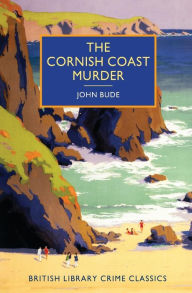
Cornish Coast Murder

Cornish Coast Murder. John Bude. 1935. 288 pages. [Source: Review copy]

First sentence: The Reverend Dodd, Vicar of St. Micahel's-on-the-Cliff, stood at the window of his comfortable bachelor study looking out into the night.

Premise/plot: This vintage mystery stars several amateur detectives (a vicar and a doctor) and several professional detectives (police inspectors). The novel was easy to follow, but, is proving hard to remember--in terms of character names. The murder happens early in the novel. A stormy night is JUST what this murderer has been waiting for. He--or SHE--is able to fire THREE shots with hardly anyone being the wiser for it. There seem to be THOUSANDS of clues, but, contradictory, almost absurd or outlandish clues that instead of leading to a cohesive story lead to a dozen "maybe" stories. Who will be the first to solve this one?

My thoughts: I liked this one. Would I have loved it if I'd read it in two or three days instead of two or three weeks? Maybe. Maybe not. If this one has a weakness, it is that the solution isn't one that readers are ever, ever, ever going to be able to piece together on their own. I'm not sure that qualifies as a weakness. It's just that with so many suspects, so many clues, so many motives...the actual murderer seems to come out of nowhere. I personally like to be able to say, OH, I SHOULD HAVE BEEN ABLE TO FIGURE THAT ONE OUT.

© 2016 Becky Laney of Becky's Book Reviews

Thursday, July 18, 2013

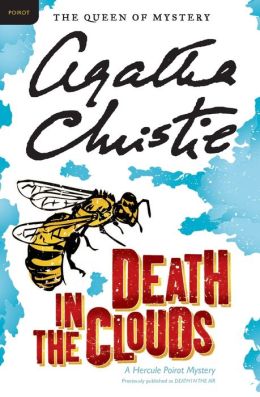
Death in the Clouds (1935)

Death in the Clouds (Death in the Air). Agatha Christie. 1935. 253 pages [Source: Library]

I really enjoyed this Hercule Poirot novel. In this mystery, Poirot is traveling from France to England via airplane. On his trip, one of the passengers dies. For a few seconds at least, it is suspected that a wasp sting is to blame for Madame Giselle's death. But only for a few seconds. A dart is found, a poisoned dart, no doubt. The question is which passenger is a murderer? Poirot has quite a mystery to solve. 

I definitely enjoyed this one! Readers get to know many of the passengers. In particular readers get to know a certain young lady, a hair dresser named Jane Grey. This mystery will take Poirot (and others) back and forth between the two countries. Some clues can only be found in France, for example. Can Poirot solve the crime before the police?

The more I read of Hercule Poirot, the more forgiving I am of his arrogance. Poirot can brag and boast; I'm not sure there is any of his mysteries where he doesn't have a big ego. But Poirot is impressive, and his reputation is well-earned.

Do you have a favorite Hercule Poirot novel? 

© 2013 Becky Laney of Becky's Book Reviews
Tuesday, June 18, 2013

Death in the Stocks (1935)

Death in the Stocks. Georgette Heyer. 1935/2009. Sourcebooks. 314 pages.

Death in the Stocks may just be my favorite Georgette Heyer mystery so far. I really enjoyed Why Shoot A Butler, and, Envious Casca had its great moments. But. Death in the Stocks was so enjoyable throughout. Some murder mysteries take too long to introduce the corpse, that is NOT the case in Death in the Stocks! Readers get a chance to know all the suspects and work alongside the detectives in solving the mystery. Of course, not all the characters were lovely people that you'd want to spend time with. But were they CHARACTERS? they were! And sometimes that is just what I need in a good book!!!

My favorite characters were Giles Carrington and Inspector Hannasyde.

© 2013 Becky Laney of Becky's Book Reviews

Thursday, April 11, 2013

Little House on the Prairie (1935)

Little House on the Prairie. Laura Ingalls Wilder. 1935. 335 pages.

 Little House on the Prairie is such a dramatic read, especially when compared with the first in the series, Little House in the Big Woods. The first half of the novel focuses on the Ingalls family journeying to Kansas (Indian Territory). It's a trip filled with MANY dangers. (When Jack becomes lost in the river and the worst is feared, well, it's hard to handle.) Even after they settle into their new place, things stay messy. At one point, the whole family becomes horribly ill, all at the same time. If not for kind neighbors (distant neighbors) checking on them because the illness is widespread, then they might all have died.

Their new home doesn't ever quite feel like home, doesn't feel right. And as tensions between white settlers and the Native Americans increase with each chapter, it's upsetting. It's quite a relief, in a way, to see them [the Ingalls] go.

If I were to judge the entire series by this one book, I'm not sure the series would be among my favorites. While there was a happy peacefulness to the first novel, this book is anxious, dramatic, full of tension and uncertainty. There isn't the assurance that everything will always work out well. (Though that could be Laura as the narrator growing up a little.) I think the novel does a good job showing Laura's unease. Laura is thoughtful and curious--at times--always observant. That doesn't mean Laura is wise or always right. (In one instance, if Laura had done what she felt to be right, things would have gone very, very wrong.) 

Of course one of the main conflicts of the book is the tension between the white settlers and the Native Americans. The way that it is presented while historically accurate and socially acceptable for the times (both the 1870s and the 1930s) can prove problematic for modern readers. My first review covers this aspect of the novel. Little House on the Prairie is not the only problem novel from the time period. Not all books in the series are equally offensive.

© 2013 Becky Laney of Becky's Book Reviews

Wednesday, February 20, 2013

Regency Buck (1935)

Regency Buck. Georgette Heyer. 1935. 352 pages.

Regency Buck was one of the first Georgette Heyer novels I read. It is the story of a brother and sister newly arrived in London. They are rich--or soon will be rich once they are of an age to inherit their father's money. But in the meanwhile they find themselves under the protection of a surprisingly young man, Earl Worth. Judith Tavener's first impression of Worth is something. Readers aren't exactly clear at times HOW he feels about her, but readers never question Judith's feelings regarding him. She HATES him. She does not trust him. She could easily name half a dozen men she'd rather spend time with. Not that Judith wants to rush into marriage with anyone. But to be told by a man she hates that she is forbidden to accept any suitor's proposal...well...it's frustrating. Is Worth doing it just to annoy her or does he perhaps know more of the world? Worth is also opinionated on Peregrine Tavener's love life. Though he does permit the young man to become engaged to a worthy woman. Still he would have him wait...

Regency Buck has drama and mystery. For as the novel progresses, readers learn that Peregrine's life is in danger. There are a series of attempts on his life, not that Peregrine is quick to realize his own danger or quick to judge those near him who may not be as trustworthy as he believes...

It is also RICH in historical detail. Though readers may not know just how rich it is unless they're familiar with the time period and the historical figures of the day.

I enjoyed the characterization and found the plot quite exciting!

My first review.

© 2013 Becky Laney of Becky's Book Reviews
Friday, May 27, 2011

A House Divided

A House Divided. Pearl S. Buck. 1935/2006. Moyer Bell. 348 pages.  

In this way Wang Yuan, son of Wang the Tiger, entered for the first time in his life the earthen house of his grandfather, Wang Lung.

The third book in Pearl S. Buck's The Good Earth trilogy. (The first two books are The Good Earth and Sons.) Is A House Divided the best of the three? Perhaps if you prefer books where characters actually have names (and some character development).

At the end of Sons, Wang Yuan had returned home to face his father. He'd been sent away to school--to learn how to become a soldier--and now he's returned. In Sons, I didn't quite grasp why he had come home. I knew he was angry--very angry. And I knew his father was shocked--very shocked--by his son's new beliefs, new philosophies. But I didn't know at the time exactly WHAT that meant for them both.

Within a few paragraphs of A House Divided, however, it all became clear. When Yuan came home it was because if he stayed at the school, if he stayed in this new army, this new revolution, it would just be a matter of time before he'd be marching against his father and his father's way of life--against the scattered war lords that dominated the country. And so when it came down to it--he chose his father. Not because he agreed with his father. Not because he wanted to step into his father's place. No, he still rejects almost everything his father stands for. But he's choosing to remove himself from both extremes, he's choosing not to do battle or choose sides at all.

So Yuan cannot--or should I say will not--stay in his father's home. So where can Yuan go? Well, after a very brief stay in his grandfather's hut in the country--Wang Lung--he decides to go to the city to see his half-sister, Ai-lan, and his stepmother. (Is stepmother the right word? His father had two wives. One wife chosen by Wang the Merchant, one wife chosen by Wang the Landlord. I believe he calls her mother but she's not his biological mother.) He remains with them--in the city--for quite a while! In the city, he goes to school--not to learn the art of war, of soldiering--but to pursue his own interests. And he has many interests. He wants to know everything, to learn everything. He wants more, more, more. Part of him is interested in beauty and nature and poetry. And another part of him is interested in agriculture, in farming. He wants to know THE BEST way to work the land. There is a part of him that would love to return to the land and be a farmer, an educated farmer, a farmer who can read and write and philosophize, but a farmer nonetheless. But his life with his half-sister and two cousins Meng and Sheng, leads him into a little trouble. For new ideas abound in the city. And some of these ideas are a little dangerous. There comes a time when his new home is no longer safe...

So Yuan goes to the United States. What will he learn there? Will he be happy? Will he be miserable? Will he hate himself for loving it? Or love himself for hating it? When he returns--how will he see his country? Will he be able to find a place to really belong in China? Will Yuan ever stop over-thinking everything in his life?  

Wang Yuan is SO different from his father, Wang the Tiger. And it was nice to see that change, that contrast. But Yuan's periods of self-doubt and self-loathing--which we see cover to cover--became tiresome. I'm not saying that he wasn't believable as a character, that he wasn't developed enough. It's just that it kept me from liking him as much as I'd hoped at the start. The first third of the book, I thought, held great promise. I was liking Yuan--pleasantly surprised that I was liking him since I hadn't really "liked" Wang Lung or Wang the Tiger--but in the end I didn't really grow to love him.

However, I can say that while I didn't *love* him as a character, I can see how Yuan's inner turmoil matches that of China, that of his generation, those torn between loyalties to the older generation and these new ideas of revolution and freedom. Yuan is not alone in his angst. 

Yuan on his "father's love."

He has never loved me all his life long! He thinks he loves me and that he holds me the only dear thing he has, and yet never once has he asked me what I really want to do, or if he did, it was to refuse me if what I aid was not his wish, so that I always must take thought to say what he wanted and I have had no freedom! (5)

Yuan on why he can't be a soldier:

I cannot kill--I am not brave, I know. The truth is I cannot hate wholly enough to kill a man. I always know how he feels, too. (44)

Yuan on the poor:

At this time of his life Yuan loved pleasure, and he was unwilling to see the poor, and yet he was so shaped within that he saw them all even while he wished he did not. (68)

Yuan on having sons of his own:

Yes, one day he would have sons. But those sons--they should be free--free of any shaping from him who was their father! They should not be made for soldiers, nor shaped for any destiny, nor bound to any family cause. (266)

© 2011 Becky Laney of Becky's Book Reviews

Friday, January 21, 2011

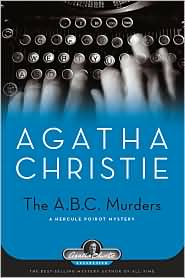
The A.B.C. Murders

The A.B.C. Murders. (Hercule Poirot). Agatha Christie. 1935/2006. Black Dog & Leventhal. 256 pages.

It was in June of 1935 that I came home from my ranch in South America for a stay of about six months. 

I liked The A.B.C. Murders. But I didn't love it. I'm not sure why. It had Hastings, the same narrator found in The Mysterious Affair at Styles; and, of course, it had Hercule Poirot. (My favorite of the three Poirot mysteries that I've read this year would probably be Murder on the Orient Express.) It had four murders instead of one, which is perhaps, why it wasn't love--for me. Instead of following the clues for one murder, instead of narrowing in on the motives for wanting one person dead, instead of figuring out who had the most to gain from the death, and all the 'good stuff' revealed along the way, Poirot is trying to outwit a serial killer. The crimes appear to be randomly connected--by the alphabet--as you can imagine. But are these murders random?

Poirot is taking this case personally because the killer has been sending him notes--warnings--about the crimes before they're committed. He's challenging Poirot, daring him to be clever enough to solve the crimes and identify him. He's an arrogant man, a seemingly insane man, who hides behind the initials ABC.

As I said, I liked this one. I don't regret reading it. And at the time I was reading I certainly found it entertaining enough. (I just had to read until I found out who the killer was.)

"Who are you? You don't belong to the police?"
"I am better than the police," said Poirot. He said it without conscious arrogance. It was, to him, a simple statement of fact. (90)

The spoken word and the written--there is an astonishing gulf between them. there is a way of turning sentences that completely reverses the original meaning. (122)

"Words, mademoiselle, are only the outer clothing of ideas." (132)

© 2011 Becky Laney of Becky's Book Reviews
Wednesday, February 17, 2010

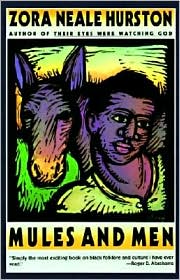
Mules and Men

Mules and Men by Zora Neale Hurston. 1935. HarperCollins. 336 pages.

As I crossed the Maitland-Eatonville township line I could see a group on the store porch. I was delighted. The town had not changed. Same love of talk and song.

I'm happy to be a part of the Classics Circuit Tour this month for The Harlem Renaissance. Be sure to visit other stops on the tour! I chose to read Mules and Men by Zora Neale Hurston. A book that has probably been on my bookshelf a decade. A book that needed this tour as a little extra push to get read.

Soon after reading Zora Neale Hurston's Their Eyes Were Watching God, I went out and bought all the ZNH I could find. (Well, that I could find used.) I just loved it so much. But while I've reread Their Eyes several times I haven't ever gotten around to reading her other books.

What can readers find in Mules and Men? It's a collection of folklore. Stories loosely woven together with the author as a character. Zora Neale Hurston has gone back to her home state, her hometown, to "collect" some good stories, some good folklore for her new project. So it "shows" her doing just that. Talking and interacting with men and women, finding the best stories, and sharing them. It's interesting getting this insider perspective. You'll find tales and stories about anything and everything. From the ordinary to the extraordinary. Stories about God, stories about the Devil, stories about men and women working, loving, fighting, playing, etc. You'll find stories about animals and nature. You'll find trickster tales as well. Men and women getting the best of each other. It is in dialect, so some readers may find this takes some getting used to.

The book is actually in two parts. The first part covers folklore and takes place in Florida. The second part covers Hoodoo and takes place in New Orleans.

I found some of the folklore, the stories, to be interesting. Some I definitely enjoyed more than others. But because they are just stories, just little stories, the book as a whole wasn't the most compelling. The good news is that the contents of each chapter is clearly identified. So readers can find specific stories. "How the Snake Got Poison" and "How Brer Dog Lost His Beautiful Voice" and "How Jack Beat the Devil" and "Why Women Always Take Advantage of Men."


© Becky Laney of Becky's Book Reviews
Saturday, March 07, 2009

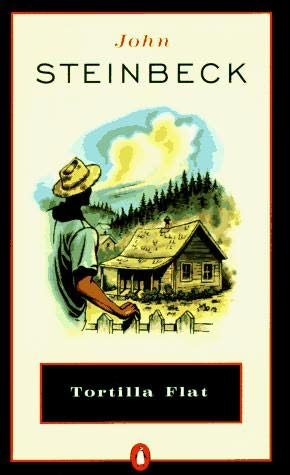
Tortilla Flat


Steinbeck, John. 1935. Tortilla Flat. 207 pages.

From the preface, "This is the story of Danny and of Danny's friends and of Danny's house. It is a story of how these three became one thing, so that in Tortilla Flat if you speak of Danny's house you do not mean a structure of wood flaked with old whitewash, overgrown with an ancient untrimmed rose of Castile. No, when you speak of Danny's house you are understood to mean a unit of which the parts are men, from which came sweetness and joy, philanthropy and, in the end, a mystic sorrow. For Danny's house was not unlike the Round Table, and Danny's friends were not unlike the knights of it. And this is the story of how that group came into being, of how it flourished and grew to be an organization beautiful and wise. This story deals with the adventuring of Danny's friends, with the good they did, with their thoughts and their endeavors. In the end, this story tells how the talisman was lost and how the group disintegrated." (1)

From the first chapter, "When Danny came home from the army he learned that he was an heir and an owner of property. The viejo, that is the grandfather, had died, leaving Danny the two small houses on Tortilla Flat." (5)


I loved this book. I did. Here's why: simple, straightforward, but oh-so-charming storytelling. No pretenses. What you see, is what you get. Danny. Pilon. Big Joe Portagee. Pablo Sanchez. Jesus Maria Corcoran. Pirate and his dogs. Some might argue that none of these are great characters. You might even make the (valid) point that each one is a 'failure' of sorts--since between them they're barely surviving by the world's standards. They live to drink and drink to live. But are they happy? Yes! These are happy-go-lucky guys that know what they want out of life. Wine and women--but no commitments or responsibilities.

The story is essentially this: a young man--a soldier--returns from World War I to learn that he has inherited two houses. After some time in jail, he remembers his new-found wealth and decides to take up residence in one of the houses. But right from the start, Danny is a magnet for like-minded men who love this free and easy lifestyle. First Pilon. Then Pablo. Then the others. These men take up with him because essentially there's just one rule: the bed is off limits. Danny's bed is Danny's bed. The only other rule is share and share alike. IF and when you find yourself in the possession of a gallon or jug of wine (or any other alcoholic beverage) you have to share with everyone living there. Likewise, food is to be shared. No rent is required.

The storytelling. It is so good. So humorous. So accessible. There's a rightness about it. It would be hard to pick a favorite chapter, but I'll narrow it down to two.

I loved "How Danny Was Ensnared By A Vacuum-Cleaner and How Danny's Friends Rescued Him." It was just so funny. Essentially, the story goes something like this. Danny is seduced by a local woman, Dolores Engracia Ramirez ("Sweets" Ramirez). When Danny happens across some money--a rare event as you'll see if you pick this one up--he decides to buy a present for his girl, who in an equally rare state-of-mind has decided to be a one-man woman...temporarily at least. What does he buy her? A vacuum cleaner! The problem? No one in Tortilla Flat has electricity! Does this make the present any less appreciated? No! Sweets prides herself on being the only one with this fancy sweeping tool. And she never ceases to bring it up in conversation. She's seen rolling it around her house and making humming-motor noises. Anyway, hysterical as that is--and I suppose you'll have to trust me on that--his friends aren't happy with Danny's infatuation. So they decide to steal the vacuum and trade it for a gallon or two of wine. So they return home and tell Danny...

The friends received him in silence when he entered Danny's house. He set one jug on the table and the other on the floor.
"I have brought you a present to take to the lady," he told Danny. "And here is a little wine for us."
They gathered happily, for their thirst was a raging fire. When the first gallon was far gone, Pilon held his glass to the candlelight and looked through it. "Things that happen are of no importance," he said. "But from everything that happens, there is a lesson to be learned. By this we learn that a present, especially to a lady, should have no quality that will require a further present. Also we learn that it is sinful to give presents of too great value, for they excite greed."
The first gallon was gone. The friends looked at Danny to see how he felt about it. He had been very quiet, but now he saw that his friends were waiting on him.... (109)


I'll leave you hanging as to what happens next. My second favorite adventure is "How Danny's Friends Threw Themselves To The Aid of a Distressed Lady."

I loved these characters. They're all distinct and wonderfully flawed. Though these men are very simple and seemingly simple-minded, there is a wisdom at times in their words.

Pilon complained, "It is not a good story. There are too many meanings and too many lessons in it. Some of those lessons are opposite. There is not a story to take into your head. It proves nothing."
"I like it," said Pablo. "I like it because it hasn't any meaning you can see, and still it does seem to mean something, I can't tell what." (168)


I recommend this one to folks wanting to read a classic...but who feel somewhat intimidated and bored by more traditional 'classics.' It was just a joy to keep reading.

© Becky Laney of Becky's Book Reviews
If you're reading this post on another site, or another feed, the content has been stolen.