
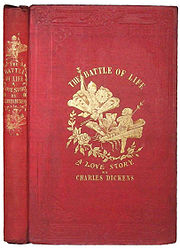
First sentence: Once upon a time, it matters little when, and in stalwart England, it matters little where, a fierce battle was fought. It was fought upon a long summer day when the waving grass was green.
Premise/plot: Doctor Jeddler has two daughters, Grace and Marion. Marion, the younger daughter, is engaged to Alfred Heathfield. No one could be happier for the couple than Grace. In fact, Grace talks about Alfred morning, noon, and night. The engagement is to be a long one, of several years. As the time nears for Alfred's return, Marion begins acting strangely. This is about the same time that Michael Warden makes plans to leave the country--due to financial disgrace/ruin. Could these two be in love? Perhaps. One thing is certain, Marion does meet secretly with him before Alfred's return. Clemency Newcome, a servant in the home, witnesses this arrangement.
My thoughts: I loved this one. I at least loved it more than I ever thought possible. Dickens introduces some great characters. Dr. Jeddler has a STRANGE philosophy about the meaning of life. As do some of the other characters in this one. (I can't remember now if it was Snitchey or Craggs that philosophizes. But here is the man's philosophy: "Everything appears to me to be made too easy, now-a-days. It’s the vice of these times. If the world is a joke (I am not prepared to say it isn’t), it ought to be made a very difficult joke to crack. It ought to be as hard a struggle, sir, as possible. That’s the intention. But, it’s being made far too easy. We are oiling the gates of life. They ought to be rusty. We shall have them beginning to turn, soon, with a smooth sound.") I really loved Clemency Newcome and Ben Britain, the two servants. They may be my favorite characters in the novella. I hoped that these two would end up together. I was so SATISFIED when they did.
The relationship between Marion and Grace was interesting and strange. I was certainly fooled by Dickens' presentation of Marion. For most of the novella, Marion is portrayed as being completely disinterested in Alfred and matrimony. Certainly there was not any indication that she's madly in love with him. Grace's crush on Alfred was obvious, and once Marion was out of the picture, it was equally obvious that these two would console each other all the way to the altar. Is it a good sign or a bad one that they choose Marion's birthday to be their wedding day?! Marion's big reveal was surprising--when it came. Is it realistic? Is it romantic? Or is it just all kinds of strange?
It did begin in an odd way, I admit. Several pages spent describing in detail a bloody battlefield. Centuries later--I'm supposing, though it could just be decades--all traces of the battle, of the blood and gore, are gone. What remains is a village full of life.
Quotes:
My private opinion is, and I hope you agree with me, that we might get on a great deal better than we do, and might be infinitely more agreeable company than we are.
‘Don’t you know it’s always somebody’s birth-day? Did you never hear how many new performers enter on this — ha! ha! ha! — it’s impossible to speak gravely of it — on this preposterous and ridiculous business called Life, every minute?’
She was about thirty years old, and had a sufficiently plump and cheerful face, though it was twisted up into an odd expression of tightness that made it comical. But, the extraordinary homeliness of her gait and manner, would have superseded any face in the world. To say that she had two left legs, and somebody else’s arms, and that all four limbs seemed to be out of joint, and to start from perfectly wrong places when they were set in motion, is to offer the mildest outline of the reality. To say that she was perfectly content and satisfied with these arrangements, and regarded them as being no business of hers, and that she took her arms and legs as they came, and allowed them to dispose of themselves just as it happened, is to render faint justice to her equanimity. Her dress was a prodigious pair of self-willed shoes, that never wanted to go where her feet went; blue stockings; a printed gown of many colours, and the most hideous pattern procurable for money; and a white apron. She always wore short sleeves, and always had, by some accident, grazed elbows, in which she took so lively an interest, that she was continually trying to turn them round and get impossible views of them.
Such, in outward form and garb, was Clemency Newcome; who was supposed to have unconsciously originated a corruption of her own Christian name, from Clementina (but nobody knew, for the deaf old mother, a very phenomenon of age, whom she had supported almost from a child, was dead, and she had no other relation); who now busied herself in preparing the table, and who stood, at intervals, with her bare red arms crossed, rubbing her grazed elbows with opposite hands, and staring at it very composedly, until she suddenly remembered something else she wanted, and jogged off to fetch it.
‘The combatants are very eager and very bitter in that same battle of Life. There’s a great deal of cutting and slashing, and firing into people’s heads from behind. There is terrible treading down, and trampling on. It is rather a bad business.’ ‘I believe, Mr. Snitchey,’ said Alfred, ‘there are quiet victories and struggles, great sacrifices of self, and noble acts of heroism, in it — even in many of its apparent lightnesses and contradictions -not the less difficult to achieve, because they have no earthly chronicle or audience — done every day in nooks and corners, and in little households, and in men’s and women’s hearts — any one of which might reconcile the sternest man to such a world, and fill him with belief and hope in it, though two-fourths of its people were at war, and another fourth at law; and that’s a bold word.’
Snitchey and Craggs were the best friends in the world, and had a real confidence in one another; but Mrs. Snitchey, by a dispensation not uncommon in the affairs of life, was on principle suspicious of Mr. Craggs; and Mrs. Craggs was on principle suspicious of Mr. Snitchey.
‘What! overcome by a story-book!’ said Doctor Jeddler. ‘Print and paper! Well, well, it’s all one. It’s as rational to make a serious matter of print and paper as of anything else. But, dry your eyes, love, dry your eyes. I dare say the heroine has got home again long ago, and made it up all round — and if she hasn’t, a real home is only four walls; and a fictitious one, mere rags and ink. What’s the matter now?’
‘Lor!’ replied his fair companion, with her favourite twist of her favourite joints. ‘I wish it was me, Britain!’ ‘Wish what was you?’ ‘A-going to be married,’ said Clemency. Benjamin took his pipe out of his mouth and laughed heartily. ‘Yes! you’re a likely subject for that!’ he said. ‘Poor Clem!’ Clemency for her part laughed as heartily as he, and seemed as much amused by the idea. ‘Yes,’ she assented, ‘I’m a likely subject for that; an’t I?’ ‘YOU’LL never be married, you know,’ said Mr. Britain, resuming his pipe. ‘Don’t you think I ever shall though?’ said Clemency, in perfect good faith. Mr. Britain shook his head. ‘Not a chance of it!’ ‘Only think!’ said Clemency. ‘Well! — I suppose you mean to, Britain, one of these days; don’t you?’
‘I can’t help liking you,’ said Mr. Britain; ‘you’re a regular good creature in your way, so shake hands, Clem. Whatever happens, I’ll always take notice of you, and be a friend to you.’ ‘Will you?’ returned Clemency. ‘Well! that’s very good of you.’ ‘Yes, yes,’ said Mr. Britain, giving her his pipe to knock the ashes out of it; ‘I’ll stand by you. Hark! That’s a curious noise!’
A month soon passes, even at its tardiest pace. The month appointed to elapse between that night and the return, was quick of foot, and went by, like a vapour. The day arrived. A raging winter day, that shook the old house, sometimes, as if it shivered in the blast.
We count by changes and events within us. Not by years.
© 2017 Becky Laney of Becky's Book Reviews


