Showing posts with label 1877. Show all posts

Friday, February 03, 2017

The American

The American. Henry James. 1877. 400 pages. [Source: Bought]

First sentence: On a brilliant day in May, in the year 1868, a gentleman was reclining at his ease on the great circular divan which at that period occupied the centre of the Salon Carré, in the Museum of the Louvre.

Premise/plot: Christopher Newman, a successful American businessman, is visiting Europe. The novel opens with him in Paris, France. His short term mission is to spend money and enjoy himself. His long term mission is to find a beautiful, perfect wife in the process of visiting Europe and taking in "culture" and "class." He meets a friend, Tom Tristram who takes him home to meet his wife. Mrs. Tristram takes it upon herself to help Newman with his short and long-term goals! She has just the potential wife in mind, a countess from an ancient family, a widow: Madame de Cintré.

He meets her; he meets her family; he goes about wooing her family in hopes that with her family's approval, all will be well.

Her family is SCARY. Not just slightly odd and off-putting, but, the stuff of nightmares. Well. There's one brother who has potential, but...expect this courtship to be anything but smooth.

My thoughts: The American is very depressing. I wonder if Thomas Hardy read it and approved of its bleakness?! I'm so glad that it was the third novel I'd read by James and not the very first.

Did I like Christopher Newman? I'm not sure I did. He was very materialistic and talked about money non-stop. His wooing left a little to be desired in my opinion. He was all, I'm rich; My money makes me quite a catch; You'll never want for anything because I have money, MORE money, EVEN more money. My money will make us both extraordinarily happy. We can live anywhere we want and do anything we want because I have MONEY. I'm not sure if he genuinely loved for all the right reasons. She met his checklist of ideals--but his ideals were all superficial to begin with. She was much more complex than he was expecting. And money couldn't buy him understanding on how to deal with a complex woman.
“Present me to a woman who comes up to my notions,” said Newman, “and I will marry her tomorrow.” “You have a strange tone about it, and I don’t quite understand you. I didn’t suppose you would be so coldblooded and calculating.” Newman was silent a while. “Well,” he said, at last, “I want a great woman. I stick to that. That’s one thing I can treat myself to, and if it is to be had I mean to have it. What else have I toiled and struggled for, all these years? I have succeeded, and now what am I to do with my success? To make it perfect, as I see it, there must be a beautiful woman perched on the pile, like a statue on a monument. She must be as good as she is beautiful, and as clever as she is good. I can give my wife a good deal, so I am not afraid to ask a good deal myself. She shall have everything a woman can desire; I shall not even object to her being too good for me; she may be cleverer and wiser than I can understand, and I shall only be the better pleased. I want to possess, in a word, the best article in the market.” 
“I told her something about you,” said Mrs. Tristram. “That’s a comfort,” said Newman, placidly. “I like people to know about me.” 

Did I like Madame de Cintré? I pitied her at the very least. Here was a woman whose thoughts and feelings were never allowed to matter or count for anything. She was manipulated by her mother and her older brother. Commanded more than manipulated perhaps. Even as a widow she wasn't allowed to be herself. I wanted her to be respected and valued. Respected for who she was as a person, her character. Valued for who she was, not for what she looked like.
To be unhappy is to be disagreeable, which, for her, is out of the question. So she has arranged her circumstances so as to be happy in them. 
She was not the only unhappy female character. I think all of them--in varying degrees--were living stuck lives. But to be fair--with the exception of Tom Tristram, who was presented as just not getting it, men and women alike were more often than not miserable and unhappy. This novel definitely shares themes with the book of Ecclesiastes.

My favorite character was her brother, Valentin de Bellegarde. This was the good brother; not the horrible controlling one. This is the brother who genuinely enjoyed Christopher Newman's company and wanted the best for his sister.

Favorite quotes:
You may depend upon it that there are things going on inside of us that we understand mighty little about.
When you want a thing so very badly you had better treat yourself to it.
One’s theories, after all, matter little; it is one’s humor that is the great thing.
His mind could no more hold principles than a sieve can hold water.
It is better to laugh too much than too little.
People are proud only when they have something to lose, and humble when they have something to gain.
She got tired of thinking aright; but there was no serious harm in it, as she got equally tired of thinking wrong.
When the heart has a heavy weight upon it, it hardly matters whether the weight be of gold or of lead; when, at any rate, happiness passes into that place in which it becomes identical with pain, a man may admit that the reign of wisdom is temporarily suspended.
It must be confessed that the number of subjects upon which Newman had no ideas was extremely large, and it must be added that as regards those subjects upon which he was without ideas he was also perfectly without words.
“I shouldn’t like to resemble anyone. It is hard enough work resembling one’s self.”
“It is a proof of cleverness,” said Newman, “to be happy without doing anything.”
I suppose that a man who may be liked may also be disliked.
When was a man ever gloomy when he could say, ‘I told you so?’
  

© 2017 Becky Laney of Becky's Book Reviews

Friday, November 21, 2014

Reread #47 Black Beauty

Black Beauty. Anna Sewell. 1877. 245 pages. [Source: Bought]

I have been wanting to reread Black Beauty since I finished it in July 2012. I loved it then. I loved it now upon rereading. In fact, I think I loved it even a tiny bit more since I knew exactly what to expect. I was able to relax a bit more, not worrying that something horrible was about to happen. Granted, plenty of horrible things do happen. If not to Black Beauty then to others. But their is a sweetness, a hopefulness to the book that keeps it from being dark and gloomy.

What I loved best about Black Beauty is the narration. From cover to cover, I was engaged with her story, her narration. I loved the writing. The book is rich in description and observation. The worldview of the book has a just-right feel to it. It's very quotable. I loved the characterization. I cared about the horses. I cared about the humans in the story.

If you haven't read it, you should give it a try. Even if you don't like animal stories.

Favorite quotes:
"I wish you to pay attention to what I am going to say to you. The colts who live here are very good colts, but they are cart-horse colts, and of course they have not learned manners. You have been well-bred and well-born; your father has a great name in these parts, and your grandfather won the cup two years at the Newmarket races; your grandmother had the sweetest temper of any horse I ever knew, and I think you have never seen me kick or bite. I hope you will grow up gentle and good, and never learn bad ways; do your work with a good will, lift your feet up well when you trot, and never bite or kick even in play." I have never forgotten my mother's advice; I knew she was a wise old horse, and our master thought a great deal of her.
The next day I was brought up for my master. I remembered my mother's counsel and my good old master's, and I tried to do exactly what he wanted me to do. I found he was a very good rider, and thoughtful for his horse too. When he came home the lady was at the hall door as he rode up. "Well, my dear," she said, "how do you like him?" "He is exactly what John said," he replied; "a pleasanter creature I never wish to mount. What shall we call him?" "Would you like Ebony?" said she; "he is as black as ebony." "No, not Ebony." "Will you call him Blackbird, like your uncle's old horse?" "No, he is far handsomer than old Blackbird ever was." "Yes," she said, "he is really quite a beauty, and he has such a sweet, good-tempered face, and such a fine, intelligent eye--what do you say to calling him Black Beauty?"
"I suppose it is fashion that makes them strap our heads up with those horrid bits that I was tortured with in London," said Ginger. "Of course it is," said he; "to my mind, fashion is one of the wickedest things in the world. Now look, for instance, at the way they serve dogs, cutting off their tails to make them look plucky, and shearing up their pretty little ears to a point to make them both look sharp, forsooth. I had a dear friend once, a brown terrier; 'Skye' they called her. She was so fond of me that she never would sleep out of my stall; she made her bed under the manger, and there she had a litter of five as pretty little puppies as need be; none were drowned, for they were a valuable kind, and how pleased she was with them! and when they got their eyes open and crawled about, it was a real pretty sight; but one day the man came and took them all away; I thought he might be afraid I should tread upon them. But it was not so; in the evening poor Skye brought them back again, one by one in her mouth; not the happy little things that they were, but bleeding and crying pitifully; they had all had a piece of their tails cut off, and the soft flap of their pretty little ears was cut quite off. How their mother licked them, and how troubled she was, poor thing! I never forgot it. They healed in time, and they forgot the pain, but the nice soft flap, that of course was intended to protect the delicate part of their ears from dust and injury, was gone forever. Why don't they cut their own children's ears into points to make them look sharp? Why don't they cut the end off their noses to make them look plucky? One would be just as sensible as the other. What right have they to torment and disfigure God's creatures?"
"He had no business to make that turn; his road was straight on!" said the man roughly. "You have often driven that pony up to my place," said master; "it only shows the creature's memory and intelligence; how did he know that you were not going there again? But that has little to do with it. I must say, Mr. Sawyer, that a more unmanly, brutal treatment of a little pony it was never my painful lot to witness, and by giving way to such passion you injure your own character as much, nay more, than you injure your horse; and remember, we shall all have to be judged according to our works, whether they be toward man or toward beast."
Master said, God had given men reason, by which they could find out things for themselves; but he had given animals knowledge which did not depend on reason, and which was much more prompt and perfect in its way, and by which they had often saved the lives of men.
But what stuck in my mind was this, he said that cruelty was the devil's own trade-mark, and if we saw any one who took pleasure in cruelty we might know who he belonged to, for the devil was a murderer from the beginning, and a tormentor to the end. On the other hand, where we saw people who loved their neighbors, and were kind to man and beast, we might know that was God's mark." "Your master never taught you a truer thing," said John; "there is no religion without love, and people may talk as much as they like about their religion, but if it does not teach them to be good and kind to man and beast it is all a sham--all a sham, James, and it won't stand when things come to be turned inside out."
"Only ignorance! only ignorance! how can you talk about only ignorance? Don't you know that it is the worst thing in the world, next to wickedness?--and which does the most mischief heaven only knows. If people can say, 'Oh! I did not know, I did not mean any harm,' they think it is all right.

"Right, Joe! you did right, my boy, whether the fellow gets a summons or not. Many folks would have ridden by and said it was not their business to interfere. Now I say that with cruelty and oppression it is everybody's business to interfere when they see it; you did right, my boy."
Every man must look after his own soul; you can't lay it down at another man's door like a foundling and expect him to take care of it.
If a thing is right it can be done, and if it is wrong it can be done without; and a good man will find a way.
Our friend stood still for a moment, and throwing his head a little back, "Do you know why this world is as bad as it is?" "No," said the other. "Then I'll tell you. It is because people think only about their own business, and won't trouble themselves to stand up for the oppressed, nor bring the wrongdoer to light. I never see a wicked thing like this without doing what I can, and many a master has thanked me for letting him know how his horses have been used." "I wish there were more gentlemen like you, sir," said Jerry, "for they are wanted badly enough in this city."

 "My doctrine is this, that if we see cruelty or wrong that we have the power to stop, and do nothing, we make ourselves sharers in the guilt."
"Is it not better," she said, "to lead a good fashion than to follow a bad one? A great many gentlemen do not use check-reins now; our carriage horses have not worn them for fifteen years, and work with much less fatigue than those who have them; besides," she added in a very serious voice, "we have no right to distress any of God's creatures without a very good reason; we call them dumb animals, and so they are, for they cannot tell us how they feel, but they do not suffer less because they have no words.

© 2014 Becky Laney of Becky's Book Reviews
Wednesday, July 18, 2012

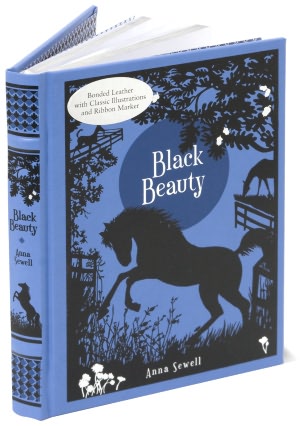
Black Beauty

Black Beauty. Anna Sewell. 1877. 245 pages.

The first place that I can well remember was a large pleasant meadow with a pond of clear water in it. Some shady trees leaned over it, and rushes and water-lilies grew at the deep end. Over the hedge on one side we looked into a plowed field, and on the other we looked over a gate at our master's house, which stood by the roadside; at the top of the meadow was a grove of fir trees, and at the bottom a running brook overhung by a steep bank.

Black Beauty is such a GREAT book. I really LOVED, LOVED, LOVED it. Which surprises me, I must admit since I generally don't like animal stories, and I'm even more reluctant to read horse books than dog books. But. I loved it. There was something timeless and wonderful about it. I can see why it became a classic, I hope it remains a beloved classic. 

Black Beauty is a great narrator, a great character. I really came to care for this horse right from the start. I had a feeling that life wouldn't always be so easy and gentle for him. I knew that they'd be dark days and nights ahead. And that proved true. As he is sold from one owner to another to another to another to another and so on. But he's so very, very, very good and understanding and wise. There were so many times he proved himself noble and worthy. And Black Beauty wasn't the only character I loved. I loved so many of the human characters too! John Manly, for example, comes to mind, as does James Howard, Joe Green, Jerry Barker, Farmer Grey, Farmer Thoroughgood, etc. Ginger's story is touching, as well, Ginger being one of many horses Black Beauty befriends.

Black Beauty also had a LOT to say about society, about virtues and vices. It had a LOT to say in regards to how animals should be treated--with respect, kindness, understanding, with dignity. It had a LOT to say about how humans should treat one another too. I was surprised at how deep this book was, how wise.

My favorite quotes:
“There is no religion without love, and people may talk as much as they like about their religion, but if it does not teach them to be good and kind to man and beast, it is all a sham.”
“Only ignorance! only ignorance! how can you talk about only ignorance? Don't you know that it is the worst thing in the world, next to wickedness? -- and which does the most mischief heaven only knows. If people can say, `Oh! I did not know, I did not mean any harm,' they think it is all right.”
“My doctrine is this, that if we see cruelty or wrong that we have the power to stop, and do nothing, we make ourselves sharers in the guilt.”
 “If a thing is right it can be done, and if it is wrong it can be done without; and a good man will find a way.”
“We call them dumb animals, and so they are, for they cannot tell us how they feel, but they do not suffer less because they have no words.” 

Read Black Beauty

    •    If you want to read one of the best children's books ever
    •    If you're a fan of animal stories, horse stories,
    •    If you enjoy historical fiction
    •    If you enjoy classics


© 2012 Becky Laney of Becky's Book Reviews
Tuesday, June 29, 2010

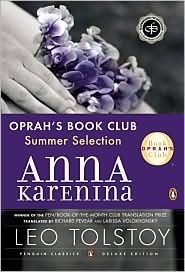
Anna Karenina


Anna Karenina. Leo Tolstoy. Translated by Richard Pevear and Larissa Volokhonsky. 2004, this translation. Penguin. 864 pages.

All happy families are alike; each unhappy family is unhappy in its own way.

Anna Karenina--big surprise--focuses on several families that are unhappy. These unhappy families are loosely connected with one another--some by marriage, some by friendship. The novel opens with Stepan Oblonsky and his wife, Dolly. Their marriage is in trouble--big trouble. But Stepan's sister, Anna, is coming to visit. She's not happily married either. (But her unhappy marriage is mostly stable. Therefore she is able to "model" how to be a wife.) He is hoping that Anna can talk some sense into Dolly. (She does.) During Anna's visit, she meets Kitty, Dolly's sister, and Alexei Vronsky, Kitty's suitor. Soon after, Vronsky drops Kitty. (Kitty who?!?!) He only has eyes for Anna Karenina. He follows her to Petersburg to pursue her. Kitty, of course, is heartbroken. She's lost Vronsky, someone she never really had in the true sense of the word, and Levin, Stepan's friend, who proposed to Kitty just days before Vronsky showed his true colors. It doesn't take long for these assorted characters to go their separate ways. The novel then takes turn visiting all these characters--all the while introducing new ones.

Anna Karenina is a novel of contrasts.

We've got the breakdown of a marriage as Anna begins an adulterous affair with Vronsky. An affair that destroys her husband and confuses her young son. Anna seeks her happiness in Vronsky, and she succeeds for a time. But it's happiness at a cost, with a sacrifice. She'll lose her son and her husband (not that she wanted him). She'll lose her social standing. She'll lose many of her friends and acquaintances. But she thinks it's worth it. For Vronsky, it's worth it. She loves him. This new relationship isn't perfect as we come to see. Readers will witness its destruction as well.

The relationship between Levin and Kitty, on the other hand, is slowly developed. This marriage, though not perfect, works. Both respect and love one another. Both value the other. The two communicate. They say what they mean, and mean what they say. This healthy relationship contrasts with the dysfunctional relationships of Anna.

To some extent, readers also follow the relationship of Dolly and Stepan. This is an unhappy marriage that--for better or worse--keeps working despite the disappointments and frustrations.

But Anna Karenina isn't just a novel about love, hate, jealousy, marriage, and adultery. It isn't just about dysfunctional families. Just about every subject is covered at one time or another. These characters like to talk. They like to hear themselves talk. They like to argue. They like to debate. (They don't always like to listen to others that well.) They like to talk politics and government. They like to talk religion. They like to talk about social class, gender, and race. They like to talk about education. (Who needs it, who doesn't.) They like to talk about the land too. Almost more than they like to find answers, they like to ask questions. Is it better to be rich or poor? married or single? happy or sad? dead or alive? Is it better to live in the country or in the city? How much should money matter? What society should you keep? When is it acceptable to get divorced? How big a role (or how small a role) should a mother have in the lives of her children? How many children should a woman have? Is it okay to not want to have any more?

I didn't love Anna Karenina. I did like aspects of it. I enjoyed certain chapters more than others. I don't find in-depth explorations of social change in nineteenth century Russia that entertaining. I don't find Levin taking joy in the physical exertion of mowing side by side with the peasants all that thrilling. (Or Levin's hunting adventures.) I did like the writing--at times. When it was more personal, more intimate, more about relationships, it was easy to connect with the story, with the characters. I didn't love the writing--the internal monologues--when it was about issues, when it was about "making statements" and voicing ideologies. It's a sad novel, but it's not without hope.

I read Anna Karenina for the Classic Circuit tour.

© Becky Laney of Becky's Book Reviews