Showing posts with label 1996. Show all posts

Thursday, August 02, 2018

Family Tree

Family Tree. Katherine Ayres. 1996. 176 pages. [Source: Bought]

First sentence: I sat in the backseat of the bus and looked out.

Premise/plot: Tyler Stoudt begins her sixth grade family tree project reluctantly. She is a miracle baby; she was delivered thirty minutes after her mother's death. Her only family is her loving father, Jakob Stoudt. She knows nothing of his family or her mother's family--not until she begins the project and her father slowly but surely starts to open up a little about his past. Can she piece together the clues from her father's stories and her mother's writing? (Her mother was an author.)

My thoughts: I enjoyed this one very much. Tyler Stoudt discovers that her father was an Amish man who married an Englisher. She had come to Lancaster, Pennsylvania, to research a book on Amish wedding traditions. The two became friendly since it is Jakob's sister who is the bride she's writing about. After that first book is published she returns to the community to write a second book: this time on woodworking--Jakob is the subject! After the two marry, Jakob is shunned by his family, and Sarah (Tyler's mother) is rejected by hers as well.

Family Tree is a satisfying read about making peace with the past and healing. I really enjoyed getting to know Tyler and her father.

I'm not sure if I would have enjoyed reading this one as a child. Readers find out very early on that Tyler's mother died. I may have put the book down right then and there and not given it a fair chance. That's the kind of reader I was as a kid. Anything that even hinted at potential sads was put aside. I have matured as a reader, thank goodness!

© 2018 Becky Laney of Becky's Book Reviews

Wednesday, May 30, 2018

Historical Cats

Historical Cats. Peter Gethers and Norman Stiles. Illustrated by William Bramhall. 1996. 86 pages. [Source: Bought]

First sentence: Nathan Hale's Cat: "I only regret that I have but nine lives to give for my country."
Albert Einstein's Cat: Ran around the living room at the speed of light for no reason at all, relatively speaking.
Sigmund Freud's Cat: Discovered that the primary motivating factor behind all behavior is the urge to rub up against furniture.

Premise/plot: What if historical figures had cats? Cats who were perhaps just as famous or just as worthy of being famous?

My thoughts: If you love cats--I'm talking LOVE cats--and are easily amused this may be a good fit for you. It is a super-quick read. Each page features an illustration and one or two sentences. I think the aim of the book was to be clever and funny. I'll be honest, there is a LOT of hit or miss within the pages.

I paid fifty cents for my copy. I'm wishing it had been a quarter instead.
  • Marie Antoinette's Cat: "Let them eat dry food."
  • Ponce de Leon's Cat: POUNCE de Leon discovered the fountain of catnip.
  • Eva Peron's Cat: Felita: "Don't meow for me, Argentina."
  • Pablo Picasso's Cat: Accidentally ran into window and created cubism.
My favorite:
Fyodor Dostoyevsky's Cat. Wrote Crime and Punishment and Do It Again Anyway, a complex novel about an evil Russian Blue, Raskolnikat, who eats off his owner's plate despite many stern warnings. Raskolnikat has overwhelming feelings of guilt but looks so cute he is never punished and ultimately dies weighing 57 pounds. 

© 2018 Becky Laney of Becky's Book Reviews

Wednesday, February 14, 2018

Kings & Queens of Britain

Kings and Queens of Britain: A Victorian Mneumonic or Learning Verse. New lines by Frances Barnes-Murphy. Illustrated by Rowan Barnes-Murphy. 1996. 40 pages. [Source: Bought]

First sentence: William the Conqueror long did reign/ William Rufus by an arrow was slain/ Henry I was a scholar bright/ Stephen was king without any right/

Premise/plot: This is a picture book adaptation of a Victorian mneumonic verse that has been updated by Frances Barnes-Murphy. The purpose of the original--and of the update--is to aid in the memorization of the kings and queens. Each monarch has his or her own page. The line of the poem about that monarch is on the top of the page. Facts--or opinions--about each monarch further litter the heavily illustrated pages. I could find no original author or source. I believe there are variations. I've included the original below, but NOT the updated text which is new.
William the Conqueror long did reign,
William, his son, by an arrow was slain;
Henry the First was a scholar bright;
Stephen was king without any right.
Henry the Second, Plantagenet's scion;
Richard the First was as brave as a lion;
John, though a tyrant, the Charter signed;
Henry the Third had a weakly mind.
Edward the First conquered Cambria dales;
Edward the Second was born Prince of Wales;
Edward the Third humbled France in its pride;
Richard the Second in prison died.
Henry the Fourth for himself took the crown;
Henry the Fifth pulled the French king down;
Henry the Sixth lost his father's gains.
Edward of York laid hold of the reins;
Edward the Fifth was killed with his brother;
Richard the Third soon made way for another.
Henry the Seventh was frugal of means;
Henry the Eighth had a great many queens.
Edward the Sixth reformation began;
Cruel Queen Mary prevented the plan.
Wise and profound were Elizabeth's aims.
England and Scotland were joined by King James.
Charles found the people a cruel corrector;
Oliver Cromwell was called Lord Protector;
Charles the Second was hid in an oak,
James the Second took Popery's yoke.
William and Mary were offered the throne,
Anne succeeded and reigned alone.
George the First from Hanover came;
George the Second kept up the name;
George the Third was loved in the land,
George the Fourth was pompous and grand,
William the Fourth had no heir of his own,
So Queen Victoria ascended the throne.
My thoughts: I'll be honest. I am fairly confident I know my Kings and Queens in order. I'd much rather be quizzed on that than on the order of American presidents. More honesty for you: I'm glad the days of pop quizzes are over for me.

I wanted to really love this one. I did. But. The illustrations are HORRIBLE. And not in a horrible history way. Someone should have told the author/illustrator/publisher that more isn't always better. In fact, sometimes it's much, much worse. The problem for me is the layout is so cluttered, so busy. The font choice is difficult to read. The font is printed often in curves and waves instead of a straight line. Sometimes the font is printed in the wrong direction altogether.

The text itself was enjoyable. Just not the layout or design.


© 2018 Becky Laney of Becky's Book Reviews

Wednesday, May 03, 2017

Minerva Louise at School

Minerva Louise at School. Janet Morgan Stoeke. 1996. 24 pages. [Source: Library]

First sentence: One morning, Minerva Louise woke up before everyone else. It was a beautiful morning, so she decided to go for a walk through the tall grass. She walked on and on. Oh, look! A big, fancy barn, thought Minerva Louise.

Premise/plot: Minerva Louise explores a "big, fancy barn" in this third adventure. The barn, of course, as you might have guessed is really a school! She explores the stalls (classrooms) and looks for animals (students.) She even finds nesting boxes (cubbies) and an egg (a baseball). She never does see any animals, but she returns to her own nesting place full of good ideas.

My thoughts: This one may be the funniest Minerva Louise yet. Especially if anyone you know and love is a teacher. It's just a very silly book. I love that the humor comes from the differences between the text and the illustrations. Minerva's "truth" is far from reality. And readers young and old can spot all the many, many ways this chicken is wrong.

Text: 5 out of 5
Illustrations: 4 out of 5
Total: 9 out of 10


© 2017 Becky Laney of Becky's Book Reviews

Wednesday, December 28, 2016

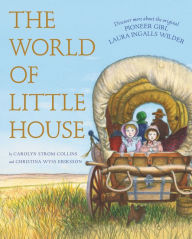
The World of Little House

The World of Little House. Carolyn Strom Collins and Christina Wyss Eriksson. 1996. 160 pages. [Source: Library]

First sentence: We know Laura Ingalls Wilder best through her nine Little House books, which tell the story of her life as a pioneer girl.

Premise/plot: This biography of Laura Ingalls Wilder would be perfect for upper elementary or middle schoolers. In some ways it's "just" a biography, but, in other ways it's so much more than that. One thing that I loved about it, for example, is the inclusion of HOUSE PLANS for all the houses Laura Ingalls Wilder lived! That plus the inclusion of crafts and recipes and extension activities really just made me happy.

For any reader who loves the book series or even the television series, this one is a fun and easy-going read.

My thoughts: While I didn't learn anything "new" about Laura Ingalls Wilder, I found it a fun, delightful presentation of what I already knew. The only book that truly was packed with I-didn't-know that information was the recently released PIONEER GIRL. This biography shares an intended audience range of the actual books. So one could go from the series to this biography smoothly. (I can't imagine a fourth or fifth grader picking up PIONEER GIRL and finishing it. Pioneer Girl just has SO MANY footnotes.)

Easy to recommend this one!

© 2016 Becky Laney of Becky's Book Reviews

Wednesday, October 12, 2016

Weighed in the Balance

Weighed in the Balance. Anne Perry. 1996. 373 pages. [Source: Library]

Out of all the William Monk mysteries that I've read so far, Weighed in the Balance was the one that has proved the hardest going. In other words, I found it dragging from almost start to finish. I'm not sure if it was my mood, or, if possibly it was the case, or perhaps even a bit of both.

Sir Oliver Rathbone has accepted a new case, for better or worse, and it's a matter of slander. He's defending a woman, a foreigner, Countess Zorah Rostova on a slander change. She has accused someone (Princess Gisela) of murder, and, won't back down even though there isn't a bit of evidence against the woman. Not that anyone looks until Rathbone hires William Monk to investigate. But still.
The case is frustrating and loathsome to him. Even after the trial starts, he is clueless as to what to say in her defense. He can't possibly win this case. It's a matter of how big a fool he wants to appear. Should he try to build a case that it is murder, or was murder, but that his client was mistaken in WHO did the crime? Or should he try to hush up the murder-aspect of it? Does he himself believe there was a crime committed? Can he work up a believable motive?

One character I appreciated more than the others in this one: Hester Latterly. I didn't have to yell at her even once while reading this one. I did, I must mention, have to yell at William Monk more than once. Rathbone, well, he always does the honorable thing, and rarely needs yelling at.

Hester has nursing duties in this book. She's tending a young man after an injury, and, he'll likely never walk again. She brings a young woman into his life, a woman first introduced in A Sudden Fearful Death. I do enjoy how the series works. It's a whole world the author has created, and, characters are always reappearing as they carry on their lives. It's nice to see. And it's not something you often see in a mystery series.


© 2016 Becky Laney of Becky's Book Reviews

Saturday, December 12, 2015

Seuss on Saturday #50

Daisy-Head Mayzie. Dr. Seuss. 1994. Random House. 56 pages. [Source: Library]

First sentence:  It's hard to believe such a thing could be true, And I hope such a thing never happens to you. But it happened, they say, to poor Mayzie McGrew. And it happened like this...

Premise/plot: Mayzie McGrew shocks everyone--first everyone at her school, and, then later the nation--when a daisy suddenly appears growing out the top of her head. So many unanswered questions?! What's to be done?!

My thoughts: I had never read this one before. Was I missing out? Not really. The story is a bit out of control and all over the place. Which may sound like a typical Seuss story, and, in many ways--at least in theory--it was. It just lacked a certain something. 

Have you read Daisy-Head Mayzie? Did you like it? love it? hate it? I'd love to know what you thought of it!

My Many Colored Days. Dr. Seuss. Illustrated by Steve Johnson and Lou Fancher. 1996. Random House. 32 pages. [Source: Library]

First sentence: Some days are yellow. Some are blue. On different days I'm different too.

Premise/plot: There's a color for each mood in My Many Colored Days.

My thoughts: I like the idea of this one, the premise of it. I like the exploration of moods and emotions and feelings. Of feeling many different ways, and, yet still being "me." I also appreciate the simplicity of the text. Some Seuss books are so very, very text-heavy.

Have you read My Many Colored Days? Did you like it? love it? hate it? I'd love to know what you thought of it!

If you'd like to join me in reading or rereading Dr. Seuss (chronologically) I'd love to have you join me! The next book I'll be reviewing is Hooray for Diffendoofer Day and The Bippolo Seed and Other Lost Stories. I'll be doubling up for the rest of the year each Saturday.

© 2015 Becky Laney of Becky's Book Reviews

Sunday, August 30, 2015

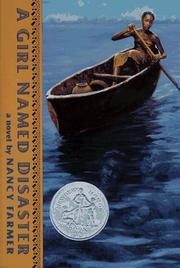
A Girl Named Disaster

A Girl Named Disaster. Nancy Farmer. 1996. Scholastic. 320 pages. [Source: Review copy]

I read A Girl Named Disaster and Shabanu: Daughter of the Wind the same week. That fact definitely influenced my thoughts on both books--fair or not. Reading is subjective, after all.

Did I enjoy reading A Girl Named Disaster? Yes and no. I didn't exactly "enjoy" it. I found it a bit slow at the beginning, and, a bit rushed at the end. There were times I definitely found it interesting, but, I never really found myself loving it.

Nancy Farmer's A Girl Named Disaster is set in Mozambique and Zimbabwe in the early 1980s. Nhamo has an interesting relationship to the rest of the family. She dearly, dearly loves her grandmother (Ambuya), and is in return beloved of her grandmother. (She is in fact probably the favorite granddaughter.) But the rest of her family is a different story. They seem to blame Nhamo for the circumstances of her birth. Her mother returned home from school (high school??? college???) pregnant and married to a "useless" man, a man named Proud. Neither is in her life when the novel opens. Her mother died when Nhamo was a toddler--eaten by a leopard. Her father had disappeared even before that. Nhamo is, without a doubt, a hard worker. Yes, she is slightly bitter that her tasks are more difficult and time-consuming than her slightly-older cousin's--Masvita. But she isn't hate-filled and overflowing with attitude either.

Like Shabanu, A Girl Named Disaster introduces readers to a culture where marriage happens VERY early in life for girls--twelve to fourteen, and where a woman's worth is very much tied to her ability to produce children, particularly sons. Like Shabanu, A Girl Named Disaster features a heroine who is to be sacrificed via marriage. Like Shabanu, this marriage is MOST, MOST unwelcome. Dare I say this would-be marriage sounds even more unpleasant than the one in Shabanu--and I never thought I'd say that. Like Shabanu, the heroine makes the only choice she can under the circumstances....

Nhamo runs away from home in an attempt to make it across the border to Zimbabwe. Once there, she'll pretend to be Catholic--her mother attended a Catholic school--and seek refuge with nuns. Is she actually Catholic? No. Of course not. Her ideas of who Jesus is are far from sound, to say the least. But that is not exactly the point of A Girl Named Disaster.

Her journey to Zimbabwe is....much longer than she imagined it ever could be. It is not a journey of a few days or even a few weeks. MONTHS go by with Nhamo still struggling to reach her destination. It is her fight for SURVIVAL. It is definitely nature versus Nhamo...with Nhamo receiving a bit of help from the spiritual world.

Will Nhamo's life be better--easier--in Zimbabwe? Will she find her father? Will she find her father's family? Will she find welcome with them? What will happen to her if she doesn't find them? What will become of her? What are her chances of a decent life, a good life???

A Girl Named Disaster is slightly less depressing than Shabanu. That's not fair. It's not. The ending sees Nhamo with a bit of hope and a chance at a future.

Still neither book "feels" like a children's book. And when I do think of Newbery or Newbery Honor, I tend to think CHILDREN'S BOOK more than anything else. Arranged marriages, child-adult marriages, don't really come to mind. Still exposure to diverse titles can be a good thing. And both books offer readers something to think about.

© 2015 Becky Laney of Becky's Book Reviews

Sunday, August 23, 2015

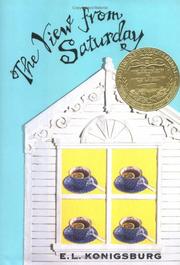
A View From Saturday

The View From Saturday. E.L. Konigsburg. 1996. 176 pages. [Source: Bought]

I enjoyed rereading E.L. Konigsburg's The View From Saturday. Though I don't usually "enjoy" (seek out) stories with multiple narrators--alternating narrators--in this case it was just right or practically perfect. Readers meet a teacher, Mrs. Olinski, and the four students on the sixth grade competitive team for the Academic Bowl. (They are Noah, Nadia, Ethan, and Julian.) All five narrate The View From Saturday. Mrs. Olinki's chapters are of the BIG competition day, and each chapter generally ends with a question being asked of the competitors. Usually. The chapters narrated by the students cover much more time, generally are full of flashbacks. It is in these narratives that characters are developed and relationships explored. All four students in her class were connected BEFORE they were chosen.

View From Saturday is a great friendship-focused, school-focused coming of age novel. Each narrative is definitely unique. And I like how interconnected the stories really are.

When I think Newbery, this is the kind of book I think of most of the time.

© 2015 Becky Laney of Becky's Book Reviews

Tuesday, December 23, 2014

The Christmas Tree

The Christmas Tree. Julie Salamon. 1996. Random House. 118 pages. [Source: Bought]

The Christmas Tree is technically a reread for me, although I haven't reviewed it on my blog. I picked this one up because I remembered enjoying the movie adaptation of it. It didn't disappoint. What I like best about this feel-good Christmas story are the flashbacks.

The chief gardener for Rockefeller Center narrates Julie Salamon's The Christmas Tree. In his own words, this gardener tells of his search, his on-going, never-ending search for THE tree. If he's not looking for this year's tree, his mind is already on finding NEXT year's tree. The book is about one special tree in particular, one that led to an ongoing friendship.

One day the narrator spots THE tree from a helicopter. He learns it's on the property of a convent. He goes. He talks. He asks. He meets Sister Anthony THE nun who will decide if he can have the tree or not. They have more in common than he was expecting certainly. But. She's not ready or willing to part with the tree called, TREE.

Sister Anthony is a storyteller. She is. And the narrator turns out to be a good listener. Over several years at least, he keeps coming back to see her, to visit with her and hear her stories. He has things to share as well. Through these sections, readers learn of Anna.

In the flashbacks, readers meet a young orphan named Anna who eventually came to be raised at the convent. Her story is very personal, and it reveals her affection, her connection to nature. The young girl as you've probably guessed IS Sister Anthony herself.

I loved Anna. I did. Her part in the story is what made it work for me. It was her connection with the tree--in the past and present--that kept me reading.

© 2014 Becky Laney of Becky's Book Reviews

Monday, October 27, 2014

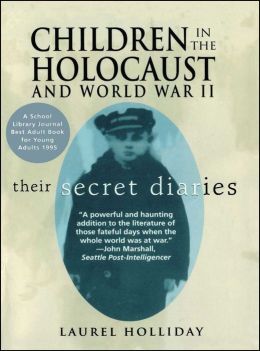
Children in the Holocaust and World War II

Children in the Holocaust: Their Secret Diaries. Laurel Holliday, ed. 1996. 432 pages. [Source: Library]

Children in the Holocaust and World War II: Their Secret Diaries is an almost must-read in my opinion. It is incredibly compelling and emotional. Memoirs are great. They are. I have loved many autobiographies and biographies. But diaries are a bit unique. They tend to stay in the moment; there is a rawness perhaps in the emotions. They capture specific moments in time. They record the best and worst and everything in between. These diary entries are well worth reading.
These children's diaries are testimonies to the fact that telling the truth about violence is not harmful. In fact, one wonders how much greater harm these boys and girls would have suffered had they not written about the horrific events they were experiencing. Far more dangerous than reading about atrocities, I believe, is the pretense that atrocities do not occur. To turn our eyes away and refuse to see, or to let children see, what prejudice and hatred lead to is truly to warp our collective psyche. It is important for all of us--adults and children alike--to acknowledge the depths to which humankind can sink. The children teach us, by sharing their own direct experience of oppression, that nothing is more valuable than human freedom. This lesson alone is reason enough to read and to encourage children to read, these diaries.
This book gathers together diary entries from twenty-two writers. The countries represented include: Poland, Holland, Germany, Czechoslovakia, Austria, Hungary, Lithuania, Russia, Belgium, England, Israel, and Denmark. Seven of the twenty-two writers are from Poland. Some writers survived the war. Others did not. I believe that all of these entries have been previously published in some format, in at least one language. The listed age refers to the writer's age for the first diary entry printed in the book. This book provides excerpts from diaries. None of the diaries, I believe, are reprinted in full. These excerpts represent the diaries as a whole, and provide a bigger picture for understanding the war.
  • Janine Phillips, Poland, 10 years old
  • Ephraim Shtenkler, Poland, 11 years old
  • Dirk Van der Heide, Holland, 12 years old
  • Werner Galnick, Germany, 12 years old
  • Janina Heshele, Poland, 12 years old
  • Helga Weissova-Hoskova, Czechoslovakia, 12 years old
  • Dawid Rubinowicz, Poland, 12 years old
  • Helga Kinsky-Pollack, Austria, 13 years old
  • Eva Heyman, Hungary, 13 years old
  • Tamarah Lazerson, Lithuania, 13 years old
  • Yitskhok Rudashevski, Lithuania, 14 years old
  • Macha Rolnikas, Lithuania, 14 years old
  • Charlotte Veresova, Czechoslovakia, 14 years old
  • Mary Berg (pseudonym), Poland, 15 years old
  • Ina Konstantinova, Russia, 16 years old
  • Moshe Flinker, Belgium, 16 years old
  • Joan Wyndham, England, 16 years old
  • Hannah Senesh, Hungary and Israel, 17 years old
  • Sarah Fishkin, Poland, 17 years old
  • Kim Malthe-Bruun, Denmark, 18 years old
  • Colin Perry, England, 18 years old
  • The Unknown Brother and Sister of Lodz Ghetto, Poland, Unknown Age and 12 years old
I won't lie. This book is difficult to read. Difficult in terms of subject matter. It is an emotional experience. Readers are reading private diary entries. The entries capture the terror and horror of the times. They capture the uncertainty that almost all felt: will I survive? will I survive the day? will I survive the war? will my family? will my friends? will I witness their deaths? will I have ANY food to eat today? tomorrow? how much worse can it get? when will this all be over? will I be alive to see the end of the war? what if the Nazis win? The diaries capture facts and details. But they also capture feelings and reactions.
Shootings have now become very frequent at the ghetto exits. Usually they are perpetrated by some guard who wants to amuse himself. Every day, morning and afternoon, when I go to school, I am not sure whether I will return alive. I have to go past two of the most dangerous German sentry posts..., Mary Berg, February 27, 1942, p. 233
Dr. Janusz Korczak's children's home is empty now. A few days ago we all stood at the window and watched the Germans surround the houses. Rows of children, holding each other by their little hands, began to walk out of the doorway. There were tiny tots of two or three years among them, while the oldest ones were perhaps thirteen. Each child carried a little bundle in his hand. All of them wore white aprons. They walked in ranks of two, calm, and even smiling. They had not the slightest foreboding of their fate. At the end of the procession marched Dr. Korczak, who saw to it that the children did not walk on the sidewalk. Now and then, with fatherly solicitude, he stroked a child on the head or arm, and straightened out the ranks. He wore high boots, with his trousers stuck in them, an alpaca coat, and a navy-blue cap, the so-called Maciejowka cap. He walked with a firm step, and was accompanied by one of the doctors of the children's home, who wore his white smock. This sad procession vanished at the corner of Dzielna and Smocza Streets. They went in the direction of Gesia Street, to the cemetery. At the cemetery all the children were shot. We were also told by our informants that Dr. Korczak was forced to witness the executions, and that he himself was shot afterward. Thus died one of the purest and noblest men who ever lived. He was the pride of the ghetto. His children's home gave us courage, and all of us gladly gave part of our own scanty means to support the model home organized by this great idealist. He devoted all his life, all his creative work as an educator and writer, to the poor children of Warsaw. Even at the last moment he refused to be separated from them. ~ Mary Berg, August, 1942, p. 239
© 2014 Becky Laney of Becky's Book Reviews

Friday, January 24, 2014

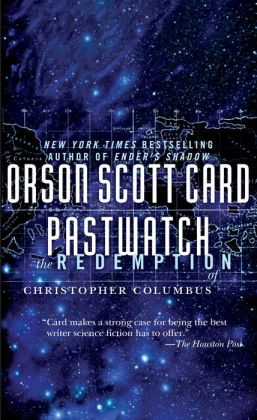
Reread #4 Pastwatch The Redemption of Christopher Columbus

Pastwatch The Redemption of Christopher Columbus. Orson Scott Card. 1996. Tor.  351 pages. [Source: Book I Bought]

I first reviewed Pastwatch for the blog in November 2007, but that was certainly not my first time to read it. I discovered Orson Scott Card's work in a library science class in the fall of 2000. I read everything I could find of his over the next year. It was my first venture into science fiction. It was LOVE.

Semi-Apocalyptic fiction. Alternate histories. Time Travel. Need I say more?! For anyone who enjoys dystopias or apocalyptic fiction, I'd say that Pastwatch was a must read! The same is true for anyone who loves reading time travel stories. The premise and plot is enough to keep one reading. But the characterization is wonderfully done as well.

In the world of Pastwatch, history can be viewed on the big screen. In the early stages, this technology could only watch vast regions--note climate changes and social changes--the building of communities and sometimes their collapses. But as this technology is developed further, it becomes possible to watch history in greater detail, minute detail. Scientists, historians, researchers (whatever you want to call them) can do studies on communities, societies, or individuals. What's the point of watching the past? To learn. To understand. To answer impossible questions. But a few historians hope for more. What if watching the past could change the past? Each historian researcher has his/her own speciality. Sometimes they work on something personally, other times they come together into various teams. Readers meet a handful of researchers--probably six or seven and learn of their lives, of their studies.

How is Christopher Columbus involved? Well, he's one of our narrators for one thing. But secondly, he becomes the subject of interest for most of our other narrators. It is HIS life that is being dissected and held up for study. What our researchers learn is that at some point in time, future scientists, interfered or manipulated the past that turned Christopher Columbus' interest to sailing west. Their quest to figure out how and why of this manipulation will lead them on a journey with massive consequences. For they're debating whether or not they should do something along the same lines...

It is a science fiction novel. And like many science fiction novels, it deals with aspects of playing God. One of the thought-provoking subjects in Pastwatch is suffering. The historian-researchers perhaps feel they can do a better job at writing or rewriting history. That they can do a better job at alleviating suffering and establishing peace and goodwill across the globe. The future-historians take on the role of God, manipulating people in the past making them believe that they are God or God's messengers. Pain and suffering was also a big, big subject in the Worthing Saga, another Card novel.

Quotes:
Though Tagiri did not put her own body back in time, it is still true to say that she was the one who stranded Christopher Columbus on the island of Hispaniola and changed the face of history forever. Though she was born seven centuries after Columbus's voyage and never left her birth continent of Africa, she found a way to reach back and sabotage the European conquest of America. It was not an act of malice. Some said that it was correcting a painful hernia in a brain damaged child: In the end, the child would still be severely limited, but it would not suffer as much along the way. But Tagiri saw it differently.
"History is not prelude," she said once. "We don't justify the suffering of people in the past because everything turned out well enough by the time we came along. Their suffering counts just as much as our peace and happiness. We look out of our golden windows and feel pity for the scenes of blood and blades, of plagues and famines that are played out in the surrounding country. When we believed that we could not go back in time and make changes, then we could be excused for shedding a tear for them and then going on about our happy lives. But once we know that it is in our power to help them, then, if we turn away and let their suffering go on, it is no golden age we live in, and we poison our own happiness. Good people do not let others suffer needlessly." What she asked was a hard thing, but some agreed with her. Not all, but in the end, enough. (25-6)
Till now, all the story-seekers in Pastwatch had devoted their careers to recording the stories of great, or at least influential men and women of the past. But Tagiri would study the slaves, not the owners; she would search throughout history, not to record the choices of the powerful, but to find the stories of those who had lost all choice. To remember the forgotten people, the ones whose dreams were murdered and whose bodies were stolen from themselves, so that they were not even featured players in their own autobiographies. The ones whose faces showed that they never forgot for one instant that they did not belong to themselves, and that there was no lasting joy possible in life because of that. (35)
 "It can be done," she said, blurting it out at once. "We can change it. We can stop--something. Something terrible, we can make it go away. We can reach back and make it better."
He said nothing. He waited.
"I know what you're thinking, Hassan. We might also make it worse."
"Do you think I haven't been going through this in my mind tonight?" said Hassan. "Over and over. Look at the world around us, Tagiri. Humanity is finally at peace. There are no plagues. No children die hungry or live untaught. The world is healing. That was not inevitable. It might have ended up far worse. What change could we possibly make in the past that would be worth the risk of creating a history without this resurrection of the world?"
"I'll tell you what change would be worth it," she said. "The world would not have needed resurrecting if it had never been killed."
"What, do you imagine that there's some change we could make that would improve human nature? Undo the rivalry of nations? Teach people that sharing is better than greed?"
"Has human nature changed even now?" asked Tagiri. "I think not. We still have as much greed, as much power-lust, as much pride and anger as we ever had. The only difference now is that we know the consequences and we fear them. We control ourselves. We have become, at long last, civilized."
"So you think that we can civilize our ancestors?"
"I think," said Tagiri, "that if we can find some way to do it, some sure way to stop the world from tearing itself to pieces as it did, then we must do it. To reach into the past and prevent the disease is better than to take the patient at the point of death and slowly, slowly bring her back to health. To create a world in which the destroyers did not triumph."
"If I know you at all, Tagiri," said Hassan, "you would not have come here tonight if you didn't know already what the change must be."
"Columbus," she said."
"One sailor? Caused the destruction of the world?" (50-1)
"I'm finding the place where the smallest, simplest change would save the world from the most suffering. That would cause the fewest cultures to be lost, the fewest people to be enslaved, the fewest species to fall extinct, the fewest resources to be exhausted. It comes together at the point where Columbus returns to Europe with his tales of gold and slaves and nations to be converted into Christian subjects of the king and queen." (52)
© 2014 Becky Laney of Becky's Book Reviews

Monday, August 12, 2013

The Unruly Queen (1996)

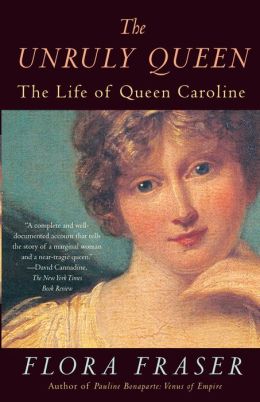
The Unruly Queen: The Life of Queen Caroline. Flora Fraser. 1996/2009. Anchor Books. 560 pages. [Source: Library]

George IV married Caroline because his father (and/or parliament) agreed to pay off his debts if he got married. This marriage was a complete disaster. Not only was it a loveless marriage, it was extremely bitter! He HATED his wife. And I believe she hated him as well. Half the biography focuses on the bickering and the back-and-forth correspondence between her legal advisers, his legal advisers, and King George III. The situation was complex because George III and George IV (he was Prince of Wales, but it's easier for me to just call him George IV) did not get along at all. They fought continuously. Their relationship was extremely strained. There were times when George III sided with "the injured Princess" Caroline instead of with his son. His wife was at various times popular with the people as well. George IV, well, he wasn't very well-liked. He had a habit of spending lots of money and wanting parliament to pay all the bills. He also had more than a few mistresses. Some of these mistresses were in favor with society--were popular enough, I suppose--others were NOT. He was never faithful to Caroline; he never even pretended to like her or love her. He made it clear that he hated to be even in the same room with her. For better or worse, the two did have one child together. (Princess Charlotte was conceived within the first month of marriage.) Princess Charlotte was more popular than her mother and father.

The biography is very detailed. It details correspondence and records. It follows Caroline's movements from her marriage to George through her death--just three weeks after her husband's coronation. She was banned from attending. For Caroline was not always on good terms with her in-laws. Sometimes she enjoyed the favor of George III and his wife. Other times, her treatment was barely civil. There were definitely times she embarrassed the family and they disapproved of her.

The Unruly Queen was an interesting read.


© 2013 Becky Laney of Becky's Book Reviews

Saturday, December 22, 2012

A Crown of Swords

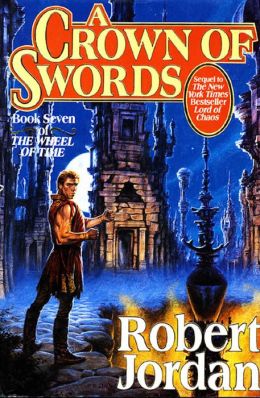
A Crown of Swords. Robert Jordan. 1996. Tor. 896 pages.

I enjoyed A Crown of Swords more than Lord of Chaos. (Though Lord of Chaos had a few GREAT scenes in it.) I took my time with A Crown of Swords knowing that if I forced myself to stick to a certain pace, I wouldn't enjoy it as much. I wanted to want to keep reading this one--not out of obligation, not out of a need to get to the next book, but for the enjoyment of taking it one book at a time, one story at a time, one character at a time.

One of the reasons I didn't feel connected to Lord of Chaos were the ever changing perspectives. A Crown of Swords visits many characters, provides many points of views, follows dozens of stories. But the changes from one to the other flowed much better in my opinion. We'd spend several chapters with Rand, then spend several chapters with Mat, etc. I feel we got to spend at least a  little time with (almost) all the characters. We did get to spend more time with Mat and Min in this book. Min being friendly with Rand. Mat keeping an eye on some of the Aes Sedai (Nynaeve, Elayne, etc.) I still don't feel we get to spend enough time with all the characters. There are some favorites of mine which I'd love to follow more closely.

Several things happen in this one, though, I admit things happen very slowly except for when they don't. Some changes happen quickly, others seem to take several books to give the appearance of budging.

This book isn't as satisfying perhaps as earlier books in the series, but, I still was happy to spend time reading it. 

Read A Crown of Swords
  • If you enjoy LONG fantasy series that move at their own leisurely speed
  • If you love world-building in fantasy novels
  • If you've enjoyed previous books in this series. This is #7.

© 2012 Becky Laney of Becky's Book Reviews

Thursday, December 13, 2012

Dear America: The Winter of Red Snow

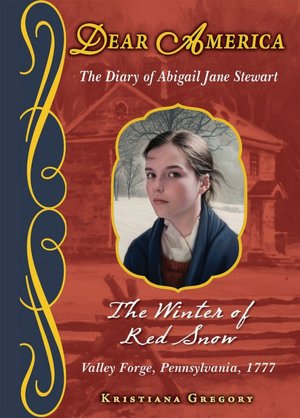
Dear America: The Diary of Abigail Jane Stewart, The Winter of Red Snow, Valley Forge, Pennsylvania. Kristiana Gregory. 1996/2010. Scholastic. 192 pages.

  The Winter of Red Snow is my third Dear America novel to read, and it is probably my least favorite. The Revolutionary War is not one of my favorite time periods to read about. The book is set in Valley Forge, Pennsylvania, and the heroine's mother does George Washington's laundry while he's there. Readers learn a little about the hardships endured by just about everyone. Abigail and her older sister have opportunities to help the soldiers--sewing shirts, sewing coats, etc. And the father is a cobbler, so he's able to help as well. The book is rich in details, I think if I'd cared more about the time period I would have found it more interesting. 

Read The Winter of Red Snow
  • If you enjoy historical fiction
  • If you enjoy diary books
  • If you enjoy books set in Colonial America around the American Revolution

© 2012 Becky Laney of Becky's Book Reviews

Saturday, April 24, 2010

The Thief (MG/YA)


The Thief by Megan Whalen Turner. 1996. HarperCollins. 224 pages.

I didn't know how long I had been in the king's prison. The days were all the same, except that as each one passed, I was dirtier than before.

Gen is a thief. He's in prison--in Sounis--for boasting that he could steal anything. Well, more precisely that he could steal something from the King. Has he been forgotten? Not exactly. There are those that would have him released from prison so they can use his services. Magus, with the approval of the King, wants Gen to steal something of mythological importance from a neighboring country. Hamiathe's Gift. Can he do it? He must if he wants his freedom! He will embark on a journey, on an adventure, with some interesting companions. Can he turn these enemies into friends?

I really enjoyed The Thief. I loved the world Megan Whalen Turner created. There are three very different countries explored: Sounis, Eddis, Attolia. Different countries, different monarchs, different intrigues, different gods and goddesses. This is a richly detailed fantasy novel. And I thought the storytelling worked well. I would definitely recommend this one!

© Becky Laney of Becky's Book Reviews
Saturday, February 21, 2009

The Banishment


Chesney, Marion. 1996. The Banishment.

The Banishment is a Regency romance novel--smut-free--that is delightful in an unpretentious way. Perhaps not the best book in the world--Chesney is no Jane Austen or Georgette Heyer--but it is a fun, light read. If it has a flaw it is that it tells more than shows. The heroine of The Banishment is Isabella Beverley. She is the oldest daughter; she's been raised with wealth and prestige. But--and there are always buts in books--all that changes when her father gambles away the family home, Mannerling, and the family is humbled and humiliated. What's a girl to do? If her parents have any sway over their daughter, they'll try to arrange it that she marries the new owner, a Mr. Judd. No matter how untasteful, no matter how insane. But is that what she wants? Or is she maybe starting to realize just how wonderful Lord Fitzpatrick, an Irish viscount, really is?
© Becky Laney of Becky's Book Reviews
If you're reading this post on another site, or another feed, the content has been stolen.