Showing posts with label mg romance. Show all posts

Wednesday, May 17, 2023

102. Flipped


Flipped. Wendelin Van Draanen. 2001. 212 pages. [Source: Library]

First sentence: All I've ever wanted is for Juli Baker to leave me alone. For her to back off--you know, just give me some space. It all started the summer before second grade when our moving van pulled into her neighborhood. And since we're now about done with the eighth grade, that, my friend, makes more than half a decade of strategic avoidance and social discomfort. She didn't just barge into my life. She barged and shoved and wedged her way into my life.

Premise/plot: Bryce Loski and Juli Baker narrate this he-said, she-said middle grade novel. It was love at first sight--in second grade--for Juli Baker. But for Bryce, well, Juli is a pesky, pesty neighbor that follows him--literally--everywhere. But in eighth grade, however, roles seemed to have flipped. She begins to doubt her feelings for him--there's more to attraction that just eyes and smile--and he begins to see her in a whole new way. 

This one opens with a flashback scene of sorts showing the introduction or "meet cute" of this unlikely pair. But most of the story chronicles sixth grade through eighth grade. Reader see the same exact events through two pairs of eyes.

My thoughts: I am rereading this one after watching the movie for the first time. I ADORED the movie. It definitely changed some things up. For one, it took the contemporary setting of Flipped and made it a period piece. In the movie, the story unfolds in 1957-1963. And the soundtrack is FANTASTIC. I think one reason--pure speculation--to make this switch is it feels a little less controversial to have a girl literally chasing down a boy and smelling him if you set it in the distant past. Also some of the viewpoints of the characters seem to align more with what you'd expect in days long ago. (Teasing about being having a  r****d in the family, etc.) Some of the scenes just have JERKS. 

This one is thought-provoking. Love it or hate it. I definitely think the book doesn't address consent or boundaries--a must for a contemporary book being published post #metoo. The main message, I believe, is looking beyond appearances. What makes someone attractive. What makes you "flip" for someone. Juli is best for illustrating this. She's so accustomed to "loving" or "crushing" on Bryce, that she doesn't stop to consider WHO he is. What kind of person is Bryce? What is his character? If she really knew him--actually knew him--would she still love him? Is her attraction all surface-level? As for Bryce, he seems much less self-aware and just a bit clueless and immature. (Not for not liking girls. But just on processing and observing the world.) 

 The book definitely is open-ended and ambiguous. As is the movie--to a certain degree--but the closing music, "Let It Be Me" and the fact that she joins him outside to help him plant the new tree, does add an element of hope that the book doesn't quite reach.

© 2023 Becky Laney of Becky's Book Reviews

Sunday, April 11, 2021

36. Sixteen Scandals


Sixteen Scandals. Sophie Jordan. 2021. [May] 256 pages. [Source: Review copy]

First sentence: She was going to die here, crouched beneath a table on a dirty tavern room floor with bits and crumbs of food that predated the Magna Carta surrounding her. Glass shattered nearby, and she flinched, shrinking into herself as tiny shards sprayed her and the pungent scent of sweat, ale, and wine soaked the air. If this was to be it, then it was an ignominious end. She had always imagined there would be more to her life. She had simply imagined there would be . . . more life.

Premise/plot: Primrose Ainsworth wakes up on her sixteenth birthday convinced that her REAL life is about to begin. You could even insert a Disney-like "I want" song at this point and you wouldn't be wrong. Her hopes are soon dashed. Not only is her family not planning to celebrate her birthday, they're not planning to celebrate her year. She won't be coming out this year, OR, in other words she won't be getting her season. She'll still be "in the nursery," if you will.

Primrose, well, isn't PRIM. And she won't just take this INCREDIBLY BITTER news calmly and rationally. If her family won't celebrate her day with her and recognize her entry into womanhood, then she'll celebrate with her best friend. And what better way to celebrate than to sneak out of the house and literally go to the MOST DANGEROUS place in LONDON: Vauxhall Gardens.

If she survives the night--with her purity intact--and can make it home before she's discovered to be missing by the servants or her family, then it may just be the best night of her life. (Of course, she's not worried about her purity! It doesn't occur to her that any trouble whatsoever could ever befall her).

Of course, her plans, well, her plans get off to a shaky start and then completely flop and flail. But do they? Could the most unexpected night filled with unexpected-to-her dangers still end up being the best night of her life?

The thrills begin when she is separated from her friend and finds herself on her own...but not for long....

Enter Jacob.

My thoughts: Expectations. I would suggest beginning the novel with low-to-medium expectations. It may just surprise you if you start low enough. I found Sixteen Scandals to be a contradiction that probably shouldn't work but probably does for many, many readers--myself included.

Yes, it is predictable. There is nothing original or unique about it. Not the characters. Not the plot. Not the steamy scenes. Not the tied up with a bow ending. But here's the thing, depending on the genre, or sub-genre, or sub-sub-genre, predictability can be an asset. It can be a strength in the hearts and minds of the readers. Of course, not every single reader predictably likes predictable.

The characters. What can I say about Primrose? She was incredibly annoying, full of angst, selfish, naive, full of herself, and foolish. She reminded me of a preschooler with lipstick smeared across the bottom of her face, standing in her mother's high heels shuffling around telling everyone she's off to work. I mean Primrose is so obviously out of her element all the while she's proclaiming complete, full, total independence. What she is saying contradicts how she is behaving. And Jacob?! Well. I think Jacob reminds me of a Disney prince OR a twelve-year-old's ideal boyfriend. I think so much of what makes Jacob, Jacob, is found in the imagination. He's just about perfect in every way.

Primrose's family--well, in some ways it's stretching it to say they are cardboard cut-outs. I don't think they are even that well fleshed out. They are a means to an end. How can we introduce a problem so it can be overcome magically and usher us straight into a fireworks exploding happily ever after???

In some ways Sixteen Scandals is no more ridiculous than Disney's A Little Mermaid.

The steam. Sixteen Scandals offers some steam. Probably not enough for older readers; maybe just maybe a little too much for younger readers. It is neither clean nor graphic.

I saw one review criticize the book for "being written for twelve-year-olds." And I'm not sure I'd label it exactly that. But it probably does read babyish for adult readers who read adult romances. And perhaps even for a young adult audience who is used to more depth, substance, and graphic-ness in their romances.

I mentioned A Little Mermaid, but, maybe that isn't the best fit. Maybe more ENCHANTED.

In the end, I found it silly but charming. I can read criticisms and technically agree most of the time, but, I still liked it.

© 2021 Becky Laney of Becky's Book Reviews

Tuesday, April 23, 2019

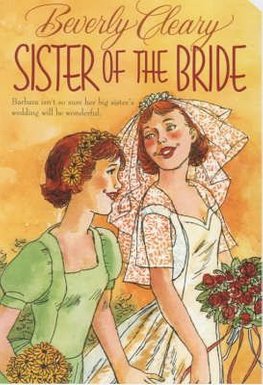
Sister of the Bride

Sister of the Bride. Beverly Cleary. 1963. 240 pages. [Source: Bought]

First sentence: I guess this is just one of those days, thought Barbara MacLane on her way home from school one bright afternoon late in April. She was not alone. She was walking beside a boy, a very tall boy, but their thoughts were like those famous parallel lines that lie in the same plane but never meet.

Premise/plot: Barbara, a junior in high school, is always playing catch up with her older sister, Rosemary, who is a freshman in college. One day Barbara gets a phone call from her sister. Can she keep a secret?!?! She's coming home that weekend--PLEASE TELL MOM NOT TO SERVE MEAT LOAF--and by the way, I'M GETTING MARRIED. Barbara has to keep the secret a day or two. It won't be easy.

It doesn't take Barbara long to get swept up, up, and away in a daydreaming frenzy. She's thinking about Rosemary's wedding--the dress, the flowers, the reception, the cake, the attendants. Will Rosemary's dress one day be her own?! Will she get to help choose her sister's dress? Will she be the maid of honor or a bridesmaid? What will her dress look like? Will the reception be at their house or at a club? Will her sister wear a dress with a long veil and a cathedral train?

But she's also thinking about her own wedding. If she does everything two years--roughly--behind Rosemary, should she focus on picking out her would-be-groom this year? When does she need to start going steady with a guy if she wants a year-long engagement? How many weeks does she have to meet her one true love? She is certain that she'll fall in love by her sister's wedding.

Will she fall in love with the nice boy with a horrible, horrible nickname of TOOTIE. Or will she fall in love with the boy who gives her rides home from school that expects COOKIES and MILK in return? (His name is Bill). One boy keeps asking her out, the other is content to hang out with her after school. She thinks she knows how she feels about both boys, but does she really?

Gordy, their brother, is NOT daydreaming about the wedding. He has dreams that he's focused on--just not romantic ones. He and two of his friends are going to be the NEXT BIG THING. A trio of folk-singers. He's a bit disappointed that his sister's wedding will not be a gig.

My thoughts: I enjoyed this one. For modern readers it might seem an equal blend of SWEET and SILLY. But I enjoyed both elements. The book can serve as a time capsule of sorts for the time in which it was written. In much the same way as FATHER OF THE BRIDE does--both movie versions. (For example, the price of groceries: eight cans of pork and beans for a dollar.)

One of the things I loved most were the family scenes. I loved spending time with this family: the father, mother, Rosemary, Barbara, and Gordy. It felt like a real family--for better or worse. I loved the give and take of it. There's also a mischievous cat that plays an integral role in the novel!

The narrative was also well done.

Quotes:
Greg made the mistake of mentioning the poet E.E. Cummings, who did not use capital letters or punctuation and often ran words together for effect. Of course this provoked an argument from Mr. MacLane. What if every author took it in his head to throw away the rules? What kind of books would we have then? Books that no one would read, that's what we would have. Greg felt that the printer's job was to print the text, not criticize the author's art. (18)
Wouldn't it be nice if people purred as charmingly as cats when they are hungry? Half the quarrels in the world would never take place. (22)
"I would hate to see any daughter of mine throw herself away on someone who approved of writers who did not use punctuation or capitals. This fellow Greg probably likes archy and mehitabel, too." "So do I, Dad," said Barbara. "And the reason there aren't any capitals in archy and mehitabel is that it was supposed to be typed by a cockroach, who couldn't jump on the capital key and a letter key at the same time. The author wasn't just being lazy. He had a good reason." Mr. MacLane chuckled. "A book written by a cockroach is just about what I would expect this fellow to like." (29)
 "And can he afford to pay the orthodontist twenty-five dollars a month?" Mr. MacLane demanded. "Have you thought of that little expense?" "No...I haven't." Crestfallen, Rosemary faltered. How awful thought Barbara as she poured out the dishwater. To want to get married when you are still having your teeth straightened. It must be humiliating to have part of your childhood left over. (43)
Two short years were not much over seven hundred days. Thinking in terms of days instead of years made Barbara feel as if she had not much time left. If she was going to get married in seven hundred days she should think about falling in love, and the sooner the better. Right now. Today. Until this minute she had thought of falling in love as something else that would happen a long time from now. (55)
Barbara watched the umbrella disappear around a bend in the road and, still smiling, she turned and walked into the house. Bill Cunningham. The last boy she had ever expected to notice her. She liked him. She really did. She liked him the way she liked the fizz in ginger ale and the cherry on the sundae. (64)
"It seems to me," said Mr. MacLane, "that ever since Rosemary has been going to the University she has been talking like someone who has read a book on psychology." "I don't know why," puzzled Mrs. MacLane. "She isn't even taking psychology." Barbara had the explanation. "But her roommate is. Millie is majoring in psychology. Rosemary learns a lot from her." "How nice," said Mrs. MacLane dryly. "I am so glad we are to share the benefits of Millie's college education." (69)
Mr. MacLane exhaled a large blue cloud of smoke. "Well, let me tell you something. Someday some mother is going to rebel against her children, and when she does, I will be the first to contribute to a statue in her honor, to be placed downtown in the center of the plaza. A bronze statue. And each year on Mother's Day I shall personally lay a wreat at her feet." (69)
"Millions of footnotes, when all I want to do is think about Greg." (91)
"Your grandfather always liked a bowl of oatmeal for breakfast, reminisced Gramma. "He said it stuck to his ribs." Rosemary looked doubtful. "I don't know whether Greg likes oatmeal or not, but I'm sure I could learn to cook it." Barbara admired her sister for tactfully not telling her grandmother she herself detested oatmeal. Or maybe it wasn't tact at all. Maybe it was love. Maybe Rosemary really would learn to cook oatmeal if Greg wanted it. Rosemary, cooking oatmeal of all things, and early in the morning, too. Rosemary, who always had such a hard time waking up. Barbara smiled to herself. She wondered if Rosemary would learn to eat oatmeal to keep Greg company. That would be the test of love, Rosemary eating oatmeal. (96)


© 2019 Becky Laney of Becky's Book Reviews

Tuesday, February 19, 2019

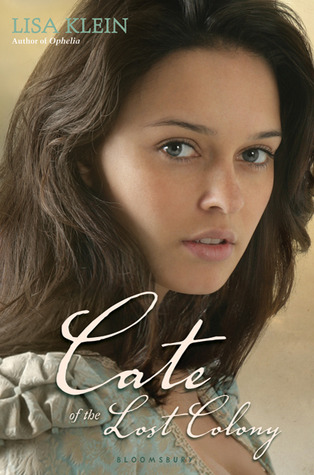
Cate of the Lost Colony

Cate of the Lost Colony. Lisa M. Klein. 2010. Bloomsbury. 336 pages. [Source: Review copy]

First sentence: At a young age I learned how quickly one's fortune's can change, a truth that never betrayed me. One day I was the beloved daughter of a Hampshire gentleman who had been chosen to serve the queen. The next, he was killed fighting in the Netherlands, and I was an orphan.

Premise/plot: Catherine Archer  becomes a maid in the court of Queen Elizabeth I. She even earns enough favor to receive a nickname--"Cat." But the Queen's favor is a fickle, fickle thing. And when the Queen discovers that Cate is in love with Sir Walter Raleigh, well it's not quite OFF WITH HER HEAD (think Alice in Wonderland) but close enough: TO THE TOWER. But her wrath subsides a tiny bit and she relents that instead of imprisonment in the tower perhaps banishment to the New World might be fitting. Raleigh (spelled Ralegh throughout the novel) has been trying to get permission for exploring and colonizing Virginia for years--this ship ends up landing/settling at Roanoke. If you are at all familiar with history--you can guess that much DANGER lies ahead.

This book has THREE narrators...Kate Archer, Walter Ralegh, and Manteo.

My thoughts: I do love reading historical fiction. I'm not entirely sure how accurate this one is or even tries to be. I'm not sure how I feel about that--do I want a historical novel to be super-accurate or do I want a somewhat happy ending?! (As happy as you can be when treating the subject.)

A few of the characters are historical figures but filtered through the author's imagination. A few characters--like Cate--are completely fictional. In this novel, Ralegh himself joins the "rescue/provision" ships bound for Roanoke.

This one spans several years and speaks of several attempts of exploration and settling in the colony of Virginia. Some of my ancestors were early Virginia colonists--though NOT this early, fortunately.

© 2019 Becky Laney of Becky's Book Reviews

Wednesday, January 02, 2019

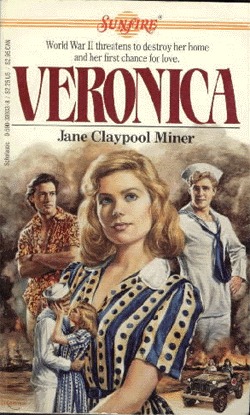
World at War: Veronica

Veronica. (Sunfire #18) Jane Claypool Miner. 1986. Scholastic. 220 pages. [Source: Bought]

First sentence: The party looked just as boring as Veronica feared, and she planned her retreat the minute she entered the room.

Premise/plot: Veronica is set in Hawaii in 1941. The novel opens a few months before the bombing of Pearl Harbor. Veronica Stewart is our sixteen year old heroine. Throughout the book she'll be courted by two young men: a slightly older sailor, Phillip, and a fellow classmate, Mike. Her snobbish mother disapproves of both. She disapproves of Mike because he's Hawaiian. She disapproves of Phillip because he's a sailor--not an officer in the Navy. (Veronica's father is an officer in the Navy). Both men are dying of love for her--or so they claim. Veronica realizes sixteen is too young to go steady or become engaged.

Veronica is staying over at a friends house the day of the bombing. She is an eyewitness to the Japanese planes flying overhead, an eyewitness to the bombs dropping, an eyewitness to a horrifying, unforgettable day. Most people who lived through it probably didn't need a reminder to remember Pearl Harbor.

My thoughts: The opening of Veronica reminds me of Gone With The Wind. Scarlett O'Hara is also sixteen. Both Scarlett and Veronica are super-super-bored by talk of politics and war. Both Scarlett and Veronica wish parties were more party-like and FUN for the young. Both Scarlett and Veronica end up serving the war cause in one way or another. But fortunately the similarities are only on the surface.

Veronica is young and carefree at the start of the novel. She's not had to grow up quickly by being weighed down by adult-size worries. But the war does change that--and she adapts well to the situation. She welcomes responsibilities and grows into a lovely young woman.


I grew up reading the Sunfire romance novels. I did. Some I reread many, many times. Some I just read once or twice. I loved the sweetness of them. They are definitely quick escapist reads. Though the subject is war, this one isn't super-serious--not like The Diary of Anne Frank or The Book Thief.

Each book does feature a love triangle. Usually readers can guess which hero is THE ONE very early on. If not, there's always the cheater-pants way to tell--by looking at the end first.

Veronica would have been born circa 1925--a year younger than my grandmother would have been when the war started.

The original readers of Veronica would have been born circa 1972-1978.

Dear Scholastic:
If I thought begging would do any good, I would plead with you to republish the Sunfire romance series originally published in the 1980s. The "name" books were my favorite-and-best books from my middle years--my first introduction to the wonderful genre of historical romance. It's a love that's still going strong, by the way. I know the Sunfire books don't contain vampires, werewolves, fairies, or demons. But why should romance novels contain such in the first place. If they were worth publishing in the first place--which they so clearly were--they are worth republishing.

I have given it a lot of thought. I have. And I think it would be wonderful if the books were republished as e-books for the same price as the original paperback books were released. Granted, I would love to see PRINT copies as well. But I imagine that they would cost more than the lovely $2.95 of the originals! But for an e-book, the thought is IT'S WORTH EVERY PENNY.

Becky

© 2018 Becky Laney of Becky's Book Reviews

Thursday, April 12, 2018

Amanda

Amanda. (Sunfire #1) Candice Ransom. 1984. Scholastic. 368 pages. [Source: Library book sale]
First sentence: It had been raining forever, endless rain that dripped down the windowpanes. Amanda Bentley could not stand the cramped hotel room another minute.

Dear Scholastic:
If I thought begging would do any good, I would plead with you to republish the Sunfire romance series originally published in the 1980s. The "name" books were my favorite-and-best books from my middle years--my first introduction to the wonderful genre of historical romance. It's a love that's still going strong, by the way. I know the Sunfire books don't contain vampires, werewolves, fairies, or demons. But why should romance novels contain such in the first place. If they were worth publishing in the first place--which they so clearly were--they are worth republishing.

I have given it a lot of thought. I have. And I think it would be wonderful if the books were republished as e-books for the same price as the original paperback books were released. Granted, I would love to see PRINT copies as well. But I imagine that they would cost more than the lovely $2.95 of the originals! But for an e-book, the thought is IT'S WORTH EVERY PENNY.

Becky

Dear Candice Ransom:

Thank you a million times for being the awesome writer that you are. (Thank you for being awesome in general!) I will forever be a fan of yours--your picture books, your early readers and chapter books, and your novels. My first introduction to your work was through the Sunfire romance series. They were--they are--some of my favorite books ever. You gave me a glorious gift--a love of reading.

I still get giddy thinking about the fact that you know who I am. That in 2009 Winchester came to visit me for a few days.

As long as you keep writing, I'll keep reading.

Becky

Premise/plot: Amanda's hopes and dreams are thwarted by her father's gambling ways and big dreams. He decides to steal away from Boston--with her--and start again. On their journey south, he gets a fever to go WEST, to go to Oregon. Amanda does NOT want to go, yet, she finds herself heading west in a wagon, in a wagon train, all the same. It will be the most challenging time in her life, but will the journey change her for the better?

My thoughts: Is Amanda my favorite Sunfire romance?! Maybe. Perhaps my favorite Sunfire romance is the one I've read most recently. Though I will say Amanda is probably always in my top five.

I enjoy a good wagon train story. Why can't wagon train stories become trendy again?!

Amanda brings to mind the only western that I love. You see, I am allergic to westerns in general. The western that is an exception to the rule is WESTWARD THE WOMEN (1951). 

© 2018 Becky Laney of Becky's Book Reviews
Sunday, July 17, 2016

Cyrano

Cyrano. Geraldine McCaughrean. 2006. HMH. 128 pages. [Source: Review copy]

First sentence: The curtain goes up. Silence falls. A painted moon wavers on a painted backdrop. The audience shivers with delight. For what could be better than an evening at a Paris theatre? Who more famous than the evening's glittering star? Enter the magnificent Montfleury, stage right!

Premise/plot: A prose adaptation--for teens--of the French play Cyrano de Bergerac written by British author Geraldine McCaughrean. Now, I do love the play. And I'd probably recommend the play over this adaptation--at least for adults. Especially since I believe it is now out of print. It is sad, right, that by the time I got to this review copy it was already out of print?!

Here's the basic story for those who don't know it: Cyrano is in love with his cousin, Roxane. He finds her to be the most beautiful woman in the world. Roxane is in love with a young soldier (cadet) named Christian. She thinks he is the most handsome man in the world. Christian loves Roxane, but, he lacks the skill to woo her the way she wants to be wooed. She's not interested so much in his kisses as his passionate words of longing. Cyrano who is just as skilled in wordplay as in swordplay steps in to help where he can. He'll give Christian the words to speak to win her heart. When both men go off to war it is Cyrano who risks his life--twice daily--to send letters to her so she won't worry that Christian has been killed. Those letters bring her great joy and drive her mad with wanting him....so much so that she goes into a war zone to find her man. When the two meet she declares, IT IS YOUR SOUL I LOVE, YOU COULD BE THE UGLIEST MAN ALIVE AND I WOULD LOVE YOU STILL, PERHAPS EVEN MORE. Now Christian begs her, PLEASE, PLEASE, PLEASE LOVE ME BECAUSE I'M BEAUTIFUL AND HANDSOME AND SWOON-WORTHY. THAT'S THE WAY I WANT TO BE WANTED. She's confused. But reader's aren't. Christian knows that it is Cyrano whom she truly loves because Cyrano is "his soul." What's to be done?!?!

My thoughts: For readers who are really intimidated by reading plays, then this one is worth seeking out. I do think it serves as a good first introduction to the story. I would hope that readers would grow into the original and seek to experience the story again and again.

© 2016 Becky Laney of Becky's Book Reviews
Saturday, February 13, 2016

First Love

First Love. 14 Warm and Glowing Stories Selected by Gay Head. 1963. Scholastic Book Services. 188 pages. [Source: Bought]

First Love is a vintage collection of short stories compiled by Gay Head for Scholastic in 1963. All of the stories chosen had been previously published in magazines. Most of the stories first appeared in the 1950s, though a few come from the 1940s and early 1960s. (If Barbie were real, this is the kind of book I could see her reading.)

The theme of this collection, is, of course, first love or young love. Some of the stories are narrated from the girl's perspective; some are, however, narrated from the guy's perspective. There is a pair of stories "Sixteen" and "Eighteen" that go together. "Sixteen" by Maureen Daly tells the girl's side of the story--how she went skating one winter's day, was suddenly grasped around the waist by a cute boy, and how they skated and chatted together for what seems like hours. He walked her home. He said he'd call. But he never did. "Eighteen" by Charlie Brodie tells HIS side of the story. Most of the stories are not interconnected.

One of my favorite stories is "Prelude" by Lucille Vaughan Payne. Essentially, this is a clean version of Valley Girl that predates the movie by quite a few decades. Nancy Hollister, the heroine, falls for Stephen Karoladis to the dismay of her popular friends. He is an absolute genius when it comes to music, playing the piano, to be exact. Nancy feels about music the same way he does--it's like they are meant to be. But. He is poor--really, truly poor, work after school as a janitor poor. He will never dress like her friends. And he'll never be able to afford to take her out to the places that her friends go with their dates. But the connection they feel is true and deep and strong. What will happen when he asks her to the prom? Will she go with him knowing that her friends will laugh and mock and bully?! This short story doesn't conclude with "Melt With You" but it ends well all the same! Since I'll never watch Valley Girl again, most likely, I'm glad to have found a clean alternative that puts a grin on my face.

Another favorite story is "Theme Song" by Dave Grubb. In this one, a young girl falls for a soldier with a broken heart or "broken heart." He's received a letter that "his girl" has taken up with someone new. Though there was a time he loved playing "their song" on the jukebox over and over and over and over again...he discovers that the "B side" of the record had never been played....much to Edith's delight. Hearts mend, and new love stories begin...

One of the more unusual stories in this collection, one that brings to mind the Sesame Street song "One of These Things Is Not Like the Other," is Epicac by Kurt Vonnegut, Jr. This "romantic" short story is about a machine--a computer--who falls in love. It's more complicated than that. The narrator and the computer both fall in love with the same girl. And it's a science-fiction twist to Cyrano de Bergerac if you will. (The computer writes the poems that make the girl fall for the narrator.)

Essentially readers who discover this vintage, out-of-print, title will discover a LOT of variety. Each story is unique. Some stories are a bit odder than others.

"Blue Valentine" by Mary Gibbons comes to mind! In this story, a guy with great intentions doesn't think through his gift choice. Angelo, the hero of the story, is essentially a good, thoughtful guy. He wants his Valentine's Day gift to his girlfriend to be extraordinarily WONDERFUL, the best of the best, the best that his money can buy. But this gift gets him in BIG TROUBLE with her family. His choice? Well, Gibbons left that a mystery for readers to solve until the last few pages of this short story--probably for some shock value. So I'll do the same.

Another 'odd' story, for me, was The Walnut Trees a story about a girl's BIG, BIG crush on a teacher. (Hint: Don't cut your teacher's yearbook photo out and put it in a heart locket. It is SURE to fall off, open, and HIM be the one to pick it up and hand it back to you!)

Each story has a description of sorts, or tagline. I'll include these for each story:
  • Stardust by Virginia Laughlin: Her heart went into orbit when she looked at him...
  • A Girl Called Charlie by William Kehoe: She thought that her whole future depended on one date...
  • Blue Valentine by Mary Gibbons: Angelo found the wrong gift for the right girl...
  • The Walnut Trees by Virginia Akin: A dream can be fashioned from cobwebs...
  • Once Upon A Pullman by Florence Jane Soman: Instant charm was not his secret of success...
  • Epicac by Kurt Vonnegut, Jr.: Can a machine fall in love? This one did...
  • Sixteen by Maureen Daly: As she saw it...
  • Eighteen by Charlie Brodie: His side of the story...
  • Prelude by Lucille Vaughan Payne: Music gave her the answer...
  • Tomboy by Gertrude Schweitzer: She thought parties were stupid until one special night...
  • Bittersweet by Arlene Hale: It takes time to forget...
  • Who is Sylvia? by Laura Nelson Baker: Her name was like a haunting melody...
  • Theme Song by Dave Grubb: The young soldier might be the answer to Edith's dreams...
  • Tough Guy by Peter Brackett: He wore a chip on his shoulder to hide the secret in his heart...
Though the taglines might seem over-the-top ridiculous, the stories in this book were actually quite good and in some ways timeless. Some are better than others, I won't lie. But there were a few I really LOVED. And overall, it was even better than I thought it would be.

© 2016 Becky Laney of Becky's Book Reviews