First sentence: For months the great pleasure excursion to Europe and the Holy Land was chatted about in the newspapers everywhere in America and discussed at countless firesides.
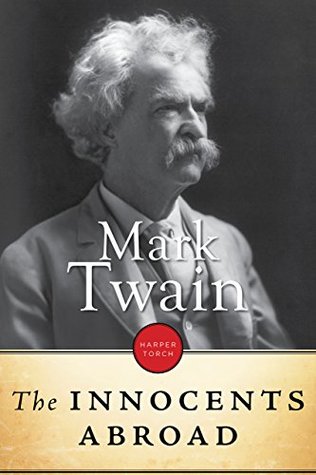
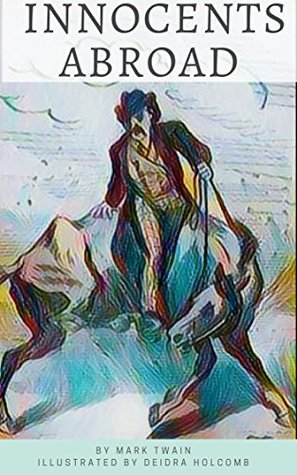
Premise/plot: The Innocents Abroad is a nonfiction travel book by Mark Twain. According to the copy I read, "it was the best selling of Twain’s works during his lifetime and one of the best selling travel books of all time." Twain and his fellow passengers are traveling aboard the ship Quaker City. They'll see parts of Europe--France, Italy, Greece, Russia--and parts of the Middle East--the Holy Land--as well. The book consists mainly of his observations--the ship, the passengers, the hotels, the guides, the tourist-y sights, the smells, the modes of travel. It also includes his observations of human nature and society itself.

My thoughts: I really loved this one. I did. It was often humorous--though not always. It is an actual travel book. Some places get the travel-book-treatment better than others. I get the idea that Twain wasn't super-super impressed with all the usual tourist-y places. That is, I'm not sure Twain loved visiting art museum after art museum after art museum. But Twain isn't one to stay bored--he creates his own entertainment if none is provided. This sometimes makes for a better narrative.
Quotes:
Reverend Henry Ward Beecher was to have accompanied the expedition, but urgent duties obliged him to give up the idea. There were other passengers who could have been spared better and would have been spared more willingly.
I was glad to know that we were to have a little printing press on board and issue a daily newspaper of our own. I was glad to learn that our piano, our parlor organ, and our melodeon were to be the best instruments of the kind that could be had in the market. Notwithstanding all this furniture, there was still room to turn around in, but not to swing a cat in, at least with entire security to the cat.
I wished to express my feelings — I wished to lift up my voice and sing; but I did not know anything to sing, and so I was obliged to give up the idea.

If there is one thing in the world that will make a man peculiarly and insufferably self-conceited, it is to have his stomach behave itself, the first day it sea, when nearly all his comrades are seasick.
I thought, if five cooks can spoil a broth, what may not five captains do with a pleasure excursion.
Some reading was done, and much smoking and sewing, though not by the same parties;
Alas! that journals so voluminously begun should come to so lame and impotent a conclusion as most of them did!
At certain periods it becomes the dearest ambition of a man to keep a faithful record of his performances in a book; and he dashes at this work with an enthusiasm that imposes on him the notion that keeping a journal is the veriest pastime in the world, and the pleasantest. But if he only lives twenty-one days, he will find out that only those rare natures that are made up of pluck, endurance, devotion to duty for duty’s sake, and invincible determination may hope to venture upon so tremendous an enterprise as the keeping of a journal and not sustain a shameful defeat.
“Yes, a journal that is incomplete isn’t of much use, but a journal properly kept is worth a thousand dollars — when you’ve got it done.” “A thousand! — well, I should think so. I wouldn’t finish it for a million.”
If you wish to inflict a heartless and malignant punishment upon a young person, pledge him to keep a journal a year.

Our music consisted of the well-mixed strains of a melodeon which was a little asthmatic and apt to catch its breath where it ought to come out strong, a clarinet which was a little unreliable on the high keys and rather melancholy on the low ones, and a disreputable accordion that had a leak somewhere and breathed louder than it squawked — a more elegant term does not occur to me just now. However, the dancing was infinitely worse than the music. The Virginia reel, as performed on board the Quaker City, had more genuine reel about it than any reel I ever saw before, and was as full of interest to the spectator as it was full of desperate chances and hairbreadth escapes to the participant.
We played the flute and the clarinet together, and made good music, too, what there was of it, but we always played the same old tune; it was a very pretty tune — how well I remember it — I wonder when I shall ever get rid of it.
I will explain that the Oracle is an innocent old ass who eats for four and looks wiser than the whole Academy of France would have any right to look, and never uses a one-syllable word when he can think of a longer one, and never by any possible chance knows the meaning of any long word he uses or ever gets it in the right place; yet he will serenely venture an opinion on the most abstruse subject and back it up complacently with quotations from authors who never existed, and finally when cornered will slide to the other side of the question, say he has been there all the time, and come back at you with your own spoken arguments, only with the big words all tangled, and play them in your very teeth as original with himself. He reads a chapter in the guidebooks, mixes the facts all up, with his bad memory, and then goes off to inflict the whole mess on somebody as wisdom which has been festering in his brain for years and which he gathered in college from erudite authors who are dead now and out of print.
We can tolerate the Oracle very easily, but we have a poet and a good-natured enterprising idiot on board, and they do distress the company.
This fellow said: “I am a free-born sovereign, sir, an American, sir, and I want everybody to know it!” He did not mention that he was a lineal descendant of Balaam’s ass, but everybody knew that without his telling it.
But we love the Old Travelers. We love to hear them prate and drivel and lie. We can tell them the moment we see them. They always throw out a few feelers; they never cast themselves adrift till they have sounded every individual and know that he has not traveled. Then they open their throttle valves, and how they do brag, and sneer, and swell, and soar, and blaspheme the sacred name of Truth! But still I love the Old Travelers. I love them for their witless platitudes, for their supernatural ability to bore, for their delightful asinine vanity, for their luxuriant fertility of imagination, for their startling, their brilliant, their overwhelming mendacity!
We went to the ‘commissionaire’ of the hotel — I don’t know what a ‘commissionaire’ is, but that is the man we went to — and told him we wanted a guide. He said he usually kept a dozen or two on hand, but he only had three now. He called them. One looked so like a very pirate that we let him go at once. The next one spoke with a simpering precision of pronunciation that was irritating. The third man captured us. He was plainly dressed, but he had a noticeable air of neatness about him.
We ordered him peremptorily to sit down with us. Here endeth the first lesson. It was a mistake. As long as we had that fellow after that, he was always hungry; he was always thirsty. Suggestions to stop, excuses to eat and to drink, were forever on his lips. The guides deceive and defraud every American who goes to Paris for the first time and sees its sights alone or in company with others as little experienced as himself. I shall visit Paris again someday, and then let the guides beware! I shall go in my war paint — I shall carry my tomahawk along.
Twenty sets formed, the music struck up, and then — I placed my hands before my face for very shame. But I looked through my fingers. They were dancing the renowned “Can-can.” A handsome girl in the set before me tripped forward lightly to meet the opposite gentleman, tripped back again, grasped her dresses vigorously on both sides with her hands, raised them pretty high, danced an extraordinary jig that had more activity and exposure about it than any jig I ever saw before, and then, drawing her clothes still higher, she advanced gaily to the center and launched a vicious kick full at her vis-a-vis that must infallibly have removed his nose if he had been seven feet high. It was a mercy he was only six. That is the can-can. The idea of it is to dance as wildly, as noisily, as furiously as you can; expose yourself as much as possible if you are a woman; and kick as high as you can, no matter which sex you belong to.
Shouts, laughter, furious music, a bewildering chaos of darting and intermingling forms, stormy jerking and snatching of gay dresses, bobbing beads, flying arms, lightning flashes of white-stockinged calves and dainty slippers in the air, and then a grand final rush, riot, a terrific hubbub, and a wild stampede!
We saw also an autograph letter of Lucrezia Borgia, a lady for whom I have always entertained the highest respect, on account of her rare histrionic capabilities, her opulence in solid gold goblets made of gilded wood, her high distinction as an operatic screamer, and the facility with which she could order a sextuple funeral and get the corpses ready for it. We saw one single coarse yellow hair from Lucrezia’s head, likewise. It awoke emotions, but we still live.

The English know how to travel comfortably, and they carry soap with them; other foreigners do not use the article. the Marseillaise only have a vague theoretical idea of its use, which they have obtained from books of travel, just as they have acquired an uncertain notion of clean shirts, and the peculiarities of the gorilla, and other curious matters.
I only envy these people; I envy them their honest admiration, if it be honest — their delight, if they feel delight. I harbor no animosity toward any of them. But at the same time the thought will intrude itself upon me, How can they see what is not visible?
I am willing to believe that the eye of the practiced artist can rest upon the Last Supper and renew a lustre where only a hint of it is left, supply a tint that has faded away, restore an expression that is gone; patch, and color, and add, to the dull canvas until at last its figures shall stand before him aglow with the life, the feeling, the freshness, yea, with all the noble beauty that was theirs when first they came from the hand of the master. But I can not work this miracle.
Expression! People coolly pretend to read it who would think themselves presumptuous if they pretended to interpret the hieroglyphics on the obelisks of Luxor — yet they are fully as competent to do the one thing as the other.
We have seen famous pictures until our eyes are weary with looking at them and refuse to find interest in them any longer.
But alas! I never could keep a promise. I do not blame myself for this weakness, because the fault must lie in my physical organization. It is likely that such a very liberal amount of space was given to the organ which enables me to make promises, that the organ which should enable me to keep them was crowded out. But I grieve not. I like no half-way things. I had rather have one faculty nobly developed than two faculties of mere ordinary capacity.
What is it that confers the noblest delight? What is that which swells a man’s breast with pride above that which any other experience can bring to him? Discovery! To give birth to an idea — to discover a great thought — an intellectual nugget, right under the dust of a field that many a brain — plow had gone over before. To find a new planet, to invent a new hinge, to find the way to make the lightnings carry your messages. To be the first — that is the idea. To do something, say something, see something, before any body else — these are the things that confer a pleasure compared with which other pleasures are tame and commonplace, other ecstasies cheap and trivial.
So far, good. If any man has a right to feel proud of himself, and satisfied, surely it is I. For I have written about the Coliseum, and the gladiators, the martyrs, and the lions, and yet have never once used the phrase “butchered to make a Roman holiday.” I am the only free white man of mature age, who has accomplished this since Byron originated the expression. Butchered to make a Roman holiday sounds well for the first seventeen or eighteen hundred thousand times one sees it in print, but after that it begins to grow tiresome.
Oliver was sitting alone in this dismal den, one night, by a sage-brush fire, writing poetry; he was very fond of digging poetry out of himself — or blasting it out when it came hard.
Relief for overtasked eyes and brain from study and sightseeing is necessary, or we shall become idiotic sure enough. Therefore this guide must continue to suffer. If he does not enjoy it, so much the worse for him. We do. Many a man has wished in his heart he could do without his guide; but knowing he could not, has wished he could get some amusement out of him as a remuneration for the affliction of his society.
It begins to dawn upon me, now, that possibly, what I have been taking for uniform ugliness in the galleries may be uniform beauty after all. I honestly hope it is, to others, but certainly it is not to me.
ASCENT OF MOUNT VESUVIUS — CONTINUED. This subject will be excellent matter for a chapter, and tomorrow or next day I will write it.
“See Naples and die.” Well, I do not know that one would necessarily die after merely seeing it, but to attempt to live there might turn out a little differently.
“All aboard — last train for Naples!” woke me up and reminded me that I belonged in the nineteenth century, and was not a dusty mummy, caked with ashes and cinders, eighteen hundred years old. The transition was startling. The idea of a railroad train actually running to old dead Pompeii, and whistling irreverently, and calling for passengers in the most bustling and business-like way, was as strange a thing as one could imagine, and as unpoetical and disagreeable as it was strange.
Mosques are plenty, churches are plenty, graveyards are plenty, but morals and whiskey are scarce.
There was not a man in the party but believed that with a little practice he could stand in a row, especially if there were others along; there was not a man but believed he could bow without tripping on his coat tail and breaking his neck; in a word, we came to believe we were equal to any item in the performance except that complicated smile.
Therefore, five gentlemen were appointed to prepare the document, and the fifty others went sadly smiling about the ship — practicing.
As I was saying, the Czar punctuated his speeches with bows: “Good morning — I am glad to see you — I am gratified — I am delighted — I am happy to receive you!” The Grand Duchess had no heels on her shoes. I do not know this of my own knowledge, but one of our ladies told me so. I was not looking at her shoes. I was glad to observe that she wore her own hair, plaited in thick braids against the back of her head, instead of the uncomely thing they call a waterfall, which is about as much like a waterfall as a canvas-covered ham is like a cataract.
Our poet has been rigidly suppressed, from the time we let go the anchor. When it was announced that we were going to visit the Emperor of Russia, the fountains of his great deep were broken up, and he rained ineffable bosh for four-and-twenty hours. Our original anxiety as to what we were going to do with ourselves, was suddenly transformed into anxiety about what we were going to do with our poet. Two alternatives were offered him — he must either swear a dreadful oath that he would not issue a line of his poetry while he was in the Czar’s dominions, or else remain under guard on board the ship until we were safe at Constantinople again. He fought the dilemma long, but yielded at last.
Baron Wrangel came, also. He used to be Russian Ambassador at Washington. I told him I had an uncle who fell down a shaft and broke himself in two, as much as a year before that. That was a falsehood, but then I was not going to let any man eclipse me on surprising adventures, merely for the want of a little invention.
Baron Ungern-Sternberg, a boisterous, whole-souled old nobleman, came with the rest. He is a man of progress and enterprise — a representative man of the age. He is the Chief Director of the railway system of Russia — a sort of railroad king. He says he has tried convict labor on his railroads, and with perfect success. He says the convicts work well, and are quiet and peaceable. He observed that he employs nearly ten thousand of them now. This appeared to be another call on my resources. I was equal to the emergency. I said we had eighty thousand convicts employed on the railways in America — all of them under sentence of death for murder in the first degree. That closed him out.
In that Russian town of Yalta I danced an astonishing sort of dance an hour long, and one I had not heard of before, with a very pretty girl, and we talked incessantly, and laughed exhaustingly, and neither one ever knew what the other was driving at. There were twenty people in the set, and the dance was very lively and complicated. It was complicated enough without me — with me it was more so. I threw in a figure now and then that surprised those Russians. But I have never ceased to think of that girl. I have written to her, but I can not direct the epistle because her name is one of those nine-jointed Russian affairs, and there are not letters enough in our alphabet to hold out. I am not reckless enough to try to pronounce it when I am awake, but I make a stagger at it in my dreams, and get up with the lockjaw in the morning. Her dear name haunts me still in my dreams. It is awful on teeth. It never comes out of my mouth but it fetches an old snag along with it. And then the lockjaw closes down and nips off a couple of the last syllables — but they taste good.
Among the oyster-shells were mixed many fragments of ancient, broken crockery ware. Now how did those masses of oyster-shells get there? Broken crockery and oyster-shells are suggestive of restaurants — but then they could have had no such places away up there on that mountain side in our time, because nobody has lived up there. A restaurant would not pay in such a stony, forbidding, desolate place. And besides, there were no champagne corks among the shells. Did they have restaurants there at three different periods of the world? — because there are two or three feet of solid earth between the oyster leads. Evidently, the restaurant solution will not answer. The hill might have been the bottom of the sea, once, and been lifted up, with its oyster-beds, by an earthquake — but, then, how about the crockery? And moreover, how about three oyster beds, one above another, and thick strata of good honest earth between? That theory will not do. It is just possible that this hill is Mount Ararat, and that Noah’s Ark rested here, and he ate oysters and threw the shells overboard. There are the three layers again and the solid earth between — and, besides, there were only eight in Noah’s family, and they could not have eaten all these oysters in the two or three months they staid on top of that mountain. The beasts — however, it is simply absurd to suppose he did not know any more than to feed the beasts on oyster suppers. It is painful — it is even humiliating — but I am reduced at last to one slender theory: that the oysters climbed up there of their own accord. But what object could they have had in view? — what did they want up there? What could any oyster want to climb a hill for? To climb a hill must necessarily be fatiguing and annoying exercise for an oyster. The most natural conclusion would be that the oysters climbed up there to look at the scenery. Yet when one comes to reflect upon the nature of an oyster, it seems plain that he does not care for scenery. An oyster has no taste for such things; he cares nothing for the beautiful. An oyster is of a retiring disposition, and not lively — not even cheerful above the average, and never enterprising. But above all, an oyster does not take any interest in scenery — he scorns it...Those oyster shells are there, in regular layers, five hundred feet above the sea, and no man knows how they got there. I have hunted up the guide-books, and the gist of what they say is this: “They are there, but how they got there is a mystery.”
No donkeys ever existed that were as hard to navigate as these, I think, or that had so many vile, exasperating instincts. Occasionally we grew so tired and breathless with fighting them that we had to desist, — and immediately the donkey would come down to a deliberate walk. This, with the fatigue, and the sun, would put a man asleep; and soon as the man was asleep, the donkey would lie down.
We all stood in the vast theatre of ancient Ephesus, — the stone-benched amphitheatre I mean — and had our picture taken. We looked as proper there as we would look any where, I suppose. We do not embellish the general desolation of a desert much. We add what dignity we can to a stately ruin with our green umbrellas and jackasses, but it is little. However, we mean well.
I will mention that I have a horse now by the name of “Jericho.” He is a mare. I have seen remarkable horses before, but none so remarkable as this. If I was correct, I have got the most spirited horse on earth. He shies at every thing he comes across, with the utmost impartiality. This creature has scared at every thing he has seen to-day, except a haystack. He walked up to that with an intrepidity and a recklessness that were astonishing. And it would fill any one with admiration to see how he preserves his self-possession in the presence of a barley sack. This dare-devil bravery will be the death of this horse some day.
The street called Straight is straighter than a corkscrew, but not as straight as a rainbow. St. Luke is careful not to commit himself; he does not say it is the street which is straight, but the “street which is called Straight.” If Ananias did not live there in St. Paul’s time, somebody else did, which is just as well.
It is hard to make a choice of the most beautiful passage in a book which is so gemmed with beautiful passages as the Bible; but it is certain that not many things within its lids may take rank above the exquisite story of Joseph. Who taught those ancient writers their simplicity of language, their felicity of expression, their pathos, and above all, their faculty of sinking themselves entirely out of sight of the reader and making the narrative stand out alone and seem to tell itself?
But why should not the truth be spoken of this region? Is the truth harmful? Has it ever needed to hide its face? God made the Sea of Galilee and its surroundings as they are.
A good horse will walk three miles an hour over nearly any kind of a road; therefore, an hour, here, always stands for three miles. Distances traveled by human feet are also estimated by hours and minutes, though I do not know what the base of the calculation is.
I can not be positive about it, but I think that there, when a man orders a pair of pantaloons, he says he wants them a quarter of a minute in the legs and nine seconds around the waist.
Two hours from Tabor to Nazareth — and as it was an uncommonly narrow, crooked trail, we necessarily met all the camel trains and jackass caravans between Jericho and Jacksonville in that particular place and nowhere else. The donkeys do not matter so much, because they are so small that you can jump your horse over them if he is an animal of spirit, but a camel is not jumpable.
I love to quote from Grimes, because he is so dramatic. And because he is so romantic. And because he seems to care but little whether he tells the truth or not, so he scares the reader or excites his envy or his admiration.
This piece of the cross was discovered in the sixteenth century. The Latin priests say it was stolen away, long ago, by priests of another sect. That seems like a hard statement to make, but we know very well that it was stolen, because we have seen it ourselves in several of the cathedrals of Italy and France.
I could not discover that we smelt really any worse than we have always smelt since we have been in Palestine. It was only a different kind of smell, but not conspicuous on that account, because we have a great deal of variety in that respect. We didn’t smell, there on the Jordan, the same as we do in Jerusalem; and we don’t smell in Jerusalem just as we did in Nazareth, or Tiberias, or Cesarea Philippi, or any of those other ruinous ancient towns in Galilee. No, we change all the time, and generally for the worse. We do our own washing.
We do not think, in the holy places; we think in bed, afterwards, when the glare, and the noise, and the confusion are gone, and in fancy we revisit alone, the solemn monuments of the past, and summon the phantom pageants of an age that has passed away.
It reminds me of the journal I opened with the New Year, once, when I was a boy and a confiding and a willing prey to those impossible schemes of reform which well-meaning old maids and grandmothers set for the feet of unwary youths at that season of the year — setting oversized tasks for them, which, necessarily failing, as infallibly weaken the boy’s strength of will, diminish his confidence in himself and injure his chances of success in life. Please accept of an extract: “Monday — Got up, washed, went to bed. “Tuesday — Got up, washed, went to bed. “Wednesday
— Got up, washed, went to bed. “Thursday — Got up, washed, went to bed. “Friday — Got up, washed, went to bed. “Next Friday — Got up, washed, went to bed. “Friday fortnight — Got up, washed, went to bed. “Following month — Got up, washed, went to bed.” I stopped, then, discouraged. Startling events appeared to be too rare, in my career, to render a diary necessary.
I still reflect with pride, however, that even at that early age I washed when I got up. That journal finished me.
The steamer Quaker City has accomplished at last her extraordinary voyage and returned to her old pier at the foot of Wall street. The expedition was a success in some respects, in some it was not.
It was not lively enough for a pleasure trip; but if we had only had a corpse it would have made a noble funeral excursion.
Wherever we went, in Europe, Asia, or Africa, we made a sensation, and, I suppose I may add, created a famine.
Things I did not like at all yesterday I like very well to-day.
A twelve months’ voyage at sea would make of an ordinary man a very miracle of meanness.
Travel is fatal to prejudice, bigotry and narrow-mindedness, and many of our people need it sorely on these accounts. Broad, wholesome, charitable views of men and things can not be acquired by vegetating in one little corner of the earth all one’s lifetime.
© 2019 Becky Laney of Becky's Book Reviews