Showing posts with label 1953. Show all posts

Thursday, February 17, 2022

27. Caves of Steel


The Caves of Steel. Isaac Asimov. 1953. 270 pages. [Source: Library]

First sentence: Lije Baley had just reached his desk when he became aware of R. Sammy watching him expectantly.

Premise/plot: The Caves of Steel is BOTH a classic science fiction novel and a classic mystery. Lije Baley is a New York City detective tasked with solving a murder. Of course, this is futuristic New York City and Lije Baley's new partner for the case is, well, a robot. 

[Humans still have a phobia about robots; and perhaps rightly so. Most robots are filling jobs previously filled by human beings. But the Spacers (who live in their own settlement and NOT in the (overpopulated) cities) feel differently. Robots and humans work and live (or should I say "live") side by side.]

Lije brings home his new partner, R. Daneel Olivaw, and, it doesn't exactly go as well as he hoped. His wife, Jessie [aka Jezebel], is suspicious that Daneel is a ROBOT. And she fears that if the public finds out that there is a humanoid robot "passing" as human in the city... and living in their apartment, well, it could lead to a riot. 

So Lije has to balance solving the case and following the clues with pacifying his wife. 

My thoughts: I do have thoughts! It was interesting to read a book that is attempting to be both science fiction and mystery. It has elements of both. There is a murder case. There are suspects. There are red herrings. There are actual clues. There are moments of brainstorming. But the setting is all sci-fi. The world needs a lot of info-dumping. And these info-dumps come through dialogue.

I was not at all expecting Asimov to bring up the Bible, Bible characters, and Bible stories. Elijah (our hero) and Jezebel (Jessie) his wife. When they meet there is a long discussion (in the scheme of things, long) about how they both happen to have names from the Bible. They talk about their Bible character counterparts. Jessie takes pride in being named Jezebel and wants to live up to that name--be as "special" and "memorable" perhaps. He talks his wife out of her need to be Jezebel 2.0. But he does it in an odd way saying that Jezebel is misunderstood. She wasn't wicked, bad, evil. She was faithful and loyal to the old ways; committed to protecting the "old ways" from those demanding "newcomers" the Hebrews. She was the portrait of a good and faithful wife who stood up for what she believed in. Jessie settles down--literally and figuratively--but they decide not to name their own child after a character in the Bible.

I was expecting this to be premise-driven and not character-driven. I wasn't wrong. The characters come across a bit clumsy in terms of development. In my opinion. There are characters that "represent" ideas and concepts. The dialogue is very un-clumsy--polished--when it comes to building up philosophies and world views and establishing the world. But when the book is not "selling" the future: explorations of new planets and worlds, new settlements with robots and humans living together in harmony, discarding the problems of earth and forging ahead with new ways of doing things...well, it can be a bit awkward and clumsy. 

The book is fascinating and charming in its own way. I did get attached to the robot Daneel. I liked the developing relationship between Lije and Daneel. It was interesting to see this story unfold. Together they solved the case. It wasn't a smooth, easy case. There were a lot of fumbles and stumbles. But the process of solving the case...well...it proved that humans and robots don't have to be enemies.

While I definitely liked it, there were so many red herrings. In my opinion. I have been binge-watching House lately, and it reminded me of that. I knew there was no way that the detective had solved the case when the book wasn't even at the halfway point. 

© 2022 Becky Laney of Becky's Book Reviews

Thursday, January 16, 2020

11. Fahrenheit 451

Fahrenheit 451. Ray Bradbury. 1953. 190 pages. [Source: Library] [Classic; Dystopia; Speculative Fiction]

First sentence: It was a pleasure to burn.

Premise/plot: Guy Montag, a fireman, is challenged in his beliefs after meeting a young neighbor girl, Clarisse, who is seventeen and crazy. Though their meetings are brief--she dies soon after--his life is forever changed by the act of actually thinking, observing, engaging.

Guy Montag has his eyes opened--and once they are open--he's quick to see that his society is in BIG, BIG TROUBLE and that most likely it is DOOMED, heading straight for collapse.

My thoughts: Fahrenheit 451 is one of my all-time favorite, favorite, favorite, favorite books. It's not about censorship--not really. Despite what any back cover says.

There is a line in a song from Beauty and the Beast that tackles what this one is about.

Gaston: Lefou, I'm afraid I've been thinking.
Lefou: A dangerous pastime,
Gaston: I know.

It is a nightmarish look at what happens to an entire civilization/culture that embraces the philosophy that IGNORANCE IS BLISS. That a mindless life is a happy life. It shows us the results of several generations CHOOSING for THEMSELVES not to think--to just be entertained quick and easy, fast and mindless. That's why I said it is NOT about censorship. Except for the occasional "oddball" that hasn't been brainwashed by the education system, the parlor families (aka television), the ads and billboards, the majority are happy and content to be mindless. They're not desperate rebels anxious to pick up a book. They don't need the government, the system, the powers that be forbidding them from picking up books and reading. It's almost a non-issue. It's the oddballs that keep the firemen in business.

Mindless, easy entertainment that never challenges or questions--merely entertains has weakened society. Though most wouldn't ever guess it or observe it on their own. They're doomed and clueless.

In addition to entertainment and education (or lack thereof) this one also has MUCH to say about war.

Favorite quotes:
I heard once that a long time ago houses used to burn by accident and they needed firemen to stop the flames. (8)
Sometimes I'm ancient. I'm afraid of children my own age. They kill each other. Did it always use to be that way? My uncle says no. Six of my friends have been shot in the last year alone. (30)
"People don't talk about anything."
"Oh, they must!"
"No, not anything. They name a lot of cars or clothes or swimming pools mostly and say how swell! But they all say the same things and nobody says anything different from anyone else..." (31)

"We need not to be let alone. We need to be really bothered once in a while. How long is it since you were really bothered? About something important, about something real?" (52)

Do you see? Out of the nursery into the college and back to the nursery; there's your intellectual pattern for the past five centuries or more. (55)

School is shortened, discipline relaxed, philosophies, histories, languages dropped, English and spelling gradually neglected, finally almost completely ignored (55)

Who knows who might be the target of the well-read man? Me? I won't stomach them for a minute. Remember, Montag, we're the happiness boys. We stand against the small tide of those who want to make everyone unhappy with conflicting theory and thought. (58)

It didn't come from the Government down. There was no dictum, no declaration, no censorship, to start with, no! Technology, mass exploitation, and minority pressure carried the trick, thank God. Today thanks to them you can stay happy all the time. (58)

Ask yourself, What do we want in this country, above all? People want to be happy, isn't that right right? Haven't you heart it all your life? I want to be happy, people say. Well, aren't they? Don't we keep them moving, don't we give them fun? That's all we live for, isn't it? For pleasure, for titillation? And you must admit our culture provides plenty of these. (59)

The home environment can undo a lot you try to do at school. That's why we've lowered the kindergarten age year after year until now we're almost snatching them from the cradle. (60)

Did you listen to him? He knows all the answers. He's right. Happiness is important. Fun is everything. (65)

"We cannot tell the precise moment when friendship is formed. As in filling a vessel drop by drop, there is at last a drop which makes it run over; so in a series of kindnesses there is at last one which makes the heart run over." (71)

Every hour so many damn things in the sky! How in hell did those bombers get up there every single second of our lives! Why doesn't someone want to talk about it! We've started and won two atomic wars since 1990! Is it because we're having so much fun at home we've forgotten the world? Is it because we're so rich and the rest of the world's so poor and we just don't care if they are? Is that why we're hated so much? Do you know why? I don't, that's sure! Maybe the books can get us half out of the cave. God, Millie, don't you see? An hour a day, two hours, with these books, and maybe. (73-4)

Good God, it isn't as simple as just picking up a book you laid down half a century ago. Remember, the firemen are rarely necessary. The public itself stopped reading of its own accord. (78)

It’s been a long time. I’m not a religious man. But it’s been a long time.’ Faber turned the pages, stopping here and there to read. ‘It’s as good as I remember. Lord, how they’ve changed it in our parlors these days. Christ is one of the family now. I often wonder if God recognizes His own son the way we’ve dressed him up, or is it dressed him down? He’s a regular peppermint stick now, all sugar-crystal and saccharine when he isn’t making veiled references to certain commercial products that every worshiper absolutely needs.’ (81)
I’m one of the innocents who could have spoken up and out when no one would listen to the ‘guilty’, but I did not speak and thus became guilty myself. (82)

It’s not the books you need, it’s some of the things that were once in books. (82)

The magic is only in what books say, how they stitched the patches of the universe together into one garment for us. (83)

And what does the word quality mean ? To me it means texture. This book has pores. It has features. This book can go under the microscope. You’d find life under the glass, streaming past in infinite profusion. The more pores, the more truthfully recorded details of life per square inch you can get on a sheet of paper, the more literary you are. That’s my definition anyway. Telling detail. Fresh detail. The good writers touch life often. The mediocre ones run a quick hand over her. The bad ones rape her and leave her for the flies. (83)

We are living in a time when flowers are trying to live on flowers, instead of growing on good rain and black loam. (83)

The books are to remind us what asses and fools we are. (86)
"Caesarians or not, children are ruinous; you're out of your mind," said Mrs. Phelps.
"I plunk the children in school nine days out of ten. I put up with them when they come home three days a month; it's not bad at all. You heave them into the 'parlor' and turn the switch. It's like washing clothes: stuff laundry in and slam the lid." Mrs. Bowles tittered. "They'd just as soon kick as kiss me. Thank God, I can kick back!" (96)

Mistakes can be profited by. Man, when I was younger I shoved my ignorance in people's faces. They beat me with sticks...if you hide your ignorance, no one will hit you and you'll never learn. (104)

What traitors books can be! You think they're backing you up, and they turn on you. (107)

Oh God, the terrible tyranny of the majority. (108)


© 2020 Becky Laney of Becky's Book Reviews

Tuesday, February 12, 2019

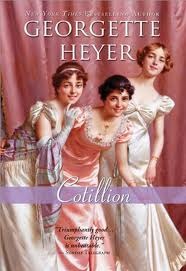
Cotillion

Cotillion. Georgette Heyer. 1953/2007. Sourcebooks. 355 pages. [Source: Review copy]

 First sentence: The saloon, like every other room in Arnside House, was large and lofty, and had been furnished, possibly some twenty years earlier, in what had then been the first style of elegance.

Premise/plot: Kitty, our heroine, will inherit a LOT of money if only she'll marry one of her cousins. Technically they're not blood relatives, she's been raised by her guardian. These "cousins" are his great-nephews. There are four single cousins to choose from...but this situation is far from ideal for everyone concerned. Kitty wants to live life a little and see what there is to see--namely go to London for the first time and mingle with society. She knows that her guardian will never allow such a thing. But if she was engaged...if she was taken under the wing of her fiance's family...then she could get what she wants. What she doesn't account for is her wants changing. She had no inkling that her sham engagement would prove to be real deal. That her ridiculous cousin, Freddy, would be her soul mate....

My thoughts: This is the third time I've read Cotillion. I will admit that it has a slow beginning. The first half of the novel moves so slow and there seems to be little reward for the effort. However, the second half is quick-paced. The characters are enjoyable--at last. The situations are comical. The dialogue turns witty. There is something about it that is very satisfying.

© 2019 Becky Laney of Becky's Book Reviews

Saturday, February 28, 2015

Seuss on Saturday #9

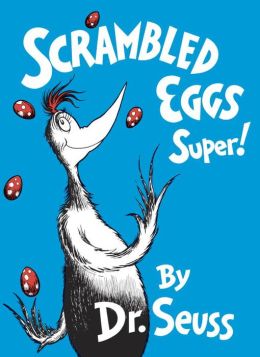
Scrambled Eggs Super! Dr. Seuss. 1953. Random House. 64 pages. [Source: Library]

First sentence:
I don't like to brag and I don't like to boast,
Said Peter T. Hooper, but speaking of toast
And speaking of kitchens and ketchup and cake
And kettles and stoves and the stuff people bake...
Well, I don't like to brag, but I'm telling you, Liz,
That speaking of cooks, I'm the best that there is!
Why, only last Tuesday, when mother was out
I really cooked something worth talking about!
Premise/Plot: Peter T. Hooper is bragging to a girl, presumably his sister? presumably named Liz? that he is the best cook ever, and that he recently made the best scrambled eggs ever. Of course, his scrambled eggs weren't ordinary. His eggs didn't come from ordinary hens. His eggs didn't come from a store. He sought out extraordinary birds--both big and small--and spared no expense or effort. He even recruited helpers to help him collect the most exotic bird eggs. 

My thoughts: Like If I Ran the Zoo, this is all about the rhyme. This is classic Seuss coming up with silly, bizarre yet oh-so-fun words to say.
Then I went for some Ziffs. They're exactly like Zuffs,
But the Ziffs live on cliffs and the Zuffs live on bluffs.
And, seeing how bluffs are exactly like cliffs,
It's mighty hard telling the Zuffs from the Ziffs.
But I know that the egg that I got from the bluffs,
if it wasn't a Ziff's from the cliffs, was a Zuff's.
The book is definitely silly and over-the-top. And Seuss is definitely beginning to develop his style.  Is it my favorite? Far from it.

Have you read Scrambled Eggs Super? Did you like it? love it? hate it? I'd love to know what you think of it!

If you'd like to join me in reading or rereading Dr. Seuss' picture books (chronologically) I'd love to have you join me! The next book I'll be reviewing is Horton Hears A Who!

© 2015 Becky Laney of Becky's Book Reviews

Friday, September 12, 2014

Reread #37 Fahrenheit 451

Fahrenheit 451. Ray Bradbury. 1953/1991. Del Rey. 179 pages. [Source: Bought]

It was a pleasure to burn. 

I've written about Fahrenheit 451 quite a bit. Once in May 2007, which was the first time I read it. Twice in 2010; one was a graphic novel. I've read A Pleasure To Burn: Fahrenheit 451 Stories, a book of short stories and novellas that show the thematic evolution of Fahrenheit 451. I've reviewed the movie. I reread it in June 2012 and September 2013.

Obviously this is a book that I absolutely love.

Fahrenheit 451 is a novel set in a world where thinking is a crime. I exaggerate perhaps. Thinking deeply is dangerous. Thinking for yourself is dangerous. Thinking superficial thoughts that everyone-else-in-society is thinking--like about what to watch, what to listen to, what to buy, where to go to have a good time--that is okay, more than okay. It is to be encouraged. It is individuality and contemplation and reflection that is dangerous. Every minute of every hour of every day is to be packed full of distractions making it impossible to think, to consider, to reflect, to observe, to question, to feel anything truly and deeply. It's a more, more, faster, faster world. And it's a world that our hero, Guy Montag realizes he loathes. He is a fireman. He burns books, houses, and sometimes people. But Guy Montag is living a secret life: he doesn't like burning books; in fact, he wishes he could save them and read them. He does manage to "save" a handful here and there. But taking them home and hiding them, well, there's a risk involved. He's willing to take it because he's so miserable, and he feels that society is so unreal and pointless. He wants answers, not ads. He wants to learn, to know, to feel.

Quotes:
"People don't talk about anything."
"Oh, they must!"
"No, not anything. They name a lot of cars or clothes or swimming pools mostly and say how swell! But they all say the same things and nobody says anything different from anyone else..." (31)
"We need not to be let alone. We need to be really bothered once in a while. How long is it since you were really bothered? About something important, about something real?" (52)
Who knows who might be the target of the well-read man? Me? I won't stomach them for a minute. (58)
Ask yourself, What do we want in this country, above all? People want to be happy, isn't that right right? Haven't you heart it all your life? I want to be happy, people say. Well, aren't they? Don't we keep them moving, don't we give them fun? That's all we live for, isn't it? For pleasure, for titillation? And you must admit our culture provides plenty of these. (59)
Did you listen to him? He knows all the answers. He's right. Happiness is important. Fun is everything. (65)
"We cannot tell the precise moment when friendship is formed. As in filling a vessel drop by drop, there is at last a drop which makes it run over; so in a series of kindnesses there is at last one which makes the heart run over." (71)
Every hour so many damn things in the sky! How in hell did those bombers get up there every single second of our lives! Why doesn't someone want to talk about it! We've started and won two atomic wars since 1990! Is it because we're having so much fun at home we've forgotten the world? Is it because we're so rich and the rest of the world's so poor and we just don't care if they are? Is that why we're hated so much? Do you know why? I don't, that's sure! Maybe the books can get us half out of the cave. God, Millie, don't you see? An hour a day, two hours, with these books, and maybe. (73-4)
It’s been a long time. I’m not a religious man. But it’s been a long time.’ Faber turned the pages, stopping here and there to read. ‘It’s as good as I remember. Lord, how they’ve changed it in our parlors these days. Christ is one of the family now. I often wonder if God recognizes His own son the way we’ve dressed him up, or is it dressed him down? He’s a regular peppermint stick now, all sugar-crystal and saccharine when he isn’t making veiled references to certain commercial products that every worshiper absolutely needs.’ (81)
"You're a hopeless romantic," said Faber. "It would be funny if it were not serious. It's not books you need, it's some of the things that once were in books. The same things could be in the 'parlor families' today. The same infinite detail and awareness could be projected through the radios and televisors, but are not. (82)
 Do you know why books such as this are so important? Because they have quality. And what does the word quality mean? To me it means texture. This book has pores. It has features. This book can go under the microscope. You'd find life under the glass, streaming past in infinite profusion. The more pores, the more truthfully recorded details of life per square inch you can get on a sheet of paper, the more 'literary' you are. That's my definition, anyway. Telling detail. Fresh detail. The good writers touch life often. the mediocre ones run a quick hand over her. The bad ones rape her and leave her for the flies. So now do you see why books are hated and feared? They show the pores in the face of life. The comfortable people want only wax moon faces, poreless, hairless, expressionless. we are living in a time when flowers are trying to live on flowers, instead of growing on good rain and black loam. (83)
"Caesarians or not, children are ruinous; you're out of your mind," said Mrs. Phelps.
"I plunk the children in school nine days out of ten. I put up with them when they come home three days a month; it's not bad at all. You heave them into the 'parlor' and turn the switch. It's like washing clothes: stuff laundry in and slam the lid." Mrs. Bowles tittered. "They'd just as soon kick as kiss me. Thank God, I can kick back!" (96)
© 2014 Becky Laney of Becky's Book Reviews

Saturday, September 14, 2013

Rereading Fahrenheit 451

Fahrenheit 451. Ray Bradbury. 1953/2003. Random House. 190 pages.

It was a pleasure to burn. 

I first read and reviewed Fahrenheit 451 in May 2007. I then read the graphic novel in October 2010. I couldn't resist reading the "real" book at that time as well. I even sought out A Pleasure to Burn, a collection of stories that traces Bradbury's developing themes. That collection included two crucial stories: "The Fireman" and "Long After Midnight." (Also I watched the movie.) The summer of 2012, I read tons of Ray Bradbury, and, of course, I had to reread Fahrenheit 451!

I definitely consider Fahrenheit 451 one of the rare must-reads. It is intense and thought-provoking. The novel, as a whole, is powerful. But it is in conversation (or dialogue) that this one truly shines. Guy Montag's conversations with Clarisse, with Faber, and to some extent even his boss and wife. It's a very reflective novel as well. In its pages, readers get a glimpse of a man at his most vulnerable: a self awakening of sorts as a man wakes up to the nightmare world in which he's been a part of all along.

Favorite quotes:

Who knows who might be the target of the well-read man? Me? I won't stomach them for a minute...Remember, Montag, we're the happiness boys. We stand against the small tide of those who want to make everyone unhappy with conflicting theory and thought. (50-1)  
 We've started and won two atomic wars since 1990! Is it because we're having so much fun at home we've forgotten the world? Is it because we're so rich and the rest of the world's so poor and we just don't care if they are? Is that why we're hated so much? Do you know why? I don't, that's sure! Maybe the books can get us half out of the cave. God, Millie, don't you see? An hour a day, two hours, with these books, and maybe... (62)
Good God, it isn't as simple as just picking up a book you laid down half a century ago. Remember, the firemen are rarely necessary. The public itself stopped reading of its own accord. (78)
 It’s been a long time. I’m not a religious man. But it’s been a long time.’ Faber turned the pages, stopping here and there to read. ‘It’s as good as I remember. Lord, how they’ve changed it in our parlors these days. Christ is one of the family now. I often wonder if God recognizes His own son the way we’ve dressed him up, or is it dressed him down? He’s a regular peppermint stick now, all sugar-crystal and saccharine when he isn’t making veiled references to certain commercial products that every worshiper absolutely needs.’ (81)
Do you know why books such as this are so important? Because they have quality. And what does the word quality mean? To me it means texture. This book has pores. It has features. This book can go under the microscope. You'd find life under the glass, streaming past in infinite profusion. The more pores, the more truthfully recorded details of life per square inch you can get on a sheet of paper, the more 'literary' you are. That's my definition, anyway. Telling detail. Fresh detail. The good writers touch life often. The mediocre ones run a quick hand over her. The bad ones rape her and leave her for the flies. So now do you see why books are hated and feared? They show the pores in the face of life. The comfortable people want only wax moon faces, poreless, hairless, expressionless. We are living in a time when flowers are trying to live on flowers, instead of growing on good rain and black loam. (83)
Though this one is "about" books, in a way, it is not. It is about the ideas, emotions, concepts behind the books. It is about the knowledge and wisdom sometimes contained in books, but never exclusively found in books. It is about choices and lifestyles. The nightmarish culture found in Fahrenheit 451 is a result of people choosing to be shallow, selfish, materialistic, technology-obsessed, and pleasure-seeking. People are "happy." But their "happiness" is fake. It comes at the cost of suppressing emotion and intellect. Free thinking is not encouraged. Thoughts shouldn't have depth and substance! One shouldn't ponder, consider, or reflect! It's about lives packed with noise and busyness--a blur of distractions--all designed to keep you from realizing there is something more, something that has been lost.

© 2013 Becky Laney of Becky's Book Reviews

Tuesday, August 06, 2013

Cotillion (1953)

Cotillion. Georgette Heyer. 1953/2007. Sourcebooks. 362 pages. [Source: Review Copy]

Cotillion was one of the first Georgette Heyer novels I ever read. I appreciated it even more as a reread. When I (first) read Cotillion, I didn't know Heyer yet; I didn't LOVE Heyer yet. I didn't know her style, her wit, her techniques. Now I do. And it made quite the difference. In my first review, I complained about the slow start. Now, I see Cotillion as being a joy from the very start! I now love it cover to cover!!!

I love how Cotillion begins: with some confusion and a bit of a fuss. A room full of men talking about their eccentric great-uncle, about his money and his will, about his ward, Miss Kitty Charing. Almost all the men in the room feel they know the reason they were invited to visit. Great-Uncle Matthew wants one of his great-nephews to propose to Miss Kitty. The happy couple will receive an inheritance. Otherwise, he will leave his money to charity. Not all the men are eligible. At least one is married already. Not all the men are willing. Three potential suitors are noticeably missing from the party. One of the three is a soldier, he never is part of the story. The other two, however, are key players! Freddy Standen and Jack Westruther. Several proposals are given that weekend...

Freddy Standen is late in arriving. In fact, Miss Kitty encounters him only because she is running away from home. (The whole situation is so embarrassing for her!) He was clueless about the weekend, about the reason for the family get together. Miss Kitty has an aha moment. She does something surprising: she proposes to him. She convinces him that a FAKE betrothal would be just the thing. She could go with him to London, to stay with his family; she could see the sights, she could go shopping, she could go to parties, she could have a life. The betrothal would only last a month or so at most. Just enough for her to have a great time away from home. Perhaps just long enough to make a certain other 'cousin' jealous. He says yes. It's a reluctant yes; Freddy isn't as clever at scheming as Miss Kitty. (And this is Miss Kitty's very first scheme! But it won't be her last...)

Cotillion was enjoyable from start to finish!!! The ending is oh-so-satisfying!!! I enjoyed Miss Kitty and I adored Freddy! I would definitely recommend this one.


© 2013 Becky Laney of Becky's Book Reviews

Saturday, June 16, 2012

Fahrenheit 451

Fahrenheit 451. Ray Bradbury. 1953/2003. Random House. 190 pages.

It was a pleasure to burn. 

Fahrenheit 451 is so wonderful, so beautiful, so amazing that it almost leaves me speechless. It is a haunting story of a bleak future. Our hero, Guy Montag, is in a loveless marriage with his wife, Mildred. He meets a young, vibrant girl, Clarisse, and they talk--talk of nothing and everything. She dares to think, to ask questions, to be curious, to be full of wonder and life, to have a spark of something that has almost been lost in society and civilization. But, her tragic end helps focus Montag's perspective. It has been coming for a while now, perhaps ever since meeting that old man, Faber, in the park, but Montag knows that he can no longer live the lie. He no longer wants to burn books, to burn houses of people who love books. He no longer wants to be a fireman. He wants to read books; he wants to learn; he wants to know what it is like to LIVE again, to think, to think critically, to think about things even if it means being sad or sorrowful or anxious and worried. He doesn't want to be mindlessly entertained by "the family" on three of his walls or a seashell in his ears. Even if there is a scary war coming. He wants to stand against the majority and face reality.

I think this is a book everyone needs to read...at least once. I could easily read it once a year! It's just a wonderful novel!!!

Favorite quotes:
Who knows who might be the target of the well-read man? Me? I won't stomach them for a minute...Remember, Montag, we're the happiness boys. We stand against the small tide of those who want to make everyone unhappy with conflicting theory and thought. (50-1)  
 We've started and won two atomic wars since 1990! Is it because we're having so much fun at home we've forgotten the world? Is it because we're so rich and the rest of the world's so poor and we just don't care if they are? Is that why we're hated so much? Do you know why? I don't, that's sure! Maybe the books can get us half out of the cave. God, Millie, don't you see? An hour a day, two hours, with these books, and maybe... (62)
Good God, it isn't as simple as just picking up a book you laid down half a century ago. Remember, the firemen are rarely necessary. The public itself stopped reading of its own accord. (78)
 It’s been a long time. I’m not a religious man. But it’s been a long time.’ Faber turned the pages, stopping here and there to read. ‘It’s as good as I remember. Lord, how they’ve changed it in our parlors these days. Christ is one of the family now. I often wonder if God recognizes His own son the way we’ve dressed him up, or is it dressed him down? He’s a regular peppermint stick now, all sugar-crystal and saccharine when he isn’t making veiled references to certain commercial products that every worshiper absolutely needs.’ (81)
Do you know why books such as this are so important? Because they have quality. And what does the word quality mean? To me it means texture. This book has pores. It has features. This book can go under the microscope. You'd find life under the glass, streaming past in infinite profusion. The more pores, the more truthfully recorded details of life per square inch you can get on a sheet of paper, the more 'literary' you are. That's my definition, anyway. Telling detail. Fresh detail. The good writers touch life often. the mediocre ones run a quick hand over her. The bad ones rape her and leave her for the flies. So now do you see why books are hated and feared? They show the pores in the face of life. The comfortable people want only wax moon faces, poreless, hairless, expressionless. we are living in a time when flowers are trying to live on flowers, instead of growing on good rain and black loam. (83)
There is a richness in Fahrenheit 451, a depth that most books don't have perhaps. There's just something about it that makes it timeless and memorable and thought-provoking.

Read Fahrenheit 451
  • If you like to read books
  • If you find intellectual freedom important
  • If you enjoy science fiction, particularly vintage science fiction
  • If you are looking for a timeless classic
  • If you enjoy dystopias 

© 2012 Becky Laney of Becky's Book Reviews

Monday, February 06, 2012

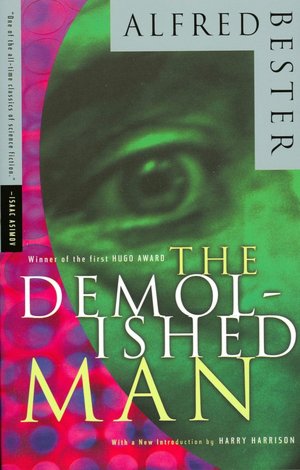
The Demolished Man

The Demolished Man. Alfred Bester. 1951. Random House. 245 pages.

Explosion! Concussion! The vault doors burst open. And deep inside, the money is racked ready for pillage, rapine, loot. Who's that? Who's inside the vault? Oh God! The Man With No Face! Looking. Looming. Silent. Horrible. Run....Run...

The Demolished Man is the winner of the first Hugo Award. I am not sure it's an absolute must-read. But. If you're a fan of science fiction, I think you should definitely consider reading this one! Depending on your expectations, of course, you might just find yourself surprised at how clever and literary well written it is.

The mystery elements of The Demolished Man made it a great read for me. The novel stars two characters. One, Ben Reich, who is determined to murder his business rival, Craye D'Courtney. With (future) society being what it is, murder is unheard of because telepaths (espers) always, always are able to read the minds of the would-be murderers and stop them before the crime is committed. But Reich plans to bribe a few high(er) level telepaths to help him cover his tracks, AND he plans on using a catchy song to distract other mind-readers in the area, to keep them from peeping his intentions.

Eight, sir; seven, sir;
Six, sir; five, sir;
Four, sir; three, sir;
two, sir; one!
'Tenser' said the Tensor.
'Tenser,' said the Tensor.
'Tension, apprehension,
And dissension have begun.' 

The second main character is Lincoln Powell, the detective on the case. (The murder is successful.) Both characters narrate this one. So readers get the view points of both the detective and the criminal. I wasn't sure how I felt about this--at first. But I think it works well, for the most part!

Have you read this one? What did you think? What did you think of the ending? Of what happens to criminals... And what did you think of the "romance"?!

This one surprised me. It did. I really liked it so much more than I thought I would. In fact, I think I may even love it. I couldn't help thinking of this Alfred Bester when I read it.

Read The Demolished Man
  • If you're a fan of classic science fiction
  • If you want to read the FIRST Hugo Winner
  • If you're interested in reading science fiction with a focus on telepaths
  • If you're a fan of mysteries and detective fiction

© 2012 Becky Laney of Becky's Book Reviews
Thursday, September 15, 2011

A Pocket Full of Rye

A Pocket Full of Rye. Agatha Christie. 1953. 256 pages.

I really enjoyed this Miss Marple mystery. I'm not sure what more I can add to that. I mean, it's a mystery. A mystery with multiple victims. A mystery that kept me guessing until the very end--or close to it.

I always enjoy Miss Marple, she's such a delightful character. And I enjoyed this Miss Marple mystery very much. I wouldn't say it is my favorite and best Marple--but it's certainly worth a read or reread!!!

The first victim, Rex Fortescue, is a business man who dies in his office after drinking his tea. They're almost positive he was murdered--poisoned. But they're also positive the poison was not in the tea. Someone in his family--someone close to him--murdered him. But can they figure out just who the murderer is?

One puzzling clue--you may have guessed it--is a pocket full of rye in his pocket. But that's just one of many puzzling clues that abound in this novel!

I definitely liked this one!

© 2011 Becky Laney of Becky's Book Reviews
Thursday, June 02, 2011

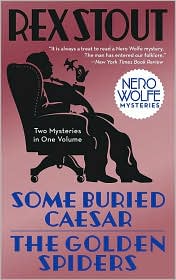
The Golden Spiders

The Golden Spiders. Rex Stout. 1953. Random House. 206 pages.

When the doorbell rings while Nero Wolfe and I are at dinner, in the old brownstone house on West Thirty-fifth Street, ordinarily it is left to Fritz to answer it. But that evening I went myself, knowing that Fritz was in no mood to handle a caller, no matter who it was.

I loved The Golden Spiders very much! Is it because I am absolutely loving Nero Wolfe and Archie Goodwin? Is it because I have found Rex Stout's books to be so charming, so satisfying? Perhaps! Since I seem to be loving each new book I read a little bit more than those I've read before. (Though I'm not sure I could *really* choose between Some Buried Caesar and The Golden Spiders.) I love the characters. I love the writing--the style of it. I love the mystery too. I love how Goodwin and Wolfe *solve* their cases.

In this mystery, Archie Goodwin interrupts Nero Wolfe's dinner to tell him that there is a child at the door--Pete Drossos. This Pete has a case to present to Wolfe. He has witnessed something--a possible crime--and he wants Wolfe to team up with him. While he was washing the windows of stopped cars in traffic--he saw (not heard) a woman ask him to get the police. She had a scratch on her face. And her earrings were quite unique--golden spiders. There was a man with her in the car--and the boy believed (though he didn't see with his own eyes) the man had a gun and was threatening the woman. Being distrustful of cops, the boy sought this famous man's help. Wolfe is interested--mainly because he knows that his interest will annoy Archie--and offers his advice on how to be a good private investigator. He also promises to call the police and let them know about the alleged crime leaving the boy's name out of it. A few days later, well, Goodwin and Wolfe learn that this boy has been the victim of another crime--a murder. The boy's mother insists on fulfilling her son's last request--to give all his money--four dollars and some change--to Wolfe. Wolfe then feels obligated to do something for the boy. True, that amount of money isn't his usual rate for clients, but this is a special case. Archie then suggests they place an ad in the paper looking for the woman with golden spider earrings...

This mystery is compelling! I enjoyed it very much. I would definitely recommend this one.

Nero Wolfe to Fritz on the matter of his starlings:

When the platter was brought in steaming, and placed before him, he sniffed, ducked his head and sniffed again, and straightened to look up at Fritz.
"The sage?"
"No, sir."
"What do you mean, no, sir?"
"I thought you might like it once in a style I have suggested, with saffron and tarragon. Much fresh tarragon, with just a touch of saffron, which is the way--"
"Remove it!"
Fritz went rigid and his lips tightened.
"You did not consult me," Wolfe said coldly. "To find that without warning one of my favorite dishes has been radically altered is an unpleasant shock. It may possibly be edible, but I am in no humor to risk it. Please dispose of it and bring me four coddled eggs and a piece of toast." (2)

Archie on Nero Wolfe:

As I went across to the office, to my desk, and dialed the number of Manhattan Homicide West, I was reflecting that of all Wolfe's thousand techniques for making himself obnoxious the worst was when he thought he was being funny. (9)

© 2011 Becky Laney of Becky's Book Reviews

Monday, April 11, 2011

Elizabeth and the Prince of Spain

Elizabeth and the Prince of Spain. Margaret Irwin. 1953/2011. Sourcebooks. 336 pages.

'My father has fought bulls singlehanded in the arena,' said the boy. 'He is brave as a lion. He has never been defeated. He is the Conqueror of the World. How could he be conquered--by a pirate fleet of heathen Moors?'

Elizabeth and the Prince of Spain follows Young Bess and Elizabeth, Captive Princess in Margaret Irwin's historical trilogy. Overall, I enjoyed this trilogy. I enjoyed watching Elizabeth grow up. While the politics could--at times--be confusing, it was rarely--if ever--boring. At the heart of this trilogy, of course, is Elizabeth, the second daughter of Henry VIII. And Elizabeth's heart is ambitious and patient. Does Elizabeth want the throne? YES! Does she know that she has to be careful, calm, reserved, and patient in order to see that dream come true? Yes.

Elizabeth and the Prince of Spain was probably my favorite of the trilogy. I enjoyed the story from Philip's point of view and Elizabeth's point of view. I was actually surprised by how much I enjoyed Philip's side of the story. (After all, I knew that England was soon to do battle with Spain!) I would recommend this one to those that enjoy historical fiction, to those that enjoy reading about ambitious politicians.

© 2011 Becky Laney of Becky's Book Reviews

Wednesday, November 17, 2010

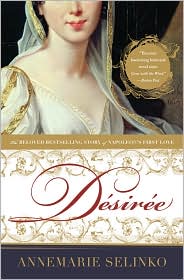
Desiree

Desiree: The Bestselling Story of Napoleon's First Love. Annemarie Selinko. 1953/2010. Sourcebooks. 608 pages.

A woman can usually get what she wants from a man if she has a well-developed figure. So I've decided to stuff four handkerchiefs into the front of my dress tomorrow; then I shall look really grown up. Actually I am grown up already, but nobody else knows that, and I don't altogether look it.

For the right reader, Desiree may satisfy. But at over six hundred pages, it didn't quite work for me. I found it to be a bit uneven. There were places where it held my interest, but, unfortunately, there were more places where it didn't.

It follows the life of a young girl, Eugenie Desiree Clary, who happened to be the "first love" of Napoleon Bonaparte. Their engagement was broken--not her choice, by the way--when he married Josephine. Awkwardly enough--at least at times--the two remained connected through the years for her sister, Julie, had married his brother, Joseph. 

She may not have married her first love. But. She did marry--and marry well. Jean Baptiste Jules Bernadotte. Though at the start no one knew how well. For her husband was adopted by the Swedish monarchy. He was chosen to be the heir to the throne. Years after the two marry, they become royalty. His royal name? Charles XIV John.

I found Desiree to be tedious in many places. As it follows the rise and fall of Napoleon. As it follows her marriage--many of which she was separated from her husband either by choice or necessity--through the decades. There were places where it worked. Places where it seemed personal, genuine. But, for the most part, I felt disconnected from Desiree as a narrator. The novel is "her diary." That is how it is presented at any rate. But. After her first disappointment with love, after her marriage, the "diary" becomes more a brief and uneven record of political and social struggles she faced as her husband fell in and out of favor with Napoleon.

Desiree was not a romance--at least not a traditional romance. Yes, the first part of the novel sees a young woman in love with love, in love with an ambitious nobody with a strange name. But the rest of the novel? Not a romance. Instead, it's a detailed account of turbulent years in France. I did not find that account particularly compelling. But maybe I'm not the right reader for this one!

© Becky Laney of Becky's Book Reviews

Tuesday, October 06, 2009

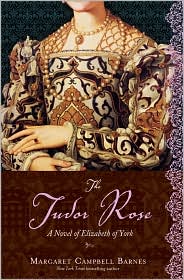
The Tudor Rose: A Novel of Elizabeth of York


Barnes, Margaret Campbell. 1953/2009. The Tudor Rose: A Novel of Elizabeth of York. Sourcebooks. 336 pages.

A long-drawn sigh of feminine ecstasy filled the room as the white velvet was lifted from its wrappings.

This is my third Margaret Campbell Barnes, and I absolutely loved it. Okay, maybe absolutely is putting it a little too strongly. After all, I'm not saying this is the most wonderful, amazing book ever written. What is it about? Elizabeth of York? Who is she? She's the daughter of Edward the IV. The sister of the two (supposedly) murdered princes. The niece of Richard III. The wife of Henry VII. The mother of Henry VIII. (You can read my thoughts on Shakespeare's Richard III.) This one novel spans many decades. We first see Elizabeth as a young woman, a girl preparing for a wedding, the "feminine sighs of ecstasy" are nothing improper, rather her reaction to trying on her wedding gown. (The engagement falls through, however.) We see her taking delight in being a daughter, a sister. We see a brief glimpse of the before. Before what? Well, before everything fell apart and then some. Before her father dies. Before her younger brother becomes the king. Before her brothers lives are at risk from someone very close at hand.

This story could not be told without focusing in on the politics. What things people will do (and say) for a chance at absolute power and control. The novel reveals a personal story. How these power plays, these political manipulations can control one's life. Because of who she is--whose daughter she is--many things are out of her control. It's not a matter of who she loves, who she desires, what she wants, what she needs, what kind of life she'd like to have. Reading this one made me see the human side of history.

The book was compelling. In fact, I had a hard time putting it down. I didn't expect that. I didn't expect a must-read feeling. I didn't expect to find such an instant connection with these characters. I didn't expect such a strong reaction. I find it interesting that even though I knew what would happen, it was so suspenseful, that I had to keep reading. I didn't find it boring...at all. So I would definitely recommend this one to fans of historical fiction. If you haven't discovered Margaret Campbell Barnes, you should really give her a try.

© Becky Laney of Becky's Book Reviews