Showing posts with label mental disorders. Show all posts

Thursday, February 09, 2023

30. Iveliz Explains It All


Iveliz Explains It All. Andrea Beatriz Arango. 2022 [September] 272 pages. [Source: Library]

First sentence: Why is it that principals
love giving second chances?
Love reminding me they were kids too?
Love acting like they're doing me a favor,
doing my mom a favor,
by sitting me down all serious
and asking what they can do?
Well, guess what.
This is seventh grade now,
And I don't need anyone's help but my own.
I've moved on from everything
that happened,
I've made lists and I've made goals,
and if I"m in the principal's office,
you can 100% bet
that it wasn't my fault.

Premise/plot: Iveliz Explains It All is a verse novel that is a Newbery Honor book. Iveliz is writing poems in her diary/journal. (As well as writing lists of goals in her diary). This coming of age novel unfolds a bit like a mystery. Readers aren't quite sure why Iveliz is always [or nearly always] getting in trouble at school, why she always has in-school suspension or actual suspension, why she struggles to keep friends or to make friends in the first place. Readers may not have the answers to these questions by the end of the novel, but, perhaps they will have walked in her shoes and gotten the chance to understand/empathize. 

This verse novel is a "problem" novel. Iveliz, our heroine, is struggling with life in many ways. At home, she struggles to get along with her mother and her grandmother. Her issues with her mother are complex, for sure. Her issues with her grandmother are simpler. She has dementia and stays a bit out of touch with reality. But when she is "with it" if you will, she strongly disagrees with the decision that Iveliz is taking medication for her mental health. At school, she struggles with getting along with anyone/everyone. Even her friend(s) have a hard time dealing with her impulsive [sometimes violent] reactions. 

My thoughts: I'm debating my thoughts and reactions. On the one hand, part of me is curious. What is her diagnosis? What exactly is going on with Iveliz? How strongly is it connected with the trauma that is revealed so incredibly slowly? On the other hand, is it really any of our business? Do we really have to know the specifics in order to be kind and compassionate and empathetic? We are not "owed" an explanation. 

Is this one that will appeal to children? actual children? I'm curious--super curious. So often the books that do win Newbery awards or recognized as honor books don't necessarily appeal to actual children. [They appeal to adults--to teachers, to librarians, to parents.] They often feel "Significant" or "Important." I do think that at the very, very least this one would be a good fit for adults who work with children--teachers, librarians, principals, etc. I think it is a thought-provoking read in that regard. No person can know everything going on in the private, personal lives of their students. This gives a good, long pause. A reminder that so much can be going on underneath the surface. 

Just because I feel adults might be a better fit doesn't mean that I think this one is inappropriate or out of place for younger readers. It's just a slightly heavy novel.


© 2023 Becky Laney of Becky's Book Reviews

Monday, November 07, 2022

144. The Girl in the Castle


The Girl in the Castle. James Patterson and Emily Raymond. 2022. [September] 368 pages. [Source: Library]

First sentence: It starts with a girl, half naked and screaming. Even though it's midtown Manhattan, in January, the girl is wearing only a thin white T-shirt over a black lace bra. She slaps at the air like she's fighting an enemy only she can see.

Premise/plot: Hannah Doe [Hannah Dory] is desperate for "you" to believe her. [By you, I mean both fictional characters in the book and, you, the reader.] Her story seems absolutely impossible. She lives in two times--2023 and 1347. So she says. In the 2023 setting, she's a patient in a Psych ward [Belman Pscyh]. It is not her first time. Almost always she's brought in by the police. In the 1347 setting, she's a peasant who would do just about anything to keep her family [what remains of it] from starving. Her village is divided into haves and have-nots, and, well, the baron has everything, and almost everyone else has nothing. Her plan has her rebelling against the powers that be--the baron--and stealing food. When she's caught--along with the other peasants she's convinced to join her in the revolt, well, things don't quite go according to plan. But even though she's gained a little in this process--at what cost. 

Jordan, a psych student [from a local college] is observing/assisting at Belman. He takes a VERY close interest in Hannah's case. [In my personal opinion, he crosses the line time and time again. He doesn't seem professional. Then again, he's just a student. But still. Like who's supervising him??? And can't they tell he seems to be falling in love with one of the patients????]

My thoughts: I read through most of this one in one day. However, I reached a point where I was running out of pages--chapters--and I knew that there was absolutely no way this one could resolve even remotely decently or satisfactorily. And by that I don't mean I had a preconceived notion of how the ending should play out. I didn't. I mean it was like the author(s) were rambling along and realized--OH NO, WE ONLY HAVE TWELVE PAGES LEFT TO RESOLVE THE STORY WHAT SHOULD WE DO. And then they just kept rambling on hoping that somehow, someway it would work itself out. But I feel like there was no plan. I think a crisis point was reached and then they brainstormed, HEY, WE'LL JUST USE THE LAST FEW PAGES TO FLASH AHEAD FIVE YEARS. Jordan and Hannah will see each other across the room and let's fade to black. That will be awesome, won't it??? NOPE. Not awesome.

I didn't love this one. Don't expect this one to be sci-fi or fantasy at all. This is 100% just a novel of someone having a mental breakdown and losing her complete grasp on reality. The narrator is unreliable from start to finish. [Which is one reason why the flash ahead several years ending just fell flat to me.] The language is definitely crude. I don't fault it for that. Just some readers like to be warned so they can make the best decision for themselves. 

I do think readers need to know in advance that it is very RAW and full of suicidal talk, suicide attempts, actual suicides, etc. It is a DARK and GRIM book. Again, some readers may seek this out and find it a good read. Others really do need a trigger warning because of the sensitive nature of this one.


© 2022 Becky Laney of Becky's Book Reviews

Friday, February 05, 2021

15. Worst-Case Collin


Worst-Case Collin. Rebecca Caprara. 2021. [September] 256 pages. [Source: Review copy]

First sentence: I used to dream about normal stuff like making the swim team, acing my social studies quiz, getting revenge on Liam for pranking me all the time. These days my main goal is to prevent disaster from striking again. Or, at the very least, to be better prepared. Which is harder than it sounds when you're in middle school and calamities of various sorts occur daily.

Premise/plot: Collin, our twelve-year-old protagonist, is a worrier carrying the weight of the world on his shoulders. It wasn't always like this. There was a Before. But he's been living in the After for almost two years now. Life without his mom is barely life. Collin has some great friends--Liam and Georgia--who are clueless about the secrets he's been keeping from them. There's a good reason he hasn't invited them inside his house--ever, ever, ever. But keeping secrets and hiding out can only take you so far...

Worst-Case Collin is a coming of age novel--with a school setting, with a strong theme of friendship--written in verse. It's also what you might call a problem novel. (That is one reason why I am reviewing it here at Becky's Book Reviews instead of Young Readers.)

My thoughts: I have many thoughts. On the one hand, WHAT A STORY. I loved meeting Collin and his friends, Liam and Georgia. I thought his two friends continually offered a ray of hope and happiness. Collin and the reader needed that hope. (I also thought Liam's mom was superb!!! It was so nice to see a good parenting role model.) On the other hand, IT IS HEAVY AND INTENSE. I think it is good heavy and good intense. But also potentially triggering--depending on the reader's home environment. 

Collin is juggling many, many, many emotions: sadness, worry, fear, frustration, anger, regret, bitterness, anxiety, hopelessness, grief, and SHAME. Collin only has a tiny amount of places where he feels safe. On the one hand, he wants to tell someone--anyone--what is going on at home and how things are different since his mom died. On the other hand, he fears what might happen if anyone ever learns the truth. He struggles daily with this dilemma. Can I go on living like this? Will it ever get better? 

Quotes:

Gravity might always win,
but I've got a choice:
fall
or
dive.
I choose to dive.
She bends her knees.
Preferably with style!
She leaps, twists, splashes.

Georgia says
there is space inside
the human heart
for infinite love
and infinite sadness
and all the messiness
in between.


© 2021 Becky Laney of Becky's Book Reviews
Tuesday, June 21, 2011

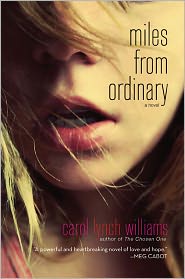
Miles from Ordinary (YA)

Miles from Ordinary. Carol Lynch Williams. 2011. St. Martin's Press. 208 pages.

There are mice.

Lacey, our heroine, is holding on to hope. Hope that everything is going to be okay. Hope that her mom will be able to handle her new job at the grocery store. Hope that she'll get to volunteer at the local library as she's planned. But with Lacey's mom, it's hard to be certain about anything. So much depends on what her Granddaddy tells her momma.

The novel opens with a bad dream, but one could argue that Lacey's bad dream is nothing compared to her real life, the daily trauma of living with a mother who is mentally ill. It's a painful life, a lonely life, having that much responsibility, feeling the weight of the whole world on her shoulders.

In the quietest of moments, Lacey dreams of simple things: having a friend to talk and laugh with, having some time to herself--time for herself, I should say. No one is taking care of Lacey. No one is helping her, supporting her.

Miles from Ordinary is the story of one day--just one day--in the life of a troubled family. On this one day, her mom will start her new job, she'll start her new volunteer job for the summer at the library, she'll talk to the cutest guy in the neighborhood, Aaron, and maybe just maybe make a real friend. Of course, that is just the part of the day that goes well...

Miles from Ordinary is a compelling read, dark yet powerful. It's well written, and oh the characters! Especially Lacey and Aaron.

Carol Lynch Williams is also the author of The Chosen One and Glimpse.

© 2011 Becky Laney of Becky's Book Reviews
Saturday, April 10, 2010

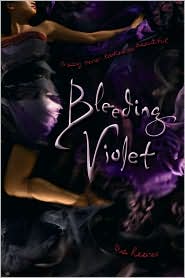
Bleeding Violet (YA)


Bleeding Violet. Dia Reeves. 2010. January 2010. Simon & Schuster. 454 pages.

The truck driver let me off on Lamartine, on the odd side of the street. I felt odd too, standing in the town where my mother lived. For the first seven years of my life, we hadn't even lived on the same continent, and now she waited only a few houses away.

Fleeing her Dallas home (where she lived with her aunt), Hanna didn't know what to expect from her middle-of-the-night confrontation with Rosalee, the mother who'd abandoned her. Will her mother let her stay? Would her aunt even take her back? (To say she left on bad terms is an understatement!)

Rosalee reluctantly agrees that she can stay. For two weeks. And two weeks only. Unless Hanna can prove that she belongs in this anything-but-sleepy small town. Hanna thinks it will be easy. It might take a little effort on her part to make friends, but surely there's someone worth being friends with. Like Wyatt.

What she doesn't expect is that those two weeks will be filled with danger. Sure danger can be exciting, thrilling, intoxicating. But it can also be deadly. Is Hanna willing to risk it all for a chance at a future with her mom?

Hanna's mental health is questionable, but there were certain things Hanna did that I couldn't excuse away.

For those looking for a good paranormal read, I think this one could work well. While, Hanna isn't perfect--far from it--she has a bit more gumption than other heroines I could mention. (Cough, cough, Bella). But this one probably won't be for everyone. I think the casual sex and violence might be a bit too much for some readers.

This one actually reminded me a bit of the Midnighters series by Scott Westerfeld.

Other reviews: Kids Lit, TheHappyNappyBookseller, Pure Imagination, Frenetic Reader,

© Becky Laney of Becky's Book Reviews
Friday, November 13, 2009

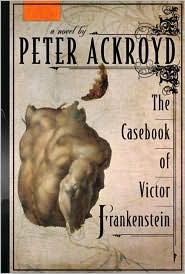
The Casebook of Victor Frankenstein


Ackroyd, Peter. 2008. The Casebook of Victor Frankenstein. Doubleday. 353 pages.

I was born in the alpine region of Switzerland, my father owning much territory between Geneva and the village of Chamonix where my family resided.

This book is a reimagining of Mary Shelley's Frankenstein. Our narrator is Victor Frankenstein. It weaves small doses of fact into the fiction by having Victor become friends with Percy Bysshe Shelley, Mary Shelley, Lord Byron, and John William Polidori. Sounds interesting, right? Like it might have some potential.


This might be a good time to talk about expectations. I had high hopes for this one. I *really* wanted to like it. I wanted to connect with this one right from the start. I wanted it to be really smart and clever and fun. I wanted it to be engaging. Perhaps if I'd had lower expectations, I wouldn't have been so let down.

I can't say if it's fortunate or unfortunate, but the jacket flap is really something else. Containing phrases like: "tour de force" "world's most accomplished" "incomparable" "brilliantly reimagines" "penned in period-perfect voice" and "sure to become a classic of the twenty-first century." (I've long thought that the phrase "sure to become a classic" should be banned from all jacket flaps and blurbs.)

Did I like this one? Not really. Why didn't I like this one? Well, it disrespected Mary Shelley's original. I could live with it playing around with the original novel. (Elizabeth being his sister and not his love interest. There being different murder victims than in the original book.) I could even come to like the directions and twists this one took. The character development of this Victor Frankenstein. The big twist did make me think. It is still making me think. (I'm still trying to puzzle out if it really truly works as a whole. Knowing the ending, does all that come before still work. Or does it all fall apart?) So the fact that this one wasn't faithful to Mary Shelley's Frankenstein didn't bother me all that much. But it disrespected history itself. By having Victor Frankenstein interact with real people--with Percy and Mary Shelley, with Lord Byron, with others of the time period you add in a whole other level.

Yes, this book is fiction. It never claims otherwise. But what few facts find their way into the book get so compressed and distorted and out of order that it was just weird. At least weird to me. It is fiction. The author can do anything he wants. It's his choice, his right. Will this bother most readers? I don't know. Probably not. And I suppose that's the good news.

Plus, this one got disgusting. Unlike the original which tended to leave things to your imagination, this one got too detailed and disturbing. (I could choose a scene or two to describe, but I don't really want to go there. I'm not comfortable going there.)

Is it readable? Is it compelling? I read it in two days. Half the time I was hating it, but I still kept reading. This isn't a book I wanted to give up on in the middle, you know, just in case it got good and redeemed itself by an oh-so-amazing ending. How easy is it to read? Well, I'd say it was about as challenging as the original novel. Ackroyd did fairly good at imitating Victor Frankenstein's complex style. Is this one for you? Maybe. Maybe not.

© Becky Laney of Becky's Book Reviews

Tuesday, May 05, 2009

The Opposite of Music


Young, Janet Ruth. 2007. The Opposite of Music. Simon & Schuster. 346 pages.

Resting one hand on the corner mailbox, I balance different ways on my bike.

Depression. Clinical depression. Billy's father has it. And it's life-changing for Billy. This novel addresses what it is like for a family--mom, dad, two kids, etc--to deal with a mental illness or disorder. Billy Morrison is our narrator. And we see up, close, and personal how terrifying it can be to see someone you love change so drastically before your eyes. This family is falling apart and there is no quick fix.

The approach in this one is a little different. At least a little different in my opinion. It is an issue-driven book at heart--there's no denying it. But if you find the subject interesting, then there's no problem. At several places within the novel, the author quotes paragraphs (up to the point of entire articles) on depression and suicide and the various treatment options including shock therapy (electroconvulsive therapy). The book approaches it from various angles. The pros and cons of various treatments and therapies including more alternate forms. (Aroma therapy, fish oil and other brain foods, yoga, etc.)

I think the book is authentic in many ways. There are no quick fixes. It's hard to get any benefits without taking risks. What works for one person might not work for another. There's a certain balance and experimentation to it. Drugs aren't necessarily the answer. But it's a big problem that you do need to seek help with treating. Doctors aren't perfect--not at all--but you do need to seek medical advice. Do-it-yourself home remedies can be dangerous. Don't believe everything your library book tells you. Contradictions are a part of life. For every study saying "this is the answer" you'll find one to counter it with "this doesn't work and is dangerous." Life itself is unpredictable.


© Becky Laney of Becky's Book Reviews
If you're reading this post on another site, or another feed, the content has been stolen.

Tuesday, September 16, 2008

Identical


Hopkins, Ellen. 2008. Identical.

If you're familiar with Ellen Hopkins' other novels (verse novels)--Crank, Burned, Impulse, and Glass--then you know what to expect from her newest novel, Identical. For those that aren't familiar, you may find yourself in a state of shock at the issues Hopkins' touches on in her novel: alcohol, drugs, cutting, eating disorders, suicidal thoughts (and attempts), and sex. And of course some may squirm at the language.

No doubt about it, her novels won't suit everyone's tastes. Yet her novels do have fans. And there's a reason--her novels are powerful, very very potent. Raw. Emotional. Very gritty. Very in-your-face. There's always a depth and complexity to the characters that make them compelling. (Even if you don't happen to *like* the characters. You can't deny that they're humanly drawn.)

Identical is a shocking book in many ways. It deals with secrets, lies, brokenness, betrayal. It has more than angst, it has burning and haunting pain on almost every single page. It focuses on a dysfunctional, abusive family with much to hide--the Gardellas. A father who's a district court judge. A mother who's running for Congress. Our narrators are two teen girls Kaeleigh and Raeanne. These two angry-and-bitter narrators share a common enemy: their father and mother.

I hesitate to say much more because really in this instance, the less you know going in...the better the book will read.


© Becky Laney of Becky's Book Reviews

Wednesday, April 16, 2008

Travel the World: Australia: Dreamrider


Jonsberg, Barry. 2008. Dreamrider.

I killed two kids at school today.

Michael Terny is our narrator. He's fat. He doesn't fit in. The other kids are cruel, cruel, cruel. But Michael has a secret. Something only he knows. He has a way of 'getting back' at those that are so mean to him. A secret gift. A secret weapon. He can change reality in his dreams. What he dreams, comes true. Or so he thinks. He's what you might call a lucid dreamer. Someone who has control over what happens in their dreams. He can "heal" or "destroy" as he sees fit.

Sounds too good to be true, doesn't it? A bit too much wishful thinking? Well, you'll just have to see how fantasy and reality blend together in this new book.

It is difficult, in my opinion, to review a book such as this one. I'm afraid that if I say too much, it will "ruin" the book for others. But I'm afraid that if I say too little that I won't be doing the book much justice at all.

S
e
m
i

S
P
O
I
L
E
R

It's a book that isn't quite what it seems. Would pair well with Invisible by Pete Hautman.

© Becky Laney of Becky's Book Reviews

Tuesday, November 06, 2007

Total Constant Order

Chappell, Crissa-Jean. 2007. Total Constant Order.

Frances Isabelle Nash (Fin) is a teen under pressure. Within the past year, she's moved from Vermont to Florida, her parents have divorced, and she's feeling overwhelmed with urges to count and draw. These 'strange' compulsions to flick light switches, to draw objects with a certain number of points, or draw things a certain number of times, have been increasing over the past few months. Fin is also finding it more and more difficult to sleep.

Under much duress, Fin starts seeing a therapist who prescribes Paxil. But Fin discovers that prescription medications can sometimes have side effects that just aren't worth it. Around the time that she's trying to come to terms with having obsessive-compulsive disorder (OCD), she meets a boy who changes how she views everything: Thayer.

To read the rest of the review where I discuss how much Thayer impacts her life....visit The Edge of the Forest October/November edition. If you're reading this posting later...after the fact...then look for it in the Edge of the Forest archives.

Tuesday, June 05, 2007

The White Darkness


McCaughrean, Geraldine. 2007. The White Darkness. (First U.S. edition, 2007; originally published in 2005).

What can I say about The White Darkness? Really? It was strange. Odd. One-of-a-kind. There were moments when I was really loving the oddness of it. After all, how many writers begin off their novel like this:

I have been in love with Titus Oates for quite a while now--which is ridiculous, since he's been dead for ninety years. But look at it this way. In ninety years I'll be dead, too, and then the age difference won't matter. Besides he isn't dead inside my head. We talk about all kinds of things. From whether hair color can change spontaneously to whether friends are better than family, and the best age for marrying: 14 or 125. Generally speaking, he knows more than I do, but on that particular subject we are even. He wasn't married--at least he wasn't when he died, which must have substantially cut down his chances. (1)

Who is Titus Oates? Why has he--though dead--captured this young teen's heart? He was an Antarctic explorer in Robert Scott's expedition in 1911/12. Her uncle fueled her interest in the Antarctic through books and dvds. Now, she is mesmerized and a tad obsessed. It must run in the family.

Her family. Also odd. There is her father who died after months of strange behavior. There is her "uncle" Victor who while no blood relation, takes the family under his protection. And there is the mother. The mother who is almost always silent. The author has almost chosen to give her no voice in this novel. And then there is our narrator, Symone. She is odd. She is to some extent deaf. She cannot hear anything without her hearing aids. That doesn't make her odd necessarily. I'm not suggesting it does. But wearing hearing aids at such a young age, does make Sym--as she calls herself--feel a little out of place with her peers. That and the fact that she is almost constantly in conversation with a dead man. Sym and Titus. An odd combination of narrators. He does play a vital role in the story. But whether that is because he provides some relief and normalcy from the other actually "real" characters...or if he is just proof of her insanity...is debatable.

The story. What happens. Uncle Victor surprises Sym with a trip to Paris. But this isn't an ordinary trip to Paris. Without telling anyone--her mom, her school, etc--he is planning to head off to Antarctica with his "niece." Symone doesn't know either, not at first. And when she does find out, she tries to contact her mother--but there always seems to be some circumstance blocking her. The phone doesn't work. The radio is out. The two, Victor and Symone, are part of a group of tourists--or are they??? What is Uncle Victor's real motivations in dragging his "niece" all this way? And why is Symone only now beginning to see just how strange her uncle truly is?

I hesitate to describe any more of the novel. I don't want to spoil the plot. But I do want to say this. The further into the novel I read, the more uncomfortable I became. The less charmed I was by the quirkiness of the narration. It became evident fairly early on that we were talking of a severe case of mental illness. The narrator's mental status also being up for debate. The other characters? All equally strange and unexplainable. There was no one normal. No one trustworthy. No one that you could actually relate to or like. Everyone was either odd, weird, strange, quirky, or eccentric.

Do I like the novel? Not really. Why? I found the characters a little too odd. Too extreme. I just didn't connect with them. Yes, I kept reading the story. Yes, I suppose I wanted to know what happened. But it was more about closure--I didn't want to leave them stranded out on the ice without learning how it was resolved. I didn't like the characters. I thought they were all crazy.

Other readers may have a different take on the novel. It may appeal to them in a way that it doesn't for me. I can only say that this novel wasn't quite my style. We didn't really click that well.

Saturday, May 05, 2007

Letters from Rapunzel


Holmes, Sara Lewis. 2007. Letters from Rapunzel.
Note: Winner of the Ursula Nordstrom First Fiction Contest

First Impressions: The cover of the book is, in my opinion, somewhat deceptive. With the long-haired Rapunzel gazing out the tower window, it could be just another fractured or retold fairy tale. It could be. But it isn't. Whether that is good news or bad news depends on the expectations of readers. Although I must say that while Rapunzel and her tower feature predominantly on the cover, there are rows of houses--modern-day houses--on the cover as well. So there are some clues that it is contemporary. The book is described thusly, "an enchanting debut novel [that] is a breath of fresh air. Told through letters, with a liberal sprinkling of fairy dust, Rapunzel's quest for a happy ending gives every reader something to believe in."

When "Rapunzel" finds a scrap of a letter in her father's chair addressed to "Box # 5667", she begins an unusual correspondence with one of her father's inspirational muses. Her father, a poet, has been hospitalized with clinical depression. Rapunzel, however, is too young to really understand that diagnosis. All she knows is that her father is under an evil spell. She hopes by writing her father's friend--his poetic guide--that she will somehow break the spell. That she will be rescued from her tower--the horribly yucky after-school Homework Club. And that her father will be rescued from his tower--the hospital. (Or clinic, or institution--I can't remember if the book was too specific in saying where the father was being kept).

Who is Box #5667? A mystery that won't be solved until the final chapters. I certainly won't tell--or even hint. But the correspondence isn't so much about "Box #5667" as it is about a young girl's inner thought life. Her joys. Her concerns. Her worries. She can be funny. She can be entertaining. But she can also be quite serious. She wants to do anything and everything she can to help her father. But there is nothing she can do. School and the homework club are just two of her troubles. Homework--so isn't fun. Teachers--so don't understand her sense of humor. Classmates--don't understand where she's coming from.

Letters from Rapunzel is an enjoyable read. The characters are well-written, and the story is heartfelt.

http://saralewisholmes.com/

Sunday, April 29, 2007

Now You See Her


Mitchard, Jacquelyn. 2007. Now You See Her.

Jacquelyn Mitchard's first novel for young adults, NOW YOU SEE HER is an excellent example of an unreliable narrator. Unreliable narrators are great for adding suspense. What's real? What's imagined? What's the truth? What's a lie? Perception is everything. Can you unravel the mystery and discern "the truth" before the final page? That is the game of it. As you might have guessed, I really enjoyed this novel.

Opening lines: "Hope is vanishing. Does that sound too dramatic? Okay, fine. It's really just barely dramatic enough. Maybe not even enough. I don't mean "hope" the way they think. How could I explain it to them? They're beyond stupid. They're clueless and retarded. All of them. I hear my mother and father say, "She doesn't realize the gravity of all this..." and I want to yell, Are you crazy? Are you on crack? I'm the one it happened to. So I, like, sort of understand the gravity." (3)

"Hope Shay" is the stage name for Bernadette Romano. She has THE GIFT. Born to be an actor. Born to be the star of the show. She is pushed, pulled, and dragged into the dramatic world of theatre by her mother. Perfection is not only expected, it's demanded. Forced to perform all of her life, to please others, to be the perfect portait of the person her parents expect her to be, it's no wonder that Hope ends up in a "special" place like Miss Taylor's. (Miss Tylers). As Hope's story unfolds the reader really doesn't know who to believe. Did she really fake her own kidnapping? Or does it only seem that way? Was Logan her boyfriend and co-conspirator? Or is he just her delusion. As Hope's world crumbles, everything begins to fall into place. Can she ever just be herself? Can she ever be normal?

NOW YOU SEE HER is very well-written. It's exciting, suspenseful, dramatic, and a real exploration of a psychotic breakdown or episode.

http://jackiemitchard.com/blog/

Thursday, April 19, 2007

Impulse


Hopkins, Ellen. 2007. Impulse.

Impulse is not particularly the kind of book you want to pick up (or post about) the week of the Virginia Tech Massacre. Like all of Ellen Hopkins books its theme is dark and depressing. That is not to say it isn’t honest and authentic. Impulse has this honest feel about it. These are characters that feel real. The pain they’re describing, they’re living, feels authentic. It feels genuine. The secrets, the lies, the hopes, the fears, the worries, the stress, everything. It is the story (fictional) of three teens who have attempted suicide. Two boys and one girl. They, all three, find themselves at Aspen Springs a mental institution for juveniles. Each teen has a story. Each teen has a journey. One tried to overdose on drugs. One tried to shoot himself. One slit her wrist. All have obstacles to overcome. All have secrets. All have quirks. Tony. Vanessa. Conner. Three teens who are walking the same self-destructive path. Can they find help in time? Can their lives be changed? Can there be hope where formerly there was none? Can broken lives find healing? It is a harsh story. Hopkins doesn’t hide the hard, bitter, dark pain of suicidal thoughts. But amidst all the pain and suffering, redemption may be just within reach.

Hopkins writing is once again powerful. Not every reader will want to journey down this dark tunnel with these three characters. Even if there is light shining at the end of the tunnel. For readers in search of "problem novels" or "edgy novels" or novels about suicide, cutting, drugs, or dysfunctional families in general, this book may be a perfect fit. It is a powerful, authentic verse novel.

Cloistered

I can't remember
when it has snowed
so much, yards
and yards of lacy ribbons,
wrapping the world in white.
Was it three years ago? Ten?

Memory is a tenuous thing,
like a rainbow's end
or a camera with a failing lens.
Sometimes my focus
is sharp, every detail
clear as the splashes
of ice, fringing the eaves;
other times it is a hazy
field of frost, like the meadow
outside my window.
I think it might be a meadow.
A lawn? A parking lot?

Is it even a window
I'm looking through,
or only cloudy panes
of vision, opening
on drifts of ivory
linens--soft cotton,
crisp percale--
my snow just
a blizzard of white
noise?

From IMPULSE by Ellen Hopkins, p. 17-18


http://www.ellenhopkins.com/

Readers may also enjoy It's Kind of A Funny Story by Ned Vizzini, The Burn Journals by Brent Runyon, and Twisted by Laurie Halse Anderson. I haven't read Twisted yet, but based on what reviews I have read...it seems like this would be a good match.

Tuesday, April 17, 2007

Booth's Daughter


Wemmlinger, Raymond. 2007. Booth's Daughter.

Booth's Daughter is a fictionalized account of a troubled family in America's past. Edwin Booth and his daughter Edwina have not had an easy life. Haunted by the actions of her uncle, John Wilkes Booth, Edwina is trying to embrace her family legacy--acting--without being crushed by the family legacy of notoriety. Will anyone ever see her for who she is? Will she forever be either the niece of that mad assassin, John Wilkes Booth, or the daughter of that world renowned actor, Edwin Booth? Can't a girl just be herself? Have her own wants and interests? Edwina Booth is a girl that can't say no. She can't disappoint her father. She can't disappoint her stepmother. She can't speak her mind in fear of causing one of her parents to slip into a 'dark' mood. She is forced into the role of caretaker. She is responsible for making sure her parents stay sane. After her stepmother's death it becomes even worse. She is now the sole person responsible for taking care of her father's moods and tempers. Taking care that he doesn't get upset. Taking care that he doesn't spiral down into depression or rage. But it's a heavy burden. She needs someone to share her load. Is there anyone who can understand her and love her for who she is?

Booth's Daughter is one woman's quest for love and acceptance. Edwina is a very sympathetic character. It's a lonely life. After all, one mustn't advertise the fact that her father's generous, magnanimous spirit is a show. One couldn't let slip the fact that he is jealous, selfish, and at times capable of irrational rage and dark depression. How can a woman balance taking care of her own needs while caring for the needs of others. It isn't an easy journey, but Edwina is a determined soul who doesn't give up easily.

I'm not sure how many readers would go out seeking a book about Edwina Booth...unless they are big fans of GOOD BROTHER, BAD BROTHER...but it is a good book nonetheless. Whether the reader is interested in the acting/theatre angle, the love triangle aspect, or the psychological aspect of dysfunction and mental disorders...Booth's Daughter offers something for everyone.

Miss Erin's review of Booth's Daughter
Chasing Ray's Review of Booth's Daughter

Monday, January 29, 2007

Ned Vizzini

Vizzini, Ned. 2006. It’s Kind of A Funny Story.

Craig Gilner thinks his acceptance into an elite high school will be the beginning of the best years of his life. But when the pressures of high school overwhelm him, he has no where to turn but to drugs. Thus his downward spiral begins at the height of his success. As academic and social pressures build, can Craig find a healthy way to cope with the anxiety? Or is he doomed to sleepless nights and days of vomiting? Can therapy and prescription drugs really be the answer? Or does the answer lay within himself? Is there a way out of his seemingly hopeless situation? It’s Kind Of A Funny Story follows the ups and downs of a young boys life as he learns about life, love, and coping with reality.

Wednesday, November 01, 2006

Burying The Past

MacCready, Robin Merrow. 2006. Buried.

Buried is a strange unfolding mystery of what happened one night when Claudine's alcoholic mother disappears after another drinking binge. Claudine is more parent than a child to her mother. But what happens to Claudine when her mother vanishes from her life altogether? How is she able to cope? And how is she able to fool the world into thinking that her mother is in rehab? Yet with one lie after another, Claudine manages to fool everyone including herself until her mother's whereabouts are even a mystery to her. Her friends and teachers have a right to be concerned as Claudine's behavior spirals from perfect control to chaos proving that what you don't know can continue to haunt you.

http://www.robinmerrowmaccready.com/