Showing posts with label jazz week. Show all posts

Monday, February 16, 2009

Jazz Week Concluded

I hope you have enjoyed my Jazz Week. Yes, I know that it ran longer than a week--but I was having SO MUCH FUN I just couldn't help myself. I'd love to have some feedback on what you thought of my theme. Would you like to see future theme-weeks in the future? Would you like to suggest a theme? In case you missed a post (or two) here is the complete listing of my themed-posts.

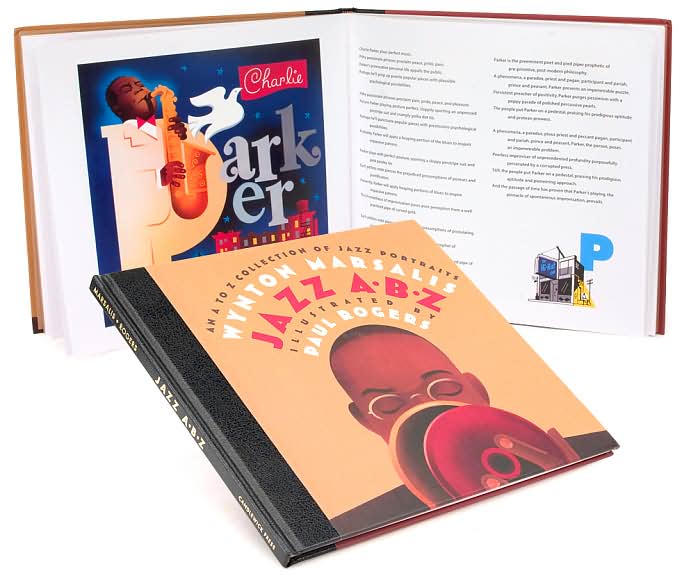
Wynton Marsalis' Jazz ABZ. 2005. (Poetry/Picture Book)
Leo and Diane Dillon's Jazz On A Saturday Night. 2007. (Picture Book)
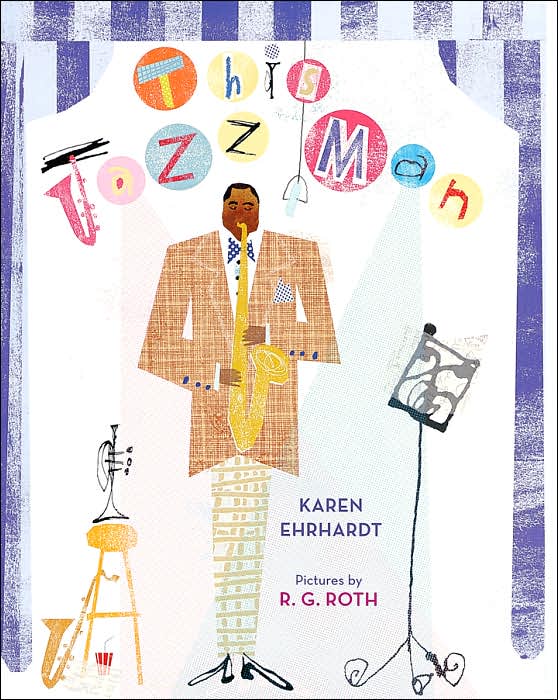
Karen Ehrhardt's This Jazz Man. 2006. (Picture book)
Stephanie Stein Crease's Duke Ellington His Life In Jazz. 2009. (Nonfiction)
Carole Boston Weatherford's Before John Was a Jazz Giant. 2008. (Picture Book)
Muriel Harris Weinstein's When Louis Armstrong Taught Me Scat. 2008. (Picture Book)
Eric Kimmel's A Horn for Louis. 2005. (Chapter Book)
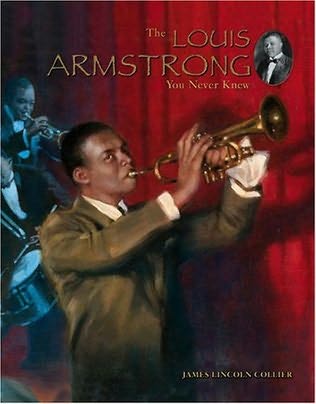
James Lincoln Collier's The Louis Armstrong You Never Knew. 2004. (Nonfiction Chapter Book)
Lisa Wheeler's Jazz Baby. 2007. (Picture Book)
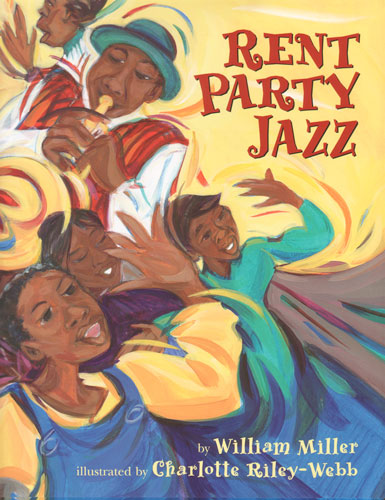
William Miller's Rent Party Jazz. 2001. (Picture Book)
Thacher Hurd's Mama Don't Allow. 1984 (Picture Book)
Walter Dean Myer's Jazz. 2006. (Poetry/Picture Book)
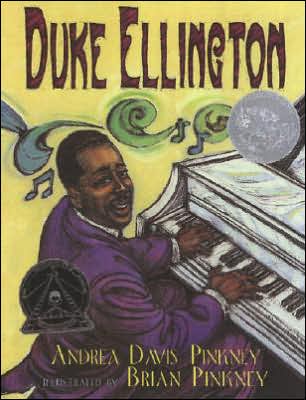
Andrea Davis Pinkney's Duke Ellington. 1998. (Picture Book Biography)
Andrea Davis Pinkney's Ella Fitzgerald. 2002. (Picture Book Biography)
Jonah Winter's Dizzy. 2006. (Picture Book Biography)
Robert Andrew Parker's Piano Starts Here: The Young Art Tatum. 2008. (Picture Book Biography)
Al Perkin's Hand, Hand, Fingers. Thumb. 1969. Random House. (Picture Book)


© Becky Laney of Becky's Book Reviews

Hand, Hand, Fingers, Thumb


Perkins, Al. 1969. Hand, Hand, Fingers, Thumb. Illustrated by Eric Gurney. Random House.

There is only one book--from my childhood--that stands a chance of topping Hand, Hand, Fingers, Thumb as my favorite, favorite, favorite picture book*. I just love Hand, Hand, Fingers, Thumb. I do. Are you familiar with this one? It's a "Bright and Early Book for Beginning Readers." Yes, it sports the Cat in the Hat in the top corner on the cover.

What do I love about Hand, Hand, Fingers, Thumb? What don't I love! The monkeys. The drums. The refrains. The rhythm of it all. I love both the illustrations and the text. Both are oh-so-magical for me. It begins off simply with one little monkey,

Hand
Hand
Fingers
Thumb

One thumb
One thumb
Drumming on a drum.

One hand
Two hands
Drumming on a drum.

Dum ditty
Dum ditty
Dum dum dum.


But one little monkey isn't quite enough, soon these monkeys start getting together--like Jack and Jake--and eventually there are millions of monkeys....

Hand in hand
More monkeys come.
Many more fingers.
Many more thumbs.
Many more monkeys.
Many more drums.

Millions of fingers!
Millions of thumbs!
Millions of monkeys
Drumming on drums!
The text lends itself to easy memorization--it is fun, it is catchy, it is practically perfect in every way.

*Note, I said my childhood. I've read plenty of picture books as an adult. I can't really compare the experiences. There are two different kinds of love.

© Becky Laney of Becky's Book Reviews

Nonfiction Monday: Two Jazz Musician Biographies


Winter, Jonah. 2006. Dizzy. Illustrated by Sean Qualls. Scholastic.

Dizzy is the picture book biography of Dizzy Gillespie. Written by Jonah Winter and illustrated by the masterful Sean Qualls, it is an entertaining look at a life. Poetic in nature, the book gets to the heart of the man, and the heart of the jazz scene. This pretty much sums it up,

"If a melody was like a rule, jazz was like breaking the rules, like inventing new rules. Jazz was getting in trouble--it was fun."

and

"For the boy with the horn, stuck inside a Podunk town in the Deep South, where white folks put you down, JAZZ was also like a ticket on a train to better days."

I enjoyed this one very much.

Parker, Robert Andrew. 2008. Piano Starts Here: The Young Art Tatum. Random House.

I was unfamiliar with this author and this artist. Art Tatum, I've come to learn, is a considered one of the all-time greats of jazz piano. A story that becomes only more inspirational when I learned that he was born nearly blind.

"Still, bad eyes can't keep me from playing the piano. My hands get to know the short black ones on top and long white ones below. I play more and more. And more. When my father leaves in the morning now, he gives me a quick hug and says, 'Don't wear out that piano today.' In the evening when my mother calls me to supper, I say, 'I'll be right back, Piano, don't go away.'

This book received some attention on award day this past January. And I can see why.

Both books are enjoyable and titles I'd be happy to recommend to young readers.


© Becky Laney of Becky's Book Reviews

Saturday, February 14, 2009

Happy Valentine's Day


Get a playlist!
Standalone player
Get Ringtones


© Becky Laney of Becky's Book Reviews

Ella Fitzgerald: The Tale of a Vocal Virtuosa


Pinkney, Andrea Davis. 2002. Ella Fitzgerald: The Tale of a Vocal Virtuosa.

I wish I could have loved Ella Fitzgerald as much as Duke Ellington. The previous picture book, Duke Ellington, was just a wonderful picture book biography. A nice blend of story, jazz, and magic. This one...well...what can I say...it doesn't quite work for me. I'll tell you why. It's narrated by a cat. I wish I could understand just why the author felt the need to insert a storytelling cat into the book, I really do. Because while the writing is nice--still rhythmic with touches of magic--the framework of the story just taints the experience for me.

You may think I look like any other cat.
But, baby, I'm in a class all by myself.
Scat Cat's my name. Scat Cat Monroe.
A name I've earned.
Got my name from knowin' Ella.
Ella Fitzgerald. The Queen of Scat.
What's scat? you ask.
Scat's the sound that don't hold back.
Ella's sound--that was scat.
Singing so supreme.
Music's velvet-ribbon dream.

Let me tell you Ella's story.
'Cause, you see, I was there. From the get-go.
I saw it all. Me. Scat Cat Monroe.
I watched Ella go from a small-town girl to the First Lady of Song.
To a Vocal Virtuousa, bar none.


I liked the language, the style. There's no denying Pinkney's great at knowing what to say, what word to use to get the right effect. I am just not feeling Scat Cat Monroe.

So I enjoyed this one. I didn't hate it. I hope I don't give off that impression. But I would have loved this one more if only...if only...

© Becky Laney of Becky's Book Reviews

Duke Ellington


Pinkney, Andrea Davis. 1998. Duke Ellington: The Piano Prince and His Orchestra. Illustrated by Brian Pinkney.

I loved this picture book biography of Duke Ellington. The illustrations were great--and I'm not alone in thinking that, the book was honored with a Caldecott Honor in 1999. The text was great too. The style was very original--smooth, jazzy, rhythmic. The facts were all there, yes, but they were dressed up nicely by the language, the words she chose to use to tell her story. She's a natural storyteller and it shows.

Here's how it begins,

You ever hear of the jazz-playin' man, the man with the cats who could swing with band? He was born in 1899, in Washington, D.C. Born Edward Kennedy Ellington. But wherever young Edward went, he said, "Hey, call me Duke." Duke's name fit him rightly. He was a smooth-talkin', slick-steppin', piano-playin' kid...


Here's another example,

But with practice, all Duke's fingers rode the piano keys. Duke started to play his own made-up melodies. Whole notes, chords, sharps, and flats. Left-handed hops and right-handed slides. Believe it, man. Duke taught himself to press on the pearlies like nobody else could. His one-and-two-umpy-dump became a thing of the past. Now playing the piano was Duke's all-time love.


Well-researched (she even shares her bibliography with readers) the book is a great example of an accessible, thoroughly readable biography meant to be read and enjoyed.

© Becky Laney of Becky's Book Reviews

Friday, February 13, 2009

Poetry Friday: Jazz


Myers, Walter Dean. 2006. Jazz. Illustrated by Christopher Myers. Holiday House.

This week I'm in with a review of a poetry book/picture book entitled Jazz. I just love the cover. How about you? There's something so vital about it, so expressive. Which gives you just a glimpse of what the book has to offer readers. The book presents jazz as a living, vital, emotional experience. About as far from boring as you can get! The book is a collection of fifteen poems. And they're good. My personal favorite is "Jazz Vocal." A poem that is just perfect for Valentine's Day.

"Jazz Vocal"
by Walter Dean Myers

A sultry love song, sassy as a summer day,
goes dancing from my heart and fills my mind
with such sweet things to say,

Like I love you oh so much
and I tremble when you touch my hand.
Can you understand?
Or can't you really see
what your beauty does to me
and your every word to me is my command?
It's our song. Our love song.
Can you hear it just beginning
Or am I just imagining those precious sounds?

it's a warm night, and much to my delight
my heart beats like a cool jazz bass,
making a special place for us to follow
as we walk on the edges of a dream
or is that horn man painting the edges of a love moonbeam?
Are those chords the heart of reason
or is this just the silly season to fall in love?
The melody and beat are blending
to a happy-ever-ending for you and me.
It's a love song. A sultry love song. All right.

The book includes a glossary of jazz terms and a time line.
© Becky Laney of Becky's Book Reviews

Thursday, February 12, 2009

Mama Don't Allow


Hurd, Thacher. 1984. Mama Don't Allow.

If you're like me, this one will bring back a particular memory: Reading Rainbow. Mama Don't Allow is just one of many titles that I was introduced to on the children's program Reading Rainbow. When I was first inspired to have a jazz week, I knew I'd have to track down a copy of this book. And I was pleased to see there is a 25th Anniversary edition of the book available from HarperCollins! I hadn't realized it'd gotten that old. (Not how I didn't say I'd gotten that old.)

This book is about a little boy, Miles, who loves to play his saxophone. Only one problem: his mother doesn't like to hear him play his music. And she's not alone. It seems that almost everyone wants him to take his music somewhere else, someplace else, far, far away. Where does a boy have to go to be appreciated? If you're Miles, then you'll have to trek your way down to the swamp. Miles and his swamp band are a BIG hit. And I bet that you can guess WHO wants them to spend lots of time in the swamp--making music. The alligators. They love his music--his loud and jazzy music. But is there an ulterior motive?

© Becky Laney of Becky's Book Reviews

Rent Party Jazz


Miller, William. 2001. Rent Party Jazz. Illustrated by Charlotte Riley-Webb. Lee & Low Books.

What an enjoyable book for introducing the concept of a rent party! This lovely picture book is set in New Orleans during the Depression. A young boy, Sonny, is trying to help his family out even though he's just a boy, a kid. When his mother loses her job, he's determined to help her out...and with a little help from a new acquaintance--a jazz musician named Smilin' Jack, he may just be the one to save the day and enable his family to be able to pay the rent on time. I love the message of hope and community.

I loved the bright and bold illustrations by Charlotte Riley-Webb.

© Becky Laney of Becky's Book Reviews

Jazz Baby


Wheeler, Lisa. 2007. Jazz Baby. Illustrated by R. Gregory Christie.

I read and fell in love with this one completely. I didn't only read it five or six times in a row. I read it aloud that many times. Sure, it's fun to read aloud to someone. But I was by myself. But I just couldn't get over how wonderful the words sounded. That doesn't always happen with picture books--even good picture books. Rhythm and sound can be tricky. And in my opinion, Jazz Baby is perfection. Jazz Baby is all about a family spending time together making sweet, sweet music. Brother's hands tap. Sister's hands snap. Itty-bitty Baby's hands clap-clap-clap! But this isn't just immediate family--no, there's plenty of room for everyone. Grandpa. Granny. Mama. Daddy. Auntie. Uncle. Cousins. They're all there. They're all having fun. They're just having the time of their lives. This is one of my favorite parts, I'm sharing it because I think it's a good example of how the text just works:
Mama swings high.
Daddy swings low.
Swingin'-singin' Baby says,
"Go, Man, Go!"

So they Boom-Boom-Boom
And they Hip-Hip-Hop
And the bouncin' baby boogies
with a Bop-Bop-Bop!
Really who could resist the line "bouncin' baby boogies with a bop-bop-bop"??? The whole book just is so perfect, so right. If you love Al Perkins' Hand, Hand, Fingers, Thumb you're going to love this one too!!!


© Becky Laney of Becky's Book Reviews
Wednesday, February 11, 2009

The Louis Armstrong You Never Knew


Collier, James Lincoln. 2004. The Louis Armstrong You Never Knew. Scholastic.

Few people have ever risen as far in life as Louis Armstrong did. He started at the very bottom of American society. It was hardly possible to begin life in worse conditions. By the time he was sixty he was one of the most famous entertainers in the world, and probably the best known black person anywhere. In his time, perhaps only the Beatles and Elvis Presley were more celebrated performers. In 1964 his recording of "Hello, Dolly" was such a hit that it bumped one of the Beatles' most famous records off the top spot on the charts.

I loved this book. It's just a great nonfiction biography--not only is it rooted in fact, it grows and blossoms there too, not relying on fictionalized dialogue to hook readers. In five chapters, Collier covers Armstrong's life. And he does so in a way that is reader-friendly. If I was in elementary school and looking for a biography to read for a book report--written or oral--this would be a good choice. It's simple, but not too simple. Rich in detail, but not to the point where it becomes bogged down in such. It explained just enough that you got a good feeling, a good taste for what his life was like, the culture was like, but it wasn't boring. I liked learning more about New Orleans and jazz. And I liked that it touched upon race relations--segregation and prejudices. I felt I learned a lot while reading this book. It has a nice blending of photographs with illustrations. And overall, I just thought it was really well done.


Get a playlist!
Standalone player
Get Ringtones


What a Wonderful World


When the Saints Go Marching In


Hello Dolly (live)


Hello, Dolly (movie)


Now You Have Jazz


High Society


A Kiss to Build a Dream On


© Becky Laney of Becky's Book Reviews
When Louis Armstrong Taught Me Scat


Weinstein, Muriel Harris. 2008. When Louis Armstrong Taught Me Scat. Illustrated by R. Gregory Christie.

Quick summary of this one...a girl listens (along with her mother) to Louis Armstrong on the radio and becomes interested in scat. That night in bed, she imagines having a private scat lesson (or should that be session?) with Satchmo himself. This scat session is all about bubble gum in all its gooey wonder.

This leads to some wonderfully rhythmic poetry (I'm only going to quote a bit of it. It goes on much longer than this.):

Rippety wrapper
Glittery new
Pinkety sweet
Stickety chew
Squash-itee
Stretch-itee
Gummity thick
Squooz-itee
Oooz-itee
Blowity quick!
Chew-itee
Chew-itee
Chew-itee
Chop
Crackity
Snappity
Poppity!
Pop!!!

I just loved that. Isn't it great??? There is much to love in this one. Then again, I love Louis Armstrong, so that may prejudice me a little. But I just really really enjoyed this one.

Last year, I simply fell in love with Jazz Baby. I loved, loved, loved the rhythm and the rhymes. It just worked really well. But one of the things I loved most about it were the illustrations. This book, When Louis Armstrong Taught Me Scat, is illustrated by the same man: the great and wonderful, R. Gregory Christie.

From the publisher:

When Louis Armstrong Taught Me Scat -- In a CRACKITY-SNAPPITY-POPPITY-POP bubblegum dream, a young girl learns to scat from the master himself, Louis Armstrong! Written in prose and scat with wild and wonderful illustrations by R. Gregory Christie, this joyful tribute is downright contagious. CHEW-ITEE CHEW-ITEE CHEW-ITEE CHOP, CRACKITY SNAPPITY POPPITY POP!
A former elementary school teacher, Muriel Harris Weinstein has taught children's poetry, prose, and playwriting at the United Nations School and the Lincoln Center Library for the Performing Arts. She lives in Great Neck, New York. R. Gregory Christie is a three-time recipient of a Coretta Scott King Award in Illustration, and two of his books, Only Passing Through: The Story of Sojourner Truth and Stars in Darkness, were named New York Times Best Illustrated Children's Books. He lives in Brooklyn, New York.

Illustrator's website.


© Becky Laney of Becky's Book Reviews

A Horn for Louis


Kimmel, Eric A. 2005. A Horn for Louis.

A Horn for Louis is a chapter book biography (of sorts) about Louis Armstrong. The story is one of how a young boy living in poverty in New Orleans got his first horn. It's reader-friendly, and the illustrations by James Bernardin make it appealing. (Did I ever tell you about my criteria for choosing a book to do a book report? This is when I was eight. Large print, pictures, and short.) All that being said, I found this one to be a bit lacking. Perhaps if I hadn't just read another biography of Armstrong; perhaps if it was a little less fictional, but why talk of perhaps.

I think you're either a person who likes fictional dialogue inserted into your biographies...or you don't. For those that love nonfiction in and of itself and are more interested in facts than fictional it-could-have-beens then this one might disappoint. But I realize that there are readers who don't mind the cushioning of facts with a nice story. The storytelling is good. There aren't flaws in the writing itself. It's just that there is so very much that I think is fictional in this story that I think it should be classified as fiction not biography.

© Becky Laney of Becky's Book Reviews

Tuesday, February 10, 2009

Before John Was a Jazz Giant


Weatherford, Carole Boston. 2008. Before John Was A Jazz Giant. Illustrated by Sean Qualls.

I just loved, loved, loved this one! It just excites me through and through. It just works. So many things to love, so many reasons why. I don't think I can do it justice. But I'll try. I'll try. The book--beautifully illustrated, award-worthy illustrations in my humble opinion--is a poetic tribute to the legendary John Coltrane. Each stanza of the poem begins with the refrain, "Before John was a jazz giant..." Each stanza gives the reader information about John's life--his family, his childhood, his background, his surroundings, etc. Weatherford's writing is just incredible--beautiful, rhythmic, and oh-so-right. The images she creates just resonate. I don't want to quote too much, but I don't want to quote too little either. These are the first two stanzas...

Before John was a jazz giant,
he heard hambones knocking in Grandma's pots,
Daddy strumming the ukulele,
and Mama cranking the phonograph.

Before John was a jazz giant,
he heard steam engines whistling past,
Cousin Mary giggling at jitterbuggers,
and Bojangles tap-dancing in the picture show.

I just loved the ending--adored it. But I'm not going to share that here. You need to pick this one up on your own!

Both the illustrations and the text were outstanding on this one.


© Becky Laney of Becky's Book Reviews
Monday, February 09, 2009

Duke Ellington His Life In Jazz


Crease, Stephanie Stein. 2009. Duke Ellington: His Life In Jazz: With 21 Activities. Chicago Review Press. 148.

I enjoyed reading Duke Ellington. Not only did I learn about this legendary jazz musician, I also learned about the life and times he lived in--the society, the culture, the history, the economics, the politics. And, of course, I learned about music. (Not just his music--great as that would have been--but about music in general.) What makes this biography extra-special (in addition to the rich details) are all the extras--the photographs, yes, but perhaps more importantly the built-in activities. Activities that invite young readers--I'd say middle schoolers on up--to get involved in music and art. (The book gives a great sense of appreciation for fine arts in general.) What kinds of activities? Well, a bit of this and that. I like how it incorporates a little bit of everything--because it's a fact that everyone has different abilities, talents, skills, aptitudes. Not everyone can find the rhythm, right? But maybe they'd find that they'd be good at making a costume for a floor show or baking corn bread. The text itself was well-written. It was both informative and interesting. The book is quite good just as it is, but it would have been nice if it had included a cd of his music. That being said, using Project Playlist, you can easily find music to accompany the book.

Granted, I've got some interest heading into the reading experience. I can't quite remember when I discovered Duke Ellington, I can tell you that his music was something I took to quite quickly.


Get a playlist!
Standalone player
Get Ringtones


Other reviews: 100 Scope Notes,

© Becky Laney of Becky's Book Reviews

Sunday, February 08, 2009

This Jazz Man


Ehrhardt, Karen. 2006. This Jazz Man. Harcourt.

Karen Ehrhardt's This Jazz Man is a fun picture book that adapts the classic song "This Old Man." This is the kind of premise that could go either way--be really, really good and clever, or be really, really bad. In my opinion, This Jazz Man is successful in its attempt to make this song swing. Like all jazz books should, it starts with Louis Armstrong.

This jazz man, he plays one,
He plays rhythm with his thumb,
With a snap! snap! snazzy-snap!
Give the man a hand,
This jazz man scats with the band.

Of course it continues counting through the jazz band.

This jazz man, he plays nine,
He plucks strings that sound divine,
With a thimp-thump! Dumple-thump!
Give the man a hand,
This jazz man jams with the band.

What the book doesn't make obvious from the get go is the fact that each number pays tribute to a jazz legend--that big reveal comes at the end of the book. 2 is Bill "Bojangles" Robinson. 3 is Luciano "Chano" Pozo y Gonzalez. 4 is Edward Kennedy "Duke" Ellington. 5 is Charlie "Bird" Parker. 6 is Art "Bu" Blakey. 7 is John Birks "Dizzy" Gillespie. 8 is "Thomas Wright "Fats" Waller. 9 is Charles "Baron" Mingus. Together these make for one great band...

The illustrations are by R.G. Roth. The book would be great for showing onomatopoeias--snap, bippity-bop, bomp, doodly-doot, etc. And for introducing jazz vocabulary--scats, jams, stomps, pounds, blows, beats, wails, swings, etc. But even if you're not looking to use the book in a classroom (or home school setting), the book is just fun--delightful even. I loved it.

© Becky Laney of Becky's Book Reviews
Saturday, February 07, 2009

Jazz on A Saturday Night


Dillon, Leo and Diane. 2007. Jazz on a Saturday Night. Blue Sky Press.

A picture book celebrating some of jazz's greatest legends: Miles Davis, Max Roach, Charlie Parker, John Coltrane, Thelonious Monk, Stanley Clarke, and Ella Fitzgerald. The authors imagined these legends all performing together on stage on a Saturday night...and the crowd finding themselves 'in heaven' with the splendor of it all.

The book has a CD accompanying it. Not full of songs by the original artists, but containing an original song celebrating the book. It also contains a track--nearly thirteen minutes in length that is instructional in nature, meant to serve as an introduction to the genre. Specifically it seeks to introduce each instrument to the reader.

I don't know what it is about this book. I think it is probably me. But I wasn't particularly thrilled--excited--about the book or the CD. Both were okay. (Though I found the CD to be a bit dry and boring. I could see myself falling asleep listening to it if it was 'required' either in or out of class.) The book lacked some of the rhythm that would make it sizzle and pop off the page. For a book about jazz, it just lacked some of the emotions that I've come to expect. (Jazz can be many things--fast, slow, happy, sad, jumping, thumping, soulful, melodic--but it shouldn't be boring.)

© Becky Laney of Becky's Book Reviews

Friday, February 06, 2009

Poetry Friday: Jazz ABZ


Marsalis, Wynton. 2005. Jazz ABZ.

This is a poetry ABC book dedicated to all things jazz. Okay, maybe not all things jazz. But it's a start. 26 jazz musicians. 26 poetry forms. Great potential, right? The book starts off--as well it should--with Louis Armstrong--and ends with Dizzy Gillespie. In between we've got artists like Count Basie, John Coltrane, Miles Davis, Duke Ellington, Thelonious Monk, Nat King Cole, Billie Holiday, and Sarah Vaughan. The book is illustrated by Paul Rogers. The poetic forms covered--how many have you heard of???--are: accumulative, blues, list, word play, meter play, preached, limerick, substitution, performance, ode, insult, lyric, free verse, nursery rhyme, abstract, pantoum, acrostic, rondeau, beat poem, haiku, calligram, sonnet, prose, ballad, tanka, and skeltonic verse.

I can see Jazz ABZ serving several purposes: for jazz enthusiasts, for music appreciation, for poetry appreciation. The last two especially might be something for teachers to consider. A great crossover option as well...seeing how students could connect the music of these artists with the history and culture of the jazz age...and perhaps discuss how these poems succeed (or fail for that matter) to do the artists justice. Would you be able to write a poem on a favorite musician? Would you be able to do it in a structured way? I know I couldn't do it. But I'm glad that Marsalis did!

© Becky Laney of Becky's Book Reviews