Showing posts with label 1866. Show all posts

Thursday, November 01, 2018

Wives and Daughters

Wives and Daughters. Elizabeth Gaskell. 1866. 649 pages. [Source: Bought]

First sentence: To begin with the old rigmarole of childhood.

Premise/plot: Molly Gibson is a doctor's daughter. Many view her as just a simple, ordinary village girl--nothing extraordinary about her. But to those that see Molly's worth--really see it--she is anything but ordinary.

Molly's world has a way of being turned upside down and shaken about.

Her mother died when she was a child. Her father has done a good job raising her by himself, but, he is a man, a doctor, with just one way of seeing the world. When her father is confronted by reality--his daughter is growing UP and the opposite sex may just start noticing her as a woman--he panics. He packs up his daughter and sends her to a neighbor's house.

Squire Hamley and his wife are happy to take her in--temporarily at least. They have two sons, but no living daughter. Osbourne and Roger are away at school. The squire doesn't want either son to fall in love with a mere doctor's daughter. But his wife takes to Molly like she's her own flesh and blood. She loves her sons--no doubt--but Molly is a faithful friend and companion, an excellent listener. 

While his daughter is being looked after elsewhere, HE meanwhile is courting a woman and contemplating a second marriage. Hyacinth Clare was a governess for a local family. (The family divides its time between the countryside estate and the city.) She married and had a daughter, Cynthia. After her husband's death, she opened up a (pitiful) school. Her daughter has only ever been a burden to her. She is looking for someone--anyone--to "save" her. This marriage doesn't touch her heart, not really. But Mr. Gibson is fooled enough--at least at the start.

After the two marry, the families try to blend together. Mr. Gibson will have to adapt to living with a new wife and a step-daughter. Cynthia and Molly are as different as night and day. Molly and Cynthia love one another--but not because they are peas in a pod. Molly knows that Cynthia is a different creature altogether. Cynthia recognizes that Molly is truly good, the real deal; there is no hypocrisy or phoniness to her. Cynthia recognizes her own nature. She is not "good." She is morally weak. She spends most of her time putting on a front. She doubts if she's capable of being sincere, honest, constant. She blames this on her father's death and her mother's lack of attention. Her mother is selfish, self-centered, self-absorbed, incapable of feeling affection or concern, vain, manipulative.

Molly will have to adapt to living with Cynthia and her step-mother. Living with Cynthia--loving Cynthia--doesn't fill like work, like a full-time job. But Molly cannot see eye to eye with her new mother. At all. There is something tedious or draining about having to get along with her. And Molly is determined to live in peace with her new stepmother--to not add to her father's worries with fights and fusses. Now peace in the household does not depend on Molly. Even if Molly and Cynthia were out of the house altogether that would not guarantee that Mr. and Mrs. Gibson would get along peacefully and smoothly.

Men in the neighborhood notice Cynthia's arrival, of course, and soon there are would-be suitors paying call to the Gibson household. Will Molly find love too?

My thoughts: I first read Wives and Daughters in 2008. I enjoyed it then. I did. It was my first novel by Elizabeth Gaskell. But I loved it even more the second time. I appreciated it more. I noticed more. I've also read more Victorian literature since the first time.

I didn't remember all the details of the novel. I kept expecting Cynthia to have committed a Hardy-esque or Eliot-esque sin. I kept expecting it to come out that Cynthia had had a child with Mr. Preston. (It didn't come out because it didn't happen.) I also kept suspecting that perhaps Miss Clare (aka Mrs. Gibson) perhaps had an entanglement herself with Mr. Preston in the past. I may have a vivid imagination.

I shared quotes from the first half of the novel here.

Quotes:
  • 'I don't think she did take it coolly; I believe I don't quite understand her either, but I love her dearly all the same.' 'Umph; I like to understand people thoroughly; but I know it's not necessary to women.' (395)
  • Oh, Molly, you don't know how I was neglected just at a time when I wanted friends most. Mamma does not know it; it is not in her to know what I might have been if I had only fallen into wise, good hands. (435)
  • How easy it is to judge rightly after one sees what evil comes from judging wrongly! (465)
  • Oh, don't call them lies, sister; it's such a strong, ugly word. Please call them tallydiddles, for I don't believe she meant any harm. (506)
  • My dear, don't repeat evil on any authority unless you can do some good by speaking about it, said Miss Browning, laying her hand on Mrs. Dawes' shoulder. I'm not a good woman, but I know what is good, and that advice is. (508)
  • 'It's all a mystery. I hate to have you mixed up in mysteries.' 'I hate to be mixed up. But what can I do? I know of another mystery which I'm pledged not to speak about. I cannot help myself.' 'Well, all I can say is, never be the heroine of a mystery that you can avoid, if you can't help being an accessory.' (516)
  • People may flatter themselves just as much by thinking that their faults are always present to other people's minds as if they believe that the world is always contemplating their individual charms and virtues. (534)
  • I like everybody to have an opinion of their own; only when my opinions are based on thought and experience, which few people have had equal opportunities of acquiring, I think it is but proper deference in others to allow themselves to be convinced. (604)

© 2018 Becky Laney of Becky's Book Reviews

Thursday, April 19, 2018

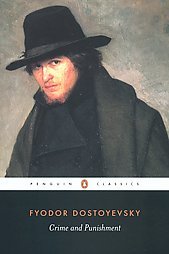
Crime and Punishment

Crime and Punishment. Fyodor Dostoyevsky. Translated by David McDuff. 1866/2002. 671 pages. [Source: Library]

First sentence: At the beginning of July, during a spell of exceptionally hot weather, towards evening, a certain young man came down on to the street from the little room he rented from some tenants in S--- Lane and slowly, almost hesitantly, set off towards K---n Bridge.

Premise/plot: Rodion Raskolnikov, the "hero" of Dostoyevsky's Crime and Punishment, has major issues. He's become convinced, mostly, that murder is justifiable if it's for the 'greater good' of mankind. He has thought a lot about this--even written an article about it. His abstract theory becomes his one consuming obsession.

Does he have what it takes to kill someone? More importantly perhaps, does he have what it takes to kill someone and get away it. In his mental state, he does not believe that the crime IS a crime. His "victim" (he doesn't see her as a victim) is a pawnbroker who "takes advantage" of the poor. The world would be a better place without her, wouldn't it? If it would be--and he is convinced it would be--it's the right thing to eliminate her. He plans everything out--to the best of his ability--but things don't go according to plan. He didn't plan on the victim's sister returning to their home mid-crime; he didn't plan on a second victim; he didn't plan on nearly being caught by young men who'd come to pawn their goods. He also didn't plan on his physical health coming unhinged just as his mental and emotional health was breaking down. Is his madness caused by illness? Is his illness caused by madness? Is his illness real or in his head? Is there a cure for what ails him?

His family--his mother and sister--come to St. Petersburg. His sister is newly engaged to a young man, a man Rodion disapproves of and despises. (It is mutual.) His mother is perhaps rightly worried about her son's well being. Fortunately one of Rodion's friends, Razumikhin, is there to provide comfort, support, and encouragement. 

Another family is central to the novel as well. Semyon Zakharovich Marmeladov is an out-of-luck drunk whom Rodion meets early in the novel. This drunk tells the tragic story of his tragic family to anyone and everyone who will listen; he tells it with drink in hand of course. Rodion witnesses his new friend's death and makes sure that he's taken to his own home to die. He meets the soon-to-be widow, Katerina Ivanovna Marmeladova, and more importantly one of his daughters, Sonya. (She's been "forced" into prostitution in an effort to keep her family alive. Her father is an incompetent drunk and her mother is dying of consumption. She has, I believe, three younger siblings.) Rodion gives the family money for the funeral. He's not trying to cause a scandal; he's moved with compassion--pity--for their plight. Sonya becomes one of the main characters of the book. She is also the first person to whom he confesses his crime. (At this point he still doesn't see it as a crime.)

Most of the novel is about the cat-and-mouse game being played by Rodion Raskolnikov and the detective Porfiry Petrovich. Rodion becomes suspicious that the detective suspects him and is trying to trap him. So he tries to stay a couple of steps ahead of him. Likewise, Porfiry KNOWS that Rodion suspects that he's suspected. He knows that Rodion is trying to stay a few steps ahead. He also knows that ultimately Rodion will fail and that justice will be done. It doesn't matter to him if the case is resolved today or next week or next month.

My thoughts: Are ideas dangerous? Can a germ--a seed--of an idea become dangerous and deadly? Do ideas have consequences? What if theories and ideas and philosophies are carried out in day to day life and bear fruit?

I don't always "like" unreliable narrators. I haven't decided if the category applies here or not. Is he mentally ill? Is he mad? Did he know right from wrong when he committed the crime? If he was insane--was the insanity long-lasting? or was it temporary? When did his madness start? And what caused it? Was the idea fermenting in his mind the root cause? Is there a cure for his madness? Even if he's punished by the state, will he ever admit moral responsibility? That is will he ever come to see his crime as a CRIME. Will he come to see that his idea of justifiable murder is reprehensible? Or will he continue to think that the only crime--the crime he's being punished for--is the crime of getting caught, the crime of being incompetent, the crime of being weak?

According to Wikipedia, Dostoyevsky was inspired by a French murderer, Pierre Francois Lacenaire.

I have shared quotes from the novel in my weekly 'My Victorian Year' posts. 

Here are my quotes from the last part of the book.
Power is given only to those who dare to lower themselves and pick it up. Only one thing matters, one thing: to be able to dare! (499)
All human beings need air, air, air...That above all else! (525)
There is nothing in the world more difficult than plain speaking, and nothing easier than flattery. If when a man is trying to speak plainly one-hundredth part of a false note creeps into what he is saying, the result is an instant dissonance, and following it--a scandal. In the case of flattery, however, even if everything in it, right down to the very last note, is false, it sounds agreeable and is received not without pleasure; even though it's a crude sort of pleasure, it's pleasure nevertheless. And no matter how crude the flattery may be, at least half of it always seems genuine. (568)
Everyone must look out for himself, and the best time is had by those who're best able to deceive themselves. (574)
But those people had the courage of their convictions, and so they were right, while I didn't, and consequently had no right to take the step I did. (649)

And here are my overall favorite quotes:
One can always forgive a man for telling lies; lying's a harmless activity, because it leads to the truth. (163)
"We've got facts," they say. But facts aren't everything: at least half the battle consists in how one makes use of them! (164)
Talking nonsense is the sole privilege mankind possesses over the other organisms. It's by talking nonsense that one gets to the truth! I talk nonsense, therefore I'm human. Not one single truth has ever been arrived at without people having talked a dozen reams of nonsense, even ten dozen reams of it, and that's an honorable thing in its own way; well, but we can't even talk nonsense with our own brains! Talk nonsense to me, by all means, but do it with your own brain, and I shall love you for it. To talk nonsense in one's own way is almost better than to talk a truth that's someone else's; in the first instance you behave like a human being, while in the second you are merely being a parrot. (242)
We've got accustomed to making do with other people's intelligence--we're soaked in it! (242)
The harmonious individual, it needs to be said, hardly exists at all. (270)
The living soul demands to live. (305)
It's impossible to leap over nature solely by means of logic! (305)
Pain and suffering are inevitable for persons of broad awareness and depth of heart. The truly great are, in my view, always bound to feel a great sense of sadness during their time upon earth. (315)

© 2018 Becky Laney of Becky's Book Reviews

Sunday, April 19, 2015

Miss Marjoribanks (1866)

Miss Marjoribanks. Margaret Oliphant. 1866. 512 pages. [Source: Bought]

First sentence: Miss Marjoribanks lost her mother when she was only fifteen, and when, to add to the misfortune, she was absent at school, and could not have it in her power to soothe her dear mamma's last moments, as she herself said. Words are sometimes very poor exponents of such an event: but it happens now and then, on the other hand, that a plain intimation expresses too much, and suggests emotion and suffering which, in reality, have but little, if any, existence.

I LOVED, LOVED, LOVED Margaret Oliphant's Miss Marjoribanks. Within a few chapters, I was going Why did NO ONE tell me how absolutely, wonderful this book is?!  Even before I finished it, I  had decided that I would NEED to read more Oliphant in the future. A lot more. (Which book should I seek out next?!)

Lucilla Marjoribanks is the heroine. She's clever and stubborn, more than a little ambitious, and manipulative but well-intentioned. I also want to add that her manners are phenomenal; she's a proper lady. Readers meet plenty of characters: men and women of all ages, both upper and lower class.

So the novel opens with Lucilla learning of her mother's death. She resolves then and there to be a comfort to her father. Her father wants Lucilla to stay in school, and, later go on a tour of Europe. But when Lucilla is nineteen, it is inevitable that she will return home to Carlingford and start being a comfort to her dear father. He's hesitant at first, as is his cook, but within a day--or two at most--she's got them both. They love and adore her. Her reign has begun without a bit of resistance.

Lucilla has plans. Not just for her father and the household (a new makeover for various rooms). But for Carlingford. She wants to make a great society. She'll host her Thursday Evenings, and the town will be changed for the better, for the most part.

As part of her project, Lucilla "rescues" Barbara Lake from the lower class (she's a drawing master's daughter) to sing duets with her on Thursday evenings. Barbara doesn't exactly like "being a project" of Lucilla's. Part of her hates the idea of a rich woman condescending to her and elevating her position--once a week--for entertainment purposes. On the other hand, she does love to sing. And one of the men who attends is quite swoon-worthy, and he flirts with her. So the evening isn't a complete waste.

The book is essentially two stories in one. The first story occurs when she's nineteen and just getting started with her Carlingford project. She's young, beautiful, smart, ambitious. And most everyone is of the opinion that she will soon marry. Despite her protests that she will not marry for at least ten years so that she can be a comfort to her father. A handful of neighbors introduce various young men to her. One of the eligible suitors is Mr. Cavendish. (Cavendish is the one who can't help flirting with Barbara Lake). The other two "eligible" suitors don't seem all that interested in Miss Marjoribanks. (One (a general) falls in love at first sight with Barbara's sister, Rose, who happens to be visiting Lucilla because she's worried about her sister. The other (Archdeacon Beverley) coincidentally is the first-lost-love of one of Lucilla's friends--another project of sorts, her name is Mrs. Mortimer.) The second story occurs when she's twenty-nine. It mainly centers around Miss Marjoribanks schemes to get Mr. Ashburton elected to parliament.

The book is part romance, part comedy, part drama. I LOVED everything about it. I loved the characterization. I loved the narration. I loved the plot. I loved that it wasn't predictable--at least not to me!

Quotes:
There are people who talk of themselves, and think of themselves, as it were, under protest, and with depreciation, not actually able to convince themselves that anybody cares; but Lucilla, for her part, had the calmest and most profound conviction that, when she discussed her own doings and plans and clevernesses, she was bringing forward the subject most interesting to her audience as well as to herself. Such a conviction is never without its fruits. To be sure, there were always one or two independent spirits who revolted; but for the crowd, it soon became impressed with a profound belief in the creed which Miss Marjoribanks supported so firmly.
At other times she had been a visitor; now she had come into her kingdom, and had no desire to be received like a guest.
But it was only in the morning that Lucilla unfolded her standard. She was down to breakfast, ready to pour out the coffee, before the Doctor had left his room. He found her, to his intense amazement, seated at the foot of the table, in the place which he usually occupied himself, before the urn and the coffee-pot. Dr Marjoribanks hesitated for one momentous instant, stricken dumb by this unparalleled audacity; but so great was the effect of his daughter's courage and steadiness, that after that moment of fate he accepted the seat by the side where everything was arranged for him, and to which Lucilla invited him sweetly, though not without a touch of mental perturbation. The moment he had seated himself, the Doctor's eyes were opened to the importance of the step he had taken. "I am afraid I have taken your seat, papa," said Miss Marjoribanks, with ingenuous sweetness. "But then I should have had to move the urn, and all the things, and I thought you would not mind."
The Doctor's formidable housekeeper conducted her young mistress downstairs afterwards, and showed her everything with the meekness of a saint. Lucilla had won a second victory still more exhilarating and satisfactory than the first; for, to be sure, it is no great credit to a woman of nineteen to make a man of any age throw down his arms; but to conquer a woman is a different matter, and Lucilla was thoroughly sensible of the difference. Now, indeed, she could feel with a sense of reality that her foundations were laid.
Lucilla, who was liberal, as genius ought always to be, was perfectly willing that all the young ladies in Carlingford should sing their little songs while she was entertaining her guests; and then at the right moment, when her ruling mind saw it was necessary, would occur the duet—the one duet which would be the great feature of the evening. Thus it will be seen that another quality of the highest order developed itself during Miss Marjoribanks's deliberations; for, to tell the truth, she set a good deal of store by her voice, and had been used to applause, and had tasted the sweetness of individual success.
There is nothing one cannot manage if one only takes the trouble.
"I am always afraid of a cousin, for my part," said Mrs Chiley; "and talking of that, what do you think of Mr Cavendish, Lucilla? He is very nice in himself, and he has a nice property; and some people say he has a very good chance to be member for Carlingford when there is an election. I think that is just what would suit you."
Thus all the world contemplated with excitement the first Thursday which was to open this enchanted chamber to their admiring eyes. "Don't expect any regular invitation," Miss Marjoribanks said. "I hope you will all come, or as many of you as can. Papa has always some men to dinner with him that day, you know, and it is so dreadfully slow for me with a heap of men. That is why I fixed on Thursday. I want you to come every week, so it would be absurd to send an invitation; and remember it is not a party, only an Evening," said Lucilla.
It was when she was in this unhappy humour that her eye fell upon Mr Cavendish, who was in the act of making the appeal to Lucilla which we have already recorded. Barbara had never as yet had a lover, but she had read an unlimited number of novels, which came to nearly the same thing, and she saw at a glance that this was somebody who resembled the indispensable hero. She looked at him with a certain fierce interest, and remembered at that instant how often in books it is the humble heroine, behind backs, whom all the young ladies snub, who wins the hero at the last. And then Miss Marjoribanks, though she sent him away, smiled benignantly upon him. The colour flushed to Barbara's cheeks, and her eyes, which had grown dull and fixed between fright and spite, took sudden expression under her straight brows. An intention, which was not so much an intention as an instinct, suddenly sprang into life within her, and, without knowing, she drew a long breath of eagerness and impotence. He was standing quite near by this time, doing his duty according to Miss Marjoribanks's orders, and flirting with all his might; and Barbara looked at him as a hungry schoolboy might be supposed to look at a tempting apple just out of his reach. How was she to get at this suitor of Lucilla's?
As for poor Barbara, she is only a little shy, but that will soon wear off. I don't see what need she has to talk—or to move either, for that matter. I thought she did very well indeed for a girl who never goes into society. Was it not clever of me to find her out the very first day I was in Carlingford? It has always been so difficult to find a voice that went perfectly with mine."
"I always make it a point never to shock anybody's prejudices," said Miss Marjoribanks. "I should do just the same with them as with other people; all you have to do is to show from the first that you mean to be good friends with everybody. But then I am so lucky: I can always get on with people," said Lucilla, rising to greet the two unfortunates who had come to Colonel Chiley's to spend a merry Christmas, and who did not know what to do with themselves.
It was rather vexatious, to tell the truth; for to see a man so near the point and not even to have the satisfaction of refusing him, is naturally aggravating to a woman.
If there was one thing in the world more than another which contented Lucilla, it was to be appealed to and called upon for active service. It did her heart good to take the management of incapable people, and arrange all their affairs for them, and solve all their difficulties. Such an office was more in her way than all the Archdeacons in the world.

For even the aid of Miss Marjoribanks was as nothing against dead selfishness and folly, the two most invincible forces in the world.


© 2015 Becky Laney of Becky's Book Reviews
Sunday, August 17, 2014

The Belton Estate

The Belton Estate. Anthony Trollope. 1866/1993. Penguin. 432 pages. [Source: Bought]

 To state it simply: it was LOVE. I have loved quite a few Anthony Trollope novels in the past. So it wasn't a big, big surprise that I loved Belton Estate. Perhaps I was surprised by just how MUCH I loved, loved, loved it! It was completely satisfying and practically perfect.

Clara Amedroz is the heroine of The Belton Estate. When her brother dies--he committed suicide--Clara's future becomes uncertain. Her father's property is entailed. She's unable to inherit from her father despite his wishes. There was a slim possibility that an aunt-like figure--a wealthy woman, of course--could leave her something. But she's left out of that will as well.

There are two men who could potentially "save" Clara. Captain Frederic Aylmer is a young (and I'm assuming relatively handsome) relation of Mrs. Winterfield (the aunt-like figure to Clara). He is the one who inherits her estate. She really wanted Clara and Frederic to marry one another. She spoke often about how much she wanted these two to marry. Days after her death, Clara receives a proposal of sorts from Frederic. The other potential "savior" is Will Belton. He is a distant cousin. He is the one who will be inheriting Clara's father's estate. He visits. Unlike Mr. Collins (from Pride and Prejudice) he is charming and likable and within weeks--if not days--Clara and her father LOVE him. He loves, loves, loves Clara. He does. He seeks permission to marry her. Clara's father thinks that would be lovely. What a good son he'd be! He also proposes to Clara.

Which man is right for Clara? Which proposal will she accept? Will she have a happily ever after?

It was oh-so-easy for me to have a favorite! I adore Will Belton. I do. I just LOVE him. I enjoyed the characters in this one so very much. I loved getting to spend so much time with Clara. This is one of Trollope's "simple" novels. Instead of having three or more couples to keep up with, or, three or more stories to follow since not all stories may end up in romance, readers just get treated to one fully developed story. There are more characters, of course. We meet Clara's closest friend and her husband. We meet Frederic's family. His mother is SOMETHING. I thought the characterization was great. I also thought it was a very thoughtful novel.

I would recommend Belton Estate to anyone who loves classic romances or historical romances. It is a GREAT love story.

Quotes:
And what did Will Belton think about his cousin, insured as he was thus supposed to be against the dangers of love? He, also, lay awake for awhile that night, thinking over this new friendship. Or rather he thought of it walking about his room, and looking out at the bright harvest moon;—for with him to be in bed was to be asleep. He sat himself down, and he walked about, and he leaned out of the window into the cool night air; and he made some comparisons in his mind, and certain calculations; and he thought of his present home, and of his sister, and of his future prospects as they were concerned with the old place at which he was now staying; and he portrayed to himself, in his mind, Clara's head and face and figure and feet;—and he resolved that she should be his wife. He had never seen a girl who seemed to suit him so well. Though he had only been with her for a day, he swore to himself that he knew he could love her. Nay;—he swore to himself that he did love her. Then,—when he had quite made up his mind, he tumbled into his bed and was asleep in five minutes.
"But, my dear, why should not he fall in love with you? It would be the most proper, and also the most convenient thing in the world."
"I hate talking of falling in love;—as though a woman has nothing else to think of whenever she sees a man."
"A woman has nothing else to think of."
"I have,—a great deal else. And so has he."
"It's quite out of the question on his part, then?"  "Quite out of the question. I'm sure he likes me. I can see it in his face, and hear it in his voice, and am so happy that it is so. But it isn't in the way that you mean. Heaven knows that I may want a friend some of these days, and I feel that I may trust to him. His feelings to me will be always those of a brother." "Perhaps so. I have seen that fraternal love before under similar circumstances, and it has always ended in the same way."
"I hope it won't end in any way between us."
"But the joke is that this suspicion, as you call it,—which makes you so indignant,—is simply a suggestion that a thing should happen which, of all things in the world, would be the best for both of you."
© 2014 Becky Laney of Becky's Book Reviews

Thursday, June 24, 2010

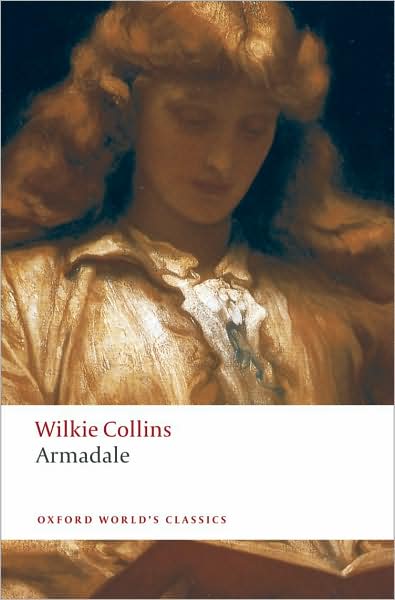
Armadale

Armadale. Wilkie Collins. 1866. (My edition. Oxford World's Classics.) 880 pages.

On a warm May night, in the year eighteen hundred and fifty-one, the Reverend Decimus Brock--at that time a visitor to the Isle of Man--retired to his bedroom, at Castletown, with a serious personal responsibility in close pursuit of him, and with no distinct idea of the means by which he might relieve himself from the pressure of his present circumstances.

Is it possible to summarize Armadale in a sentence or two? In a paragraph or two? Probably not. Wilkie Collins is all about layers. Who else besides Collins would premise a novel with fifty-eight pages of prologue? A prologue that establishes the background of three of his main characters. A foreshadowing prologue that shapes and reshapes the novel. Two men. One name. One dark secret.

Armadale centers around three characters: Allan Armadale, Ozias Midwinter, and Lydia Gwilt. Armadale and Midwinter are best friends. But this friendship is strained at times because Midwinter knows things Armadale doesn't. He knows the dark connection they share. Midwinter learned these secrets through a letter he received when he came of age. His father warned him to never ever have anything to do with Allan Armadale. His father's letter also warned him of a dangerous woman.

Lydia Gwilt, one of our narrators, also enters into the drama. Both Midwinter and Armadale (not to mention the elderly Bashwood) fall in love with Miss Gwilt. But Gwilt is incapable of honesty, and her lies may spin everything out of control.

Armadale is about the struggle of the human soul between good and evil. A novel that asks the question--should children suffer for the sins of their fathers? A novel that explores the idea of Fate and free will.

This is my second Wilkie Collins novel. Last year, I read and reviewed Man and Wife. Armadale is a stronger novel, a better novel. (But it doesn't have a Sir Patrick.) Did I love Armadale? I certainly enjoyed it. I found it difficult to put down. I found myself smiling at Collins descriptions. He could definitely be witty when he wanted to be! I found Armadale to be complex. The characters are drawn from human nature; each of the main characters is flawed. I liked the multiple narrators as well. I was surprised at how much of this story is told from Gwilt's perspective--through letters and diary entries mainly. I thought the pacing was suspenseful, and the last two hundred pages were intense. I would definitely recommend the novel.

'Excuse me,' said the impenetrable Scotchman. 'I beg to suggest that you are losing the thread of the narrative.'
'Nothing more likely,' returned the doctor, recovering his good humour. 'It is in the habit of my nation to be perpetually losing the thread--and it is evidently in the habit of yours, sir, to be perpetually finding it. What an example here of the order of the universe, and the everlasting fitness of things!' (17)


The object of Allan's humane caution was corpulent elderly woman of the type called 'motherly.' Fourteen stairs were all that separated her from the master of the house: she ascended them with fourteen stoppages and fourteen sighs. Nature, various in all things, is infinitely various in the female sex. There are some women whose personal qualities reveal the Loves and the Graces; and there are other women whose personal qualities suggest the Perquisites and the Grease Pot. This was one of the other women. (203)

A young man who plays his part in society by looking on in green spectacles, and listening with a sickly smile, may be a prodigy of intellect and a mine of virtue, but he is hardly, perhaps, the right sort of man to have at a picnic. An old lady afflicted with deafness, whose one inexhaustible subject of interest is the subject of her son, and who (on the happily rare occasions when that son opens his lips) asks everybody eagerly, 'What does my boy say?' is a person to be pitied in respect of her infirmities, and a person to be admired in respect of her maternal devotedness, but not a person, if the thing could possibly be avoided, to take to a picnic. Such a man, nevertheless, was the Reverend Samuel Pentecost, and such a woman was the Reverend Samuel's mother; and in the dearth of any other producible guests, there they were, engaged to eat, drink, and be merry for the day at Mr. Armadale's pleasure-party to the Norfolk Broads. (292)
The age we live in is an age which finds no human creature inexcusable. (374)
'When you say no to a woman, sir,' remarked Pedgift Senior, 'always say it in one word. If you give her your reasons, she invariably believes that you mean Yes.' (439)
The plain fact was, that the music-master attached to the establishment fell in love with Miss Gwilt. He was a respectable middle-aged man, with a wife and family--and finding the circumstances entirely hopeless, he took a pistol, and rashly assuming that he had brains in his head, tried to blow them out. The doctors saved his life, but not his reason--he ended, where he had better have begun, in an asylum. (635)


Other reviews: Shelf Love, Novel Insights, The Curious Reader, Bibliolatry, Savidge Reads,

© Becky Laney of Becky's Book Reviews