Crime and Punishment: A BBC Radio 4 Full Cast Dramatisation. Fyodor Dostoyevsky. Adapted by Mike Walker. 3 hrs.
This one was available through my local library.
I began reading Crime and Punishment because it was my Classics Spin winner. I believe I started reading the book in March. I finished it this week. (Hurray!!!) I celebrated by listening to an abridged audio book of it. I often award myself by either watching a film adaptation or listening to an audio adaptation. This one was a treat!
Crime and Punishment definitely comes across as a psychological drama--or thriller. I'm not sure "thriller" is the right word. But I'm not positive it's the wrong word either. DRAMA is the perfect word however.
The book keeps you very much inside the head of the narrator--Raskolnikov. That is not unusual in and of itself. But Raskolnikov is a tortured soul. And his inner voice comes across as quite mad or tortured throughout the production. In some ways I think the audio DRAMA does a better job of conveying this even more so than the book itself. (Though it is abridged.)
My review of the book.
I also listened to ORSON WELLES "War of the Worlds" Radio Broadcast. October 30, 1938. Mercury Theatre on the Air. 1 hour.
War of the Worlds is a science fiction novel by H.G. Wells. It was directed by Orson Welles; it also starred Orson Welles. Did listeners really hear the radio broadcast and panic? Maybe. Maybe not. I am slightly skeptical that anyone could hear it and be fooled...for long. For one thing, I believe it says at least two to three times that it is a radio drama. Second, you'd have to REALLY suspend your disbelief to think that all of the action and drama was happening in real time. It spans WEEKS. I think the panic element of it has become a dramatic legend that is part of our culture. True or not, people may enjoy believing it. Sensational drama sells. And the idea of "the public" "the masses" going crazy is certainly sensational. I'm not convinced either way in terms of if the panic was "real" or a fabrication that grows larger and larger as the story is told and retold.
© 2018 Becky Laney of Becky's Book Reviews
Showing posts with label Fyodor Dostoyevsky. Show all posts
Saturday, April 21, 2018
Thursday, April 19, 2018
Crime and Punishment
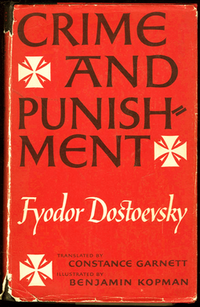
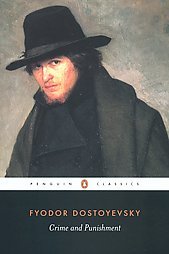
Crime and Punishment. Fyodor Dostoyevsky. Translated by David McDuff. 1866/2002. 671 pages. [Source: Library]
First sentence: At the beginning of July, during a spell of exceptionally hot weather, towards evening, a certain young man came down on to the street from the little room he rented from some tenants in S--- Lane and slowly, almost hesitantly, set off towards K---n Bridge.
Premise/plot: Rodion Raskolnikov, the "hero" of Dostoyevsky's Crime and Punishment, has major issues. He's become convinced, mostly, that murder is justifiable if it's for the 'greater good' of mankind. He has thought a lot about this--even written an article about it. His abstract theory becomes his one consuming obsession.
Does he have what it takes to kill someone? More importantly perhaps, does he have what it takes to kill someone and get away it. In his mental state, he does not believe that the crime IS a crime. His "victim" (he doesn't see her as a victim) is a pawnbroker who "takes advantage" of the poor. The world would be a better place without her, wouldn't it? If it would be--and he is convinced it would be--it's the right thing to eliminate her. He plans everything out--to the best of his ability--but things don't go according to plan. He didn't plan on the victim's sister returning to their home mid-crime; he didn't plan on a second victim; he didn't plan on nearly being caught by young men who'd come to pawn their goods. He also didn't plan on his physical health coming unhinged just as his mental and emotional health was breaking down. Is his madness caused by illness? Is his illness caused by madness? Is his illness real or in his head? Is there a cure for what ails him?
His family--his mother and sister--come to St. Petersburg. His sister is newly engaged to a young man, a man Rodion disapproves of and despises. (It is mutual.) His mother is perhaps rightly worried about her son's well being. Fortunately one of Rodion's friends, Razumikhin, is there to provide comfort, support, and encouragement.
Another family is central to the novel as well. Semyon Zakharovich Marmeladov is an out-of-luck drunk whom Rodion meets early in the novel. This drunk tells the tragic story of his tragic family to anyone and everyone who will listen; he tells it with drink in hand of course. Rodion witnesses his new friend's death and makes sure that he's taken to his own home to die. He meets the soon-to-be widow, Katerina Ivanovna Marmeladova, and more importantly one of his daughters, Sonya. (She's been "forced" into prostitution in an effort to keep her family alive. Her father is an incompetent drunk and her mother is dying of consumption. She has, I believe, three younger siblings.) Rodion gives the family money for the funeral. He's not trying to cause a scandal; he's moved with compassion--pity--for their plight. Sonya becomes one of the main characters of the book. She is also the first person to whom he confesses his crime. (At this point he still doesn't see it as a crime.)
Most of the novel is about the cat-and-mouse game being played by Rodion Raskolnikov and the detective Porfiry Petrovich. Rodion becomes suspicious that the detective suspects him and is trying to trap him. So he tries to stay a couple of steps ahead of him. Likewise, Porfiry KNOWS that Rodion suspects that he's suspected. He knows that Rodion is trying to stay a few steps ahead. He also knows that ultimately Rodion will fail and that justice will be done. It doesn't matter to him if the case is resolved today or next week or next month.
My thoughts: Are ideas dangerous? Can a germ--a seed--of an idea become dangerous and deadly? Do ideas have consequences? What if theories and ideas and philosophies are carried out in day to day life and bear fruit?
I don't always "like" unreliable narrators. I haven't decided if the category applies here or not. Is he mentally ill? Is he mad? Did he know right from wrong when he committed the crime? If he was insane--was the insanity long-lasting? or was it temporary? When did his madness start? And what caused it? Was the idea fermenting in his mind the root cause? Is there a cure for his madness? Even if he's punished by the state, will he ever admit moral responsibility? That is will he ever come to see his crime as a CRIME. Will he come to see that his idea of justifiable murder is reprehensible? Or will he continue to think that the only crime--the crime he's being punished for--is the crime of getting caught, the crime of being incompetent, the crime of being weak?
According to Wikipedia, Dostoyevsky was inspired by a French murderer, Pierre Francois Lacenaire.
I have shared quotes from the novel in my weekly 'My Victorian Year' posts.
Here are my quotes from the last part of the book.
And here are my overall favorite quotes:
© 2018 Becky Laney of Becky's Book Reviews
First sentence: At the beginning of July, during a spell of exceptionally hot weather, towards evening, a certain young man came down on to the street from the little room he rented from some tenants in S--- Lane and slowly, almost hesitantly, set off towards K---n Bridge.
Premise/plot: Rodion Raskolnikov, the "hero" of Dostoyevsky's Crime and Punishment, has major issues. He's become convinced, mostly, that murder is justifiable if it's for the 'greater good' of mankind. He has thought a lot about this--even written an article about it. His abstract theory becomes his one consuming obsession.
Does he have what it takes to kill someone? More importantly perhaps, does he have what it takes to kill someone and get away it. In his mental state, he does not believe that the crime IS a crime. His "victim" (he doesn't see her as a victim) is a pawnbroker who "takes advantage" of the poor. The world would be a better place without her, wouldn't it? If it would be--and he is convinced it would be--it's the right thing to eliminate her. He plans everything out--to the best of his ability--but things don't go according to plan. He didn't plan on the victim's sister returning to their home mid-crime; he didn't plan on a second victim; he didn't plan on nearly being caught by young men who'd come to pawn their goods. He also didn't plan on his physical health coming unhinged just as his mental and emotional health was breaking down. Is his madness caused by illness? Is his illness caused by madness? Is his illness real or in his head? Is there a cure for what ails him?
His family--his mother and sister--come to St. Petersburg. His sister is newly engaged to a young man, a man Rodion disapproves of and despises. (It is mutual.) His mother is perhaps rightly worried about her son's well being. Fortunately one of Rodion's friends, Razumikhin, is there to provide comfort, support, and encouragement.
Another family is central to the novel as well. Semyon Zakharovich Marmeladov is an out-of-luck drunk whom Rodion meets early in the novel. This drunk tells the tragic story of his tragic family to anyone and everyone who will listen; he tells it with drink in hand of course. Rodion witnesses his new friend's death and makes sure that he's taken to his own home to die. He meets the soon-to-be widow, Katerina Ivanovna Marmeladova, and more importantly one of his daughters, Sonya. (She's been "forced" into prostitution in an effort to keep her family alive. Her father is an incompetent drunk and her mother is dying of consumption. She has, I believe, three younger siblings.) Rodion gives the family money for the funeral. He's not trying to cause a scandal; he's moved with compassion--pity--for their plight. Sonya becomes one of the main characters of the book. She is also the first person to whom he confesses his crime. (At this point he still doesn't see it as a crime.)
Most of the novel is about the cat-and-mouse game being played by Rodion Raskolnikov and the detective Porfiry Petrovich. Rodion becomes suspicious that the detective suspects him and is trying to trap him. So he tries to stay a couple of steps ahead of him. Likewise, Porfiry KNOWS that Rodion suspects that he's suspected. He knows that Rodion is trying to stay a few steps ahead. He also knows that ultimately Rodion will fail and that justice will be done. It doesn't matter to him if the case is resolved today or next week or next month.
My thoughts: Are ideas dangerous? Can a germ--a seed--of an idea become dangerous and deadly? Do ideas have consequences? What if theories and ideas and philosophies are carried out in day to day life and bear fruit?
I don't always "like" unreliable narrators. I haven't decided if the category applies here or not. Is he mentally ill? Is he mad? Did he know right from wrong when he committed the crime? If he was insane--was the insanity long-lasting? or was it temporary? When did his madness start? And what caused it? Was the idea fermenting in his mind the root cause? Is there a cure for his madness? Even if he's punished by the state, will he ever admit moral responsibility? That is will he ever come to see his crime as a CRIME. Will he come to see that his idea of justifiable murder is reprehensible? Or will he continue to think that the only crime--the crime he's being punished for--is the crime of getting caught, the crime of being incompetent, the crime of being weak?
According to Wikipedia, Dostoyevsky was inspired by a French murderer, Pierre Francois Lacenaire.
I have shared quotes from the novel in my weekly 'My Victorian Year' posts.
Here are my quotes from the last part of the book.
Power is given only to those who dare to lower themselves and pick it up. Only one thing matters, one thing: to be able to dare! (499)
All human beings need air, air, air...That above all else! (525)
There is nothing in the world more difficult than plain speaking, and nothing easier than flattery. If when a man is trying to speak plainly one-hundredth part of a false note creeps into what he is saying, the result is an instant dissonance, and following it--a scandal. In the case of flattery, however, even if everything in it, right down to the very last note, is false, it sounds agreeable and is received not without pleasure; even though it's a crude sort of pleasure, it's pleasure nevertheless. And no matter how crude the flattery may be, at least half of it always seems genuine. (568)
Everyone must look out for himself, and the best time is had by those who're best able to deceive themselves. (574)
But those people had the courage of their convictions, and so they were right, while I didn't, and consequently had no right to take the step I did. (649)
And here are my overall favorite quotes:
One can always forgive a man for telling lies; lying's a harmless activity, because it leads to the truth. (163)
"We've got facts," they say. But facts aren't everything: at least half the battle consists in how one makes use of them! (164)
Talking nonsense is the sole privilege mankind possesses over the other organisms. It's by talking nonsense that one gets to the truth! I talk nonsense, therefore I'm human. Not one single truth has ever been arrived at without people having talked a dozen reams of nonsense, even ten dozen reams of it, and that's an honorable thing in its own way; well, but we can't even talk nonsense with our own brains! Talk nonsense to me, by all means, but do it with your own brain, and I shall love you for it. To talk nonsense in one's own way is almost better than to talk a truth that's someone else's; in the first instance you behave like a human being, while in the second you are merely being a parrot. (242)
We've got accustomed to making do with other people's intelligence--we're soaked in it! (242)
The harmonious individual, it needs to be said, hardly exists at all. (270)
The living soul demands to live. (305)
It's impossible to leap over nature solely by means of logic! (305)
Pain and suffering are inevitable for persons of broad awareness and depth of heart. The truly great are, in my view, always bound to feel a great sense of sadness during their time upon earth. (315)
© 2018 Becky Laney of Becky's Book Reviews
Saturday, April 14, 2018
My Victorian Year #15
Still reading Crime and Punishment by Fyodor Dostoyevsky and Orley Farm by Anthony Trollope.
Quotes from Crime and Punishment:
© 2018 Becky Laney of Becky's Book Reviews
Quotes from Crime and Punishment:
No, it's better in Russia: here, at least, one can blame other people for everything, and find excuses for oneself. (341)
Human nature is a mirror, sir, a mirror of the most transparent kind! (408)Quotes from Orley Farm:
But the judge was an odd man in many of the theories of his life. One of them, with reference to his children, was very odd, and altogether opposed to the usual practice of the world. It was this, — that they should be allowed, as far as was practicable, to do what they liked. Now the general opinion of the world is certainly quite the reverse — namely this, that children, as long as they are under the control of their parents, should be hindered and prevented in those things to which they are most inclined. Of course the world in general, in carrying out this practice, excuses it by an assertion, — made to themselves or others, — that children customarily like those things which they ought not to like. But the judge had an idea quite opposed to this.
“Mr. Chaffanbrass no doubt is a very clever man, and it may be wise in such a case as this to have the services of a barrister who is perhaps unequalled in his power of cross-examining a witness.” “Does his power consist in making a witness speak the truth, or in making him conceal it?”
There are things one can’t talk about, — not to anybody. One feels as though one would burst in mentioning it. I do, I know.” Martha Biggs could not but feel that this was hard, but she knew that friendship is nothing if it be not long enduring.
Mrs. Furnival would tell Rachel but would not tell her. This was very, very hard, as Miss Biggs felt. But, nevertheless, friendship, sincere friendship is long enduring, and true patient merit will generally receive at last its appropriate reward.
There is no human bliss equal to twelve hours of work with only six hours in which to do it.
Success is the necessary misfortune of life, but it is only to the very unfortunate that it comes early.
© 2018 Becky Laney of Becky's Book Reviews
Saturday, March 31, 2018
My Victorian Year #13
Still reading Crime and Punishment by Fyodor Dostoyevsky and Orley Farm by Anthony Trollope.
Quotes from Orley Farm
Quotes from Crime and Punishment:
© 2018 Becky Laney of Becky's Book Reviews
Quotes from Orley Farm
There are men of this sort, men slow in their thoughts but very keen in their memories; men who will look for the glance of a certain bright eye from a window-pane, though years have rolled on since last they saw it, — since last they passed that window. Such men will bethink themselves, after an interval of weeks, how they might have brought up wit to their use and improved an occasion which chance had given them.
Her mind was one that dwelt on the present, not on the past. She was unhappy about her furniture, unhappy about the frocks of those four younger children, unhappy that the loaves of bread went faster and faster every day, very unhappy now at the savageness with which her husband prosecuted his anger against Lady Mason. But it did not occur to her to be unhappy because she had not become Mrs. Kenneby.
All this was understood by Mrs. Moulder, who knew that it only signified that her husband was half tipsy, and that in all probability he would be whole tipsy before long. There was no help for it.
He grunted out some half-pronounced threat as they moved him; but he did not stir, and his wife knew that she was again mistress of the room for the next two hours. It was true that he snored horribly, but then she was used to that.
There are periods in the lives of some of us — I trust but of few — when, with the silent inner voice of suffering, we call on the mountains to fall and crush us, and on the earth to gape open and take us in.
Her teeth were shaking in her head, but any suffering was better than the suffering of being seen.
“Oh, that I could die!” said the poor wretch, expressing in words that terrible wish that the mountains might fall upon her and crush her. “You must not say that. That would be wicked, you know. He can comfort you. Do you not know that He will comfort you, if you are sorry for your sins and go to Him?”
All sin is selfish.
What are love and friendship worth if they cannot stand against such trials as these?
Talking nonsense is the sole privilege mankind possesses over the other organisms. It's by talking nonsense that one gets to the truth! I talk nonsense, therefore I'm human. Not one single truth has ever been arrived at without people having talked a dozen reams of nonsense, even ten dozen reams of it, and that's an honorable thing in its own way; well, but we can't even talk nonsense with our own brains! Talk nonsense to me, by all means, but do it with your own brain, and I shall love you for it. To talk nonsense in one's own way is almost better than to talk a truth that's someone else's; in the first instance you behave like a human being, while in the second you are merely being a parrot. (242)
We've got accustomed to making do with other people's intelligence--we're soaked in it! (242)
The harmonious individual, it needs to be said, hardly exists at all. (270)
The living soul demands to live. (305)
It's impossible to leap over nature solely by means of logic! (305)
Pain and suffering are inevitable for persons of broad awareness and depth of heart. The truly great are, in my view, always bound to feel a great sense of sadness during their time upon earth. (315)
© 2018 Becky Laney of Becky's Book Reviews
Saturday, March 24, 2018
My Victorian Year #12
I'm still slaving away happily reading pressing ahead in Anthony Trollope's Orley Farm. I have only one question: WHAT KIND OF BOOK HAS EIGHTY CHAPTERS?!?!
Every time I think I'm making some kind of progress, I get discouraged. I believe I've read forty-two or forty-three chapters. (Most books these days don't even have forty-three chapters!)
I am also reading Fyodor Dostoyevsky's Crime and Punishment. I will say this so far: it is more compelling than Orley Farm. (Also darker. Also a LOT more confusing. Characters are so much harder to keep track of when they are Russian and have a couple nicknames per character.)
Quotes from Crime and Punishment:
© 2018 Becky Laney of Becky's Book Reviews
Every time I think I'm making some kind of progress, I get discouraged. I believe I've read forty-two or forty-three chapters. (Most books these days don't even have forty-three chapters!)
I am also reading Fyodor Dostoyevsky's Crime and Punishment. I will say this so far: it is more compelling than Orley Farm. (Also darker. Also a LOT more confusing. Characters are so much harder to keep track of when they are Russian and have a couple nicknames per character.)
Quotes from Crime and Punishment:
Efficiency's acquired with some effort, it doesn't just fall from the skies. (179)
'Where was it,' thought Raskolnikov, as he walked onward, 'where was it I read about a man who's been sentenced to die, saying or thinking, the hour before his death, that even if he had to live somewhere high up on a rock, and in such a tiny area that he could just stand on it, with all around precipices, an ocean, endless murk, endless solitude and endless storms--and had to stand there, on those two feet of space, all his life, for a thousand years, eternity--that it would be better to live like that, than to die so very soon! If only he could live, live and live! Never mind what life was like! As long as he could live!...What truth there is in that! Lord, what truth! Man is a villain. And whoever calls him a villain because of it is one himself!' he added a moment later. (191)Quotes from Orley Farm:
Men will not labour who have gotten all that they require without work.
Why strive to deserve any woman, when women are plenty who do not care to be deserved? That plan of picking up the fallen apples is so much the easier.
Mrs. Furnival had made up her mind that war was expedient, — nay, absolutely necessary. She had an idea, formed no doubt from the reading of history, that some allies require a smart brush now and again to blow away the clouds of distrust which become engendered by time between them; and that they may become better allies than ever afterwards.
At last the battle began. He was not looking, but he heard her first movement as she prepared herself. “Tom!” she said, and then the voice of the war goddess was again silent. He did not choose to answer her at the instant, and then the war goddess rose from her seat and again spoke. “Tom!” she said, standing over him and looking at him.
Saturday, March 17, 2018
My Victorian Year #11
This week I continued reading Anthony Trollope's Orley Farm. I also made a strong effort in Fyodor Dostoyevsky's Crime and Punishment. The premise of Crime and Punishment is a dark one. The narrator, our "hero," is a bit mad. He's got a notion in his head of committing murder and seeing if he can get away with it. The crime has been committed now, and I'm just awaiting whatever "punishment" may be coming next. Assuming that the title tells all!
Quotes from Crime and Punishment:
© 2018 Becky Laney of Becky's Book Reviews
Quotes from Crime and Punishment:
One death to a hundred lives--I mean, there's arithmetic for you! And anyway, what does the life of that horrible, stupid, consumptive old woman count for when weighed in the common balance? No more than the life of a louse, a cockroach, and it's not even worth that, because the old woman is harmful. (80)
To be quite honest, if one goes into all the ins and outs of everyone, are there really going to be all that many good people left? (162)
One can always forgive a man for telling lies; lying's a harmless activity, because it leads to the truth. (163)
"We've got facts," they say. But facts aren't everything: at least half the battle consists in how one makes use of them! (164)Quotes from Orley Farm:
Mr. Furnival might feel himself sufficient to secure the acquittal of an innocent person, or even of a guilty person, under ordinary circumstances; but if any man in England could secure the acquittal of a guilty person under extraordinary circumstances, it would be Mr. Chaffanbrass.
Why should I not? Such had been the question which Sir Peregrine Orme had asked himself over and over again, in these latter days, since Lady Mason had been staying at his house; and the purport of the question was this: — Why should he not make Lady Mason his wife?
I and my readers can probably see very many reasons why he should not do so; but then we are not in love with Lady Mason. Her charms and her sorrows, — her soft, sad smile and her more lovely tears have not operated upon us.
Lady Mason was rich with female charms, and she used them partly with the innocence of the dove, but partly also with the wisdom of the serpent.
“You have every right. You shall have every right if you will accept it. Lady Mason, I am an old man, — some would say a very old man. But I am not too old to love you. Can, you accept the love of an old man like me?”
“It shall not be withdrawn. Do not let that feeling actuate you. Answer me out of your heart, and however your heart may answer, remember this, that my friendship and support shall be the same. If you will take me for your husband, as your husband will I stand by you. If you cannot, — then I will stand by you as your father.”
Saturday, March 10, 2018
My Victorian Year #10
This week I read often in Anthony Trollope's Orley Farm. I also began Crime and Punishment by Fyodor Dostoyevsky. Crime and Punishment was the classic spins winner.
From Orley Farm:
© 2018 Becky Laney of Becky's Book Reviews
From Orley Farm:
- The body dries up and withers away, and the bones grow old; the brain, too, becomes decrepit, as do the sight, the hearing, and the soul. But the heart that is tender once remains tender to the last.
- “But, mamma, would you let a man die because it would cost a few pounds to cure him?” “My dear, we all hope that Mr. Graham won’t die — at any rate not at present. If there be any danger you may be sure that your papa will send for the best advice.”
- But Madeline was by no means satisfied. She could not understand economy in a matter of life and death.
- “He’s all right; only he’ll be as fretful as a porcupine, shut up there. At least I should be. Are there lots of novels in the house? Mind you send for a batch to-morrow. Novels are the only chance a man has when he’s laid up like that.”
- She would have thought, had she brought herself absolutely to think upon it, that all speech of love should be very delicate; that love should grow slowly, and then be whispered softly, doubtingly, and with infinite care.“And when a man knows he’s right, he has a deal of inward satisfaction in the feeling.”
- You can put two and two together as well as I can, Mr. Mason. I find they make four. I don’t know whether your calculation will be the same. My belief is, that these people are determined to save that woman.
- In speaking of the character and antecedents of Felix Graham I have said that he was moulding a wife for himself. The idea of a wife thus moulded to fit a man’s own grooves, and educated to suit matrimonial purposes according to the exact views of the future husband was by no means original with him.
- It is open, in the first place, to this objection, — that the moulder does not generally conceive such idea very early in life, and the idea when conceived must necessarily be carried out on a young subject.
- Such a plan is the result of much deliberate thought, and has generally arisen from long observation, on the part of the thinker, of the unhappiness arising from marriages in which there has been no moulding. Such a frame of mind comes upon a bachelor, perhaps about his thirty-fifth year, and then he goes to work with a girl of fourteen.
- On the whole I think that the ordinary plan is the better, and even the safer. Dance with a girl three times, and if you like the light of her eye and the tone of voice with which she, breathless, answers your little questions about horseflesh and music — about affairs masculine and feminine, — then take the leap in the dark. There is danger, no doubt; but the moulded wife is, I think, more dangerous.
From Crime and Punishment
- On an exceptionally hot evening early in July a young man came out of the garret in which he lodged in S. Place and walked slowly, as though in hesitation, toward K. bridge.
- It would be interesting to know what it is men are most afraid of.
- But I am talking too much. It’s because I chatter that I do nothing. Or perhaps it is that I chatter because I do nothing.
Subscribe to:
Posts (Atom)


