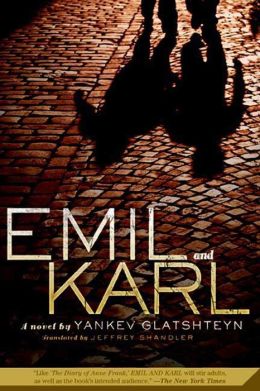
Emil and Karl. Yankev Glatshteyn. Translated from the Yiddish by Jeffrey Shandler. 1940/2006. Roaring Book Press. 208 pages. [Source: Review copy]
I love the idea of loving Emil and Karl by Yankev Glatshteyn. Emil and Karl was written in 1940 in Yiddish. It is set in Austria. It is the first--or at least among the very first--book written for children about the persecution Jews were experiencing from the Nazis.
Emil and Karl have always, always been best friends. Emil's Jewish. Karl's the son of socialists. Both are "orphans" in a way because of the Nazis. The book opens with intensity: readers first glimpse of Karl is haunting. Karl's mother has been taken away by the Nazis. He's witnessed this: not only the arrest, but the beating too. He's alone in the apartment, feeling very alone, very frightened, very worried. For they told him they'd be back to take him too. He doesn't know what to do next, where to go, who to trust. He decides to run to Emil's house. Emil's world has also been devastated within the past day or two. His father was taken and killed. His mother is grieving and shattered.
Karl and Emil are very much on their own it seems. The two stick together no matter what. They'll face danger and be put into difficult situations time and time again. There are many scenes that stay with you.
But while I find the premise of this one fascinating, it isn't the absolute best book about the holocaust. It may be among the first, but, that doesn't make it among the best of the best. Worth reading? I think so if you already have an interest in the subject. But if you only read one book on the subject, I'd have to recommend you go with another book.
© 2015 Becky Laney of Becky's Book Reviews
Showing posts with label Roaring Book Press. Show all posts
Wednesday, March 11, 2015
Friday, February 06, 2015
The Graham Cracker Plot
The Graham Cracker Plot. Shelley Tougas. 2015. Roaring Brook Press. 288 pages. [Source: Library]
Most of The Graham Cracker Plot is a notebook or journal written to Judge Henry. The heroine, Daisy (Aurora Dawn) Bauer, though twelve, has gotten into trouble with the law. When the novel opens, Daisy is convinced of one thing. It is ALL Graham's fault. By the novel's close, will she have accepted responsibility for her role in 'The Graham Cracker' plot?
Will this review have spoilers? It depends. I tell no more than what the opening sentences reveal on the jacket flap. Actually, I reveal far less than the jacket flap does. In my opinion, this particular jacket flap reveals EVERY detail of the book. But the whole format of the book is an after-the-fact perspective of events.
So what is the Graham Cracker plot? Well. Daisy's father is in prison. She calls him the Chemist. (To my recollection, readers don't learn his real name.) She visits her father once a month with her grandmother. That is, she's supposed to be allowed to visit him once a month. Actually, Daisy loses her privilege of seeing him because of her behavior, her privileges are suspended for either three months or six. She loves the Chemist. And she hates to see him in prison. Not that she hates going there and seeing him. She feels she needs to see him in order to be okay. But she hates that he is in prison at all. She strongly feels that the Chemist is innocent and doesn't deserve to be in prison at all. The Graham Cracker plot is about breaking him out of prison and fleeing to Canada. It is the work primarily by two (troubled) children: Graham Hassler and Daisy herself. They get another person involved--Ashley. From start to finish, the Graham Cracker plot is a complete mess, a cringe-worthy failure of a plan. No matter what happens, however, Daisy and Graham want to carry on and keep on going.
Readers already know that the plan goes horribly wrong, and that Daisy is being 'punished' in some way for her involvement.
What I liked best about The Graham Cracker plot was the development of Daisy's character. The Daisy we meet at the beginning of the novel, is not quite the same Daisy readers are left with at the close. Some maturing has occurred. Which is a good thing, in my opinion. This one does have cringe-worthy moments. Moments where the characters are making horrible decisions--embarrassingly bad decisions.
© 2015 Becky Laney of Becky's Book Reviews
Most of The Graham Cracker Plot is a notebook or journal written to Judge Henry. The heroine, Daisy (Aurora Dawn) Bauer, though twelve, has gotten into trouble with the law. When the novel opens, Daisy is convinced of one thing. It is ALL Graham's fault. By the novel's close, will she have accepted responsibility for her role in 'The Graham Cracker' plot?
Will this review have spoilers? It depends. I tell no more than what the opening sentences reveal on the jacket flap. Actually, I reveal far less than the jacket flap does. In my opinion, this particular jacket flap reveals EVERY detail of the book. But the whole format of the book is an after-the-fact perspective of events.
So what is the Graham Cracker plot? Well. Daisy's father is in prison. She calls him the Chemist. (To my recollection, readers don't learn his real name.) She visits her father once a month with her grandmother. That is, she's supposed to be allowed to visit him once a month. Actually, Daisy loses her privilege of seeing him because of her behavior, her privileges are suspended for either three months or six. She loves the Chemist. And she hates to see him in prison. Not that she hates going there and seeing him. She feels she needs to see him in order to be okay. But she hates that he is in prison at all. She strongly feels that the Chemist is innocent and doesn't deserve to be in prison at all. The Graham Cracker plot is about breaking him out of prison and fleeing to Canada. It is the work primarily by two (troubled) children: Graham Hassler and Daisy herself. They get another person involved--Ashley. From start to finish, the Graham Cracker plot is a complete mess, a cringe-worthy failure of a plan. No matter what happens, however, Daisy and Graham want to carry on and keep on going.
Readers already know that the plan goes horribly wrong, and that Daisy is being 'punished' in some way for her involvement.
What I liked best about The Graham Cracker plot was the development of Daisy's character. The Daisy we meet at the beginning of the novel, is not quite the same Daisy readers are left with at the close. Some maturing has occurred. Which is a good thing, in my opinion. This one does have cringe-worthy moments. Moments where the characters are making horrible decisions--embarrassingly bad decisions.
© 2015 Becky Laney of Becky's Book Reviews
Monday, November 03, 2014
Port Chicago 50
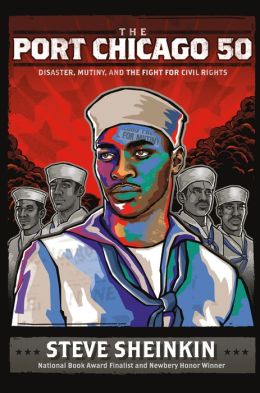
The Port Chicago 50: Disaster, Mutiny, and the Fight for Civil Rights. Steve Sheinkin. 2014. Roaring Brook. 208 pages. [Source: Library]
Wow! What a book! Port Chicago 50 is a compelling nonfiction read. It is informative and detailed, but, it never felt like it was too much, like it was too-information-heavy. It was fascinating and at times shocking. It examines HOW African-Americans were treated in the navy during the second world war. It deals with prejudice and discrimination and injustice. Specifically it focuses on a select group of soldiers stationed at Port Chicago. The soldiers moving explosives from docks to ships were all African-Americans. These soldiers received no special training or instructions. It didn't take them long to figure out that disaster could come at any time, that every day came with big, big risks. Disaster did come. It was awful. It changed the survivors--haunted the survivors. So when these men are asked weeks later to go back to work with explosives, well, some decide to say no. The book is ultimately about 50 men who decided that they did not want to obey orders to load explosives. About the consequences of their actions--or inaction as the case may be. The men were charged with mutiny and put on trial. Would justice be served? Would they have a fair hearing?
The Port Chicago 50 is emotional and fascinating. It was a beautifully written story about the fight for justice and equality. It was everything a nonfiction book should be.
Definitely recommended.
© 2014 Becky Laney of Becky's Book Reviews
Wow! What a book! Port Chicago 50 is a compelling nonfiction read. It is informative and detailed, but, it never felt like it was too much, like it was too-information-heavy. It was fascinating and at times shocking. It examines HOW African-Americans were treated in the navy during the second world war. It deals with prejudice and discrimination and injustice. Specifically it focuses on a select group of soldiers stationed at Port Chicago. The soldiers moving explosives from docks to ships were all African-Americans. These soldiers received no special training or instructions. It didn't take them long to figure out that disaster could come at any time, that every day came with big, big risks. Disaster did come. It was awful. It changed the survivors--haunted the survivors. So when these men are asked weeks later to go back to work with explosives, well, some decide to say no. The book is ultimately about 50 men who decided that they did not want to obey orders to load explosives. About the consequences of their actions--or inaction as the case may be. The men were charged with mutiny and put on trial. Would justice be served? Would they have a fair hearing?
The Port Chicago 50 is emotional and fascinating. It was a beautifully written story about the fight for justice and equality. It was everything a nonfiction book should be.
Definitely recommended.
© 2014 Becky Laney of Becky's Book Reviews
Thursday, June 03, 2010
Birthmarked (YA)
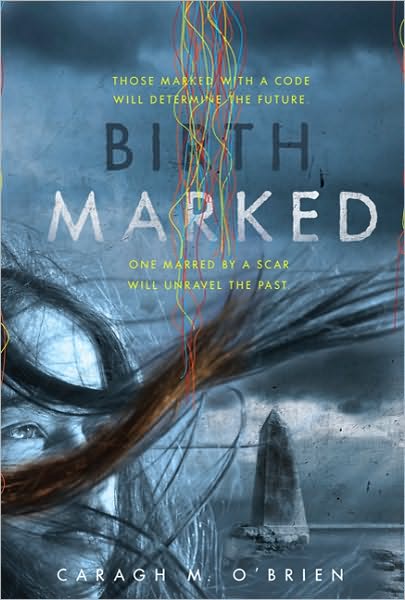
Birthmarked. Caragh M. O'Brien. 2010. March 2010. Roaring Brook Press. 368 pages.
In the dim hovel, the mother clenched her body into one final, straining push, and the baby slithered out into Gaia's ready hands.
Gaia is a young woman training to be a midwife just like her mother before her. When Birthmarked opens, Gaia is attending her first birth. For the first time, she'll be the midwife--not just the apprentice. What Gaia doesn't know is that at the very time she's attending this birth, her parents are being arrested by the Enclave. When she returns home, when she learns this truth, her life is forever changed.
Birthmarked is an emotional read. Or at least I found it to be so! In the first chapter, Gaia helps a woman deliver a baby--a girl--only to take that baby away from its distraught mother. This newborn babe will never know its mother, for she is one of the babies being "advanced" that month. Gaia sees this as just the way things are. Some babies are advanced, others aren't. It's just a given that a couple will lose some of its children to the Enclave. They should just be grateful, right? Because life in the Enclave is better than life on the outside, right? That's how it appears on the Tvaltar anyway. And what reason would the Enclave have for lying?
After Gaia learns of the arrest, she's in a vulnerable position. She's forced into questioning everything. She has to reflect on her life--on her past, on everything she knows about her parents--and to begin contemplating her future. Should she continue to serve the Enclave? Should she continue to hand over babies even if the monthly quota goes up? Should she cooperate with the Enclave? Even if it means incriminating her parents?
I am fascinated by futuristic books, dystopias especially. I enjoyed this one. I would recommend it!
Other reviews: Presenting Lenore, There's A Book, What Book Is That?, Reading Rocks, Steph Su Reads, The Reading Zone, Kids Lit, One Librarian's Book Reviews, Bloggin' Bout Books.
© Becky Laney of Becky's Book Reviews
Labels:
2010,
dystopia,
review copy,
Roaring Book Press,
YA Fiction,
YA Science Fiction
Thursday, April 23, 2009
Emil and Karl
Glatshteyn, Yankev. 2006. Emil and Karl. Square Fish. (Roaring Book Press) 194 pages.
There is an immediacy and urgency to Emil and Karl. Written in 1938--in Yiddish--it was only recently (2006) translated and published in English. Set in Austria, Vienna to be exact. The Third Reich is in power, yet the horror of World War II has not yet dawned. The full wrath unleashed during the Holocaust--the organized full-scale murdering of the Jewish people*--has yet to begin. Though the hate is strong and ever-present. Meet Emil and Karl. Best friends. One is Jewish. The other is not. But despite it being in Karl's "best interest" to forget about his Jewish friend, Emil, he can't brush him off.
The seriousness of the novel is apparent from the very beginning. When we first meet Karl, he is alone.
"Karl sat on a low stool, petrified. The apartment was as still as death. He looked at the pieces of the broken vase scattered on the floor. Several times he reached out with one hand to pick up an overturned chair lying beside him. The chair looked like a man who had fallen on his face and couldn't get up. But each time Karl tried, he could only lift the chair up a little bit, and then it fell down again. It was even quieter in the kitchen and the bedroom--so quiet he was afraid to go in there. It wasn't that Karl minded being in the apartment by himself. He'd been left alone there more than once before; he could even go to bed by himself without being afraid. He wasn't scared of spooks or devils. Instead, he loved to stare, wide-eyed, into the darkness and make up stories." (1)
Why is he afraid? He witnessed what I imagine would have seemed the unthinkable. He watched them take his mother. He watched them hurt her. He heard their threats. He heard them threaten to come back...for him. In one night, everything in Karl's world is turned upside down.
When he does move, act, it is to go see his friend, Emil. He seeks the comfort of a true friend. What he learns is that Emil too has changed. Emil and Karl have an enemy in common now. Both have been orphaned. Both have only each other. Can these two children find a way to survive in this topsy-turvy ever-dangerous world where hate rules supreme?
What makes Emil and Karl unique--in my opinion--is its urgency. When it was written, this wasn't a distant event in the past. This wasn't historical fiction. This was current events. This was the threat and danger facing the world. And at the time it was written, it was a threat that had not been conquered. There's a suspenseful quality to it. A sense of the unknown. There was no happy ending light at the end of the tunnel to brighten it up. In fact, the worse was yet to come. It's an emotional novel; it's brilliantly and intelligently written to make you feel that you are there, that you are witness.
*I'm not forgetting that the Holocaust also was about murdering other people as well. There were political prisoners as well as the targeting of gays and gypsies.
© Becky Laney of Becky's Book Reviews
If you're reading this post on another site, or another feed, the content has been stolen.
Labels:
1940,
2006,
J Fiction,
Roaring Book Press,
Square Fish,
YA Fiction
Subscribe to:
Posts (Atom)