Showing posts with label Holocaust. Show all posts

Monday, September 16, 2024

71. Not Nothing

71. Not Nothing. Gayle Forman. 2024. 288 pages. [Source: Library] [MG Historical Fiction] [3 stars]

First sentence:  Let me tell you a story. Actually, it's two stories, one you will recognize and one you won't. One is about me and you. The other is about the boy. But it's also about me. And about you. I know. I'm not making sense. I'm 107 years old. It goes with the territory. Forgive me my meanderings.

Premise/plot: Alex, aka "the boy," has an opportunity--or "opportunity" to change direction in his life--as appointed by the court. He'll be doing time--community service--at Shady Glen Retirement Home. He's reluctant, as you might expect, in part because everything that could be going wrong in his life has gone wrong and is continuing to go wrong. Nothing is going his way. As he's doing his service, he forms a bond with a resident, the 107 year old narrator, Josey (aka Josef???) who hasn't spoken in years (in fact those that work there thought he was unable to speak.) He tells the boy his life story--primarily focusing on the second world war. Meanwhile, there's things happening at Shady Glen and he's becoming friendly with others as well. 

My thoughts: Definitely an almost. The premise seems like it would be an absolutely perfectly perfect fit for the kind of book that I would love. I love intergenerational stories. I love stories with a strong focus on friendship...and stories with a strong focus on storytelling. Yet I had a hard time connecting with any of the characters. This might be ALL on me. Reading is subjective. This might be a little well everyone (and their dog) is saying that this is the best book of the year so therefore I can get contrary at times when a book doesn't live up to the hype. Or it could be merely the timing of when I read it. 

The narration did not always seem cohesive to me. I found myself slightly confused at times. Never knowing if I'd dropped the plot and spaced out for a few pages or if the book was written in a disorienting way. I also thought the narration wasn't constant; that is a horrible way to describe it. But if the narrator is stuck in his room AND/or he's stuck at Shady Glen 24/7, then I think he knew too much and the focus was too wide for it to be truly his perspective. I would have almost preferred third person omniscient. It was also weird for me--personally--that the narration continued after the character's death. I also thought the "big reveal" of the crime was a little clunky in that wouldn't Shady Glen have known ahead of time????

 This one just didn't sit "as right" with me as I wanted it to. Again, I thought it would be a book that I absolutely loved and I ended up in a very meh place. 

--This one is being called
timely
timeless
book we all need
perfect
life-affirming
mind-expanding
heart-wrenching

© 2024 Becky Laney of Becky's Book Reviews

Monday, January 01, 2024

1. Courage to Dream


Courage to Dream: Tales of Hope in the Holocaust. Neal Shusterman. Illustrated by Andres Vera Martinez. 2023. [October] 256 pages. [Source: Library]

Genre(s): Graphic novel, short stories, historical fiction, speculative fiction, alternate realities, MG fiction, 

First sentence of "He Opens a Window": Gretchen, No! 

Premise/plot: There are five thematically-linked stories told in graphic novel format. The approach isn't strictly historical, each story has a speculative twist [science fiction, fantasy]. It definitely has a Twilight Zone feel. I don't mean it in a glib way. While some might view Twilight Zone as just being entertainment and spooky fun, there are some thought-provoking episodes. The stories in Courage to Dream ARE thought-provoking. They engage you on a what-if or what-might-have-been level. 

The five stories are "He Opens a Window," "Legend Speaks of a Superhero...," "Spirits of Resistance," "Exodus," and "The Untold."

My thoughts: As I mentioned above, this one very much embraces the twisty-turns of speculative fiction.

Will this one be for every reader? Probably not. It isn't historically "true" or "accurate" enough to read to really learn the realities [of the horrors] of the Holocaust. It is very much a serious, sobering sci-fi twist to our reality. 

I found all five stories memorable and haunting. I don't know that I could pick a true favorite of the bunch. "Exodus" might stand out a little more than the others. My least favorite story is probably "Spirits of Resistance" (but I could see it being someone's favorite.)

I do think it can be enjoyed by readers middle grade on up. I found it enjoyable as an adult.

© 2024 Becky Laney of Becky's Book Reviews

Monday, October 09, 2023

169. Impossible Escape


169. Impossible Escape: A True Story of Survival and Heroism in Nazi Europe. Steven Sheinkin. 2023. [August] 256 pages. [Source: Library] [MG Nonfiction; YA Nonfiction]

First sentence:  Rudi would find a way to fight Adolf Hitler. It can be said, without risk of exaggeration, that he would go on to be--while still a teenager--one of the great heroes of the entire Second World War. But not in a way he ever could have imagined.

Premise/plot: Nonfiction for middle school and high school. To be fair, nonfiction for everyone. [But I might be biased in thinking everyone needs to read World War II books, in particular books about the Holocaust.] This one tells the story of two teens: Rudolph (Rudi) Vrba and Gerta Sidonová. 

My thoughts: I had read about Rudi Vrba  [Walter Rosenberg] before in an adult book. So I knew what to expect. It didn't make this one less necessary. I think it is important for stories to be told to all audiences, in appropriate ways of course. I found it a quick, absorbing read. I think for those that know less it might be even more so. 

Last October I read Jonathan Freedland's The Escape Artist. It was an AMAZING, amazing read. Difficult topic/subject to be sure. Definitely thought provoking. This one for young adults seems tamer. But I do think it is still a good read.


© 2023 Becky Laney of Becky's Book Reviews

Thursday, May 04, 2023

92. Signs of Survival


Signs of Survival: A Memoir of the Holocaust. Renee Hartman with Joshua M. Greene. 2022. (2021) 128 pages. [Source: Library]

First sentence: Renee: In 1943, German soldiers rounded up the Jews living in my city, Bratislava, and sent them to death camps to be killed. 

Premise/plot: Signs of Survival is nonfiction for young(er) readers. It is the story of Renee and Herta, two sisters sent to Bergen-Belsen. Renee was the only 'hearing' member of her family. Her sister and parents were deaf. She is the ears of her family. After their parents are taken away, these two rely on one another. Rely might not be the right word--together they are better, stronger; being together keeps hope alive. 

The book alternates between the two girls. The last third of the novel is an aftermath, what happens to the two sisters after the war is over and they are freed from the concentration camp. 

My thoughts: I am completely unoriginal when it comes to reviewing these types of books. I always say the story is compelling. (True once again). I always say that nonfiction is powerful. (Again true this time too.) I always say every voice is worth being heard, and that every story matters. (True and true.) If you find yourself drawn to Holocaust stories and/or war stories, this one is worth your time. It is for a younger audience. (I'd say elementary school, mid-to-upper elementary schools). It is probably more intense than say Number the Stars. This one offers a unique perspective (all survivor stories could be said to be unique, I don't mean to compare apples and oranges). The situation is 100% terrifying no matter what. To imagine being in that situation and unable to hear and communicate--seems to magnify the terror. Herta relies on Renee to sign everything she needs to know.


© 2023 Becky Laney of Becky's Book Reviews

Friday, February 24, 2023

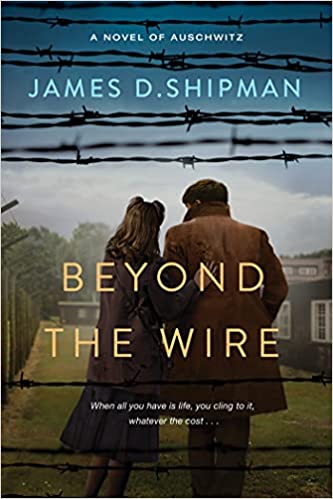
44. Beyond the Wire


Beyond the Wire. James D. Shipman. 2022. 349 pages. [Source: Library]

First sentence: The screams faded. Jakub hunted through the coat of a dead man. He searched with a practiced hand, groping through pockets, fingering seams. He felt something hard. Eyes forward, he tore at the fabric, ripping open a secret pocket. An object fell into his hand, circular and metallic. A watch. He glimpsed a flash of gold. 

Premise/plot: Beyond the Wire is a historical novel set at Auschwitz-Birkenau circa 1944 through 1945. Jakub, our protagonist, has managed to survive the concentration camp...so far. But at great cost. His job, one of the 'cozier' jobs of the camp, is to go through the possessions of the new arrivals--those soon to be gassed/murdered. He is able to steal here and there enough to keep the guards bribed. He can buy extra food. He can buy his way into the women's camp to socialize. Anna, our second protagonist, is Jakob's girlfriend. They meet secretly. He is her protector. But they have secrets from one another... Jakob has been approached multiple times by Roch Laska, a prisoner who is plotting a revolt/revolution. Tomasz, Jacob's best-friend-and-companion, is dead-set against Jakob joining such a plot/scheme. Anna is "for" him joining, by the way. But soon he finds himself mixed in with the rebellion...for better or worse...and it starts with someone who is threatening Anna.

My thoughts: This is a very intense read. The author has a note on which elements of the story are 'true' and which are pure fiction. I believe the main characters--our two protagonists--are fictional. This one is packed with action and heartache.


© 2023 Becky Laney of Becky's Book Reviews
Monday, February 20, 2023

41. The Tower of Life


The Tower of Life: How Yaffa Eliach Rebuilt Her Town In Stories and Photographs. Chana Stiefel. Illustrated by Susan Gal. 2022. 40 pages. [Source: Library]

First sentence: There once was a girl named Yaffa. She was a spirited girl who loved her home and her family. She was born in a shtetl, a small Jewish town that pulsed with love, laughter, and light. The name of her shtetl was Eishyshok (Ay-shi-shok). The family roots of the people in Eishyshok ran deep. For 900 years, their histories and spirits were woven into the fabric of the town. 

Premise/plot: Nonfiction picture book and/or nonfiction picture book biography. I could see it being classified as either/both. The jacket copy says it is the biography of Yaffa Eliach the woman who created "the Tower of Faces" (aka The Tower of Life) at the Holocaust Memorial Museum in Washington, DC. It is definitely the story of her life, her work, her life's work. But it is also so much more than that. It is the story of her community, and the story of the Holocaust as well.

My thoughts: I found this one FASCINATING. I really loved this nonfiction picture book. I loved learning the story behind The Tower of Faces. Though I'd not heard of this particular exhibit, I have heard of the Holocaust Memorial Museum. I would love to learn more about this exhibit and the others as well. I loved, loved, loved the photographs of this one.

I found it a powerfully compelling read. I'm not surprised a bit that it won the Sydney Taylor Book Award. (It was also a Robert F. Sibert Honor book). 


© 2023 Becky Laney of Becky's Book Reviews

Thursday, November 03, 2022

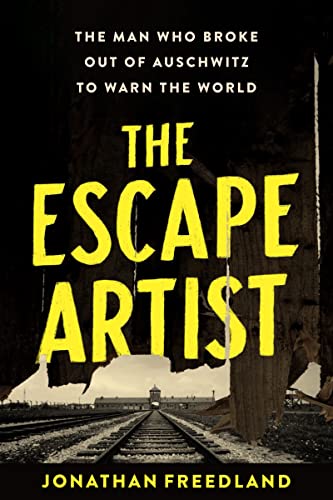
141. The Escape Artist


The Escape Artist: The Man Who Broke Out of Auschwitz To Warn the World. Jonathan Freedland. 2022. [October] 400 pages. [Source: Library]

First sentence: FROM THE START he knew he was special. He was not yet Rudolf Vrba, that would come later. His name was Walter Rosenberg and he had only to look into his mother’s eyes to know he was a one-off. Ilona Rosenberg had waited so long for him, desperate for his arrival. She was already a stepmother – her husband, Elias, came with three children from a previous marriage – but that was not the same as holding a baby of her own. For ten years, she had yearned for a child; the doctors told her she should stop hoping. So when Walter arrived on 11 September 1924, she greeted him like a miracle.

Premise/plot: The Escape Artist is a biography of Walter Rosenberg/Rudolf Vrba. He and Fred Wetzler escaped from Auschwitz--quite a feat--and tried their best to warn the world--especially, especially the Hungarian Jews who were the next target of the Nazis--about the "Final Solution." But that is only a fraction of his story. This is his life story, not only the story of those horrifying war years. Those chapters--which are considerable--are heart-shattering. But just because the contents are heart-shattering and horrifyingly tragic, doesn't mean that readers should look away. All voices should be heard. 

My thoughts: Words don't do this book justice. I know that. I found it an incredible read. Incredibly thought-provoking. Incredibly sad. Incredibly memorable. Sad seems an obvious description due to the subject, but, different kinds of sadness. His life after the war, for example, and how his early experiences effected his marriages (there were two) his children (there were two) and his overall health (mental and physical). The book never once uses the term PTSD, but, certainly I think that might explain so much. Another kind of sadness is that as heart-breaking, heart-shattering, horrifying, and haunting as the Holocaust was--and he witnessed so, so, so, so much, he didn't think that was the most tragic thing that ever happened to him. But I hesitate to spoil this one.

Quotes:

And yet Walter only really began to know of it that moment in Kanada where, in that pile of tiny shoes, the truth was staring him too hard in the face and he could not look away. Perhaps he could be forgiven for taking so long to understand what would eventually seem obvious, for failing to absorb the evidence that surrounded him, for failing to turn clear facts into knowledge. The SS had taken great pains to keep this operation hidden, even from those who were living at the scene of the crime.

The Nazis lied to their victims at every step of their journey towards destruction, step after step after step. Those people falling out of those stinking cattle trucks had boarded them believing they were being taken to new lives in a new place: ‘resettlement in the east’, they called it. Those Jews had packed up their belongings and held on tight to them because they thought they were building a new home, one that would need pots and pans, clothes for their backs and toys for their children. They believed that because that was what the Nazis had told them and it was what their own friends and families had told them, in the form of those postcards home that they did not realise had been written at gunpoint – those messages of forced cheer that Walter had heard read out on the train on the way to Majdanek – and which were designed to seal the lie.
 
For at eighteen years old Walter would witness events so harrowing they could change the life of the person who glimpsed them. He was witnessing such moments not once or twice, but day after day after day. He was in Auschwitz, a place where moral boundaries had dissolved long ago, where everything was permissible. This was a place where Dr Mengele once punished a Jewish woman by making a dog of her young son, because she had, in self-defence, killed an SS attack dog: he had the boy trained at the point of a whip to run on all fours, bark without pause and attack and bite Jews. Walter was in a place where one inmate might steal bread from another, even when that prisoner was dying and when the bread was covered in faeces. 
 
He had drawn a conclusion that would become an article of faith, an unshakeable creed that would drive every decision he took next. He now understood that the difference between knowledge and ignorance, between truth and lies, was the difference between life and death.
It was clear to him from then on that the Jews destined for destruction could defy their fate here only if they knew of it, incontrovertibly and before it was too late. Somehow Walter had to get out of this place and tell the world what was happening. He did not know it yet, but he was about to meet the people who could help.
 
If he had to be a spectator to horror, then he would make himself a witness. He would be a reporter. Christmas came and went, the SS forcing their Jewish captives to learn and sing ‘Stille Nacht’ – ‘Silent Night’ – perhaps to remind the Germans of home. Those who did not sing it properly were murdered. In Birkenau, the SS put up a huge Christmas tree and on Christmas Eve they brought out a group of prisoners. For their own entertainment, they gave the men a pointless task, ordering them to gather up soil in their coats, shooting any man who collected too little. Then they stacked the corpses in a heap under the tree, piled up like festive gifts.
 
The way Walter saw it, they had been written off by the world the day they stopped being Alfréd Wetzler and Walter Rosenberg and became prisoners 29162 and 44070, if not the day they stepped on to those deportation trains. True, they had become people of standing in the Auschwitz inmate hierarchy, but all that was lost now. The moment they crept out from under that fence they had entered a social vacuum. They knew no one; they had no one.
 
Rudolf Vrba was not an entirely new creation. There had been an influential Czech Catholic priest of that name who had died five years earlier, having built a reputation as an energetic antisemite: he had proposed a set of measures to secure the exclusion of Jews from Bohemian life. But the new Rudi, as he was to become, was not bothered by that association, if he was aware of it at all. (Nor, apparently, was he much fazed by sharing his new first name with the commandant of Auschwitz.) All that mattered was to be free of what, to him, was the Germanic taint of ‘Rosenberg’. He wanted to sever every connection with that supposedly ‘civilised’ nation. Walter Rosenberg was no more. From now on, and for the rest of his days, he would be Rudolf Vrba, with a name that was impeccably Czech, carrying no hint of German or, for that matter, Jew. The two men, reborn as Jozef and Rudi, headed for the mountains. Meanwhile, the work of their lives, the Auschwitz Report, was about to embark on a journey of its own.
 
Those audiences would have thrilled to hear the story of his escape and his mission to tell the world of Auschwitz, but he never left it at that. He would not serve up a morally comfortable narrative in which the only villains were the Nazis. Instead he always insisted on hitting out at Kasztner and the Hungarian Jewish leadership, as well as the Jewish council in Slovakia. He faulted them for failing to pass on his report and, in the Slovak case, for compiling the lists that had put him on a deportation train in the first place.
What made Rudi a more awkward witness still was his tendency to refer to the Jews whom he blamed as ‘Zionists’. As it happened, Rudolf Vrba was a supporter of Israel and rooted for it: he believed that the existence of the state of Israel was a good thing for Jews and for the world. But he could not contain his anger against those Zionists who he felt had betrayed the Jewish people, starting with Kasztner.
 
Rudolf Vrba refused to conform to what the world expects of a Holocaust survivor.
 
Rudi had to confront the fact that his younger self had been wrong to believe that the Allies did not know, and wrong to believe that they would come to the rescue of the Jews if they had. But he could cling to one last conviction: that if the Jews of Hungary had only known what he and Fred knew and had written down in their report, then they would have refused to go to their deaths.
Rudi held fast to that belief, and yet in his later years that too would be challenged.


© 2022 Becky Laney of Becky's Book Reviews
Monday, November 01, 2021

135. Don't Tell the Nazis


Don't Tell the Nazis. Marsha Forchuk Skrypuch. 2019. 226 pages. [Source: Library]

First sentence: I huddled close to my sister under the comforter and prayed that we'd live through the night. At any moment the door might burst open and we could be dragged from our beds.

Don't Tell the Nazis opens in June 1941 in Ukraine in the days leading up to the Soviet retreat and the Nazi occupation. The Ukrainians suffered at the hands of the Soviets--no doubt--but any hope is short-lived that treatment under the Nazi regime would improve. If anything, the situation worsens. The book follows a young girl, Krystia, and her family. She'll face more than any child--any human--should be made to endure.

Don't Tell the Nazis is not an easy book to summarize. What you should know is that it is intense, compelling, heartbreaking, disturbing, haunting. It's the kind of book that requires a freezer. It is inspired by a true story, but it has been fictionalized to a certain degree. I found the author's note fascinating.

 It is not the kind of book any reader "enjoys" reading. It is horrific and traumatic not because the author has a depraved, disturbed mind BUT because it is authentically capturing the horrifying and shocking truth of history. History that should never be denied, discounted, or dismissed. When history shocks and disturbs the answer is not to bury your head in the sand but to take notice, listen, and learn.

© 2021 Becky Laney of Becky's Book Reviews

Tuesday, August 10, 2021

86. The Light of Days


The Light of Days: The Untold Story of Women Resistance Fighters in Hitler's Ghettos. Judy Batalion. 2021. 288 pages. [Source: Library]

 First sentence from the introduction: In the spring of 2007, I lived in London and worked as an art historian by day and a comedian by night. I was writing a play about strong Jewish women, and I wanted to learn more about Hannah Senesh, one of the few female resisters in World War II who was not lost to history.

First sentence from chapter one: On Friday, October 10, as the Jews in the small Polish town of Jedrzejow (pronounced YEN-jeh-yuf in Polish) were shutting their shops and preparing for the Sabbath--a day of religious observance--Moshe Kukielka rushed from his store.

There is a central character in this one: Renia Kukielka. But it isn't the story of one person--one woman. It is the story of many working together in Poland during the Second World War. The book opens with a Who's Who: Renia Kukielka, Sarah Kukielka, Zivia Lubetkin, Frumka Plotnicka, Hantze Plotnicka, Chajka Klinger, Gusta Davidson, Hela Schupper, Irena Adamowicz, Bela Hazan, Ruzka Korczak, Vitka Kempner, Faye Schulman, Anna Heilman. You might be tempted to skim it lightly--or even skip it altogether. I won't judge you if you do. But by the end, I'm guessing you'll circle back around in appreciation of what the author has accomplished.

The book, obviously, is set in Poland in the years leading up to the Second World War and the war itself. The focus is on the Jewish communities and neighborhoods. The stories of the ghettos. One doesn't need to use melodrama and imagination to paint the picture--just facts and accounts. This book highlights those that actively resisted. It follows a dozen or so characters through these war years...and if the text alone isn't compelling enough...hitting you right in the heart....the book concludes with PHOTOGRAPHS of those mentioned in the book.

It was a powerful, intense, compelling, substantive read. It was very good.

Quotes:

How do you react to news that you are going to be killed? Do you try to stay optimistic to keep your sanity? Or do you fight back?
When Zivia heard about the mass execution, she didn't doubt it for a second. Other Jews had escaped from death camps and shared their own shocking stories.
If anything, Zivia felt guilty. Why hadn't she seen more clearly that the Nazis meant to kill all Jews? Why hadn't she done more sooner? Precious time had been wasted.


I pledge to engage in active resistance within the framework of the Jewish Fighting Organization of the Halutz Youth Movement. I swear by everything most dear to me, and above all by the memory and honor of dying Polish Jewry, that I will fight with all the weapons available to me until the last moment of my life to resist the Germans, the National Socialists, and those in league with them, the mighty enemies of the Jewish people and of all humanity. I pledge to avenge the innocent deaths of millions of children, mothers, fathers, and aged Jewish people, to uphold Jewish spirit, and to raise the flag of freedom proudly. I pledge to shed my own blood fighting to achieve a bright and independent future of the Jewish nation. I pledge to fight for justice, freedom, and the right of all human beings to live in dignity. I will fight side by side with those who share my desire for a free and equitable social order. I will serve humanity faithfully, dedicating myself without hesitation to achieving human rights for all, subordinating my personal desires and ambitions to that noble cause. I pledge to accept as a brother anyone willing to join me in this struggle against the enemy. I pledge to set the seal of death on anyone who betrays our shared ideals. I pledge to hold out to the end, not to retreat in the face of overwhelming adversity or even death.

© 2021 Becky Laney of Becky's Book Reviews

Tuesday, May 26, 2020

73. The Tale of a Niggun

The Tale of a Niggun. Elie Wiesel. Illustrated by Mark Podwal. 2020. [November] 64 pages. [Source: Review copy] [World War II; Holocaust; Poetry]

First sentence: A ghetto, somewhere in the East, during the reign of night, under skies of copper and fire. The leaders of the community, good people all, courageous all, fearing God and loving His Law, came to see the rabbi who has cried and cried, and has searched darkness for an answer with such passion that he no longer can see. It’s urgent, they tell him, it’s more than urgent; it’s a matter of life or death for some Jews and perhaps all Jews.

Premise/plot: The Tale of a Niggun is a narrative poem by Elie Wiesel originally published circa 1978 within a larger collection of works honoring Rabbi Wolfe Kelman. It has newly been republished on its own--or soon will be published in November 2020.

The setting is a GHETTO in the midst of the second World War. The leaders are seeking an answer to an impossible question: should they supply the Nazis with a list of TEN names of people to be deported/taken? If they fail to give a list, then ANY could be taken or ALL could be taken. Perhaps every person will die as a result of not cooperating. Yet wouldn't it be murder to cooperate and help choose WHO dies? A rabbi reluctantly wrestles with this question seeking out the wisdom of his ancestors.

My thoughts: It's a quick read but super-super-super intense and masterful. It is written as a narrative poem. It may at first seem intimidating to the non-Jewish reader, BUT, a helpful glossary is provided in the back of the book that will prove super helpful.

if the enemy wishes to kill, let him kill—and do not tell him whom to kill. Your role, my young brother and colleague, the role of rabbi is to be with his Jews, not facing them. Should they be summoned by God or the enemy, should they choose to respond, do as they do, walk with them, pray with them or for them, howl with them, weep as they weep; share their anguish and their anger as you have shared their joy; see to it that the sacrifice imposed by the enemy unites his victims instead of separating them; as rabbi, there is only one call you must issue: Jews stay together, Jews stay together as Jews. 


© 2020 Becky Laney of Becky's Book Reviews

Wednesday, May 08, 2019

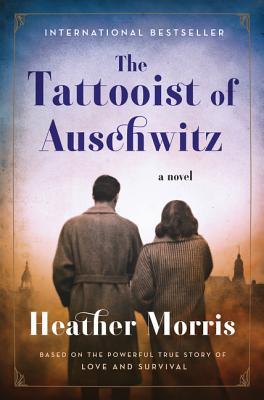
World at War: The Tattooist of Auschwitz

The Tattooist of Auschwitz. Heather Morris. 2018. 262 pages. [Source: Library]

First sentence: Lale tries not to look up. He reaches out to take the piece of paper being handed to him. He must transfer the five digits onto the girl who held it. There is already a number there, but it is faded. He pushes the needle into her left arm, making a three, trying to be gentle. Blood oozes. But the needle hasn't gone deep enough, and he has to trace the number again. She doesn't flinch at the pain Lale knows he's inflicting. They've been warned--say nothing, do nothing. He wipes away the blood and rubs green ink into the wound.

Premise/plot: The Tattooist of Auschwitz is a novel based on a true story. It is the story of a young man, Lale, who survives in part because of his important work--tattooing numbers on all the arrivals as they enter Auschwitz-Birkenau. He falls in love at first sight with a young woman he tattoos. He learns her name and which block she lives. (Her name is Gita). A courtship--albeit not a traditional one--begins. Three years--three long years--the two fight to hold onto hope, to survive, to cling to one another no matter how hard it gets. His job comes with a few privileges, and he takes advantage of that fact though not in a selfish way. Though many might find reason to resent him, his kindness and compassion shine through. He makes friends; he is even on civil terms with a few of the Nazis.

The novel focuses on the years 1942-1945.

My thoughts: I found this to be a compelling read. Not every Holocaust book features a romance--this one does. I definitely enjoyed Lale and Gita's story. I was cheering for them from the first. Though I could have peeked at the end to see if both survived the war, if the two got their happily ever after, I resisted. I'm glad I did. I would definitely recommend this one.


© 2019 Becky Laney of Becky's Book Reviews
Wednesday, April 24, 2019

World at War: Resistance

Resistance. Jennifer A. Nielsen. 2018. Scholastic. 385 pages. [Source: Review copy]

First sentence:  Two minutes. That's how long I had to get past this Nazi.

Premise/plot: Resistance is set in Poland during the Second World War. Our heroine, Chaya Lindner, is a courier for the resistance. She's Jewish, but she's able to pass as Polish. She slips in and out of Jewish ghettos thanks to her forged papers, appearance, and COURAGE. She is able to smuggle in food, weapons, forged papers, information, and other black market items. She is able to smuggle out children. It's dangerous work. She's known that from day one. But she's fully committed to the cause--saving lives, resisting Nazis, killing Nazis. She is not alone.

When Chaya first meets Esther, she has doubts--BIG DOUBTS. Esther doesn't look like she's capable of helping the cause--far from it. Chaya is convinced that working with Esther will put them--the resistance cell--all in danger. People could die because of Esther. But is Chaya wrong about Esther? Only time will tell.

My thoughts: What a book! Those three words don't say nearly enough. Yet I always hesitate to say that I love, love, love a book that is so dark and intense. Though these characters are fictional, the story of resistance is not. There were real men, women, children who were part of the Jewish/Polish resistance. Many--though not all--died. To resist could lead to death. To not resist would lead to death. There were no easy, safe choices. This is an emotional read starring two very different heroines.

"I wonder if this will ever end."
"The war?"
"The hatred. I remember my father saying that he'd finally come to believe the world had moved past its hatred of Jews, and then this happened."
"Maybe when the world opens its eyes to what has been done to us, they will realize how destructive hate can be."
Esther shrugged again. "Maybe. But they'll forget again, in time. And when they forget, this will all start once more."
I put an arm around her and used it to straighten her posture, "Enough of us must survive the war to tell our stories, and every story will matter. When they remember our stories, they will forget their hatred." (160)

"Why do the Nazis feel they can commit such violence against us? How do they justify it?"
I shrugged. "Because they believe we are less than human. Like animals."
"Exactly! They herd us into train cars like cattle, give our rabbis and scholars the work of oxen, feed us less than what is given to their dogs. And they kill us with no more regard than they'd give to slaughtering a farm animal. But there is something a human can do that an animal never can."
"Create art." I considered that for a moment. "So you sing because--"
"It's proof of my humanity. It allows me, just for the length of that song, to remember who I really am, no matter what surrounds me." (272)

"I loved my father, Chaya. I still do. But being in the Judenrat was an impossible situation. I remember at the beginning, he thought he could help the people here, and he did a lot of good. But very soon, the choices weren't between good and bad, they were between bad and awful."
"A choiceless choice," I mumbled. "There is no winning, only a decision as to how we will lose." (296)
 

© 2019 Becky Laney of Becky's Book Reviews

Wednesday, March 13, 2019

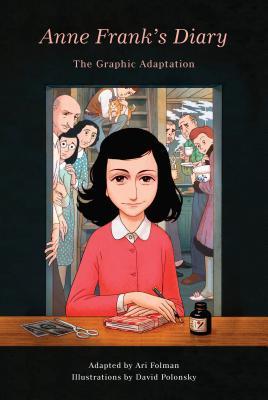
Anne Frank's Diary: The Graphic Adaptation

Anne Frank's Diary: The Graphic Adaptation. Adapted by Ari Folman. Original text by Anne Frank. Illustrated by David Polonsky. 2018. 160 pages. [Source: Review copy]

First sentence: No one would believe me, but at the age of 13, I feel totally alone in this world.

Premise/plot: This is a graphic novel adaptation of Anne Frank's Diary of a Young Girl. It is not unabridged by any means; the text has been condensed/adapted. But much of the text remains recognizably Anne's own words.

My thoughts: I really enjoyed this one. I don't usually enjoy graphic novels....but...every now and then I find myself loving one. Did I love this one? Yes, for the most part. I think the adaptation was well done. It condensed some of the material--which almost by necessity is a bit repetitive--and put the emphasis on some of the more dramatic sections. The book remains a coming-of-age memoir; readers witness Anne's emotional ride through puberty in the midst of war and uncertainty. I liked how the amount of text varied throughout. Sometimes Anne's own words are more powerful than any image could ever hope to be. And sometimes the illustrations really convey Anne's inner life remarkably well. For example, there's a spread where the illustrator is showing how Anne feels about being compared to her "perfect" sister Margot. That was PRICELESS in my opinion. Another great example is an illustration revealing Anne's disgust with her dentist roommate. She finds HIS UNDERWEAR on Kitty--her diary. That would certainly explain a lot if it is true.

I reviewed the definitive edition of her diary earlier this year where I discussed my reactions to Anne's text.

© 2019 Becky Laney of Becky's Book Reviews
Wednesday, February 20, 2019

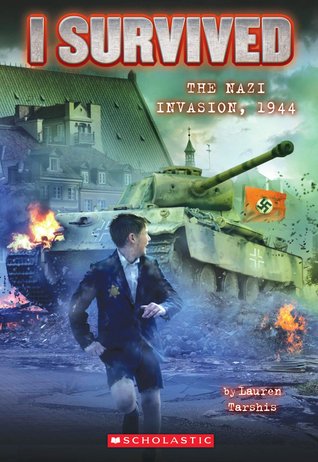
World at War: I Survived The Nazi Invasion 1944

I Survived The Nazi Invasion, 1944. Lauren Tarshis. 2014. Scholastic. 112 pages. [Source: Review copy]

First sentence: All across Europe, Jewish people were being hunted. Millions were already dead. But eleven year old Max Rosen was determined to stay alive.

Premise/plot: Can Max and his sister, Zena, survive the Holocaust? Can they avoid being shot by Nazis? rounded up by Nazis? blown up by Nazis? bombed out by Nazis? Is hiding out in the forests of Poland the best plan? How about joining the Resistance fighters?

My thoughts: I did like this "I Survived..." title better than the one I read earlier in the year. I did like Max and his sister, Zena. I was relieved they survived. But I'm also a little surprised that their father, their Papa, managed to escape a train bound for a concentration camp...and make his way to his kids hiding out in the Forest. I haven't really heard any stories of people who successfully escaped off the train and actually made it to safety. When the novel opens, he's been gone a little over a month--a month since his arrest. It just seems a bit too convenient that this happy reunion happened. Not that I wanted this book to be tragic.

© 2019 Becky Laney of Becky's Book Reviews
Tuesday, December 05, 2017

The Librarian of Auschwitz

The Librarian of Auschwitz. Antonio Iturbe. Translated by Lilit Thwaites. 2017. 424 pages. [Source: Library]

First sentence: The Nazi officers are dressed in black. They look at death with the indifference of a gravedigger.

Premise/plot: Though it is a work of fiction, The Librarian of Auschwitz is based on a true story: the story of a super-small library and its young librarian, Dita. Block 31 is different, special, almost miraculous and too good to be true. Here Jewish children come together every day while their parents labor under the watchful eyes of their guards. School is forbidden; learning is forbidden. But. A school it is. There are teachers and teenage helpers. Dita is one of the helpers or assistants. She's also the librarian. For what is a school without a library? This library collection, like the school, is completely forbidden. It consists of EIGHT books plus additional living books. Dita's job is risky, but important. Block 31 exists for one reason only: to fool the world in case someone comes looking for answers. The Germans mistreat Jews? You've got to be kidding. Just look! Here's a camp of families. We even see that the children are taken care of during the day and laugh and play and sing. The prisoners are not fooled for a minute, but, the children are fortunate in some ways.

The book is an intense, important read.

My thoughts: I would definitely recommend this one! It is a powerful, memorable story. It is well-written. Here are two of my favorite quotes:
"A book is like a trapdoor that leads to a secret attic; You can open it and go inside. And your world is different" (193)
"Life, any life, is very short. But if you've managed to be happy for at least an instant, it will have been worth living" (289)
© 2017 Becky Laney of Becky's Book Reviews

Wednesday, November 01, 2017

Almost Autumn

Almost Autumn. Marianne Kaurin. Translated by Rosie Hedger. 2012/2017. Scholastic. 278 pages. [Source: Review copy]

First sentence: Summer is over.

Premise/plot: Almost Autumn is set in Oslo, Norway in 1942. The heroine is a young teenager named Ilse Stern. She has an older sister and a younger sister. The novel opens with Ilse sneaking out of the house wearing a white dress with red polka dots. It's clearly a summer dress, and it is almost autumn. But she's meeting a boy, Hermann Rod, and it's more important to be beautiful than warm. He breaks the date, and disappoints the girl. But he's broken the date for an important reason: he's part of the Resistance, and he's trapped hiding in a building waiting for the Nazis to disperse. She doesn't know this, of course, no one does. Hermann isn't going to to around telling everyone what he's doing when he's not at work--not even his parents, especially not his parents. Hermann struggles in this one: should he warn Ilse Stern and her family to flee for their lives and press on her the urgency of the matter, the seriousness of the situation, or does he wait until he knows more?

Hermann isn't the only one struggling, there are others as well. Isak Stern is struggling as well. Should he and his family stay? Should they try to sneak out of the country and into Sweden? How much time does he have before it becomes critical? He's reluctant to make such a drastic, dramatic decision. But time isn't on his side.

Another who is struggling is a taxi driver who lives in the same apartment building. One day he's hired by the Germans for a secret project. He knows that it is wrong on every level to be doing what he's doing. Some of the Jews he's transporting for round-up are his friends, his neighbors. But he goes along with it anyway. Yet is he beyond redemption? Will he always lose the struggle with his conscience?

My thoughts: Almost Autumn is a fictional account of the Holocaust from the point of view of Norwegian Jews. In October, Jewish men were arrested and rounded up. In November, Jewish women and children were arrested and rounded up. They were sent by ship to concentration camps.
"The German ship Donau sailed from Oslo on the afternoon of that same day [November 26, 1942] with 532 Norwegian Jews on board. Only nine of those were to survive Auschwitz." (276)

Almost Autumn is dramatic but not overly dramatic. I think it's well worth reading. It's not unusual for Holocaust books to be set in Germany, Poland, or Austria, but how many have you read set in Norway? Even if there were dozens, no two stories are the same.

© 2017 Becky Laney of Becky's Book Reviews

Wednesday, June 28, 2017

The Pianist

The Pianist. Wladyslaw Szpilman. Translated by Anthea Bell. 1946/1999. 222 pages. [Source: Library]

First sentence: I began my wartime career as a pianist in the Cafe Nowoczesna, which was in Nowolipki Street in the very heart of the Warsaw ghetto.

Premise/plot: In 1946, I believe, Wladyslaw Szpilman published a memoir sharing his story of how he survived the war. The book was later translated into English and began to include extracts from the diary of Captain Wilm Hosenfeld. The book did inspire a film, and, the film won lots of awards. As for the contents of the book, the life he led during the war, the near-death encounters he experienced, the physical and emotional trials--shocks--he endured, I'm near speechless. His style is matter-of-fact. It is rich in detail that would have been fresh on his mind, but, his intention was not to shock or manipulate to gain sympathy. It is very unemotional. It isn't a book of feelings or emotions. It isn't a diary he recorded day-by-day that captures the in-the-moment horrors of the war.

My thoughts: I read this one before I watched the movie. I am glad I read it first. If it had packed the emotional punch of the movie though, I'm not sure I could have endured it. It isn't that the movie portrays things differently. In fact, one of the things I noticed almost immediately was how true-to-the-book it was. It was that by visualizing it--seeing it, hearing it--changes things. For example, the violence, the destruction, the horror of it all. If you've seen the movie, chances are you know what I'm talking about. There are dramatic, traumatic scenes that words just can't do justice to. At times I watched the movie almost in shock that humans could treat each other like this, that so much hatred could exist, that the world could be unjust. But then I'd switch from the movie to the news, and, it was all reaffirmed.

The movie is not devoid of hope, nor should it be. If its about humanity--it shows us at our best and at our worst. There is good to be found as well as evil. There are kind, generous, loving people as well as monsters.


© 2017 Becky Laney of Becky's Book Reviews

Friday, April 21, 2017

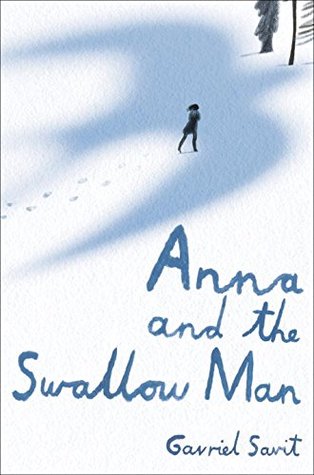
Anna and the Swallow Man

Anna and the Swallow Man. Gavriel Savit. 2016. 240 pages. [Source: Library]

First sentence: When Anna Lania woke on the morning of the sixth of November in the year 1939--her seventh--there were several things that she did not know...

Premise/plot: The day after Anna's father disappears forever, she follows a stranger into the forest because of a brief connection they shared outside a shop. She wants to know his name, after all he now knows hers. But he thinks names are dangerous things, he allows her to call him Swallow Man. (She wanted to call him Solomon because he is WISE.) This one is set in Poland during World War II. These two wander around together for the duration of the war--or most of it. Both speak multiple languages well. But the language they speak most often is Road. It is impossible to lie when speaking Road he tells the innocent girl. Their stories change always from one encounter to the next. He is her whole world, her everything. But as she grows up, she begins to see that he has flaws. A time even comes when she has to make life or death decisions for them both.

Will Anna survive the war?

My thoughts: In this YA book, readers really only get to know three characters: Anna, the Swallow Man, and Reb Hirschl. I hated what happened to Reb. It was all so pointless in my opinion. Overall, I found the first half to be delightfully written, just beautiful sentences woven together to tell a unique story. The second half, however, was not a good fit for me. I became less enchanted of the Swallow Man, and more concerned for Anna. It made sense that facts were hazy impressions when she was seven. Not so much when she became older.

At first I thought this one would be a good match for Book Thief fans, but by the end it just didn't hold up. Definitely more for adults who love literary fiction and non-endings.

Quotes:
Disappointment, though heavy, is an easy enough thing to pack away in a suitcase--it has straight edges and rounded corners, and it always fits into the last remaining empty space. Hope is much the same. But somehow the hybrid of the two is something much less uniform--awkward, bulkier, and no less heavy. It is far too delicate to pack away. It must be carried in the hands. (224)
© 2017 Becky Laney of Becky's Book Reviews
Friday, January 29, 2016

Hana's Suitcase

Hana's Suitcase. Karen Levine. 2002/2016. Crown Books. 144 pages. [Source: Review copy]

Would I recommend Hana's Suitcase by Karen Levine? Yes, yes, a thousand times yes. This would be a great introduction to the subject of the Holocaust for elementary students. (My first "Holocaust book" was The Hiding Place by Corrie ten Boom. Do you remember your first Holocaust book?) One reason why I think it would be a good fit for young readers is the way the subject is approached. It is unusual and unique. It is a story about children learning about the Holocaust for the first time. It is about the learning process--the research process as well.

Chapters alternate between the present and the past. The "present" story begins with an empty suitcase, "Hana's" suitcase. This is an object found in a Japanese Holocaust museum. The children--and the director--are eager to know WHO IS HANA? They know her birth date, that she was Jewish, that she ended up in a Nazi concentration camp. But who was she? what did she look like? what was her family like? what was her childhood like? What happened to her? Did she survive? Did she die?

The present chapters narrate this learning-process, this investigation. I love that it illustrates history-coming-to-life, how fun and exciting history can be, even how relevant and important it can be to ask questions, to be persistent, to follow leads, etc.

There are also chapters set in the past that tell Hana's story, and tell it almost from her point of view. Readers ultimately learn that much of this information came from her brother who did survive the war. Because the chapters alternate, readers will get the answers to some questions before the people in the book.

I liked how these two stories come together. This one is worth reading.

© 2016 Becky Laney of Becky's Book Reviews
Monday, October 05, 2015

Somewhere There Is Still A Sun

Somewhere There Is Still A Sun. Michael Gruenbaum and Todd Hasak-Lowy. 2015. 384 pages. [Source: Library]

Looking to read a memoir of the holocaust? Michael Gruenbaum has teamed up with Todd Hasak-Lowry to write Somewhere There Is Still A Sun. This memoir is not reflective. In fact, it is actually written in present tense, first person present. I must admit that took a bit of getting used to on my part. In a way, it almost seems unnatural. But. It wasn't a distraction either. I did not stay focused on the mechanics of how it was written for long. I did get swept up in the narrative. And with good reason, it is compelling and intense.

There is an innocence to the narrator, to Misha, for he is as sheltered as he possibly can be as a Jew living in a Nazi-occupied country. That is, Misha hasn't really grasped how life-and-death the situation is. Misha is still focused on life, on things like playing soccer and going to the movies. His mother and older sister seem to be keeping some things from him, for better or worse. And these things don't come to the reader's attention until the author's note. (Do all readers read authors' notes? I do. But I'm not sure everyone does.) Because of Misha's innocence, many readers may know more than he does. (Though maybe not all readers. I don't want to presume that every single reader will have read five or six holocaust books by the time they come across Somewhere There Is Still A Sun.) It is an interesting position to be put in as a reader, to know more than a character.

Misha's memoir focuses on his time in a Jewish ghetto in Prague, and, in Terezin. Terezin is still relatively new to me to read about, so I found this one fascinating. For example, Misha takes part in one or two of the plays held in Terezin.

What I appreciated the most about Somewhere There Is Still A Sun is the focus on relationships--the bonds between characters. Misha is separated from his mother and sister for many years. He is one of many assigned to a room. (I want to say that forty young boys shared a room?) Relationships matter in books, and it really gives one a complete story.

© 2015 Becky Laney of Becky's Book Reviews