Showing posts with label adult poetry. Show all posts

Tuesday, October 13, 2020

123. Goblin Market


Goblin Market. Christina Rossetti. 1862. 48 pages. [Source: Bought]

First sentence:

Morning and evening
Maids heard the goblins cry:
“Come buy our orchard fruits,
Come buy, come buy:

Premise/plot: Laura and Lizzie are sisters. Lizzie warns Laura time and time and time again NOT to be tempted by the goblin men nor the wares they sell--their forbidden fruit. But Laura, well, Laura is mightily tempted and gives in despite the warnings, perhaps because of the warnings. At first, nothing tastes so wonderful and amazing as that forbidden fruit, but it comes at high cost--her very life is in danger. Can Lizzie find a way to save her sister? Or will she succumb like others before her now resting in the graveyard?

My thoughts: I have read this multiple times. Whenever I remember it, I remember it fondly. The poem is lovely. The language is exquisite. 

Laugh’d every goblin
When they spied her peeping:
Came towards her hobbling,
Flying, running, leaping,
Puffing and blowing,
Chuckling, clapping, crowing,
Clucking and gobbling,
Mopping and mowing,
Full of airs and graces,
Pulling wry faces,
Demure grimaces,
Cat-like and rat-like,
Ratel- and wombat-like,
Snail-paced in a hurry,
Parrot-voiced and whistler,
Helter skelter, hurry skurry,
Chattering like magpies,
Fluttering like pigeons,
Gliding like fishes,—
Hugg’d her and kiss’d her:
Squeez’d and caress’d her:
Stretch’d up their dishes,
Panniers, and plates:
“Look at our apples
Russet and dun,
Bob at our cherries,
Bite at our peaches,
Citrons and dates,
Grapes for the asking,
Pears red with basking
Out in the sun,
Plums on their twigs;
Pluck them and suck them,
Pomegranates, figs.”—

 It's an atmospheric read for this time of year that I recommend.

© 2020 Becky Laney of Becky's Book Reviews

Tuesday, May 26, 2020

73. The Tale of a Niggun

The Tale of a Niggun. Elie Wiesel. Illustrated by Mark Podwal. 2020. [November] 64 pages. [Source: Review copy] [World War II; Holocaust; Poetry]

First sentence: A ghetto, somewhere in the East, during the reign of night, under skies of copper and fire. The leaders of the community, good people all, courageous all, fearing God and loving His Law, came to see the rabbi who has cried and cried, and has searched darkness for an answer with such passion that he no longer can see. It’s urgent, they tell him, it’s more than urgent; it’s a matter of life or death for some Jews and perhaps all Jews.

Premise/plot: The Tale of a Niggun is a narrative poem by Elie Wiesel originally published circa 1978 within a larger collection of works honoring Rabbi Wolfe Kelman. It has newly been republished on its own--or soon will be published in November 2020.

The setting is a GHETTO in the midst of the second World War. The leaders are seeking an answer to an impossible question: should they supply the Nazis with a list of TEN names of people to be deported/taken? If they fail to give a list, then ANY could be taken or ALL could be taken. Perhaps every person will die as a result of not cooperating. Yet wouldn't it be murder to cooperate and help choose WHO dies? A rabbi reluctantly wrestles with this question seeking out the wisdom of his ancestors.

My thoughts: It's a quick read but super-super-super intense and masterful. It is written as a narrative poem. It may at first seem intimidating to the non-Jewish reader, BUT, a helpful glossary is provided in the back of the book that will prove super helpful.

if the enemy wishes to kill, let him kill—and do not tell him whom to kill. Your role, my young brother and colleague, the role of rabbi is to be with his Jews, not facing them. Should they be summoned by God or the enemy, should they choose to respond, do as they do, walk with them, pray with them or for them, howl with them, weep as they weep; share their anguish and their anger as you have shared their joy; see to it that the sacrifice imposed by the enemy unites his victims instead of separating them; as rabbi, there is only one call you must issue: Jews stay together, Jews stay together as Jews. 


© 2020 Becky Laney of Becky's Book Reviews

Monday, April 29, 2019

Hebrew Melodies

Hebrew Melodies. George Gordon, Lord Byron. 1815/1824. 70 pages. [Source: Bought]

First sentence: She walks in beauty like the night/ Of cloudless climes and starry skies,/ And all that's best of dark and bright/ Meet in her aspect and her eyes;/ Thus mellowed to the tender light/ Which heaven to gaudy day denies.

Premise/plot: Hebrew Melodies is a collection of poetry by Lord Byron first published in 1815. The poems were written to be set to music composed by Isaac Nathan. The first poem is perhaps one of Byron's best known poems, "She Walks In Beauty."

It seems some versions of Hebrew Melodies have twenty-eight poems, and other versions have thirty poems. The edition published in 1815 certainly did not have twenty-eight or thirty.  

My thoughts: Don't expect all the poems in Hebrew Melodies to be as wonderful as She Walks In Beauty. If you do, chances are you'll be disappointed with what you actually get.

Many of the poems have a melancholic almost fatalistic theme.

Did I "like" this collection? I am a more reluctant poetry enthusiast. I struggle with poetry. There are some poems that I do love, love, love. It is discovering poems that I do love that keeps me reading poetry instead of avoiding it. But I didn't really love this collection.

© 2019 Becky Laney of Becky's Book Reviews

Tuesday, May 15, 2018

For Every One

For Every One. Jason Reynolds. 2018. Simon & Schuster. 112 pages. [Source: Library]

First sentence: Dear Dreamer, this letter is being written from a place of raw honesty and love but not at all a place of expertise on how to make your dreams come true. I don't know nothing about that.

Premise/plot: For Every One is a poetic essay on the meaning of life. Is that an exaggeration? Maybe. It is a motivational--though realistic and honest--piece on ATTITUDE and PERSPECTIVE. If attitude and perspective don't play a major role in how you define the meaning of life, I don't know what does. Reynolds' piece is above all grounded in reality yet saturated in hope or optimism. This essay is written in verse.

My eyes
are swollen with exhaustion,
my body sputtering
on its way down,
but my dream
won't stop crying,
screaming
like a colicky
infant.
Sometimes I think
it needs to be changed.
Usually
It just needs to be fed.
So I feed it everything
I have.
And it feeds me everything
I have. (52-3)

My thoughts: I read this one twice. I really, really liked it. I hope it gets some love from readers of all ages.

The book celebrates the journey that all dreamers find themselves on. It's a journey that most--if not all--can relate to easily. It is a book for everyone. But even the author acknowledges that not every single book is for every single person. There are many books on dreams, on dreaming, on pursuing your dreams, on pursuing this evasive thing called SUCCESS. Not every book is a keeper. I hope this one is a keeper.


© 2018 Becky Laney of Becky's Book Reviews

Sunday, March 12, 2017

Poetry for Cats

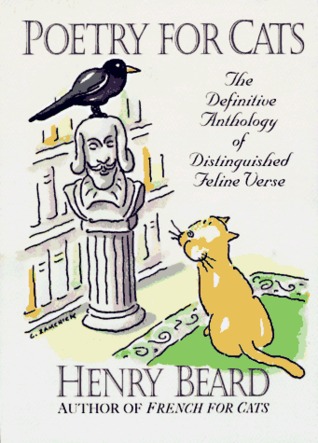
Poetry for Cats: The Definitive Anthology of Distinguished Feline Verse. Henry Beard. 1994. 96 pages. [Source: Borrowed.]

Premise/plot: Ever wonder what kind of poetry cats would write? What about the cats of famous poets?! In Henry Beard's Poetry for Cats he writes in the style (and punctuation) of some really famous poets from the perspective of their cats.
To go outside, and there perchance to stay/ Or to remain within: that is the question...William Shakespeare's cat
Vet, be not proud, though thou canst make cats die/ Thou livest but one life, while we live nine,/ And if our lives were half as bleak as thine,/ We would not seek from thy cold grasp to fly. John Donne's cat
How do I break thee? Let me count the ways. Elizabeth Barrett Browning's cat
If you can disappear when all about you/ Are madly searching for you everywhere,/ And then just when they start to leave without you,/ Turn up as if you always were right there;/ If you can shed your hair in any season,/ And cough up half of all that you devour,/ And rush from room to room without a reason,/ Then sit and stare at nothing for an hour; Rudyard Kipling's cat
Do not go peaceable to that damn vet,/ A cat can always tell a trip is due,/ Hide, hide, when your appointment time is set. Dylan Thomas's cat
My thoughts: I thought this one was very well done overall. I would have loved to see a list at the end pointing readers back to the original poems being parodied. I knew some of them--maybe even half of them. But I wasn't equally familiar with all of the poets being imitated. For cat lovers with an English degree, this is a very fun treat!

My favorite poem was without a doubt the one by Rudyard Kipling's cat! The whole poem is wonderful! I wish I could share it all. I thought the poem by Geoffrey Chaucer's cat was clever. "She thinketh that no Canterbury mous/ Be worth an expeditioun from hir hous,/" It also includes words like yschlept and sawgh. If you've attempted the original, how could you help grinning at this imitation? And it is easier to unpack, by the way!

I won't focus on each poem, but many of them are worth reading and rereading.

A few might be worth sharing with the whole family, but this isn't necessarily kid-appropriate book.

© 2017 Becky Laney of Becky's Book Reviews
Friday, May 20, 2016

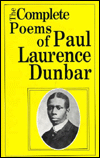
Complete Poems of Paul Laurence Dunbar

The Complete Poems of Paul Laurence Dunbar. Paul Laurence Dunbar. 290 pages. [Source: Library]

Last year I reviewed Jump Back, Paul a lovely biography of Paul Laurence Dunbar for middle grade and up by Sally Derby. I had never heard of Dunbar before picking up that book, and, it hooked me. I have been meaning to go and read MORE of his work ever since. Almost nine months later, I checked out The Complete Poems of Paul Laurence Dunbar.

It includes:
  • An introduction to Lyrics of Lowly Life by William Dean Howells
  • Lyrics of Lowly Life (1896)
  • Lyrics of the Hearthside (1902)
  • Lyrics of Love and Laughter
  • Lyrics of Love and Sorrow
  • Lyrics of Sunshine and Shadow (1905)
  • Miscellaneous
Some of the sections seem to be titled after poetry collections published during his life. But not all. Since the book claims to be the COMPLETE poems, I'm assuming that poems from his other published books have been arranged and gathered into the other sections.

I enjoyed reading this one very much. Enjoyed may not convey how deeply I feel about this collection of poetry! I loved it. I truly LOVED, LOVED, LOVED it. As in, why did NO ONE tell me about him before?!?! How could I have gone this long without knowing who he is and what he wrote?!?!

So roughly half of his poems--give or take--are written in dialect. Now readers may have valid reactions to this--either loving or hating it. I personally loved it. I did. I think the key to deciphering dialect is to HEAR it as you read.

Here is one of the first dialect poems that appears in Lyrics of Lowly Life. It is called Accountability.
FOLKS ain't got no right to censuah othah folks about dey habits;
Him dat giv' de squir'ls de bushtails made de bobtails fu' de rabbits.
Him dat built de gread big mountains hollered out de little valleys,
Him dat made de streets an' driveways wasn't shamed to make de alleys.

We is all constructed diff'ent, d'ain't no two of us de same;
We cain't he'p ouah likes an' dislikes, ef we'se bad we ain't to blame.
Ef we'se good, we need n't show off, case you bet it ain't ouah doin'
We gits into su'ttain channels dat we jes' cain't he'p pu'suin'.

But we all fits into places dat no othah ones could fill,
An' we does the things we has to, big er little, good er ill.
John cain't tek de place o' Henry, Su an' Sally ain't alike;
Bass ain't nuthin' like a suckah, chub ain't nuthin' like a pike.

When you come to think about it, how it's all planned out it's splendid.
Nuthin's done er evah happens, 'dout hit's somefin' dat's intended;
Don't keer whut you does, you has to, an' hit sholy beats de dickens,--
Viney, go put on de kittle, I got one o' mastah's chickens.
Dunbar also wrote in "literary English." (That is how they are referred to by Howells in the introduction.) Half of the poems are written in this way, this style.

Here is one of his "literary" poems that appears early in that same collection. (It's the second poem.) It's called The Poet and His Song.
A SONG is but a little thing,
And yet what joy it is to sing!
In hours of toil it gives me zest,
And when at eve I long for rest;
When cows come home along the bars,
And in the fold I hear the bell,
As Night, the shepherd, herds his stars,
I sing my song, and all is well.

There are no ears to hear my lays,
No lips to lift a word of praise;
But still, with faith unfaltering,
I live and laugh and love and sing.
What matters yon unheeding throng?
They cannot feel my spirit's spell,
Since life is sweet and love is long,
I sing my song, and all is well.

My days are never days of ease;
I till my ground and prune my trees.
When ripened gold is all the plain,
I put my sickle to the grain.
I labor hard, and toil and sweat,
While others dream within the dell;
But even while my brow is wet,
I sing my song, and all is well.

Sometimes the sun, unkindly hot,
My garden makes a desert spot;
Sometimes a blight upon the tree
Takes all my fruit away from me;
And then with throes of bitter pain
Rebellious passions rise and swell;
But - life is more than fruit or grain,
And so I sing, and all is well.
Here are my favorite 'literary' poems:
  • The Seedling
  • We Wear the Mask 
  •  The Unsung Heroes (about African American soldiers) 
  • The Poet and His Song
  • Dawn
  • Christmas Carol
  • Riding to Town
  • If
  • Yesterday and Tomorrow
  • A Hymn 
  • By Rugged Ways
  • Sympathy
  • Roses 
  • Ione
Here are my favorite 'dialect' poems:
  • A Negro Love Song (with the refrain Jump back, honey, jump back)
  • Deacon Jones' Grievance
  • The Ol' Tunes
  • The Spellin'-Bee
  • Joggin' Erlong
  • When de Co'n Pone's Hot
  • Accountability
  • Signs of the Times (a poem about Thanksgiving) 
  • Soliloquy of a Turkey (a poem about Christmas)
  • Foolin' Wid de Seasons
  • James Whitcomb Riley


© 2016 Becky Laney of Becky's Book Reviews