Showing posts with label 1994. Show all posts

Tuesday, May 02, 2017

A Hat for Minerva Louise

A Hat for Minerva Louise. Janet Morgan Stoeke. 1994. 24 pages. [Source: Library]

First sentence: Minerva Louise loved snowy mornings. Her friends didn't like them one bit. They stayed inside all day with their heads tucked under their wings.

Premise/plot: Minerva Louise is back in her second adventure, I believe, and in this adventure she goes and plays in the snow. Part of this snowy-day adventure includes searching for WARM THINGS to put on which would enable her to stay out and play longer. She tries many things on before finding a "hat" to wear.

My thoughts: This one was silly. Minerva Louise is quite mistaken about a lot of things. For example, a water hose is not a scarf, and gardening gloves are not shoes. I like the silliness of it. The story overall was very enjoyable.

Text: 4 out of 5
Illustrations: 4 out of 5
Total: 8 out of 10
© 2017 Becky Laney of Becky's Book Reviews

Sunday, March 12, 2017

Poetry for Cats

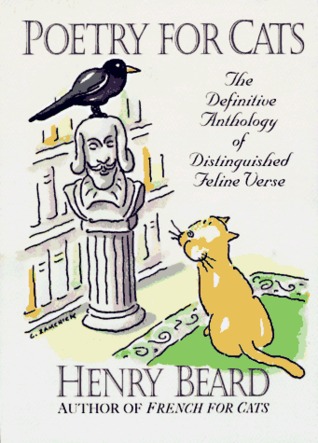
Poetry for Cats: The Definitive Anthology of Distinguished Feline Verse. Henry Beard. 1994. 96 pages. [Source: Borrowed.]

Premise/plot: Ever wonder what kind of poetry cats would write? What about the cats of famous poets?! In Henry Beard's Poetry for Cats he writes in the style (and punctuation) of some really famous poets from the perspective of their cats.
To go outside, and there perchance to stay/ Or to remain within: that is the question...William Shakespeare's cat
Vet, be not proud, though thou canst make cats die/ Thou livest but one life, while we live nine,/ And if our lives were half as bleak as thine,/ We would not seek from thy cold grasp to fly. John Donne's cat
How do I break thee? Let me count the ways. Elizabeth Barrett Browning's cat
If you can disappear when all about you/ Are madly searching for you everywhere,/ And then just when they start to leave without you,/ Turn up as if you always were right there;/ If you can shed your hair in any season,/ And cough up half of all that you devour,/ And rush from room to room without a reason,/ Then sit and stare at nothing for an hour; Rudyard Kipling's cat
Do not go peaceable to that damn vet,/ A cat can always tell a trip is due,/ Hide, hide, when your appointment time is set. Dylan Thomas's cat
My thoughts: I thought this one was very well done overall. I would have loved to see a list at the end pointing readers back to the original poems being parodied. I knew some of them--maybe even half of them. But I wasn't equally familiar with all of the poets being imitated. For cat lovers with an English degree, this is a very fun treat!

My favorite poem was without a doubt the one by Rudyard Kipling's cat! The whole poem is wonderful! I wish I could share it all. I thought the poem by Geoffrey Chaucer's cat was clever. "She thinketh that no Canterbury mous/ Be worth an expeditioun from hir hous,/" It also includes words like yschlept and sawgh. If you've attempted the original, how could you help grinning at this imitation? And it is easier to unpack, by the way!

I won't focus on each poem, but many of them are worth reading and rereading.

A few might be worth sharing with the whole family, but this isn't necessarily kid-appropriate book.

© 2017 Becky Laney of Becky's Book Reviews

Wednesday, September 28, 2016

The Worst Best School Year Ever

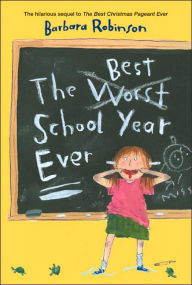
The Best (Worst) School Year Ever. Barbara Robinson. 1994. 117 pages. [Source: Bought]

First sentence: Unless you're somebody like Huckleberry Finn, the first day of school isn't too bad.

Premise/plot: This book is a sequel to the Best Christmas Pageant Ever. Both books are narrated by a girl named Beth who bear witness to the awfulness of the Herdman family. The book loosely takes place between the first and last days of school. The chapters are more episodic than linked to one another. All focus in on the Herdman family. Some chapters are better than others. I wouldn't say that any were wonderful.

My thoughts: I really LOVE, LOVE, LOVE The Best Christmas Pageant ever. And I think the reason why was that it had a point--a redemptive point. The Herdmans surprised everyone with their humanness, and, they weren't just the town joke when all was said and done. That isn't the case with The Worst Best School Year Ever. While there was one touching moment when Beth, the narrator, noticed Imogene at her best, that alone wasn't enough to make up for all the "let's laugh at the Herdmans." The scene I did like was when Beth noticed the initials on the blanket "returned" to baby Howard. I.H. When Howard lost his blanket--he was the bald baby whose head the Herdmans tattooed with waterproof markers--Imogene gave him her old blanket and pretended it was his that she had found. Only Beth suspected the truth. The first book seemed to end with a fuzzy removal of the "us" and "them" distinction. Not so with this one. And that is disappointing.

© 2016 Becky Laney of Becky's Book Reviews

Saturday, December 12, 2015

Seuss on Saturday #50

Daisy-Head Mayzie. Dr. Seuss. 1994. Random House. 56 pages. [Source: Library]

First sentence:  It's hard to believe such a thing could be true, And I hope such a thing never happens to you. But it happened, they say, to poor Mayzie McGrew. And it happened like this...

Premise/plot: Mayzie McGrew shocks everyone--first everyone at her school, and, then later the nation--when a daisy suddenly appears growing out the top of her head. So many unanswered questions?! What's to be done?!

My thoughts: I had never read this one before. Was I missing out? Not really. The story is a bit out of control and all over the place. Which may sound like a typical Seuss story, and, in many ways--at least in theory--it was. It just lacked a certain something. 

Have you read Daisy-Head Mayzie? Did you like it? love it? hate it? I'd love to know what you thought of it!

My Many Colored Days. Dr. Seuss. Illustrated by Steve Johnson and Lou Fancher. 1996. Random House. 32 pages. [Source: Library]

First sentence: Some days are yellow. Some are blue. On different days I'm different too.

Premise/plot: There's a color for each mood in My Many Colored Days.

My thoughts: I like the idea of this one, the premise of it. I like the exploration of moods and emotions and feelings. Of feeling many different ways, and, yet still being "me." I also appreciate the simplicity of the text. Some Seuss books are so very, very text-heavy.

Have you read My Many Colored Days? Did you like it? love it? hate it? I'd love to know what you thought of it!

If you'd like to join me in reading or rereading Dr. Seuss (chronologically) I'd love to have you join me! The next book I'll be reviewing is Hooray for Diffendoofer Day and The Bippolo Seed and Other Lost Stories. I'll be doubling up for the rest of the year each Saturday.

© 2015 Becky Laney of Becky's Book Reviews

Sunday, September 06, 2015

Meet Inspector Rutledge

A Test of Wills (Ian Rutledge #1) Charles Todd. 1994/2006. Harper Collins. 305 pages. [Source: Library]

A Test of Wills is the first book in Charles Todd's Inspector Ian Rutledge mystery series. He has returned home from war--the first world war--and is on his first case. It will prove challenging in more ways than one. First, the war has left him changed--broken, confused, uncertain. Second, the case itself is tricky. One of the suspects is super-friendly with royalty, and there is pressure to solve the case, but, solve it in such a way that there isn't a scandal. He is arriving on the scene several days after the crime, the murder, and he doesn't even see the crime scene or the body. His work mainly has him interviewing anyone and everyone that might have seen something--or heard something. But there aren't many leads that are fruitful. He has a handful of clues, but, the clues lead him to no one person. There's always something off. For example, the person with the best motive, has an alibi that is solid. The people with opportunity have no motive, etc. So can he do it? can he solve the case?

I liked this one well enough. Ian Rutledge is so very, very different from Bess Crawford. (I've read two or three of the Bess Crawford mystery series also by Charles Todd). Both show the effect of the war certainly. Bess Crawford mainly does this through her other characters: Bess is nursing men who have been wounded--sometimes severely--and/or are suffering from post traumatic stress disorder. The soldiers we meet in the Crawford mystery series certainly showcase the effect of war. But with the Ian Rutledge series it is completely different. It's an inside-out look, for better or worse. Ian is very broken, very disturbed, and we're in his head for the most part. It was an interesting aspect and added a new level to the mystery.

© 2015 Becky Laney of Becky's Book Reviews

Sunday, August 09, 2015

Walk Two Moons

Walk Two Moons. Sharon Creech. 1994. HarperCollins. 280 pages. [Source: Bought]

Gramps says that I am a country girl at heart, and that is true. I have lived most of my thirteen years in Bybanks, Kentucky, which is not much more than a caboodle of houses roosting in a green spot alongside the Ohio River. 

Did I love Sharon Creech's Walk Two Moons? Yes and no. On the one hand, it's a book that I know I would have either--as a kid-- avoided at all costs (if anyone had dropped hints of how sad it was) OR found myself hating, bitterly regretting having picked it up in the first place. There was a time I thought all sad books should be labeled. So at least you were making an informed decision before you got swept up in the story and invested a part of yourself in it. On the other hand--as an adult--I couldn't help finding it a beautiful and compelling story.

Sal--the heroine--is on a road trip with her grandparents (Gram and Gramps). They are on their way to "see" Sal's mother. That's what readers are told, and, as an adult I connected the dots early on. (Sal's world is upset when her Dad moves them to a new town after learning that the mom wouldn't be coming back.) But much is left a mystery for the reader. I can't honestly say how I would have interpreted the text as a kid. It doesn't really matter. The trip is enlivened by Sal's storytelling. She is telling the story of her new friend, her classmate, her almost-neighbor: Phoebe. (Readers also hear of other friends--classmates--including a boy named Ben.) Phoebe's life is also becoming something of a mess. Though Sal is better at spotting the signs than Phoebe herself. The book alternates between focusing on the past--Sal's new life, her friendships, her memories, her emotions--and the present, the road trip. Both stories are compelling. Mainly through dialogue, the grandparents become fully fleshed characters that you can't help loving and admiring. The way they love Sal, and, cherish her. There is just something sweet about this family. And readers do get to know them better than any other adult in the novel. Unfortunately, I think that is why the book left me angry. Part of me angry anyway. THE ENDING. I did not see it coming. And it was beyond cruel to this reader. Was it realistic? Yes. Looking back were their signs that it was coming? Probably. But though I guessed one reason why the novel was one of those dreaded SAD books. I didn't the second. And the second HURT so much.

Walk Two Moons is the 1995 Newbery winner.

Have you read Walk Two Moons? What did you think? Like it? Love it? Hate it? Do you like sad books? Or do you avoid them when you can?

© 2015 Becky Laney of Becky's Book Reviews

Tuesday, April 22, 2014

When Christ And His Saints Slept (1994)

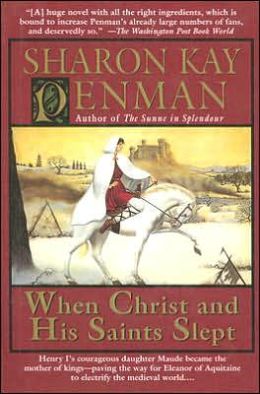
When Christ and His Saints Slept by Sharon Kay Penman. 1994. Random House. 746 pages. [Source: Bought]

I've been meaning to read more of Sharon Kay Penman's work for years now. When Christ and His Saints Slept is set in the twelfth century. It begins with the tragic sailing of The White Ship and ends with Henry II ready to be crowned king of England. For readers who like numbers, that would be 1120-1154. It covers the later part of Henry I's reign: his grief and desperation over the loss of his son and heir, his wanting his daughter, Maude, to be his successor; it covers the war--which lasted over ten years--between Stephen and Maude for the crown of England. Readers also get a chance to see Maude's son, Henry, grow up to become "Henry II."

It is a novel with many strengths. One of its greatest strengths, perhaps, is in the wide range of characters or narrators. Stephen and Matilda, on one side, Maude and Geoffrey, on the other. Readers meet the men (and women) who supported Maude, including many of Henry I's illegitimate sons. Readers meet the men (and women) who supported Stephen's claim to the throne. If there is a point to When Christ and His Saints Slept, it is this: war is ugly and cruel and pointless. Readers see Stephen and his supporters--his army--do horribly cruel things in the name of war. Readers see Maude's army do some equally horrid things. One side is not holier than the other. While neither army was as cruel as they possibly could be all the time, without ceasing, year after year, the truth was that England suffered greatly during this tug of war. The truth was very few cared WHO ruled England, so long as England was ruled peaceably and practically. The burning. The stealing and looting. The raping. The killing. The holding of hostages. England was in a BIG BIG mess if this was the best either side could manage.

If the novel has one hero, one "main" character, it would be Ranulf. Ranulf is a fictional illegitimate son of Henry I. It is not a stretch to fit him in historically since Henry I recognized over twenty such sons! Ranulf along with Robert and Gilbert and Miles and Brien, and countless others supported Maude and her claim to the throne. While the novel does focus on the battles, the war, the political mess--it also gives a personal side to the time period. Readers see Ranulf grow up a bit, fall in love, make mistakes, find true love, and settle down to marry and raise his own family.

If the novel is allowed to have more than one hero, well, an obvious choice to me is Henry II. The book covers his teenage years: 14 to 19. The last third of the novel truly focuses on Henry, on his relationship with his parents, with his relationship with Eleanor of Aquitaine. Those last few chapters are far from clean.

I loved how many characters we get to meet and know. I loved that we get to know men AND women from the time period, most of them historical figures, though not all. I loved that readers get introduced to real history. Penman's pacing was wonderful, I felt!

For readers who ENJOY history, When Christ and His Saints Slept is easy to recommend. She gives you enough context so that you're not lost (or at least not lost past all hope!) but it never weighed the text down in my opinion. I admit that "being lost" in a history book is all a subjective matter based on what one does or doesn't know heading into a book, but, I thought she did a good balancing job.


Quotes:
And so began for the wretched people of England, a time of suffering so great that they came to fear "Christ and his saints slept." (171)
If ever there was a woman unable to learn from her mistakes, it was this one for certes. No more than Stephen could. If the Lord God plucked him out of his Bristol prison on the morrow and restored him to power at Westminster, nothing would change. He'd still go on forgiving men he ought to hang, promising more than he could deliver, failing to keep the King's Peace. Maude and Stephen, a match made in Hell. What was it Geoffrey de Mandeville had once said--a lifetime ago? Ah, yes, that Maude would listen to no one and Stephen to anyone. Had there ever, he wondered, been a war like this? Was there a single soul--not related to them by blood or marriage--who truly wanted to see either one of them on England's throne? (281)
"I am truly glad to have you safe, Robert. But tonight I feel as if... as if we'd struggled and panted and clawed our way up a mountain, only to stumble just as we neared the summit and fall all the way down, landing in a bloodied, bruised heap at the bottom. What in God's Name do we do now?"
"I suppose," he said, "we start climbing again."
"How many of our men will have the heart for it?" Rising, she began to pace, "To come so close and then to have it all snatched away like this...it is so unfair, Robert, so damnably unfair!"
"Life is unfair," he said, sounding so stoical, so rational, and so dispassionate that she was suddenly angry, a scalding, seething, impotent rage that spared no one--not herself, not Robert, not God.
"You think I don't know that? When has life ever been fair to women? Just think upon how easy it was for Stephen to steal my crown, and how bitter and bloody has been my struggle to win it back. Even after we'd caged Stephen at Bristol Castle, he was still a rival, still a threat...and why? Because he was so much braver or more clever or capable than me? No...because I was a woman, for it always came back to that. I'll not deny that I made mistakes, but you do not know what it is like, Robert, to be judged so unfairly, to be rejected not for what you've done but for what you are. It is a poison that seeps into the soul, that makes you half crazed with the need to prove yourself..."
She stopped to catch her breath, and only then did she see the look on Robert's face, one of disbelief and then utter and overwhelming fury, burning as hot as her own anger, hotter even, for being so long suppressed.
"I do not know what it is like?" he said incredulously. "I was our father's firstborn son, but was I his heir? No, I was just his bastard. He trusted me and relied upon me and needed me. But none of that mattered, not even after the White Ship sank and he lost his only lawfully begotten son. He was so desperate to have an heir of his body that he dragged you back--unwilling--from Germany, forced you into a marriage that he knew was doomed, and then risked rebellion by ramming you down the throats of his barons. And all the while, he had a son capable of ruling after him--he had me! But I was the son born of his sin, so I was not worthy to be king. As if I could have blundered any worse than you or Stephen!"Maude was stunned. She stared at him, too stricken for words, not knowing what to say even if she'd been capable of speech. Robert seemed equally shattered by his outburst: his face was suddenly ashen. He started to speak, then turned abruptly and walked out. (343-44).
© 2014 Becky Laney of Becky's Book Reviews

Saturday, November 17, 2012

Lord of Chaos

Lord of Chaos. (Wheel of Time #6) Robert Jordan. 1994. Tor. 720 pages.

I struggled my way through Lord of Chaos. I didn't find it as easy to love as some of the earlier books in Robert Jordan's Wheel of Time series. Because I was so enthusiastic at the start of the series, it was disappointing to "just" like a book instead of love it.

Lord of Chaos does have almost all of the characters I've come to like, love, enjoy. (Of course, in this good vs. evil battle there are plenty of not-so-good characters.) Rand isn't having an easy time being the Dragon Reborn. Sure, some people love him or the idea of him. Some might arguably be a little too enthusiastic for the cause. But others hate him and will stop at nothing to bring him down. But rather it's love or hate, there are plenty who just don't know him at all. They see him as a symbol, an idea, not a human being. Being around Rand brings danger to his friends... But this is never just Rand's story. There are a dozen or so "main" stories in this series. And hundreds of characters--at least--to follow through the narration. Some characters seem to have chapters and chapters dedicated to them, and others just a couple. Unfortunately, the proportion this time around didn't match my interest level. That is also how I felt about much of Lord of the Rings. There were characters that I just LOVED, LOVED, LOVED so very much and whose stories I found so compelling and wonderful. And then there were other sections where I just kept reading so I could get to the good parts I knew were coming.

Read Lord of Chaos
  • If you're a fan of fantasy series, long fantasy series
  • If you enjoy epic battles between good and evil 

© 2012 Becky Laney of Becky's Book Reviews

Thursday, January 05, 2012

Death At Wentwater Court

Death at Wentwater Court. Carola Dunn. 1994. Kensington. 254 pages.

"He'll come to a bad end, mark my words, and she won't lift a finger to stop him. It's the little ones I'm worried about." The stout lady heaved a sigh, her old-fashioned mantle, a hideous yellowish green, billowing about her. "Four already and another due any day now."
Daisy Dalrymple was constantly amazed at the way total strangers insisted on regaling her with their life stories, their marital misfortunes, or their children's misdeeds. Not that she objected. One day she was going to write a novel, and then every hint of human experience might come in handy.

I found Death at Wentwater Court a pleasantly cozy read. Was it the best mystery ever? Probably not. But it was an enjoyable way to spend an afternoon. What I liked best about this mystery was the heroine. I just really enjoyed getting to know Daisy Dalrymple. And this novel--the first in a series--made me want to spend more time with her. I liked her personality, her character. And I also liked her love interest, Alec Fletcher, the inspector of the crime(s). Their conversations were quite fun! For those that like the lightest touches of romance with their mysteries, I think this one won't disappoint. I also enjoyed the setting of this one--England in the 1920s.

So Daisy Dalrymple is a journalist and photographer. She has come to Wentwater Court to write an article and take some lovely photographs. She is just getting to know the family--for better or worse, just beginning to make some observations about their personal lives--their troubles--when the worst happens. One of their guests is murdered. The murder isn't obvious, the body is found in such a way that it looks like an accident. But Daisy and her camera discover the truth....that a crime has been committed. What isn't obvious--to Daisy--is who did it.

Can Alec and Daisy solve this one?

Read Death at Wentwater Court
  • If you enjoy cozy mysteries
  • If you enjoy mysteries set in Britain
  • If you enjoy reading Dorothy Sayers and Agatha Christie
  • If you enjoy historical mysteries
  • If you're looking for a very light, very quick read

© 2012 Becky Laney of Becky's Book Reviews
Monday, April 18, 2011

What Jane Austen Ate and Charles Dickens Knew

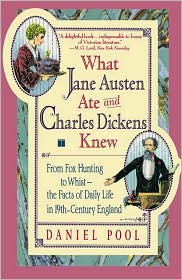
What Jane Austen Ate and Charles Dickens Knew: From Fox Hunting to Whist -- The Facts of Daily Life in 19th Century England. Daniel Pool. 1994. Simon & Schuster. 416 pages. 

I enjoyed reading What Jane Austen Ate and Charles Dickens Knew. I enjoyed reading about various aspects of life in 19th Century England. I won't lie. There were chapters and sections more appealing, more interesting than others. (I'll admit to "skimming" the sections on lawyers.) But, for the most part, I enjoyed it. I liked all the bookish references. I would say most--if not all--sections reference at least one or two British authors. Charles Dickens and Jane Austen, of course, but also including Anthony Trollope, Emily and Charlotte Bronte, Thomas Hardy, George Eliot, etc. (Sadly, he does not include Elizabeth Gaskell or Wilkie Collins.) He takes the time to name specific characters and situations from specific books to highlight and illustrate social customs. Readers may not be familiar with all of these characters, and sometimes what he says about a book could be considered spoilerish. But since these are books that have been around over a hundred years, keeping things spoiler free isn't a necessity.

This one is in two parts. (I read the first part. The second part is a glossary.) As you can see, it covers a little bit of everything--both public and private.

The Basics:
  • Currency, 
  • The Calendar, 
  • Hogsheads and Drams: English Measurement, 
  • England, 
  • London.

The Public World:
  • Precedence: Of Bishops, Barristers, and Baronets,
  • The Titled,
  • How To Address Your Betters
  • Esq., Gentl., KCB., etc.
  • Status: Gentlemen and Lesser Folk
  • Society: Society and "The Season," Basic Etiquette, How To Address the Nontitled, "May I Have This Dance?', The Rules of Whist and Other Card Games, Calling Cards and Calls, 
  • The Major Rituals: Presentation at Court, The Dinner Party, The Ball, The Country House Visit
  • Money: Being Wealthy, Entail and Protecting the Estate, Bankruptcy, Debt, and Moneylending
  • Power and the Establishment: The Government, Britannia Rules the Waves, The Army, The Church of England, Oxford and Cambridge, Schools, "The Law Is An Ass," Lawyers, Crime and Punishment

Transition:
  • The Horse
  • Please, James, the Coach
  • The Railroad
  • The Mail

The Country:
  • Life on the Farm
  • The Midlands, Wessex, and Yorkshire
  • Who's Who in the Country
  • Shire and Shire Alike: Local Government in Britain
  • "The Theory and System of Fox Hunting"
  • Vermin, Poachers, and Keepers
  • Fairs and Markets

The Private World:
  • "Reader, I Married Him"
  • Sex
  • An Englishman's Home
  • Houses with Names
  • Furniture
  • Lighting
  • How the English Kept Clean
  • "Please, Sir, I Want Some More."
  • Pudding!
  • Tea
  • Drink and the Evils Thereof
  • Women's Clothing
  • Men's Clothing
  • Servants
  • The Governess
  • A Taxonomy of Maids
  • Victorian Recycling

The Grim World:
  • The Orphan
  • Occupations
  • Apprentices
  • The Workhouse
  • Disease
  • Doctors
  • Death and Other Grave Matters

And if you'd like to read Jane Austen or Charles Dickens for the Classics Circuit blog tour, you've still got through tomorrow--April 19th--to sign up!

© 2011 Becky Laney of Becky's Book Reviews