Showing posts with label Newbery. Show all posts

Tuesday, February 11, 2025

14. First State of Being


14. First State of Being. Erin Entrada Kelly. 2024. 272 pages. [Source: Library] [4 stars, Newbery Medal, MG Speculative Fiction, MG Fiction, Time Travel]

First sentence: Peaches, Michael Rosario thought. That's what we need. His mother loved peaches. If the world came to a standstill at midnight on January 1, 2000, at least she would have two things she cherished: peaches and Michael.

Premise/plot: The year is 1999. Michael Rosario, the narrator, struggles with worry and anxiety. His biggest anxiety at the moment is the end of the world, aka Y2K. He is secretly hoarding food and supplies. Since he doesn't have money to pay--he's a kid, after all, just twelve--he's picked up the habit of shoplifting. His second biggest anxiety is that his mom will lose another job--just like before. Right now they are living paycheck to paycheck, he fears what would happen....if. There are so many 'ifs' of the future. He does have friends in the apartment complex, and, I believe he's friends with some--at least one--of the adults as well. But it is his new friend, Ridge, a friend who claims to be from the FUTURE and even has a book in hand that details historical events, who may just change his perspective and help him come into 'the first state of being' (aka living IN the moment, IN now).

 My thoughts: I enjoyed this one. I am so glad I finally read it. It had been on my want to read list for months. It recently won the Newbery Medal. I thought the premise of a time traveler was interesting. It is more usual, more typical, to read books from the point of view of the time traveler, that is not the case here. Michael is tempted--incredibly tempted--by trying to find out anything, everything, something--about the future. Here is his opportunity to KNOW what the future holds...but would knowing change things for the better or the worse? And what if the theories of how damaging knowing could be if it leads to changes.


© 2025 Becky Laney of Becky's Book Reviews

Saturday, October 22, 2022

135. Hitty: Her First Hundred Years


Hitty: Her First Hundred Years. Rachel Field. Illustrated by Dorothy P. Lathrop. 1929. 256 pages. [Source: Library]

First sentence: The antique shop is very still now. Theobold and I have it all to ourselves, for the cuckoo clock was sold day before yesterday and Theobold has been so industrious of late there are no more mice to venture out from behind the woodwork. Theobold is the shop cat--the only thing in it is that is not for sale, which has made him rather overbearing at times. Not that I wish to be critical of him. We all have our little infirmaties and if it had not been for his I might not now be writing my memoirs. Still, infirmities are one thing, and claws are another, as I have reason to know.

Premise/plot: Hitty, Her First Hundred Years won the Newbery award in 1930. Who is Hitty? Hitty is a doll. A wooden doll made from the ever-lucky mountain-ash wood. Her story begins when an Old Peddler--old peddlers are so rarely named in books--takes refuge with a family in Maine. Mrs. Preble is awaiting the return of her husband--who is a whaler--and she has the children to care for. One of her children is a young girl named Phoebe. (The other is a boy named Andy.) The Peddler takes refuge in the storm, but ends up staying quite a while with the family. At some point during his visit, he carves this doll--soon named Mehitabel--for the little girl. Phoebe's told she must sew clothes for the doll before she can be played with--and one of the items Phoebe makes is an undergarment--a chemise--with "Hitty" cross-stitched on it.

Hitty's (mis)adventures span the globe and span generations. Sometimes her change of locale is purposeful--when the Preble family takes her on a ship's voyage to the South Seas--and other times it is quite accidental--when Phoebe drops the doll in India and she is "discovered" by a wandering snake charmer. She has many different owners; she has many different adventures. Throughout it all, she tries to hold on to as much grace and dignity as she can. Which isn't always easy. (Like when she's made an idol in the South Seas.)

My thoughts: Hitty--the doll--is a plaything for children, yet, her various owners through the decades are only rarely children who play with her [and love her as a toy]. Many adults own Hitty. A seamstress sees Hitty as an opportunity to experiment with fashion design and fabrics. Another sees a pincushion. Some see an antique to be displayed and valued. Hitty's purpose changes and fluctuates. 

Much the same, Hitty--the book--may have started out its life as a children's book--a winner of the Newbery, no doubt--yet I venture forth a guess that most often her readers in the past few decades--at least--are adults. And perhaps that is for the best. There is without a doubt much value (or potential value) in vintage antiques. But sometimes antiques lose their suitability for children. Or perhaps the better word may just as well be appeal. I think it's a bit of both with the case of Hitty. 

Not all of Hitty is out of sorts or out of fashion. Plenty remains to charm. But there are definitely episodes--or chapters, or parts of chapters--that just are jarring to modern readers. A little cringe here or there. Injuns, savages, Hindoos...these are just a few of the things that might read a bit off. [One of Hitty's owners has a best friend who is a German immigrant, the German speaks very broken English.] 

As I said, Hitty isn't perfectly-perfect for modern readers. But it isn't without charm. Hitty is a wooden doll who sees, hears, thinks, feels, and sometimes even moves. She observes over a century--give or take a few years--of what we would call history. Imagine how much the world would change from 1829 to 1929! Hitty has "lived" life--the good, the bad, the really ugly. [A low point might be her YEARS buried in a horse-hair sofa.] Her misadventures/adventures have taken a lot out of her physically. Just like some might pass her by as an "ugly" doll, some readers might take a pass on Hitty. But I think she'll find friends here and there that do appreciate her for what she is.

© 2022 Becky Laney of Becky's Book Reviews

Wednesday, February 02, 2022

18. The Last Cuentista


The Last Cuentista. Donna Barba Higuera. 2021. 336 pages. [Source: Library]

First sentence: Lita tosses another pinon log onto the fire. Sweet smoke drifts past us into the starry sky. Her knees crack as she sits back down on the blanket next to me. The cup of hot chocolate with cinnamon she's made me sits untouched this time.

Premise/plot: Petra Peña, our heroine, might just be humanity's last chance to stay connected with our troubled past. The Collective has seemingly won the ultimate victory--making nauseating sacrifices all for a 'good cause.' What better way to protect humanity's future than to completely annihilate any memory of our past. (Even wiping away memories of the planet Earth.) But perhaps I'm rushing things a bit?

The novel opens with a few spaceships getting ready to leave Earth behind. Earth's destruction literally being days (perhaps less than one???) away. The deed being done by a comet. It will take hundreds of years to arrive on Sagan, the new planet believed to be capable of supporting life. Petra, her family, and the other families selected will be making the journey in stasis.

But the humans guarding the sleepers, well, they have thoughts, opinions, ideas that are radically dangerous. Dangerous might not be the right word--deadly might suit better. If memories cannot be totally erased and new programming rewritten, well then, OOPS, that's just a necessary sacrifice.

Petra seems to be the only one to retain her memories. Memories packed with stories, stories, and more stories. Being found out--or found out too soon--may be costly. It will take wisdom to know when to make her move, to act against the Collective... And even then resistance may prove futile. And even if dozens of things go right, well, the odds may not be in her favor. An unexplored planet with a million uncertainties. Still, she's humanity's last chance to REMEMBER, to reflect.

 My thoughts: Newbery Medal 2022. It's impossible to read Newbery winners with a completely open mind and low expectations. (Which, in my opinion, is how most books should be read for the highest degree of enjoyment.)

On the one hand, it celebrates stories, storytelling, and storytellers. It celebrates the notions that stories not only entertain but they inform as well. Stories help us make sense or process the world around us. Ourselves. Others. Life. Stories matter because even fiction (or in this case folklore) can contain truths that make us better. Maybe better isn't the right word. Stories contain truths that can give us an opportunity to think, engage, learn, grow, reflect, etc. Emotions and feelings can be chaotic, messy, overwhelming...stories help us manage life.

The book is political in that many, many science fiction stories are political. The book is essentially a dystopia set on a spaceship and another planet. Dystopias are almost always political because they show us power gone sour. The Collective is BAD news obviously. But how did the Collective come to be? That we really don't have a lot of answers for. Except that we know that the Collective is built on this one idea that knowledge of the past, our history, is irrevocably dangerous to our survival. Wipe out ALL memories of our mistakes, conflicts, tragedies, abuses, injustices, wars, etc., and humanity has a chance. In the same way that the futuristic society of The Giver celebrates SAMENESS. The Collective fears DIFFERENCES.
It asks the question--what is the value--is there value--in history? The Collective perhaps started out rewriting or revising history before changing tactics to annihilating and destroying.

I would argue that history always matters. Whether it be denial or revision, you can't learn from the past that you disconnect from. 

On the other hand, I really HATED the ending. Or non-ending if you will. I don't like endings where you are CLUELESS what happens and what it means. It might as well be written in a foreign language as far as I'm concerned. I've read the last few pages a few times, and still, I'm like what does it mean? what happened? what is about to happen? was it good? was it bad?

© 2022 Becky Laney of Becky's Book Reviews

Wednesday, October 13, 2021

131. Roll of Thunder, Hear My Cry


Roll of Thunder, Hear My Cry. Mildred D. Taylor. 1976. 288 pages. [Source: Library]

First sentence: "Little Man, would you come on? You keep it up and you're gonna make us late."

Roll of Thunder, Hear My Cry earned the Newbery Medal for 1977. The novel is set circa 1933 and stars the Logan family. Cassie Logan, our heroine, has brothers--many brothers, some older, some younger. The family is put through many trials as tension builds in their community. There is a thin line between holding onto one's dignity and staying strong and resolute AND doing what one must to survive the times. 

The family definitely is facing many grown-up problems. But the problems aren't limited to the grown-ups. No, the children--Cassie, Robert (her older brother), TJ (Robert's friend), etc. also face their own trials and tribulations. At its heart, Roll of Thunder, Hear My Cry is a coming of age story.

Roll of Thunder, Hear My Cry is a heavy novel. It is more bitter than sweet. There are many tragic notes. I do wonder if this is the kind of book that adults would appreciate a million times more than a child reader. 

The love and tenderness in this family are heartwarming. There are other books--some set earlier, some set later--that follow the Logan family. This is the only one I've read. I *believe* this was the first to be published. But GoodReads now lists it as FOURTH in the series. It used to be a trilogy--that I remember from book fair days--but now there are ten books in the series.

© 2021 Becky Laney of Becky's Book Reviews

Wednesday, February 26, 2020

33. New Kid

New Kid. Jerry Craft. 2019. 256 pages. [Source: Library][Newbery Medal; coming of age; mg realistic fiction; mg fiction; j realistic fiction; j fiction]

First sentence: This is how I feel every single day of my life, like I’m falling without a parachute.

Premise/plot: Jordan Banks is starting seventh grade in a new private school whether he wants to or not. His mom insists that this is the best for him and will teach him lessons he’ll need to succeed and thrive in life as an adult. His dad is less certain that this school—made up of 98 to 99% white students—is the only place to learn those lessons. Jordan finds himself one of two African American students in his classes. Drew is the other. One teacher—maybe even more—(and it’s their home room teacher at that) rarely calls them by the right name.

Overall, there are definitely some universal themes going on in this coming of age graphic novel. Jordan is an artist and not an athlete. He’s brand new to the school, some of these kids have known each other since kindergarten. He doesn’t hate every single thing about his new school, his classes, his classmates. But he doesn’t love everything either. He makes a few friends, but he’s not super popular and comfortable with the crowd. He is adjusting but not overnight. He wants to be seen, heard, understood, liked for who he is. Very universal that. Even if you’re not in middle school.

Race is kept front and center for the most part. This book examines what it is like to be black in a mostly only white private school.

My thoughts: It is the Newbery Medal for 2020. I am glad I read it. I would not have sought it out on my own because graphic novels aren’t usually my thing. But I liked it, definitely liked it.

One scene that stuck out to me—resonated with me—was the one where his homeroom teacher finds his art journal, reads it without permission, confronts and judges him. I hate that she is accusing him of being angry, having a bad attitude and not trying hard enough to adjust or fit in at the school. First she had no business to read his private journal—art or not. Second she took his accounts and experiences and negates his feelings, experiences, etc. and blames him for not being happy happy joyful grateful for being there. As if he would prefer to be teased and doesn’t want to be friends with anyone. 


© 2020 Becky Laney of Becky's Book Reviews

Tuesday, January 14, 2020

9. The Giver

The Giver. Lois Lowry. 1993. Houghton Mifflin. 180 pages. [Source: Library] [Children's Fiction; Dystopia; MG Fiction; Newbery Medal]

First sentence: It was almost December, and Jonas was beginning to be frightened. No. Wrong word, Jonas thought. Frightened meant that deep, sickening feeling of something terrible about to happen. Frightened was the way he had felt a year ago when an unidentified aircraft had overflown the community twice. He had seen it both times. Squinting toward the sky, he had seen the sleek jet, almost a blur at its high speed, go past, and a second later heard the blast of sound that followed. Then one more time, a moment later, from the opposite direction, the same plane.

Premise/plot: Jonas, a twelve-year-old boy, is chosen to be his community's new Receiver. This assignment is rare; this is truly something that occurs only once per generation--sometimes two or even three. But what is it he is receiving? The Giver--the former Receiver, the old man pictured on the cover--is sharing his memories, but not just HIS memories but many, many, many, many generations of memories. Memories of time before, of history past, of days long before the SAMENESS. These memories will supposedly enable him to see beyond and gain wisdom beyond his years. But can he handle the truth? Once his eyes are opened, can he be content with the way things are?!?! Could you?!?!

My thoughts: The Giver has to be one of my most favorite books of all times. According to my blog, this is my sixth book review of The Giver. According to GoodReads, I've read it ten times now. That sounds about right. I certainly read it before I started blogging. Though I don't think I read it when it came out in 1993.


Favorite quotes:

"We don't dare to let people make choices of their own."
"Not safe?" The Giver suggested.
"Definitely not safe," Jonas said with certainty. "What if they were allowed to choose their own mate? And chose wrong? Or what if," he went on, almost laughing at the absurdity, "they chose their own jobs?'
"Frightening, isn't it? The Giver said.
Jonas chuckled. "Very frightening. I can't even imagine it. We really have to protect people from wrong choices."
"It's safer."
"Yes," Jonas agreed. "Much safer." (98-9)
"Do you love me?"
There was an awkward silence for a moment. Then Father gave a little chuckle. "Jonas, You, of all people. Precision of language, please!"
"What do you mean?" Jonas asked. Amusement was not at all what he had anticipated.
"Your father means that you used a very generalized word, so meaningless that it's become almost obsolete," his mother explained carefully.
Jonas stared at them. Meaningless? He had never before felt anything as meaningful as the memory.
"And of course our community can't function smoothly if people don't use precise language. You could ask, 'Do you enjoy me?' The answer is 'Yes,'" his mother said. "Or," his father suggested, "Do you take pride in my accomplishments?' And the answer is wholeheartedly 'Yes.'"
"Do you understand why it's inappropriate to use a word like 'love'?" Mother asked.
Jonas nodded. "Yes, thank you, I do," he replied slowly.
It was his first lie to his parents. (127)


© 2020 Becky Laney of Becky's Book Reviews

Monday, February 11, 2019

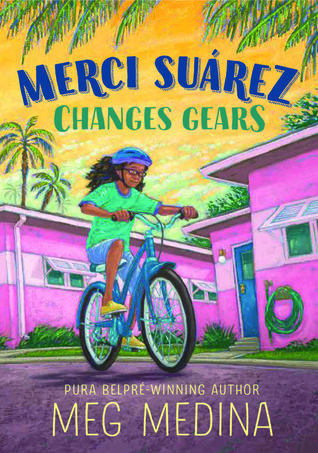
Merci Suárez Changes Gears

Merci Suarez Changes Gears. Meg Medina. 2018. 368 pages. [Source: Library]

First sentence: To think, only yesterday I was in chancletas, sipping lemonade and watching my twin cousins run through the sprinkler in the yard. Now, I'm here in Mr. Patchett's class, sweating in my polyester school blazer and waiting for this torture to be over.

Premise/plot: Merci Suarez Changes Gears is your typical coming-of-age novel--perhaps with one exception--it is the Newbery Medal winner for 2019. Merci Suarez has a big, loving family--though far from perfect. Merci Suarez is having some difficulty fitting in at school. (Sixth grade isn't all that easy, and the school work may be way easier than the social aspects.) Merci Suarez is at odds with another student in her class, a mean girl, EDNA. Merci will have to ultimately make peace with all the changes in her life--at home, at school.

Merci Suarez doesn't want things to change. She wants things to stay the same, or if not stay exactly the same, go HER way. For example, she wants to try out for the school's soccer team. BUT because of the big changes going on at home--her grandfather is no longer able to take care of her twin cousins after school--she can't. The truth is many things aren't going her way--not really. Will she let her circumstances make her miserable or will she rise above?

My thoughts: I liked this one okay. Part of me is curious...IF I'd read this one before the Newbery announcement would I have liked it better?!?! But I didn't. I read it AFTER the announcement, therefore I expected the book to be all kinds of wonderful. I wanted the book to stand out as amazing and unique. It didn't. I found it...well...typical. Not just the situations but the writing.

There were many things I did like...just nothing that I loved, loved, loved. Merci did have eye surgery as a child and still has a lazy eye (at times). I could relate to that. Merci was "different" from her classmates in that she was a scholarship student. She comes from a different social class, a different neighborhood than her classmates. Again, I could relate to that to a certain degree. I liked getting to know her and her family. I found the book a quick and mostly enjoyable read.


© 2019 Becky Laney of Becky's Book Reviews

Wednesday, July 18, 2018

Roller Skates

Roller Skates. Ruth Sawyer. 1936. 186 pages. [Source: Bought]

First sentence: Spring has come; windows are open.

Premise/plot: Roller Skates is set in New York City in the 1890s. Lucinda Wyman, our roller-skating heroine, will be staying with the Misses Peters (Miss Peters, Miss Nettie) while her parents go abroad for a year. She'll still have to visit her prim and proper relatives once a week, but, most of her time is her own...and she'll use it to make friends with anyone and everyone regardless of their age, gender, and/or social class.

My thoughts: If I'd read this book in one or two days instead of three or four weeks, would I have liked it better? Probably. Reading one or two chapters per week killed the enjoyment I might have gotten from the story.

To be honest the introduction also unsettled me a bit. Who is narrating the introduction? Who is the unnamed old friend Lucinda is visiting? How many years have passed? Were they children together? Or is the unnamed old friend one of the adult friends she made? Is the unnamed friend a man or a woman? Why did Lucinda give this person her diary? And why didn't the book END with her giving someone her diary? Why did the end absolutely not tie back to the introduction at all?

I will need to reread this at some point to give it a better chance to charm me.


© 2018 Becky Laney of Becky's Book Reviews

Friday, April 20, 2018

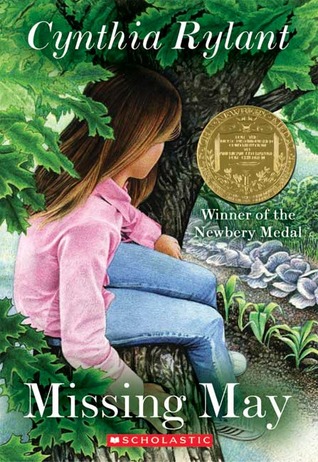
Missing May

Missing May. Cynthia Rylant. 1992. Scholastic. 89 pages. [Source: Library]

First sentence: When May died, Ob came back to the trailer, got out of his good suit and into his regular clothes, then went and sat in the Chevy for the rest of the night.

Premise/plot: Missing May won the Newbery Medal in 1993. This novel for young readers explores grief. Summer and Ob are the central characters; they are the ones most 'missing' May. All the happiness Summer has known has been in the home of her aunt and uncle. May and Ob took her in and adopted her; times were good, love abounded. But May died in her garden, and life hasn't been the same since she's left.

Ob wants more than anything to make contact with May's spirit. Summer isn't sure that that is even possible, but she hopes it is for Ob's sake. Cletus is relatively new friend of the family. He's around Summer's age. But he has a way--a knack--with Ob that is healing and comforting. Together these three set out on a road trip. The destination? A spiritualist church that Cletus read about with a medium as a pastor. Will May reach out from beyond the grave with a message for Ob? for May?

My thoughts: Did I like it? No. Yes. No. Maybe. I'll start with what I did like. Rylant is a strong writer. She did a great job with the setting. It's set in West Virginia a place where she herself grew up. She captures a specific place--if not a specific time. Which brings me to her characterization. Her characters were human--there's a rawness to them, a take-me-like-I-am rawness. I think Cletus may just be my favorite among them. Her writing was GREAT.

Here is one of her descriptions of May:
She understood people and she let them be whatever way they needed to be. She had faith in every single person she ever met, and this never failed her, for nobody ever disappointed May. Seems people knew she saw the very best of them, and they'd turn that side to her to give her a better look. (15-16)
And one of Cletus:
Cletus had some gifts--I was learning this bit by bit--and knowing when to talk and when not to was turning out to be one of them. (37)
I can certainly see why it was honored with the Newbery award.

So what didn't I like? I didn't like the content, the story. Specifically, I did not like the ongoing quest to make contact with the dead--either through Cletus (that attempt failed) or through a professional medium (that one failed as well). In a way, it is thought-provoking. When someone you love dies--where is your hope? Is your hope in making contact with them again in the here and now? Is your hope in finding messages in feelings, signs, visions, dreams? Is your hope in mediums and psychics?

Or is your hope found in the resurrection of Jesus Christ? Is your hope in heaven? That you will spend eternity with them in heaven because you both believed that Jesus is the way, the truth, the life--the only way to the Father? Is your comfort found in the Word of God? Can you find peace and comfort through the Spirit and the fellowship of believers?

Summer and Ob are both searching for peace and comfort. Specifically Summer wants Ob to come to a place of peace so that he will start living again. She fears that he has lost all the will to live. And if he's lost the will to live, then who will take care of her? who will love her?

As a Christian, I saw the lost-ness, the despair of Summer and Ob. Ob is in need of answers, in need of peace, in need of comfort. But he's seeking in the wrong places in the wrong ways. Summer is young and confused. She doesn't believe strongly--one way or the other--about the after life. I pitied them both. I'm not sure readers are supposed to pity them. I'm not sure readers are not supposed to pity them either.

Grief wears many faces. There isn't one right way to grieve. Each person is different. Christian or not--every person grieves in his or her unique way. And it's not like anyone--insider or outsider--can say a handful of phrases to 'snap someone out of their grief' to 'fix them' or 'heal them.' There are plenty of WRONG things to say that hurt instead of help. I think everyone could learn from Cletus--a bit--in just BEING there and listening. (But to be fair, Cletus is far from perfect, it is Cletus who suggests going to a professional medium.)

Would I have liked Missing May as a child? I probably would not have read it. a) I was still AVOIDING all books that had the potential for sadness. b) I was certainly reading in 1992/1993, but probably not books for this age group. c) I attended a Christian school with a small library budget and high standards of what was appropriate and inappropriate. I don't think a book with talk of mediums and contacting the dead would have made the cut. But I could be wrong. It DID win the Newbery. And I honestly can't say if the librarian was reading every book before it was ordered and placed within the collection.

Christian families shouldn't necessarily avoid the book at all costs. But if you do read it, you may want to read it together and use it as a discussion opportunity. As I said, it is thought-provoking.

© 2018 Becky Laney of Becky's Book Reviews

Tuesday, February 27, 2018

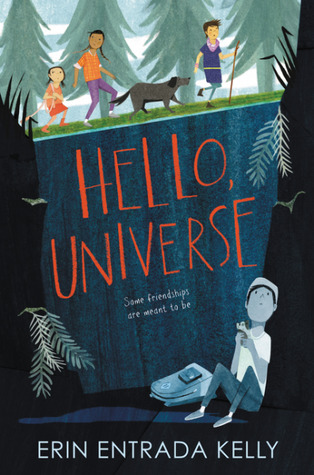
Hello, Universe

Hello, Universe. Erin Entrada Kelly. 2017. 313 pages. [Source: Library]

First sentence: Eleven-year old Virgil Salinas already regretted the rest of middle school, and he'd only just finished sixth grade.

Premise/plot: Virgil Salinas has a problem. He has a big crush on Valencia Somerset, but he's gone the whole school year without even saying hello. For some reason, this shyness is not a crushing failure until the first day of summer school. He seeks the guidance of a child psychic--a fortune teller--Kaori Tanaka. Kaori only takes children for clients, and she's aided by her younger sister, Gen. Virgil is one of her clients, but she's got another client as well, a new one. Valencia Somerset has been having nightmares. Will Kaori be able to interpret her dreams and solve her problem? One thing her two clients have in common is that they are both being picked on by Chet Bullens. What happens in the woods one Saturday morning may change all of their lives forever.

My thoughts: Hello, Universe won the Newbery Medal for 2018. If it hadn't won the Newbery would  I have been as disappointed with Hello, Universe? Maybe, maybe not. One thing is for certain, I did not like this book. (My expectations would have been lower, and thus my disappointment not so big if it hadn't won the Newbery.)

The book has alternating narrators. My favorite narrator was probably Valencia Somerset. In fact, if the book was told solely through her perspective and if she never met Kaori Tanaka, I might have enjoyed the book. I did not care for the other narrators for the most part, though I liked Virgil just fine until the incident in the woods. (Virgil's grandmother was a character I liked.)

What didn't I like about the book? Well. I didn't like Kaori Tanaka's fortune-telling. I didn't like her reading the stars, playing with crystals, and being an amateur astrologist. I also didn't like Virgil's time in the well. I didn't like how the spirits talked to him, and how he talked to the spirits. I found all of that weird and out of place. I also am not sure why Virgil often took his guinea pig, Gulliver, with him in his back pack. Other than the fact that this was a necessary part of the plot to bring all the characters together. The plot just didn't work for me.

© 2018 Becky Laney of Becky's Book Reviews

Tuesday, February 07, 2017

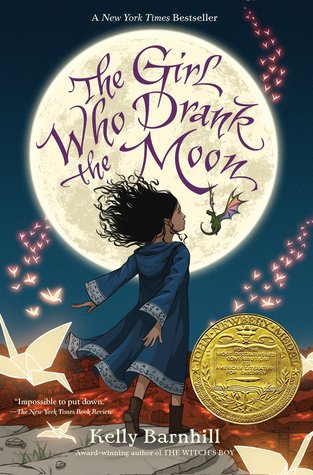
The Girl Who Drank the Moon

The Girl Who Drank the Moon. Kelly Barnhill. 2016. 388 pages. [Source: Library]

First sentence: Yes. There is a witch in the woods. There has always been a witch.

Premise/plot: There are two sides to every story. The villagers of the Protectorate believe that it's a necessary evil to sacrifice the youngest baby to the witch in the woods every year on a certain day. Sorrow hangs about the village certainly even driving a few mad now and then. Xan, who lives in the woods along with a dragon and swamp monster, wonders why the crazy villagers abandon a baby every year leaving it in a particular place. It's nonsense from her perspective. Who would do such a thing? She happily takes the baby through the woods to the safety of one of the free cities. The baby is adopted, loved, cared for.

One year something changes. Xan accidentally draws power from the moon--the full moon--instead of the stars to nourish the baby on the trek through the woods. The baby--soon named Luna--becomes enmagicked. Xan decides that she had better raise the child herself! Luna's real mother forgets her own name, the name of her child, her life before that terrible day when she spoke up against those who were cruelly taking her baby. She's locked away in a tower, kept prisoner by the Sisters.

The truth seems buried, but by the child's thirteenth birthday the truth will shine through the darkest of sorrows and hope will take root.

My thoughts: To readers who are thrilled by all things witchy, this may prove fun. I certainly enjoyed the tiny dragon who truly believed he was simply enormous. The paper birds were truly terrifying but unique in my opinion. The struggles were many for all the characters, and the author didn't give easy solutions. But. As a Christian I found this book less than ideal. There were several places that proved too much for me to ignore. I'm thinking of chapter twelve and forty-seven.
"In the beginning there was only Bog, and Bog, and Bog. There were no people. There were no fish. There were no birds or beasts or mountains or forest or sky. The bog was everything, and everything was the Bog....and so the Bog created a Body: a great Beast that walked out of the Bog on its own strong, boggy legs. The beast was the Bog, and the Bog was the Beast. The Beast loved the Bog and the Bog loved the Beast...the Beast's chest was full of warm and life-giving compassion. He felt the shine of love radiating outward. And the Beast wanted words to explain how he felt. And so there were words." (83-84) 
Clearly drawing from the literary style of the Bible....to turn God into a boggy swamp monster is just too much for me to personally overlook. I would never discourage anyone from reading the book and judging its merit on their own. I do wish this Bog element had been left out though.

© 2017 Becky Laney of Becky's Book Reviews

Friday, January 20, 2017

Carry On, Mr. Bowditch

Carry On, Mr. Bowditch. Jean Lee Latham. 1955. 251 pages. [Source: Bought]

First sentence: Nat lay very still in the dark, trying to stay awake until his big brother, Hab, went to sleep.

Premise/plot: Based on history, Latham chronicles the coming of age of Nat Bowditch. The book opens during the Revolutionary war and is set in Salem. His childhood was not easy. With the economy being what it was, with risks high, no matter how hard the family worked, the odds were against their success. One by one the boys had to drop out of school to work with their father in a struggle to survive. Nat takes this the hardest. He being a genius and having a passion for book knowledge. He's encouraged by plenty that he is destined for Harvard. But instead he becomes indentured for nine years. When he's free he'll be too old to go back to school. But he is determined--persistent. He will teach himself. Latin. French. Algebra. Trigonometry. Astronomy. Navigation. Surveying. If there is a book he can borrow he will read it, take notes, and absorb the information. Not all of his learning comes from books. There are people in his life whom he cultivates relationships with learning all he can through conversations. When he is free, he becomes a sailor--a clerk or super cargo. The learning continues. He learns about sailing, about guns, and how to get along with all sorts of people. (He also learns Spanish). He begins teaching the crew--anyone and everyone--about navigation, specifically about taking lunars--using the moon, the stars to figure out longitude. After finding hundreds if not thousands of mistakes in a navigation guide--in the tables--he thinks about writing his own book one day.

My thoughts: I probably would not have found this one interesting as a child, but the adult me found it engaging. Society is so quick to label children, I wonder what they would have made of Bowditch. He loved math because math is logical and predictable. He wasn't as fond of people finding them impossible to predict and understand. He was amazingly gifted and he learned how to teach others in a way they could understand. Loved the fact that he recognized that education empowers and gives people choices that they never would have had before. He wasn't naturally patient--who is?--but he worked hard at his people skills.

I also loved, loved, loved that he learned new languages using the New Testament. The first verse of John is quoted several times!

Favorite quotes:
We can't have freedom unless we have freedom. And that means freedom to speak our minds (91).

© 2017 Becky Laney of Becky's Book Reviews

Tuesday, March 08, 2016

Last Stop on Market Street

Last Stop on Market Street. Matt de la Pena. Illustrated by Christian Robinson. 2015. 32 pages. [Source: Library]

First sentence: CJ pushed through the church doors, skipped down the steps. The outside air smelled like freedom, but it also smelled like rain, which freckled CJ's shirt and dripped down his nose.

Premise: CJ and his Nana enjoy a bus ride after church; readers are led to believe that this is a frequent occurrence for the pair. But what is the last stop on Market Street?! That mystery is not revealed immediately. Readers instead are part of the journey page by page. CJ's conversation with Nana reveals a worldview of sorts that is admirable in every way.

My thoughts: How I wish I'd read this one BEFORE it won the Newbery! It also earned a Caldecott Honor. Both are deserved, in my opinion. But one is more surprising than the other, of course. Not many picture books get the Newbery medal. This isn't the first, and, it probably won't be the last. But still--it's rare.

Why do I wish I'd read it before the big announcement? Well. Once a book wins the Newbery, it seems my expectations go over-the-top. I'm "robbed" of reading the book on its own merits without the burden of comparing and contrasting it with every other Newbery winner I've read. It's not that I intentionally set out to do so. No, it's something I try to refrain from doing when I notice it. But expectations can be sneaky.

So what do I think of this one? Well, at the very, very least I really like it. I can honestly say that I love, love, love the character of Nana! Nana and CJ are a cute pair, and, the dialogue between the two which takes up almost all of the book is well worth reading several times. The first time through you might be caught up in plot to notice the little things, the tiny things, the small elements that when seen as a whole are lovely and delightful. Such as the opening description.

Text: 4 out of 5
Illustrations: 4 out of 5
Total: 8 out of 10

© 2016 Becky Laney of Becky's Book Reviews

Sunday, October 11, 2015

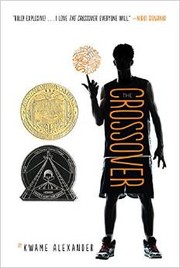
The Crossover (2014)

The Crossover. Kwame Alexander. 2014. HMH. 240 pages. [Source: Library]

First, I owe this book an apology. I've been purposefully avoiding it, despite it winning a Newbery, simply because it was about basketball. You see, I don't necessarily "like" reading sports books. I wasn't trusting enough, perhaps, that a book could be about basketball and so much more than basketball at the same time.

The Crossover is an award-winning verse novel starring Josh Bell (aka, Filthy McNasty) and his family. Josh and his brother Jordan (aka, JB) both play basketball. Their father, at one time, played professional basketball. But an injury ended all that, and now his focus, his full-time focus, is on his boys, his family. Their mother's almost full-time focus is on the health of her husband who absolutely refuses to go to the doctor. Though, of course, she loves watching her sons play basketball too.

The novel has its ups and downs...especially for Josh. Things are changing, always changing, and he doesn't like it. His brother is distancing himself from the family, from him, and even from the game itself at times, because he's head over heels in love with 'the new girl.' The more besotted his brother becomes, the more disgruntled Josh becomes. And Josh's choices, well, they aren't perfectly good and right. (Whose are?) Still, the two brothers will be tested as never before when their mother's fears prove correct...

I wasn't expecting such an emotional journey. But that's exactly what I got. This one has depth and substance to it. The characterization was very well done. And the narrative verse worked really well.

© 2015 Becky Laney of Becky's Book Reviews

Friday, September 18, 2015

Criss Cross (2005)

Criss Cross. Lynne Rae Perkins. 2005. 337 pages. [Source: Library]

If Criss Cross had not won a Newbery, would I have felt differently about it? I think I definitely would have had lower expectations, and lower expectations or even no expectations often work in a book's favor. High expectations can lead to disappointment and frustration.

Criss Cross didn't "wow" me. I wasn't overly impressed with the writing, the characterization, or the plot. That is I did not find the writing, the characterization, or the plot: amazing, brilliant, wonderful, spectacular, or overly memorable. There was never this WOW, WHAT A BOOK moment.

The writing was okay. It was. The characterization was just fine. The plot, well, not much happens, but not much has to happen if I'm enjoying the writing or the characters. It was an ordinary, just fine, not-extra-memorable read for me. Nothing to complain about certainly, but nothing to gush about.

Criss Cross visits the lives of a handful of teens: some boys, some girls. One of the characters is a girl named Debbie. She almost has a main-character feel to her. But just almost. There were too many character perspectives to really feel properly settled with any one of them as being the main character. There lives sometimes touch each other. (One chapter even has two perspectives side by side.) Criss Cross is definitely made up of many moments--seemingly insignificant moments--that when reflected upon later take on a bit of significance.

For those who love coming-of-age stories, this one could prove satisfying enough.

I will add that this one is historical fiction. Though the historical setting is a bit fuzzy. There are hints throughout the text that this is set in the past, but, it may not prove obvious to every reader, especially in the beginning.

© 2015 Becky Laney of Becky's Book Reviews

Sunday, August 23, 2015

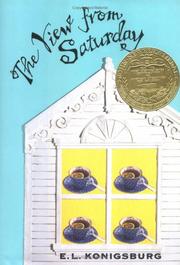
A View From Saturday

The View From Saturday. E.L. Konigsburg. 1996. 176 pages. [Source: Bought]

I enjoyed rereading E.L. Konigsburg's The View From Saturday. Though I don't usually "enjoy" (seek out) stories with multiple narrators--alternating narrators--in this case it was just right or practically perfect. Readers meet a teacher, Mrs. Olinski, and the four students on the sixth grade competitive team for the Academic Bowl. (They are Noah, Nadia, Ethan, and Julian.) All five narrate The View From Saturday. Mrs. Olinki's chapters are of the BIG competition day, and each chapter generally ends with a question being asked of the competitors. Usually. The chapters narrated by the students cover much more time, generally are full of flashbacks. It is in these narratives that characters are developed and relationships explored. All four students in her class were connected BEFORE they were chosen.

View From Saturday is a great friendship-focused, school-focused coming of age novel. Each narrative is definitely unique. And I like how interconnected the stories really are.

When I think Newbery, this is the kind of book I think of most of the time.

© 2015 Becky Laney of Becky's Book Reviews

Tuesday, August 18, 2015

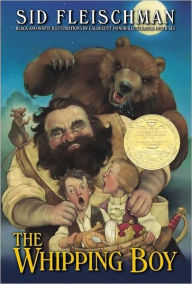
The Whipping Boy

The Whipping Boy. Sid Fleischman. Illustrated by Peter Sis. 1986. 96 pages. [Source: Bought]

First sentence: The young prince was known here and there (and just about everywhere else) as Prince Brat. Not even black cats would cross his path.

Jemmy is "the whipping boy" of Prince Horace (Prince Brat). Every time Prince Brat misbehaves, it is Jemmy who receives his punishment. And does Prince Brat get in trouble often? That would be an understatement. He is ALWAYS getting in trouble, and Jemmy suffers oh-so-bravely for it. Does he cry out, whimper, shed a tear? No, never. And Prince Brat almost hates him for not putting on a show. Doesn't Jemmy know that it would be so much more entertaining if he just would shout or cry out?

The Whipping Boy is the story of what happens when Jemmy and Prince Brat "run away" from the palace. Jemmy is hoping to make his own escape, to sneak away from Prince Brat, and to end his whipping days for good. But before Jemmy can make his second get away, the two are kidnapped...

Beyond that, I will say NOTHING. Except that this is a surprisingly delightful adventure story....

This may be one of the Newbery winners that has surprised me most. I wasn't expecting to like it, to find it so readable, so enjoyable. But I really found myself swept into the story. I liked this one very much. 

Have you read it? Did you like it? love it? hate it? Did you like Jemmy? Did you eventually come to like Prince Brat a tiny bit at least? Do you have a favorite Newbery winner? Which one has surprised you the most?

© 2015 Becky Laney of Becky's Book Reviews
Sunday, August 09, 2015

Walk Two Moons

Walk Two Moons. Sharon Creech. 1994. HarperCollins. 280 pages. [Source: Bought]

Gramps says that I am a country girl at heart, and that is true. I have lived most of my thirteen years in Bybanks, Kentucky, which is not much more than a caboodle of houses roosting in a green spot alongside the Ohio River. 

Did I love Sharon Creech's Walk Two Moons? Yes and no. On the one hand, it's a book that I know I would have either--as a kid-- avoided at all costs (if anyone had dropped hints of how sad it was) OR found myself hating, bitterly regretting having picked it up in the first place. There was a time I thought all sad books should be labeled. So at least you were making an informed decision before you got swept up in the story and invested a part of yourself in it. On the other hand--as an adult--I couldn't help finding it a beautiful and compelling story.

Sal--the heroine--is on a road trip with her grandparents (Gram and Gramps). They are on their way to "see" Sal's mother. That's what readers are told, and, as an adult I connected the dots early on. (Sal's world is upset when her Dad moves them to a new town after learning that the mom wouldn't be coming back.) But much is left a mystery for the reader. I can't honestly say how I would have interpreted the text as a kid. It doesn't really matter. The trip is enlivened by Sal's storytelling. She is telling the story of her new friend, her classmate, her almost-neighbor: Phoebe. (Readers also hear of other friends--classmates--including a boy named Ben.) Phoebe's life is also becoming something of a mess. Though Sal is better at spotting the signs than Phoebe herself. The book alternates between focusing on the past--Sal's new life, her friendships, her memories, her emotions--and the present, the road trip. Both stories are compelling. Mainly through dialogue, the grandparents become fully fleshed characters that you can't help loving and admiring. The way they love Sal, and, cherish her. There is just something sweet about this family. And readers do get to know them better than any other adult in the novel. Unfortunately, I think that is why the book left me angry. Part of me angry anyway. THE ENDING. I did not see it coming. And it was beyond cruel to this reader. Was it realistic? Yes. Looking back were their signs that it was coming? Probably. But though I guessed one reason why the novel was one of those dreaded SAD books. I didn't the second. And the second HURT so much.

Walk Two Moons is the 1995 Newbery winner.

Have you read Walk Two Moons? What did you think? Like it? Love it? Hate it? Do you like sad books? Or do you avoid them when you can?

© 2015 Becky Laney of Becky's Book Reviews

Sunday, July 12, 2015

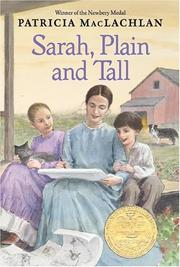
Sarah, Plain and Tall

Sarah, Plain and Tall. Patricia MacLachlan. 1985. Houghton Mifflin. 64 pages. [Source: Library]

I've read Sarah, Plain and Tall several times, but, I can't find proof that I've blogged about it. So. Sarah, Plain and Tall won the Newbery in 1986. It is historical fiction for the youngest of readers.

Anna is the heroine of Sarah, Plain and Tall. Through her we meet Caleb, her brother; her father; and Sarah, the woman who may become her step-mother if all goes well. The children want this very much, a new mother.

Sarah comes to visit the family for one month. Will she come to love them? Will they come to love her? Will they belong together? Is this meant to be? Or will Sarah miss her old home and her old life too much to stay?

This is a sweet novel full of innocent longing. I loved all of the characters. There is something so simple and pure about it. Definitely recommended.

© 2015 Becky Laney of Becky's Book Reviews
Sunday, June 14, 2015

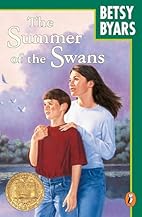
The Summer of the Swan (1970)

The Summer of the Swans. Betsy Byars. 1970. Penguin. 144 pages. [Source: Bought]

First sentence: Sara Godfrey was lying on the bed tying a kerchief on the dog, Boysie.

I'm so glad that Hope is the Word is hosting a Newbery Through the Decades reading challenge. June is the month dedicated to reading winners and honors from the 1970s. I may never have picked up Betsy Byars' The Summer of the Swans without a little extra motivation. And The Summer of the Swans? Well, it's compelling, very compelling.

Sara loves her brother Charlie. She does. But she doesn't always like him, or, like having to take care of him all the time. To be fair, Sara, on the day we meet her, is in a bit of a mood. This is one of those days when it seems almost every person in Sara's life is frustrating or annoying her. Sara's day will get worse before it gets better.

I really liked The Summer of the Swans. I liked the intensity of it. Charlie goes missing in the night, and that changes everything. Primarily we see this through Sara's perspective. Though we know that it is upsetting news to their Aunt Willie as well. Everyone in the neighborhood gets involved including a boy, Joe, that Sara really doesn't like or trust. Will Sara, however, change her mind about Joe after spending the day with him? after seeing the 'real' him? Will Charlie be found? Is he okay?

The Summer of the Swans won a Newbery in 1971.

© 2015 Becky Laney of Becky's Book Reviews