Showing posts with label Caldecott Honor. Show all posts

Wednesday, February 05, 2025

12. Up, Up, Ever Up!


12. Up, Up, Ever Up! Junko Tabei: A Life in the Mountains. Anita Yasuda. Illustrated by Yuko Shimizu. 2024. 48 pages. [Source: Library] [nonfiction picture book, 3 stars]

First sentence: Junko's hill was her entire world. 

Premise/plot: Up, Up Ever Up! is a picture book biography of mountain climber and activist Junko Tabei. It recently earned a Caldecott Honor. 

My thoughts: I liked this one. I did. Books about mountain climbing aren't really "my thing" if you will. But I do try to keep up with the Newbery and Caldecott winners and honors. And I do enjoy a good nonfiction picture book biography. I think this one will appeal to readers who do like adventure-y outdoors sports. There are so many good-to-great nonfiction biographies that kids can read these days.

As for the rating. I have gone back and forth a dozen times between three stars and four stars. I have. This book was just made for a three and half star rating. (Which I don't do because GoodReads doesn't do).


© 2025 Becky Laney of Becky's Book Reviews

Thursday, January 25, 2024

10. There Was a Party for Langston


There Was a Party for Langston. Jason Reynolds. Illustrated by Jerome Pumphrey and Jarrett Pumphrey. 2023. 56 pages. [Source: Library] [picture book]

First sentence: There was a party for Langston at the library. A jam in Harlem to celebrate the word-making man--Langston, the king of letters whose ABC's became drums, bumping jumping thumping like a heart the size of the whole wide world.

Premise/plot: This party for Langston Hughes was held in February 1991. The author, Jason Reynolds, was inspired to write about this party after seeing a photograph of two authors dancing--Maya Angelou and Amiri Baraka. The book celebrates Langston Hughes AND his continuing legacy. There are word-makers and word-breakers. Word-breakers being those who would ban books and limit freedom. 

My thoughts: This picture book earned a Caldecott Honor and a Coretta Scott King Illustrator Honor. 

I loved the text of this one--very rhythmic. Definitely fitting, I think, to celebrating a poet. 

I loved the illustrations--very vibrant, joyful, jumping off the page. 


© 2024 Becky Laney of Becky's Book Reviews

Friday, February 16, 2018

Crown: An Ode to the Fresh Cut

Crown: An Ode to the Fresh Cut. Derrick Barnes. Illustrated by Gordon C. James. 2017. 32 pages. [Source: Library]

First sentence: When it's your turn in the chair, you stand at attention and forget about who you were when you walked through that door. You came in as a lump of clay, a blank canvas, a slab of marble. But when my man is done with you, they'll want to post you up in a museum! 

Premise/plot: A young boy--a man in the making--talks about the pride and happiness he feels every time he walks into and out of a barber shop. 

My thoughts: This past Monday, Crown got a lot of love on awards day. How much love? A Coretta Scott King Illustrator Honor. A Coretta Scott King Author Honor. A Caldecott Honor. A Newbery Honor. I had actually noticed this one at the library on display, picked it up and turned a few pages, and put it back down a few days before. So I can't boast that I knew about the book before it won all the glory.

My recommendation: Before you read a single word of this one, read the author's note. But if you can't help reading it cover-to-cover, at the very least don't skip the author's note. I had never really thought of the picture book format as being a place for a coming-of-age story, but after reading this one, I see that it can be.

Text: 3 out of 5
Illustrations: 3 out of 5
Total: 6 out of 10

© 2018 Becky Laney of Becky's Book Reviews

Wednesday, February 08, 2017

Freedom in Congo Square

Freedom in Congo Square. Carole Boston Weatherford. Illustrated by R. Gregory Christie. 2016. 34 pages. [Source: Library]

First sentence: Mondays, there were hogs to slop, mules to train, and logs to chop. Slavery was no ways fair. Six more days to Congo Square. Tuesdays, there were cows to feed, fields to plow, and rows to seed. A moment without work was rare. Five more days to Congo Square.

Premise/plot: Freedom in Congo Square received a Caldecott Honor and a Coretta Scott King Illustrators Honor. It was well deserved. This picture book is set in New Orleans. One day a week, on Sunday, slaves and free blacks could meet together in Congo Square. It was the slaves only day off. The book explains how music and dance continued to be influential during these years.

My thoughts: I loved this one. It was simple enough that I think you could share it as a read-aloud. It didn't lack complexity, by any means, but it wasn't overly wordy. (Older readers can appreciate the foreword and the author's note.) I loved the counting down, the building up of excitement. I loved learning more about the historical roots of jazz music.

Text: 5 out of 5
Illustrations: 5 out of 5
Total: 10 out of 10
© 2017 Becky Laney of Becky's Book Reviews

Sunday, January 08, 2017

Freight Train

Freight Train. Donald Crews. 1978. 26 pages. [Source: Borrowed]

First sentence: A train runs across this track. Red caboose at the back. Orange tank car next. Yellow hopper car.

Premise/plot: Freight Train is a concept book teaching colors, a train-themed concept book teaching colors. It received a Caldecott Honor in 1979, I believe. If I had to guess the most memorized picture book ever, I bet it would be Freight Train or Goodnight Moon. What do you think it would be?

My thoughts: What's not to love about this children's classic? It wasn't the first train book, it certainly won't be the last. What is it about kids and trains?!

Text: 4 out of 5
Illustrations: 4 out of 5
Total: 8 out of 10

© 2017 Becky Laney of Becky's Book Reviews
Tuesday, March 08, 2016

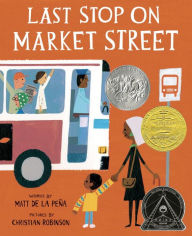
Last Stop on Market Street

Last Stop on Market Street. Matt de la Pena. Illustrated by Christian Robinson. 2015. 32 pages. [Source: Library]

First sentence: CJ pushed through the church doors, skipped down the steps. The outside air smelled like freedom, but it also smelled like rain, which freckled CJ's shirt and dripped down his nose.

Premise: CJ and his Nana enjoy a bus ride after church; readers are led to believe that this is a frequent occurrence for the pair. But what is the last stop on Market Street?! That mystery is not revealed immediately. Readers instead are part of the journey page by page. CJ's conversation with Nana reveals a worldview of sorts that is admirable in every way.

My thoughts: How I wish I'd read this one BEFORE it won the Newbery! It also earned a Caldecott Honor. Both are deserved, in my opinion. But one is more surprising than the other, of course. Not many picture books get the Newbery medal. This isn't the first, and, it probably won't be the last. But still--it's rare.

Why do I wish I'd read it before the big announcement? Well. Once a book wins the Newbery, it seems my expectations go over-the-top. I'm "robbed" of reading the book on its own merits without the burden of comparing and contrasting it with every other Newbery winner I've read. It's not that I intentionally set out to do so. No, it's something I try to refrain from doing when I notice it. But expectations can be sneaky.

So what do I think of this one? Well, at the very, very least I really like it. I can honestly say that I love, love, love the character of Nana! Nana and CJ are a cute pair, and, the dialogue between the two which takes up almost all of the book is well worth reading several times. The first time through you might be caught up in plot to notice the little things, the tiny things, the small elements that when seen as a whole are lovely and delightful. Such as the opening description.

Text: 4 out of 5
Illustrations: 4 out of 5
Total: 8 out of 10

© 2016 Becky Laney of Becky's Book Reviews
Saturday, February 27, 2016

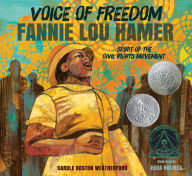
Voice of Freedom

Voice of Freedom Fannie Lou Hamer. Carole Boston Weatherford. Illustrated by Ekua Holmes. 2015. Candlewick. 56 pages. [Source: Library]

Voice of Freedom: Fannie Lou Hamer: The Spirit of the Civil Rights Movement is a book both easy to categorize and difficult. It is nonfiction. It is a biography of Fannie Lou Hamer--a picture book biography. A biography written in verse. So it's poetry too. And it's about the civil rights movement. Yes, the focus is on Fannie Lou Hamer's role in the civil rights movement, but, it isn't as if it's her story alone. It is so much more than that. The fact that it is a picture book biography written in verse about the civil rights movement makes it a great example of a picture book for older readers. (And the fact that it's about the civil rights movement, and, a heroine of the movement, makes it a great example of a diverse title and one highlighting a remarkable woman.) So there are at least half a dozen reasons why one would want to pick this one up and read it.

But could I be forgetting the most important reason to seek this one out to read?! It is a GREAT read. It was fascinating, absorbing, compelling. I've read a dozen or so books--mainly for young readers, I admit--about the civil rights movement, yet I still found myself learning things I hadn't known before. I love to learn as a I read. And it is so beautifully written, the narrative voice is just outstanding. A typical spread includes one poem and an illustration by Ekua Holmes.

Would I recommend it??? YES!
© 2016 Becky Laney of Becky's Book Reviews
Thursday, February 25, 2016

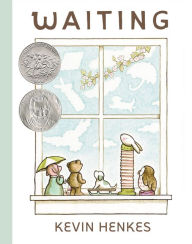
Waiting

Waiting. Kevin Henkes. 2015. HarperCollins. 32 pages. [Source: Library]

First sentence: There were five of them. And they were waiting....

Premise/plot: A collection of toys sit on a window sill and wait. Most toys are waiting for something specific, but, not all. Some just like looking out the window at anything and everything. There is some sense of companionship among the toys, but, I wouldn't necessarily call this one friendship-themed.

My thoughts: Unique, yes, I think it is. Simple too. But at times, I found it charming and sweet. This is sometimes conveyed by the text of the story. One of my favorite lines is, "When it finally snowed, the puppy was happy. He'd waited a very long time." But I'd say that most of the charm is conveyed by the illustrations. (Both text and illustrations are by Kevin Henkes.) One of my favorite scenes is when the toys are all shown "sleeping" on the sill. And in another scene, the toys are shown huddled together--afraid--because of the storm outside. It is more expressive than you might at first think.

I'd recommend it easily to anyone who enjoys Henkes' work. Is it my personal favorite by him? I'd say no. It is not an action-packed, make-you-laugh-out-loud book to share with children. It is a quieter, subtler read instead. Nice doesn't have to be a bad thing in terms of describing a book.

Text: 4 out of 5
Illustrations: 4 out of 5
Total: 8 out of 10
© 2016 Becky Laney of Becky's Book Reviews
Sunday, April 19, 2015

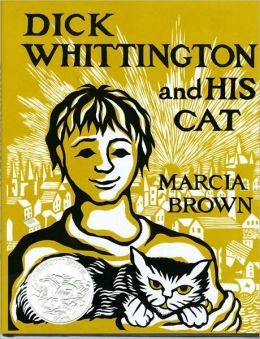
Dick Whittington and His Cat (1950)

Dick Whittington and His Cat. Told and cut in linoleum by Marcia Brown. 1950. Simon & Schuster. 32 pages. [Source: Bought]

First sentence: Long ago in England there lived a little boy named Dick Whittington. Dick's father and mother died when he was very young, and as he was too small to work, he had a hard time of it.

Premise/plot: Dick Whittington, an orphan, goes to London to seek his fortune--or at least a somewhat better life. It won't be easily come by that's for sure! He eventually finds work in the home of a merchant as a cook's assistant. With his one penny, he happens to buy a cat who is an excellent mouser. The cat will be the key to it all: his eventual success.
Not long after this, Mr. Fitzwarren had a ship ready to sail. He called all his servants into the parlor and asked them what they chose to send to trade. All the servants brought something but poor Dick. Since he had neither money nor goods, he couldn't think of sending anything. "I'll put some money down for him," offered Miss Alice, and she called Dick into the parlor. But the merchant said, "That will not do. It must be something of his own." "I have nothing but a cat," said Dick. "Fetch your cat, boy," said the merchant, "and let her go!" 
My thoughts: Loved the story. Dick Whittington and His Cat received a Caldecott Honor in 1951. I can't say that I particularly "liked" the illustrations. (But I didn't dislike them either.) I enjoyed the story more though.

Have you read Dick Whittington and His Cat? What did you think? Do you have a favorite Caldecott or Caldecott Honor book? 


© 2015 Becky Laney of Becky's Book Reviews