Showing posts with label 2016. Show all posts

Tuesday, August 04, 2026

53. The Best Bear in All the World


53. The Best Bear in All the World. Paul Bright, Brian Sibley, Jeanne Willis, Kate Saunders. 2016. 115 pages. [Source: Library] [3 stars, audio book, Winnie the Pooh sequel]

First sentence: "Ninety?" said Winnie the Pooh. "Is that more than seven?" "Yes, Pooh," said Kanga patiently. "You're ninety years old, which calls for a celebration."

Premise/plot: Four new stories starring Winnie the Pooh and all his friends from the Hundred Acre Woods. There is a story set in Autumn (in which Pooh and Piglet prepare to meet a Dragon). There is a story set in Winter (in which Penguin arrives in the forest). There is a story set in spring (in which Eeyore suspects another donkey is after his thistles). There is a story set in summer (in which Pooh dreams of the Sauce of the Nile).

My thoughts: I have wanted to READ this one for years. But the library didn't have it in print. I saw it on audio book and thought I'd give it a try. I didn't like it much on audio. BUT I realize that could be the narrator being a disappointment in doing ALL the characters in unique voices. I realize that no one can DO the character voices like Disney does. I wasn't expecting it to be amazing. But I wanted it to be better than it was. I also think that the book would have been more enjoyable, perhaps, if it had had ONE author instead of four. The stories are just decent. These aren't "new" stories or "original" stories so much as slightly changing and adapting a few stories and having them happen again slightly differently.

Perhaps audio wasn't the best way to experience this book since I missed out on the illustrations. AND it's certainly possible that reading the book in print with the more proper voices in my head narrating might have led me to like it better.


© 2026 Becky Laney of Becky's Book Reviews

Tuesday, July 08, 2025

72. The Wild Robot


72. The Wild Robot. Peter Brown. 2016. 282 pages. [Source: Library] [5 stars, j fantasy, j fiction] 

First sentence: Our story begins on the ocean, with wind and rain and thunder and lightning and waves. A hurricane roared and raged through the night. And in the middle of the chaos, a cargo ship was sinking down down down to the ocean floor. The ship left hundreds of crates floating on the surface. But as the hurricane thrashed and swirled and knocked them around, the crates also began sinking into the depths. One after another, they were swallowed up by the waves, until only five crates remained.

Premise/plot: Roz [a robot] finds herself on an island, an island inhabited by wildlife. The animals are scared of her--she's a MONSTER, of course, right?!?!--but as she observes the animals, slowly but surely, she learns their ways and becomes a wild robot. Her first friend is her 'son' Brightbill, a goose. The book follows several seasons...

My thoughts: The book The Wild Robot is not at all like the movie The Wild Robot. I loved the movie having never read the book. It was exciting, dramatic, well-paced, intense. The book, however, is much slower-paced, more heart and soul, quieter, subtler. The characters come across differently if you're comparing and contrasting. I enjoyed both. I did. But the book definitely is better....in my opinion.


© 2025 Becky Laney of Becky's Book Reviews

Friday, November 08, 2024

93. Superman: The Golden Age Volume 1

93. Superman: The Golden Age #1 Jerry Siegel. Joe Shuster. 2016. (Comics are from June 1938 through December 1939.) 392 pages. [Source: Library] [5 stars] [comic books; graphic novel; superheroes; action]

First sentence: As a distant planet was destroyed by old age, a scientist placed his infant son within a hastily devised space-ship, launching it toward Earth!

Premise/plot: What you see is what you get. This book is a collection of the earliest Superman comic books. The comic books include Action Comics (where he first appeared), New York World's Fair Comics, and the self-titled Superman comics. The main villain in these--appearing more than any other villain, I mean--is Ultra. But more often than not, each comic book has its own villain, or "villain." Sometimes the villain is a greedy businessman who takes shortcuts with the quality of his products, and sometimes they are out-and-out villainous. Ultra, for example, is out for world domination. Superman also at least once--maybe a few more times--does some "aggressive negotiating" with countries at war. He is not above beating out a confession from a villain either. 

My thoughts: A handful of these are extremely moralistic and didactic. To those that have read this book, a handful might not come across as the right word. There are super-incredibly-obvious didactic tactics at play. There are direct moralization at play. There are more subtle and indirect moralization at play. There's a range of spectrum. Even at its worst--it's enjoyable for a giggle. The writing is SO over the top and "special." My new favorites being SHORTLY LATER which appears more often than not in most of the adventures followed up by SHORTLY AFTER. The second half of the book, the writers seemed to have switched up the phrase. IF readers got paid a penny for every time the word "muscles" was used, then they'd be able to afford a LOT of comics. 

I can definitely see the appeal of Superman. Though it's not necessarily a visual appeal in the comics. I think this might just be the times in which they were written, but, it is almost like there were essentially three male faces and one perhaps two female faces that appear. Everybody looks the same, or same-ish. There are no details, no expressions. I thought it was funny--perhaps ironic--that Superman was able to take the place of at least two different people and masquerade as someone else. Once as a football player and once as a boxer??? Honestly, the way these characters are drawn, I believe it. That being said, I enjoyed the vintage-ness of it.


© 2024 Becky Laney of Becky's Book Reviews

Tuesday, September 10, 2024

70. Batman The Golden Age, volume 1

Batman The Golden Age, Volume 1. Bill Finger, Gardner F. Fox, Whitney Ellsworth, et al. 2016. 411 pages. [Source: Library] [4 stars]

First sentence: "Well commissioner, anything exciting happening these days?" "No...except this fellow they call the "Bat-Man" puzzles me!"

Premise/plot: Batman The Golden Age is an omnibus of original Batman (and Robin) comics which originally appeared in Detective Comics and Batman comics. The first issue in the omnibus is Detective Comics #27 from May 1939, and the last issue in the omnibus is Detective Comics #45 from November 1940. All comics predate the Second World War as you can see. There are a variety of villainous villains--including Cat Woman and the Joker--but only one sidekick, Robin the BOY WONDER.The comics are formulaic, as you can imagine, and Batman is never to be outwitted or defeated.

My thoughts: I enjoyed this so much more than I thought I would. Now I don't see myself turning into someone who reads comic books--and superhero action comic books at that--regularly. I do think this is more for adults perhaps. (I wonder if kids would seek out Batman comics on their own???) I say that merely because it would be rare indeed for an entire issue--each issue has multiple stories--to not offend someone in someway these days. But there is something  right in the fact that Batman rarely changes. Action with a hefty side of cheese.

 Some of the stories were GREAT, absolutely worth the read. A few weren't so great. Plenty were just meh. Still I'm glad I read this one.

© 2024 Becky Laney of Becky's Book Reviews

Monday, January 02, 2023

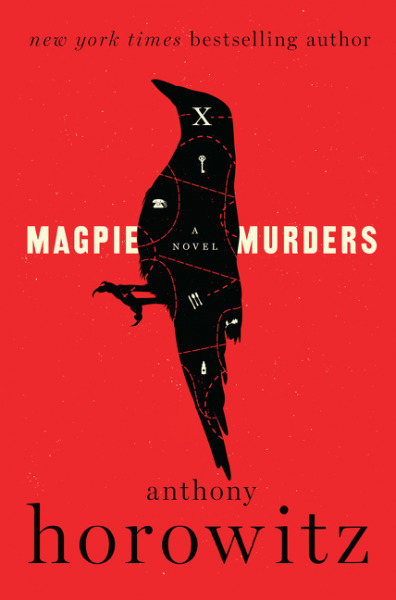
2. Magpie Murders


Magpie Murders. Anthony Horowitz. 2016. 477 pages. [Source: Library]

First sentence: A bottle of wine. A family-sized packet of Nacho Cheese Flavoured Tortilla Chips and a jar of hot salsa dip. A packet of cigarettes on the side (I know, I know). The rain hammering against the windows. And a book. What could have been lovelier? Magpie Murders was number nine in the much-loved and world-bestselling Atticus Pünd series. When I first opened it on that wet August evening, it existed only as a typescript and it would be my job to edit it before it was published. First, I intended to enjoy it.

Premise/plot: Susan Ryeland, our heroine, is an editor. She edits Alan Conway's mysteries. Alan Conway's newest book [and final book] is Magpie Murders. The book opens with an entire book-within-a-book. Readers are reading alongside Susan, the manuscript for a mystery novel. Readers discover along with Susan that THE LAST FEW CHAPTERS are missing from the manuscript in front of her. Soon after she realizes this, news breaks that Alan Conway [the author, if you remember] is DEAD. Susan has mysteries to solve. Where are the missing chapters? In the book, who did it??? who was the murderer??? And in real life, WHY did Conway choose to take his own life???? Or did he??? Was this a set up??? Was he murdered??? Are these two events connected???? Did the murderer [if there was a murderer] take the last chapters of the manuscript??? If so, why????

My thoughts: I watched the television show first. For better or worse. You are probably wondering, ARE THEY THE SAME????? And the answer is there are differences, definitely differences. The book is a thousand times easier to follow. And there are differences in DETAILS and clues as well. Ultimately, who did it in both mysteries is the same. But there are differences in the journey and how everything unfolds. I definitely preferred the book. But the television show prompted me to pick up the book. So it was definitely worth watching for that alone.


© 2023 Becky Laney of Becky's Book Reviews

Friday, December 09, 2022

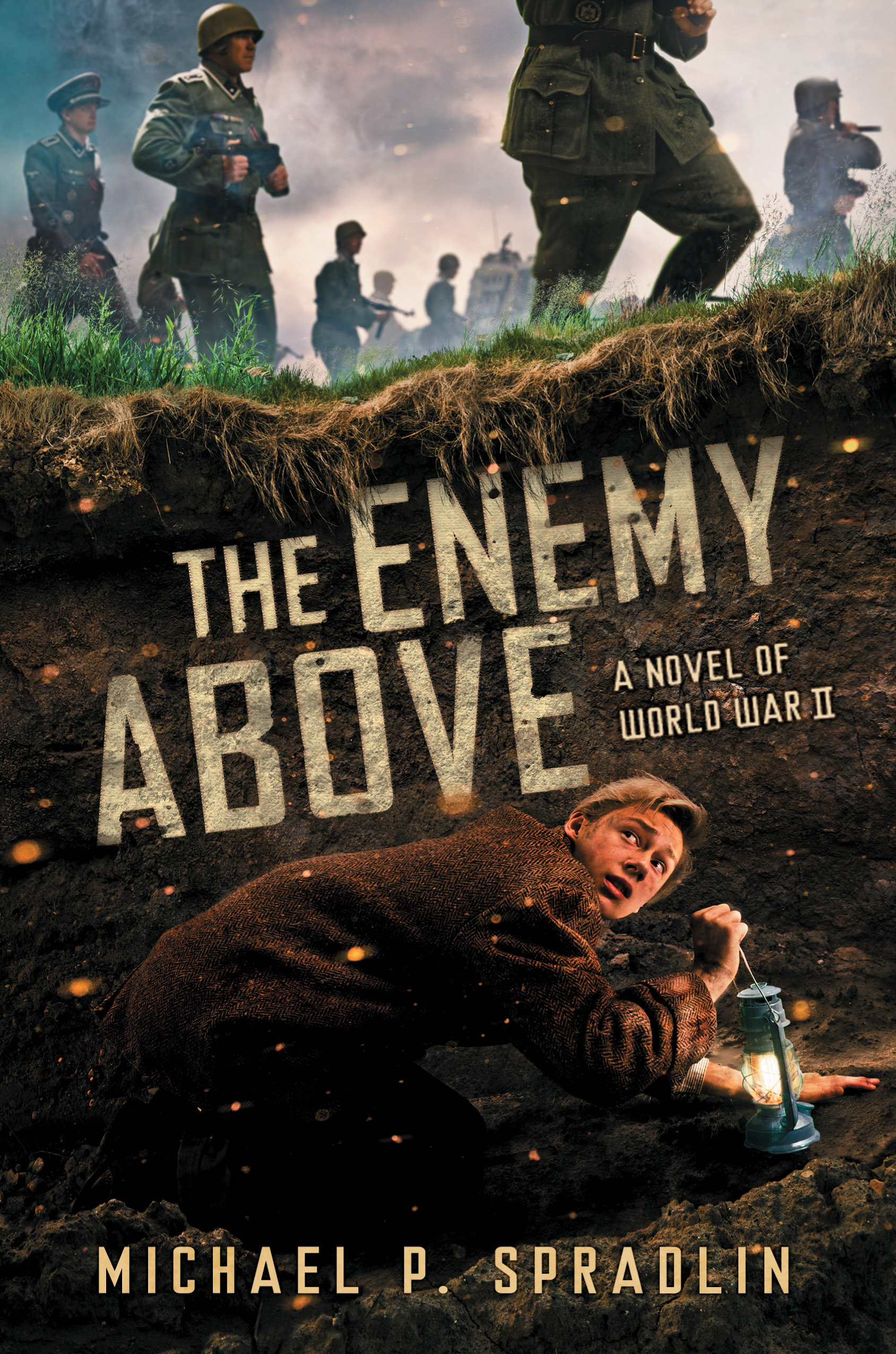
173. The Enemy Above


The Enemy Above. Michael P. Spradlin. 2016. 240 pages. [Source: Review copy]

First sentence: At first, Anton thought the rumble was a summer storm.

Premise/plot: Anton, our twelve-year-old protagonist, is coming of age during the second world war. Both fronts--the Germans and the Soviets--are closing in on his family's farm in Ukraine. Both sides pose real risks to Anton and his grandmother...and to the community at large. In particular, the Jewish community. There's not enough time to actually, actually flee with any hope of success. But there may just be enough time to find a hiding place in plain sight. The caves below may just prove a refuge to a community. But it isn't a cozy-safe-refuge. War is literally raging above. And there are those who will go to any lengths to hunt down Jews. 

Can Anton keep his grandmother safe?

My thoughts: This one is compelling, intense, action-packed. There are so many, many close-call moments. so many chapters end in a cliff-hanger. Emotions build as the novel unfolds. There is always this question of CAN Anton save his grandmother? Can he save himself? 

I was not at all expecting a dual narrative. It was so ODD and unusual that readers get a Nazi [Major Karl Von Duesen] viewpoint. We get both the HUNTER and the HUNTED perspectives. The flipping/switching back and forth during very intense scenes was something. I definitely don't like *being* in Karl's mind. 

This one does not tie things in bows. While some war novels have some amount of light to counterbalance the dark, this one doesn't. I think that is fair and realistic. 


© 2022 Becky Laney of Becky's Book Reviews

Tuesday, November 08, 2022

145. The Hidden Oracle


The Hidden Oracle (The Trials of Apollo #1) Rick Riordan. 2016. 384 pages. [Source: Library]

First sentence: My name is Apollo. I used to be a god.

Premise/plot: Apollo, the god, is being punished by Zeus. His punishment? To become a mortal teenage boy named Lester Papadopoulos. He has his memories intact--for the most part--but not his supernatural abilities or gifts. He's 'saved' from bullies by a girl named Meg. He recognizes that she is very-likely-most-probably a demigod. Together they make their way to Camp Halfblood--after a short stop to visit Percy Jackson who, I believe, may just be a Senior in high school now??? Or perhaps a Junior??? He's sitting this misadventure out--so he claims. If the world needs saving, other demigods will have to handle it. 

When Apollo/Lester arrives at camp, he learns that campers [halfbloods/demigods] have been mysteriously disappearing. And there are still no prophecies or oracles. With no prophecies, there will be no quests. With no quests, how can they save the day and solve mysteries??? 

Apollo has plenty to keep him busy. Especially when some of his own children go missing. Soon he is tracking down the mystery--sometimes with Meg, sometimes without. The adventure/misadventure is on the light side. But this is only book one in a new series. 

My thoughts: I liked this one. I liked Apollo. I liked that it was mainly centered on Apollo--or his point of view. Keeping up with seven to nine narrators was getting to be a little too much in the previous series. I definitely liked this one!


© 2022 Becky Laney of Becky's Book Reviews

Thursday, June 23, 2022

77. Garvey's Choice

Garvey's Choice. Nikki Grimes. 2016. 120 pages. [Source: Library]

First sentence: When I was seven/ and crazy for Mr. Spock,/ a Star Trek lunch box/ was all I craved. Instead, Dad/ bought one blaring the logo/ of some football team/ I'd never heard of./ I shoved that thing in/ the coal black of my closet,/ then celebrated with cake.

Premise/plot: Garvey's Choice is a verse novel. (The verse is written in tanka.) Garvey is an overweight teen who'd much rather sing or read than play sports. There exists between father and son a gap that nothing seems to fill. At least at first. Garvey tries--unsuccessfully--to fill this gap with food. Garvey's dad may talk about sports--a lot--but I don't get the impression that he's actually cruel to his son. The two just aren't speaking the same love languages. 

In the novel, Garvey makes several choices. Will he choose to try out for chorus and risk rejection or humiliation? He ultimately decides that he has nothing to lose and everything to gain. After all, he's already being teased by his classmates; he's already hating lunch time. What he finds out is that he's really talented at singing; and his singing not only makes him happy in the process, but makes others happy too. That and he makes a second friend. Another choice he makes regards his weight. Will he try to lose weight? Should he try to lose weight? How should he go about it? What can he change in his life to be healthier and happier?

This aspect of the verse novel was a bit iffier for me. I hated to see him get in the cycle of dieting in unhealthy ways, ways that are doomed to fail. I was yelling DON'T DO IT. JUST DON'T. 

My thoughts: I think the verses are authentic in that many, many, many, many people turn to food as a way to deal with emotions they don't know how to handle any other way. It's not the best way perhaps, but it is the easy way. I liked how singing took the place of food in some ways as a way to cope with the ups and downs of life.

One of the songs mentioned throughout the book is "Dance with My Father." I encourage you to give it a listen if you pick this one up.

One of my favorite poems: "Summer Lost and Found"

Stories are breadcrumbs.
Just follow the trail of books
and you will find me
lost among the galaxies
of scorched stars and ships to Mars. (4)
And here's another: "Alien"
Over breakfast, Dad
eyes me like an alien
never seen before.
Sometimes, I could swear that he's
hoping to make first contact. (17)

 My new thoughts: I first read this one in February 2017. I reread it in June 2022 because a sequel is coming!!! I am so excited to get another book starring Garvey!!! The poems still resonate. SO much can be communicated in just a few lines.


© 2022 Becky Laney of Becky's Book Reviews

Monday, December 20, 2021

150. Scrooge #worstgiftever


Scrooge #worstgiftever. Adapted by Brett Wright. 2016. 112 pages. [Source: Library]

First sentence: Jacob Marley is dead.

Premise/plot: The Christmas Carol adapted and told through text messages with plenty of emojis to spare. 

My thoughts: The book's biggest strength is that it is an absolute breeze to get through. It won't take much of your time as a reader. Of course, that could be because there isn't much substance. To be fair, there are plenty of adaptations of A Christmas Carol--on film especially. The shortest I've seen is under ten minutes. The story lends itself well to adaptation.

The book is essentially a hundred plus pages of gimmick. It is a novelty book cover to cover. If you find the idea of Scrooge and the four visiting ghosts texting hilarious to amusing, then this one might amuse you for most of the book. I personally was over the gimmick relatively early.

Because it has been adapted so many times in so many different ways, people might assume that there isn't all that much there to Dickens' characters. Some adaptations are amazing at depth of character--in particular Scrooge. But some are not--some are barely caricature. For the story to have the ability to MOVE the reader--to resonate with the reader--Scrooge must be fully fleshed out or made human. This "book" lacks ALL characterization. 

Also it is marketed as a children's book--published by Random House's children's division--yet it contains adult-ish abbreviations that aren't quite kid-appropriate (in my opinion). So I wouldn't personally recommend it for kids.


© 2021 Becky Laney of Becky's Book Reviews

Thursday, July 09, 2020

92. Arsenic with Austen

Arsenic with Austen. Katherine Bolger Hyde. 2016. 312 pages. [Source: Library]

First sentence: A gentle late-spring breeze ruffled the tender leaves of the maple and cherry trees on Reed College's front lawn, flirted with the skirts of the graduates' robes and tugged at the edges of their mortarboards, then swirled up three stories to tease Emily's upswept hair as she stood at her open office window.

Premise/plot: Emily Cavanaugh, our heroine, inherits a LARGE fortune and estate from her great-aunt Beatrice. (It includes a large house, a HUGE book collection, and many, many, many properties about town.) She takes up residence in Stony Beach, Oregon, and begins her new life by embarking to solve a few mysteries. Did Beatrice die of natural causes? Could she have been poisoned? Who would want her dead? Why is the town so divided on what is in its best interest moving forward?

My thoughts: I really LOVED this one. I loved it in spite of its almost obnoxious first sentence. Fortunately, the writing doesn't really keep on like that!!! I read this one quickly and found it a satisfying book. There's quite a few mysteries to solve, and a side dish of romance with an old summer love. I appreciated the fact that our heroine isn't all that young--in her mid to late fifties. It's not all that common to have romances starring an older couple. It was nice.


© 2020 Becky Laney of Becky's Book Reviews

Tuesday, February 04, 2020

21. Blue Madonna

Blue Madonna. (Billy Boyle #11) James R. Benn. 2016. 316 pages. [Source: Library] [Historical; Mystery; World War II]

First sentence: It was a nice day for a drive.

Premise/plot: Blue Madonna is the eleventh historical mystery starring Billy Boyle. This one is set May/June 1944 in England and France. It begins with a shocking twist: a court martial for Billy Boyle. But after an unusual start it soon settles into a more predictable Billy Boyle mystery. Wherever he goes, he finds murders to solve and clues to follow. Even in Nazi occupied France.

My thoughts: I love, love, love the series as a whole. These characters live for me. I am thoroughly attached to Billy Boyle, Kaz, Big Mike, Diana, etc. I love following the stories from book to book as to how these relationships and stories develop and evolve. But. Sometimes individual titles are just okay and not super amazing or oh so compelling. Blue Madonna is not my favorite in the series.

© 2020 Becky Laney of Becky's Book Reviews

Wednesday, October 16, 2019

World at War: Lady Cop Makes Trouble

Lady Cop Makes Trouble. Kopp Sisters #2. Amy Stewart. 2016. 310 pages. [Source: Library]

First sentence: I handed the newspaper back to Mrs. Headison. “I suppose you replied to the box-holder?”

Premise/plot: Will she or won’t she be hired on as deputy?! That is the underlying question throughout the second book in the Kopp sisters series by Amy Stewart. Constance, Norma, and Fleurette are the Kopp sisters. The first book ended with Constance searching for a job. She has now found work as an unofficial-almost deputy to Sheriff Heath and matron of the jail. Her official job has her overseeing the female prisoners. Her unofficial job has her hunting down big time fugitives. Can she prove her worth and get the job done?

My thoughts: This book like Girl Waits with Gun is based on true people and events as reported in newspapers of the time. It even includes a photograph of the real Constance Kopp. I loved, loved, loved the first book which focused more on her relationship with her sisters. It had plenty of action and adventure. This second book focuses almost exclusively on her professional life. I liked it. I did. But maybe not quite as much. I would still recommend the series. 


© 2019 Becky Laney of Becky's Book Reviews

Monday, July 30, 2018

Bob The Railway Dog

Bob The Railway Dog: The True Story of An Adventurous Dog. Corinne Fenton. Illustrated by Andrew McLean. 2016. Candlewick. 32 pages. [Source: Review copy]

First sentence: In those hushed moments before sunset, a train crept, hissing and sighing, into Carrieton Station, South Australia. It was September 1884.

Premise/plot: Set in nineteenth-century Australia, this picture book tells the story of an adventure-loving dog named Bob who rode the trains and explored a country. Guard Ferry, his "owner," adopts him as a pup. Soon Bob is riding the trains with him. But Bob longs for more adventure, more trains, more people to love. The picture book is based on a true story.

My thoughts: I liked this one. If you enjoy nonfiction, history, dogs, or trains there is a good chance you'll enjoy this one too. I appreciated that it wasn't too text-heavy. This is still very much a story picture book.

Text: 4 out of 5
Illustrations: 3 out of 5
Total: 7 out of 10

© 2018 Becky Laney of Becky's Book Reviews

The Tudors

The Tudors: Kings, Queens, Scribes, and Ferrets! Marcia Williams. 2016. 48 pages. Candlewick Press.  [Source: Review copy]

First sentence: For thirty years, a great civil war raged across England. I was not alive to witness it, but it is still spoken of with awe.

Premise/plot: This nonfiction picture book was "written" by Arthur Inkblott and his ferret, Smudge. Its packed with information about Tudor England: the kings, the queens, famous folk, and common folk too. The subjects covered include:
  • The Wars of the Roses
  • The Battle of Bosworth Field
  • Who was Henry Tudor?
  • Henry VII rewrites History
  • A Royal Wedding
  • Money
  • Power
  • Christopher Columbus
  • Henry VII's Family
  • The Spare Prince
  • Henry VIII: The Headstrong
  • Palaces and Potties
  • The Field of the Cloth of Gold
  • Henry's Great Matter
  • Henry's Six Wives
  • The Death of Bluff King Hal
  • The Short Reign of Edward VI
  • Queen Mary I
  • Queen Elizabeth II
  • Mary, Queen of Scots
  • The Spanish Armada
  • Sir Francis Drake
  • Sir Walter Raleigh
  • William Shakespeare
  • The End of the Tudor Dynasty 
My thoughts: This one may be above my maturity level. In other words, Marcia Williams' biases are evident and they don't align with my biases. Perhaps many readers won't come to the book with opinions on these monarchs and the truth of their reigns. But I do. The Tudors are not my favorite. And Richard III has been WRONGED by Williams' text. That's all I have to say about that.

The font of this one is super-super tiny. And everything is very busy--the text is crammed as are the illustrations.

But it is mildly entertaining. I think my favorite bits focused on the commoners. 

© 2018 Becky Laney of Becky's Book Reviews

Monday, April 23, 2018

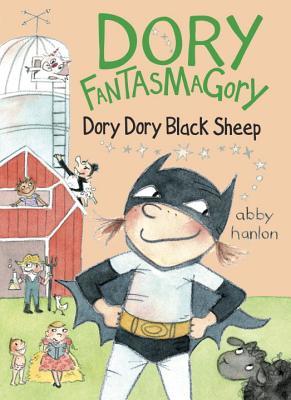
Dory Fantasmagory: Dory Dory Black Sheep

Dory Dory Black Sheep (Dory Fantasmagory #3) Abby Hanlon. 2016. 156 pages. [Source: Library]

First sentence: My name is Dory but everyone calls me Rascal. I am six. I have a lot of freckles. My hair is just messy. This is my nightgown that I try to wear as much as I can. But the most important thing about me is that I have two worlds. One is real and one is imaginary.

Premise/plot: Is Dory the black sheep of her family? Perhaps if you accept the lighthearted definition provided for readers at the beginning of the book: "a member of a family or group who does things a little differently." Dory does things differently. Ask her mom...or teacher...or her older brother, Luke, or her older sister, Violet. (Though her siblings' opinions might be biased!)

Dory does indeed live in two worlds: one real and one imaginary. But she doesn't give equal time and attention to both. In fact, 90% of the time she's in her own world and completely out-of-touch with reality. To use the world miracle lightly and perhaps inappropriately, it's a miracle if Dory stays on task and answers questions when asked.

Because Dory rarely--if ever--stays on task she's having difficulty learning to read. Her reading instruction time at school seems to be completely independent and without much guidance or instruction. Essentially the teacher saying: hey kid, read this book. Dory is paired with a partner, but the partner hasn't any more clue of how to read than Dory does. The teacher doesn't seem concerned with teaching them how to read--the skills and techniques they need to know to progress. Perhaps she just hasn't gotten around to working with their group yet.

Dory doesn't like being in the lowest reading group and being given a basket of "baby books" to read. But when she opens up the book and begins reading the illustrations, well, she supplies a story of her own imagination. A story peopled with her own imaginary friends and characters, and the black sheep of the farm story, well he leaps out of the book and becomes part of Dory's day-in, day-out imagination. Can she get the black sheep back in the book? Does she want to?

Her friends soon get swept up, up, and away with this new story. Even her friend who is able to read LONG chapter books all on her own. Dory's story is more exciting perhaps. 

This is Dory's third adventure. (I reviewed the first chapter book in the series in 2015. And here's my review of the second book in the series.)

My thoughts: One thing is delightful for sure: the illustrations. I LOVE, LOVE, LOVE the illustrations.

 I wanted to love, love, love this one. I didn't quite. Perhaps because I had a hard time NOT taking it seriously. Instead of getting swept up, up, and away by Dory's overactive imagination and delighting in her creative, free spirit, I kept thinking that her mom and her teacher weren't really giving Dory the attention she needed.

Learning to read is important, significant, life-changing. It isn't a cookie cutter process. And every child has his or her own timeframe for learning to read or becoming a fluent reader. There isn't one perfectly-perfect right way to teach reading. But I do think it is something that requires instruction. You just can't leave a child with a basket of books and hope for the best.
We pretend we are reading until she leaves. "If I was the farmer, I would just eat all the animals," whispers George. "If I was the farmer, I would move to the city and get an apartment with an elevator, I say. "If I was the farmer, I would run around naked and put mud all over my body and then stick things to it," says George. "But you would do that anyway," I say. "Yeah..." he says. 
"This little black sheep is kind of cute." I show George the picture. "And he's looking at you," George says. "What do you mean?" I say, and hold the book up closer. "I think his name is Goblin," I say. "Does it say that?" George asks. "I don't know," I say. "I can't read." "Raise your hand if you hate reading!" says George. And we both raise our hands high in the air.
Parenting Dory would be DIFFICULT to say the least. I don't envy her mom the task. But I get the idea that reading aloud to Dory wasn't ever a high priority to her. Perhaps Dory protested every time she tried. Perhaps the struggle wasn't worth it. Perhaps she was busy helping the older children with their homework. Perhaps Dory was so amazing at entertaining herself that she didn't want to interrupt her play, her free time. Perhaps she thinks teaching reading is the teacher's responsibility alone.

But Dory's homework of reading for a certain amount each day is completely independent. Her mom doesn't sit down with her, doesn't listen to her daughter read aloud, doesn't ask her questions about her reading, doesn't witness if her daughter is reading or not. So essentially there are no adults in her life that know Dory is struggling with reading. Dory seems to be all on her own, expected to make progress without any help, encouragement, or instruction.

Does Dory want to learn to read? Yes. Does she stay on task when left on her own to practice? Not really.

The book is cheerful. Dory, for the most part, is happy, happy, happy nearly all the time. She has her real friends and her imaginary friends to keep her company 24/7. Her imagination is over-the-top delightful. And I think Dory is content to make up her own stories instead of reading stories from a book. Her stories seem to be packed more with adventure and excitement.

Dory is a fictional character. I need to keep this in mind. Dory's over-the-top IMAGINATION has the potential to enchant young readers, to make them really excited about reading. Engaging real readers--real children--is more important than a technical behind-the-scenes guide for adults in how to teach children how to read. 

The writing is fun.

Quotes:
But before I get dressed, I have to wake up Mary. Lately, I've had to wake her up with a pan in my hand so she knows I really mean it. She's gotten super lazy now that she stays home when I'm at school. 
Rosabelle has a big thick chapter book in her lap. She looks up and sees me running toward her. We take turns picking each other up. It's like hugging, but more dangerous. 


© 2018 Becky Laney of Becky's Book Reviews

Thursday, January 18, 2018

Florence Nightingale

Florence Nightingale: The Courageous Life of the Legendary Nurse. Catherine Reef. 2016. Houghton Mifflin Harcourt. 197 pages. [Source: Review copy]

First sentence: Things happening at night had the look of old paintings.

Premise/plot: Catherine Reef has written a biography of Florence Nightingale. I would recommend it to those interested in Florence Nightingale (obviously), the Victorian period in general, the Crimean War specifically, and last but not least those interested in women's roles and rights in the nineteenth century. Readers learn about Florence Nightingale's struggle to follow God's call on her life: to be a nurse.

At the time she was growing up, nurses were held in little respect. Nurses were held to have few morals--be drunkards and prostitutes. Nurses also did not have to be trained professionals. So to say her parents were shocked or disappointed or frustrated with their daughter would be on target. Florence didn't want what other young women wanted; her interests were her own. Though her parents didn't always accept her, there were other adults in her life who did; there were those who encouraged her and enabled her, in fact, to pursue a career in nursing. (She received training in a nursing school in Germany).

One relationship that stayed rocky for decades was her relationship with her sister. Those two did not get along, and her sister really did not understand why her sister had to be so weird. There were times these two seemed allergic to one another's company.

There was a LOT of name dropping in this one. Even before she became THE FAMOUS FLORENCE NIGHTINGALE of Crimean war fame, she met some famous or would-be-famous Victorians. And Victorians being Victorians, there are diaries and letters about such meetings and impressions.

My thoughts: I liked this one. I didn't love it. Perhaps I'm just more interested in Queen Victoria? Perhaps it was just bad timing on my part. I am glad I read it. I don't regret my time. It just didn't captivate or fascinate me.

If Catherine Reef would like to write more books about Victorians, I can think of a few suggestions: George Eliot, Elizabeth Gaskell, Margaret Oliphant, Mary Elizabeth Braddon, Ada Lovelace, to name a few. 

OR possibly Fanny Burney, Maria Edgeworth, or Mary Shelley if you opened up the field.


© 2018 Becky Laney of Becky's Book Reviews

Monday, November 27, 2017

Waylon: One Awesome Thing

Waylon! One Awesome Thing. Sara Pennypacker. Illustrated by Marla Frazee. 2016. 208 pages. [Source: Library]

First sentence: Waylon craned his neck. "Moon at the nearest point in its orbit--check. Clouds--check. But Joe, I'm telling you--"

Premise/plot: Waylon is in fourth grade, and it's complicated. Most of the time, he's happy to just be--to be himself, to be excited about anything and everything connected to science and nature. But some of the time, well, he starts to imagine how he appears to others. "As though he was outside his body watching himself. Not extraterrestrial others. Extraterrestrials watching wouldn't bother him at all. If they were looking down from their space pods. Waylon felt sure they would grok him. Grok was a word he'd learned in a science fiction story. It meant to understand something so completely you practically merged with it. No, it wasn't extraterrestrials he worried about, it was other human kids. And when Waylon imagined other human kids watching him, he imagined them laughing--not nice laughs, but mean smirks" (22-3). In the past few weeks, his class has started dividing into teams. And he HATES that. Why do they need to divide into an "us" and "them." And which team would he want to be on if he has to be on a team. But the arrival of a not-so-new-kid, Baxter, changes the class dynamics. Is there hope for Waylon after all?

My thoughts: I loved Sara Pennypacker's Clementine series. LOVED. This fourth grade class has Clementine in it, but the narrator is Waylon. And to be honest, Waylon is more interested in science, sports, and dogs than in girls. I really enjoyed this chapter book. Some names will be familiar to readers--since so many elements of Clementine's stories focused on her school life. It didn't take many chapters for me to love Waylon for himself.

I loved the characters, the writing, the story, and the illustrations.
© 2017 Becky Laney of Becky's Book Reviews

Wednesday, November 15, 2017

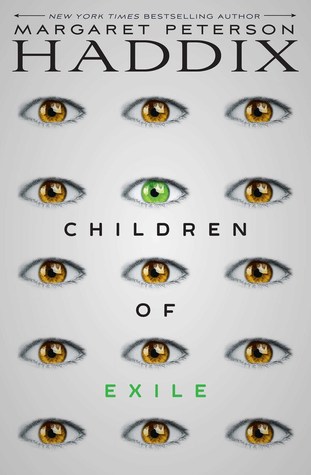
Children of Exile

Children of Exile. Margaret Peterson Haddix. 2016. Simon & Schuster. 304 pages. [Source: Review copy]

First sentence: We weren't orphans after all. That was the first surprise. The second was that we were going home.

Premise/plot: Rosi and Bobo are two of many children who are being sent back home to their real parents. For the past twelve years, the children have been raised not by their birth parents, their "real parents" but by the Freds of Fredtown. The children range in ages and reactions. Some are hopeful; some are angry. A few are very, very suspicious. Among the most suspicious is a boy named Edwy. Rosi is typically annoyed with Edwy's conspiracies and negativity. But she changes her mind after arriving "back home." Nothing in Fredtown could have prepared her for the harsh, cruel "real" world of her parents. And assimilation is not easy. Are the children safe? Are their lives now in danger?

My thoughts: Haddix's novels are always--or almost always--quick and compelling reads. Even if the plot later falls apart as you think more and more about the characters, the story, the writing. For better or worse, I'm rarely plagued with questions and doubts as I read the book itself. Did I love Children of Exile. I don't know now. Ask me later. As in when I've finished the second book in the series. Personally, I'd rather have one large book that tells a whole story than two smaller books that just tease you and leave you frustrated.
© 2017 Becky Laney of Becky's Book Reviews

Monday, November 13, 2017

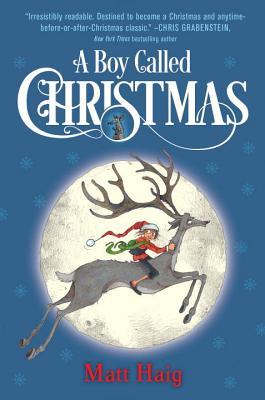
Boy Called Christmas

Boy Called Christmas. Matt Haig. Illustrated by Chris Mould. 2015/2016. Random House. 240 pages. [Source: Review copy]

First sentence: You are about to read the true story of Father Christmas.

Premise/plot: "Can you believe there was a time when no one in the world knew about him? A time when he was just an ordinary boy called Nikolas, living in the middle of nowhere, or the middle of Finland, doing nothing with magic except believing in it? A boy who knew very little about the world except the taste of mushroom soup, the feel of a cold north wind, and the stories he was told. And who only had a doll made out of a turnip to play with. But life was going to change for Nikolas, in ways he could never have imagined. Things were going to happen to him. Good things. Bad things. But if you are one of those people who believe that some things are impossible, you should put this book down right away. It is most certainly not for you. Because this book is full of impossible things."

I normally never share so long a quote. But this excerpt from the first chapter captures not only what the book is about, but also the spirit or style of it. And if that quote doesn't draw you in, then this probably isn't the book for you. Nothing I could add would change your mind.

My thoughts: I really enjoyed this one. I found it fun and charming. Nikolas was just your average poor boy UNTIL his father decides to leave him to go off on an adventure looking for ELVES. Nikolas was left to the care of his aunt. And this aunt is AWFUL. Eventually, he decides to run away and go on a quest to find his father. That adventure--full of misadventures--will prove to be his making.
 
This is a fun holiday-themed coming-of-age fantasy.

© 2017 Becky Laney of Becky's Book Reviews

Monday, November 06, 2017

Tru & Nelle

Tru & Nelle. G. Neri. 2016. HMH. 336 pages. [Source: Review copy]

First sentence: When Truman first spotted Nelle, he thought she was a boy.

Premise/plot: Tru & Nelle is set in Monroeville, Alabama, during the Great Depression. It features a young Harper Lee and Truman Capote. The book IS historical fiction, but the two were definitely friends in real life, particularly as children.

My thoughts: I really enjoyed this one. To Kill A Mockingbird is one of my favorite books and one of my favorite movies as well. Scout has to be one of the best characters ever. So it was interesting to see a young Nelle in action. The focus is more on Truman, or Tru, perhaps. This book is an account of their adventures and misadventures. It spans several years. I know there are at least two Halloweens mentioned. These two discover they have something in common: a love of books, a love of reading, a love of MYSTERY. These two become Sherlock and Watson, and, the town best beware! Nelle's father later gifts them with a type writer to spare the town their meddling and to encourage them to solve FICTIONAL mysteries instead.

If historical coming-of-age novels are something you enjoy, I'd recommend this one. 

"Life is a heck of a hill to climb, Little Chappie. But if it gets too steep for ya, just get down on your hands and knees and keep going. Sooner or later, you'll get over the hump," Bud said. (62)

© 2017 Becky Laney of Becky's Book Reviews