Showing posts with label 1938. Show all posts

Friday, November 08, 2024

93. Superman: The Golden Age Volume 1

93. Superman: The Golden Age #1 Jerry Siegel. Joe Shuster. 2016. (Comics are from June 1938 through December 1939.) 392 pages. [Source: Library] [5 stars] [comic books; graphic novel; superheroes; action]

First sentence: As a distant planet was destroyed by old age, a scientist placed his infant son within a hastily devised space-ship, launching it toward Earth!

Premise/plot: What you see is what you get. This book is a collection of the earliest Superman comic books. The comic books include Action Comics (where he first appeared), New York World's Fair Comics, and the self-titled Superman comics. The main villain in these--appearing more than any other villain, I mean--is Ultra. But more often than not, each comic book has its own villain, or "villain." Sometimes the villain is a greedy businessman who takes shortcuts with the quality of his products, and sometimes they are out-and-out villainous. Ultra, for example, is out for world domination. Superman also at least once--maybe a few more times--does some "aggressive negotiating" with countries at war. He is not above beating out a confession from a villain either. 

My thoughts: A handful of these are extremely moralistic and didactic. To those that have read this book, a handful might not come across as the right word. There are super-incredibly-obvious didactic tactics at play. There are direct moralization at play. There are more subtle and indirect moralization at play. There's a range of spectrum. Even at its worst--it's enjoyable for a giggle. The writing is SO over the top and "special." My new favorites being SHORTLY LATER which appears more often than not in most of the adventures followed up by SHORTLY AFTER. The second half of the book, the writers seemed to have switched up the phrase. IF readers got paid a penny for every time the word "muscles" was used, then they'd be able to afford a LOT of comics. 

I can definitely see the appeal of Superman. Though it's not necessarily a visual appeal in the comics. I think this might just be the times in which they were written, but, it is almost like there were essentially three male faces and one perhaps two female faces that appear. Everybody looks the same, or same-ish. There are no details, no expressions. I thought it was funny--perhaps ironic--that Superman was able to take the place of at least two different people and masquerade as someone else. Once as a football player and once as a boxer??? Honestly, the way these characters are drawn, I believe it. That being said, I enjoyed the vintage-ness of it.


© 2024 Becky Laney of Becky's Book Reviews

Thursday, May 21, 2020

70. Miss Pettigrew Lives for a Day

Miss Pettigrew Lives for a Day. Winifred Watson. 1938. 234 pages. [Source: Library]

First sentence: Miss Pettigrew pushed open the door of the employment agency and went in as the clock struck quarter past nine.

Premise/plot: Miss Guinevere Pettigrew is down on her luck. It is a matter of utmost urgency that she get a job--a post--that very day. So she sets off to interview for governess at a MISS LaFosse's house. When she arrives, she's in for a shock...or two...or three. But while at first things just seem to happen around her--she's an observer of the DRAMA--soon Miss Pettigrew finds herself a LIVING part of the DRAMA and ACTION. This may just be a life-changing day after all. Miss Pettigrew finds herself NEEDED by Miss LaFosse whose love life is a complete and total wreck. Could a middle-aged spinster who has never been in love, never been kissed, be just the person needed to save Miss LaFosse...and her friends?!

My thoughts: Miss Pettigrew Lives for A Day is a DELIGHTFUL romantic comedy. All the "action" is implied and off-screen, which is just how I prefer it. Miss LaFosse no doubt about it has a TANGLED love life juggling three different men: Phil, Nick, and Michael. But despite all that's going on in her personal life, there's something PG about the book itself. It never once felt like SMUT. But I am digressing.

I definitely enjoyed seeing life through Miss Pettigrew's eyes. She was a LOVELY character to spend a day with. I really loved almost all of the characters: even the ones that tended more towards love-to-hate or hate-to-love. Like Nick. There were just so many scenes that almost sparkled; I could definitely see why this would be a WONDERFUL movie for any era. I have not seen the movie adaptation from 2008. (I probably won't see it for a while because of COVID). But I imagine it would have been awesome as a black and white film from the 1930s or 40s.

Favorite quote(s):
"When I was born my feet were only made to carry eight pounds. The rest of me has grown out of proportion." (190)

"Talk just happened. No difficulty. It simply arrived." (190)


© 2020 Becky Laney of Becky's Book Reviews

Monday, March 13, 2017

Caps for Sale

Caps for Sale. Esphyr Slobodkina. 1938. 48 pages. [Source: Library]

First sentence: Once there was a peddler who sold caps. But he was not like an ordinary peddler carrying his wares on his back. He carried them on top of his head. First he had on his own checked cap, then a bunch of gray caps, then a bunch of brown caps, then a bunch of blue caps, and on the very top a bunch of red caps.

Premise/plot: One morning--after having no luck selling his caps--he decides to take a detour, a walk in the country. This leads to a nap, of course! While under a tree--sleeping--some naughty monkeys steal almost all of his caps!!! Can the peddler outsmart the monkeys?

My thoughts: My mom loved to read this one aloud!!! She did a great job voicing the angry peddler yelling at the monkeys! It's a fun book and very silly.

Text: 5 out of 5
Illustrations: 3 out of 5
Total: 8 out of 10

© 2017 Becky Laney of Becky's Book Reviews

Wednesday, December 14, 2016

Our Town

Our Town. Thornton Wilder. 1938. 181 pages. [Source: Library]

First sentence: Stage Manager: This play is called "Our Town."

Premise/plot: Set in Grover's Corners, New Hampshire, at the turn of the twentieth century, this Pulitzer-prize winning drama follows two families: the Gibbs and the Webbs as the meaning of life is explored.

Readers--viewers--"see" certain life events in the town. Some BIG moments (the wedding between George and Emily, Emily's funeral), some small moments (the opening scene, for example, Emily's birthday, the first "aha" moment when George and Emily realize they'll be together until they are parted by death). The narrator who speeds us along life's journey is the "Stage Manager."

My thoughts: I knew this was a famous play. And I knew I "needed" to read it. I am glad I read it as an adult. I am not sure that a 17 year old me would have gotten it. The play essentially is about how you live life--or how you DON'T actually "live" life as the case may be. Life is made up of moments. And we are so super-busy and super-self-absorbed that we don't live in the moments. We don't treasure the moments we're given. We don't see enough, feel enough, give thanks enough, understand enough.


© 2016 Becky Laney of Becky's Book Reviews

Tuesday, April 26, 2016

Murder in the Museum

Murder in the Museum. John Rowland. 1938. Poisoned Pen Press. 250 pages. [Source: Review copy]

I really loved reading John Rowland's Murder in the Museum. It was a quick, entertaining read with filled with characters that you can't help wanting to spend time with.

The book opens with Henry Fairhurst happening upon a dead body at the British Museum--in the reading room. He speaks, of course, to the police inspectors--Inspector Shelley and (Constable) Cunningham--and they let slip that it was murder--poison, cyanide. While a bit shocked, perhaps, by the discovery, he's a bit thrilled underneath it all. Nothing like this has ever happened to him before--and the excitement of it, well, he doesn't want to let it go. He wants to help solve the case. They don't agree to this, not right away, of course. But as his volunteered tips prove useful on more than one occasion, soon, he's unofficially taking part.

The victim is a professor of Elizabethan literature, named Julius Arnell. His love of almonds--sugared almonds, I believe--did him in. That is where the poison was.

As I said I loved this one. I loved the mystery of it, the unfolding of clues and suspects. It was also a tension-filled read in many ways. There is more than one crime, for one thing, and readers see one crime in progress. It's a suspenseful read to be sure!!!

© 2016 Becky Laney of Becky's Book Reviews

Wednesday, June 17, 2015

I Know A Story (1938)

I Know A Story. Miriam Blanton Huber, Frank Seely Salisbury, and Mabel O'Donnell. Illustrated by Florence and Margaret Hoopes. Wonder-Story. 1938/1953, 1962. Harper & Row. 190 pages. [Source: Bought]

This is a decades-old reading textbook featuring folk tales! It includes these stories:
  • The Gingerbread Boy
  • The Three Bears
  • Billy Goats Gruff
  • Mr. Vinegar
  • The Straw Ox
  • Little Red Riding Hood
  • The Boy Who Went to the North Wind
It also includes these poems:
  • The Rabbit
  • Mice
  • In The Fashion
  • Chipmunk
  • Mother Goose Rhymes
  • Indian Children
  • The Woodpecker
  • The Animal Store
  • A Visit From St. Nicholas
I was familiar with many of these stories, you probably are as well. But a few were new-to-me. For example, I'd never heard "Mr. Vinegar," "The Straw Ox," or "The Boy Who Went to the North Wind."
"Mr. Vinegar" was a strange story of a foolish man. The ending made no sense either! But despite its strangeness, there were some elements I found myself liking.

Overall, I liked the stories much better than the poetry. My favorite story was probably "The Boy Who Went to the North Wind."


© 2015 Becky Laney of Becky's Book Reviews

Sunday, February 08, 2015

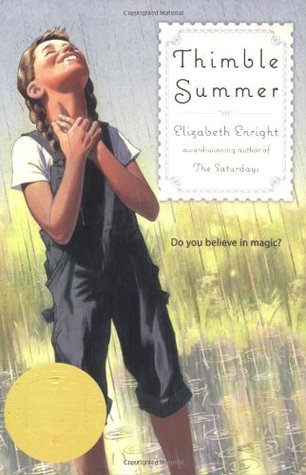
Thimble Summer (1938)

Thimble Summer. Elizabeth Enright. 1938/2008. SquareFish. 144 pages. [Source: Review copy]

Garnet thought this must be the hottest day that had ever been in the world. Every day for weeks she had thought the same thing, but this was really the worst of all. 

Thimble Summer won the Newbery in 1939. Thimble Summer is about the 'magical' summer Garnet Linden (the heroine) experiences after finding a silver thimble in a dried up riverbed. (The book opens with a drought. It is hot, hot, hot, and rain is much needed.)

Thimble Summer celebrates life and family. I loved it.

In the first chapter, readers meet Garnet, her family, and her best friend. This is the chapter where she finds the thimble that "changes" everything. (She certainly believes it changes her luck).
In the second chapter, Garnet and her best friend, Citronella, visit Citronella's great-grandmother and hear a story about when she was very naughty. (I loved this bit!) The third and fourth chapters go together. The family is building a new barn, and a lime kiln is needed. During their time watching the kiln, a stranger is introduced to the family, a young boy named Eric. After listening to his story, well, the family just has to 'keep' him. In the fifth chapter, Citronella and Garnet accidentally get locked-in at the library. Chapters six and seven are about when Garnet runs away from home to the 'big' city for a day. Chapters eight and nine are about the fair--and all the fun to be had. Her pig also won a blue ribbon.  Chapter ten is Garnet reflecting at how WONDERFUL the summer has been, and how much she loves life just as it is.

I loved this one. I loved Garnet. I loved her family. I loved getting to know Jay, her older brother, and Eric, her new 'adopted' brother. (She has more brothers. But they are all younger, and, Garnet hardly has much to do with them.) I loved her adventures with or without Citronella! It's just a satisfying read from cover to cover.

© 2015 Becky Laney of Becky's Book Reviews

Saturday, January 10, 2015

Seuss on Saturday #2

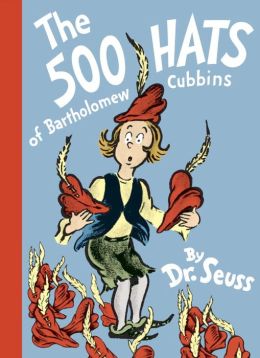
The 500 Hats of Bartholomew Cubbins. 1938/1965. Random House. 56 pages. [Source: Library]

First sentence:
 In the beginning, Bartholomew Cubbins didn't have five hundred hats. He had only one hat. It was an old one that had belonged to his father and his father's father before him. It was probably the oldest and the plainest hat in the whole Kingdom of Didd, where Bartholomew Cubbins lived.
Premise/plot. Bartholomew Cubbins gets into big, big trouble when he "refuses" to remove his hat in the presence of the king. The king gets more and more flustered as he sees the "insolence" of Bartholomew. To Bartholomew's credit, he is trying very hard to remove his hat. But every time he removes a hat, another appears on his head. What is going on?! What will the king do?!

My thoughts: I have only read this one twice. It definitely has more text than And To Think That I Saw it On Mulberry Street. And it also is written in prose. It does not rhyme. The story is just as over-the-top as And To Think That I Saw It On Mulberry Street, but it definitely has a different feel to it. According to Wikipedia, it was received well by reviewers. What did I think? Well, it was silly. I think the key to enjoying it is in focusing on the king and his reaction to the "problem." Seeing the king and those close to him try to solve the problem. For example, at one point he calls in seven black-gowned magicians:
Low and slow, they were chanting words that were strange...
"Dig a hole five furlongs deep,
Down to where the night snakes creep,
Mix and mold the mystic mud,
Malber, Balber, Tidder, Tudd."
In came seven black-gowned magicians, and beside each one stalked a lean black cat. They circled around Bartholomew Cubbins muttering deep and mysterious sounds.
It's never fun to be frustrated yourself. But the king's frustration proves comical. There are no real questions answered in this one.  But the ending proves satisfying enough.

Have you read The 500 Hats of Barthomew Cubbins? Did you like it? love it? hate it? What age do you think it works best for?

If you'd like to join me in reading or rereading Dr. Seuss' picture books (chronologically) I'd love to have you join me! The next book I'll be reviewing is The King's Stilts.


© 2015 Becky Laney of Becky's Book Reviews

Sunday, December 07, 2014

Ten Christmas Picture Books

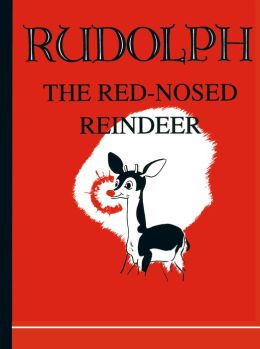
Rudolph the Red-Nosed Reindeer. Robert Lewis May. Illustrated by Denver Gillen. 1939/1990. Applewood Books. 32 pages. [Source: Library]

I enjoyed this one more than I thought I would. This is the original story by Robert L. May with the original illustrations by Denver Gillen. It is so different from the song and the stop-motion animated special. And I think it was the fact that it was different that made me appreciate it more.

The story is told in rhyme. It's essentially one long (perhaps poorly punctuated) poem. Here's how it begins:
Twas the day before Christmas, and all through the hills
The reindeer were playing…enjoying the spills
Of skating and coasting, and climbing the willows…
And hop-scotch and leap-frog (protected by pillows!)
While every so often they'd stop to call names
At one little deer not allowed in their games:--
"Ha ha! Look at Rudolph! His nose is a sight!"
"It's red as a beet!" "Twice as big!" "Twice as bright!"
While Rudolph just wept.
What else could he do?
He knew that the things
they were saying were true!
Readers first meet Rudolph, a young deer who is teased by his peers. He does NOT live at the North Pole. And he's not one of Santa's own reindeer.
What we do learn is that he's a very good, very obedient deer who is expecting Santa to leave him some lovely presents because he's been so very, very good.

Readers then meet Santa and learn of the horrible weather conditions that prove most challenging. Santa starts out on his trip, it isn't until he's delivering presents to Rudolph's house that he notices the brilliant light of his nose.

Santa then decides to wake him up and ask for his help. The rest of the journey goes much easier for Santa!

The book concludes with Santa returning Rudolph to his family, to his hometown. He is now a hero, of course.

I liked this one. I liked some of the rhymes more than others. There are definitely some quirky lines!
Come Dasher! Come Dancer! Come Prancer and Vixen!
Come Comet! Come Cupid! Come Donner and Blitzen!
Be quick with your suppers! Get hitched in a hurry!
You, too, will find fog a delay and a worry!"
And Santa was right. (As he usually is!)
The fog was as thick as a soda's white fizz.
The book is definitely text-heavy. So a longer attention span would be needed for little ones to enjoy this one.

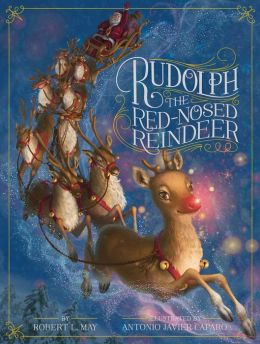
The copy I read was a facsimile edition. A 75th Anniversary edition with new illustrations was released in September 2014.

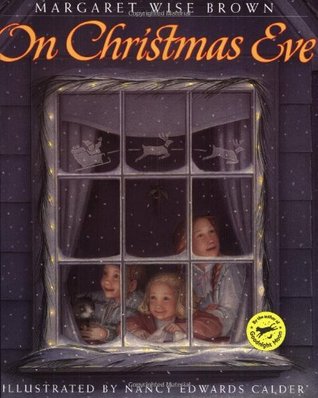
On Christmas Eve. Margaret Wise Brown. Illustrated by Nancy Edwards Calder. 1938/1961/1996. HarperCollins. 32 pages. [Source: Library]

It was the middle of the night. And night of all  nights it was Christmas.

I enjoyed Margaret Wise Brown's On Christmas Eve. It is a descriptive look at what Christmas--at what Christmas Eve--is like for children. It focuses on simple things: what your eyes see, what your ears hear, what your nose smells, what your hands and feet touch. It seeks to capture the emotion of the holiday: the excitement, the waiting, the longing.

Lots of details, lots of adjectives. It's rich in imagery and description. There is also a bit of repetition. The text is lyrical in places.

I can't say that I loved it. But it was very enjoyable. I was also glad to see that one of the presents under the tree was a train. The children are just in awe of the magic of Christmas, of the stockings and packages, of the snow falling outside, of the carolers outside.

It was a sweet story about three siblings.

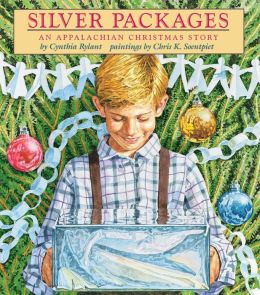
Silver Packages: An Appalachian Christmas Story. Cynthia Rylant. Illustrated by Chris K. Soentpiet. 1987. Scholastic. 32 pages. [Source: Library]

Silver Packages is a picture book for older readers most likely. I wouldn't say it is for an exclusively adult audience. But I think readers need some perspective in order to appreciate the book fully. I think it can resonate with readers, it has the potential. But I don't think the emotional reaction would be--or even should be--automatic. One can't assume that every reader will respond with tears and "this is the best book I've ever read!!!"

Silver Packages is about giving back to the community. In this instance, one very specific community--Appalachia. The book is about the Christmas Train. It starts with one man who wants to show his appreciation for the community that helped him when he needed it. He was injured in an accident, the community took in this stranger and nursed him back to health without asking for anything in return. He decides that he will come every year--by train--and hand out packages to the children who meet the train. These packages are wrapped in silver paper. Every story needs a protagonist. Silver Packages introduces us to Frankie. Readers first meet Frankie as a boy. He's a boy with a dream. He wants to be a doctor. And he really, really, really wants a doctor kit for Christmas. But each year, he's slightly disappointed. He receives a handful of silver packages through the years. Every gift seems to have a toy--something a boy or girl might want--and something a boy or girl might need. The practical gifts include: socks, mittens, hats, scarves, etc. Readers later see Frankie all grown up. He is a doctor. He reflects on his life, on his past Christmases, he has a light-bulb moment. He decides it is his turn to give back to the community in his own special way. It's a book about kindness and gratefulness and community awareness.

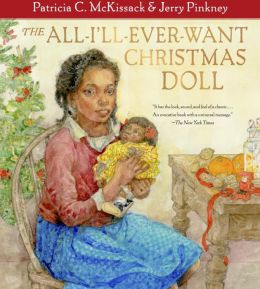
The All-I'll-Ever-Want Christmas Doll. Patricia C. McKissack. Illustrated by Jerry Pinkney. 2007. Schwartz & Wade. 40 pages. [Source: Library]

Christmas always came to our house, but Santy Claus only once in a while.

I haven't read The All-I'll-Ever Want-Christmas Doll in years. It was just as good as I remembered. The book is set during the Depression. A little girl, Nella, knows that her family is poor, that Santy may not come this year at all. Yet, she can't resist writing to him all the same begging for a Baby Betty doll. Her two sisters perhaps think a little less of Nella for her dreaming so big. She shouldn't expect so much from Christmas. But on Christmas morning, there are a few surprises. Each girl gets a Christmas sack filled with walnuts, peppermint candy, an orange, and a box of raisins. But there is one present, one special present remaining: a doll. Nella thinks the doll should be HERS and hers alone. After all, her sisters haven't gone around talking about the doll nonstop, her sisters didn't write Santa a letter begging for the doll. Why should she have to share the doll with them? But does the doll make her happy? Is the doll truly all she'll ever want? She has a few lessons to learn for sure!

I really enjoyed the story and the message.

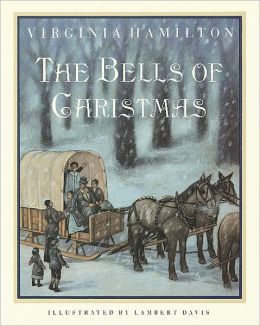
The Bells of Christmas. Virginia Hamilton. Illustrated by Lambert Davis. 1989/1997. Houghton Mifflin Harcourt. 64 pages. [Source: Library]

I didn't dislike Virginia Hamilton's The Bells of Christmas. But I didn't love, love, love it either. I think it depends on what exactly you're expecting from a Christmas book. The Bells of Christmas is very much a celebration of a Christmas long ago. Christmas 1890. Readers meet a young boy, Jason Bell, and experience the holiday through his perspective. We learn about his mom and dad, his brothers and sisters, his cousins, his aunt and uncle, his friend, Matthew. The book is set over a period of several days. Among the things readers learn that Jason's dad is a carpenter, that he wants his sons to join him in his business one day, his dad has only one leg, that his dad wears a peg leg part of the time and is in his wheel chair the rest of the time. Readers also learn that Jason is just a wee bit obsessed with wheels--mainly trains, but, also wagons, etc. The book has plenty of detail and characterization which is a good thing. Jason is waiting for quite a few things: 1) he can't wait for Christmas morning and presents! 2) he can't wait for the Bells to arrive--his uncle and aunt and cousins, 3) he is excited about church, most everyone is performing and participating in some way. (Jason is singing a solo.) The book perhaps seeks to capture one Christmas for one extended family. It is a pleasant, enjoyable book. It isn't quite a chapter book or novel. It isn't quite a picture book.
 
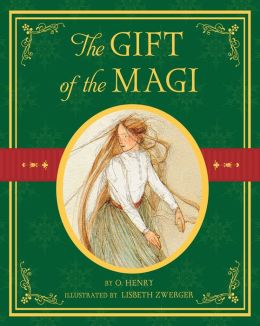
The Gift of the Magi. O. Henry. Illustrated by Lisbeth Zwerger. 1905/2006. Simon & Schuster. 32 pages. [Source: Library]

I've seen adaptations of The Gift of the Magi--who hasn't? (My favorite is Bert and Ernie and Mr. Hooper.) But this is the first time I've read the actual short story. I haven't decided how I feel about it. Is this couple wise or foolish? Or are they at times foolish and at times wise?

The wife, Della, takes extraordinary pride in her long hair. She doesn't seem the vain sort except for when it comes to her hair. And even if she is vain about it, there's no indication it's anything besides a private vanity. The wife apparently has been coveting expensive hair combs as well. The husband, Jim, takes extraordinary pride in the family watch. The narrator uses exaggeration when discussing the woman's long hair and the man's gold watch. I didn't love the narrator. In fact, I think the narrator is a distraction. He won't let the reader forget for a moment that this is a precious story.
Now, there were two possessions of the James Dillingham Youngs in which they both took a mighty pride. One was Jim's gold watch that had been his father's and his grandfather's. The other was Della's hair. Had the queen of Sheba lived in the flat across the airshaft, Della would have let her hair hang out the window some day to dry just to depreciate Her Majesty's jewels and gifts. Had King Solomon been the janitor, with all his treasures piled up in the basement, Jim would have pulled out his watch every time he passed, just to see him pluck at his beard from envy.
The wife can't afford a gift for her husband. The husband can't afford a gift the wife. The wife knows this--or should know this. The husband knows this--or should know this. The wife has saved $1.87. The husband might have saved a small sum as well. Readers don't know one way or the other. Both husband and wife will have something to offer the other, however. Something more than love. For both have decided--quite independently--to give sacrificially. To give up what they supposedly value most: her hair, his watch. And this giving up wasn't to support the family, but, to support the other's vanity.

I think actions can speak more than words. I think the narration took away some of my enjoyment of this one. It felt odd at times. There were sentences that were eloquent and refined and then it would slip into something else.
"It's sold, I tell you--sold and gone, too. It's Christmas Eve, boy. Be good to me, for it went for you. Maybe the hairs of my head were numbered," she went on with sudden serious sweetness, "but nobody could ever count my love for you. Shall I put the chops on, Jim?"
I think I like the adaptations better.

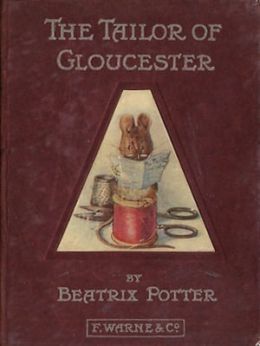
The Tailor of Gloucester. Beatrix Potter. 1903. 58 pages. [Source: Library] 
In the time of swords and periwigs and full-skirted coats with flowered lappets—when gentlemen wore ruffles, and gold-laced waistcoats of paduasoy and taffeta—there lived a tailor in Gloucester.
He sat in the window of a little shop in Westgate Street, cross-legged on a table, from morning till dark.
All day long while the light lasted he sewed and snippeted, piecing out his satin and pompadour, and lutestring; stuffs had strange names, and were very expensive in the days of the Tailor of Gloucester.
I enjoyed rereading Beatrix Potter's The Tailor of Glouchester. In this delightful Christmas tale, readers meet a tailor, a cat named Simpkin, and some lovely mice. It is several days before Christmas. He's working hard to finish a coat and waistcoat for the Mayor of Glouchester. The Mayor is getting married on Christmas day. The tailor has just enough money to finish the coat. Not a penny to spare. He sends his cat, Simpkin, with his money to buy what he needs: a little for himself (food: bread, sausage, milk) a little for his work (one twist of cherry-coloured silk). It is only after the fact that he questions whether he should have sent the cat or gone himself. The cat returns, but, in a mood. The cat is upset for he's discovered that the tailor freed the mice he had captured and hid under the teacups. The cat hides the twist. The man is upset, of course, and sick. He takes to his bed unable to work. The oh-so-thankful mice go to his shop and finish his work for him. But since they are one twist short, they are unable to finish completely. Still, they do what they can, and they do a wonderful job. The cat who spies them at work, I believe, has a change of heart and gives the twist to the old man on Christmas morning. He has just enough time to finish. The Mayor is very, very pleased. And the tailor's luck changes for the better, and his business is much improved. This one is a lovely, delightful read from start to finish.

Lucy's Christmas. Donald Hall. Illustrated by Michael McCurdy. 1998. Houghton Mifflin Harcourt. 40 pages. [Source: Library]

I enjoyed reading Lucy's Christmas by Donald Hall. Lucy's Christmas is a picture book set in 1909 in New Hampshire. In the fall of 1909, Lucy and her family start preparing for Christmas. For Lucy, this means starting to make her own gifts for her family and friends. It pays to plan ahead since so many gifts take time, and thought must be placed into each gift. She's not the only one thinking ahead. This year the family is ordering a new stove for the kitchen. The family has spent a lot of time browsing in the Sears catalog. Lucy's choice is the one the family decides upon: the Glenwood Kitchen Range. The focus is not just on gifts: planning, making, giving, receiving. The focus is also on family life and community life. Readers get glimpses of the school and church. Both places are very busy! I enjoyed this glimpse into the past! It was interesting to see the family prepare for the new year--1910. The enthusiasm in the story is sweet. The author's note reveals that this picture book is based on family history.

I really liked this one very much. I liked Lucy and her family. I liked the fact that the church plays such a HUGE role in the Christmas celebrations. There are gifts, it's true. But it's not commercialized and selfish.

Baboushka and the Three Kings. Ruth Robbins. Illustrated by Nicholas Sidjakov. 1960/1986. Houghton Mifflin Harcourt. 32 pages. [Source: Library]

Long ago and far away, on a winter's evening, the wind blew hard and cold around a small hut.

Baboushka and the Three Kings won the Caldecott Medal in 1961. It is Russian folktale with a Christmas setting. The three kings--wise men--come to Baboushka's hut. They only stay a few minutes. Long enough to extend an invitation to the old woman. Will she join them in their procession, in their quest, to find the Babe, the Child? She'd love to join them, she'd love to bring gifts to the Child. But she is not ready to go just yet. Couldn't they all wait until morning? Couldn't they wait for her to finish up a few small, tiny chores first? Couldn't they wait for the storm to clear? Their answer was firm. Their journey to the Child was too important to postpone. They couldn't linger longer. She watched them depart. But they were not easy men to forget. The next morning, she begins a journey of her own. A journey that will take her far. But will her journey lead her to where she wants to go?

It's a simple story, nicely written. "It is no ordinary Babe they seek. Yes! I must go and follow them! To find the new Babe, to offer Him her gift, was now her one yearning. This thought burned in her mind like a candle in the dark." It is also nicely illustrated. The illustrations complement the text well. Both illustrations and text have a different flavor, an authentic flavor, but not exactly American. After several readings, I came to appreciate both a bit more.

In case you're unfamiliar with the story, the book is bittersweet at best. While it is true that Russian children everywhere look forward to Baboushka's gifts each year as her journey continues, it is also true that Baboushka's journey has no happy ending. She never finds the Child. She is never able to give Him her gifts.

Polar Express. Chris Van Allsburg. 1985/2009. Houghton Mifflin Harcourt. 32 pages. [Source: Library]

The Polar Express is one of my favorite Christmas books. It is. The book is a thousand times better than the movie. (Though the soundtrack of the movie isn't bad.) So if you've only seen the movie, you might want to give the book a try to. You might have a different response to it.

The Polar Express is about belief and doubt--in Santa. It's told in the first person, so we never learn the protagonist's name, but it is a little boy with a younger sister named Sarah. One Christmas Eve, the little boy is awakened by The Polar Express. He goes to the North Pole on the Polar Express train, there are other passengers too. All presumably boys and girls on the verge of not-believing. At the North Pole, he sees Santa, reindeer, and elves. He happens to be chosen to receive the first gift of Christmas. He asks for a bell from Santa's reindeer. This gift is not in his possession for long, however, because he has a hole in his pocket. On Christmas day, he receives a special gift under the tree: the bell he had lost. He can hear it. His sister can hear it. But his parents do not. The book ends wonderfully with a message for "all those who truly believe."

I loved this one cover to cover, though I love the ending most of all.


© 2014 Becky Laney of Becky's Book Reviews

Friday, June 28, 2013

A Blunt Instrument (1938)

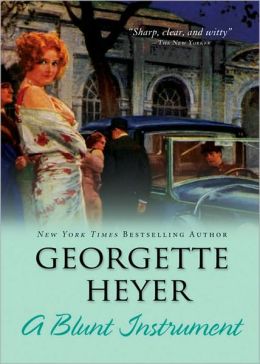
A Blunt Instrument. Georgette Heyer. 1938. Sourcebooks. 309 pages.

 I hated A Blunt Instrument. I loved a Blunt Instrument. Blunt Instrument stars one of the most ANNOYING (and offensive) characters I've ever found in a mystery: Constable Malachi Glass. What makes him annoying? He only speaks in Scripture. Almost every single sentence out of his mouth--no matter the situation or context--is a quote from Scripture. So his coworkers--Inspector Hannasyde and Inspector Hemingway--could be asking a perfectly logical question extremely relevant to the murder case in question, and do they get a logical response? No! They are stuck with Glass who is more of a puzzle than a help. (If Glass is supposed to represent a "Christian" I'd be very offended! Glass is anything but.) Glass is the main reason I "hated" this mystery novel.

However, there were plenty of reasons why I LOVED it as well. There were two possibilities for romance in this one, and I happened to care about both couples! Some of the suspects in this murder mystery were so fascinating! Helen North, a neighbor, is one suspect, as is her husband, John. (The two are separated.) Helen's sister, Sally Drew, lives with her and she's a detective writer, I believe. Another memorable character and another big suspect is Neville Fletcher, the nephew-and-heir of the victim. And I really have come to enjoy seeing Inspector Hannasyde and Inspector Hemingway work together!

© 2013 Becky Laney of Becky's Book Reviews

Wednesday, December 14, 2011

Hercule Poirot's Christmas

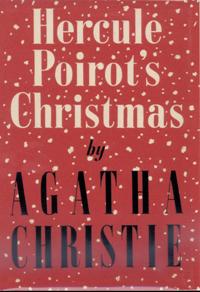
Hercule Poirot's Christmas. Agatha Christie. 1938/1939. Black Dog & Leventhal. 272 pages.

Stephen pulled up the collar of his coat as he walked briskly along the platform.

Christmas can be stressful for families--especially unhappy families. For one family, the holidays led to quite a few heated arguments and a very violent death. But which of the family did the old man in?

Simeon Lee, the victim, was a MEAN old man who didn't always treat his children right. (And he never, ever treated his wife right.) And perhaps some of the grown children should have been suspicious when their father invited them for a big family Christmas get-together. After all, he wasn't one for being sociable and nice and loving and happy. But could anyone really have predicted that someone wanted him dead?

Hercule Poirot has his opinions on the crime...and readers are in for a treat with this one.

While this wouldn't be my favorite Agatha Christie, while it wouldn't be my favorite Poirot novel, I did enjoy reading this one!

"The character of the victim has always something to do with his or her murder. The frank and unsuspicious mind of Desdemona was the direct cause of her death. A more suspicious woman would have seen Iago's machinations and circumvented them much earlier. The uncleanness of Morat directly invited his end in a bath. From the temper of Mercutio's mind came his death at the sword's point." (125-126)

"If a human being converses much, it is impossible for him to avoid the truth." (148)

© 2011 Becky Laney of Becky's Book Reviews

Wednesday, July 20, 2011

Heidi Grows Up

Heidi Grows Up. Charles Tritten. 1938. 190 pages. 

At nine o'clock one evening a very shy-appearing little girl stepped off the train at the big station in Lausanne.

Heidi Grows Up is the sequel to Heidi by Johanna Spyri written by Spyri's translator, Charles Tritten. The novel covers Heidi's teen years, for the most part. Readers briefly see a fourteen-year-old Heidi attend a French school. She meets other girls her own age and makes a few good friends. Her best friend being a girl named Jamy. The focus is on her first semester at school and her first summer vacation back home. The novel then speeds ahead to when Heidi has finished her schooling and is ready to teach school in the local village school. There readers are treated to learning about her first year as a teacher. We see her successes and failures as a teacher. We see her stand up to the school warden, and battle some of the bigger problems in the education department.

But Heidi Grows Up is still very much a sweet family story. We see a tender, loving Heidi who always knows what is most important in life. We see Heidi devoted and loyal as ever to her grandfather, to the doctor, to Peter, and even to the goats. One cute scene--early on in the novel--is when Heidi is praying. She's lifting her concerns for God and praying for those she loves best. And...at the end...she mentions each of the village goats by name. Yes, there's something very simple--and very pleasant--about this story.

I did like this one. I am still liking the characters very much. I am liking Heidi. And Peter seems to have grown out of some of his issues. Enough that by the ending, I was pleased with the development!


© 2011 Becky Laney of Becky's Book Reviews

Sunday, June 05, 2011

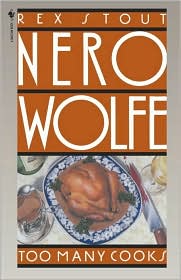
Too Many Cooks

Too Many Cooks. A Nero Wolfe Mystery. Rex Stout. 1938/1993. Bantam. 240 pages.

Walking up and down the platform alongside the train in the Pennsylvania Station, having wiped the sweat from my brow, I lit a cigarette with the feeling that after it had calmed my nerves a little I would be prepared to move the Pyramid of Cheops from Egypt to the top of the Empire State Building with my bare hands, in a swimming suit; after what I had just gone through. But as I was drawing in the third puff I was stopped by a tapping on the window I was passing, and, leaning to peer through the glass, I was confronted by a desperate glare from Nero Wolfe, from his seat in the bedroom which we had engaged in one of the new-style Pullmans, where I had at last got him deposited intact. He shouted at me through the closed window: "Archie! Confound you! Get in here! They're going to start the train! You have the tickets!"
I yelled back at him, "You said it was too close to smoke in there! It's only 9:32! I've decided not to go! Pleasant dreams!"
I sauntered on. Tickets my eye. It wasn't tickets that bothered him; he was frantic with fear because he was alone on the train and it might begin to move. He hated things that moved, and was fond of arguing that nine times out of ten the places that people were on their way to were no improvement whatever on those they were coming from. (1-2)
Too Many Cooks starts off great. The first chapter provides so many laughs! As readers witness Archie and Nero Wolfe at their absolute best. Nero being made so vulnerable through his fear of the train ride ahead. Nero being so pathetic as he pleads for the recipe of his favorite-and-best sausage. And, of course, readers witness Archie's weakness as well--as he meets a beautiful young woman. (The daughter of a famous chef, the chef Nero is pleading with so enthusiastically!) Both Nero Wolfe and Archie Goodwin are on their way to a West Virginian spa. Nero Wolfe is even the guest of honor. He'll have the privilege of making a speech on American cuisine.

Ten of the world's greatest chefs will be gathering at Kanawha Spa. These chefs are elected members of Les Quinze Maitres. Among the celebrating, the speech-making, the tasting, the drinking, the dancing, the gossiping, they'll be electing three new members to replace those that have died since the last big gathering. (I believe they meet every five years?) There is much jesting, much teasing, much quarreling between members. And this leads to one making a boast and setting up a game--a test. It seems to be all in fun.

But then, this chef ends up dead.

Nero Wolfe and Archie Goodwin are on vacation. And at first Nero has no interest at all in 'helping' solve this one. But when this investigation complicates his plans to return to New York, his return to routine, he becomes more cooperative. Can Archie and Nero solve this one before anyone else gets hurt?

I liked this one. I just LOVED the first chapter or two. But this one has its squirmy moments, its awkward moments. You could say it shows its age in race relations. The use of the n-word, for example. The way African Americans are treated with hostility, disrespect, and mistrust by the local police and with condescension and kindness by Nero Wolfe. The way Archie is shocked or startled by the appearance of fourteen African-Americans outside Wolfe's door, they are there to be "questioned" by Wolfe as he tries to solve this one. He doesn't trust the police to do it right. And the way the murderer uses blackface as a disguise when he commits the crime. But it isn't only the treatment of one race or ethnicity that makes this one squirmy. The matter-of-fact way they speak about the Chinese wife of one of the chefs, an eyewitness to the crime. (The police may or may not believe her story. She is Chinese after all.)

There are many things about Too Many Cooks that I did enjoy. There were many things that made it a pleasant read, a satisfying read. It's a good mystery. And the dialogue between Archie and Nero is not to be missed. These two are so much fun! They are two of my favorite characters ever created. But I can't say that it's a perfect read.

Some of my favorite quotes:

Archie Goodwin to Nero Wolfe:
"I am not deaf, sir. And while you can beef as much as you want to, because it's your own breath if you want to waste it, I do object to your implying either in word or tone that I am in any way responsible for your misery. I made this speech up last night, knowing that I would need it. This is your idea, this trip. You wanted to come--at least, you wanted to be at Kanawha Spa. Six months ago you told Vukcic that you would go there on April 6th. Now you regret it. So do I. As far as our engine is concerned, they use only the newest and best on these crack trains, and not even a child--" (3)
Archie on love at first sight:
It takes a long time to know people. How are you going to tell about anyone until you know them? Take love at first sight, for instance, it's ridiculous. That's not love, it's just an acute desire to get acquainted. (23)
Archie being surprised by Nero:
For ten years I had been accustomed to being as sure of finding Nero Wolfe where I had left him as if he had been the Statue of Liberty, unless his house had burned down, and it was upsetting, not to mention humiliating, to find him flitting around like a humming bird for a chance to lick the boots of a dago sausage cook. (34)

© 2011 Becky Laney of Becky's Book Reviews

Tuesday, May 24, 2011

Some Buried Caesar

Some Buried Caesar. Nero Wolfe Mystery. Rex Stout. 1938. Random House. 288 pages.

That sunny September day was full of surprises. 

Some Buried Caesar is my third Rex Stout mystery. And I am just LOVING Nero Wolfe and Archie Goodwin. I am. I can officially call it love now. For Some Buried Caesar may just be my favorite yet. (The other two that I've read are The Silent Speaker and The Black Orchid.)

So Archie Goodwin and Nero Wolfe are "on vacation" you might say. They've taken some of Wolfe's orchids to an exhibition or fair where there will be judged. Many, many things are being judged--including livestock. So on their way, Archie has a car accident. The two decide--after some disagreement--that together they will walk to the nearest house to phone for help. But there's one little problem that becomes a big problem--the two decide to take a short cut through a pasture. Turns out the fence was there for a very good reason. A bull. A bull who sees Nero and Archie as threats? Or maybe just good fun? Anyway, Archie manages to reach the other side of the fence--in time. But Nero is stuck on a big rock--safe enough for the moment. But. Not safe enough to be *really* relaxed. He gets a GOOD LOOK at the bull while he's waiting to be rescued.

Nero Wolfe and Archie Goodwin just happen to stumble into a controversial mess. The bull in question is a prize bull destined--if all goes according to plan, the plan of his new owner--to be barbecued for a big, big party. An advertising scheme perhaps for this rich restaurant owner? Regardless, there are a handful of people that are very angry--violently angry perhaps?--about the fate of Hickory Caesar Grindon. How far will they go to "protect" this bull?

This may not sound like a great mystery--like a great book. But it is. It really is. I just loved so many things about this one! I loved the narrative voice. I loved the detail. How everything in this story comes together. I loved seeing Nero Wolfe become more involved in this case. We get to see him play  more of a questioning role perhaps? Though Archie Goodwin is still plenty busy! Anyway, I loved seeing the relationship between Archie and Nero. There was just something so delightful, so charming, so satisfying about this one!

I would definitely recommend this one! I think it would be a great place to start!

Archie Goodwin:

No man was ever taken to hell by a woman unless he already had a ticket in his pocket, or at least had been fooling around with timetables. (47)
Lily Rowan to Archie Goodwin:

Lily Rowan said, "Two chicken fricasee with dumplings."
"Wait a minute," I protested. "It says there they have beef pot roast and veal--"
"No." Lily was firm. "The fricassee with dumplings is made by a Mrs. Miller whose husband has left her four times on account of her disposition and returned four times on account of her cooking and is still there. So I was told yesterday by Jimmy Pratt. (79)

Nero Wolfe:

"There is no other form of human activity quite so impertinent as a competent murder investigation, and I fear you're not equipped to tolerate. Abandon the idea. You can mail me a check at your convenience--" 
"I'm going on with it.""Then prepare yourself for annoyance, intrusion, plague, the insolence of publicity--" (95)

Archie Goodwin:

In all ordinary circumstances Wolfe's cocky and unlimited conceit prevents the development of any of the tender sentiments, such as compassion for instance, but that afternoon I felt sorry for him. He was being compelled to break some of his most ironclad rules. He was riding behind strange drivers, walking in crowds, obeying a summons from a prospective client, and calling upon a public official, urged on by his desperate desire to find a decent place to sit down. (96)

Nero Wolfe:

"I am careful with my opinions, sir; they are my bread and butter and the main source of my self-esteem." (105)

Nero Wolfe:

"Tell me anyway. Of course I'm impertinent, but I'll have to decide if I'm also irrelevant." (120)

Lily Rowan to Archie Goodwin:

"Kiss me."
"I can't until I wash my face. Anyway, I told you that wasn't a precedent. I have to be careful. I kissed a girl once in the subway and when she came to she was on top of the Empire State Building. She had floated out through a grating and right on up."
"Goodness. Did you ever send one clear to heaven?"
"The place is full of them." (226)

Archie Goodwin to the local police (or perhaps the district attorney?):

"You have no judgment. It's perfectly true that there are people who can be opened up by making faces at them and talking loud, but if I was one of them how long do you think I'd last as Nero Wolfe's favorite employee, eating with him at his table?" (234)

Barrow to Nero Wolfe:

"Look here, Wolfe," he said in a nasty tone. "I've concluded you're no better than a waste of time, and probably worse." (236)

© 2011 Becky Laney of Becky's Book Reviews