Showing posts with label 2007. Show all posts

Monday, November 03, 2025

114. Harry Potter and the Deathly Hallows


114. Harry Potter and the Deathly Hallows. (Harry Potter #7) J.K. Rowling. 2007. 759 pages. [Source: Library]  [4 stars]

First sentence: The two men appeared out of nowhere, a few yards apart in the narrow, moonlit lane. For a second they stood quite still, wands directed at each other's chests; then, recognizing each other, they stowed their wands beneath their cloaks and started walking briskly in the same direction.

ETA: The third time around, I LISTENED to the audio book narrated by Stephen Fry. It was a great choice. Will I read the series a fourth time? That's a good question. I think three times might be a reasonably good number of times to have read the series. Time will tell.

Premise/plot: Harry Potter is on his final quest(s) in this final fantasy novel starring Harry Potter and company. (In particular, Ron and Hermione are his companions for most of the novel.) He is preparing day and night (night and day) for that final battle, the big showdown. He's also trying to decipher (uncover, discover) the mysteries of Dumbledore. There's so much he doesn't know, and he's still grieving the loss of his mentor.

My thoughts: This was my SECOND time to read the series. I will say I don't do the absolute best with super-intense action sequences. I more anxiously skim than stay present in the moment. I thought a reread would slow me down so I could appreciate everything more--especially towards the end. But even though I knew how things ended up, I just couldn't handle it! 

When I read the series the first time, I wasn't sure I would ever revisit the series. I did decide to reread and I am so glad I did. I can't say the series will ever be at the top of my favorite series. But I do feel like I better grasp the characters and the story. There were things I noticed the second time around that I didn't quite appreciate or get the first time around. I would imagine the more times you read the books, the more you notice the small things. Also little things might become quite meaningful to you. 

Will I read the series a third time? Only time will tell. Maybe. Maybe not. I still don't own the books. There are so many other series books that I would love to read--some would be new-to-me series, and some would be rereads. So I may not get to it again for a while--if at all.

This last book is quite different from the others in the series. But that is okay--this series grew with its original audience which is nice. 

© 2025 Becky Laney of Becky's Book Reviews

Thursday, June 12, 2025

56. Home of the Brave

56. Home of the Brave. Katherine Applegate. 2007. 256 pages. [Source: Library] [mg fiction, mg realistic fiction, mg verse novel, 4 stars]

First sentence: When the flying boat
returns to earth at last,
I open my eyes
and gaze out the window.
What is all the white? I whisper.
Where is all the world?

Premise/plot: Kek is newly arrived in America after spending time in a refugee camp. He's been separated from his family. Some he knows are gone forever, but, he holds out home that his mother is alive somewhere and that someday the two will be reunited. He is staying with his aunt and older cousin. He's coming of age in a strange-to-him country unsure of his future and mourning his past. He takes comfort where he can. One of his great comforts is working on a farm part time and befriending the cow, Gol.

My thoughts: Home of the Brave is a verse novel, a coming of age novel, a refugee story. It was a quick read, a mostly compelling read. The narrative captures his awe, his confusion, his frustration, his aching heart. In some ways it's a heavy read. I'm not sure how realistic the ending is. 

© 2025 Becky Laney of Becky's Book Reviews

Friday, January 19, 2024

6. Something Rotten


Something Rotten. (Horatio Wilkes Mystery #1)  Alan Gratz. 2007. 208 pages. [Source: Library] [YA Mystery; YA Suspense; dysfunctional families; adaptation of William Shakespeare]

First sentence: Denmark, Tennessee, stank. Bad. Like dead fish fricasseed in sewer water.

Premise/plot: The Prince family of Denmark, Tennessee, is rich and corrupt. Mostly. Horatio Wilkes, the narrator, is a school friend visiting Hamilton Prince for the summer. Their first stop? The family paper plant--Elsinore Paper Plant--the source of the stink in Denmark. This one is an adaptation of Hamlet by William Shakespeare. Those familiar with the original will notice similarities [and differences] right away.

[I don't know how familiar teens are with Hamlet these days. I would imagine it's still assigned reading in some places.] But those who are familiar will recognize how Gratz updates the memorable ghost scene which opens the play. A videotape reveals a startling image:

The man on the screen had snow white hair and a face like a walnut. He looked like he was a hundred years old, but it was Mr. Prince, sure enough. There was a sad, hollow look in his eyes that I knew but couldn't place.

The tape goes on...

Hamilton, if the boys show you this tape, it means something bad has happened. Something very bad. It means I've been murdered. . . It was poison . . .

Hamilton immediately suspects his uncle Claude. His new step-father. Horatio isn't as quick to jump to conclusions. He treats this situation like a true mystery. He decides to observe, listen, and wait patiently for the pieces to fall into place. Hamilton? Well, Hamilton just wants to yell, mope, drink, and be a miserable drain to everyone's mood.

All the familiar characters are there. I think the more familiar you are with the play--either through reading it or seeing it--the more you can appreciate it. However, I doubt that that is essential.

My thoughts: There were many things I enjoyed about this one, though I didn't love, love, love it. Still, I can see myself recommending this one to others. I know a few people who love Shakespeare, and this will definitely be something I mention to them.

This is a reread for me. I've pieced some of the original review (especially in the summary) while adding a few new sentences. I didn't know it when I read the first book back in November 2007, but I would go on to love, love, love, love the second book in the series which is an adaptation of Macbeth. I've always intended to reread both books. [I did not own a copy of the first book so I had to interlibrary loan it.]  

I do wish the series had been enough of a success that more had been written. I don't know that the series failed OR if Alan Gratz just realized that he preferred writing amazing, awesome historical fiction instead of young adult mysteries. I DO love his historical books--especially those with a world war two setting.


© 2024 Becky Laney of Becky's Book Reviews
Saturday, April 22, 2023

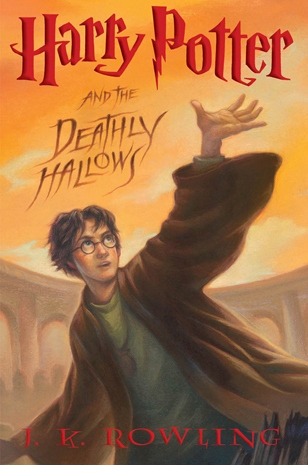
82. Harry Potter and the Deathly Hallows


Harry Potter and the Deathly Hallows. (Harry Potter #7) J.K. Rowling. 2007. 759 pages. [Source: Library]

First sentence: The two men appeared out of nowhere, a few yards apart in the narrow, moonlit lane. For a second they stood quite still, wands directed at each other's chests; then, recognizing each other, they stowed their wands beneath their cloaks and started walking briskly in the same direction.

Premise/plot: Harry Potter is on his final quest(s) in this final fantasy novel starring Harry Potter and company. (In particular, Ron and Hermione are his companions for most of the novel.) He is preparing day and night (night and day) for that final battle, the big showdown. He's also trying to decipher (uncover, discover) the mysteries of Dumbledore. There's so much he doesn't know, and he's still grieving the loss of his mentor. 

My thoughts: I thought I'd share my thoughts on the series as a whole. The seven books do need to stand together, work together. I would say the first few books are like waiting to watch water boil. Depending on how hungry you are, and how anxious you are for that water to boil so you can begin actually cooking your meal, you may or may not find them satisfying in and of themselves. I found the pace to be a bit slow. Or if not slow, a bit uneven. All the books do build up to a climax, of sorts, but never the BIG finale-style showdown you know is bound to be coming. The last two books, however, the pacing is much quicker; there isn't as much waiting around for the sake of waiting around. Everything seems to be happening quickly and "now." There's action, action, more action. (Or perhaps my analogy is wrong. Maybe the series isn't like boiling water...maybe it's making homemade bread and the slow pacing is like waiting for the bread to rise (in cycles) and occasionally you get to punch it down and have some fun kneading). The last two novels are, by far, my favorite in terms of pace and action. 

Did I enjoy the series? Yes. No. Maybe. It is not one that I see myself reading again and again and again. I am VERY glad I read through them once. I am glad I've met the characters. But I can't see myself become obsessed with the series, with the characters, with the story and actually needing to revisit it again and again. I can't see myself getting caught up in it, going all fangirl. 

I do think it is unfortunate that the series isn't allowed to just be a series. That you've got two VERY rigid extremes. One side being Harry Potter must be canceled because J.K. Rowling is a terrible, horrible, no good, very bad person. She has thoughts. She has opinions. We don't like her thoughts and opinions. We can't allow ourselves to enjoy Harry Potter BECAUSE we don't like the author's thoughts and opinions. Never mind that the book never once goes there and voices anything remotely about the 'controversial' subject. Rowling has been deemed bad, all must unite to agree that Rowling is bad. The other side being Harry Potter must be canceled because of witchcraft, wizards, and magic, oh my. This is by far, the longest held "canceling" position. And my thoughts about both are you do you. It's this need to make every other person agree with you, to feel what you feel, to be as outraged as you, etc. It would have been interesting how things would have unfolded [for the series] if there hadn't been such an uproar, outrage, strong reaction to the initial book being published. If it hadn't been made such a LINE IN THE SAND HAS BEEN DRAWN phenomenon. Depending on where you lived, I suppose, it was very defining--are you the type of Christian who WILL or WON'T read the books. There was a LOT of judgment. And I'm *all* for discernment. I am. I really am. I think every single person should have control over what they personally read (or watch or listen to). 

© 2023 Becky Laney of Becky's Book Reviews

Monday, December 12, 2022

174. The Golden Dreydl


The Golden Dreydl. Ellen Kushner. Illustrated by Ilene Winn-Lederer. 2007. 126 pages. [Source: Review copy]

First sentence: It was the holiday season, but Sara was not happy. Riding home from school in the bus was pure torture. Sara stared out the window at all the colored lights decorating the houses on street after street....Sometimes people left their curtains open, and Sara could see right into their living rooms, where big trees glittered and shone. 

Premise/plot: First and foremost potential readers need to know this is a spin on The Nutcracker. Sara, our protagonist, is about to go on a little adventure with her "gift" from an eccentric relation. It is a Chanukah themed fantasy novel for children. 

Sara is not looking forward to Chanukah. She doesn't want to celebrate with her family. She definitely doesn't want to play dreydl with all of her cousins--some older, some younger. She's just a super-crank. But when her great-aunt comes with gifts, well, things get interesting. Sara receives a golden dreydl. It doesn't make her want to play dreydl, more, but it is lovely all the same. 

But that night when every one else is sleeping....well....Sara has an adventure of her own...and it all begins with the transformation of the Golden Dreydl into a girl. They arrive in a fantasy land, of sorts, with demons, peacocks, a fool, and King Solomon and the Queen of Sheba. There is also much talk of a Tree of Life.

Sara is given a quest, of sorts, to save the girl from the demons/demon king. She has the Fool to help her. A few riddle games are played. First, between Sara and the Fool, and, then later between the Demon King and Sara and the Fool.

My thoughts: As I said, this one is a spin off of The Nutcracker. There is music that goes with this one. I highly recommend listening to the music.


© 2022 Becky Laney of Becky's Book Reviews

Sunday, July 24, 2022

88. The Titan's Curse


The Titan's Curse. (Percy Jackson and the Olympians #3) Rick Riordan. 2007. 320 pages. [Source: Library]

First sentence: The Friday before winter break, my mom packed me an overnight bag and a few deadly weapons and took me to a new boarding school. We picked up my friends Annabeth and Thalia on the way.
It was an eight-hour drive from New York to Bar Harbor, Maine. Sleet and snow pounded the highway. Annabeth, Thalia, and I hadn't seen each other in months, but between the blizzard and the thought of what we were about to do, we were too nervous to talk much. Except for my mom. She talks more when she's nervous. By the time we finally got to Westover hall, it was getting dark, and she'd told Annabeth and Thalia every embarrassing baby story there was to tell about me.
Thalia wiped the fog off the car window and peered outside. "Oh yeah. This'll be fun."
Westover Hall looked like an evil knight's castle. It was all black stone, with towers and slit windows and a big set of wooden double doors. It stood on a snowy cliff overlooking this big frosty forest on one side and the gray churning ocean on the other.
"Are you sure you don't want me to wait?" my mother asked.
"No, thanks, Mom," I said. "I don't know how long it will take. We'll be okay."
"But how will you get back? I'm worried, Percy."
I hoped I wasn't blushing. It was bad enough I had to depend on my mom to drive me to my battles.

Premise/plot:  The stakes have never been higher in the third adventure in the Percy Jackson fantasy series by Rick Riordan. The quest(s) in this third book make the other quests [in books one and two] seem easy-breezy. 

While The Titan's Curse certainly stars some of our well-known and well-loved cast [from previous books], plenty of new characters--both demi-god, god, and monster--are introduced and play integral roles. Like Bianca and Nico. This is also the first book where readers get a chance to learn about the newly resurrected from the dead, Thalia. [She was technically a tree for all of book one and most of book two.] 

Like the previous two books, this one mainly occurs outside of Camp Half-blood and involves a quest....or should that be quests. Because the stakes have never been higher, there will be BIG consequences if the quest goes anything like the prophecy foretells. And Percy, well, he may have to live with the fall out....

My thoughts: I really enjoyed this one! I did. The only one in the series that I am super familiar with is the first book, The Lightning Thief. Reading book two and three is like reading them again for the very first time. And that is such a delight. I think there are pros and cons to waiting so very long to reread a series you've adored in the past. I am loving the characters. I am enjoying the action. I am remembering all the reasons why I made my mom read this series with me.

© 2022 Becky Laney of Becky's Book Reviews

Monday, January 17, 2022

11. The Accidental Time Machine


The Accidental Time Machine. Joe Haldeman. 2007. 278 pages. [Source: Library]

First sentence: The story would have been a lot different if Matt's supervisor had been watching him when the machine first went away.

Our hero, our narrator, is a twenty-something MIT grad student named Matt Fuller. He loves working in the labs. And he's putting off writing his dissertation. You might think he sounds pretty typical for a science geek. (He's also recently been dumped by his girlfriend.) But his life is about to take a different turn. And it all starts when his calibrator disappears. It reappears in a flash. It was just a flicker, one brief instant in time--a true if I'd a blinked I'd a missed moment--but it was long enough that it changed a young man's life forever.

The reset button.

All of the drama, the action, centers around this one tiny button on a machine that is about the size of a shoe box. You might not expect something so tiny to have the ability to change the world in the blink of an eye. But it can and does.

Here we have a time machine that can travel only in one direction; each jump of longer duration. No way to predict if the future will be better or worse. No way to go back. 

This is my second time to read The Accidental Time Machine. I first read it in February 2008. I loved it then. Loved it enough to gush about it. I've always meant to reread it....

But. I didn't enjoy it as much (if at all) the second time around.

What I still loved was the conclusion. I love, love, love how the book ends. The last chapter maybe last two chapters I still enjoyed very much.

What I didn't love was just about everything that came before. To be honest, it was the blasphemy and crudeness that I found so off-putting the second time around. That is great news for most readers. Chances are that *most* readers won't be bothered by such content. That doesn't guarantee you'll love it--far from it. You could still find fault with say the science or the logic or the characterization.

There were parts of this that seem super rushed. But the ending worked for me.

© 2022 Becky Laney of Becky's Book Reviews

Sunday, September 26, 2021

121. The Case of the Left-Handed Lady


The Case of the Left-Handed Lady (Enola Holmes #2) Nancy Springer. 2007. 234 pages. [Source: Library]

First sentence: With a shock of astonishment I read the card brought in to me on a silver tray by the page-boy. Dr. John Watson, M.D.

Premise/plot: Enola Holmes is back for her second adventure in The Case of the Left-Handed Lady. The book opens with Dr. John Watson going to visit a Dr. Ragostin. Enola is posing as his assistant, Ivy Meshle. (She later poses as Mrs. Ragostin.) She learns from Watson that her brothers are still puzzled by her disappearance. They haven't a clue to her whereabouts...yet. She has certainly settled into London since first arriving. She's gotten used to taking up missing person cases...with some success. In this one, she is looking for Lady Cecily Alistair....

Meanwhile, the hunt is ever on for her mother. Enola has little reason to believe her mother will ever return to her as a loving, caring mother...but can they find a way to stay in touch even a little bit???

My thoughts: I liked it okay. I am beginning to realize that these mysteries are super-shallow, a bit frothy. There just isn't a lot of substance, depth, or weight to these stories. On one hand, they are a breeze to get through. On the other hand, there's just not much there. I did think this one had a bit more to it than the first book. So maybe each book improves the story???


© 2021 Becky Laney of Becky's Book Reviews

Thursday, August 20, 2020

104. Letters From the Corrugated Castle

Letters From the Corrugated Castle: A Novel of Gold Rush California: 1850-1852. Joan W. Blos. 2007. 320 pages. [Source: Review copy]

First sentence: Dear Cousin Sallie, I begin with words I never thought to write: I am not an orphan!

Premise/plot: Letters From the Corrugated Castle is told entirely through a series of letters. The letters are primarily from Eldora, our heroine, to her cousin Sallie. (Though sometimes she writes someone else.) But the letters are not exclusively from Eldora. The book has sections devoted to both main characters, Eldora, of course, but also a friend of the family named Luke Hall. Luke Hall writes the other letters. If there are additional letters written by different characters--they are few and far between. These two are the main characters. Eldora and Luke live in San Francisco. They start out as mere acquaintances at best--they don't have much in common, or even many people in common, but by the end of the story, their worlds are merging more and more. (Luke Hall even lives with her aunt and uncle for a bit of time while his own father is recovering.)

So the book is set in California during 1850-1852. During the course of the book, California becomes a state.

Eldora's story is definitely more of a coming of age story. She has believed herself to be an orphan all of her remembered life. But she learns that her mother did not die of a fever as they believed. She survived. And she's found her daughter again. Should Eldora leave the couple--her "aunt" and "uncle" that have raised her since she was two or three??? Should she go with her mother to another California town and live at her mother's inn???? Or is San Francisco where she belongs?

Luke's story is also coming of age in many ways. At first, he is ONLY about wanting to find gold and get rich. He wants to grow up really quickly. He doesn't want to fool with going to school and following rules when there's gold to be found. But slowly but surely he learns there is more to life...and education is essential to having a rich life.

My thoughts: I really enjoyed this one. I was surprised by the low ratings this one has. The one stars that say I hate historical fiction I can understand because there will always be haters hating. That would be their "review" for any historical novel basically. The two and three stars that find fault with the characterization and storytelling are more confusing. Reading is subjective. I know this to be true.

I did not find the book boring--far from it. I found it an engaging read. Granted, I didn't read it in one day, I read it one section per day perhaps. But I always put it down wanting to read more. And I always picked it up excited to keep reading. I felt that other characters were fleshed out because we got to know them through both Luke and Eldora's writing.

Much has been said in other reviews that the book was lacking because we don't have any responses to the letters; we never once hear from Cousin Sallie, for example. I didn't find this problematic. Not many epistolary novels do. I'm sure there is probably at least one that does because there are almost always exceptions to the rules--but for the most part, this is completely normal to only have ONE side of the correspondence. It makes me wonder how many epistolary novels the other reviewers have read in their lives to find this one flawed because of this "one-sided-ness."

Now I will say that I completely understand why some would find it jarring to switch back and forth between Eldora's story and Luke's story. (Both, of course, told through letters.) That I get. I mean I liked both narrators. I did. And I personally did not have issues with this switching back and forth. But I could see why that might be a legitimate reason for someone to say this book isn't what I wanted.

The book is INTROSPECTIVE and character-driven. I could see how some might think it was lacking action. But again, some people might enjoy it because it is introspective and character-driven.


© 2020 Becky Laney of Becky's Book Reviews

Wednesday, July 01, 2020

90. Unwind

Unwind. Neal Shusterman. 2007. 337 pages. [Source: Library]

First sentence from the prologue: The Second Civil War, also known as "The Heartland War," was a long and bloody conflict fought over a single issue. To end the war, a set of constitutional amendments known as "The Bill of Life" was passed. It satisfied both the Pro-life and the Pro-choice armies. The Bill of Life states that human life may not be touched from the moment of conception until a child reaches the age of thirteen. However, between the ages of thirteen and eighteen, a parent may choose to retroactively "abort" a child...on the condition that the child's life doesn't technically end. The process by which a child is both terminated and yet kept alive is called "unwinding." Unwinding is now a common and accepted practice in society.

First sentence: "There are places you can go," Ariana tells him, "and a guy as smart as you has a decent chance of surviving to eighteen." Connor isn't so sure, but looking into Ariana's eyes makes his doubts go away, if only for a moment.

Premise/plot: Imagine living in a world where—if you're a teenager—your life is constantly in danger. If you anger your parents just one time too many, you could be on the next bus out of town heading to a Harvest camp or the "chop shop" as it's called in slang. Your organs—every single part of you (except maybe your appendix), stripped away and 'donated' to make someone else's life better. This scenario is about to become terrifyingly real to three teenagers.

Connor, Risa, and Lev are three of many Unwinds on the run and trying to survive. All are under the age of eighteen. Connor's parents have decided to Unwind him, perhaps because of his attitude. Risa, well, Risa's a ward of a state home and they must make room for new children. She's reached her full potential of life--according to the powers that be. Lev, well, Lev's case is different as well. He's a tithe. His family knew from the moment he was conceived that they would unwind him when he turned thirteen so that he could offer up his service to God. Other teens are introduced as well throughout the book, but the narrators are Connor, Risa, and Lev.

My thoughts: Told through many narrators, Unwind is a suspenseful, fast-paced read. While the premise is fascinating in and of itself, Shusterman manages to make this story resonate with strong characters. The world he creates is haunting yet not completely without hope and redemption as people—teens and adults—team up to change the world one step at a time.

Unwind by Neal Shusterman is dystopia at its best.

Quotes:

"Funny but when he was little Connor was terrified of the boogeyman. He would have to sleep with the lights on, he would have his parents check his closet every night. They told him that the boogeyman wasn't real, but they lied. The Bill of Life made the boogeyman real, and he didn't need the closet; he came walking right in through the front door." (4)

"What does it take to unwind the unwanted? It takes twelve surgeons, in teams of two, rotating in and out as their medical specialty is needed. It takes nine surgical assistants and four nurses. It takes three hours." 


© 2020 Becky Laney of Becky's Book Reviews

Tuesday, November 05, 2019

A Fatal Grace

A Fatal Grace (Chief Inspector Armand Gamache #2) Louise Penny. 2007. 311 pages. [Source: Library]

First sentence: Had CC de Poitiers known she was going to be murdered she might have bought her husband, Richard, a Christmas gift.

Premise/plot: This is the second mystery in the Chief Inspector Armand Gamache series set in Quebec, Canada. Three Pines is a small, super small, village that is about to have another murder. In the first book, the murder victim was an incredibly sweet and kind old woman. In this one, not so much. In fact it wouldn’t be out of place if a couple dozen munchkins jumped out and started singing. The mystery happens during the holidays in December. I believe the murder occurs on Boxing Day.

My thoughts: I really loved the first book. I liked the second one but didn’t love it. I enjoyed the detective aspects of it but not the set-up. I love Gamache. I do. So I will probably keep up with the series and hope for better with the next one.

The language is not clean, this one had some language that bothered me. If the first book did too, I was so busy being swept up by the story I didn’t pause long enough to notice.

© 2019 Becky Laney of Becky's Book Reviews

Wednesday, October 09, 2019

World at War: The First Wave

The First Wave (Billy Boyle #2) James R. Benn. 2007. 304 pages. [Source: Library]

First sentence: It was dark, and I was at sea, hunkered down in a flat-bottomed landing craft, slamming through four-foot swells and chugging noisily towards shore, leaving the relative safety of our troop transport behind.

Premise/plot: The First Wave is the second book in the historical mystery series starring Billy Boyle. The first novel was set in England in 1942; the second novel is set in North Africa (Algeria) in late 1942. The plan was supposed to be simple: Harding and Boyle are supposed to be involved in the negotiations for the surrender of the Vichy French forces. But it’s a snafu from the start. The surrender won’t happen quickly—if at all. Soon Boyle is back to solving murders—and the body count keeps going up.

My thoughts: I wanted to love this one just as much as the first book. I do still really like the characters Boyle and Kaz. I was heartbroken over Diana’s situation. I think the weightiness of that kept me from fully engaging with this one. The mystery element also disappointed me. I don’t know why, but, I guessed the identity of the murderer super early. I usually don’t do this in the first half. Sometimes authors keep me guessing until the last handful of pages. I like the suspense. This one definitely reads more like a trauma-filled war novel. Gritty—very much showing the horrors of war.
© 2019 Becky Laney of Becky's Book Reviews

Friday, July 12, 2019

In Dublin's Fair City

In Dublin's Fair City. (Molly Murphy #6) Rhys Bowen. 2007. 272 pages. [Source: Library]

First sentence: "Be careful what you wish for." That was another of my mother's favorite sayings--one of the few in her wealth of warnings that didn't predict a bad end, hell fire, and eternal damnation.

Premise/plot: In Dublin's Fair City is the sixth Molly Murphy mystery. Molly Murphy gets a couple of paying jobs in this one. First, she's hired by a playwright (Tommy Burke) to go to Ireland and search for his long-lost "baby" sister, Mary Ann Burke. This search will take her--you guessed it--to Dublin, Ireland. Her second paying job is to switch places with a famous New York actress on the voyage over. This one isn't an investigative job, but, it leads to a whole other kind of investigation.

Now you may be wanting to know if there's any movement in the Daniel Sullivan story line--there isn't. Daniel is STILL in trouble with the law and awaiting his trial. He is out on bail. But Molly is quick to leave him--and New York City--behind when she gets an opportunity to earn some money.

My thoughts: I am finding the series as a whole mainly enjoyable. Molly is still stubborn and willful. Molly is still fierce and sometimes obnoxious. BUT. To be fair, in the big fight scene with Daniel...I wanted to yell at Daniel AND I wanted to yell at Molly. They were both being a bit obnoxious.

© 2019 Becky Laney of Becky's Book Reviews

Friday, February 01, 2019

The White Cascade

The White Cascade: The Great Northern Railway Disaster and America's Deadliest Avalanche. Gary Krist. 2007. 315 pages. [Source: Library]

First sentence:
Summer 1910
The last body was found at the end of July, twenty-one weeks after the avalanche.
Premise/plot: Gary Krist's The White Cascade is a compelling nonfiction read about a tragic disaster. On March 1, 1910 an avalanche swept two trains off the track and into the canyon below. But that's not quite the whole story--the trains had been trapped on the side of the snowy mountain for six days. Snow slides kept trapping all traffic on the tracks. It was a demanding, never-ending, no-relief-in-sight job to keep the tracks clear of snow. And this week/weekend proved impossible. The storm was relentless.

The White Cascade tells the story--the weather, the storms, the history of the railway, the management by James Henry O'Neill, the passengers and workers. It was an intense situation for all parties involved. Intense for O'Neill who was responsible--not for the weather, mind you, that would be nonsense--but for how the railroad chose to deal with the weather. He was in charge of which trains went where. He was in charge of determining which tracks stayed open, which tracks closed down; he was in charge of rerouting trains. He was in charge of managing resources--men, coal, other supplies, etc. It was also intense for the passengers on board the two trains. One train was a fast mail train who up until this time had had a great record for being dependable and on time. The other train was an express passenger train. Nobody stepped on that train expecting anything other than a quick train ride. Unfortunately it was worst case scenario almost from the start.

My thoughts: I don't know if a book could get any bleaker than The White Cascade. The passengers soon became aware--after the first day or two--of the risks and dangers of being STUCK on the side of a mountain in a precarious place. True, there were attempts to calm them down by saying that this particular location had never been the site of a slide or avalanche before...but...common sense told most if not all of the adults that that meant NOTHING. There was much talk of doing something--demanding to see O'Neill, demanding the railway move the train somewhere else, demanding the railway try to rescue passengers and get them down off the mountain another way, demanding more be done to clear the tracks so the train could be on its way. There was this waiting, waiting, waiting, waiting, waiting. Would the storm pass? Would the weather improve? Were higher temperatures a good thing or a bad thing? Was it safer to stay on the train and wait out the storm? Was it safer to hike down the mountain on foot? (Some passengers did choose to hike down the mountain. It was difficult going--not without some risk--but it was possible.) Still not everyone could hike down the mountain--what about the mothers with young children? What about the elderly? the sick?

This was a compelling read. I read it in two days--it was intense and heartbreaking.

I don't know if it's possible to "love" a book this bleak, but, I love how well-researched this one was.


© 2019 Becky Laney of Becky's Book Reviews

Saturday, August 12, 2017

And the Train Goes

And the Train Goes. William Bee. 2007. Candlewick. 32 pages. [Source: Library]

First sentence: Here is the station all noisy and full, and the station clock goes tick-tock, tickerty-tock...and the man in the station office cries, "Hurry up! Hurry up! Any more tickets...?"

Premise/plot: I guess the point of this one is to make adult readers make a lot of silly noises out loud? There is a definite repeated pattern. "Here is the..." and "And the train goes..." The sounds themselves don't repeat all that often--until the ending when a parrot says all the sounds over again.

My thoughts: I was disappointed. It is not as obnoxious as say, The Wheels on the Bus. But I think it's a missed opportunity of a great train book with familiar, repeated train noises. For example, why is the fireman MUTTERING "shovel-shovel" to himself. That's not an onomatopoeia. It doesn't even make for a good story. For me, this one just lacks something.

Text: 2 out of 5
Illustrations: 2 out of 5
Total: 4 out of 10


© 2017 Becky Laney of Becky's Book Reviews
Thursday, June 08, 2017

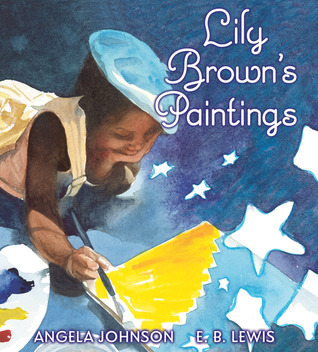
Lily Brown's Paintings

Lily Brown's Paintings. Angela Johnson. 2007. 32 pages. [Source: Review copy]

First sentence: Lily Brown loves her mama, daddy, and baby brother and the world they live in. Sometimes she spins around her room thinking about their world. And it's wondrous. But when Lily Brown paints, her world starts to change.

Premise/plot: Lily lives happily in two worlds. The second world she lives in is one of her own imagination, her own reckoning.
When Lily Brown paints fruit at the corner market, it is striped and polka-dotted. It speaks to people, then laughs out loud. When people put the fruit in bags to take home, the apples sing all the way there.
At the end of the day, when the painting--for now--has all been done, she happily returns to the real world and LOVES it just as much.

My thoughts: What doesn't this picture book celebrate? It celebrates art, freedom of expression, love of life, love of family, JOY, imagination. I'm sure I could think of more if I keep rereading it. It's just a joy to spend time with Lily.

Text: 5 out of 5
Illustrations: 4 out of 5
Total: 9 out of 10


© 2017 Becky Laney of Becky's Book Reviews

Monday, May 08, 2017

Minerva Louise on Christmas Eve

Minerva Louise on Christmas Eve. Janet Morgan Stoeke. 2007. 24 pages. [Source: Library]

First sentence: Minerva Louise loved the way the snow sparkled on the house with the red curtains.

Premise/plot: Minerva Louise returns to the house with red curtains. She's curious about the sparkly tree topped with a hen and the goats on the roof. Why is the farmer wearing a red hat? So many questions this hen has. She's back and as silly as ever.

My thoughts: It's Christmas and Minerva Louise is confused about all the changes inside and out! I really am fond of this chicken! My favorite is her confusion about why the strange man was eating her farmers' breakfast!

Text: 5 out of 5
Illustrations: 4 out of 5
Total: 9 out of 10

© 2017 Becky Laney of Becky's Book Reviews

Sunday, April 23, 2017

The Adventures of Thor the Thunder God

The Adventures of Thor the Thunder God. Lise Lunge-Larsen. Illustrated by Jim Madsen. 2007. HMH. 80 pages. [Source: Library]

First sentence: Long, long ago, when the Vikings ruled the seas, people loved to tell stories about gods and giants. Renowned as warriors and sailors, the Vikings were also great storytellers. Their most treasured stories were about a god named Thor.

Premise/plot: This is a story book for elementary readers. It contains nine stories--all generously illustrated. The stories are: "Why Thor Is Called the Thunder God," "The Giants," "Thor's Family," "Loki's Bet," "Tialvi and the Billy Goats," "A Duel," "Outwitted," and "Stolen Thunder."

My thoughts: I liked this one. I didn't perhaps love, love, love it like I did Neil Gaiman's Norse Mythology. But this is a children's book. And the focus isn't on ALL the gods, but specifically on Thor. Some stories are in both books. I really enjoyed some of these stories. My favorites were "Outwitted," "Stolen Thunder," and "Loki's Bet." The stories are action-packed and most are packed with humor as well.

© 2017 Becky Laney of Becky's Book Reviews

Tuesday, March 14, 2017

How To Steal A Dog

How To Steal A Dog. Barbara O'Connor. 2007. 170 pages. [Source: Review copy]

First sentence: The day I decided to steal a dog was the same day my best friend, Luanne Godfrey, found out I lived in a car.

Premise/plot: Georgina and her brother, Toby, decide to steal a dog early in the novel. Why? Because she spots a missing dog poster offering a $500 reward. Since the three of them--her mother, her brother, herself--are living in a car, they need money anyway they can get it. First she'll steal a dog, a well-loved dog, a dog with wealthy-looking owners. Second, she'll wait until she sees missing posters up in the neighborhood. Third, she'll return the dog to the owner and get MONEY. She'll give the money to her mom, of course, and that money will help find them a place to live. That's the plan, but, does she have what it takes to carry it through?!

My thoughts: I really loved Barbara O'Connor's novel. I loved the strong narrative voice of Georgina. Our flawed heroine is easy to sympathize with most of the time. This was a quick and easy read with plenty of emotion. For a book with a dog on the cover, it proved surprisingly satisfying. NO DOGS DIE in this one.

© 2017 Becky Laney of Becky's Book Reviews
Monday, January 02, 2017

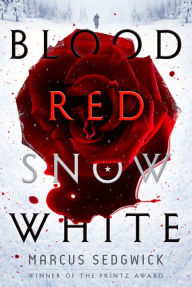
Blood Red Snow White

Blood Red Snow White. Marcus Sedgwick. 2016. 320 pages. [Source: Library; Audience: YA, Adult]

First sentence: The years slip away.

Premise/plot: Set during the Russian Revolution, Blood Red Snow White is narrated by Arthur Ransome, children's book writer and journalist. Though a fictionalized account it does have a historical basis. The writing is lyrical.

My thoughts: What a book!!!! This one should not be forgotten when Cybils comes around again next year. I love the writing. It is beautiful and amazing. The story itself is compelling; the details are fascinating.

The title brings to mind fairy tales. Ransome loved fairy tales, and even wrote a collection of Russian fairy tales for children. While this one is not a fantasy exactly, fairy tale lovers may find it well worth their time! It very much celebrates storytelling.

Favorite quotes:
Beyond the sunrise, halfway to the moon, and so very far away it would make your feet weep to think about it, lies a land vast in size and deep in sadness. (7)
The typewriter was a marvel of miniaturization, made from steel and rubber and ivory. A simple enough thing, though to him, a miracle in itself, for in that box was the potential to write everything that could ever be written. Every word, every sentence, every thought that could ever be, was waiting to be made from the machine in the box. Every single idea ever was in there. And that in itself was a wonderful idea. One day I'll write a story about a closed wooden box. (31)
Stories twist and turn and grow and meet and give birth to other stories. (41)
Language is a subtle but vicious killer. (119)

© 2017 Becky Laney of Becky's Book Reviews