Hug This Book. Barney Saltzberg. Illustrated by Fred Benaglia. 2016. 32 pages. [Source: Library]
First sentence: You can read this book to a hippo. You can read this book in the bath. If you read this book being tickled, I dare you not to laugh! You can kiss and hug and smell this book. That might sound sort of silly. You can wrap this book in a sweater, if it ever gets too chilly.
Premise/plot: The children in this book have found a book that they LOVE, LOVE, LOVE.
My thoughts: Who hasn't wanted to hug a book? Be honest. Aren't there some books that you really do love in a crazy, over-the-top way? The question isn't have I ever really, truly loved a book. The question is do I feel that way about Barney Saltzberg's Hug This Book?! I can appreciate the over-the-top nature of the book. It's very silly. But the thing is that I really do find myself loving the rhythm and rhyme of it. I think the text just works really well when read aloud. That being said, do I love the art? Not really. In fact, I really don't.
Text: 5 out of 5
Illustrations: 3 out of 5
Total: 8 out of 10
© 2017 Becky Laney of Becky's Book Reviews
Showing posts with label 2017 Cybils Eligible. Show all posts
Saturday, October 21, 2017
Monday, October 16, 2017
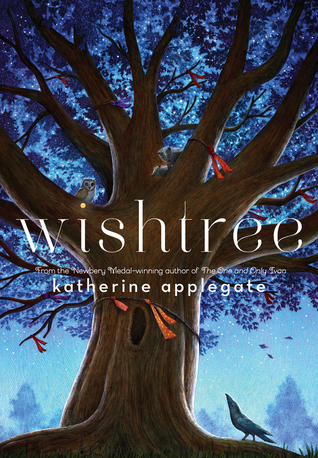
Wishtree
Wishtree. Katherine Applegate. 2017. 224 pages. [Source: Library]
First sentence: It's hard to talk to trees. We're not big on chitchat. That's not to say we can't do amazing things, things you'll probably never do.
Premise/plot: The narrator of Katherine Applegate's newest novel is a tree named Red. Red is a wishing tree--a raggy tree. Every year people write their wishes and tie them to the branches by May 1. Red has seen a lot of years come and go--he's over two hundred years old--but this wishing season is different. The new girl in the neighborhood, Samar, has wished for a friend. Perhaps because some bully carved the word LEAVE on Red's bark, perhaps because Samar comes to visit him each night, perhaps because Red has a feeling that his days are numbered, Red decides to get involved with the human drama unfolding before her eyes. Find a friend for Samar--that is Red's number one priority.
My thoughts: I really enjoyed this one. I enjoyed Red more than I ever thought I could--or would. I enjoyed all the animals that made Red their home. It was a lovely read.
© 2017 Becky Laney of Becky's Book Reviews
First sentence: It's hard to talk to trees. We're not big on chitchat. That's not to say we can't do amazing things, things you'll probably never do.
Premise/plot: The narrator of Katherine Applegate's newest novel is a tree named Red. Red is a wishing tree--a raggy tree. Every year people write their wishes and tie them to the branches by May 1. Red has seen a lot of years come and go--he's over two hundred years old--but this wishing season is different. The new girl in the neighborhood, Samar, has wished for a friend. Perhaps because some bully carved the word LEAVE on Red's bark, perhaps because Samar comes to visit him each night, perhaps because Red has a feeling that his days are numbered, Red decides to get involved with the human drama unfolding before her eyes. Find a friend for Samar--that is Red's number one priority.
My thoughts: I really enjoyed this one. I enjoyed Red more than I ever thought I could--or would. I enjoyed all the animals that made Red their home. It was a lovely read.
"We grow as we must grow, as our seeds decided long ago." (39)
"For two hundred and sixteen rings, I've sat on my roots and listened to people hope for things. And a lot of times, those wishes never happened, I'm guessing."
Bongo tucked a feather into place. "Sometimes that's for the best. Remember that kindergartner who wanted a bulldozer?"
"I'm passive. I just sit here watching the world."
"You're a tree, Red. That's kind of the job description."
"This is a good wish. And it's a wish I can make happen." I paused. "Well, we can make happen." (88)
© 2017 Becky Laney of Becky's Book Reviews
Thursday, October 12, 2017
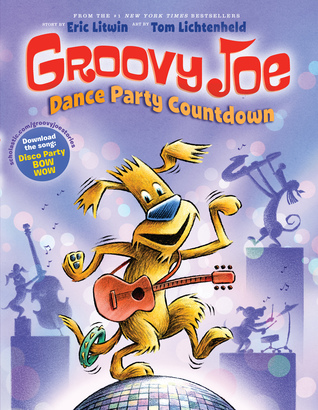
Groovy Joe Dance Party Countdown
Groovy Joe: Dance Party Countdown. Eric Litwin. Illustrated by Tom Lichtenheld. 2017. Scholastic. 40 pages. [Source: Review copy]
First sentence: Groovy Joe is totally fun. He's a song-singing, tail-wagging party of one! And he rocks like this. Disco party bow wow! Disco party bow wow! Knock! Knock! Who's there? One! One who? One more dog is going to disco with you! How many dogs are there now?
Premise/plot: Groovy Joe is ready to DISCO. Though this starts out as a me-party, a party of one, it soon turns into a big dance party! Groovy Joe is always happy to open his door and welcome more into his home.
My thoughts: Eric Litwin's original Pete the Cat books made me giddy. Those original books are: Pete the Cat: I Love My White Shoes, Pete the Cat and His Four Groovy Buttons, Pete the Cat: Rocking In My School Shoes, Pete the Cat Saves Christmas. I love them all. I especially love singing Four Groovy Buttons and I Love My White Shoes. There's something magical about the stories and songs--and how seamlessly the two work together. I fell in love with the character and his GOODNESS NO! philosophy of living life. That "Goodness No!" philosophy is back with Groovy Joe. And I think a lot of the things I absolutely loved about his earlier work is present in this story.
This one features math--addition. (Pete the Cat and His Four Groovy Buttons was all about subtraction.) It follows a definite pattern. "Does Joe get upset? Goodness no! He keeps rocking!" And it features a moral--as many of the Pete the Cat stories did. The moral of this one is: "There's always room for one more!"
Watch him perform part of the story. Listen to the whole story.
Text: 5 out of 5
Illustrations: 4 out of 5
Total: 9 out of 10
© 2017 Becky Laney of Becky's Book Reviews
First sentence: Groovy Joe is totally fun. He's a song-singing, tail-wagging party of one! And he rocks like this. Disco party bow wow! Disco party bow wow! Knock! Knock! Who's there? One! One who? One more dog is going to disco with you! How many dogs are there now?
Premise/plot: Groovy Joe is ready to DISCO. Though this starts out as a me-party, a party of one, it soon turns into a big dance party! Groovy Joe is always happy to open his door and welcome more into his home.
My thoughts: Eric Litwin's original Pete the Cat books made me giddy. Those original books are: Pete the Cat: I Love My White Shoes, Pete the Cat and His Four Groovy Buttons, Pete the Cat: Rocking In My School Shoes, Pete the Cat Saves Christmas. I love them all. I especially love singing Four Groovy Buttons and I Love My White Shoes. There's something magical about the stories and songs--and how seamlessly the two work together. I fell in love with the character and his GOODNESS NO! philosophy of living life. That "Goodness No!" philosophy is back with Groovy Joe. And I think a lot of the things I absolutely loved about his earlier work is present in this story.
This one features math--addition. (Pete the Cat and His Four Groovy Buttons was all about subtraction.) It follows a definite pattern. "Does Joe get upset? Goodness no! He keeps rocking!" And it features a moral--as many of the Pete the Cat stories did. The moral of this one is: "There's always room for one more!"
Watch him perform part of the story. Listen to the whole story.
Text: 5 out of 5
Illustrations: 4 out of 5
Total: 9 out of 10
© 2017 Becky Laney of Becky's Book Reviews
Monday, October 09, 2017
This Beautiful Day
This Beautiful Day. Richard Jackson. Illustrated by Suzy Lee. 2017. 40 pages. [Source: Library]
First sentence: This beautiful day...has everyone dancing and spinning and swinging around, has all of us stamping and stomping our feet on the ground...
Premise/plot: Readers see what one family does on a rainy day. This book answers the question, "Can rainy days be beautiful?!"
My thoughts: I liked this one. I definitely liked it. But it's not a book best appreciated with a brief, quick scan. This is a book that demands your fuller attention. I noticed so much more the second time I read it. I can only imagine that a few more times will bring even more detail to my attention. For example, notice the endpapers. The opening endpapers are black, white, and gray--a stormy day indeed. The closing endpapers are a huge contrast: we see a beautiful BLUE sky with a happy-happy family running, jumping, playing.
The illustrations make this one WONDERFUL. Without a doubt the illustrations make a good book, GREAT. I love how expressive and lively the illustrations are.
Text: 4 out of 5
Illustrations: 5 out of 5
Total: 9 out of 10
© 2017 Becky Laney of Becky's Book Reviews
First sentence: This beautiful day...has everyone dancing and spinning and swinging around, has all of us stamping and stomping our feet on the ground...
Premise/plot: Readers see what one family does on a rainy day. This book answers the question, "Can rainy days be beautiful?!"
My thoughts: I liked this one. I definitely liked it. But it's not a book best appreciated with a brief, quick scan. This is a book that demands your fuller attention. I noticed so much more the second time I read it. I can only imagine that a few more times will bring even more detail to my attention. For example, notice the endpapers. The opening endpapers are black, white, and gray--a stormy day indeed. The closing endpapers are a huge contrast: we see a beautiful BLUE sky with a happy-happy family running, jumping, playing.
The illustrations make this one WONDERFUL. Without a doubt the illustrations make a good book, GREAT. I love how expressive and lively the illustrations are.
Text: 4 out of 5
Illustrations: 5 out of 5
Total: 9 out of 10
© 2017 Becky Laney of Becky's Book Reviews
Thursday, October 05, 2017
Dollmaker of Krakow
First sentence: There once was a little doll named Karolina, who lived in a country far from the human world. The Land of the Dolls was a large kingdom that stretched countless miles in any direction one could think of.
Premise/plot: The Dollmaker of Krakow is historical fantasy set during the Second World War. Cyryl Brzezick is a dollmaker living in Krakow; one day he's carving a wooden doll from a memory. Without knowing how or why, he discovers he's called a soul into the body of the doll--that soul is Karolina. She is a living doll. And the two become close friends. Though he worries that not everyone will understand and accept his magic. He urges her to stay quiet when others are about. And even before the Nazi soldiers come storming into Poland, into Krakow, into their lives, not every face is a friendly face.
The dollmaker and Karolina become extremely close with a Jewish man (Jozef Trzmiel) and his daughter (Rena). There will come a time when this friendship is tested and proved. Will Karolina and the Dollmaker find the courage and strength to stand up to EVIL?!
My thoughts: This fantasy novel is compelling. (I read it at the same time I was reading Irena's Children--a nonfiction biography.) Perhaps I found the nonfiction biography even more compelling and engaging than this fantasy novel. But that's not to say there isn't a place for historical fantasy. This book involved two wars: the war in the human world involving the Nazis and the war in the Land of Dolls involving the invading RATS. I would have much rather the focus been on the human world. The rat segments just didn't captivate me. That being said, it's not my place to review what "should have been" or what "could have been." Did I like it--yes or no? I definitely liked it. Was it sad? YES.
Favorite quotes:
"When a human cries out for a doll, there is always a reason. They need you and you may find that they have what you need too."
The depth of the look that passed between the Dollmaker and Karolina could not be conveyed in a single word; it was too full of every story and victory and long night they had shared with each other. It was too full of love. And so the Dollmaker chose not one word but two. "Live well," he told her.
Magic is an odd thing. It never takes the form you'd expect.
You can destroy a person, Karolina, but destroying their story is far more difficult. No one is ever really lost as long as their story still exists.
Dolls were like children; they could not hide their joy.
An entire lifetime spent without believing anything marvelous would be gloomy and dull.
© 2017 Becky Laney of Becky's Book Reviews
Wednesday, October 04, 2017
A Perfect Day
A Perfect Day. Lane Smith. 2017. 32 pages. [Source: Library]
First sentence: The warmth of the sun...felt good on Cat's back. Cat liked to be in the flower bed where the daffodils grew. It was a perfect day for Cat. The cool of the water was what Dog liked best. When it was hot, Dog sat in the wading pool that his friend Bert filled for him. It was a perfect day for Dog.
Premise/plot: A Perfect Day is a near-perfect look at differing perspectives. Cat. Dog. Chickadee. Squirrel. Readers meet them one by one. Not everyone will have a perfect day....all day. Enter BEAR.
My thoughts: I enjoyed this one very much. It starts off perfectly lovely. Readers meet a cat, a dog, a boy named Bert, a chickadee, and a squirrel. As much as I "hate" to say it, the Bear MAKES the book. There would be no story without the Bear. The Bear makes for some conflict. My favorite illustration of the book is the spread where Bear has the corncob--formerly Squirrel's corncob--in his mouth seemingly grinning. The text reads: It was a perfect day for Squirrel. The WAS appears in a different font and a different size from the rest of the text giving it emphasis. This "was" emphasis continues as readers see what else Bear needs for his perfect day.
The back jacket flap shows a snapshot of a bear eating birdseed out of a bird feeder. My guess is this one is based on a true story.
Text 5 out of 5
Illustrations: 5 out of 5
Total: 10 out of 10
© 2017 Becky Laney of Becky's Book Reviews
First sentence: The warmth of the sun...felt good on Cat's back. Cat liked to be in the flower bed where the daffodils grew. It was a perfect day for Cat. The cool of the water was what Dog liked best. When it was hot, Dog sat in the wading pool that his friend Bert filled for him. It was a perfect day for Dog.
Premise/plot: A Perfect Day is a near-perfect look at differing perspectives. Cat. Dog. Chickadee. Squirrel. Readers meet them one by one. Not everyone will have a perfect day....all day. Enter BEAR.
My thoughts: I enjoyed this one very much. It starts off perfectly lovely. Readers meet a cat, a dog, a boy named Bert, a chickadee, and a squirrel. As much as I "hate" to say it, the Bear MAKES the book. There would be no story without the Bear. The Bear makes for some conflict. My favorite illustration of the book is the spread where Bear has the corncob--formerly Squirrel's corncob--in his mouth seemingly grinning. The text reads: It was a perfect day for Squirrel. The WAS appears in a different font and a different size from the rest of the text giving it emphasis. This "was" emphasis continues as readers see what else Bear needs for his perfect day.
The back jacket flap shows a snapshot of a bear eating birdseed out of a bird feeder. My guess is this one is based on a true story.
Text 5 out of 5
Illustrations: 5 out of 5
Total: 10 out of 10
© 2017 Becky Laney of Becky's Book Reviews
Tuesday, October 03, 2017
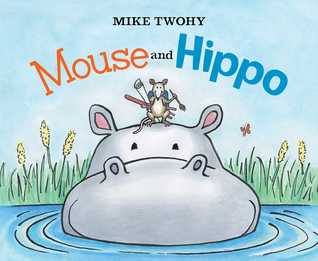
Mouse and Hippo
Mouse and Hippo. Mike Twohy. 2017. Simon Schuster. 32 pages. [Source: Library]
First sentence: Whoa! Oops, excuse me, I had an itch. Your itch was me...and HELP...I can't swim!
Premise/plot: The story opens with a mouse painting the ocean. His easel is set up on a rock...or is it?! Turns out that Mouse's "rock" is really HIPPO. After Hippo saves Mouse from drowning, Mouse volunteers to paint him. But how does a mouse get all of Hippo to fit on his small canvas?! Mouse paints what he sees, and he uses his largest brush to do so. Hippo is delighted--absolutely delighted--with his portrait. Hippo then decides to paint a portrait of Mouse. Hippo paints what he sees--as Mouse did--and Mouse is charmed with the results. (Hippo uses a tiny brush to paint Mouse.)
My thoughts: This book is ALL about perspective. Well, that's an exaggeration. It's equally about friendship, art, and perspective. How do YOU see the world around you? How do you represent what you see on the page--or the canvas--in front of you?
The text of the book is all dialogue. Hippo's words are in black. Mouse's words are in brown. It could work as a traditional read aloud--in the home, at school, at the library. Or. It could be a book a parent and child read together. One could read the part of hippo. The other could read the part of Mouse. I think either way it could work well.
Personally, I LOVED, LOVED, LOVED this one. It made me smile again and again. I thought the illustrations were absolutely perfect. I thought the text was great as well.
Illustrations: 5 out of 5
Total: 10 out of 10
© 2017 Becky Laney of Becky's Book Reviews
First sentence: Whoa! Oops, excuse me, I had an itch. Your itch was me...and HELP...I can't swim!
Premise/plot: The story opens with a mouse painting the ocean. His easel is set up on a rock...or is it?! Turns out that Mouse's "rock" is really HIPPO. After Hippo saves Mouse from drowning, Mouse volunteers to paint him. But how does a mouse get all of Hippo to fit on his small canvas?! Mouse paints what he sees, and he uses his largest brush to do so. Hippo is delighted--absolutely delighted--with his portrait. Hippo then decides to paint a portrait of Mouse. Hippo paints what he sees--as Mouse did--and Mouse is charmed with the results. (Hippo uses a tiny brush to paint Mouse.)
My thoughts: This book is ALL about perspective. Well, that's an exaggeration. It's equally about friendship, art, and perspective. How do YOU see the world around you? How do you represent what you see on the page--or the canvas--in front of you?
The text of the book is all dialogue. Hippo's words are in black. Mouse's words are in brown. It could work as a traditional read aloud--in the home, at school, at the library. Or. It could be a book a parent and child read together. One could read the part of hippo. The other could read the part of Mouse. I think either way it could work well.
Personally, I LOVED, LOVED, LOVED this one. It made me smile again and again. I thought the illustrations were absolutely perfect. I thought the text was great as well.
Gee--you don't really know how big a hippo is until you try to paint one!Text: 5 out of 5
Illustrations: 5 out of 5
Total: 10 out of 10
© 2017 Becky Laney of Becky's Book Reviews
Saturday, September 30, 2017
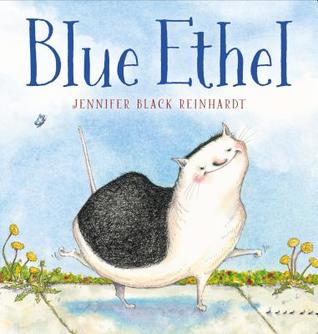
Blue Ethel
Blue Ethel. Jennifer Black Reinhardt. 2017. 40 pages. [Source: Library]
First sentence: Ethel was old. She was fat. She was black. She was white. And she was very set in her ways.
Premise/plot: Love cats? You should meet Ethel. I loved her at hello. She's a creature of routine, and, I can certainly appreciate that!
My thoughts: I ADORED the text of this one. I absolutely adored it. I loved how Ethel made friends with Fluffy. And the ending was FABULOUS. I couldn't imagine a better ending for this one. That being said, I'm not sure I adored the illustrations as much as I did the text. A few pages I loved however. (For example, the page with the sidewalk. A child has been BUSY. And the art on the sidewalk is definitely KID ART.) I loved the end papers as well!
Text: 5 out of 5
Illustrations: 4 out of 5
Total: 9 out of 10
© 2017 Becky Laney of Becky's Book Reviews
First sentence: Ethel was old. She was fat. She was black. She was white. And she was very set in her ways.
Premise/plot: Love cats? You should meet Ethel. I loved her at hello. She's a creature of routine, and, I can certainly appreciate that!
Every day Ethel went outside to survey the land, monitor the weather, chase villains, and explore her favorite sidewalk square, where she liked to roll before taking a nap after her long day. It wasn't easy being Ethel, but she was good at it.Blue Ethel is the story of what happens to shake up Ethel's routine. One day Ethel's sidewalk square has been colored on with sidewalk chalk. And Ethel, well, she's not quite the same cat as before once she's done rolling around on HER square.
My thoughts: I ADORED the text of this one. I absolutely adored it. I loved how Ethel made friends with Fluffy. And the ending was FABULOUS. I couldn't imagine a better ending for this one. That being said, I'm not sure I adored the illustrations as much as I did the text. A few pages I loved however. (For example, the page with the sidewalk. A child has been BUSY. And the art on the sidewalk is definitely KID ART.) I loved the end papers as well!
Text: 5 out of 5
Illustrations: 4 out of 5
Total: 9 out of 10
© 2017 Becky Laney of Becky's Book Reviews
Labels:
2017,
2017 Cybils Eligible,
books reviewed in 2017,
cats,
FSG,
library book,
picture books
Friday, September 29, 2017
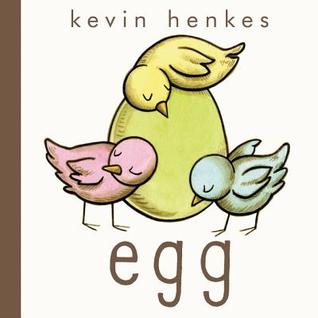
Egg
Egg. Kevin Henkes. 2017. 40 pages. [Source: Library]
First sentence: egg, egg, egg, egg. crack, crack, crack, egg. surprise! surprise! surprise! egg. goodbye, goodbye, goodbye, egg.
Premise/plot: Egg is the story of FOUR eggs. Three of the four eggs hatch together: a red bird, a yellow bird, a blue bird. The green egg, well, the green egg doesn't--for the longest time. When that egg hatches, what will emerge?! Will the birds make a new friend?!
My thoughts: I really enjoyed Egg. I was skeptical of this one at first. Before I even opened it, I thought that it would probably not work for me. The cover just didn't say "read me, read me." But when I saw the format and read the story, I was pleased. One of my favorite things about early Sesame Street was playing/singing: "One of these things is not like the others, one of these things just doesn't belong..." This book definitely fits in with that concept or theme. But the book does challenge the "doesn't belong" aspect of it.
The story is told very simply. I'm not sure there's a complete sentence in the whole book. The story is told a phrase at a time. There is a LOT of repetition. But the story is also told largely through the illustrations. One could definitely read this one through the pictures alone and get the basics of the story. Sure, children might not get the word "miserable" from the illustration alone...but SAD...yes.
Text: 5 out of 5
Illustrations: 5 out of 5
Total: 10 out of 10
© 2017 Becky Laney of Becky's Book Reviews
First sentence: egg, egg, egg, egg. crack, crack, crack, egg. surprise! surprise! surprise! egg. goodbye, goodbye, goodbye, egg.
Premise/plot: Egg is the story of FOUR eggs. Three of the four eggs hatch together: a red bird, a yellow bird, a blue bird. The green egg, well, the green egg doesn't--for the longest time. When that egg hatches, what will emerge?! Will the birds make a new friend?!
My thoughts: I really enjoyed Egg. I was skeptical of this one at first. Before I even opened it, I thought that it would probably not work for me. The cover just didn't say "read me, read me." But when I saw the format and read the story, I was pleased. One of my favorite things about early Sesame Street was playing/singing: "One of these things is not like the others, one of these things just doesn't belong..." This book definitely fits in with that concept or theme. But the book does challenge the "doesn't belong" aspect of it.
The story is told very simply. I'm not sure there's a complete sentence in the whole book. The story is told a phrase at a time. There is a LOT of repetition. But the story is also told largely through the illustrations. One could definitely read this one through the pictures alone and get the basics of the story. Sure, children might not get the word "miserable" from the illustration alone...but SAD...yes.
Text: 5 out of 5
Illustrations: 5 out of 5
Total: 10 out of 10
© 2017 Becky Laney of Becky's Book Reviews
Thursday, September 28, 2017
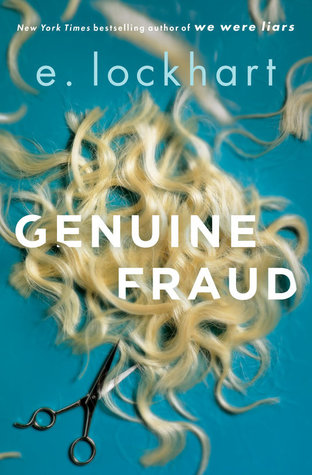
Genuine Fraud
Genuine Fraud. E. Lockhart. 2017. 272 pages. [Source: Library]
First sentence: It was a bloody great hotel.
Premise/plot: Looking for a book that is told completely in reverse chronology? Have I got a book for you. E. Lockhart's Genuine Fraud. Lockhart mentions two specific inspirations for her novel: Great Expectations by Charles Dickens and The Talented Mr. Ripley by Patricia Highsmith.
I have not read The Talented Mr. Ripley. I've read reviews saying that Lockhart has borrowed every plot point, every character, directly from this book. And for people who've read both--it was too much echoing to be inspiration.
© 2017 Becky Laney of Becky's Book Reviews
First sentence: It was a bloody great hotel.
Premise/plot: Looking for a book that is told completely in reverse chronology? Have I got a book for you. E. Lockhart's Genuine Fraud. Lockhart mentions two specific inspirations for her novel: Great Expectations by Charles Dickens and The Talented Mr. Ripley by Patricia Highsmith.
Mysteries perpetuate the status quo. Everything always wraps up at the end. Order is restored. But order doesn't really exist, right? It's an artificial construct. The whole genre of the mystery novel reinforces the hegemony of Western notions of causation. In L'Etranger, you know everything that happens from the beginning. There's nothing to find out, because human existence is ultimately meaningless. (70) ~ Forrest to JulesJules, the heroine of Genuine Fraud, sees herself as the center of an action movie.
She knew that women were rarely the centers of such stories. Instead, they were eye candy, arm candy, victims, or love interests. Mostly they existed to help the great white hetero hero on his [...] epic journey. When there was a heroine, she weighed very little, wore very little, and had had her teeth fixed. Jule knew she didn't look like those women. She would never look like those women. But she was everything those heroes were, and in some ways, she was more. She knew that too. (22)
I am the center of the story now, Jule said to herself. I don't have to weigh very little, wear very little, or have my teeth fixed. I am the center. (150)My thoughts: Genuine Fraud isn't my typical book. I don't typically do psychological thrillers. I don't have a special love for unreliable narrators. But. There was something intriguing about E. Lockhart's Genuine Fraud. Something that kept me reading even if that something wasn't suspense. Was Lockhart hoping to lead her readers on a quest for the WHY? Or perhaps was it all about illustrating how there are no whys to explain away murderers actions?
I have not read The Talented Mr. Ripley. I've read reviews saying that Lockhart has borrowed every plot point, every character, directly from this book. And for people who've read both--it was too much echoing to be inspiration.
© 2017 Becky Laney of Becky's Book Reviews
Wednesday, September 27, 2017
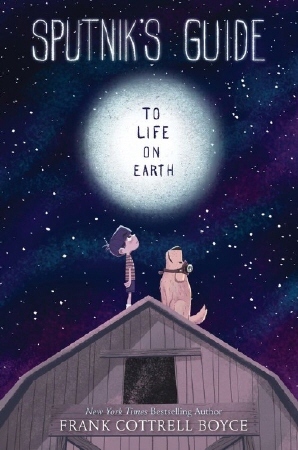
Sputnik's Guide to Life On Earth
Sputnik's Guide to Life on Earth. Frank Cottrell Boyce. 2017. 336 pages. [Source: Library]
First sentence: Before you start anything, make a list. That's what my grandad says. If you're making a cake, make a list. If you're moving house, make a list. If you're running away to sea, make a list. At least that's what he used to say.
Premise/plot: Prez Mellows is a foster kid who doesn't say much--until one day Sputnik shows up at the door of his new temporary home. To the rest of the world, Sputnik appears to be an ordinary dog. Only Prez sees him for who he is or perhaps what he is--an alien who can read his mind. Sputnik tells Prez that he's the reason he came to earth. Together they have an important job to do: save earth from destruction by coming up with a list of ten reasons why earth is worth seeing. Prez balances this mission with an even greater one: how to be reunited with his Grandad again.
My thoughts: This was an enjoyable read. It dealt with a serious topic yet it wasn't too heavy. It had heart, but it wasn't about making you cry. Prez's grandad has dementia; his dementia has caused the two to be separated. He has to go in a nursing home where he can be cared for properly, and Prez has to go to a foster home. Sputnik was a hoot. This one packed in plenty of adventure. I enjoyed Prez's new foster family as well.
© 2017 Becky Laney of Becky's Book Reviews
First sentence: Before you start anything, make a list. That's what my grandad says. If you're making a cake, make a list. If you're moving house, make a list. If you're running away to sea, make a list. At least that's what he used to say.
Premise/plot: Prez Mellows is a foster kid who doesn't say much--until one day Sputnik shows up at the door of his new temporary home. To the rest of the world, Sputnik appears to be an ordinary dog. Only Prez sees him for who he is or perhaps what he is--an alien who can read his mind. Sputnik tells Prez that he's the reason he came to earth. Together they have an important job to do: save earth from destruction by coming up with a list of ten reasons why earth is worth seeing. Prez balances this mission with an even greater one: how to be reunited with his Grandad again.
My thoughts: This was an enjoyable read. It dealt with a serious topic yet it wasn't too heavy. It had heart, but it wasn't about making you cry. Prez's grandad has dementia; his dementia has caused the two to be separated. He has to go in a nursing home where he can be cared for properly, and Prez has to go to a foster home. Sputnik was a hoot. This one packed in plenty of adventure. I enjoyed Prez's new foster family as well.
"You get homesick? But you said you didn't have a home." "You don't have to have a home to get homesick. You just have to want one. The whole history of your wee planet is nothing but people looking for a home.
© 2017 Becky Laney of Becky's Book Reviews
Tuesday, September 26, 2017
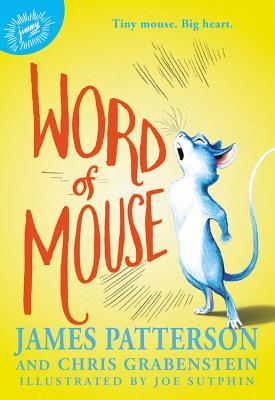
Word of Mouse
Word of Mouse. James Patterson and Chris Grabenstein. 2016 [December] Little, Brown. 304 pages. [Source: Library]
First sentence: My story starts on the day I lost my entire family.
Premise/plot: Isaiah is the runt of his mischief. He has 96 older brothers and sisters. As you might have guessed, Isaiah, the hero of Word of Mouse, is a mouse--a blue mouse. The novel opens with his family running from an evil lab. Isaiah gets separated from his family; within hours ALL of his family has been recaptured. But Isaiah learns that there are many ways to define family as the novel unfolds. There's his new mischief with the oh-so-lovely Mikayla. There's his human friend, Hailey, as well. Isaiah may be carrying a heavy burden, but, he's not carrying it alone. He's loved. He's valued. Will Isaiah find a way to be reunited with his family?
My thoughts: Isaiah is a great little character. I enjoyed getting to know him. I loved how each chapter starts out with a quote from Isaiah. I loved the short chapters. The short chapters kept me READING. I also enjoyed the illustrations. I found them just as delightful as the text.
© 2017 Becky Laney of Becky's Book Reviews
First sentence: My story starts on the day I lost my entire family.
Premise/plot: Isaiah is the runt of his mischief. He has 96 older brothers and sisters. As you might have guessed, Isaiah, the hero of Word of Mouse, is a mouse--a blue mouse. The novel opens with his family running from an evil lab. Isaiah gets separated from his family; within hours ALL of his family has been recaptured. But Isaiah learns that there are many ways to define family as the novel unfolds. There's his new mischief with the oh-so-lovely Mikayla. There's his human friend, Hailey, as well. Isaiah may be carrying a heavy burden, but, he's not carrying it alone. He's loved. He's valued. Will Isaiah find a way to be reunited with his family?
My thoughts: Isaiah is a great little character. I enjoyed getting to know him. I loved how each chapter starts out with a quote from Isaiah. I loved the short chapters. The short chapters kept me READING. I also enjoyed the illustrations. I found them just as delightful as the text.
© 2017 Becky Laney of Becky's Book Reviews
Monday, September 25, 2017
When My Sister Started Kissing
When My Sister Started Kissing. Helen Frost. 2017. FSG. 208 pages. [Source: Library]
First sentence: The baby, Claire, in a sunsuit and yellow hat, sat on her father's shoulders, the great wide world spread out before them. Two egrets flew home to their nest as thunder rumbled, far off in the distance.
Premise/plot: If you read many verse novels, then chances are good you're familiar with Helen Frost. When My Sister Started Kissing is her newest verse novel; it has multiple narrators. Claire and her older sister, Abigail, have always spent the summer at the cabin with their dad. This year is the first year that the girls' stepmother, Pam, will be joining them. And this family of four is about to become a family of FIVE. Claire who is nearly eleven isn't a fan of change. Abigail is all about change. For example, she now wants to be called Abi. She doesn't want to hang out with her sister; she wants to spend time with Brock and the other teenagers. She doesn't want to spend every moment with her family; she wants to be allowed to go off with her friends and do whatever/whenever. Claire and Abigail are obvious narrators. The third narrator is the LAKE.
My thoughts: I definitely enjoyed this one. The writing is excellent. The verse aspects of this one are essential. There are at least three different poetry forms used throughout the book. Each narrator has their own poetic form that suits the story, the character, best.
This novel is set over one summer vacation. Claire's narration keeps the novel focused on the family. Abigail's narration, on the other hand, keeps the novel focused on BOYS. TJ is a family friend; the two families have vacationed near one another for years. Last summer, Abigail and TJ kissed--"for practice." This summer, Abigail thinks kissing should be reserved for someone that you really like-like. She's nervous to see TJ again. Will he be interested in her still? Does she even like-like him? Is he boyfriend material or like-a-brother? And then there is Brock. He's new. He's cute. He's got FANS. There are half a dozen girls who cling to him. Brock seems to notice HER out of the crowd. And though she doesn't know him, she likes being liked. She feels grown up with Brock, perhaps because she hasn't grown up with him. Claire doesn't get why Abi is ignoring TJ and going out of her way to avoid his family and why she's sneaking around to see Brock. This love triangle is resolved--for now--by the end of the novel.
© 2017 Becky Laney of Becky's Book Reviews
First sentence: The baby, Claire, in a sunsuit and yellow hat, sat on her father's shoulders, the great wide world spread out before them. Two egrets flew home to their nest as thunder rumbled, far off in the distance.
Premise/plot: If you read many verse novels, then chances are good you're familiar with Helen Frost. When My Sister Started Kissing is her newest verse novel; it has multiple narrators. Claire and her older sister, Abigail, have always spent the summer at the cabin with their dad. This year is the first year that the girls' stepmother, Pam, will be joining them. And this family of four is about to become a family of FIVE. Claire who is nearly eleven isn't a fan of change. Abigail is all about change. For example, she now wants to be called Abi. She doesn't want to hang out with her sister; she wants to spend time with Brock and the other teenagers. She doesn't want to spend every moment with her family; she wants to be allowed to go off with her friends and do whatever/whenever. Claire and Abigail are obvious narrators. The third narrator is the LAKE.
My thoughts: I definitely enjoyed this one. The writing is excellent. The verse aspects of this one are essential. There are at least three different poetry forms used throughout the book. Each narrator has their own poetic form that suits the story, the character, best.
This novel is set over one summer vacation. Claire's narration keeps the novel focused on the family. Abigail's narration, on the other hand, keeps the novel focused on BOYS. TJ is a family friend; the two families have vacationed near one another for years. Last summer, Abigail and TJ kissed--"for practice." This summer, Abigail thinks kissing should be reserved for someone that you really like-like. She's nervous to see TJ again. Will he be interested in her still? Does she even like-like him? Is he boyfriend material or like-a-brother? And then there is Brock. He's new. He's cute. He's got FANS. There are half a dozen girls who cling to him. Brock seems to notice HER out of the crowd. And though she doesn't know him, she likes being liked. She feels grown up with Brock, perhaps because she hasn't grown up with him. Claire doesn't get why Abi is ignoring TJ and going out of her way to avoid his family and why she's sneaking around to see Brock. This love triangle is resolved--for now--by the end of the novel.
© 2017 Becky Laney of Becky's Book Reviews
Sunday, September 24, 2017
The Goat
The Goat. Anne Fleming. 2017. 120 pages. [Source: Library]
First sentence: Once there was a mountain goat who lived in New York City.
Premise/plot: A goat lives on the roof of a New York City apartment building. Only a few residents have spotted the goat--and its rumored that if you do see him, you'll have years of good luck. But most don't believe the rumors are true--about the goat being real or about the goat bringing luck. But one person definitely believes, a kid named KID. Kid teams up with her new friends to find out all she can about the goat.
My thoughts: I wanted to love this one. It sounded like it had a great premise. It seemed to promise a dozen or so super quirky characters. The potential for humor was definitely there. And it seemed to have potential for some heart as well: friends to be made, experiences to be gained. But. It remained an "almost" for me. I didn't dislike it. I just didn't love it. I thought it would be memorable and one-of-a-kind. I was slightly disappointed that it wasn't awesome.
© 2017 Becky Laney of Becky's Book Reviews
First sentence: Once there was a mountain goat who lived in New York City.
Premise/plot: A goat lives on the roof of a New York City apartment building. Only a few residents have spotted the goat--and its rumored that if you do see him, you'll have years of good luck. But most don't believe the rumors are true--about the goat being real or about the goat bringing luck. But one person definitely believes, a kid named KID. Kid teams up with her new friends to find out all she can about the goat.
My thoughts: I wanted to love this one. It sounded like it had a great premise. It seemed to promise a dozen or so super quirky characters. The potential for humor was definitely there. And it seemed to have potential for some heart as well: friends to be made, experiences to be gained. But. It remained an "almost" for me. I didn't dislike it. I just didn't love it. I thought it would be memorable and one-of-a-kind. I was slightly disappointed that it wasn't awesome.
© 2017 Becky Laney of Becky's Book Reviews
Friday, September 22, 2017
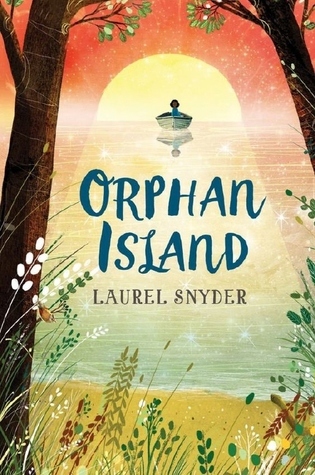
Orphan Island
Orphan Island. Laurel Snyder. 2017. 288 pages. [Source: Library]
First sentence: Jinny heard the bell. She threw down her book, rose from the stale comfort of the old brown sofa, and scrambled for the door. When she burst from the cabin into the evening air, Jinny ran.
Premise/plot: The setting is an island that seems to in some way take care of the nine children who inhabit it. It's not your ordinary island.
Jinny becomes the new elder soon after the novel opens. Her care is a young girl named Ess. Jinny struggles in her role as elder. She both loves and hates it. It is without a doubt the hardest thing she's ever done.
At the end of the year, Jinny knows she should get in the boat--like every other elder that has gone before her. But will she be able to face her fears, face the uncertainties?
Orphan Island, I believe, is supposed to be an allegory about the struggles of growing up, about the journey of leaving childhood behind. Jinny, our heroine, doesn't want to grow up. The idea of leaving the safety of the island behind her and journeying forth literally into the unknown terrifies her.
My thoughts: Orphan Island left me speechless--for the most part. I have no answers because there are so many questions are still unanswered by the end of the novel. Mainly questions about how the children got on the island, how the island takes care of the children, why just nine children, who sends and directs the boat, where the elders go when they leave the island.
One fascinating aspect of Orphan Island is the unknown Abigail. The children have no idea who Abigail is/was. But her books are on the island. Her notes are in the books. Some of the children feel like they *know* Abigail through the clues she's left behind. I would LOVE to know more about Abigail and the first generation of children who lived on the island.
I would recommend this one. But if you hate untidy endings that leave you wanting more, then maybe it's best to know that ahead of time. There will be questions you *need* answered. They won't be answered in the book. Perhaps they'll never be answered by the author. Perhaps you'll have to choose your own ending.
© 2017 Becky Laney of Becky's Book Reviews
First sentence: Jinny heard the bell. She threw down her book, rose from the stale comfort of the old brown sofa, and scrambled for the door. When she burst from the cabin into the evening air, Jinny ran.
Premise/plot: The setting is an island that seems to in some way take care of the nine children who inhabit it. It's not your ordinary island.
Nine on an island, orphans all,Every year a boat comes bearing a young child--perhaps four or five years of age. The eldest child of the island gets in the boat and departs. The next-to-oldest becomes the new elder and takes charge of the new child. In that one year, the elder will teach her care how to survive--thrive even--on the island. (Or his care.)
Any more, the sky might fall.
Jinny becomes the new elder soon after the novel opens. Her care is a young girl named Ess. Jinny struggles in her role as elder. She both loves and hates it. It is without a doubt the hardest thing she's ever done.
At the end of the year, Jinny knows she should get in the boat--like every other elder that has gone before her. But will she be able to face her fears, face the uncertainties?
Orphan Island, I believe, is supposed to be an allegory about the struggles of growing up, about the journey of leaving childhood behind. Jinny, our heroine, doesn't want to grow up. The idea of leaving the safety of the island behind her and journeying forth literally into the unknown terrifies her.
My thoughts: Orphan Island left me speechless--for the most part. I have no answers because there are so many questions are still unanswered by the end of the novel. Mainly questions about how the children got on the island, how the island takes care of the children, why just nine children, who sends and directs the boat, where the elders go when they leave the island.
One fascinating aspect of Orphan Island is the unknown Abigail. The children have no idea who Abigail is/was. But her books are on the island. Her notes are in the books. Some of the children feel like they *know* Abigail through the clues she's left behind. I would LOVE to know more about Abigail and the first generation of children who lived on the island.
I would recommend this one. But if you hate untidy endings that leave you wanting more, then maybe it's best to know that ahead of time. There will be questions you *need* answered. They won't be answered in the book. Perhaps they'll never be answered by the author. Perhaps you'll have to choose your own ending.
© 2017 Becky Laney of Becky's Book Reviews
Wednesday, September 20, 2017
You Can Read
You Can Read. Helaine Becker. Illustrated by Mark Hoffmann. 2017. 32 pages. [Source: Library]
First sentence: You can read in the classroom. You can read in the park. You can read on a mission under cover in the dark.
Premise/plot: You Can Read celebrates reading books anywhere and everywhere. It rhymes, and in a good way.
My thoughts: The text of the book is in all-caps. I found this very annoying to read. But even more annoying is the disturbing lack of periods. There is not a single period in the whole book. (I couldn't help adding periods into the text I quoted above. I just couldn't present it the way it is in the book.) (Two sentences end in exclamation points.) If this book were getting graded by a first grade teacher, it would lose a lot of points. (The students in the first grade class might love it because of the illustrated underwear.)
That being said, the text of the book itself isn't bad. The message is a good one. I LOVE books. (Everybody knows that I love books.) I wanted to love, love, love it. The illustrations were not my style at all.
Text: 4 out of 5
Illustrations: 1 out of 5
Total: 5 out of 10
© 2017 Becky Laney of Becky's Book Reviews
First sentence: You can read in the classroom. You can read in the park. You can read on a mission under cover in the dark.
Premise/plot: You Can Read celebrates reading books anywhere and everywhere. It rhymes, and in a good way.
My thoughts: The text of the book is in all-caps. I found this very annoying to read. But even more annoying is the disturbing lack of periods. There is not a single period in the whole book. (I couldn't help adding periods into the text I quoted above. I just couldn't present it the way it is in the book.) (Two sentences end in exclamation points.) If this book were getting graded by a first grade teacher, it would lose a lot of points. (The students in the first grade class might love it because of the illustrated underwear.)
That being said, the text of the book itself isn't bad. The message is a good one. I LOVE books. (Everybody knows that I love books.) I wanted to love, love, love it. The illustrations were not my style at all.
Text: 4 out of 5
Illustrations: 1 out of 5
Total: 5 out of 10
© 2017 Becky Laney of Becky's Book Reviews
Tuesday, September 19, 2017
Forget Me Not
Forget Me Not. Ellie Terry. 2017. 336 pages. [Source: Library]
First sentence: I open my dresser drawers, find them empty, empty, empty.
Premise/plot: Calliope June is the young heroine in Ellie Terry's Forget Me Not. This middle grade novel actually has two narrators. Calli's narrates in verse while Jinsong narrates in prose. Here's what you need to know about Calli: a) she HATES moving; b) she HATES having to introduce herself to her classmates; c) she struggles to make friends; d) she wishes her mom would grow up; e) she has Tourette syndrome. Here's what you need to know about Jinsong: a) he LOVES baseball b) he's popular; c) he like-likes Calli; d) he's afraid to be friends with her in public; e) he cares too much about what others think of him; f) he's self-aware enough to know he's being a big jerk and a coward.
My thoughts: I found this to be a quick, compelling read. I enjoyed the characterization. Readers really only get to know Jinsong and Calli, but, these two are well developed in my opinion. The relationship that tortured me the most was between Calli and her mom. I really wanted Calli's mom to grow up and get the help she needed. I hated that Calli's life was being turned upside down every few months because of her mom's love life. The ending leaves me worried. I think Calli has matured a great deal, but, her mom is still a big, big mess.
Does this one "need" to be a verse novel? I'm not sure it does. The verse isn't spectacular poetry. Calli could have told her story in prose just as well. I am glad Calli's story got told. I like her as a narrator. And being in verse does make it go quicker because there are fewer words.
Do we "need" Jinsong's narration? I'm not sure we do. But I am conflicted on this. His narrative does allow readers to see Calli from a different perspective, an outside perspective. We see most of the bullying from his perspective. He's a mostly silent bystander. He does some much-needed growing up in this one.
© 2017 Becky Laney of Becky's Book Reviews
First sentence: I open my dresser drawers, find them empty, empty, empty.
Premise/plot: Calliope June is the young heroine in Ellie Terry's Forget Me Not. This middle grade novel actually has two narrators. Calli's narrates in verse while Jinsong narrates in prose. Here's what you need to know about Calli: a) she HATES moving; b) she HATES having to introduce herself to her classmates; c) she struggles to make friends; d) she wishes her mom would grow up; e) she has Tourette syndrome. Here's what you need to know about Jinsong: a) he LOVES baseball b) he's popular; c) he like-likes Calli; d) he's afraid to be friends with her in public; e) he cares too much about what others think of him; f) he's self-aware enough to know he's being a big jerk and a coward.
My thoughts: I found this to be a quick, compelling read. I enjoyed the characterization. Readers really only get to know Jinsong and Calli, but, these two are well developed in my opinion. The relationship that tortured me the most was between Calli and her mom. I really wanted Calli's mom to grow up and get the help she needed. I hated that Calli's life was being turned upside down every few months because of her mom's love life. The ending leaves me worried. I think Calli has matured a great deal, but, her mom is still a big, big mess.
Does this one "need" to be a verse novel? I'm not sure it does. The verse isn't spectacular poetry. Calli could have told her story in prose just as well. I am glad Calli's story got told. I like her as a narrator. And being in verse does make it go quicker because there are fewer words.
Do we "need" Jinsong's narration? I'm not sure we do. But I am conflicted on this. His narrative does allow readers to see Calli from a different perspective, an outside perspective. We see most of the bullying from his perspective. He's a mostly silent bystander. He does some much-needed growing up in this one.
© 2017 Becky Laney of Becky's Book Reviews
Monday, September 18, 2017
Train I Ride
Train I Ride. Paul Mosier. 2017. HarperCollins. 192 pages. [Source: Library]
First sentence: The train I ride is sixteen coaches long.
Premise/plot: Rydr is our young heroine. After the death of her grandmother, she finds herself on a train heading east to live with her great uncle. Readers learn what happened before in a series of flashes, memories. The novel ends when she arrives in Chicago; it ends before she meets her new guardian. So readers are left with a bit of uncertainty. Rydr's story is revealed as she interacts with fellow passengers on the train--both children and adults.
My thoughts: I didn't expect to love, love, love this one. But I did. Rydr is a vulnerable young girl with a big heart. Her heart may not be trusting, and, she may have more than a couple of schemes always in place. Yet how could you say she isn't compassionate?! I'm thinking of the scene where she spends what little money she has--five dollars--buying a hand-made bracelet from a young girl who is just as desperate for money as Rydr is. I have many, many favorite scenes in this one. I loved Rydr's friendship with Tenderchucks, a young boy scout. These two are so good for one another. Another relationship I loved to see develop through the course of the novel was that of Rydr and Neal.
What I loved about this one: the writing, the coming-of age elements, the relationship-building, the characterization.
Favorite quotes:
If a poem is using words in a way that isn't quite what you're accustomed to, don't think that there's something wrong with you or your ability to understand them. They're just art objects painted with words. Sometimes they look like things you recognize, and sometimes not. (65)
"We should make a pact," he says. "A non-cruelty pact." "Between us?" "Between us. And everyone we meet. Until it extends to everyone." (93)
The people sitting at the table with me feel like a family. My family. If I could choose my family they'd be just like this. (113)
Carlos folds and unfolds his hands. "The best kind of people are people who feel, and who hold hope in their hearts. Even if it sometimes means being hurt and disappointed. Even if it means always being hurt and disappointed." (161)© 2017 Becky Laney of Becky's Book Reviews
Saturday, September 16, 2017
Seeking Mansfield
Seeking Mansfield. Kate Watson. 2017. 300 pages. [Source: Library]
First sentence: Finley Price was a fool.
Premise/plot: Seeking Mansfield by Kate Watson is a YA adaption of Jane Austen's Mansfield Park. Finley Price lives with the Bertrams, but she's not related to the Bertrams. Finley's father was fraternity brothers with Mr. Bertram, I believe. After her father's death and her mother's breakdown, the Bertrams took her in and raised her as one of her own. Finley is particularly close with the two Bertram sons, Tate and Oliver. There is a sister as well, but, Finley isn't close with her. Finley's one-big-passion is the theatre, and her one-big-dream is to direct. Harlan Crawford, and his sister Emma, come to town. Harlan Crawford is a teen celebrity, as a child actor he worked with Finley's dad. These two start to date just as Emma begins to date Oliver. Does Finley have what it takes to be in the spotlight?
My thoughts: I had a love-hate relationship with this one. It would be a fair question to ask if I have an equally love-hate relationship with the original Austen novel. I think hate is a strong word. It's a complex novel with complex characters. With such complexities, readers can interpret things subjectively.
For example, in the original is Henry Crawford evil incarnate? Was he truly in love with Fanny? Was he manipulated into a compromising situation? There is depth and substance to Austen's work. You can read it several times and still come away with insights--newer, stronger, better. You can respectfully disagree with other readers. You can see things from other perspectives. You can see other points that are valid--just as valid as your own.
Seeking Mansfield lacks complexity. The characterization is superficial. The creativity comes in the details, not the characterization. The novel is rooted in a contemporary setting. Instead of characters being concerned about Fanny borrowing/owning a horse, the matter is should she have her own cell phone. If she does have her own cell phone, should the phone be a hand-me-down phone or a new phone? If she does get her own cell phone, should it be a smart phone? The only meanie the author has left in place is Aunt Nora. Nora hasn't been updated one little bit. And every scene with Nora in it is cringe-worthy. Because she just doesn't belong in this retelling--at least not with a modern update or twist.
Are the characters true to Austen's originals? Not really. I think every single character in Mansfield Park--but especially Fanny, Edmund, Mary, and Henry--is often misunderstood. How you react to the novel--love it, hate it--depends on how you "read" each character and their relationship to all the others.
In Seeking Mansfield, Oliver is madly in love with Finley from start to finish. He doesn't think of her as a sister; he doesn't take her for granted; Finley is never underappreciated by him; he does not begin to neglect her because he's attracted to someone else. In fact, lusty thoughts of Finley play in his mind often. Oliver bears little in resemblance to Edmund Bertram.
I was most disappointed in the character of Harlan. He's just not all that believable as a fleshed-out character. I think when a certain page count was reached, it was like a switch went off--better make him evil incarnate now.
© 2017 Becky Laney of Becky's Book Reviews
First sentence: Finley Price was a fool.
Premise/plot: Seeking Mansfield by Kate Watson is a YA adaption of Jane Austen's Mansfield Park. Finley Price lives with the Bertrams, but she's not related to the Bertrams. Finley's father was fraternity brothers with Mr. Bertram, I believe. After her father's death and her mother's breakdown, the Bertrams took her in and raised her as one of her own. Finley is particularly close with the two Bertram sons, Tate and Oliver. There is a sister as well, but, Finley isn't close with her. Finley's one-big-passion is the theatre, and her one-big-dream is to direct. Harlan Crawford, and his sister Emma, come to town. Harlan Crawford is a teen celebrity, as a child actor he worked with Finley's dad. These two start to date just as Emma begins to date Oliver. Does Finley have what it takes to be in the spotlight?
My thoughts: I had a love-hate relationship with this one. It would be a fair question to ask if I have an equally love-hate relationship with the original Austen novel. I think hate is a strong word. It's a complex novel with complex characters. With such complexities, readers can interpret things subjectively.
For example, in the original is Henry Crawford evil incarnate? Was he truly in love with Fanny? Was he manipulated into a compromising situation? There is depth and substance to Austen's work. You can read it several times and still come away with insights--newer, stronger, better. You can respectfully disagree with other readers. You can see things from other perspectives. You can see other points that are valid--just as valid as your own.
Seeking Mansfield lacks complexity. The characterization is superficial. The creativity comes in the details, not the characterization. The novel is rooted in a contemporary setting. Instead of characters being concerned about Fanny borrowing/owning a horse, the matter is should she have her own cell phone. If she does have her own cell phone, should the phone be a hand-me-down phone or a new phone? If she does get her own cell phone, should it be a smart phone? The only meanie the author has left in place is Aunt Nora. Nora hasn't been updated one little bit. And every scene with Nora in it is cringe-worthy. Because she just doesn't belong in this retelling--at least not with a modern update or twist.
Are the characters true to Austen's originals? Not really. I think every single character in Mansfield Park--but especially Fanny, Edmund, Mary, and Henry--is often misunderstood. How you react to the novel--love it, hate it--depends on how you "read" each character and their relationship to all the others.
In Seeking Mansfield, Oliver is madly in love with Finley from start to finish. He doesn't think of her as a sister; he doesn't take her for granted; Finley is never underappreciated by him; he does not begin to neglect her because he's attracted to someone else. In fact, lusty thoughts of Finley play in his mind often. Oliver bears little in resemblance to Edmund Bertram.
I was most disappointed in the character of Harlan. He's just not all that believable as a fleshed-out character. I think when a certain page count was reached, it was like a switch went off--better make him evil incarnate now.
© 2017 Becky Laney of Becky's Book Reviews
Friday, September 15, 2017
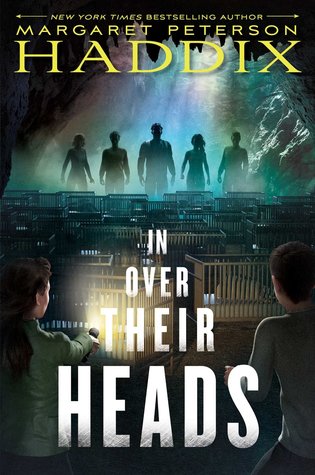
In Over Their Heads
In Over Their Heads. (Under Their Skin #2) Margaret Peterson Haddix. 2017. Simon & Schuster. 320 pages. [Source: Library]
First sentence: The warning alarm woke Lida Mae from the deepest of sleep.
Premise/plot: In Over Their Heads is the sequel to Margaret Peterson Haddix' Under Their Skin. Both books are science fiction for the middle grade audience. In the first book, readers met Nick and Eryn, our hero and heroine who made a shocking discovery about the world they live in. In the second book, the adventure continues. Instead of being told solely from Nick and Eryn's perspective, however, the narrative expands to include more points of view: Ava, Jackson, and Lida Mae. As to the action in this one, I can't reveal that without spoiling the first book!
My thoughts: I liked the whole story as contained in both books. Both books read like one good episode of The Twilight Zone. I think young readers who enjoy eery science fiction will enjoy this two-book series. Fans of these novels who haven't watched The Twilight Zone should definitely seek out some episodes!
© 2017 Becky Laney of Becky's Book Reviews
First sentence: The warning alarm woke Lida Mae from the deepest of sleep.
Premise/plot: In Over Their Heads is the sequel to Margaret Peterson Haddix' Under Their Skin. Both books are science fiction for the middle grade audience. In the first book, readers met Nick and Eryn, our hero and heroine who made a shocking discovery about the world they live in. In the second book, the adventure continues. Instead of being told solely from Nick and Eryn's perspective, however, the narrative expands to include more points of view: Ava, Jackson, and Lida Mae. As to the action in this one, I can't reveal that without spoiling the first book!
My thoughts: I liked the whole story as contained in both books. Both books read like one good episode of The Twilight Zone. I think young readers who enjoy eery science fiction will enjoy this two-book series. Fans of these novels who haven't watched The Twilight Zone should definitely seek out some episodes!
© 2017 Becky Laney of Becky's Book Reviews
Subscribe to:
Posts (Atom)