Showing posts with label picture book. Show all posts

Thursday, June 04, 2026

41. Song After Song: The Musical Life of Julie Andrews


41. Song After Song: The Musical Life of Julie Andrews. Julie Hedlund. Illustrated by Ilaria Urbinati. 2023. 40 pages. [Source: Library] [4 stars, picture book, biography, music appreciation]

First sentence: Julia Elizabeth Wells was born into a melody--her childhood attuned to the timbre of her tiny English village where she heard music in the rhythm of the river, in the whistle of the wind, in the symphony of songbirds.

Premise/plot: Julie Hedlund has written a picture book biography of Julie Andrews. It focuses mainly on her childhood and her early start in music, in show business. It is only the last few pages that explores her life's work.

My thoughts: I have grown up loving Julie Andrews. Not just her work in the musicals I watched again and again and again and again, but also her work as an author. MANDY which she published under the name Julie Edwards is one of my all time favorite, favorite, favorite, favorite, favorite books.

This picture book is bittersweet in many ways. On the one hand, Julie discovers a great love of music. But on the other hand, there is a lot of sadness and confusion in her home life. It was sad that she was torn away from her father. That her mother forced her to call her stepdad, dad. That her mom forced a change of last name upon her. Music allowed her to express herself, but, still, my heart is sad for her childhood.


© 2026 Becky Laney of Becky's Book Reviews

Thursday, April 02, 2026

30. The Littlest Elephant


30. The Littlest Elephant. Katherine Applegate. 2026. 36 pages. [Source: Library] [3 stars, picture book, animal fantasy]

First sentence: Nobody ever listens to the littlest elephant. And around here, the littlest elephant is me. When you're the littlest elephant, they call you things like "Buttercup" and "Ru-Ru" and "Twizzletrunk." Even though your name is Ruby.

Premise/plot: Ruby is the littlest elephant. But she's growing, growing, growing. Her new tusks are a sign of her growing up. Ruby is conflicted. She doesn't know if she wants to do the growing up. What if she wants to stay the littlest elephant. The book is about a celebration of her growing her. And Ruby doesn't want to do the remembering bit that is encouraged by the older, wiser elephants.

My thoughts: I liked this one well enough. I love the middle grade novels in this series. I do. I don't love the picture books as much. Well, that's not quite true. With this one, the audience is definitely older readers. Dare I say it's best for adult readers? That it is more a book for adults to appreciate? It is text heavy. I can't see the story appealing unless you've already read the middle grade novel(s). The themes are mature--not because of content but because they are deeper in a philosophical, reflective way. I liked it.


© 2026 Becky Laney of Becky's Book Reviews

Wednesday, February 18, 2026

21. Bittersweet


21. Bittersweet: Based on the True Tale of the Berlin Candy Bombers. Christy Mandin. 2025. 40 pages. [Source: Library] [4 stars, nonfiction picture book, history, world war II aftermath]

First sentence: A bitter war was over. But for Hilda, the war didn't end when the bombs stopped falling. The war raged on in her belly, a rumbling hunger that never seemed to go away. Her too-tight shoes pinched her toes. Rubble piled up where buildings once stood. Neighbors waited in long lines for little bits of food. Hilda's country was broken into chunks like a wheel of old cheese, each part controlled by a different military.

Premise/plot: This picture book tells of the Berlin Candy Bombers and how one man's act of kindness started it all. It is set in Berlin after the Second World War. While it uses Hilda as a main character, the story is true, or true enough. I believe it is classified as narrative nonfiction.

My thoughts: What a great story! I'd read a little about the Berlin Candy Bombers but not in such a kid-friendly format. I thought it was a great story. Nonfiction that reads as easily as fiction. I would definitely recommend this one for elementary ages.


© 2026 Becky Laney of Becky's Book Reviews

Tuesday, September 16, 2025

102. Hansel and Gretel


102. Hansel and Gretel. Stephen King. Illustrated by Maurice Sendak. 2025. 48 pages. [Source: Library] [picture book, 4 stars]

First sentence: Once upon a time, long before your grandmother's grandmother was born, a poor broom maker and his wife lived on the edge of a great dark forest with his two children, Hansel and Gretel. The broom maker was an easygoing man; his wife, the children's stepmother, was a shrew who liked to have her way and mostly got it.

Premise/plot: The illustrations are by Maurice Sendak. The narrative text is by Stephen King. The story, obviously, is Hansel and Gretel. This "picture" book features plenty of illustrations, but, it is extremely text-heavy.

My thoughts: I have not read the variations of Hansel and Gretel. I know that Grimm's Fairy Tales have gone through several printings and there are some variations perhaps. I could not begin to tell you how Stephen King's retelling differs from the original. I'm not even going to try to judge that. I could not tell you if this one is "lighter" or "darker" than the original. I just don't know. I can tell you that I enjoyed Maurice Sendak's illustrations. And the narrative text was pleasant enough. I wasn't wowed by the retelling. Then again, I'm not sure that Hansel and Gretel has ever been my favorite fairy tale.


© 2025 Becky Laney of Becky's Book Reviews

Monday, February 24, 2025

20. The House on the Canal


20. The House on the Canal. Thomas Harding. Illustrated by Britta Teckentrup. 2025. 56 pages. [Source: Library] [picture book, picture book for older readers, 4 stars, nonfiction]

First sentence: In the middle of Amsterdam, next to a canal, stands a tall, narrow house. It was built almost four hundred years ago and has served as a home, a warehouse, a stable, and a hiding place. 

Premise/plot: The House on the Canal is a picture book for older readers. It is nonfiction picture book that is more abstract in nature which makes it perhaps more fitting for older readers. It is the history of a house--a specific place throughout the centuries. The book roughly spans five and a half centuries. [Though don't trust my math!] It is the place--which in the opening spreads is not even a physical building yet--that is front and center. It all leads up to the time when the house was a hiding place for Anne Frank and her family. The house was rich in history before it became a warehouse and hiding place. This book sheds light on the some of the more permanent things in life.

My thoughts: This book gives the "Here" treatment to the Anne Frank house. Though I wouldn't be surprised if the book was in the works long before the feature film, Here, was released. The text has an almost poetic--definitely artistic--vibe. The illustrations are quite artistic as well. Definitely detailed enough to give study for those interested in art or history.


© 2025 Becky Laney of Becky's Book Reviews

Tuesday, February 06, 2024

18. Fighting With Love


Fighting With Love: The Legacy of John Lewis. Lesa Cline-Ransome. Illustrated by James E. Ransome. 2024. [January] 48 pages. [Source: Library] [nonfiction picture book; picture book biography; civil rights movement]

First sentence: Before John Robert Lewis was old enough to read the word "love" in his Bible, he could feel it all around him. 

Premise/plot: Fighting with Love is a nonfiction picture book biography of civil rights activist [and politician], John Lewis. 

My thoughts: There are a handful of picture book biographies of John Lewis. In fact, I think there are biographies of John Lewis for just about every age reader--children, middle grade, young adult, adult. I have read a few of these in the past. I wasn't expecting to learn something new. [Be reminded of previous facts, yes, yes, always yes. My memory doesn't hold onto all the details from every book.] What struck me with this picture book is the spread about how the activists [college students mainly] PRACTICED nonviolent protests. 

Quote: They took turns playing the part of the angry whites they would face, and acted out standing silently while being shouted and cursed at. They practiced how to curl in tight on the ground to protect themselves from kicks and punches that would beat down on them. They remembered to look into the eyes of their attackers, reminding them that a child of God was looking back. After hearing the words and feeling the fists, some never finished their training at Highlander, leaving as fast as they'd come, asking what kind of love means you've got to be beaten up outside and in. But John knew. "It is love that accepts and embraces the hateful and the hurtful." And so, John stayed and practiced some more.

The illustrations are quite engaging--bright, bold, colorful. 


© 2024 Becky Laney of Becky's Book Reviews

Thursday, January 25, 2024

11. Big


Big. Vashti Harrison. 2023. 60 pages. [Source: Library] [picture book]

First sentence: Once there was a girl with a big laugh and a big heart and very big dreams. 

Premise/plot: Big is a picture book about self-love and body-positivity. It is a book that embraces all the wonderful things that BIG can be. It examines the confusing, blurry, contradictory messages humans believe [and at times convey]. Is big good? Is big bad? Why is it great to be big when you're a baby/toddler but not as a second grader? (To get into specifics of this particular picture book.) The star of this one is a second grader who loves dancing ballet, but, who increasingly feels belittled and invisible as others--kids and adults--make a big deal out of her "bigness." She is hurt by words and actions.The book chronicles her journey to feeling beautiful AND being big.

My thoughts: I mostly loved this one. The illustrations are amazing--beyond amazing. I am not at all surprised this one won the Caldecott MEDAL [which is for illustrations.] It also earned a Coretta Scott King HONOR in illustrations and for author. Both text and illustrations are wonderful.

This book makes a statement. A statement without shame. Big. Is. Beautiful. End. Of. Story.

I said mostly, I meant mostly. I am ALL for body-positivity. I would not want any person to feel ashamed or embarrassed because of their size. I would not want any one to be made to feel "less than" or "not good enough" or "unworthy."At the same time, I am not prepared to throw health and nutrition away [completely] for some warm and cozy feelings. There are a million and one reasons why a person--of any age--might be "big." There is not a one-size-fits-all cure. For example, IF a person is eating because they are eating their feelings. If they are eating because of anger, rebellion, fear, loneliness, anxiety, boredom, whatever possible emotion, wouldn't it be better to get better coping skills--and other supports in place--than to just continue eating. Isn't it better to catch it early than to live with it for decades? NOT because a person is unworthy if big, but because there are better ways to deal with life's hardships and difficulties than turning to food. Again, there are a million and one reasons why a person might be big. You can't look at a "big" person and say this is why and judge them for it. I am not advocating for judgment or criticism. But the book specifically says that anyone who offers help or support is just as harmful and dangerous as those who are bullies. Big is beautiful. Bigger is beautiful. Biggest is beautiful. To infinity and beyond, keep celebrating being big. Again, I hate, hate, hate, hate, hate, HATE diet culture. I am not advocating "cookie cutter" ideals for what is beautiful. I think cultural beauty standards can be super problematic.


© 2024 Becky Laney of Becky's Book Reviews

10. There Was a Party for Langston


There Was a Party for Langston. Jason Reynolds. Illustrated by Jerome Pumphrey and Jarrett Pumphrey. 2023. 56 pages. [Source: Library] [picture book]

First sentence: There was a party for Langston at the library. A jam in Harlem to celebrate the word-making man--Langston, the king of letters whose ABC's became drums, bumping jumping thumping like a heart the size of the whole wide world.

Premise/plot: This party for Langston Hughes was held in February 1991. The author, Jason Reynolds, was inspired to write about this party after seeing a photograph of two authors dancing--Maya Angelou and Amiri Baraka. The book celebrates Langston Hughes AND his continuing legacy. There are word-makers and word-breakers. Word-breakers being those who would ban books and limit freedom. 

My thoughts: This picture book earned a Caldecott Honor and a Coretta Scott King Illustrator Honor. 

I loved the text of this one--very rhythmic. Definitely fitting, I think, to celebrating a poet. 

I loved the illustrations--very vibrant, joyful, jumping off the page. 


© 2024 Becky Laney of Becky's Book Reviews

Thursday, October 06, 2022

121. So Much More to Helen!


So Much More to Helen! Meeg Pincus. Illustrated by Caroline Bonne-Muller. 2022. [April] 32 pages. [Source: Library]

First sentence: Asked of Helen Keller's glory,
most folks talk of this one story:
DeafBlind girl--no one could reach her.
First word "water," thanks to teacher.
It's (mostly) true and worth retellin'--
Yet there's so much more to Helen!

Premise/plot: Picture book biography of Helen Keller. Each spread celebrates a side to Helen Keller that you may not be familiar with. 

My thoughts: I really loved, loved, loved this one!!! So beautiful. I loved the text and the illustrations. I loved the message as well.


© 2022 Becky Laney of Becky's Book Reviews

Monday, November 22, 2021

142. The Nutcracker Comes To America


The Nutcracker Comes To America: How Three Ballet-Loving Brothers Created a Holiday Tradition. Chris Barton. Illustrated by Cathy Gendron. 2015. Millbrook Press. 36 pages. [Source: Library]

First sentence: When you think of the Nutcracker, you probably think of this. And this. And maybe even this. You probably don't think of this. One hundred years ago, hardly anyone in the United States had ever heard of this old Russian ballet. So how did it become a holiday tradition? Well, our story kicks off in a small Utah town in the early 1900s and it's three brothers doing the kicking.

Premise/plot: The Nutcracker Comes To America is a nonfiction picture book. It is almost a picture book biography--almost. It is the story of the Nutcracker ballet, and it's a story that focuses on three dancing brothers--William (Willam), Harold, and Lew Christensen. Not all three brothers were born loving to dance even though it was the family business, but, they all learned to love dancing and excelled at it. In fact, two of the brothers left their hometown and sought to become professional dancers, first doing Vaudeville and then later New York. The book focuses not just on dancing, but on the lives of the brothers, on their careers, their contributions to the dance world. Notably, their contribution was in popularizing THE NUTCRACKER ballet into a holiday tradition or sensation.

In 1934, one of the brother's has his ballet students perform a few selections from The Nutcracker. Ten years later, 1944, sees the FIRST full-length American production of The Nutcracker. (Note: Fantasia, a Disney film released in 1940, had used several songs from the Nutcracker. So perhaps a few people would have first heard these songs from watching that movie.) This first production is in San Francisco where two of the brothers, I believe, are working. Two more productions follow: one in 1949 and one in 1951. Many different productions began to follow in the 1950s, including, notably, Balanchine's New York City production in 1954. Also of note, to me at least, is that there was a live television broadcast of THE NUTCRACKER in 1957.

It includes plenty of details on the Christensen brothers, on ballet, and specifically on The Nutcracker. The story is worth sharing. This picture book is a great example of why nonfiction picture books can be SO GOOD AND SATISFYING.

I loved The Nutcracker Comes to America. I did. True, I don't think it comes as a big, big surprise to anyone who knows how much I love, love, love The Nutcracker. But still, I loved it.  I loved, loved, loved the illustrations by Cathy Gendron. They were just-right and complemented the text perfectly. I loved the end papers too! I loved everything about this one!!! 

ETA: I first read this one in November 2015. I reread it November 2021. I found it just as fascinating the second time through. I probably should check this one out from the library to read every year.

© 2021 Becky Laney of Becky's Book Reviews

Tuesday, October 27, 2020

129. Grace Banker and Her Hello Girls


Grace Banker and Her Hello Girls Answer the Call. Claudia Friddell. Illustrated by Elizabeth Baddeley. 2021. [February] 40 pages. [Source: Review copy]

First sentence: Grace Banker opened the newspaper on a brisk December morning in 1917--the world was at war, and General John J. Pershing, the commander of US troops across the Atlantic, was calling for female telephone operators to join the fight against Germany. 

Premise/plot: This nonfiction picture book biography stars Grace Banker one of the female telephone operators recruited to serve overseas in France during World War I at great risk to her own life. (She became the Chief Operator of the 1st Unit of World War I telephone operators.)

My thoughts: I really enjoyed this one! I had not heard of Grace Banker or the 'Hello Girls.' (Earlier this year or maybe late last year I came across a sentence or two in another book mentioning telephone operators during the first world war, but I had no idea really about what these women experienced.) I found the story fascinating. It is a well written narrative--well researched too. I loved all that back material which provided more context for understanding their place in history.


© 2020 Becky Laney of Becky's Book Reviews

Monday, May 06, 2019

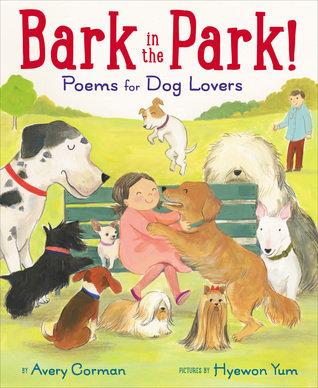
Bark in the Park

Bark in the Park! Poems for Dog Lovers. Avery Corman. Illustrated by Hyewon Yum. 2019. 48 pages. [Source: Review copy]

First sentence:
Afghan Hound
Although he's noble and aloof,
He's still a dog, so he still says, "Woof!"

Basset Hound
For things she can smell,
She's a comer and goer.
She's much like a Beagle,
But longer and lower.

Beagle
The beagle is bent
On tracking a scent.
He follows his nose
wherever it goes.
 Premise/plot: A collection of poems about dogs/dog breeds. Each poem is short. Some poems are just two lines; other poems are all of four lines. All rhyme--for better or worse.

My thoughts: I like the idea of liking this one. I do. But sometimes I wish authors knew that poems don't always, always, always have to rhyme in order to be poetry. Sometimes poems come across as forced. You can always tell when a poem chooses a word just because--only because--it "rhymes."

That being said, there were definitely quite a few poems in this one that I really enjoyed.

© 2019 Becky Laney of Becky's Book Reviews

Wednesday, August 23, 2017

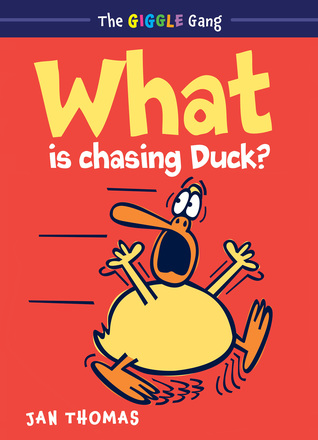
What is Chasing Duck?

What Is Chasing Duck? Jan Thomas. 2017. HMH. 48 pages. [Source: Review copy]

First sentence: Quack! What is chasing Duck? Quack! You say it's something wild and hairy? Wild and Hairy! Oh dear! Let's get out of here!

Premise/plot: Something is chasing Duck?! Who is chasing him? And why is he being chased in the first place? Duck and friends overreact a little bit, you might say. But that might be expected. This gang has overreacted in the past. Now that they star in an early readers series, should things be all that different?

My thoughts: I really love, love, love Jan Thomas. I love her characters, for the most part. And you can always count on her books for a smile or two. They are also super-super fun to read aloud. Because you can be very expressive while reading her stories.
© 2017 Becky Laney of Becky's Book Reviews

Tuesday, October 25, 2016

I Am A Story

I Am A Story. Dan Yaccarino. 2016. HarperCollins. 40 pages. [Source: Library]

First sentence: I am a story. I was told around a campfire, then painted on cave walls. I was carved onto clay tablets and told in pictures. I was written on papyrus and printed with ink and woodblocks, then woven into tapestries and copied into big books to illuminate minds.

Premise/plot: The story's autobiography. The concept of 'story' is personified and communicated in very simple, basic terms that readers of all ages can appreciate.

My thoughts: LOVED it. Loved, loved, loved, LOVED it. It's so simple yet so brilliant. Would recommend to anyone and everyone who loves stories and storytelling. It's not just for people who love books and libraries, but, for anyone who celebrates storytelling and communities.

Text: 5 out of 5
Illustrations: 4 out of 5
Total; 9 out of 10

© 2016 Becky Laney of Becky's Book Reviews

Tuesday, October 18, 2016

Peppa Pig and the Little Train

Peppa Pig and the Little Train. 2016. Candlewick. 32 pages. [Source: Review copy]

First sentence: Peppa and George are visiting Granny and Grandpa Pig. Bang! Crash! Bang! Bang! "What's that noise?" asks Peppa. "Grandpa Pig is building a surprise for you," says Granny Pig.

Premise/plot: The book is an adaptation of a television episode of Peppa Pig. In this book, Peppa and George are surprised with Gertrude, a miniature locomotive made by their Grandpa. Soon, all their friends are riding Gertrude as well. One of the refrains of the book is that Gertrude is NOT a toy.

My thoughts: I LOVE this episode very much. But the book adaptation leaves a little to be desired. Not only has it been Americanized, but the lyrics to GRANDPA'S LITTTLE TRAIN SONG has been changed for no reason whatsoever. In the TV episode, Grandpa's little train goes CHOO, CHOO, CHOO. In the book, it goes CHUG, CHUG, CHUG. I don't expect the book to include the full song--it has multiple verses after all. But to not get the chorus right is just annoying. Any parent and child who KNOW the show, are going to KNOW the words to the "real song" and want to know WHY the book gets it wrong.

Text: 3 out of 5
Illustrations: 3 out of 5
Total: 6 out of 10

© 2016 Becky Laney of Becky's Book Reviews

Monday, October 17, 2016

Trains

Trains: A Pop-Up Railroad. Robert Crowther. 2016. Candlewick Press. 10 pages. [Source: Review copy]

First sentence: Locomotives. The first trains were just linked mining wagons pulled by human or horse power, used to carry coal and mineral ores back in sixteenth century Europe. The invention of the first powered locomotive in the early nineteenth century revolutionized the way a train moved.

Premise/plot: This is POP-UP book celebrating trains. It is an interactive book. Trains don't just pop-up on a few pages. There are flaps to lift and tabs to pull as well. Above all else, this one is packed with very detailed information.

Did You Know?
  • That Richard Trevithick built the first working steam locomotive in 1804.
  • That British trains began carrying passengers in 1829 and American trains began carrying passengers in 1830.
  • That Dr. Rudolf Diesel built the first diesel engine in 1897. 
  • That George Pullman introduced the first luxury sleeping cars in 1865.
  • That the fastest steam locomotive is/was the Mallard. It set the record in 1938 with 126 mph. The record has never been broken...by another steam train.
  • That the fastest train these days is the Japanese train, Maglev. It can go up to 374 mph!
My thoughts: I liked this one. I'm not a huge train enthusiast. But I know many people--of all ages--are. I think this one is a good and fun resource to have. It isn't so much a narrative to read aloud--there isn't a proper story. But it is a resource: plenty of definitions, explanations, illustrations, and such.


© 2016 Becky Laney of Becky's Book Reviews

Saturday, October 15, 2016

What's An Apple?

What's An Apple? Marilyn Singer. Illustrated by Greg Pizzoli. 2016. Abrams. 24 pages. [Source: Review copy]

First sentence: What's an Apple? You can pick it. You can kick it. You can throw away the core. You can toss it. You can sauce it. You can roll it on the floor. You can wash it, try to squash it, or pretend that it's a ball. You can drink it. You can sink it. Give your teacher one this fall!

Premise/plot: Marilyn Singer has crafted a poem answering the question, "What's An Apple?" The text is simple and rhythmic. Plenty of rhymes to be found. It reads pretty effortlessly.

My thoughts: I do like this one more than What's A Banana? Perhaps in part because I LOVE apples and don't really like bananas. But also because I think some of the rhymes are just better in this one. I really like the 'You can smell it, caramel it' line. The books do complement one another.

Text: 4 out of 5
Illustrations: 3 out of 5
Total: 7 out of 10

© 2016 Becky Laney of Becky's Book Reviews

Friday, October 14, 2016

What's A Banana?

What's A Banana? Marilyn Singer. Illustrated by Greg Pizzoli. 2016. Abrams. 24 pages. [Source: Review copy]

First sentence: What's a banana? You can grip it and unzip it. Smash and mash it with a spoon. You can trace it. Outer-space it--make believe that it's the moon.

Premise/plot: The whole book is a poem answering the question 'What's a Banana?'

My thoughts: Marilyn Singer writes poetry for children. Usually her books are collections of her poems. Not one poem stretched to cover an entire book. I have really enjoyed her work in the past, so I wanted to really like this one. I didn't quite. It was okay for me. I don't want my three minutes back or anything. I just wasn't wowed.

Text: 3 out of 5
Illustrations: 3 out of 5
Total: 6 out of 10

© 2016 Becky Laney of Becky's Book Reviews

Tuesday, October 11, 2016

Mustache Baby Meets His Match

Mustache Baby Meets His Match. Bridget Heos. 2015. 40 pages. [Source: Library]

First sentence: Baby Billy was born with a mustache.

Premise/plot: This is the sequel to Mustache Baby. In this second book, Baby Billy is mostly at odds with Baby Javier, a bearded baby. The problem? Baby Javier and Baby Billy both want to be THE BOSS and tell the other what to do. Also both babies want to be THE BEST. Can these two learn to be friends and get along?

My thoughts: I liked this one. I did. I don't know that I LOVED, LOVED, LOVED it like I did the first book. But I liked it. The illustrations make this a clever read. It's the little details--often in the illustrations--that bring a smile. For example, when the two compete at running for President.

Text: 4 out of 5
Illustrations: 5 out of 5
Total: 9 out of 10

© 2016 Becky Laney of Becky's Book Reviews

Wednesday, August 31, 2016

Amigo

Amigo. Byrd Baylor. Illustrated by Garth Williams. 1963. 48 pages. [Source: Bought]

First sentence: His mother said, "Come Francisco, my son. Tell me why your eyes are sad, my little one."

Premise/plot: Amigo is written in verse. It is historical fiction--about a boy longing for a dog. His family can't afford an actual dog, but, his parents encourage him to tame something wild, something that can take care of itself, something like a prairie dog. So Francisco sets out to tame a prairie dog, and, he knows just what he'll call it: Amigo. That's half the story. Amigo is a prairie dog that is curious and longs for adventures. He's drawn to humans, and he longs to tame a boy. Amigo picks out just the boy to tame, and, surprise, surprise, it's Francisco. Readers in on both sides of the stories can predict where this one is heading. It's cute.

My thoughts: I'll be honest: I bought it for the art. The illustrations are by Garth Williams. I thought if the text was nice, it would be an extra bonus. But really, I was just happy to see more of Garth Williams' work. I did enjoy the text. Do I think it's the most wonderful, amazing story ever? Probably not. I would have enjoyed more prose and less verse. But it's not awful.


© 2016 Becky Laney of Becky's Book Reviews