Showing posts with label 2019 Cybils Eligible. Show all posts

Tuesday, September 24, 2019

The Mostly True Story of Pudding Tat

The Mostly True Story of Pudding Tat Adventuring Cat. Caroline Adderson. Illustrated by Stacy Innerst. 2019. 128 pages. [Source: Library]

First sentence: This is the mostly true story of Pudding Tat, much-traveled cat, whose adventuring life began in the first year of a new and promising century. Not ours, but one long ago.

Premise/plot: Pudding Tat is the (cat) hero of this middle grade animal fantasy. He was born in 1901 in Ontario, Canada; he’s not like the other kittens born to Mother Tat—he’s an albino. His mother worries about him because he’s mostly blind. How can he hunt mice?! How can he avoid foxes?! How he can he stay out of the way of humans?! But Pudding Tat is a cat seemingly destined for adventures—big ones that will take him across borders and seas. This novel is told in episodic adventures spanning 1901-1915. Pudding is host to one flea—could this flea be unlike his 499 brothers and sisters?! These two communicate in an unusual way.

My thoughts: There was something satisfying and enjoyable about this one. I enjoyed the characters and stories. There are many humans that go in and out of Pudding’s life. The author admits—though most readers could probably guess on their own—that this mostly true story is pure fiction with some true events occurring in the background. (For example, the sinking of the Titanic.)

I loved the full circle-ness of this one!!!

© 2019 Becky Laney of Becky's Book Reviews

Wednesday, August 28, 2019

World at War: A Place to Belong

A Place to Belong. Cynthia Kadohata. Illustrated by Julia Kuo. 2019. 416 pages. [Source: Library]

First sentence: This was the secret thing Hanako felt about old people: she really didn’t understand them.

Premise/plot: Hanako and her brother Akira are traveling to Japan with their parents. It will be the first time they meet their grandparents. There will be many, many firsts both on the journey by ship, the train ride to Hiroshima, and life in a small country village. The year is 1946; Hanako’s family is one of hundreds that have renounced their American citizenship. (The parents have—not the children, at least in this case.) Hanako thought any life outside the camps (internment camps) would be an improvement. One thing the family has in abundance love and affection. There is a sweet, tender, compassionate side to all the relationships. The two children love, love, love their grandfather and grandmother. It is mutual. These two grandparents have been unconditionally loving them since they were born. But there are many, many hardships—namely lack of food. There isn’t enough food to feed six people. Even if everyone works every day all day. Hunger is ever present and it gnaws at the family’s hope. It is important for them all that the children hold onto hope. Is there a future for them all in Japan? Is Japan the place the family belongs? Or is America still home despite the way they were treated?

My thoughts: What a tender and compelling read! Hanako touched me and I believe she’ll touch you too. What I loved most about her was her heart. She is kind, generous, thoughtful, sensitive to others. She is the model of empathy. And not in a goody two shoes way. She sees how the war—particularly the dropping of the atomic bomb has devastated a community and impacted so many. She sees the pain and seeks to do something—anything, even if it’s just a small gesture.

I also loved the family as a whole. Unconditional love, sacrificial love, selfless love. There was just something lovely and tender yet bittersweet as well. I just wanted to hug all the characters.

The book is character-driven. It told a story that I was unfamiliar with and found fascinating. I had no idea that some families chose to leave America and “return” to Japan after the war. I had no idea that many later hired a lawyer to fight on their behalf to have their citizenships reinstated. Did the families truly choose or were they pressured to renounce? The book also gives readers a behind the scenes glimpse at life in Japan in the immediate aftermath of the war.

Highly recommended.
© 2019 Becky Laney of Becky's Book Reviews

Friday, August 23, 2019

Eventown

Eventown. Corey Ann Haydu. 2019. 328 pages. [Source: Library]

First sentence: Jenny Horowitz likes horses and the color pink and asking lots of questions about things I don’t want to talk about.

Premise/plot: Elodee, our heroine, is a twin; her sister is Naomi. Both are in the fifth grade. Both are struggling with their emotions and feelings. Both are trying to support the other. The Lively family as a whole is struggling actually. The parents decide that what is best for them all is a move, a move to the oh-so-perfect town of Eventown. Every one is always happy, friendly, comfortable in Eventown. They live in identical houses, have similar yards, have similar interests and traditions. There is a right way to do community.

Elodee has trouble truly fitting in. Naomi blossoms and shines in this even environment. But Elodee, well, she has questions—dozens of them. Why is there only one song sung in Eventown?! Why is the no television, no internet, no music, no movies?! Why are all the books in the library beautifully bound but blank?!

The school also seems to have its own priorities in the curriculum. Readers can clearly discern that something is afoot. What makes Eventown unique? Why would anyone choose to move there?

My thoughts: I found this to be a compelling, suspenseful read. Suspenseful in a Twilight Zone way. A not-so-subtle creepiness that closes in around you as you turn the pages. At one point, for example, vines surround their house blocking out the light and making it difficult to open the door.

I really enjoyed the characters and relationships. I loved Elodee’s friendship with Veena and her Mom. I also liked her relationship with her dad.

This one reminded me of Lois Lowry’s The Giver. (Also of Orson Scott Card's under-appreciated Worthing Saga). I would not be disappointed if it won an award or two.

I used to think feelings were part of a person, but lately I’ve been thinking they are separate beings, that they come like aliens and invade people’s bodies and cause destruction.


S
P
O
I
L
E
R

This one hints of darkness. The family has a reason—right or wrong—for wanting a new start or beginning. But this beginning comes at a huge price. Do we truly want to forget completely everything that has hurt and challenged us?


© 2019 Becky Laney of Becky's Book Reviews

Wednesday, August 21, 2019

World at War: The Brave Princess and Me

The Brave Princess and Me. Kathy Kacer. Illustrated by Juliana Kolesova. 2019. 32 pages. [Source: Review copy]

First sentence: There once was a princess who lived in Greece. Her full name was Victoria Alice Elizabeth Julia Marie, but she was called Princess Alice. When she was very young her family discovered that she was deaf.

Premise/plot: Rachel Cohen and her daughter, Tilde, are desperate for help and they find it in the kind and gracious acts of a princess. This illustrated book for young readers is set in Greece during the Second World War. The story is inspired by true events. The princess that stars in this one is the mother of Prince Philip who is married to Queen Elizabeth II.

My thoughts: I loved, loved, loved the illustrations of this one. They are simply beautiful. I also love that it is inspired by true people and events. I have read very little about the Second World War that was set in Greece. I loved how Princess Alice fooled the Nazis by playing dumb. It never occurred to them apparently that a deaf person could be intelligent, informed, opinionated, political.

The story is written in the first person. It is short but packed with emotion.


© 2019 Becky Laney of Becky's Book Reviews

Monday, August 19, 2019

A Time Traveler's Theory of Relativity

A Time  Traveler's Theory of Relativity. Nicole Valentine. 2019. 352 pages. [Source: Review copy]

First sentence from the prologue: We lie to ourselves when necessary. Some of us are more convincing than others. My family has always been particularly good at it.

First sentence from chapter one: Finnegan Firth slid out of his bedroom window and padded on bare feet across the cold slate patio.

Premise/plot: Finn, our hero, believes that science holds the answers to everything. But he's forced to question and re-question everything he believes to be true after his grandmother's death. For the night she died, she revealed a huge family secret. The women in their family are travelers. Most have only ever been able to travel to the PAST. But in recent generations--notably his mother and grandmother--they have been able to travel to the future. (In fact the Grandma revealing the HUGE secret is not the Grandma from his time line. That Grandma is lying dead in bed as they speak.) She wants him to try to time travel via a portal that his mom created in order to help save his family from their current crisis. But does Finn have enough faith? Perhaps even enough faith to save FAITH? Who is Faith? Faith is his twin sister who disappeared--believed drowned--when they were three. Her body was never found. What would a great, noble, oh-so-dangerous quest be without a best friend? Finn's best friend is Gabi.

My thoughts: I loved, loved, LOVED, LOVED, LOVED this one. It was super-compelling and packed with action and intrigue. You should know that I tend to LOVE time travel stories. I do. I always have. I think my first exposure to time travel came via Star Trek and Star Trek the Next Generation. I have never really stopped being intrigued and fascinated by the concept of traveling to the past or the future.

I enjoyed the dual narrators. The second narrator--the one of the prologue--is super-spooky. Her voice is a haunting one. I wouldn't say it kept me reading--Finn's voice alone probably would have achieved the same thing--but it added a certain darkness or richness to the text overall.

“I don’t want to hear any ancient stories, Gran. I want to hear about now.” She studied him for a moment, her eyes narrowed. “Everything is now, dear boy. And make no mistake, things that happened before you were born have everything to do with who you are and what you do. So much of our lives are built on what happened before we even arrived. The past is never dead. It’s not even past. Faulkner said that.”


© 2019 Becky Laney of Becky's Book Reviews

Thursday, July 25, 2019

Lafayette! (Nathan Hale's Hazardous Tales)

Nathan Hale's Hazardous Tales #8 Lafayette! Nathan Hale. 2018. [October 16] Harry N. Abrams. 128 pages. [Source: Library]

First sentence: This title page would be better with sound effects. Whang! Klang! Shing! Slice! Stab!

Premise/plot: Nathan Hale is still prolonging his life by telling stories to his two executioners. The story he is sharing with them today is of Major General Lafayette, a Frenchman who came to help Americans fight for their independence from Britain, a good friend to many of our founding fathers including George Washington, Alexander Hamilton, Benjamin Franklin, etc. It is set in France, America, and Canada. Nathan Hale's STORY of Lafayette ends with the American Revolution. This book does NOT in any way cover Lafayette's involvement in the French Revolution. What it does cover are many, many battles in the American Revolution.

My thoughts: I really have loved this graphic novel series. Nathan Hale doesn't just tell stories about the American Revolution, though in this case he does. He also tells entertaining, adventure stories from many different wars, conflicts, and battles. OR even episodes in history like the DONNER PARTY, the underground railroad, or the exploration of the Grand Canyon. The series could go on for quite a while since Nathan Hale is in no rush to get to his own execution.

I will say that the size of the font seems to have shrunk since the last time I read and reviewed one of the series. Surely it's not just my eye sight?! Okay. It could be just my eye sight. There were days when I couldn't even read it with squinting. But eventually I did get through all of it! It was a good read though perhaps not as compelling  as some of the other books in the series.

© 2019 Becky Laney of Becky's Book Reviews

Wednesday, July 24, 2019

World at War: Lovely War

Lovely War. Julie Berry. 2019. 480 pages. [Source: Library]

First sentence: It is early evening in the lobby of an elegant Manhattan hotel.

Premise/plot: The novel opens during the second world war. A husband has caught his wife having an affair: an impromptu trial results. That husband? His name is Hephaestus. That wife? Her name is Aphrodite. The lover? Ares. If those names sound at all familiar to you--and they should--then it is because they are gods and goddesses. Aphrodite asks to tell a story of LOVE and WAR. That story is set during the Great War, the first World War.

Hazel Windicott, one of our heroines, is a young and talented pianist. She's playing at a dance when a young soldier--a young, about-to-ship-out-overseas soldier--James Alderidge sees her and falls in love with her. The two only share three days together, but oh what wonderful days. Both feel that this could be LOVE, the once-in-a-lifetime true love. He will be serving in France.

Aubrey Edwards, one of our heroes, is a young and talented ragtime (and jazz) musician. (He does play piano, but he doesn't only play piano.) He's a black man serving overseas in France. (He's a soldier and an entertainer.)

Hazel follows her heart across the channel and volunteers in France with the YMCA as an entertainer. She becomes quite chummy with our other heroine, Collette Fournier, another entertainer--a singer/dancer. Her story is quite tragic. She's the sole survivor of her family; she's a Belgian war orphan/refugee. She has known great love and great loss. Her heart has given all it can, or has it?

Hazel knows that it is against all the rules for her and Collette to socialize with the black soldiers. (Probably with any of the soldiers. It wouldn't be proper. But there is a definite extra stigma of prejudice going on as well.) Likewise it is against the rules for black soldiers like Aubrey to sneak out from camp and visit with women. But these three are drawn together--powerfully connected--by music.

Will Hazel and James get their happy ending? Will Aubrey and Collette? What price will the war demand of their love? And what impact will these stories have on the gods and goddesses?

My thoughts: I LOVED, LOVED, LOVED, LOVED, LOVED this one. It was such an incredibly well-told story. I loved the dual settings. We get flashes of England and France during the Great War, the first world war. Our flashes of the second world war perhaps lack some of the perspective, being that they are all within a hotel room in New York. BUT. I think it still works overall pulling readers far enough away to see the bigger picture. There is no war to end all wars; war will always be; war will always destroy and kill, pull apart. Yet where there is love there is hope and goodness. I don't always love, love, love stories within stories, BUT this one was absolute perfection.

James "Jim" Europe and the 15th New York
I love the mythological touch. This is something that I would have never, ever, ever, ever thought of on my own. Adding Greek goddesses to a compelling war story very much grounded in reality. (The characters are fictional, of course, but James Reese Europe, one of the characters, was very much a real person.)

I love the importance and significance of music (and to some degree other arts). The beauty of music, of love, of life, of friendship provide an important--crucial--contrast against the ugly brutality of war. Both Aubrey and James are changed by seeing action at the front, changed by the training (or lack of training in some cases), that they receive while in France. No one can return home from war unchanged. And yet, and yet life still goes on. Beauty remains though perspective changes.
 
I love that hope resonates. It isn't that Aubrey and Collette and James and Hazel are absolutely guaranteed happily-ever-after endings with neat, perfect little bows and ribbons. It isn't that there's a guarantee against sadness, heartbreak, doubts, fears, disappointments, frustrations. But love HOPES and TRUSTS.

I love the writing, the language. It could be giddy-making in a romantic way. It could be quite funny.
"If I'm not a secret," he said, "what am I?"
"You're a brand-new piece of sheet music," she said slowly, "for a song which, once played, I'd swear I'd always known." (48)
"All I'm saying"--Apollo is still chewing--"is that my little flu virus, in its microscopic, contagious way, was a thing of beauty." He smacks his lips. "Annihilation has its own je ne sais quoi. We're all guilty of it. So spare me the sermons."
"I'm not guilty of it," says Aphrodite. "Destruction has nothing to do with me."
The male gods stare, then explode laughing. Aphrodite turns her back on them all.
"Then there's the poetry," says Apollo. "Another reason to love war. Why in the Great War...Not since the Trojan War has a conflict inspired such verse. Here, let me recite for you--"
"No!" Three divine voices sound together, for once in perfect accord.
Apollo looks genuinely surprised. "You don't want me to?" He plucks a ukulele out of the air. "Well, I'll be darned. Anyway," he says, "there was the music. The Great War lit a musical fire that engulfed the world." (59)
I also loved that it was written in five acts. It added just the right amount of DRAMA and TENSION.

© 2019 Becky Laney of Becky's Book Reviews

Tuesday, July 23, 2019

The Strangers

The Strangers (The Greystone Secrets #1) Margaret Peterson Haddix. Illustrated by Anne Lambelet. 2019. 416 pages. [Source: Library]

First sentence: The three Greystone kids always raced each other home when they got off the school bus, and Finn always won. It wasn't because he was the fastest. Even he knew that his older brother and sister, Chess and Emma, let him win so he could make a grand entrance.

Premise/plot: Kate Greystone is a single mom (a widow) raising three children on her own: Chess, Emma, and Finn. These kids are super-close to their mom. Readers get a small hint of the good times they share together before the mystery rapidly begins unfolding. It starts with the news. Three children in Arizona have been kidnapped. Sad? Sure! Of course, anyone empathetic would say so. But why should it change their lives and turn things topsy-turvy? That's part of the mystery, I suppose. But ultimately the first clue is that the three children share the kids' names, ages, and birthdays. And the kidnapped children also have a mom named KATE who looks IDENTICAL to their own mom. Though there's no indication that the Greystone children are familiar with THE TWILIGHT ZONE, they've certainly entered it, right?!?!

Mrs. Greystone feels led to ACT, to do SOMETHING, which means leaving Chess, Emma, and Finn in the care of Mrs. Morales and her daughter, Natalie. Natalie teams up with the Greystone children to solve the mystery...for their mom's business trip is no ordinary business trip...and Kate Greystone has been keeping a couple of HUGE secrets from her children.

My thoughts: If you enjoy books where middle school age children team up to solve mysteries--puzzles, codes, clues, oh my!--then The Strangers may be a perfect fit for you. It is the first in a new series. (I'm assuming there will be two books, perhaps three.) This one is told in alternating narratives: Emma, Finn, and Chess. Each voice is distinct, which is always a plus where you've got alternating narrators. It's always a disappointment when voices blend together and you're never sure who's who.

I am a BIG, BIG, BIG, BIG fan of Margaret Peterson Haddix. I love her adventure stories. She knows how to tell compelling stories with twists and turns (predictably they will have twists and turns, but the twists and turns themselves aren't always predictable). I love how characterization is never sacrificed in place of ACTION, ADVENTURE, THRILLS. You can have both.

Another bonus, for me, is this one has a cat.

© 2019 Becky Laney of Becky's Book Reviews

Monday, July 22, 2019

We Set the Dark on Fire

We Set the Dark on Fire. Tehlor Kay Mejia. 2019. 384 pages. [Source: Library]

First sentence: In the beginning, there were two brother-gods: the God of Salt and the God of Sun.

Premise/plot: The book is set in the fictional island-world of Medio. In this culture, every man--or at least every man of rank--has two wives.

Dani, our heroine, has spent years training to be a Primera--a first wife. She won't be her husband's only wife, but she will be his equal, his helpmate. She'll manage his household, and keep things running smoothly. When she graduates she'll be fulfilling her parents' dream and making all their sacrifices worth it. But is it what she really wants? Maybe, maybe not. Dani's country is just as unsettled and out of sorts as her heart and mind. Political unrest has been growing and building--mainly concerning the nation's borders and those seeking to cross. Dani's would-be husband is a wealthy politician--the son of a wealthy politician. She'll take her husband's status and shed forever hers--which is for the best, right? But if it's right, why does it feel so wrong?

On the day she marries Mateo Garcia, he marries his Segunda (second wife) as well. Her name is Carmen. The two young women have been training at the same school for years. Segundas have an entirely different role within the family. They are for heart, passion, and childbearing. Dani worries that Carmen--who has sometimes bullied her in the past--will make life difficult for her.

She enters into the marriage uneasy...and her intuition is correct...there will be nothing predictable about it.

My thoughts: The prologue was beautifully written. It made it sound like there would be at least some mythological substance, some spirituality to the world-building. In the first few chapters, Dani alludes to the fact that her gods--the gods of her family--are not those of Medio. But this thread tends to not go anywhere or serve a purpose. Though the prologue makes you think its about gods in conflict with one another--sibling rivalry--the book isn't really.

I was drawn into this one from the prologue and the first chapter or two. Dani, our narrator, has a tough decision to make. Will she continue living a lie just because her parents want her to have a better life? Will she continue living that lie out of self-preservation? Will her secret come out? (The secret is about where she was born--what side of the border she was born on and the sacrifices her parents made to falsify her documents.) How does she feel about the border? about the racism? about the violence? about politics?

Medio. The culture isn't really explored as fully as I had hoped. The more I read, the shallower it felt to me. It just felt undeveloped.

It is definitely action-driven and not character-driven. I felt most of the characters--with the exception of Carmen and Dani--were incredibly flat and insubstantial. The action wasn't particularly satisfying--to me. The book seemed to digress from being a political thriller with SPIES to being about two women who make out a lot.


© 2019 Becky Laney of Becky's Book Reviews

Wednesday, July 17, 2019

World at War: Standing Up Against Hate

Standing Up Against Hate: How Black Women in the Army Helped Change the Course of World War II. Mary Cronk Farrell. 2019. 208 pages. [Source: Review copy]

First sentence: It was a wet, gunmetal-gray February in 1945. Rank upon rank of American khaki-clad soldiers marched down the gangplank of the Ile de France in Glasgow, Scotland.

Premise/plot: Standing Up Against Hate is a children's nonfiction book about African American women serving in the Women's Army Auxiliary Corps and Women's Army Corps. (The name switched from WAAC to WAC towards the end of the war. But it was much more than a name change.) It is the story of one woman--Charity Adams--it is the story of many women. It gives young readers (elementary, middle school) a behind-the-scenes glimpse of what it was like to be an African American WOMAN serving during the second world war. They faced prejudice because they were women; they faced prejudice because they were African American. How you were treated, what your experience was like, varied greatly based on WHERE you served and WHOM you served. (Some people could be JERKS.) Towards the end of the war, one unit (led by Charity Adams) did get to serve overseas. But as I mentioned before, this isn't just the story of one battalion. The book touches on many different experiences, many different voices.

My thoughts: I found this to be a super-compelling, super-fascinating read. I have read many books set during this time period. I've never--to my recollection--read one about the WAC, let alone one that focuses on the African American experience. It was an eye-opener. It was good--really good. My background--in terms of women in the military during this time period--focuses on the WASP which I know excluded black women. I would definitely recommend this one. 

© 2019 Becky Laney of Becky's Book Reviews

Thursday, July 11, 2019

Degas, Painter of Ballerinas

Degas, Painter of Ballerinas. Susan Goldman Rubin. 2019. Harry N. Abrams. 64 pages. [Source: Review copy]

First sentence: As the young girls adjusted their toe shoes and warmed up for class, Edgar Degas studied them.

Premise/plot: This is a nonfiction picture book for older readers and/or art lovers of all ages. This one focuses both on the ART of Edgar Degas (and the subject of his art: dancers) and the LIFE of Edgar Degas. (Roughly eight pages is devoted to his life--the rest is focused on his art.)

Each spread highlights a piece of art. (Sometimes a spread highlights two pieces of artwork.) There is an overall narrative to the text. But each piece of art also has accompanying sidebar packed with details.

I thought the narrative was lovely! It even included a few quotes.
During his long career from 1852 to 1912, Degas created more than a thousand dance pictures. He learned that ballet training was very much like studying art. It took hard work and hours and hours of practice. Degas drew the same poses again and again, just as the dancers repeated their positions at the barre again and again. "One must repeat the same subject ten times, a hundred times," said Degas. "Nothing in art, not even movement, must seem an accident." (2)
Sometimes Degas invented his own costumes for his paintings. In the classroom, the dancers really wore plain white skirts and tops, but he added blue and pink sashes and black throat ribbons. He needed the accents of color. Once when Degas was giving art lessons to a friend's son, he told the young student to paint the whole canvas in tones of a single color, perhaps gray or brown. "You put a little color on it, a touch here, a touch there," said Degas, "and you will see how little it takes to make it come to life." (14)

My thoughts: I enjoyed this one. It isn't a book to be rushed through and read cover to cover. Though if one wanted to get the big picture...one could certainly do that first. But it is best to be enjoyed a little here and there. The art deserved to be appreciated, which takes time and effort. I loved learning about each piece.

I would definitely recommend this one.


© 2019 Becky Laney of Becky's Book Reviews

Thursday, July 04, 2019

Now You Know What You Eat

Now You Know What You Eat. Valorie Fisher. 2019. [October 15] Scholastic. 40 pages. [Source: Review copy]

First sentence: How to read this book:
a + b = c  a combination of a and b equals c
a - b = a without b equals c
a } b a comes from or can be found in B.

Premise/plot: Now You Know What You Eat is a fascinating concept book for young readers. There are plenty of details packed into the illustrations. It does rely mainly on the illustrations and photographs. There is no central narrative text, just text boxes accompanying some of the illustrations. So the premise, what is it? On each page or two page spread, a food is highlighted. For example, vanilla ice cream cone, oatmeal raisin cookie, peanut butter and jelly sandwich, macaroni and cheese, pizza, vegetable soup, potato chip, etc. On the spread (or single page), illustrations/photographs reveal what is in that food and how it is made.

What ingredients make up an ice cream cone? What ingredients make up vanilla ice cream?

Some examples are more detailed than others. One of the more detailed pages is for oatmeal raisin cookies. Readers can learn where individual ingredients come from and then how to make those ingredients into a homemade cookie.

The page on peanut butter and jelly spends a good amount of time explaining the growing process of peanuts.

It has plenty of information including a nutrition guide, a page on vitamins and minerals, and a glossary of words to know.

My thoughts: I enjoyed this one. I love that it uses play food in the photographs. Not every illustration is a photograph, mind you. There isn't "play food" to represent a vanilla orchid, for example! But much of the finished food products are photographs of play food. Even the author (aka "book creator")  includes a photograph of a PLAY DOLL instead of her actual picture.

Kids are curious. And this book feeds on that natural curiosity. I found this one a very fun and satisfying read! It would have been GREAT fun if they'd included a spread on lunchables. (I understand why they wouldn't/couldn't. But still.) Also why was there no page on CHICKEN NUGGETS?!?! Fisher could have easily swapped out DILL PICKLES or VEGETABLE SOUP for a spread on chicken nuggets.


© 2019 Becky Laney of Becky's Book Reviews

Friday, June 28, 2019

The Bridge Home

The Bridge Home. Padma Venkatraman. 2019. 208 pages. [Source: Library]

First sentence: Talking to you was always easy, Rukku. But writing's hard. "Write her a letter," Celina Aunty said, laying a sheet of paper on the desk.

Premise/plot: The Bridge Home is a coming of age children's novel set in India. Viji, our heroine, is writing to her sister, Rukku, recounting the past few months. It's written in second person past tense. (That's a bit unusual, but oddly enough it works for the most part.) Their adventures begin when Viji and Rukku run away from home--their father is abusive, and their mother can't stop him. They have very little, but Viji is confident that she'll be able to find some kind of work in the big city. But will she? Can she find a way to support her little sister?

In the big city, the two are homeless. They become family with two boys--Arul and Muthi.  These four may be homeless and living day to day but they've found something special in each other.

My thoughts: The Bridge Home isn't for the faint of heart. It's a SAD, SAD, SAD book. And not because there's a dog on the cover. It addresses big issues--poverty, hunger, homelessness, etc. It is beautifully written.

I took the orange and turned it around, just as you had. It glowed like a small, pale sun. I felt its weight, its perfect ripeness--not too soft, not too firm. I breathed in its citrus scent. I started to peel it, noticing things I'd never noticed before: how the leathery peel isn't colored the same all the way through, how the papery sections inside feel like leafy veins, how the pulp is shaped like raindrops. When, at last, I placed a section in my mouth, I could hear it burst as my teeth met the flesh, squeezing the juice out onto my tongue, tart at first and then sweet. Everything else melted away except for the taste, the smell, the feel of the fruit on my tongue. I ate the fruit slowly. The way you liked to do things. Until then, I'd thought it was a sad thing that you were sometimes slower than the rest of us. But that day, I realized that slow can be better than fast. Like magic, you could stretch time out when we needed it, so that a moment felt endless. So the taste of half an orange could last and last. (45)

© 2019 Becky Laney of Becky's Book Reviews

Tuesday, June 25, 2019

Elvis is King!

Elvis is King! Jonah Winter. Illustrated by Red Nose Studios. 2019. 40 pages. [Source: Library]

First sentence:
Elvis is born!
But alas, he is born
in a humble shack
on the wrong side of the railroad tracks,
the side where the poorest of the poor live,
down down down in the Deep South--Tupelo, Mississippi.
Premise/plot: This picture book biography of Elvis Presley is written in verse. Each poem highlights a moment in his life. I should mention that this book only covers his childhood and his early young adult years. It ends with the success of Heartbreak Hotel. This picture book biography does not mention his many number one songs, his time in the military, his movie career, etc. This one is just the early stuff.

Hardware Store Guitar
There it is, hanging from a strap
behind the counter.
With pennies she saved,
Mama buys her eleven-year-old birthday boy
the most important gift he will ever receive.
It will be the key to his salvation.
 My thoughts: I don't dislike Elvis. I don't. But I don't love, love, love his work either. Still I was happy to review a picture book biography about his life. I know many people still love and adore Elvis and would love to share that love with their little ones.

I do have a slight pet peeve. I'm guessing the author didn't mean anything disrespectful to those of faith by saying that a guitar is the "most important" gift he ever received and it was "the key to his salvation." But it rubbed me the wrong way all the same. Not in an offended way, but in an annoyed way. (If you can see the distinction.)

I do like the text more than the illustrations. I HATED the illustrations.

Text: 4 out of 5
Illustrations: 1 out of 5
Total: 5 out of 10


© 2019 Becky Laney of Becky's Book Reviews

Friday, June 21, 2019

The Rest of the Story

The Rest of the Story. Sarah Dessen. 2019. 440 pages. [Source: Library]

First sentence: The wedding was over. But the party had just begun.

Premise/plot: While her father and new step-mother are on their honeymoon in Greece, Emma Saylor Payne goes to visit her maternal grandmother (and extended family). She has no memories of her grandmother, Mimi, or her cousins. (Though she knows that she visited there when she was four.) It's a bit of an adjustment. It's a tourist-y town by a lake. Her grandmother owns and runs a motel. Her cousins--including a very pregnant one named Trinity--do a lot of the work. At first, Mimi thinks of SAYLOR as a guest. Saylor is not to do any work whatsoever. But lines between family and guest are blurred as she becomes more at home. She's hanging out with her cousins and their friends, including ROO, and working alongside them too.

Much of this one revolves around the question Who is she really??? Is she "Emma" or is she "Saylor"? Is she more like her father? Is she more like her mother?

My thoughts: Love YA romance? Love Sarah Dessen? There is much to love in her newest book. Dessen does an excellent job of developing heroes and heroines who fall in love. In the case of The Rest of the Story that would be Emma Saylor and Roo. I also enjoyed seeing relationships develop between Emma, Bailey, Trinity, and Gordon. (There's another cousin, Jack, who isn't all that developed. Not really). Not all the characters are fully developed. (Mimi and Nana come to mind. As well as Emma's dad and stepmom.) Quite a few are flat. (I'm thinking of Blake and Colin). The characters we spend the most time with are oh-so-human.

The Rest of the Story while it isn't an issue-driven novel does handle some big issues. Emma has to deal with the good, the bad, the ugly of her mother's past. Her mom was an addict. Her life was a big, big mess. Her mom hurt a lot of people--including herself. By letting herself really get to know her mom's side of the family, she's opening up the past and getting new and different glimpses of who her mom was and what she meant to other people. Does her mom's addiction mean that she's more likely to become an addict herself? Is she fated to make the same mistakes as her mom? Could she hurt others in the same way as her mom?

I enjoyed this one. It was nice to have a heroine who was anxious and had OCD. 

© 2019 Becky Laney of Becky's Book Reviews

Thursday, June 20, 2019

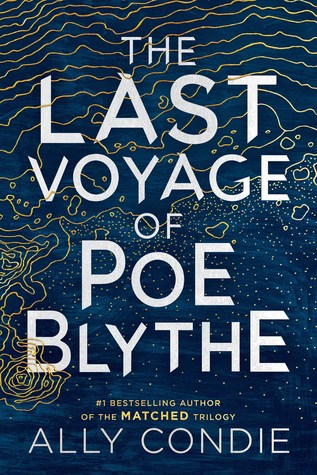
The Last Voyage of Poe Blythe

The Last Voyage of Poe Blythe. Ally Condie. 2019. 328 pages. [Source: Library]

First sentence: Call tells me he sees a star and that makes me laugh.

Premise/plot: The Last Voyage of Poe Blythe is a dystopian young adult novel. Poe loves Call. Call loves Poe. In a perfect, perfect world these two would find a way to run away together and get a chance at a happily ever after. But this isn't a perfect, perfect world--it's a dystopian novel. Call, Poe's true love, is killed in the prologue thus inspiring Poe's lust for revenge. This lust suits the Admiral just fine. In fact he considers Poe a great weapon against 'the enemy.' 

Gold. The Admiral wants/needs it--badly. There are ships that dredge the river in pursuit of gold. Call and Poe are on such a ship in the prologue. And Poe spends the rest of the novel as Captain of another mining ship. This ship has been armed with a weapon of her own design--one that will keep the river raiders from boarding, from slaughtering, from stealing. It was a raider who murdered Call. But is living for revenge really living? There are many secrets to be discovered--it would be a shock and disappointment if there weren't secrets galore.

My thoughts: Action-packed. The Last Voyage of Poe Blythe is packed cover to cover with action. But is it equally packed with heart and soul? Is there much substance or depth to the world Condie has created for teens? I would say no and no. Don't get me wrong. The action alone may keep you reading. (I read this one in two days.) There's nothing wrong with a book using action, violence, and suspense to keep you turning pages. A book can be a great escape.

This is definitely an action-driven novel. Dystopians can be premise-driven, action-driven, or character-driven. Perhaps the best of the best of the genre combine all three. I prefer premise-driven or character-driven dystopians. Novels that make me think or rethink the world. Novels that feature characters that I won't be forgetting any time soon. I definitely thought the character development suffered a bit in this one.

© 2019 Becky Laney of Becky's Book Reviews

Monday, June 17, 2019

From An Idea to LEGO

From An Idea to LEGO: The Building Bricks Behind the World's Largest Toy Company. Lowey Bundy Sichol. 2019. Houghton Mifflin Harcourt. 128 pages. [Source: Review copy]

First sentence from chapter one: Ole (pronounced OH-lay) Kirk Christiansen was born on April 7, 1891, in the small village of Filskov, Denmark.

Premise/plot: This nonfiction book provides young readers with a behind-the-scenes look at LEGO. The LEGO story begins as a very human story--the story of a carpenter and his sons. He didn't set out to make and sell toys--especially not plastic toys, after all he was a carpenter. As for one day being the world's largest toy company--I imagine he'd laugh and cry. The story is packed with details.

My thoughts: Nonfiction can be so fascinating. I really enjoyed this one and would recommend it to just about anyone and everyone. I was familiar with much of the story told within the book. Having watched the LEGO Story movie a couple dozen of times when it first came out. There were still plenty of things I learned from this book.

But this book goes beyond that simple story of how it came to be. It also includes plenty of informational text that focuses on business and economics.


© 2019 Becky Laney of Becky's Book Reviews

Thursday, June 13, 2019

Queen of the Sea

Queen of the Sea. Dylan Meconis. 2019. Candlewick Press. 400 pages. [Source: Review copy]

First sentence: A queen does not abandon her people.

Premise/plot: Queen of the Sea is a graphic novel loosely inspired by the Tudors. Loosely. The author purposefully did not make it about Henry VIII, Bloody Mary, and Queen Elizabeth I. Though that would have been an intriguing subject for a graphic novel, that isn't this graphic novel.

Queen of the Sea has a young heroine, Margaret, who has lived on an island, Albion, off another island, also Albion. She doesn't know who her father and mother were, or if they are alive or dead. All she knows is life at the convent. But while you might think life at the convent would offer no variety, no excitement, no adventure...well, you'd be mostly right...but not completely. Plenty happens--for better or worse.

It is a lovely coming of age novel.

My thoughts: I loved it. That's the short version. Did I love it because it's a graphic novel? No. Yes. Maybe. I really, really, really loved the characters and the story. Part of that story is told in the illustrations. So while a novel on the same topic would most likely thrill me just as much, there's a little something special in the illustrations.


I loved the characterization. I loved spending time with Margaret, William, Eleanor, Francis, and some of the sisters. Margaret and Eleanor's relationship is complex--rightly so. This one just had depth and substance to it. 
 
I loved the story and found it compelling. I read this one in one sitting. It was rough there at the end--it's hard for me to sit still that long--but it was worth it. No bookmark needed. Ha!
 
I would definitely recommend this one. Perhaps not to those that love, love, love graphic novels. I think the appeal is the HISTORY and the WORLD-BUILDING. If you don't love history, if you don't find it fascinating, then I'm not sure that this graphic novel would sweep you up, up, and away. But if you do, this is a treat of a book. So give it a try even if graphic novels aren't quite your cup of tea.  


© 2019 Becky Laney of Becky's Book Reviews

Tuesday, June 11, 2019

Love and the Rocking Chair

Love and the Rocking Chair. Diane and Leo Dillon. 2019. [October 15] Scholastic. 40 pages. [Source: Review copy]

First sentence: Many years ago, a young couple stood in a sea of chairs, searching for just the right one. "Look at that chair over there. It's perfect for the baby's room," the young woman said.

Premise/plot: Love and the Rocking Chair celebrates generations of a family and the legacy of a rocking chair passed on through the years. The book opens with a young couple expecting a baby and looking for just-the-right rocking chair. The chair is used when he is a baby and as he continues to grow. It is a chair he chooses to use in his own nursery when he's all grown up and expecting a child of his own...

My thoughts: Love and The Rocking Chair is a picture book for older readers. Dare I say it's a picture books written specificially with adults in mind?! It's a lovely book, don't get me wrong. But it's a book packed with sentiment and wisdom that only age can truly appreciate.

Love and the Rocking Chair is a bittersweet read. On the one hand, captured within this gem of a book are scenes of a family through the years. Babies being rocked. Toddlers being read to. Children imagining and playing. Children growing up, getting older, moving on, etc. On the other hand, it captures some heartbreaking moments as well. The husband/father getting old/sick, the wife/mother and the son standing together by a casket mourning. The wife/mother/grandmother wishing that her husband could be by her side to see his granddaughter. It's TOUGH, TOUGH I tell you on the heart strings.

It captures what life is--the way things are, the way things will always be in this world. LOVE is always present. Every single spread captures what it means to love and be loved. That's a difficult thing perhaps to capture in a meaningful way.

Text: 5 out of 5
Illustrations: 4 out of 5
Total: 9 out of 10


© 2019 Becky Laney of Becky's Book Reviews

Monday, June 10, 2019

Before They Were Authors

Before They Were Authors: Famous Writers as Kids. Elizabeth Haidle. 2019. Houghton Mifflin Harcourt. 64 pages. [Source: Review copy]

First sentence: What makes a writer? Many of us wonder about the stories behind the stories of best selling authors...

Premise/plot: What do you call a nonfiction book that uses the graphic novel format?! This one is nonfiction. It includes brief biographies of ten--yes, ten--writers. (5 Men. 5 Women.) The writers included are Mark Twain, Maya Angelou, Dr. Seuss, Sandra Cisneros, Roald Dahl, J.K. Rowling, Gene Luen Yang, Beatrix Potter, C.S. Lewis, and Madeleine L'Engle. Some of these writers wrote for children--toddlers, preschoolers, grade school students; some of these writers wrote for young adults or even adults.

Each author biography is told over several pages. As I mentioned earlier, it uses the graphic novel/comic book format to tell the stories. Sprinkled throughout the biographies are quotes from the writers.

My thoughts: I love the idea of loving this one. I do. The truth is very few readers are going to agree on which ten authors "should" be included in the book. There are no right answers here. Some seem obvious to me--Dr. Seuss, for example or even J.K. Rowling. There is one "omission" that saddens me. I would have LOVED, LOVED, LOVED to see Beverly Cleary included here. Her story is surely just as interesting as Beatrix Potter's?! Another "omission" that comes to mind is L.M. Montgomery. Also Mo Willems. And Shannon Hale.

Are these ten authors personal favorites of mine? Not really. That's okay. The subtitle isn't Becky's Favorite Writers As Kids.


© 2019 Becky Laney of Becky's Book Reviews