Showing posts with label utopia/dystopia. Show all posts

Wednesday, May 03, 2023

91. Project F


Project F. Jeanne DuPrau. 2023. [October 10] 224 pages. [Source: Review copy]

First sentence: All was going well in our country at the time this story begins, which is several hundred years in the future from the time you're reading it. There were no wars, few wildfires and floods, no famines.

Premise/plot: Looking for a children's book written with a hammer instead of a pen? Not literally, I suppose, since I imagine almost all writers type instead of write by hand. But this may be one of the most heavy-handed books I've read in my life--definitely the most obnoxiously didactic I've read in 2023. So what is the premise? DuPrau has created a perfectly perfect utopia set several hundred years after a terrible/horrible/disastrous fall. No fossil fuels are used at all. At all. And though the world's population is much smaller, civilization less advanced, and technology frozen at a socially-acceptable place, everything is just about perfect--in a self-righteous way. (The characters are so SMUG.)

Keith Arlo, our protagonist, hasn't been paying close enough attention to history lectures about the evilly-evil monsters of the past. So he's gullible and falls prey to adventure. It starts with a train ride. He is going to collect his newly-orphaned cousin, Lulu. But Malcolm, the passenger sitting close to him, is working on Project F. He tells just enough to make Keith super curious. When the two passenger's bags are mixed up--Keith takes Malcolm, Malcolm takes Keith, Keith's fate is nearly-sealed. He MUST return Malcolm's bag; he must explore all the secret documents and drawings; he must read the HISTORY OF THE TWENTIETH CENTURY, a book in his suitcase. 

The fate of the world may just rest on Keith's young shoulders and because he's not great at researching the evil-monsters of the past at the library OR great at listening in history class, then utopia is threatened.

So what is Project F? Well, it's MODEL F. F for Freedom? F for Fossil Fuels? F for Fun? Model F stands in opposition to everything this new utopia stands for. And Keith is tempted to have fun and experience freedom. Will the world collapse a second time?

My thoughts: I suppose I blended some of my thoughts in the premise/plot summary. I couldn't help it. It's rare I'm so incredibly disappointed by a book. I would say that City of Ember is one of my all time favorite-favorite-favorite books to reread. I adore that book SO MUCH. It's like one of my go-to books that I love to recommend to anyone/everyone. It's just a fantastic adventure. This book is the complete opposite. The character development is horrible. Unless the goal was to create characters that are so incredibly self-righteous, smug, proud, condescending, that you can't help but to hate them. The story is weak/thin--in my opinion. The writing is horrible. All tell, no show. I think the biggest annoyance was that whole pages of this one are just excerpts from a book HISTORY OF THE TWENTIETH CENTURY. These excerpts are literally just over-the-top lectures. As if the main narrative thread wasn't didactic enough.

It is my opinion that even GOOD messages (or GREAT messages) can be incredibly annoying if used as a hammer. No opinion is made better by being used as a weapon, a hammer; you can't beat a belief into someone else's head. You can't. You just can't. But you can get it published apparently. 

I don't love disliking a book. I don't. I was super excited to read her newest book. I had high hopes. I even moved it to the top of my list. I was eager to read this. I welcomed this. But I was disappointed.

I also thought some of this one was blasphemous. Yes, I know not every reader will come from a Christian background, a religious background with Christian roots, but this futuristic "update" of sorts to the doxology was horrendous.

Praise Earth from whom all blessings flow.
Praise sky above and sea below.
Praise creatures great and small between.
Praise darkness, light, and holy green.

© 2023 Becky Laney of Becky's Book Reviews

Wednesday, March 08, 2023

52. The Town With No Mirrors


The Town With No Mirrors. Christina Collins. 2023. [February] 304 pages. [Source: Library]

First sentence: I think I have a staring problem. It feels worst here in art class, but also safest. While everyone else's eyes fix on their projects, mine can roam free.

Premise/plot: Zailey, our protagonist, has lived in the community of Gladder Hill since she was four. In fact, no child over the age of four was allowed to move into this super-special community. She's spent the last eight to nine years there. And she's happy--for the most part. Perhaps not glad, glad, super-glad all the time. But happy-enough. Except sometimes she wrestles with Bad Thoughts, Superficial thoughts. Thoughts that are strongly discouraged to say the least. There are about one hundred people in Gladder Hill, give or take two or three. Everyone knows everybody. What unites this community? The lack of mirrors, lack of ANYTHING (even spoons, even eyeglasses) that have reflective properties. The community has also embraced select censorship as well--"deleting" many words deemed superficial. It is taboo to talk about anyone's appearance--including your own. 

Zailey is a bit of a rebel in that she loves to draw faces. She's working on drawing all the people who live in Gladder Hill. But she has to keep this super-super-secret because she doesn't want to risk putting her grandmother in a difficult position. (Especially after one man is kicked out of the community because he's got a SPOON in his house). 

Zailey dreams of leaving Gladder Hill...someday, someway. But she doesn't expect to leave town the way she does....

 My thoughts: I found this an intriguing read. I did. I enjoyed the world-building. I don't know that it was as thorough and immersive as say City of Ember or The Giver. But I don't know that it *has* to be. I thought it was a thoughtful and thought-provoking read. 

I appreciated that this utopia wasn't ever really a dystopia. It wasn't managed by a super-evil-tyrant-dictator. There were no characters that were over the top dramatically evil. All the characters are just human. That is so refreshing. 

I thought the utopia was relatively-mostly believable. 


© 2023 Becky Laney of Becky's Book Reviews

Tuesday, August 20, 2019

The Handmaid's Tale

The Handmaid's Tale. Margaret Atwood. 1985. 344 pages. [Source: Library]

First sentence: We slept in what had once been the gymnasium.

Premise/plot: The Handmaid's Tale is a dystopian classic by Margaret Atwood. It is narrated by a handmaid, Offred, and set in the Republic of Gilead. Offred, which is her new name not her birth name, remembers a time before--a time when women were free: free to work, free to manage their own money, free to read and write. Because she married a divorced man, when the change happened, her marriage became illegal--immoral. She was retrained/reschooled--taught by "Aunts" in how to be an obedient servant to the Republic. In her new role as handmaid, she will seek to bear the Commander's child. Different women are assigned different tasks. Some are for sex and the bearing of children. Some are for working. Only the poorest of men have econowives--one woman expected to do ALL the household work and tasks.

The novel definitely gives us an ALTERNATE 1980s.

My thoughts: I read this one not because it is a feminist classic but because it is a dystopian classic. I found it a compelling read for the most part. It was strange to see biblical themes appear and reappear throughout the novel in various ways--none of them exactly true to an actual biblical interpretation. It would be sad if readers actually assumed this is the Christian way of thinking and that to be a Christian means you want to live in the Republic of Gilead.

I believe it is written in stream of consciousness. Offred's recollections are mixed in generously with the here and now. It is only a sense--an intuition--that keeps readers discerning what is happening in the present and what may have happened last week, last month, last year, ten years ago. I followed it for the most part. I was swept up in the story. I would not want to be quizzed on the ins and outs of it. But it kept my attention.

A few weeks ago I reviewed We Set the Dark on Fire a novel that supposedly mirrors--for a young adult audience--The Handmaid's Tale. I found it lacking even before reading this one. It just isn't as thought-provoking or as substantive. The world building just isn't there. What the two do have in common is that towards the end the narrators become distracted sexually. Offred becomes enamored--filled with lust--for Nick. And Dani becomes obsessed with Carmen. One big difference between the two is that The Handmaid's Tale is a serious work of fiction that is carefully crafted throughout. We Set the Dark on Fire, on the other hand, has the mere potential to be a serious work. I wanted it to be a political, feminist WORK. I didn't want it to be a silly, flimsy work.

The Handmaid's Tale does leave DOZENS of unanswered questions. But it does so in a way that still builds the world up satisfactorily. The danger is real in Handmaid's Tale. It is never quite in We Set the Dark on Fire.


© 2019 Becky Laney of Becky's Book Reviews

Monday, July 22, 2019

We Set the Dark on Fire

We Set the Dark on Fire. Tehlor Kay Mejia. 2019. 384 pages. [Source: Library]

First sentence: In the beginning, there were two brother-gods: the God of Salt and the God of Sun.

Premise/plot: The book is set in the fictional island-world of Medio. In this culture, every man--or at least every man of rank--has two wives.

Dani, our heroine, has spent years training to be a Primera--a first wife. She won't be her husband's only wife, but she will be his equal, his helpmate. She'll manage his household, and keep things running smoothly. When she graduates she'll be fulfilling her parents' dream and making all their sacrifices worth it. But is it what she really wants? Maybe, maybe not. Dani's country is just as unsettled and out of sorts as her heart and mind. Political unrest has been growing and building--mainly concerning the nation's borders and those seeking to cross. Dani's would-be husband is a wealthy politician--the son of a wealthy politician. She'll take her husband's status and shed forever hers--which is for the best, right? But if it's right, why does it feel so wrong?

On the day she marries Mateo Garcia, he marries his Segunda (second wife) as well. Her name is Carmen. The two young women have been training at the same school for years. Segundas have an entirely different role within the family. They are for heart, passion, and childbearing. Dani worries that Carmen--who has sometimes bullied her in the past--will make life difficult for her.

She enters into the marriage uneasy...and her intuition is correct...there will be nothing predictable about it.

My thoughts: The prologue was beautifully written. It made it sound like there would be at least some mythological substance, some spirituality to the world-building. In the first few chapters, Dani alludes to the fact that her gods--the gods of her family--are not those of Medio. But this thread tends to not go anywhere or serve a purpose. Though the prologue makes you think its about gods in conflict with one another--sibling rivalry--the book isn't really.

I was drawn into this one from the prologue and the first chapter or two. Dani, our narrator, has a tough decision to make. Will she continue living a lie just because her parents want her to have a better life? Will she continue living that lie out of self-preservation? Will her secret come out? (The secret is about where she was born--what side of the border she was born on and the sacrifices her parents made to falsify her documents.) How does she feel about the border? about the racism? about the violence? about politics?

Medio. The culture isn't really explored as fully as I had hoped. The more I read, the shallower it felt to me. It just felt undeveloped.

It is definitely action-driven and not character-driven. I felt most of the characters--with the exception of Carmen and Dani--were incredibly flat and insubstantial. The action wasn't particularly satisfying--to me. The book seemed to digress from being a political thriller with SPIES to being about two women who make out a lot.


© 2019 Becky Laney of Becky's Book Reviews

Monday, August 13, 2018

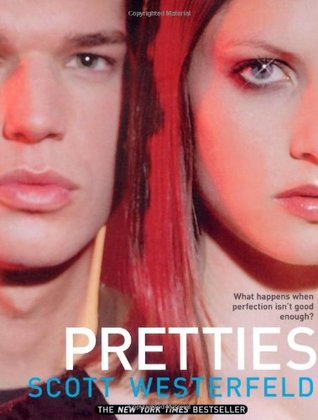
Pretties

Pretties. (Uglies #2) Scott Westerfeld. 2005. Simon & Schuster. 370 pages. [Source: Library]

First sentence: Getting dressed was always the hardest part of the afternoon.

Premise/plot: Pretties is the second book in Scott Westerfeld's futuristic dystopian series. In the first book, Uglies, Tally, our heroine, decides to become PRETTY so that she can be the guinea pig for the cure for the brain lesions. She wrote herself a note explaining everything--or almost everything. But what she didn't take into account was how being pretty would change your thinking and reasoning ability. Instead of taking the two-pill cure herself Tally decided to split the cure with her new friend, Zane. She took one pill; he took the other. Now they are awaiting the results. Will they be cured of their pretty-thinking? Will they stay bubbly all the time? Is it time for the PRETTIES to revolt against the system?

My thoughts: This is a reread. I believe this is the third time I've read it and the second time I've blogged a review. I do like Tally Youngblood. She's flawed but believably so in my opinion. If the series has a flaw--emphasis on if--it's the LOVE TRIANGLE aspect of it that some readers might be annoyed by. The first book was all David. This second book is all Zane. One she loved as an ugly. The other she loves as a pretty. She's endured a lot of hard circumstances with both--situations that draw you close to someone.

I listened to UGLIES on audio a few weeks ago. It was such a relief to read PRETTIES. Shay is much less annoying in print. 

© 2018 Becky Laney of Becky's Book Reviews
Monday, July 23, 2018

Herland

Herland. Charlotte Perkins Gilman. 1915/1979. 147 pages. [Source: Bought]

First sentence: This is written from memory, unfortunately. If I could have brought with me the material I so carefully prepared, this would be a very different story.

Premise/plot: Vandyck Jennings is a sociologist traveling or exploring with Terry O. Nicholson and Jeff Margrave. On one of their trips they hear rumors of a 'strange and terrible Woman land...this strange country where no men lived--only women and girl children.' They don't have time on this first trip to seek it out, but, they become determined to return on their own and find it next year. Return they do, and they think they've packed, planned, and prepared all they need. But they could not begin to imagine the reality of Herland.

Herland is a utopian adventure story. Van, Jeff, and Terry venture into Herland, are 'captured' by the women, educated by the women, and eventually given some freedom. Perhaps not all the men were worthy of that freedom.

The education of the men gives Gilman an opportunity to info dump about the world she has created. (Though we learn little of their native language--perhaps Gilman was no Tolkien.) Readers learn alongside of Van, Jeff, and Terry two thousand years of history. How did Herland come into existence? Where there ever men? How do the women reproduce without men? How are children raised? What is society like? How has their society evolved through the centuries?

Info dump isn't quite the right word. It also gives Gilman an opportunity to explore the ideas and philosophies of this 'utopian' world and to a certain extent the real world as well. Gender roles being a subject that is front and center of the whole novel. What does it mean to be feminine? to be womanly? What is natural? Are the stereotypical notions of femininity just a reflection or reaction to masculinity. Without the masculine how would the feminine have developed or evolved?

She spends one whole chapter on the religion/faith of Herland and how it compares to Van's Christianity. In Herland, there is no sin, no punishment, no crime, no criminals, no need for a Savior, no need for a sacrifice, no need for heaven or hell, no need for laws or rules. Society has almost agreed upon a list of ideals and lumped them together into the notion of God and decided to live as if God were real and express in their lives those same ideals.

The concept of 'home' does not exist. Babies and children are raised collectively, taught collectively, work collectively. You might give birth to a baby but not be active in raising it. The most qualified do the raising. All generations belong to one another--there are no individual families or homes. No child belongs more to one person than another. Pride is felt collectively.

Just as the most qualified do the raising, only the 'most qualified' the 'best sorts' of women are allowed to have children--to will them into existence by their deep longing for Motherhood. Other women are discouraged from longing and are directed to focus their thoughts, their energies elsewhere. By not allowing everyone to have children, they ensure that only the best qualities are passed on from generation to generation.

My thoughts: I found Herland to be a quick read. I read it in one evening. Every time I thought about putting down the book, I decided I just had to read one more chapter. So without a doubt I found it an engaging read.

I was thankful there were three male characters. Jeff adapted the easiest to the new country. It didn't take him long at all to decide that he had come home at last and this is where he wanted to live the rest of his life. Herland was his paradise.

Van was open-minded. He was always ready and willing to discuss any and all aspects of the culture and compare them to the outside world, to America in particular. He was respectful and genuine. I think Van represented hope for the world, that men could be taught to accept women as equals if not superior at times.

Terry was close-minded. There was no changing his mind. He had a one track mind; women were objects to be TAKEN, to be owned, to be mastered, to be ruled, to be possessed. Terry didn't care about ideas and thoughts and feelings. Some form of justice was carried out against Terry. 

I'm not sure what I think of the world Gilman created. I certainly disagreed with some of her ideas or notions. Her utopia is not every woman's utopia. And her notion of Utopia was created in 1915 is in some ways dated and problematic. Some aspects were just disturbing.

© 2018 Becky Laney of Becky's Book Reviews

Tuesday, March 27, 2018

The City of Ember

The City of Ember. Jeanne DuPrau. 2003. 270 pages. [Source: Bought]

First sentence: In the city of Ember, the sky was always dark.

Premise/plot: The City of Ember is one of my all-time favorite books. Ember was built by the BUILDERS to protect humanity from its biggest threat in dark, dark days. Hundreds of years have passed, the inhabits of Ember know nothing of the world outside. They know nothing of blue skies and yellow sun. In part, the builders wanted it that way--to protect the people from knowledge of the past. But the time has come--has almost come and gone, in fact--for the people to leave Ember behind and rejoin the world above. The problem? The instructions have been lost. And only one person even knows that something important--something vital--has been lost and is worth searching for. And few take her words seriously because she's "senile" and "not herself." Lina Mayfleet, our heroine, stumbles upon these instructions quite by accident, and really all in thanks to her baby sister, Poppy. Will she be able to decode the instructions--what remain of them after Poppy's little snack--and solve the mystery? It is too big to solve on her own. But Lina has a few good friends that she thinks are trustworthy--and clever. The one who becomes her best friend is Doon Harrow. These two grow close as they work on solving the problems that threaten life as they know it.

My thoughts: I love this book. I do. I can't believe--in a way--that it was the author's first book. It is just MARVELOUS. I love the world-building. I love how thought-provoking it is. And I love the characterization. It is one of those rare books that defies expectations. It is premise-driven, plot-driven, and character-driven.

One of my favorite quotes:
The trouble with anger is, it gets hold of you. And then you aren't the master of yourself anymore. Anger is. (89)

© 2018 Becky Laney of Becky's Book Reviews

Thursday, March 22, 2018

Thunderhead

Thunderhead (Arc of a Scythe #2) Neal Shusterman. 2018. 5014 pages. [Source: Library]
First sentence: Peach velvet with embroidered baby-blue trim. Honorable Scythe Braums loved his robe. True, the velvet became uncomfortably hot in the summer months, but it was something he had grown accustomed to in his sixty-three years as a scythe.

Premise/plot: Thunderhead is the sequel to Scythe. If you haven't read Scythe yet, you should. What should you know about the series? Well...it's set in the future. Many advancements have been made. Immortality is the norm--for most. Gone are the days where you could die of disease or old age. Most people who die can be revived. Dead has become deadish. But a small percentage of the population is gleaned each year. That is the role of the Scythes. Readers meet many scythes in the first novel in the series. Two of the main characters in the first book were Rowan and Citra. Both characters are back in the sequel. Rowan has adopted the name "Scythe Lucifer" and is on a mission of his own. Citra has adopted the name "Scythe Anastasia." Two main characters that take prominence in Thunderhead are the THUNDERHEAD and Greyson Tolliver.

The Scythes are finding themselves divided into two factions: the 'old' guard that believe that the role of scythe is honorable but heavy with responsibility and the 'new order' which believe that killing is an exhilarating joy. They don't work with heavy hearts and solemnity. No, they approach the job as a pleasure. Scythe Anastasia and Scythe Curie are of the old guard faction.

There are some truly EVIL characters in Thunderhead.

My thoughts: I'm not sure I have words. The ending left me crushed and broken. (I can only compare it perhaps to listening to the whole Hamilton soundtrack.) I think the book is well written and well plotted. It almost goes without saying that it is incredibly compelling--intense and dramatic.

I do recommend the series. Read them back to back if you can. I did not reread the first book. If there is a third book, I will try to make a point to reread all the books.

© 2018 Becky Laney of Becky's Book Reviews

Sunday, January 08, 2017

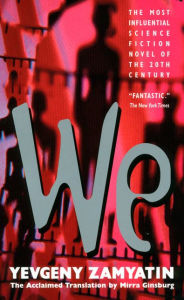
We

We. Yevgeny Zamyatin. Translated by Clarence Brown. 1924/1993. 225 pages. [Source: Bought]

First sentence: I shall simply copy, word for word, the proclamation that appeared today in the One State Gazette...

Premise/plot: The Russian novel, We, consists of journal entries of D-503, the chief architect of the rocket ship Integral. Is he a reliable narrator? Maybe. At the very least his sanity is touch and go. And perhaps he's sanest when he's sickest? Readers meet a handful of characters--all designated by letters and numbers--as the plot moves forward to the testing of the ship.

This dystopian novel features a love triangle of sorts. One thing I know for certain is O-90 loves, loves, loves D-503. He doesn't seem to feel the same about her, though she is familiar and comfortable to be around on designated sexual days--sex requires pink coupons. He becomes obsessed with I-330. Obsessed is the right word in my opinion. He finds her mysterious, unpredictable, illogical, nonconformist. He doesn't stand a chance of ever understanding her, yet he can't help risking everything for more glimpses of her. I-330 remains a mystery to me honestly.

Without a doubt, this is a political book. But without D-503 being so physically drawn to I-330 I'm not sure he would have become as interested in her politics. But. I-330 is so much more than 'just a woman.' 

Does D-503 develop a soul through the course of the novel? That is what may be happening. He has become comfortable with the idea of being a unique individual, of forsaking logic for love and jealousy. He has begun thinking independently of the One State. And he's started bending rules and going his own way.

My thoughts: Well, it's certainly an atmospheric read with thorough world-building. The narrative style is distinct and difficult. The world is so foreign to readers--to me--that while engaging at times it is also confusing. The last third of the novel in particular. D-503 stumbles across a big life-changing secret and he discusses it with at least two or three people; but his journal entries are so cryptic to me that I don't know what it is.

Favorite quotes:
  • A man must think, at least a little. It helps. (11)
  • The only means of ridding man of crime is ridding him of freedom. (35)
  • There is only one truth, and one true way; this truth is two times two, and the true way--four. (67)
  • There are clay ideas, and there are ideas forever carved of gold or of our precious glass. (115)
  • A human being is like a novel; until the last page you don't know how it will end. (162)
  • Revolutions are infinite. (174)
  • Children are the only bold philosophers. (175)


© 2017 Becky Laney of Becky's Book Reviews
Sunday, April 08, 2007

Ella Minnow Pea


Dunn, Mark. 2001. Ella Minnow Pea.

Ella Minnow Pea isn’t a new book, but it is a new-to-me book. Set on a fictional island of Nollop off the coast of South Carolina, it follows the lives of a family enduring stress and hardship as their ‘perfect’ society begins to collapse. This society is based on worshipping Nevin Nollop who invented the famous lipogram “The quick brown fox jumps over the lazy dog.” When the letters start falling from the statue or monument, the Council decides that it is a message from beyond-the-grave. The message is clear: each fallen letter must be discarded from use. No words with the fallen letters must ever be used. This eliminates most (if not all) books from the library, and renders teachers practically useless. The punishment is severe and a three strikes you’re out policy is instituted. Can these islanders find a way to save their society? It’s a race against time as each letter falls from place.

Reading Group Guide
Interview with Mark Dunn