Showing posts with label Quest. Show all posts

Friday, August 01, 2025

84. The Return of the King


84. The Return of the King. (Lord of the Rings) J.R.R. Tolkien. 1955/1965. Houghton Mifflin. 440 pages.
 
First sentence: Pippin looked out from the shelter of Gandalf's cloak.
 
ETA: I listened to The Return of the King on audio narrated by Andy Serkis. It was great. I've listened to The Hobbit, Fellowship of the Ring, Two Towers, and Return of the King all narrated by Andy Serkis. He's a fabulous voice actor and it was a great experience.

So Return of the King consists of books five and six of Lord of the Rings. In book five, narrators shift from chapter to chapter to chapter. Essentially we spend time with everyone but Sam and Frodo. We spend time in Rohan and Gondor. Scarlett O'Hara would be nothing but bored, bored, bored for this one is all about WAR, WAR, WAR. If they're not actually IN battle, they're marching towards battle, planning battle tactics, or recovering from battle. Did I personally find it boring??? Far from it, it is INTENSE and heartbreaking in places. (For example, Theoden's end.) I would actually say almost all the action happens in book five.

Book six starts out as being all about Sam and Frodo, but, it doesn't stay their book. The climax to the trilogy comes early in book six. Soon the fellowship is reunited and readers get the full cast of characters they've become so attached to. Here we have two to three romances squeezed in. If I had any advice for new readers it would be this: don't expect the book to be as focused on ROMANCE and FEELINGS as the movies are. 

So does book six drag? Is the end of the war coming so early in the novel a weakness in the book? I'm going to say perhaps and NO. I love that the book shows what happens next. I love that the book focuses on soldiers going home, on trying to settle back into life after the war. I love that we see the effect of the war. I love that we don't get a polished, rushed happy ending. It would be so easy for a movie to end in a parade and award ceremony. (Think Star Wars!) But life isn't like that. It isn't always easy for soldiers to adjust back into life, into society. I love that we see the ongoing consequences of war. We see how war has changed everyone--not just the Frodo, Sam, Merry, and Pippin--but everyone in the Shire.

Favorite quotes:

Well, no need to brood on what tomorrow may bring. For one thing, tomorrow will be certain to bring worse than today, for many days to come. And there is nothing more that I can do to help it. The board is set, and the pieces are moving. 
‘Nine o’clock we’d call it in the Shire,’ said Pippin aloud to himself. ‘Just the time for a nice breakfast by the open window in spring sunshine. And how I should like breakfast! Do these people ever have it, or is it over? And when do they have dinner, and where?’

‘I am no warrior at all and dislike any thought of battle; but waiting on the edge of one that I can’t escape is worst of all. What a long day it seems already! I should be happier, if we were not obliged to stand and watch, making no move, striking nowhere first.
‘So we come to it in the end,’ he said: ‘the great battle of our time, in which many things shall pass away. But at least there is no longer need for hiding. We will ride the straight way and the open road and with all our speed. The muster shall begin at once, and wait for none that tarry. Have you good store in Minas Tirith? For if we must ride now in all haste, then we must ride light, with but meal and water enough to last us into battle.
‘O Sam!’ cried Frodo. ‘What have I said? What have I done? Forgive me! After all you have done. It is the horrible power of the Ring. I wish it had never, never, been found. But don’t mind me, Sam. I must carry the burden to the end. It can’t be altered. You can’t come between me and this doom.’
‘So that was the job I felt I had to do when I started,’ thought Sam: ‘to help Mr. Frodo to the last step and then die with him? Well, if that is the job then I must do it. But I would dearly like to see Bywater again, and Rosie Cotton and her brothers, and the Gaffer and Marigold and all. I can’t think somehow that Gandalf would have sent Mr. Frodo on this errand, if there hadn’t a’ been any hope of his ever coming back at all. Things all went wrong when he went down in Moria. I wish he hadn’t. He would have done something.’ But even as hope died in Sam, or seemed to die, it was turned to a new strength. Sam’s plain hobbit-face grew stern, almost grim, as the will hardened in him, and he felt through all his limbs a thrill, as if he was turning into some creature of stone and steel that neither despair nor weariness nor endless barren miles could subdue.
Sam looked at him and wept in his heart, but no tears came to his dry and stinging eyes. ‘I said I’d carry him, if it broke my back,’ he muttered, ‘and I will!’ ‘Come, Mr. Frodo!’ he cried. ‘I can’t carry it for you, but I can carry you and it as well. So up you get! Come on, Mr. Frodo dear! Sam will give you a ride. Just tell him where to go, and he’ll go.’ As Frodo clung upon his back, arms loosely about his neck, legs clasped firmly under his arms, Sam staggered to his feet; and then to his amazement he felt the burden light.
Then to the wonder of many Aragorn did not put the crown upon his head, but gave it back to Faramir, and said: ‘By the labour and valour of many I have come into my inheritance. In token of this I would have the Ring-bearer bring the crown to me, and let Mithrandir set it upon my head, if he will; for he has been the mover of all that has been accomplished, and this is his victory.’ Then Frodo came forward and took the crown from Faramir and bore it to Gandalf; and Aragorn knelt, and Gandalf set the White Crown upon his head, and said:
‘Now come the days of the King, and may they be blessed while the thrones of the Valar endure!’ But when Aragorn arose all that beheld him gazed in silence, for it seemed to them that he was revealed to them now for the first time. Tall as the sea-kings of old, he stood above all that were near; ancient of days he seemed and yet in the flower of manhood; and wisdom sat upon his brow, and strength and healing were in his hands, and a light was about him. And then Faramir cried: ‘Behold the King!’
‘Are you in pain, Frodo?’ said Gandalf quietly as he rode by Frodo’s side. ‘Well, yes I am,’ said Frodo. ‘It is my shoulder. The wound aches, and the memory of darkness is heavy on me. It was a year ago today.’ ‘Alas! there are some wounds that cannot be wholly cured,’ said Gandalf. ‘I fear it may be so with mine,’ said Frodo. ‘There is no real going back. Though I may come to the Shire, it will not seem the same; for I shall not be the same. I am wounded with knife, sting, and tooth, and a long burden. Where shall I find rest?’ Gandalf did not answer.


© 2025 Becky Laney of Becky's Book Reviews

Thursday, May 18, 2023

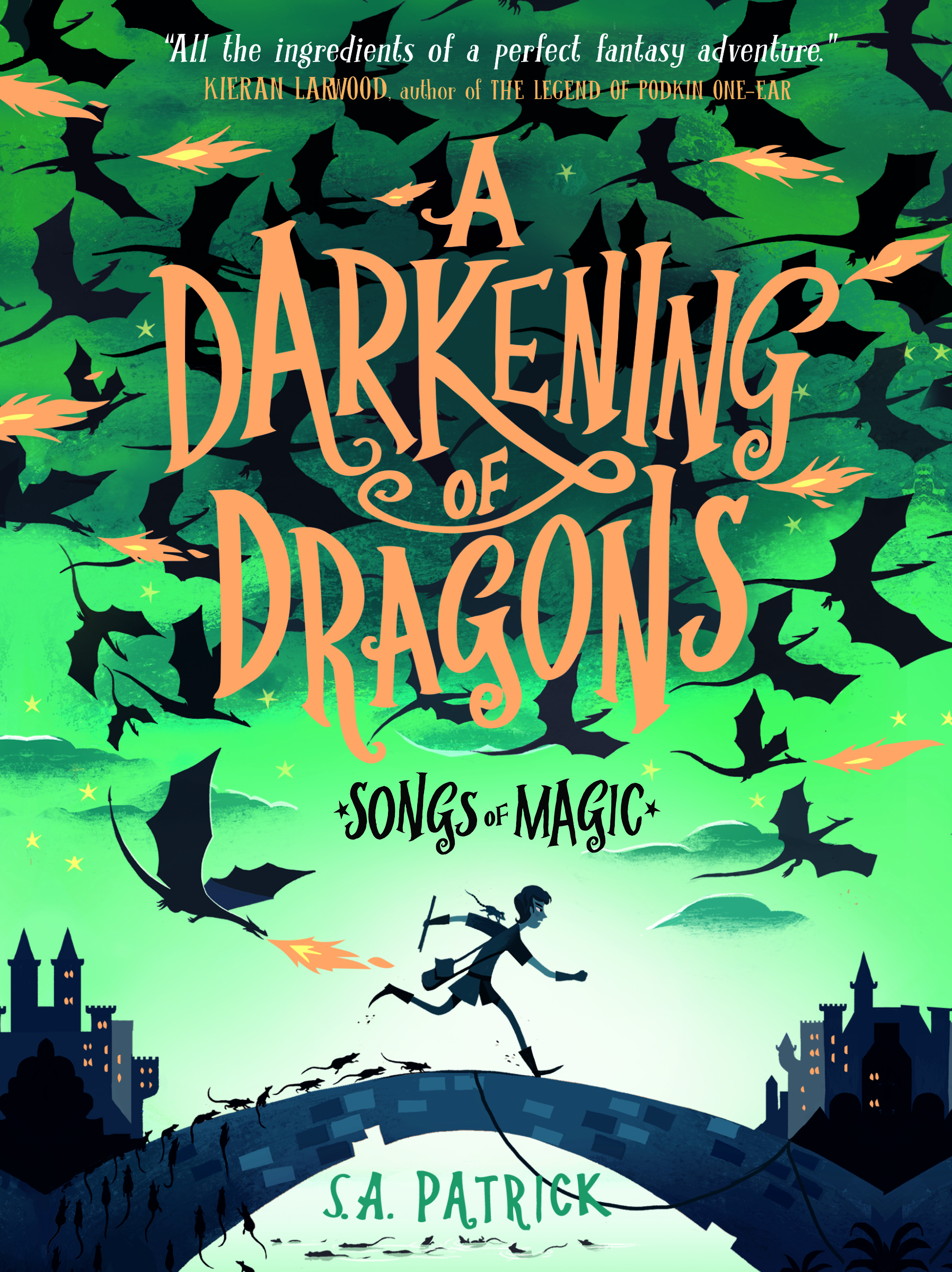
103. A Darkening of Dragons


A Darkening of Dragons. (Songs of Magic #1) S.A. Patrick. 2018/2020/2022/2023. 400 pages. [Source: Library]

First sentence: The screams of the children brought the villagers running. 

Premise/plot: A Darkening of Dragons is the first in a fantasy trilogy that is an adapted twist on the Piper of Hamelyn tale. Patch Brightwater, our hero soon to be on a quest, isn't your typical hero. In fact, he soon lands himself in prison. The prisoner next door is legendary, and, obviously not in a good way: the evil Piper of Hamelyn. He's wearing an iron mask to prevent him from mischief, doomed to repeat the last word he said before the mask was attached. Wren, a girl with big dreams, has been cursed and turned into a rat. Wren and Patch become great friends. When an opportunity for escape presents itself (this scene reminded me of Pirates of the Caribbean), Patch and Wren make a run for it. Soon they are joined by Barver, a dracogriff (dragon/griffin). Thus begins their bigger adventures...

My thoughts: The world building in this fantasy novel is great. The characterization is there--it's substantive. I never thought I would get so attached to Wren and Barver. (But I did.) The quest doesn't begin on page one, there's lots of build-up. There were twists and turns along the way....and, of course, it ends on a cliffhanger. 

I can't wait to start the second book!


© 2023 Becky Laney of Becky's Book Reviews

Sunday, July 17, 2022

86. The Sea of Monsters


The Sea of Monsters. (Percy Jackson and the Olympians #2) Rick Riordan. 2006. 279 pages. [Source: Library]

First sentence: My nightmare started like this. I was standing on a deserted street in some little beach town. It was the middle of the night. A storm was blowing. Wind and rain ripped at the palm trees along the sidewalk. Pink and yellow stucco buildings lined the street, their windows boarded up. A block away, past a line of hibiscus bushes, the ocean churned. Florida, I thought.

Premise/plot: The Sea of Monsters is the sequel to The Lightning Thief. A year has passed since the events of the first [fantasy] novel. Percy will soon be returning to Camp Half-blood and rejoining his friends, frenemies, and perhaps actual enemies. He's been having troubling dreams the past few days--mainly concerning his friend Grover. He senses danger. He just doesn't know how grave the danger is...for all of them. The tree that [helps] protect the camp from monsters is dying; it has in fact been poisoned. To save the camp may require another quest, but, not everyone thinks the camp needs to be saved. (Could their be traitors at camp still???) 

Annabeth, Percy, and TYSON (a new character introduced) team up to save Grover...but their quest is UNofficial. They do not have permission to leave camp let alone permission to go on a quest for the golden fleece. Their quest will not take them all across the United States but down to Florida to THE SEA OF MONSTERS which is off the coast of Florida. They'll face monsters, monsters, and more monsters. But will their quest be successful?

My thoughts: I have so many memories of The Lightning Thief. Every chapter of the first novel is super familiar. But there was something delightful about reading this second novel. It has been so many years since I first read it (it would have been circa 2006), that it was like experiencing this fantasy-adventure-questing novel for the first time...again. That is rare (in my opinion.) 

I liked Tyson. I did. I missed Grover being an active part of their adventure, but I didn't blame Tyson for being a replacement of sorts. Grover is in the book, just, not an active part of the quest. He's the point of the quest. I thought there were some great character-building scenes in this one. I thought we got a chance to better get to know Annabeth. The siren sequence was quite something. Percy truly risked all--not only for Annabeth, but later for Grover and for Tyson.


© 2022 Becky Laney of Becky's Book Reviews

Friday, July 08, 2022

81. The Lightning Thief


The Lightning Thief. Rick Riordan. 2005. 377 pages. [Source: Library]

First sentence: Look I didn't want to be a half-blood. If you're reading this because you think you might be one, my advice is: close this book right now. Believe whatever lie your mom or dad told you about your birth, and try to lead a normal life. Being a half-blood is dangerous. It's scary. Most of the time, it gets you killed in painful, nasty ways. If you're a normal kid, reading this because you think it's fiction, great. Read on. I envy you for being able to believe that none of this ever happened. But if you recognize yourself in these pages--if you feel something stirring inside--stop reading immediately. You might be one of us. And once you know that, it's only a matter of time before they sense it too, and they'll come for you. Don't say I didn't warn you.

Premise/plot: Percy Jackson, our hero, is about to be thrown into quite the adventure. It will be quite the fight for survival. Though he doesn't know it at the start, he's a half-blood. His mother is mortal and his father is a god, one of the big three gods, POSEIDON. And well, his very existence is upsetting the order of things. (You see, the big three had a pact that they would not have any more children with mortals. Things get messy when they did.) Soon after the novel opens, he finds himself at camp with others like himself--other halfbloods. He'll be making some great friends--like Grover and Annabeth. Camp may be interesting, but, not nearly as interesting as the quest he's soon given. Percy and his friends have quite an undertaking before them...an undertaking that may even take them to the underworld....and hopefully back again. 

My thoughts: I would have thought I'd have so many reviews of this up on my blog. I guess I haven't reread it nearly as much as I thought I had. That being said, it was so familiar. Each chapter was like an old friend. I have vivid memories of a handful of scenes (like the casino, for example). I also remembered *who* at camp was going to end up fulfilling a certain prophecy that the oracle gave Percy. So a few of the twists and turns and surprises were no longer twisty-turny. But that's a small sacrifice to make for revisiting with such good friends.

I don't think I've reread the others nearly as much. 


© 2022 Becky Laney of Becky's Book Reviews

Thursday, September 12, 2019

Max Tilt: Fire the Depths

Max Tilt: Fire the Depths (Max Tilt #1) Peter Lerangis. 2017. HarperCollins. 368 pages. [Source: Library]

First sentence: Before the day he was abandoned, Max Tilt thought life was pretty much perfect.

Premise/plot: When Max’s mom gets sick, his parents leave him in the care of his older cousin, Alex, as they seek treatment out of town. The two (Max and Alex) soon discover that the parents have been horribly irresponsible. The electricity is turned off the second day, I think! The eviction notice has been served and is due to take effect within a week maybe two. Instead of contacting the parents (either Max or Alex’s), the two decide that by selling the contents of the home online and perhaps getting a part-time job they should be able to get the bills paid and stay in the home. One of the items they list brings trouble to their door! The item is an empty trunk that belonged to Jules Verne, THE Jules Verne. The two set out on a quest when they find a hidden text by Verne, the bad guys are never far behind. In fact, they end up keeping close company with the villains for most of the book. Can they best them by the end and get their hands on the lost manuscript?

My thoughts: I liked the premise of this one. Max and Alex are descendants of Jules Verne. They have inherited some of his things and discover a secret, hidden, mystery text. The descendants of Captain Nemo (or descendant) know about this mystery letter/manuscript and have been hunting for it. The two must battle it out in the book. Both claim that they want to save the world.

You have to suspend ALL your disbelief if you want to enjoy this one. It isn’t unusual for this sub genre. In fact it reminds me a bit of The Magician’s Nephew by C.S. Lewis. Two kids without much—if any—adult support set out to save the world. But it wasn’t the adventure quest that had me stumbling. It was the parents leaving Max in such a horrible position. How could they knowingly leave their son knowing that the electric bill is overdue?! Knowing that other utilities will soon follow?! Knowing that the family will be evicted in a few weeks?! It sounds like they are skipping town and abandoning Max. How could they not know about their unpaid bills?! How could they leave knowing?!

Perhaps they expected Alex to take Max home with her?!

I also wondered how the two made it to New York City since both had no money....

But the book did keep me reading. I have plans to read the second book in the series.

© 2019 Becky Laney of Becky's Book Reviews

Tuesday, August 27, 2019

The Fellowship of the Ring

The Fellowship of the Ring. J.R.R. Tolkien. 1954/1965. Houghton Mifflin. 423 pages. [Source: Bought]

First sentence from the prologue: This book is largely concerned with Hobbits, and from its pages a reader may discover much of their character and a little of their history.

First sentence from chapter one: When Mr. Bilbo Baggins of Bag End announced that he would shortly be celebrating his eleventy-first birthday with a party of special magnificence, there was much talk and excitement in Hobbiton.

Premise/plot: The novel opens with a HUGE celebration. Bilbo will be turning 111 and Frodo will be turning 33.

Bilbo is preparing to leave the Shire forever, but, he'll be leaving most everything to Frodo--including his magical ring. Gandalf is relieved that the ring will pass onto Frodo, it makes him a bit nervous to see Bilbo so attached to it and calling it precious. As the years go by--and years DO go by--Gandalf becomes concerned, worried, anxious about the ring. He fears that it is the ONE RING, and that Frodo's possession of the ring is dangerous.

I believe Frodo is about fifty when he does eventually set out on his very own adventure. And he won't be alone. He'll be accompanied by Sam, Pippin, and Merry. As their journey progresses, more people join the fellowship, and more risks are faced.

My thoughts: I love, love, loved rereading The Fellowship of the Ring. I think this is my third time to finish the series. (Yes, I've read all three of the trilogy when I'm writing this review.) There is something comforting about rereading it. I think it gets better each time. I find more to love, more to share. I notice more as well.

  On birthday presents:

Hobbits give presents to other people on their own birthdays. Not very expensive ones, as a rule, and not so lavishly as on this occasion; but it was not a bad system. Actually in Hobbiton and Bywater every day in the year was somebody’s birthday, so that every hobbit in those parts had a fair chance of at least one present at least once a week. But they never got tired of them.
It was a tendency of hobbit-holes to get cluttered up: for which the custom of giving so many birthday-presents was largely responsible. Not, of course, that the birthday-presents were always new; there were one or two old mathoms of forgotten uses that had circulated all around the district; but Bilbo had usually given new presents, and kept those that he received. 
On the food at the birthday party:
There were three official meals: lunch, tea, and dinner (or supper). But lunch and tea were marked chiefly by the fact that at those times all the guests were sitting down and eating together. At other times there were merely lots of people eating and drinking – continuously from elevenses until six-thirty, when the fireworks started. 
Bilbo confesses something to Gandalf:
‘I am old, Gandalf. I don’t look it, but I am beginning to feel it in my heart of hearts. Well-preserved indeed!’ he snorted. ‘Why, I feel all thin, sort of stretched, if you know what I mean: like butter that has been scraped over too much bread. That can’t be right. I need a change, or something.’ Gandalf looked curiously and closely at him. ‘No, it does not seem right,’ he said thoughtfully. ‘No, after all I believe your plan is probably the best.’ ‘Well, I’ve made up my mind, anyway. I want to see mountains again, Gandalf – mountains; and then find somewhere where I can rest. In peace and quiet, without a lot of relatives prying around, and a string of confounded visitors hanging on the bell. I might find somewhere where I can finish my book. I have thought of a nice ending for it: and he lived happily ever after to the end of his days.’ 
The ring:
As Frodo did so, he now saw fine lines, finer than the finest pen-strokes, running along the ring, outside and inside: lines of fire that seemed to form the letters of a flowing script. They shone piercingly bright, and yet remote, as if out of a great depth. ‘I cannot read the fiery letters,’ said Frodo in a quavering voice. ‘No,’ said Gandalf, ‘but I can. The letters are Elvish, of an ancient mode, but the language is that of Mordor, which I will not utter here. But this in the Common Tongue is what is said, close enough: One Ring to rule them all, One Ring to find them, One Ring to bring them all and in the darkness bind them.
It is only two lines of a verse long known in Elven-lore: Three Rings for the Elven-kings under the sky, Seven for the Dwarf-lords in their halls of stone, Nine for Mortal Men doomed to die, One for the Dark Lord on his dark throne In the Land of Mordor where the Shadows lie. One Ring to rule them all, One Ring to find them, One Ring to bring them all and in the darkness bind them In the Land of Mordor where the Shadows lie.’
But as for breaking the Ring, force is useless. Even if you took it and struck it with a heavy sledge-hammer, it would make no dint in it. It cannot be unmade by your hands, or by mine. 
‘There is only one way: to find the Cracks of Doom in the depths of Orodruin, the Fire-mountain, and cast the Ring in there, if you really wish to destroy it, to put it beyond the grasp of the Enemy for ever.’ 
Frodo and Gandalf 'regret' the times in which they live:
‘I wish it need not have happened in my time,’ said Frodo. ‘So do I,’ said Gandalf, ‘and so do all who live to see such times. But that is not for them to decide. All we have to decide is what to do with the time that is given us. And already, Frodo, our time is beginning to look black. The Enemy is fast becoming very strong. His plans are far from ripe, I think, but they are ripening. We shall be hard put to it. We should be very hard put to it, even if it were not for this dreadful chance. 
I am not made for perilous quests. I wish I had never seen the Ring! Why did it come to me? Why was I chosen?’ ‘You may be sure that it was not for any merit that others do not possess: not for power or wisdom, at any rate. But you have been chosen, and you must therefore use such strength and heart and wits as you have.’
‘Not safe for ever,’ said Gandalf. ‘There are many things in the deep waters; and seas and lands may change. And it is not our part here to take thought only for a season, or for a few lives of Men, or for a passing age of the world. We should seek a final end of this menace, even if we do not hope to make one.’ 
More words of wisdom from Gandalf:
Many that live deserve death. And some that die deserve life. Can you give it to them? Then do not be too eager to deal out death in judgement. For even the very wise cannot see all ends. 
Hobbits really are amazing creatures, as I have said before. You can learn all that there is to know about their ways in a month, and yet after a hundred years they can still surprise you at a pinch.  
The wide world is all about you: you can fence yourselves in, but you cannot for ever fence it out.’ 
It is perilous to study too deeply the arts of the Enemy, for good or for ill. But such falls and betrayals, alas, have happened before. 
‘Despair, or folly?’ said Gandalf. ‘It is not despair, for despair is only for those who see the end beyond all doubt. We do not. It is wisdom to recognize necessity, when all other courses have been weighed, though as folly it may appear to those who cling to false hope. Well, let folly be our cloak, a veil before the eyes of the Enemy! For he is very wise, and weighs all things to a nicety in the scales of his malice. But the only measure that he knows is desire, desire for power; and so he judges all hearts. Into his heart the thought will not enter that any will refuse it, that having the Ring we may seek to destroy it. If we seek this, we shall put him out of reckoning.’ 
Favorite Sam Bits:
‘Well, sir,’ said Sam dithering a little. ‘I heard a deal that I didn’t rightly understand, about an enemy, and rings, and Mr. Bilbo, sir, and dragons, and a fiery mountain, and – and Elves, sir. I listened because I couldn’t help myself, if you know what I mean. Lor bless me, sir, but I do love tales of that sort. And I believe them too, whatever Ted may say. Elves, sir! I would dearly love to see them. Couldn’t you take me to see Elves, sir, when you go?’
‘It is going to be very dangerous, Sam. It is already dangerous. Most likely neither of us will come back.’ ‘If you don’t come back, sir, then I shan’t, that’s certain,’ said Sam. ‘Don’t you leave him! they said to me. Leave him! I said. I never mean to. I am going with him, if he climbs to the Moon; and if any of those Black Riders try to stop him, they’ll have Sam Gamgee to reckon with, I said. They laughed.’
‘Do you feel any need to leave the Shire now – now that your wish to see them has come true already?’ he asked. ‘Yes, sir. I don’t know how to say it, but after last night I feel different. I seem to see ahead, in a kind of way. I know we are going to take a very long road, into darkness; but I know I can’t turn back. It isn’t to see Elves now, nor dragons, nor mountains, that I want – I don’t rightly know what I want: but I have something to do before the end, and it lies ahead, not in the Shire. I must see it through, sir, if you understand me.’
Sam looked at him unhappily. ‘It all depends on what you want,’ put in Merry. ‘You can trust us to stick to you through thick and thin – to the bitter end. And you can trust us to keep any secret of yours – closer than you keep it yourself. But you cannot trust us to let you face trouble alone, and go off without a word. We are your friends, Frodo. Anyway: there it is. We know most of what Gandalf has told you. We know a good deal about the Ring. We are horribly afraid – but we are coming with you; or following you like hounds.’ 
‘Where did you come by that, Sam?’ asked Pippin. ‘I’ve never heard those words before.’ Sam muttered something inaudible. ‘It’s out of his own head, of course,’ said Frodo. ‘I am learning a lot about Sam Gamgee on this journey. First he was a conspirator, now he’s a jester. He’ll end up by becoming a wizard – or a warrior!’ ‘I hope not,’ said Sam. ‘I don’t want to be neither!’ 
Sam sat on the ground and put his head in his hands. ‘I wish I had never come here, and I don’t want to see no more magic,’ he said and fell silent. After a moment he spoke again thickly, as if struggling with tears. ‘No, I’ll go home by the long road with Mr. Frodo, or not at all,’ he said. ‘But I hope I do get back some day. If what I’ve seen turns out true, somebody’s going to catch it hot!’ 
‘So all my plan is spoilt!’ said Frodo. ‘It is no good trying to escape you. But I’m glad, Sam. I cannot tell you how glad. Come along! It is plain that we were meant to go together. We will go, and may the others find a safe road! Strider will look after them. I don’t suppose we shall see them again.’ ‘Yet we may, Mr. Frodo. We may,’ said Sam.
Concerning Aragorn and other members of the Fellowship:
All that is gold does not glitter, Not all those who wander are lost; The old that is strong does not wither, Deep roots are not reached by the frost. From the ashes a fire shall be woken, A light from the shadows shall spring; Renewed shall be blade that was broken, The crownless again shall be king. 
‘I am Aragorn son of Arathorn; and if by life or death I can save you, I will.’
‘Did the verses apply to you then?’ asked Frodo. ‘I could not make out what they were about. But how did you know that they were in Gandalf’s letter, if you have never seen it?’ ‘I did not know,’ he answered. ‘But I am Aragorn, and those verses go with that name.’ He drew out his sword, and they saw that the blade was indeed broken a foot below the hilt. ‘Not much use is it, Sam?’ said Strider. ‘But the time is near when it shall be forged anew.’
There is naught that you can do, other than to resist, with hope or without it. But you do not stand alone. You will learn that your trouble is but part of the trouble of all the western world.

© 2019 Becky Laney of Becky's Book Reviews

Monday, July 23, 2018

Herland

Herland. Charlotte Perkins Gilman. 1915/1979. 147 pages. [Source: Bought]

First sentence: This is written from memory, unfortunately. If I could have brought with me the material I so carefully prepared, this would be a very different story.

Premise/plot: Vandyck Jennings is a sociologist traveling or exploring with Terry O. Nicholson and Jeff Margrave. On one of their trips they hear rumors of a 'strange and terrible Woman land...this strange country where no men lived--only women and girl children.' They don't have time on this first trip to seek it out, but, they become determined to return on their own and find it next year. Return they do, and they think they've packed, planned, and prepared all they need. But they could not begin to imagine the reality of Herland.

Herland is a utopian adventure story. Van, Jeff, and Terry venture into Herland, are 'captured' by the women, educated by the women, and eventually given some freedom. Perhaps not all the men were worthy of that freedom.

The education of the men gives Gilman an opportunity to info dump about the world she has created. (Though we learn little of their native language--perhaps Gilman was no Tolkien.) Readers learn alongside of Van, Jeff, and Terry two thousand years of history. How did Herland come into existence? Where there ever men? How do the women reproduce without men? How are children raised? What is society like? How has their society evolved through the centuries?

Info dump isn't quite the right word. It also gives Gilman an opportunity to explore the ideas and philosophies of this 'utopian' world and to a certain extent the real world as well. Gender roles being a subject that is front and center of the whole novel. What does it mean to be feminine? to be womanly? What is natural? Are the stereotypical notions of femininity just a reflection or reaction to masculinity. Without the masculine how would the feminine have developed or evolved?

She spends one whole chapter on the religion/faith of Herland and how it compares to Van's Christianity. In Herland, there is no sin, no punishment, no crime, no criminals, no need for a Savior, no need for a sacrifice, no need for heaven or hell, no need for laws or rules. Society has almost agreed upon a list of ideals and lumped them together into the notion of God and decided to live as if God were real and express in their lives those same ideals.

The concept of 'home' does not exist. Babies and children are raised collectively, taught collectively, work collectively. You might give birth to a baby but not be active in raising it. The most qualified do the raising. All generations belong to one another--there are no individual families or homes. No child belongs more to one person than another. Pride is felt collectively.

Just as the most qualified do the raising, only the 'most qualified' the 'best sorts' of women are allowed to have children--to will them into existence by their deep longing for Motherhood. Other women are discouraged from longing and are directed to focus their thoughts, their energies elsewhere. By not allowing everyone to have children, they ensure that only the best qualities are passed on from generation to generation.

My thoughts: I found Herland to be a quick read. I read it in one evening. Every time I thought about putting down the book, I decided I just had to read one more chapter. So without a doubt I found it an engaging read.

I was thankful there were three male characters. Jeff adapted the easiest to the new country. It didn't take him long at all to decide that he had come home at last and this is where he wanted to live the rest of his life. Herland was his paradise.

Van was open-minded. He was always ready and willing to discuss any and all aspects of the culture and compare them to the outside world, to America in particular. He was respectful and genuine. I think Van represented hope for the world, that men could be taught to accept women as equals if not superior at times.

Terry was close-minded. There was no changing his mind. He had a one track mind; women were objects to be TAKEN, to be owned, to be mastered, to be ruled, to be possessed. Terry didn't care about ideas and thoughts and feelings. Some form of justice was carried out against Terry. 

I'm not sure what I think of the world Gilman created. I certainly disagreed with some of her ideas or notions. Her utopia is not every woman's utopia. And her notion of Utopia was created in 1915 is in some ways dated and problematic. Some aspects were just disturbing.

© 2018 Becky Laney of Becky's Book Reviews

Friday, October 17, 2014

Reread #42 The Eye of the World

The Eye of the World (Wheel of Time #1) Robert Jordan. 1990. Tor. 814 pages. [Source: Bought]

The Wheel of Time turns, and Ages come and pass, leaving memories that become legend. Legend fades to myth, and even myth is long forgotten when the Age that gave it birth comes again. In one Age, called the Third Age by some, an Age yet to come, an Age long past, a wind rose in the Mountains of Mist. The wind was not the beginning. There are neither beginnings nor endings to the turning of the Wheel of Time. But it was a beginning.

The Eye of the World is the first in Robert Jordan's Wheel of Time series. I first reviewed this one in October 2012. I thought the book was promising, that it had great potential. As the first book in a long series, it also serves as an introduction. An introduction not just to the world or to the main characters, but an introduction to the writing style: the details, the descriptions, the narration, the foreshadowing. It also hints at the complexity. Hints. (If you think there are a lot of names--both people and place--to keep up with in the first book, then you should know it only becomes more challenging in later books. It isn't necessarily good or bad that this is so. It just is.)

To keep it very simple, The Eye of the World is a coming-of-age adventure-quest story. It is all about the journey, or, you could just as easily say it is all about the chase. Eye of the World is essentially setting the stage for a big battle between the forces of good and evil.

The Eye of the World introduces readers to a handful of characters. Three young men who could potentially change the world for better or worse: Rand, Perrin, and Mat. Two young women who follow them into danger: Egwene and Nynaeve. Both have significant roles to play in the books ahead. Neither really steal the show in this first book. We learn that both women are able to touch the True Source (One Power) though they've not received training. Both women intrigue Moiraine, the Aes Sedai who has promised to protect them all--to the best of her ability. She knows that the Dark One seeks to destroy these three men, and quite possibly all those that stand in his way. Moiraine and Lan, her warder, will do what they can but they know it will be a continual struggle, a challenge, to stay a step or two ahead of the evil that pursues them.

There are also other characters introduced in this book that I'd like to mention. I love, love, love Loial. He's introduced relatively late in this one. But I adore him! He's an Ogier. There is also Thom Merrilin. He's a gleeman--an entertainer, storyteller, musician, juggler, etc. He travels with this group at the very beginning. There's also a young girl, Min, who is able to a certain degree to see the future. Readers also briefly meet Elayne, Gawyn, and Galad. And Queen Morgase. And the queen's Aes Sedai, Elaida.

It had been two years since I'd read this one. It was interesting to see what I remembered, and what I'd completely forgotten. I liked this one very much upon rereading. I enjoyed so many things about it still.

Quotes:
Not more than twenty spans back down the road a cloaked figure on horseback followed them, horse and rider alike black, dull and ungleaming. It was more habit than anything else that kept him walking backward alongside the cart even while he looked. The rider’s cloak covered him to his boot tops, the cowl tugged well forward so no part of him showed. Vaguely Rand thought there was something odd about the horseman, but it was the shadowed opening of the hood that fascinated him. He could see only the vaguest outlines of a face, but he had the feeling he was looking right into the rider’s eyes. And he could not look away. Queasiness settled in his stomach. There was only shadow to see in the hood, but he felt hatred as sharply as if he could see a snarling face, hatred for everything that lived. Hatred for him most of all, for him above all things.
He was hoping his father had not noticed he was afraid when Tam said, “Remember the flame, lad, and the void.” It was an odd thing Tam had taught him. Concentrate on a single flame and feed all your passions into it—fear, hate, anger—until your mind became empty. Become one with the void, Tam said, and you could do anything.
Strangers and a gleeman, fireworks and a peddler. It was going to be the best Bel Tine ever.
Aes Sedai and wars and false Dragons: those were the stuff of stories told late at night in front of the fireplace, with one candle making strange shapes on the wall and the wind howling against the shutters. On the whole, he believed he would rather have blizzards and wolves. Still, it must be different out there, beyond the Two Rivers, like living in the middle of a gleeman’s tale. An adventure. One long adventure. A whole lifetime of it.
“What kind of need would be great enough that we’d want the Dragon to save us from it?” Rand mused. “As well ask for help from the Dark One.”
“I still think you shouldn’t come,” he said. “I wasn’t making it up about the Trollocs. But I promise I will take care of you.” “Perhaps I’ll take care of you,” she replied lightly. At his exasperated look she smiled and bent down to smooth his hair. “I know you’ll look after me, Rand. We will look after each other. But now you had better look after getting on your horse.”
The Aes Sedai you will find in Tar Valon are human, no different from any other women except for the ability that sets us apart. They are brave and cowardly, strong and weak, kind and cruel, warm-hearted and cold. Becoming an Aes Sedai will not change you from what you are.
But hope is like a piece of string when you’re drowning; it just isn’t enough to get you out by itself.

© 2014 Becky Laney of Becky's Book Reviews
Wednesday, August 20, 2014

Oliver and the Seawigs (2014)

Oliver and the Seawigs. Philip Reeve. Illustrated by Sarah McIntyre. 2014. Random House. 208 pages. [Source: Review copy]

I didn't not like it. I could easily say I liked it well enough. But you know how there are certain books that you read and get excited about and just can't wait to talk about? This wasn't that kind of book for me. While there was not one thing about the book that I didn't like, I just didn't find myself loving it. I don't know why readers feel, in some ways, obligated to love everything they read.

I liked the opening paragraphs. "Oliver Crisp was only ten years old, but they had been a busy and exciting ten years, because Oliver's mother and father were explorers. They had met on top of Mount Everest. They had been married at the Lost Temple of Amon Hotep, and had spent their honeymoon searching for the elephants' graveyard. And when young Oliver was born, they simply bought themselves a back carrier and an off-road baby carriage and went right on exploring." See. It starts off cute and promising. And it doesn't disappoint. You know from the start what kind of book this will be. And you get just that.

I liked the characters. I liked Oliver Crisp. I liked the wandering albatross, Mr. Culpeper. I liked the near-sighted mermaid, Iris. I liked the island, Cliff. I liked how they met and became friends. You can certainly see this is a unique story.

I liked the pacing. It is a nice, imaginative adventure story starring unique characters.

I like the illustrations. I like the layout. Many kids, like Lewis Carroll's fictional Alice, do look for stories with plenty of pictures! It's a sign of it not being horribly dull. If you share Alice's opinion on books that is.

© 2014 Becky Laney of Becky's Book Reviews
Thursday, August 14, 2014

The Glass Sentence (2014)

The Glass Sentence. S.E. Grove. 2014. Penguin. 512 pages. [Source: Library]

The Glass Sentence has an intriguing premise with incredible potential. As soon as I heard the premise, I knew I had to read it. And, in many ways, it is a premise-driven novel. And there's nothing at all wrong with that, not when the premise is so unique. What is the premise? A Great Disruption occurs (roughly 1799) which fragments time itself. Continents and countries are displaced in time, if you will. So explorers are not just traveling from place to place, but also time to time. It makes exploring even more dangerous and unpredictable. Some societies want to forbid travel between Ages, want to stop foreigners from coming to their land, want to forbid travelers from leaving.

In The Glass Sentence, readers meet Sophia Tims. Her parents are explorers that have been missing most of her life. She has been raised by her uncle Shadrack, a cartologer. He insisted that her parents leave her behind. She was just three. She loves him, she does, but she misses her parents. She holds onto the hope that they'll come back OR that she'll go off adventuring and find them. Shortly after the novel opens, he begins to teach Sophia what he knows. He begins to share his secrets with her; he tells her that there are many different types of maps. That maps can be written on things besides paper. They can be written on glass, for instance, or even water. She's looking forward to learning...

But. Just when it is getting started, Sophia returns home to learn that her uncle has been kidnapped and that his study has been destroyed. Sophia and a new friend, Theo, a former zoo exhibit, team up to save the day. Can they find her uncle? Can they rescue him? Can the bad guys be defeated?

The world building works. It's an interesting and complex world. And, as I said, the premise has great potential. It's just an exciting sounding premise with plenty of appeal.

I liked it. I did. I didn't quite love it as I was hoping. But it was well worth a read.

© 2014 Becky Laney of Becky's Book Reviews
Wednesday, August 14, 2013

New Lands (2013)

New Lands (Chronicles of Egg #2). Geoff Rodkey. 2013. Penguin. 336 pages. [Source: Review copy]

I hung my head over the side of the Thrush and watched the prow carve the seawater into a hissing spray. Viewed up close, the Blue Sea wasn't all that blue, and I wondered--for the umpteenth time in the past few days--who had named it that, and why they hadn't bothered to get it right.

I really enjoyed the first book in the series. Egg and Guts are on a quest, and the journey ahead of them is dangerous and uncertain. These two somewhat unlikely friends make a great pair! I didn't have much of an opinion on Guts in the first book, but he definitely grew on me in the second. (The way he named his hook, Lucy, the way he loves to play guitar, how he loves his foreign language lessons, etc.) I also enjoyed the two female characters, Kira, a native (Okalu), and Millicent Pembroke. (I have mixed feelings on Millicent though). One of my favorite characters, however, is a minor one. I really loved seeing Burn Healy again!!!

If you enjoy adventure-fantasy with a historical feel, then this series might satisfy! I enjoy the action, the adventure, the humor. I really like the way these two are narrated! 

© 2013 Becky Laney of Becky's Book Reviews
Monday, April 29, 2013

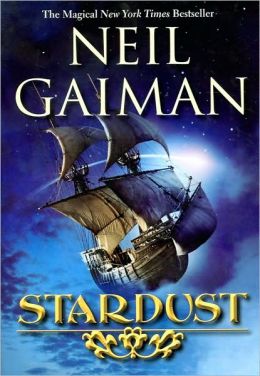
Stardust (1998)

Stardust. Neil Gaiman. 1998. 368 pages.

There was once a young man who wished to gain his Heart's Desire. And while that is, as beginnings go, not entirely novel (for every tale about every young man there ever was or will be could start in a similar manner) there was much about this young man and what happened to him that was unusual, although even he never knew the whole of it. 

Stardust is probably my favorite Neil Gaiman novel. It's set during the Victorian time period, and it has a classic fantasy-adventure feel to it. There is definitely some romance to it--it isn't a children's book, there's some adult content after all. All the elements work together for an enjoyable read!

In Victorian novels, it isn't unusual for an author to begin his or her story with extensive background, providing readers with information that sooner or later may prove important. Details on where the story is set, what life is like in that community, the families that live there, the story--romantic or practical--of the main character's parents, perhaps even going into great detail on the successes and failures, hopes and disappointments. Wilkie Collins, for example, can spend fifty pages or so just setting up the background for his novel. Gaiman spends the first chapter of Stardust doing just that, he sets up the family history so he can move the story forward sixteen or seventeen years and get off to a proper start in chapter two with the actual hero of the story, Tristran. Is this necessary?! Yes, in Tristran's case for his parentage makes him very unique. Still, it was a little unsettling to me--the first time at least. But I think it works.

There is a loveliness to the writing, the storytelling. It is rich in detail, in places, and at times very creative. I definitely enjoyed following Tristran Thorn on his quest. I liked seeing him transform into someone a bit wiser and kinder. I thought we met plenty of interesting characters along the way. Some of these characters I liked more than others! But overall, I definitely liked it. I think I loved it more the first time I read it, however.

When I first read Stardust in 2008, I wasn't as familiar with the time period as I am now, so paragraphs like this one meant little to me:
The events that follow transpired many years ago. Queen Victoria was on the throne of England, but she was not yet the black-clad widow of Windsor: she had apples in her cheeks and a spring in her step, and Lord Melbourne often had cause to upbraid, gently, the young queen for her flightiness. She was, as yet, unmarried, although she was very much in love. Mr. Charles Dickens was serializing his novel Oliver Twist; Mr. Draper had just taken the first photograph of the moon, freezing her pale face on cold paper; Mr. Morse had recently announced a way of transmitting messages down metal wires. (5)
Update: I've now seen the movie! It is quite different from the book! I enjoyed some of the changes, but not quite all of them. I think I definitely prefer the book to the movie. I thought the book was more clever, perhaps. I think one of my favorite things about the movie was the soundtrack! It was quite lovely!

© 2013 Becky Laney of Becky's Book Reviews
Saturday, December 15, 2012

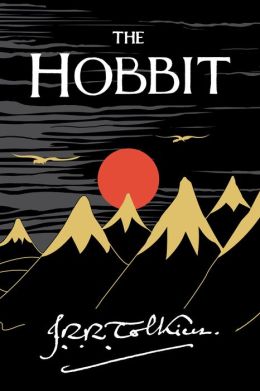
The Hobbit (MG)

The Hobbit. J.R.R. Tolkien. 1937.  320 pages.

In a hole in the ground there lived a hobbit. Not a nasty, dirty, wet hole, filled with the ends of worms and an oozy smell, nor yet a dry, bare, sandy hole with nothing in it to sit down on or to eat: it was a hobbit-hole, and that means comfort.

The Hobbit is one of my favorite children's books, or, should I say one of my favorite children's books that I discovered as an adult. This was my third time to read The Hobbit, and I think I love it a little more each time. I just love the beginning. I love meeting Bilbo Baggins and Gandalf. And I love how Bilbo is tricked into hosting all those dwarfs and manipulated into joining the expedition as a professional burglar. These opening chapters are so rich!  

I love the journey, the adventures and misadventures they have along the way. They happen into one calamity after another, and that is before they even come close to the "dangerous" part of their journey: the mountain with the dragon, Smaug, and all that glorious, wonderful treasure that Thorin can't wait to claim. These calamities provide adventure and drama, of course, but they are also preparing Bilbo. These calamities are crafting Bilbo into someone the dwarfs can trust and respect. And perhaps even more importantly Bilbo is realizing things about himself that he never would have if he'd never left his comfortable home.

These calamities are separate adventures, in a way. So it makes sense that to do the book justice, there should be multiple films.

Favorite quotes:
“Do you wish me a good morning, or mean that it is a good morning whether I want it or not; or that you feel good this morning; or that it is a morning to be good on?” 
“I am looking for someone to share in an adventure that I am arranging, and it's very difficult to find anyone.'
I should think so — in these parts! We are plain quiet folk and have no use for adventures. Nasty disturbing uncomfortable things! Make you late for dinner!”  
“Go back?" he thought. "No good at all! Go sideways? Impossible! Go forward? Only thing to do! On we go!" So up he got, and trotted along with his little sword held in front of him and one hand feeling the wall, and his heart all of a patter and a pitter.” 
“If you want to know what cram is, I can only say that I don’t know the recipe; but it is biscuitish, keeps good indefinitely, is supposed to be sustaining, and is certainly not entertaining, being in fact very uninteresting except as a chewing exercise.”  
“That was Thorin's style. He was an important dwarf. If he had been allowed, he would probably have gone on like this until he was out of breath, without telling anyone there anything that was not known already. But he was rudely interrupted.”
© 2012 Becky Laney of Becky's Book Reviews
Saturday, October 06, 2012

The Eye of the World

The Eye of the World (Wheel of Time #1) Robert Jordan. 1990. Tor. 814 pages. 

Perhaps I was just in the perfect mood for The Eye of The World, or maybe it's just that good. I do know that it was an experience. I read this one in just three days!!! I knew within a chapter or two that this one was just right for me, one that I'd really enjoy through and through. I enjoyed the world-building, the characterization, the storytelling, and, of course, the quest and adventure. If you don't like quests or journeys, or heroes-in-the-making setting out for long, uncertain journeys then perhaps this one wouldn't thrill you.

Three young men (Rand, Mat, and Perrin) are escaping danger and setting forth on a very dangerous journey with a couple of strangers (Moraine and Lan) whom they have reason both to trust and mistrust. On the one hand, Moraine has proven herself by helping to heal the wounded in Two Rivers after a devastating Trolloc attack. She saved Rand's father, Tam, when no one else would even try. So Rand, at least, owes her something. And she is trying to save all their lives--she knows all three are in great danger. On the other hand, Moraine is Aes Sedai, and Lan is her Warder. There has never been a story or tale told where Aes Sedai are good and trustworthy and safe. Also along for the journey are Egwene, a young woman who cares for Rand deeply, and Thom Merrilin, a gleeman--entertainer, storyteller, musician, etc. They are also joined by Nynaeve, a young woman, the local Wisdom, intent on one thing getting all three men back where they belong: Two Rivers.

There is definitely a good amount of uncertainty, mystery, and danger in The Eye of the World. Danger comes in many, many shapes and sizes. And there's plenty of action along the way leading up to some intense chapters at the end. I enjoyed it for the journey just as much as the end. I enjoyed the narrative style, for the most part.

I definitely LOVED it.

Read The Eye of the World
  • If you enjoy fantasy
  • If you really enjoy fantasy
  • If you like coming-of-age, going-on-a-quest fantasy
  • If you like world-building and storytelling

© 2012 Becky Laney of Becky's Book Reviews

Tuesday, July 10, 2012

Raider's Ransom (MG)

Raider's Ransom. Emily Diamand. 2009. Scholastic. 368 pages.

Cat puts up his nose to sniff the breath of wind barely filling the sail, and opens his small pink mouth to speak.

Knowing that I could never quite do justice to Raider's Ransom in my review, let me encourage you to just pick up this one and give it a try. I can't promise that you'll love it. But. You just may. It's that kind of book. The kind that actually delivers what it promises.
If you like action/adventure quests, I think you'll really, really appreciate Raider's Ransom. I think you'll enjoy the world Diamand created in the novel. I think there will be scenes that stay with you. I think you'll enjoy not only her world-building but her characterization and storytelling too.

The heroine of Raider's Ransom is a young girl, Lilly. She may be young, but she's a fisherman with a small (very small) boat of her own. And to the dismay of some, she's the owner of a cat, a sea cat. Not something to be taken lightly in her community of survivors. When she's at home, on land, she stays with her grandmother. But. Readers don't get a chance to see a more relaxed Lilly. For the novel opens with Lilly discovering the tragic truth: when she was out sailing her vessel, out fishing, the raiders (or should that be Raiders?) attacked her village. They were looking for something specific, the attack wasn't just random. I don't know if that makes things better or worse for Lilly since one of the things they were looking for was her cat. The Raiders kill Lilly's grandmother, and kidnap the Prime Minister's daughter. One might think that they kidnapped her for a nice ransom, but, they had something even more in mind. They return without their sought-after object, a particular jewel. And that's only the beginning. The problem? Well, I can't talk about this one without revealing too much. I think this is one of those that is best discovered all on your own. Trust me.

So. I won't go into details. But I will say we get another narrator. And that proves most interesting indeed! For I certainly wasn't expecting it at all.

This one went above and beyond all my expectations. It really did. It surprised me in a good way.

Read Raider's Ransom
  • If you like survival stories or starting over stories; 
  • If you like action/adventure stories with a quest, a journey, a mission
  • If you like action stories with battles and close escapes
  • If you like dystopias, novels set in the future with a society quite unlike our own
  • If you like good storytelling

© 2012 Becky Laney of Becky's Book Reviews

Wednesday, July 04, 2012

The Princess and Curdie (MG)

The Princess and Curdie. George MacDonald. 1883. 272 pages.

Curdie was the son of Peter the miner. He lived with his father and mother in a cottage built on a mountain, and he worked with his father inside the mountain.

The Princess and Curdie is the sequel to George MacDonald's The Princess and the Goblin. It is set several years after the events of the first book. And those are years that Curdie has spent away from Princess Irene--the young princess and the great-great-great-great-grandmother Irene. He hasn't completely forgotten the Princess and her father, the King. But he's a growing boy, a busy boy, and well, he needs a bit of a wake up call perhaps.

He has his own encounter with the old woman--the grandmother Irene. And it changes EVERYTHING. For she gives him a very unique gift--with the touch of his hand, he can know what a man or woman truly is: if they are truly human, or if there is a "beast" inside. If it sounds confusing, well, it is in a way. It definitely requires you to suspend your disbelief, to fully engage in this FANTASY world. This one excerpt will do a better job than I ever could in describing what this book is like, and what to expect from this adventure-fantasy-quest.
'Curdie,' she said in answer to his eyes, 'you have stood more than one trial already, and have stood them well: now I am going to put you to a harder. Do you think you are prepared for it?'
'How can I tell, ma'am,' he returned, 'seeing I do not know what it is, or what preparation it needs? Judge me yourself, ma'am.'
'It needs only trust and obedience,' answered the lady.
'I dare not say anything, ma'am. If you think me fit, command me.'
'It will hurt you terribly, Curdie, but that will be all; no real hurt but much good will come to you from it.'
Curdie made no answer but stood gazing with parted lips in the lady's face.
'Go and thrust both your hands into that fire,' she said quickly, almost hurriedly.
Curdie dared not stop to think. It was much too terrible to think about. He rushed to the fire, and thrust both of his hands right into the middle of the heap of flaming roses, and his arms halfway up to the elbows. And it did hurt! But he did not draw them back. He held the pain as if it were a thing that would kill him if he let it go—as indeed it would have done. He was in terrible fear lest it should conquer him.
But when it had risen to the pitch that he thought he could bear it no longer, it began to fall again, and went on growing less and less until by contrast with its former severity it had become rather pleasant. At last it ceased altogether, and Curdie thought his hands must be burned to cinders if not ashes, for he did not feel them at all. The princess told him to take them out and look at them. He did so, and found that all that was gone of them was the rough, hard skin; they were white and smooth like the princess's.
'Come to me,' she said.
He obeyed and saw, to his surprise, that her face looked as if she had been weeping.
'Oh, Princess! What is the matter?' he cried. 'Did I make a noise and vex you?'
'No, Curdie, she answered; 'but it was very bad.'
'Did you feel it too then?'
'Of course I did. But now it is over, and all is well. Would you like to know why I made You put your hands in the fire?' Curdie looked at them again—then said:
'To take the marks of the work off them and make them fit for the king's court, I suppose.'
'No, Curdie,' answered the princess, shaking her head, for she was not pleased with the answer. 'It would be a poor way of making your hands fit for the king's court to take off them signs of his service. There is a far greater difference on them than that. Do you feel none?'
'No, ma'am.'
'You will, though, by and by, when the time comes. But perhaps even then you might not know what had been given you, therefore I will tell you. Have you ever heard what some philosophers say—that men were all animals once?'
'No, ma'am.'
'It is of no consequence. But there is another thing that is of the greatest consequence—this: that all men, if they do not take care, go down the hill to the animals' country; that many men are actually, all their lives, going to be beasts. People knew it once, but it is long since they forgot it.'
'I am not surprised to hear it, ma'am, when I think of some of our miners.'
'Ah! But you must beware, Curdie, how you say of this man or that man that he is travelling beastward. There are not nearly so many going that way as at first sight you might think. When you met your father on the hill tonight, you stood and spoke together on the same spot; and although one of you was going up and the other coming down, at a little distance no one could have told which was bound in the one direction and which in the other. Just so two people may be at the same spot in manners and behaviour, and yet one may be getting better and the other worse, which is just the greatest of all differences that could possibly exist between them.'
'But ma'am,' said Curdie, 'where is the good of knowing that there is such a difference, if you can never know where it is?'
'Now, Curdie, you must mind exactly what words I use, because although the right words cannot do exactly what I want them to do, the wrong words will certainly do what I do not want them to do. I did not say you can never know. When there is a necessity for your knowing, when you have to do important business with this or that man, there is always a way of knowing enough to keep you from any great blunder. And as you will have important business to do by and by, and that with people of whom you yet know nothing, it will be necessary that you should have some better means than usual of learning the nature of them.
'Now listen. Since it is always what they do, whether in their minds or their bodies, that makes men go down to be less than men, that is, beasts, the change always comes first in their hands—and first of all in the inside hands, to which the outside ones are but as the gloves. They do not know it of course; for a beast does not know that he is a beast, and the nearer a man gets to being a beast the less he knows it. Neither can their best friends, or their worst enemies indeed, see any difference in their hands, for they see only the living gloves of them. But there are not a few who feel a vague something repulsive in the hand of a man who is growing a beast.
'Now here is what the rose-fire has done for you: it has made your hands so knowing and wise, it has brought your real hands so near the outside of your flesh gloves, that you will henceforth be able to know at once the hand of a man who is growing into a beast; nay, more—you will at once feel the foot of the beast he is growing, just as if there were no glove made like a man's hand between you and it.
'Hence of course it follows that you will be able often, and with further education in zoology, will be able always to tell, not only when a man is growing a beast, but what beast he is growing to, for you will know the foot—what it is and what beast's it is. According, then, to your knowledge of that beast will be your knowledge of the man you have to do with. Only there is one beautiful and awful thing about it, that if any one gifted with this perception once uses it for his own ends, it is taken from him, and then, not knowing that it is gone, he is in a far worse condition than before, for he trusts to what he has not got.'
'How dreadful!' Said Curdie. 'I must mind what I am about.'
'Yes, indeed, Curdie.'
'But may not one sometimes make a mistake without being able to help it?'
'Yes. But so long as he is not after his own ends, he will never make a serious mistake.'
'I suppose you want me, ma'am, to warn every one whose hand tells me that he is growing a beast—because, as you say, he does not know it himself.'
The princess smiled.
'Much good that would do, Curdie! I don't say there are no cases in which it would be of use, but they are very rare and peculiar cases, and if such come you will know them. To such a person there is in general no insult like the truth. He cannot endure it, not because he is growing a beast, but because he is ceasing to be a man. It is the dying man in him that it makes uncomfortable, and he trots, or creeps, or swims, or flutters out of its way—calls it a foolish feeling, a whim, an old wives' fable, a bit of priests' humbug, an effete superstition, and so on.'
'And is there no hope for him? Can nothing be done? It's so awful to think of going down, down, down like that!'
'Even when it's with his own will?'
'That's what seems to me to make it worst of all,' said Curdie.
'You are right,' answered the princess, nodding her head; 'but there is this amount of excuse to make for all such, remember—that they do not know what or how horrid their coming fate is. Many a lady, so delicate and nice that she can bear nothing coarser than the finest linen to touch her body, if she had a mirror that could show her the animal she is growing to, as it lies waiting within the fair skin and the fine linen and the silk and the jewels, would receive a shock that might possibly wake her up.'
'Why then, ma'am, shouldn't she have it?'
The princess held her peace.
'Come here, Lina,' she said after a long pause.
From somewhere behind Curdie, crept forward the same hideous animal which had fawned at his feet at the door, and which, without his knowing it, had followed him every step up the dove tower. She ran to the princess, and lay down flat at her feet, looking up at her with an expression so pitiful that in Curdie's heart it overcame all the ludicrousness of her horrible mass of incongruities. She had a very short body, and very long legs made like an elephant's, so that in lying down she kneeled with both pairs. Her tail, which dragged on the floor behind her, was twice as long and quite as thick as her body. Her head was something between that of a polar bear and a snake. Her eyes were dark green, with a yellow light in them. Her under teeth came up like a fringe of icicles, only very white, outside of her upper lip. Her throat looked as if the hair had been plucked off. It showed a skin white and smooth.
'Give Curdie a paw, Lina,' said the princess.
The creature rose, and, lifting a long foreleg, held up a great doglike paw to Curdie. He took it gently. But what a shudder, as of terrified delight, ran through him, when, instead of the paw of a dog, such as it seemed to his eyes, he clasped in his great mining fist the soft, neat little hand of a child! He took it in both of his, and held it as if he could not let it go. The green eyes stared at him with their yellow light, and the mouth was turned up toward him with its constant half grin; but here was the child's hand! If he could but pull the child out of the beast! His eyes sought the princess. She was watching him with evident satisfaction.
'Ma'am, here is a child's hand!' said Curdie.
'Your gift does more for you than it promised. It is yet better to perceive a hidden good than a hidden evil.'
Curdie sets out on his mission/quest to visit the city of Gwyntystorm--where the King and Princess Irene live. He doesn't know exactly why he's going--what the desired outcome is. But he trust that he's been sent for a reason, for a higher purpose and that is more than enough for him.

I will warn you that Irene, the heroine from The Princess and the Goblin, does not appear until the novel is halfway over. This isn't her story, this isn't her adventure. The adventure belongs more to Curdie and Lina than anyone else. 

This is more fantasy than fairy tale. There is definitely a struggle between good and evil. But I definitely liked it. At times I even loved it.


Read The Princess and Curdie
  • If you're a fan of George MacDonald
  • If you enjoy children's classics
  • If you enjoy children's fantasy
  • If you enjoy C.S. Lewis and J.R.R. Tolkien
  • If you enjoy adventurous fantasy novels with quests; the ongoing struggle between good and evil
© 2012 Becky Laney of Becky's Book Reviews

Friday, July 01, 2011

The Search for Wondla (MG)

The Search for Wondla by Tony DiTerlizzi. 2010. Simon & Schuster. 477 pages. 

Eva Nine was dying. The tiny scarlet dots on her hand mirrored the glowering eyes of the snake that had just bitten her.

I didn't love The Search for Wondla. I'm not even sure I liked it. One of the reasons it didn't quite work for me was that the ending left me unsatisfied. I wanted to shout at the book, "That's not an ending!" Then again, maybe it's not fair to judge a first book in a series by the ending.

Eva Nine, our heroine, may just be the last human on the planet. She has spent her whole life underground in Sanctuary. She was raised by a robot--albeit a robot with a mothering program built right in. (Muthr is always, always nagging Eva Nine to do this or that. Little things like picking up her room, etc.) When the novel opens, Eva Nine is in the middle of a test to determine if she's ready to live Sanctuary and venture into the real world above ground. Her muthr isn't convinced that she is ready. But she's going to give her one more chance, if Eva Nine doesn't improve, well, they may just have to go back to the basics.
Six Basic Survival Skills for Humans
1. Trust technology
2. Signal others
3. Find shelter
4. Create fire
5. Procure food and water
6. Know first aid
But ready or not, Eva Nine may be forced into the cruel, ugly world of unknowns. When someone breaks into sanctuary--destroying it in the process--Eva Nine is forced to flee the only home she's ever known. She is taking a few technological items with her, like her Omnipod, but what she soon discovers is that NO technology can protect her now, keep her safe, or guide her. The whole world--the whole planet--is unknown.

But Eva Nine won't be on her own for long, though her companions are not human--not even close.

The Search for Wondla is a blending of so many genres and subgenres. It's both science fiction and fantasy, in my opinion. It's an adventure story--a survival story. And of course it's one big mystery. Where is Eva Nine? What planet is she on? How did she get there? Is she really, truly the last human? Where did all these species come from?

The world Tony DiTerlizzi created is interesting. At times I found it confusing, I had to keep telling myself to keep reading and that it would start making sense eventually if I just read long enough. And that worked, for the most part. It helped when I decided the confusion might just be intentional. Eva Nine, our heroine, is thrust into a world that is completely foreign to her. She doesn't recognize any of the trees or plants. She doesn't recognize any of the life forms. These creatures--animals--speak in their own languages. She doesn't know what's dangerous and what's safe. She's completely out of her element.

Have you read this one? What did you think?

© 2011 Becky Laney of Becky's Book Reviews
Monday, April 25, 2011

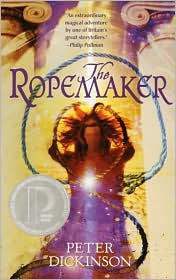
The Ropemaker (MG/YA)

The Ropemaker. Peter Dickinson. 2001. Random House. 384 pages.

It had snowed in the night. Tilja knew this before she woke, and waking she remembered how she knew. Somewhere between dream and dream a hand had shaken her shoulder and she'd heard Ma's whisper.

The Ropemaker reminded me of all the reasons I love reading fantasy. Did I love it? I didn't want it to end! I wanted to savor every moment of it. Why? Well, because I loved not only the characters, not only the story, but the world Peter Dickinson created! My favorite character happens to be our heroine, Tilja.

Tilja's valley has almost always--twenty generations--been protected by magic. Protected from its neighbors--those who would love to tax, tax, tax in the name of "providing protection" and those who would invade and plunder and conquer. There is a story passed down through the generations--a story some scarcely believe these days--about how the valley came to be protected. A story about two people on a quest for a magician named Asarta. We learn this story in chapter two. Here is how it starts:

There was time in the Valley, of course--how could there not be? But there was no history. In all the rich farmland between the northern mountains and the forest there were no wars, or reports of wars, only days, seasons, generations. No kings or other rulers, only parents, grandparents, ancestors. For eighteen generations nothing had happened in the Valley that anyone would have thought worth putting in a book, or setting up a memorial stone to record. So, no history. Only time. And the story of Asarta. (17)

Did I mention I love the writing?! Well, I did!!! Anyway, Tilja, our unlikely heroine, joins three others on a quest to "save" the magic that protects them. For they know the magic is fading, that soon unwelcome guests might invade--when they realize the truth. So Tilja and her grandmother, Meena, and Tahl, and his grandfather, Alnor, set out on a dangerous and uncertain journey. Their quest is to find the magician, Faheel, the magician who first helped the Valley all those generations ago. Is he still alive? Can he be found? Does he want to be found? Will he help them? Can he help them? Has his powers grown stronger or weaker through the years?

The Ropemaker is about their journey, their quest, as they face countless dangers, as they meet many, many people along the way. This journey will require them to be wise and courageous and diligent. To protect the Valley, to protect their families, their homes, their villages, they may have to risk it all.

I enjoyed this one very much! I'd definitely recommend it.

© 2011 Becky Laney of Becky's Book Reviews

Saturday, May 15, 2010

The Red Pyramid (MG)


The Red Pyramid. (Kane Chronicles #1) Rick Riordan. 2010. May 2010. Hyperion. 528 pages.
We only have a few hours, so listen carefully.
If you're hearing this story, you're already in danger. Sadie and I might be your only chance.
Go to the school. Find the locker. I won't tell you which school or which locker, because if you're the right person, you'll find it. The combination is 13/32/33. By the time you finish listening, you'll know what those numbers mean. Just remember the story we're about to tell you isn't complete yet. How it ends will depend on you.
The most important thing: when you open the package and find what's inside, don't keep it longer than a week. Sure it'll be tempting. I mean, it will grant you almost unlimited power. But if you possess it too long, it will consume you. Learn its secrets quickly and pass it on. Hide it for the next person, the way Sadie and I did for you. Then be prepared for your life to get very interesting.
The Red Pyramid is narrated by Carter and Sadie, a brother-sister team who hold the fate of the world in their hands. Carter has spent most of his life traveling the world with his father, Dr. Julius Kane, an archaeologist who specializes in Ancient Egypt. Sadie, his sister, has spent most of her life living in England with her grandparents--the Fausts. She only sees her dad and her brother a couple of times a year. (It's been like that since their mother's tragic death). But one Christmas Eve, everything changes. Because that is when Dr. Kane accidentally-on-purpose explodes the Rosetta Stone in the British Museum. And life is never the same for these two after that.

Carter and Sadie discover many things in The Red Pyramid. For starters that Egyptian gods and goddesses are very real. And that they can be unleashed in the modern world with great big consequences. Sometimes for good, sometimes for evil. One god, Set, is out to destroy the world. And it falls to these two kids to stop him. Of course, they aren't working all on their own. But just who is helping, well, I'll let you discover that on your own! Then there are the family secrets--details about just who these two children really are...and their connection with the House of Life, a secret order of magicians.

If you're a fan of Rick Riordan's Percy Jackson and the Olympians series, chances are you'll pick this one up no matter what I say, no matter what any reviewer says. How do I think these two compared? Well, that's tough.

I think The Red Pyramid is a bit longer than The Lightning Thief. I felt it to be a bit weightier as well. So much time is spent setting everything up. The little details here and there that give a richness, a depth, to this fantasy world, but at the same time slow it down just a bit. (Not enough that I would ever stop reading, stop caring. Just that I wasn't able to speed through this one.)

I think it's an interesting choice to have two narrators with different strengths and weaknesses. Interesting to have biracial narrators facing their own challenges--you know in addition to facing the powers of evil. (Carter is darker than his sister, and sometimes people don't realize that these two are brother-and-sister. Especially since their mom's death. And he has faced some discrimination in his life. And Sadie, well, Sadie has some issues with her dad's lack of involvement in her life.)

I can't say I feel as connected with either Sadie or Carter as I did with Percy Jackson upon first reading it. That's not to say that these two may not grow on me with further reading. (Bast just isn't Grover. And the baboon Khufu just annoyed me.) But I would definitely want to keep reading more of this series!

I did enjoy The Red Pyramid. I found it to be an enjoyable, interesting read. I would recommend it.

Other reviews: Book Aunt, Random Ramblings,

© Becky Laney of Becky's Book Reviews

Saturday, April 24, 2010

The Thief (MG/YA)


The Thief by Megan Whalen Turner. 1996. HarperCollins. 224 pages.

I didn't know how long I had been in the king's prison. The days were all the same, except that as each one passed, I was dirtier than before.

Gen is a thief. He's in prison--in Sounis--for boasting that he could steal anything. Well, more precisely that he could steal something from the King. Has he been forgotten? Not exactly. There are those that would have him released from prison so they can use his services. Magus, with the approval of the King, wants Gen to steal something of mythological importance from a neighboring country. Hamiathe's Gift. Can he do it? He must if he wants his freedom! He will embark on a journey, on an adventure, with some interesting companions. Can he turn these enemies into friends?

I really enjoyed The Thief. I loved the world Megan Whalen Turner created. There are three very different countries explored: Sounis, Eddis, Attolia. Different countries, different monarchs, different intrigues, different gods and goddesses. This is a richly detailed fantasy novel. And I thought the storytelling worked well. I would definitely recommend this one!

© Becky Laney of Becky's Book Reviews