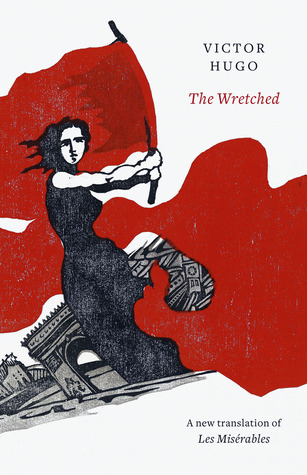
The Wretched. Victor Hugo. Translated by Christine Donougher. 1862/2013. 1456 pages. [Source: Bought]
First sentence: In 1815, Charles-François-Bienvenu Myriel was bishop of Digne. He was an old man of about seventy-five. He had been bishop of Digne since 1806.
Premise/plot: An ex-convict does his best to live life according to his conscience. Will it ever be enough?
My thoughts: I love, love, love Victor Hugo's Les Miserables. I believe this is my third time to review it for the blog? My
2013 review. My
2014 review.
Political, philosophical, spiritual, dramatic, and romantic. Each word describes the novel,
in part.
While there are many characters in this novel, I loved the narrator the
best of all. Who are some of the characters? Bishop Myriel, Jean
Valjean, Fantine, Inspector Javert, Cosette, Marius, Eponine, Enjolras,
and Gavroche--just to name a few.
Jean Valjean is an ex-convict who seeks shelter from Bishop Myriel one
night. Though he's been treated only with kindness, Valjean in his
bitterness (he was sent to prison for stealing a loaf of bread), he
steals the bishop's silver. When the theft is discovered, the bishop is
all compassion telling the officials that there has been a
misunderstanding. Valjean did not steal the silver; it was given as a
gift. In fact, he's happy to give Valjean his silver candlesticks as
well. Valjean is shocked and overwhelmed. The meeting turns out to be
quite life-changing.
When readers next meet Valjean, he has a new name and life. Monsieur
Madeleine is a successful business man. He has a BIG heart. He's always
giving. He's always thinking of others. He's always doing what he can,
when he can to make a difference when and where it matters most. One
woman he is determined to help is a young, single mother, Fantine.
Circumstances have separated Fantine from her child, Cosette, but,
Valjean is determined to correct as many wrongs as he can in this
situation. He will see to it personally.
Unfortunately, his past catches up with him. He learns that a man has
been arrested; "Jean Valjean" has been caught. Of course, Madeleine
knows this is nonsense. Can he let another take his place in prison? If
he tells the truth then he can no longer help the poor, but if he
doesn't tell the truth, how could he live with himself? He does the
honorable thing--though it is one of the greatest challenges he's faced
so far.
But that means, for the moment, that Cosette is left in unpleasant circumstances...
There comes a time, an opportunity for Valjean to escape. What he does
with his freedom--this time he's assumed drowned, I believe--is go and
find Cosette. The two become everything to one another. Cosette is the
family he's never had, never even knew he needed or wanted... the two
end up in Paris.
Almost half of the novel follows the love story between Marius and
Cosette. But it isn't only a love story. Marius is a poor man in
conflict with his rich grandfather. The two disagree about many things.
But their main source of disagreement is politics. At first, Marius is
swept up in his father's politics, with a new awareness of who his
father was as a soldier, as a man, as a possible hero. But later, Marius
begins to think for himself, to contemplate political and philosophical
things for himself. He becomes friendly with a political group at this
time. But his love of politics dims when he falls in love with
Cosette...and she becomes his whole reason for being. For the longest
time these two don't even know each other's names! This romance isn't
without challenges...
This novel has so much drama! I found it beautifully written. So many
amazing passages! Such interesting characters! I'm not sure I loved the
ending. And I was frustrated with Marius at times. But. I definitely
loved this book!
It's also a novel heavy on details. When it's good, it's REALLY good.
But at times some of the details are too taste-specific. In other words,
some of the details weigh the story down. At times Les Miserables is
boring. It's worth reading. It is. It's worth pushing through to the
end. It's okay to skim certain sections, in my opinion, because it is
one of the most satisfying reading experiences overall. Not that I LOVE
the ending, though I think I may have made peace with it this time
around.
I definitely enjoyed this translation of the novel. I LOVED the introductory materials. I found the notes to be thorough. If I were to ever STUDY the book, this would be the translation I'd use because the notes are so extensive.
Favorite quotes:
- True or false, what is said about men often figures as large in their lives, and above all in the fate that befalls them, as what they do.
- ‘To sin as little as possible, that is the law of mankind. Not to sin at all is the angel’s dream. Everything earthly is subject to sin. Sin is a gravitational force.’
- Where the telescope ends, the microscope begins. Which of the two has the greater vision? You choose.
- Certain thoughts are prayers. There are moments when, whatever position the body might be in, the soul is on its knees.
If you are human, be love.
-
Love is an ardent forgetfulness of everything else.
-
Suspicions are nothing but wrinkles.
- Alas! to have climbed does not preclude falling. This can be seen in history more frequently than anyone would wish.
-
Everything can be parodied, even parody.
- To love, or to have loved, is enough. Ask for nothing more. There is no other pearl to be found in life’s shadowy convolutions. To love is an achievement.
The first step is nothing, it is the last step that is hard.
-
When the heart is on the slippery slope, there is no stopping it.
-
Love each other always. That’s about the only thing in the world that matters: loving each other.
© 2017 Becky Laney of
Becky's Book Reviews