Showing posts with label civil rights movement. Show all posts

Wednesday, January 10, 2024

3. Coretta: The Autobiography of Mrs. Coretta Scott King


Coretta: The Autobiography of Coretta Scott King. Coretta Scott King. Illustrated by Ekua Holmes. 2024. [January] 40 pages. [Source: Library] [nonfiction picture book, biography, autobiography, children's nonfiction]

First sentence: I was born on April 27, 1927, in Heiberger, Alabama, at a time and in a place where everything I would eventually become was impossible even to imagine. 

Premise/plot: This is a nonfiction picture book for children [and older readers.] It is adapted from a memoir or autobiography written by Coretta Scott King, civil rights activist and wife of Martin Luther King Jr. 

My thoughts: Without a doubt librarians and teachers will pick this one up and push it, push it, push it. Is that a bad thing? Probably not. Just honestly saying that this is probably more a book adults will encourage children to choose instead of being one of those books that children will choose to pick up and read on their own. No judgment intended. 

As an adult, I appreciated it. I definitely found the illustrations to be wonderful. I liked the text as well.  


© 2024 Becky Laney of Becky's Book Reviews

Friday, October 07, 2022

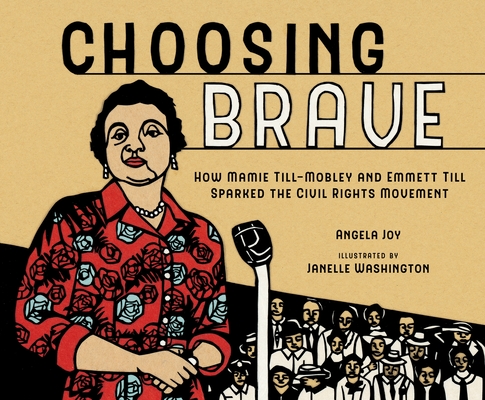
122. Choosing Brave


Choosing Brave: How Mamie Till-Mobley and Emmett Till Sparked the Civil Rights Movement. Angela Joy. Illustrated by Janelle Washington. 2022. 64 pages. [Source: Library]

First sentence: The boy they found was far frome home,
far from Mother and Grandmother.
"Here on a visit," Papa Mose would say.
The sheriff set out to dig a grave that day,
To hide the crime in the mud of Mississippi,
Where no one would see the boy's suffering.
But Mamie did the harder thing.
She said, "No. You send my son home."
It was the braver thing
That changed everything.

Premise/plot: Choosing Brave is a picture book biography of Mamie Till-Mobley, the mother of Emmett Till, and perhaps the mother (or godmother) of the Civil Rights Movement. Because of the incredibly, heavy subject matter, I'm thinking it is a picture book for older readers (upper elementary through adults). 

My thoughts: Choosing Brave is a powerful, compelling, beautiful, haunting, poignant biography written in verse. It does require a bit of 'bravery' to read it because the subject matter is so heartbreaking and rightly heavy. Each word, each phrase, each line was like a puzzle piece coming together to make an incredible picture. The recurring theme of Mamie choosing to do the harder thing, the braver thing because it was RIGHT thing gives readers much food for thought. 

Definitely recommended.
 

© 2022 Becky Laney of Becky's Book Reviews

Friday, March 02, 2018

Let The Children March

Let the Children March. Monica Clark-Robinson. Illustrated by Frank Morrison. 2018. Houghton Mifflin Harcourt. 40 pages. [Source: Review copy]

First sentence: One warm spring night, my family went to church. We weren't there to have regular services. We were there to hear Dr. King speak. We were there to plan. He wanted to raise an army of peaceful protesters to fight for freedom. His brown eyes flashing fire and love, Dr. King told us the time had come to march.

Premise/plot: This nonfiction picture book is about the children's crusade aspect of the civil rights movement in the 1960s. The timeline for the movement begins on the end papers. But it's probably not like the timelines you're used to seeing. Each date and fact is on a sign held by a child. A brief prologue sets the story into context:
1963. Birmingham, Alabama. I couldn't play on the same playground as the white kids. I couldn't go to their schools. I couldn't drink from their water fountains. There were so many things I couldn't do. 
The book is one answer to the question: Can I make a difference in the world? Children stepped up to become Dr. King's army and make a difference, they did!

My thoughts: I would definitely recommend this one. The narrative is well-written. It's written in the first-person giving the book a personal aspect. History is not boring--never boring--when you view it through personal lens or personalities. History is more than facts and dates to memorize. The narrative is also well-researched. The book includes an afterward, quote sources, and a bibliography.

I LOVED the illustrations. Cover-to-cover the illustrations make a visual impact on the reader. In my opinion, they capture the emotional intensity and drama of the narrative.

Text: 5 out of 5
Illustrations: 5 out of 5
Total: 10 out of 10

© 2018 Becky Laney of Becky's Book Reviews

Monday, January 15, 2018

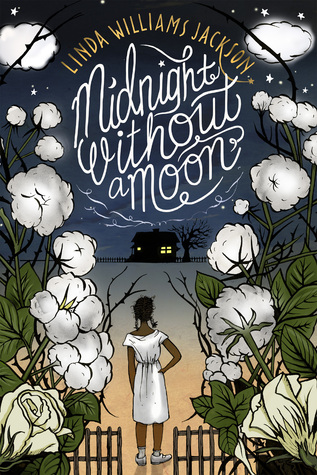
Midnight without a Moon

Midnight Without a Moon. Linda Williams Jackson. 2017. HMH. 320 pages. [Source: Review copy]

First sentence: Papa used to say I had a memory like an elephant's. According to him, an elephant never forgets. I'm not sure how my self-educated, tenant-farming grandfather knew what an elephant's memory was like, but he sure was right about mine. Most folks didn't believe me, but I could remember all the way back from when I was only a year and a half old, when my brother Fred Lee was born. That was June 1943.

Premise/plot: Midnight Without a Moon is set in the summer/autumn of 1955 in Mississippi. It is narrated by Rose Lee Carter, a thirteen year old being raised by her grandparents. Her mother abandoned Rose and her brother, Fred, when she found a new family: Mr. Pete and his two young children. Rose and Fred became "Aunt" and "Uncle." Soon after the novel opens, she learns that her mother, stepfather, and step-siblings are moving to Chicago. This news comes on a day that was already hard for Rose.

The novel in fact opens with Rose Lee being almost run off the road by a white teenage boy. Her grandmother is more upset by the fact that Rose dropped the eggs she was delivering than by the fact that Rose could have been killed. If she was killed, I get the sense that Ma Pearl would still be more upset at the loss of eggs, and the loss of a field worker than a grandchild.  If grandchildren were ranked, Rose Lee knows she'd be at the bottom. She is almost certain it's because she's the darkest skinned grandchild. Ma Pearl's favorite, Queen, is the lightest skinned. Queen, who is nearly sixteen, does no house work or field work.

If the novel just focused on the troubled home life of Rose Lee, it would be an emotional coming-of-age novel. But it's not. Rose Lee is coming-of-age at a tumultuous time. While Emmett Till's death isn't the only death--murder--that summer, it is the one that hits closest to home since he was so very young, near Rose's own age.

The community is torn apart: not just facing adversaries from without--the whites--but also from within. There are those--like Ma Pearl--that think the NAACP is of the devil. That Negroes that are killed are killed because they're trouble-makers, they're asking for it. Ma Pearl, for example, blames Till's death not on the white men that murdered him for supposedly whistling at a white woman but on Till and his mother. She should never have let him come south. The mother lacked sense; she should have known better.

Ma Pearl's harsh words aren't just for her closest kin; she is cruel to most everybody.

My thoughts: I took my time reading this one. It was a heartbreaking, emotional read. I ached for Rose. To bear witness to the verbal and sometimes physical abuse was difficult to do. It didn't take me long to HATE Ma Pearl. She made me furious. She left me speechless at times. Rose held onto hope, and her courage to keep hoping kept me reading. I loved her relationship--friendship--with the preacher's son, Hallelujah. Some of my favorite scenes are their conversations with each other.

One more thing I'd like to add is that faith is important in this novel. Rose Lee gets saved in the book and receives baptism. Not many books these days deal with faith in a realistic, positive way. 

Quotes:
Maybe Hallelujah was right. Maybe Mississippi itself was hell. No. Mississippi was worse than hell. At least in hell you know who the enemy is. And at least, if you believe the Bible, you know how to keep yourself from going there. But in Mississippi you never knew what little thing could spark a flame and get you killed. (178)
"Stars can't shine without darkness," I said. "What?" "Stars can't shine without darkness." "What's that supposed to mean?" "I have no idea. I don't even know where the words came from....
"Stars can't shine without darkness," Hallelujah repeated. "You've got to have some darkness to know what light is. If every Negro who could leave packed up and left, the struggle wouldn't be the same. Dreams have more meaning when you have to fight for them. (254-5)

© 2018 Becky Laney of Becky's Book Reviews

Monday, November 07, 2016

March: Book One

March: Book One. John Lewis, Andrew Aydin. Illustrated by Nate Powell. 2013. 128 pages. [Source: Library]

First sentence: Can you swim? No. Well, neither can I--but we might have to.

Premise/plot: March is the graphic novel autobiography of John Lewis. So far, there are three volumes in this autobiography. Today, I am reviewing book one. Lewis gives us an incredible behind-the-scenes glimpse of the civil rights movement. This one also has a built-in framework: it is set in 2009, and he's reflecting on his life before attending the Inauguration.

My thoughts: Dare I say this one is a must read? I'm tempted, really tempted. (And if you follow me on the blog and know my tastes inside and out, then you know that I don't usually read graphic novels.)

What I like best about this one is that it is engaging, compelling, emotional, personal, and above all else cohesive. It gives you a truer sense of the 'big picture' of the civil rights movement than any other book I've read--that I can remember at least. (When you read 400+ books a year, I'll be the first to admit that you don't necessarily recall most of them with much detail.)

I also love the amount of detail. (For example, that he used to preach to his chickens!)

I've read the first two books now and I'm excited to begin the third.


© 2016 Becky Laney of Becky's Book Reviews

Friday, January 18, 2013

Kizzy Ann Stamps (2012)

Kizzy Ann Stamps. Jeri Watt. 2012. Candlewick. 192 pages.

Dear Miss Anderson,
My teacher, Mrs. Warren, says I have to write you, and when Mrs. Warren says to do something, you do it. 

Kizzy Ann Stamps is set in Virginia in 1963. Our heroine, Kizzy, is nervous about starting public school--the newly integrated public school. Her old school is closing, her old teacher retiring, just so Kizzy and the other students will have the best opportunity to succeed. The novel is told through a series of letters and journal entries: Kizzy writing to her new (white) teacher Miss Anderson. Through these entries, readers meet Kizzy and her family, but even more importantly they will meet her border collie, Shag. (These two are definitely the best of friends.) Readers will also learn a little something about the times in which Kizzy and her family lived. It's a good coming-of-age novel.

Kizzy's self-description:
I'm not frilly, not froufrou, not fancy. I am plain and down to business. I'm a no-bow girl, like Shag is a no-bow dog. I am not a strawberry sundae or a dream. I am just me. I am who I am. I am jeans, dirt on my hands, and my dog with me at the end of the day. (44)
Other favorites:
Folks may be pretending to offer some chances to black people, going to school together and all, but this is still a place that can see Medgar Evers shot down in his driveway like he is nothing and no one gets arrested. This is still a place where a white man can tell somebody else to switch a black girl in public and no one does a thing. You say that things are changing, Miss Anderson, but I don't see much changing at all. (62)
All I want to do is move on, especially from the scar, away from it and from the people who stare and make me feel like I am some sort of a freak because I have a crease on my face that makes me different from them. Differences aren't welcome. Being the same is what matters. People like same. And I'm not the same. I'm me. (80)
Mama says you can learn something from everyone in the world, but I don't know what I can learn from them. I know what I learn from eating with Omera and Ovita, the twins. They hardly say boo, except when they talk to each other in their twin language, so what I learn is Christian patience. I am exhausted after eating with them, and also more than a little annoyed. But Granny Bits says it is good for my soul to be tried by fire. Well, I am getting a good workout on my patience, that's for sure. (96)
How can one man dying make the whole world hush. (103)
I love words. They just pour over you like hot syrup on corn bread. Drizzle, drizzle, drizzle, rush, rush, rush. (153)
Read Kizzy Ann Stamps
  • If you have an interest in dog shows and/or training dogs
  • If you have an interest in spelling bees
  • If you like heroines who LOVE writing
  • If you are interested in the civil rights movement and school integration
  • If you enjoy historical fiction

© 2013 Becky Laney of Becky's Book Reviews

Thursday, February 09, 2012

Sylvia & Aki (MG)

Sylvia & Aki. Winifred Conkling. 2011. Random House. 160 pages.

Sylvia Mendez imagined her first day of third grade at Westminster School. She would use her freshly sharpened yellow pencils to write her name in cursive at the top of her worksheets. Her just-out-of-the-shoe-box black Mary Janes would glide across the polished linoleum of the hallway. At the end of the day, she would come home and her father would hug her and ask, "What did you learn today?" Then she would tell him about her teacher and her classmates and everything else.
Sylvia never imagined the one that that actually happened even before her first day of school: she was turned away.

This wonderful little book is based on true events. The main characters Sylvia Mendez and Aki Munemitsu are real people, the novel is based on their experiences during World War II.

Sylvia Mendez and her siblings have been told they cannot attend Westminster School because they are Mexican. They will need to attend the Mexican school in the county. Every Mexican--no matter where they live--are to go to the same school. To say that the two schools are anywhere close to equal would be a joke. But Sylvia's father takes his children's education VERY seriously. And the answer the school board gives him just isn't acceptable to him. What he sees is injustice, and he wants it to end. This fight for justice and equality will end in court. And the chapters focused on this trial are fascinating and disturbing. Those chapters alone would make this one a worthy read.

Aki Munemitsu and her family are one of many families of Japanese descent being deported from California after the bombing of Pearl Harbor. Her family is being sent to an internment camp in Arizona. The novel focuses on her experiences during those years.

So how do these two stories connect? Sylvia's father is leasing the farm from Aki's family. Sylvia is living in Aki's house, sleeping in her bedroom. Sylvia discovers Aki's doll, the doll she had to leave behind. Sylvia decides to go with her dad on one of his trips to the internment camp to pay rent. The two girls meet and decide to write one another.

I liked this one. I did. It was a wonderful little novel. I found it informative and fascinating. I learned so much while reading this one. I would definitely recommend it!

Favorite quotes:

After weeks of trying to convince people to sign his letter to the school board stating that Mexican and white children should go to school together, Sylvia's father had collected only eight signatures.
"What are you going to do with the letter?" Sylvia asked her father. She didn't think he would turn it in with so few names.
"I'm going to deliver it," he said. "It would be the right thing to do, even if no one else is willing to sign."
Sylvia rode with her father to the courthouse in Santa Ana on the day he dropped off the letter. Just a couple of blocks from the courthouse Sylvia saw a sign posted in a diner window: NO DOGS OR MEXICANS. The words made her feel sick. She was glad her father had spotted someone he knew on the street and hadn't noticed the sign.
That sign is talking about me, she thought. Dogs and Mexicans and me. The sign gnawed at Sylvia all afternoon and into the evening. Before drifting off to sleep that night, she stared at the ceiling and thought about how those four little words could hurt her so much. Then she recalled the hateful signs she had seen posted in town about the Japanese--hand-lettered signs reading JAPS GO HOME and government-printed notices telling them that they had to go away, to leave their houses, to go to the camps. This made her think of the girl she knew only from a photograph and the few scraps of her life that were left in what was now Sylvia's bedroom.
How did Aki feel when she saw those signs and read those posters? Sylvia wondered. Did Aki feel as hurt as I do now?
Sylvia looked over at her dolls. Carmencita leaned against the corner of one shelf, and Keiko stood in the corner of another.
Sylvia got out of bed and moved Keiko to the shelf next to Carmencita. She placed the dolls side by side, then stood back. How nice they look together--almost like sisters. She rested Keiko's pale china hand in Carmencita's brown cloth one. It seemed right and good to see them so close. I wonder if I will ever meet Aki. Could we ever be friends? (65-6)

Read Sylvia and Aki
  • If you like historical books written for children
  • If you like books written about this time period, the second world war
  • If you like books written about different cultures

© 2012 Becky Laney of Becky's Book Reviews

Thursday, December 22, 2011

The Help

The Help. Kathryn Stockett. 2009. Thorndike Press. 722 pages.

August 1962
Mae Mobley was born on a early Sunday morning in August, 1960. A church baby we like to call it. Taking care a white babies, that's what I do, along with all the cooking and the cleaning. I done raised seventeen kids in my lifetime. I know how to get them babies to sleep, stop crying, and go in the toilet bowl before they mamas even get out a bed in the morning.

Have you read The Help yet? What did you think?! I thought it was one of the best books ever. It was incredibly intense, very emotional, fascinating, disturbing, thought-provoking and unforgettable. I could go on and on. It's just one of those books that I know I'll never forget. One of those books that I just have to recommend.

If you're looking for great storytelling, you'll find it in The Help. If you're looking for great characters--very well-developed, unforgettable characters--you'll find it in The Help. If you want an absorbing, fascinating, can't-put-down book, you'll find it in The Help.

The Help is set in Jackson, Mississippi, in the early sixties. To be precise, 1962-1964. The story is narrated by three characters. Two black maids, Aibileen, who works for Miss Elizabeth Leefolt, and Minny, who works for Miss Celia Foote, and a young white woman, Miss Skeeter, who dreams of becoming a journalist or novelist. (Miss Skeeter's 'real' name is Eugenia Phelan.) Each narrator has their  own story to tell. Each is very human, very memorable, very unique. Each voice matters in The Help. In fact, that could be one of the themes perhaps, that each person has a story to tell, but not every person has the freedom to tell it--well, not without taking risks.

So, one day Miss Skeeter is playing bridge with her friends. She is shocked by the turn of conversation. Is shock the right word? Maybe not. Perhaps made uncomfortable is a better fit. The disturbing conversation is about how horrible, how dreadful it is that Miss Leefolt does not have a separate toilet for her maid, Aibileen, to use. How horrible it is--the group is actually repulsed--by the idea that a black woman uses the guest toilet. Miss Hilly Holbrook, the bossiest woman in town--take my word for it, wants not only to help her friend out, but wants to start a movement (get an initiative) so that everyone will build separate bathrooms--in their garage, in their sheds, etc--for the help to use. As I said, Miss Skeeter is uncomfortable with this. It's not like she knows Aibileen well, though she does see her--maids aren't invisible to her like they seem to be to others. But the way the ladies are talking--with Aibileen in the room--makes her squirm. She begins to ask herself, how does Aibileen really feel about this? Does this talk of her (and other colored people) being disease-ridden make her angry?

About this time, Miss Skeeter is trying to find a writing job. She's very ambitiously written to a publisher in New York, Harper & Row, I believe. And a very kind, very generous editor has taken a few minutes to tell her the truth. She just doesn't have the experience needed, not yet anyway. If she wants to be somebody, she's going to need a big story. She's going to need to be creative and tell a story like no one else. Writing about the experiences of maids isn't her first idea. But it is her best idea. If only she can get volunteers for interviews.

But where can she find maids willing to talk to her about their lives? About their experiences--past and present--in working for white families. How can they trust her? Wouldn't they be risking their jobs and maybe even their lives by talking to her?

Aibileen and Minny are two of the women that are brave enough to work with Miss Skeeter. And between the two of them they might just encourage more to join the secret project. But will it be worth it in the end?!

This book is so wonderful. It really is. It's so intense, so powerful, so well written. Each of the narrators is so well done, so unique, so persuasive. I cared about each one. I could write so much about each woman, each story. But not without spoiling it, not without saying too much. It's just there is so much to say!!!

Here is just one of the dramatic decision-points in the novel. Miss Skeeter has to choose whether to publish this item in the League's newsletter. She's put it off 'accidentally' for many months. But now it's time to make her choice...

Hilly Holbrook introduces the Home Help Sanitation Initiative. A disease preventative measure. Low-cost bathroom installation in your garage or shed, for homes without such an important fixture.
Ladies, did you know that:
  • 99% of all colored diseases are carried in the urine
  • Whites can become permanently disabled by nearly all of these diseases because we lack immunities coloreds carry in their darker pigmentation
  • Some germs carried by whites can also be harmful to coloreds too
Protect yourself. Protect your children. Protect your help.
From the Holbrooks, we say, You're welcome! (257)
I loved this novel. I really LOVED it. And I definitely recommend it!!!

© 2011 Becky Laney of Becky's Book Reviews

Tuesday, October 19, 2010

One Crazy Summer (MG)

One Crazy Summer. Rita Williams-Garcia. 2010. [January 2010] HarperCollins. 218 pages.

Good thing the plane had seat belts and we'd been strapped in right before takeoff. Without them, that last jolt would have been enough to throw Vonetta into orbit and Fern across the aisle.

Historical fiction set in the summer of 1968. 

Three girls travel cross country to visit the mother that abandoned them in Rita Williams-Garcia's newest novel, One Crazy Summer. Delphine, the oldest of the three, narrates. Of the three, she is the one who remembers their mother best--which isn't saying all that much. What can they learn from their mother in 28 days?

In many ways, 28 days feels like forever. Especially since their mother continues to push them away. She makes it clear--time and time again--that she does not want them in her home, in her life, and especially in her kitchen. But. The girls continue to try, continue to cope. Like it or not, they're there for the month. And since their mother doesn't want to spend any of her time with them, well, they're on their own. The three end up spending their days in the community learning about the Black Panthers--from the Black Panthers.

One Crazy Summer is a novel about relationships--between mother and daughter, of course, but also between sisters. These three have their issues--with one another--but they love one another too. And Delphine struggles with being both a sister and a substitute mom. It's also a coming of age story.

I enjoyed One Crazy Summer. It's a great novel. Written very well. The narrative voice is incredible--moving, compelling, believable. I would definitely recommend this one.

© Becky Laney of Becky's Book Reviews

Monday, January 25, 2010

Nonfiction Monday: Claudette Colvin Twice Toward Justice


Claudette Colvin: Twice Toward Justice. Phillip Hoose. 2009. FSG. 144 pages.

Claudette Colvin: I was about four years old the first time I ever saw what happened when you acted up to whites.

Have you heard of Claudette Colvin? Have you heard her story? Before Rosa Parks, there was Claudette Colvin. She was arrested for refusing to give up her seat to a white passenger on a Montgomery bus. Only 15 at the time, there wasn't a consensus in the community to support her, to rally around her, to make this incident the needed catalyst to fight Jim Crow laws. Yet, even though she may not be as famous as Parks, her story is important and significant. Because she did make a significant contribution to the civil rights movement.

What I enjoyed most about this one is hearing the story in Claudette's own words. The author conducted a series of interviews with Claudette Colvin (among others) and these frame the book well. I thought it was a good balance really. We hear from Claudette Colvin (and other eyewitnesses), yet we also have strong narration by Hoose to piece it all together. We see the big picture, yet, at the same time we get an intimate behind-the-scenes look.

Winner of the National Book Award. Also a Sibert Honor. And a Newbery Honor.

© Becky Laney of Becky's Book Reviews
Tuesday, May 27, 2008

The Glory Field


Myers, Walter Dean. 1994. The Glory Field.

Recently released in a new paperback edition, The Glory Field is a true must-read. Why? It's practically perfect in every way. It is a novel that traces a family from its Sierra Leone roots to what was at the time of its publishing modern-day, urban America. The Glory Field loosely weaves together the story of one family through multiple generations. Our story begins with a brief vignette (1753) focusing on Muhammad Bilal, a young boy who is captured and sold into slavery in the South. Many settings, many narrators, many individual stories and legacies that collectively capture the African-American experience. (1753, 1864, 1900, 1930, 1964, 1994). It is an emotional, well-written, almost poetic journey. Very heartfelt. Very real. Very moving. The characterization is wonderful. I really came to love, came to care for all the characters across the generations. I've read a few other novels through the years that have sought to tell a multi-generational story...but none have been so effective, so masterfully done.

If you love historical fiction, then you MUST read this one. It's a truly great novel.

"We come a long way and we got a long way to go. You can't make much progress if you don't leave home, but you can sure mess yourself up if you don't remember where home is." (232)

© Becky Laney of Becky's Book Reviews