Showing posts with label 1992. Show all posts

Friday, February 13, 2026

18. If You Traveled West in a Covered Wagon


18. If You Traveled West in a Covered Wagon. Ellen Levine. Illustrated by Elroy Freem. 1986. 80 pages. [Source: Bought] [4 stars, children's nonfiction]

First sentence: One hundred and fifty years ago there was no railroad that went all across the country. There were no cars or buses or airplanes. The only was to travel across the country was to ride a horse, or if you went with your family, to travel in a covered wagon. In the 1840s and 1850s, thousands of people traveled West. So if you lived at that time, there was a chance you might have traveled in a covered wagon. This book is about traveling and living in a covered wagon. It tells what it was like to be one of the early pioneers to travel to Oregon.

Premise/plot: What you see is what you get. Each two page spread answers one question. All questions relate to traveling in a covered wagon or traveling west. The questions cover the basics and also goes beyond that a bit to more specific, detailed questions. Will it answer every single possible question? Maybe. Maybe not. But it is a great nonfiction book to pair with fiction titles.

My thoughts: I don't remember all the books in this series, but, I know there were a few at least. I loved these kinds of books as a kid. I was so happy to thrift a copy of this one!

© 2026 Becky Laney of Becky's Book Reviews

Friday, December 27, 2024

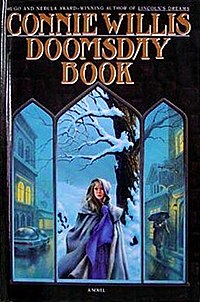
109. Doomsday Book

109. Doomsday Book. Connie Willis. 1992. Random House. 592 pages.  [Source: Book I Bought]

First sentence: Mr. Dunworthy opened the door to the laboratory and his spectacles promptly steamed up.
"Am I too late?" he said, yanking them off and squinting at Mary.
"Shut the door," she said. "I can't hear you over the sound of those ghastly carols."
Dunworthy closed the door, but it didn't completely shut out the sound of "O Come, All Ye Faithful" wafting in from the quad. "Am I too late?" he said again.  

 Premise/plot: In a world where historians learn their subject firsthand by time travel, Kivrin, our heroine--one of them--is sent to the middle ages to learn just "how exaggerated" (according to her professor/advisor Gilchrist) the accounts of the Black Death were. That's spinning it a bit. Kivrin is there to LEARN and OBSERVE and ABSORB. Technically, she's to be sent to 1320--the Advent/Christmas/Epiphany season in OXFORD. But that's if all goes according to plan and there are no mix-ups or mistakes. 

Mr. Dunworthy, our hero, has a bad feeling that those in charge of the project are incapable and incompetent and imbeciles. The book opens moments before she is sent back in time....it isn't long before Dunworthy has reason to panic...But this book isn't about one man's panic--his helicopter teaching, if you will. It is about TWO pandemics. One is set in the present of 2054. This pandemic requires a quarantine, contact tracing, mask-wearing, and safety protocols. With it comes toilet paper shortages--along with soap! The present story line is full of mystery and action. The other is set in the past--the Black Death. There is a theme of helplessness in both.

My thoughts: Doomsday Book by Connie Willis is one of my favorite, favorite, favorite, favorite, favorite books. This is my seventh? time to read and review it. I last reviewed it in 2023. I love and adore this book so much. It is set during Christmas/Epiphany. It's just a book that calls out to me every year to reread. I am surprised it has never been adapted into a film. The world needs more action Christmas movies.


© 2024 Becky Laney of Becky's Book Reviews

Monday, January 09, 2023

5. Doomsday Book


Doomsday Book. Connie Willis. 1992. Random House. 592 pages.  [Source: Book I Bought]

First sentence: Mr. Dunworthy opened the door to the laboratory and his spectacles promptly steamed up.
"Am I too late?" he said, yanking them off and squinting at Mary.
"Shut the door," she said. "I can't hear you over the sound of those ghastly carols."
Dunworthy closed the door, but it didn't completely shut out the sound of "O Come, All Ye Faithful" wafting in from the quad. "Am I too late?" he said again.  

 Premise/plot: In a world where historians learn their subject firsthand by time travel, Kivrin, our heroine--one of them--is sent to the middle ages to learn just "how exaggerated" (according to her professor/advisor Gilchrist) the accounts of the Black Death were. That's spinning it a bit. Kivrin is there to LEARN and OBSERVE and ABSORB. Technically, she's to be sent to 1320--the Advent/Christmas/Epiphany season in OXFORD. But that's if all goes according to plan and there are no mix-ups or mistakes. Mr. Dunworthy, our hero, has a bad feeling that those in charge of the project are incapable and incompetent and imbeciles. The book opens moments before she is sent back in time....it isn't long before Dunworthy has reason to panic...

But this book isn't about one man's panic--his helicopter teaching, if you will. It is about TWO pandemics. One is set in the present of 2054. This pandemic requires a quarantine, contact tracing, mask-wearing, and safety protocols. With it comes toilet paper shortages--along with soap! The present story line is full of mystery and action. The other is set in the past--the Black Death. There is a theme of helplessness in both.

My thoughts: Doomsday Book by Connie Willis is one of my favorite, favorite, favorite, favorite, favorite books. This is my SIXTH time to read and review it. I last reviewed it in 2020. I love and adore this book so much. It is set during Christmas/Epiphany. It's just a book that calls out to me every year to reread. I started it in December of 2022, but didn't finish up until this past weekend!


© 2023 Becky Laney of Becky's Book Reviews

Saturday, June 19, 2021

53. The Shadow Rising


The Shadow Rising. (The Wheel of Time #4) Robert Jordan. 1992. 672 pages. [Source: Bought]

First sentence: The Wheel of Time turns, and Ages come and pass, leaving memories that become legend. Legend fades to myth, and even myth is long forgotten when the Age that gave it birth comes again. In one Age, called the Third Age by some, an Age yet to come, an Age long past, a wind rose on the great plain called the Caralain Grass. The wind was not the beginning. There are neither beginnings nor endings to the turning of the Wheel of Time. But it was a beginning.

Premise/plot: The Shadow Rising is the fourth book in the Wheel of Time fantasy series by Robert Jordan. The series has grown more complex--in my opinion--with each book. The cast of characters and the amount of side stories increases.

There are four-ish main stories unfolding all at once. Not all chapters are narrated by the good guys. Occasionally (for whatever reason, for better or worse) Jordan gives us sections--sometimes entire chapters--from the point of view of the villains. Usually these are super tricksy and confusing to piece together. (It could be because readers are trying to keep up with a thousand plus named characters. According to Wikipedia the entire series has over 2,700 named characters). Darkfriends including the "Forsaken." Seanchan. Children of the Light.

So the main stories:

Rand is out to fulfill more prophecy and be recognized by the Aiel as He Who Comes With the Dawn. It won't be easy. I won't say it's more difficult than any other or every other obstacle he's faced in previous books. But he's always in danger--with a target on his back, if you will--plenty want to turn him, use him, destroy him, etc.

Mat and Egwene travel with Rand for very different reasons. It has been revealed to Mat that his life depends on him going to Rhuidean. The two go into the abandoned city--VERY SPOOKY ABANDONED CITY--together and have very different experiences. Egwene is there to learn from the Wise Ones how to dreamwalk or better dreamwalk.

Moraine (and presumably Lan) are along for this adventure as well. Though as more characters come into the stories, they seem to fade into the background and be less significant.

Aviendha is introduced I believe in this book. She seems to play a major role in the story. She watches over Rand, and it seems to be a case of hate at first sight. (But is this hate love in disguise????)

Nynaeve and Elayne are still in search of the Black Ajah. Their mission takes them to Tanchico. Along for the ride are Thom (the former gleeman) and Juilin Sandar (whom we met briefly in a previous book). It is tricky business looking for the Black Ajah because they are hunting hunters. If they channel, they risk alerting the bad guys to their presence. Yet sometimes it seems so necessary to channel in self defense as they face risks and dangers.

Perrin and Faile (along with Loial, whom I adore) return to Two Rivers. But all is not well--far from it--at home. In the two years (roughly) he's been gone, a LOT has changed. And the lives of those he cares about (and those he's just grown up with) are in danger. He will have to be ever vigilant and ready to fight, fight, fight if he wants to protect his people/country. MEANWHILE, PERRIN AND FAILE GET MARRIED. *Squeal*

Min--for whatever reason, convenience to the story really--is at the White Tower. And she's there just in time to possibly save some lives. All is not well at Tar Valon. And it seems the Black Ajah have a few tricks.

The stories are told unevenly. That is they don't receive equal attention and weight. You might go twenty chapters without hearing from a character only then to have them pop up again.

My thoughts: I have thoughts. I do. I wish I had a paperback copy of this one. The hardback was cumbersome to read from. But the last third was truly EXCITING and ACTION-PACKED. I might compare the first third being like standing in line to ride a roller coaster. Your feet start hurting. You seem to barely be moving. It might be hot. You are just ready for the thrills. The second third is like getting on the roller coaster, getting ready to hold on, and perhaps going up that first big hill. The last third--as I mentioned--is ALL THRILLS AND EXCITEMENT. In the end it makes it worth it.

I am so thankful there is a glossary. It is super handy. I can't imagine listening to this on audio book without a glossary to turn to whenever you need it. I also can't imagine loving an e-book as much for the same reasons. (Though probably an e-book would have a table of contents so maybe it wouldn't be impossible.)


© 2021 Becky Laney of Becky's Book Reviews

Thursday, December 10, 2020

150. Doomsday Book


Doomsday Book. Connie Willis. 1992. Random House. 592 pages.  [Source: Book I Bought]

First sentence: Mr. Dunworthy opened the door to the laboratory and his spectacles promptly steamed up.
"Am I too late?" he said, yanking them off and squinting at Mary.
"Shut the door," she said. "I can't hear you over the sound of those ghastly carols."
Dunworthy closed the door, but it didn't completely shut out the sound of "O Come, All Ye Faithful" wafting in from the quad. "Am I too late?" he said again.   

 Premise/plot: In a world where historians learn their subject firsthand by time travel, Kivrin, our heroine--one of them--is sent to the middle ages to learn just "how exaggerated" (according to her professor/advisor Gilchrist) the accounts of the Black Death were. That's spinning it a bit. Kivrin is there to LEARN and OBSERVE and ABSORB. Technically, she's to be sent to 1320--the Advent/Christmas/Epiphany season in OXFORD. But that's if all goes according to plan and there are no mix-ups or mistakes. Mr. Dunworthy, our hero, has a bad feeling that those in charge of the project are incapable and incompetent and imbeciles. The book opens moments before she is sent back in time....it isn't long before Dunworthy has reason to panic...

But this book isn't about one man's panic--his helicopter teaching, if you will. It is about TWO pandemics. One is set in the present of 2054. This pandemic requires a quarantine, contact tracing, mask-wearing, and safety protocols. With it comes toilet paper shortages--along with soap! The present story line is full of mystery and action. The other is set in the past--the Black Death. There is a theme of helplessness in both.

My thoughts: Doomsday Book by Connie Willis is one of my favorite, favorite, favorite, favorite, favorite books. I believe this is my fifth time to read it and review it for Becky's Book Reviews. The last time I read it, I believe, was 2015. 

Reading Doomsday Book in 2020 was like reading it with FRESH EYES and in a NEW LIGHT. I noticed hundreds of things that I never really absorbed or processed before. Much of the present story line is set IN THE HOSPITAL and follows doctors and nurses as they care for patients trying to make sense of a virus they know little about. They are TRYING to save lives--but wrestling with the unknown. They are protecting themselves to the best of their ability--wearing all the gowns, masks, gloves, shields, etc.--but they themselves are getting sick and even dying while trying to save lives. 

The book also has a bit to say about the mob mentality--those who are critical of quarantines, of wearing masks; those whose first reaction is to throw science and common sense out of the window making prejudicial and unfounded claims, spreading fear and propaganda. 

The book also has a bit to say about POLITICS. No not politics in terms of political parties, governments, and candidates. But PERSONAL and PROFESSIONAL "politics." Readers see the belittling and childish behavior of the spats between Dunworthy and Gilchrist. No doubt Gilchrist is the bigger fool--perhaps the biggest fool in the book--but these two professors are from "dueling" schools. Gilchrist is so concerned with maintaining authority and control and looking good that he has no concern for others, especially his enemies. 

There is talk between characters of a PANDEMIC twenty or so years before this one opens. 

I have always deeply appreciated the novel in terms of RELATIONSHIPS. This still holds true. I love the characters and the development of relationships throughout both story lines. I think I love the character of Colin the best. Colin's relationship with Mr. Dunworthy--a stranger at the start, but family by the end--is just so endearing and PERFECT. I think the characters are just so authentically and believably HUMAN. These characters live and breathe. 

It's an emotional ride from start to finish. 

It isn't without humor. There's quite a bit considering the subject matter. Some of the humor comes at the expense of other characters. I don't know if the author meant it as a running gag--but I thought the MYSTERY of where Basingame was a running gag.

It asks some deep questions without ever once providing an answer. I am not saying that is a good thing or a bad thing--just an observation of mine. 

Ringing bells recur throughout the book--in both time lines. I am sure there is some significance to having so many ringing bells. I haven't puzzled out exactly what. But if I were still in school and wanting to write a paper on it, I'm sure I could brainstorm and do some research.

Quotes:

  • “I said, mufflers are always an appropriate Christmas gift for boys, don’t you think?” He looked at the muffler she was holding up for his inspection. It was of dark gray plaid wool. He would not have been caught dead in it when he was a boy, and that had been fifty years ago.  “This century doesn’t have the Black Death.” “It had the Pandemic, which killed sixty-five million people. And the Black Death wasn’t in England in 1320,” “It didn’t reach there till 1348.” She put her mug down on the table, and the figurine of Mary fell over. “But even if it had, Kivrin couldn’t get it. I immunized her against bubonic plague.” Besides, she would never get the plague because we’re both worrying over it. None of the things one frets about ever happen. Something one’s never thought of does.” 
  • For a time I worried about not knowing what to worry about, and then I didn’t worry at all. Fretting doesn’t work properly unless one can visualize disasters in all their particulars, including the weather and the time of day. 
  • Gilchrist was saying. “Attitudes toward death in the 1300s differed greatly from ours. Death was a common and accepted part of life, and the contemps were incapable of feeling loss or grief.” 
  • The original regulations had required it in every case of “unidentified disease or suspicion of contagion,” but those had been passed in the first hysteria after the Pandemic, and they had been amended and watered down every few years since then till Dunworthy had no idea what they were now. 
  • “Explain! Perhaps you’d like to explain it to me, too. I’m not used to having my civil liberties taken away like this. In America, nobody would dream of telling you where you can or can’t go.” And over thirty million Americans died during the Pandemic as a result of that sort of thinking, he thought. 
  • “No, sir, I’m just on my way. What should I do about supplies, sir? We’ve adequate stores of soap, but we’re very low on lavatory paper.” 
  • “Should I ration the lavatory paper, do you think, sir,” Finch said, “or put up notices asking everyone to conserve?” “I’ve taken steps to remedy the lavatory paper situation. I’ve put up notices with the motto: Waste Leads to Want.”
  • “Tell her we haven’t any room. Tell her the dormitories are being sterilized.”  “I did, sir, but she said in that case she would room with William. I don’t like to do that to him, sir.” “No,” Dunworthy said. “There are some things one shouldn’t have to endure, even in an epidemic. Have you told William his mother’s coming?”  The medical staff are always the first exposed. If they come down with it, or the supply of antimicrobials gives out, this century could be the one that’s a ten.
  • “Are they still holding the Christmas Eve service?” Dunworthy said. “I shouldn’t think anyone would come under the circumstances.” “He said the Interchurch Committee had voted to hold it regardless,” Finch said...The priest from Holy Re-Formed is going to read from the Mass in Time of Pestilence.” “Ah,” Dunworthy said. “That should help in keeping up morale.”
  • “Here’s your Scripture. It’s from the King James this year. The Church of the Millennium insisted on it, but at least it’s not the People’s Common like last year.
  • The King James may be archaic, but at least it’s not criminal.”
  • “What are they all doing here?” Dunworthy said. “Don’t they realize we’re in the midst of an epidemic?” “It’s always this way,” the vicar said. “I remember the beginning of the Pandemic.
  • “One sees the same sort of thing during wartime. They come for the drama of the thing.” “And spread the infection twice as fast, I should think,” Dunworthy said. “Hasn’t anyone told them the virus is contagious?” “I intend to,” the vicar said. “
  • The King James is archaic, he thought. And where Kivrin is, it hasn’t been written yet. 
  • On top was an NHS directive headed: “Early Symptoms of Influenza. 1.) Disorientation. 2.) Headache. 3.) Muscle Aches. Avoid contracting it. Wear your NHS regulation face mask at all times.” “Face mask?” Dunworthy asked.“The NHS delivered them this morning,” Finch said. “I don’t know how we’re going to manage the washing up. We’re nearly out of soap.”
  • “Isn’t there some sort of volunteer work she could do at Infirmary or something?” Finch asked. “To keep her out of college?” “We can hardly inflict her on poor helpless flu victims. It might kill them. What about asking the vicar? He was looking for volunteers to run errands.” “Have a heart, Mr. Dunworthy. I’m working for the vicar.”  “The priest from Holy Re-Formed then,” Dunworthy said. “He’s fond of reciting the Mass in Time of Pestilence for morale. They should get along swimmingly.”
  • A man in a sandwich board was standing outside the door in the rain. The sandwich board said, “The doom we feared is upon us,” which seemed oddly fitting. 
  • The carillon was massacring “In the Bleak Midwinter,” which also seemed fitting, and the streets were still deserted, but as they turned down the Broad, a familiar figure hurried toward them, hunched against the rain. 
  • “That paper the NHS sent around said disorientation, fever, and headache, but that isn’t any good. The bells always give us headaches.”  One of them grabbed Dunworthy’s arm. “The government’s got no right to keep you here against your will,” he said, thrusting his striped face up to Dunworthy’s face mask.
  • And He shall smite thee with Mrs. Gaddson, he thought, and she shall read you Scriptures to keep your morale up. 
  • Heating systems and the EC and time travel. During the Pandemic it had been the American germ warfare program and air conditioning. Back in the Middle Ages they had blamed Satan and the appearance of comets for their epidemics.
  • Doubtless when the fact that the virus had originated in South Carolina was revealed, the Confederacy, or southern fried chicken, would be blamed. 
  • Her SPG’s looked like she’d slept in them, and her mask dangled from her neck by one tie. 
  • Finch, helping assemble the cots and make beds, announced that they were nearly out of clean linens, face masks, and lavatory paper. 
  • “I’ve posted notices asking that everyone conserve lavatory paper, but it’s done no good at all. The Americans are particularly wasteful.” 
  • “They’re saying it’s some sort of biological weapon,” Colin said. “They’re saying it escaped from a laboratory.” 
 

 © 2020 Becky Laney of Becky's Book Reviews

Friday, April 19, 2019

Aunt Dimity's Death

Aunt Dimity's Death. (Aunt Dimity Mystery #1) Nancy Atherton. 1992. 244 pages. [Source: Library]

First sentence: When I learned of Aunt Dimity's death, I was stunned. Not because she was dead, but because I had never known she'd been alive. Maybe I should explain.

Premise/plot: Lori Shepherd is down on her luck. Within a (relatively) short amount of time, she's gotten divorced, lost her job, and her mother has died. But when a letter finally catches up with her, her life is potentially changed forever: a lawyer has contacted her. It seems that she's mentioned in Aunt Dimity's will.

Lori grew up hearing her mother tell Aunt Dimity stories; they were bedtime stories. Lori thought that Aunt Dimity was a fictional creation of her mother's making. But Dimity was a real person--a person that her mother met and befriended in England during the second world war. The two had kept in touch--corresponded after the war.

Aunt Dimity wants Lori to go to England, stay in her cottage, and sort through that correspondence. Ultimately Lori will need to write an introduction to a collection of stories--Aunt Dimity stories. But she won't be going alone. The lawyer's son, Bill, will go with her and help her.  That is what her lawyer is expecting her to do...but a letter from her mother adds to her mission.

My thoughts: I loved, loved, loved, loved, LOVED this one. I'm a little mad at my library that the next book in the series which they have is #8. (Then another big jump to either #12 or #13). If you love cozy mysteries, I think you will love this one just as much as I did. But even if you don't love, love, love mysteries...if you love romance then there's still a good chance that you'll still end up loving it. It has a very 90s rom-com feel to it. In a good way. In a satisfying way. If this was ever adapted into a movie or television series, I'd want to watch it again-again.


© 2019 Becky Laney of Becky's Book Reviews

Friday, April 20, 2018

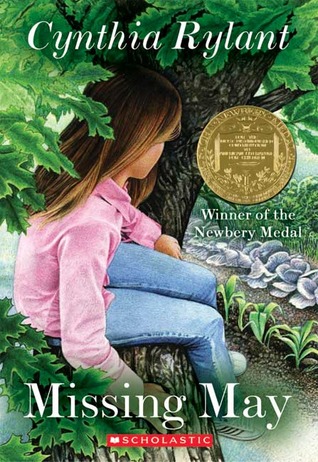
Missing May

Missing May. Cynthia Rylant. 1992. Scholastic. 89 pages. [Source: Library]

First sentence: When May died, Ob came back to the trailer, got out of his good suit and into his regular clothes, then went and sat in the Chevy for the rest of the night.

Premise/plot: Missing May won the Newbery Medal in 1993. This novel for young readers explores grief. Summer and Ob are the central characters; they are the ones most 'missing' May. All the happiness Summer has known has been in the home of her aunt and uncle. May and Ob took her in and adopted her; times were good, love abounded. But May died in her garden, and life hasn't been the same since she's left.

Ob wants more than anything to make contact with May's spirit. Summer isn't sure that that is even possible, but she hopes it is for Ob's sake. Cletus is relatively new friend of the family. He's around Summer's age. But he has a way--a knack--with Ob that is healing and comforting. Together these three set out on a road trip. The destination? A spiritualist church that Cletus read about with a medium as a pastor. Will May reach out from beyond the grave with a message for Ob? for May?

My thoughts: Did I like it? No. Yes. No. Maybe. I'll start with what I did like. Rylant is a strong writer. She did a great job with the setting. It's set in West Virginia a place where she herself grew up. She captures a specific place--if not a specific time. Which brings me to her characterization. Her characters were human--there's a rawness to them, a take-me-like-I-am rawness. I think Cletus may just be my favorite among them. Her writing was GREAT.

Here is one of her descriptions of May:
She understood people and she let them be whatever way they needed to be. She had faith in every single person she ever met, and this never failed her, for nobody ever disappointed May. Seems people knew she saw the very best of them, and they'd turn that side to her to give her a better look. (15-16)
And one of Cletus:
Cletus had some gifts--I was learning this bit by bit--and knowing when to talk and when not to was turning out to be one of them. (37)
I can certainly see why it was honored with the Newbery award.

So what didn't I like? I didn't like the content, the story. Specifically, I did not like the ongoing quest to make contact with the dead--either through Cletus (that attempt failed) or through a professional medium (that one failed as well). In a way, it is thought-provoking. When someone you love dies--where is your hope? Is your hope in making contact with them again in the here and now? Is your hope in finding messages in feelings, signs, visions, dreams? Is your hope in mediums and psychics?

Or is your hope found in the resurrection of Jesus Christ? Is your hope in heaven? That you will spend eternity with them in heaven because you both believed that Jesus is the way, the truth, the life--the only way to the Father? Is your comfort found in the Word of God? Can you find peace and comfort through the Spirit and the fellowship of believers?

Summer and Ob are both searching for peace and comfort. Specifically Summer wants Ob to come to a place of peace so that he will start living again. She fears that he has lost all the will to live. And if he's lost the will to live, then who will take care of her? who will love her?

As a Christian, I saw the lost-ness, the despair of Summer and Ob. Ob is in need of answers, in need of peace, in need of comfort. But he's seeking in the wrong places in the wrong ways. Summer is young and confused. She doesn't believe strongly--one way or the other--about the after life. I pitied them both. I'm not sure readers are supposed to pity them. I'm not sure readers are not supposed to pity them either.

Grief wears many faces. There isn't one right way to grieve. Each person is different. Christian or not--every person grieves in his or her unique way. And it's not like anyone--insider or outsider--can say a handful of phrases to 'snap someone out of their grief' to 'fix them' or 'heal them.' There are plenty of WRONG things to say that hurt instead of help. I think everyone could learn from Cletus--a bit--in just BEING there and listening. (But to be fair, Cletus is far from perfect, it is Cletus who suggests going to a professional medium.)

Would I have liked Missing May as a child? I probably would not have read it. a) I was still AVOIDING all books that had the potential for sadness. b) I was certainly reading in 1992/1993, but probably not books for this age group. c) I attended a Christian school with a small library budget and high standards of what was appropriate and inappropriate. I don't think a book with talk of mediums and contacting the dead would have made the cut. But I could be wrong. It DID win the Newbery. And I honestly can't say if the librarian was reading every book before it was ordered and placed within the collection.

Christian families shouldn't necessarily avoid the book at all costs. But if you do read it, you may want to read it together and use it as a discussion opportunity. As I said, it is thought-provoking.

© 2018 Becky Laney of Becky's Book Reviews

Sunday, March 26, 2017

Advanced French for Exceptional Cats

Advanced French for Exceptional Cats. Henry N. Beard. 1992. 96 pages. [Source: Borrowed]

First sentence: The Exceptional Cat Le Chat Exceptionnel

Premise/plot: If you and your cat loved the first book, it's time to expand your knowledge. The phrases taught in this one go above and beyond your basic, practical needs with a few exceptions.
I don't mind Bach and Mozart as long as there is no singing.
Je veux bien ecouter Bach et Mozart pourvu que personne ne chante.
I nap, therefore I am.
Je fais un somme, donc je suis.
In this one the cat travels to France--to Paris--for part of this one. Most of the phrases are complex. There are sections on dining out, philosophy, music, etc.

My thoughts: I liked it. I like both books in the series.

© 2017 Becky Laney of Becky's Book Reviews

Friday, February 10, 2017

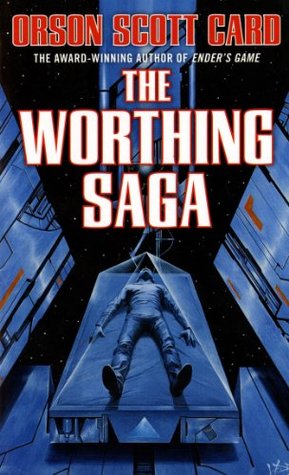
Worthing Saga

The Worthing Saga. Orson Scott Card. 1992. Tor. 463 pages. [Source: Bought]

First sentence: In many places in the Peopled Worlds, the pain came suddenly in the midst of the day's labor. It was as if an ancient and comfortable presence left them, one that they had never noticed until it was gone, and no one knew what to make of it at first, though all knew at once that something had changed deep at the heart of the world.

Premise/plot: Imagine living in a world where there is no pain, no suffering, no grief, no fear, no anger, no violence, no injury. Wrong actions, in a sense, have ceased to have consequences. If a person were to hurt himself/herself chopping wood or tending the fires, then there would be instant--almost magical--healing. Even morally wrong actions are prevented, on this world there are no children out of wedlock; and the child is always the husband's never the lover's if you're an adulteress. Yes, there is an occasional death, but never for the very young, never for the able-bodied. It is hard to imagine for us this life of easy contentment. A life with no struggles? A life truly worry-free? A world where fire doesn't burn you and ice doesn't freeze you? Surely there must be a catch, right? Some reason why this world isn't a perfect paradise...

The change came in the middle of the night. Imagine going to bed with everything being quite all right, and waking up to find that life is not what you thought it was. Pain. Grief. Suffering. Worry. Fear. Anger. And it wasn't just emotional, as the village learned. It was physical, too. As one accident after another occurred, the villagers soon realized that they could not only be hurt, but they could also DIE. With the whole village (and indeed the whole world) in confusion, no one knows quite what to think. Is God dead? If God is still watching over them, why then is there suffering? Why suffering after all these centuries of watchful care? Folks are going along muttering that God doesn't look out for them anymore.
The old clerk trembled and nodded and his voice quivered as he spoke. 'I have read the books of ancient times,' he began, and all eyes turned to him. 'I have read the books of ancient times, and in them the old ones spoke of wounds that bleed like slaughtered cattle, and great griefs when the living suddenly are dead, and anger that turns to blows among people. But that was long, long ago, when men were still animals, and God was young and inexperienced. (5-6)
Yes, no one understands this Day of Pain. Least of all, Lared, our young hero. But it is Lared who will become the chosen speaker that will write the story and tell the tales that will explain this Day and give it meaning. Two strangers come to the inn, the inn that Lared's parents own, and it is Lared and his sister, Sala, who befriend them. Jason. Justice. A man and woman. The two are mysterious, no doubt about it, and more than one person suspects that they're coming is linked with the Day of Pain.

The two share their stories mostly through dreams and waking visions. Jason will occasionally share one the old-fashioned way, but most are transmitted directly into Lared's mind. Lared doesn't know what to think. He doesn't like the dreams. He doesn't like the uneasy feelings they leave him with...but he also knows that he has been called, chosen, if you will, to write this down. To record them. It is not his place to understand everything, just to write it down as it's been given to him.

Lared and his village provide the framework for the stories that Jason and Justice share. It is a story of two men, one empire, and one powerful drug.

Abner Doon. A name that still strikes fear in people thousands of years after his death. Some even say that he was the devil himself. But was he really? His name is associated with death and destruction, and in some ways, it is easy to understand why. He caused the death and destruction of the EMPIRE. The very arrogant, often corrupt, very stagnant empire. But was the fall of the empire really that bad? Wasn't it better for humanity in general? Jason Worthing certainly thinks so.

Jason Worthing. Another name that people fear to speak aloud. Why? It is a name of reverence. Many people feel that Jason Worthing is God. The creator of life. The sustainer of the universe, even. But was he really? Yes, he had a hand in establishing life and building civilization, at least on one planet, but the creator of all life? No. Just an ordinary man with unusual psychic powers who came from a technologically advanced society.

The empire. It's not that the empire was completely evil. Sure the empire had its fair share of corrupt and power-hungry politicians. More than its fair share. Every branch of the empire had its corrupt officials. And there was nothing that couldn't be bought--as long as you had money. But that wasn't the real crime of the empire. The real crime was that humanity was being robbed of its very soul, its very essence. They had lost the point of living. They were corrupting the very nature of our existence.

Somec. Perhaps the most powerful drug the empire had ever known. What did it do? It put the user into a deep sleep, a coma, if you will. First, the user would have his/her memories downloaded or recorded, if you will, onto a tape or into a bubble. I forget quite how they did it. I just know that there was a way of downloading and uploading memory. Then the assistant would inject somec. It wasn't a pretty picture. It burned. It hurt. It caused severe physical problems--sweating, discomfort, pain--but the user would forever be unaware of it because the memories would never include this part of the experience. Who was it for? At first, it was just for starship pilots. Their skills would be needed throughout a long voyage. And if a trip took hundreds or perhaps thousands of years, then they'd need Somec to function. The computer would always be able to wake them up in case of an emergency. But they'd arrive at their destination intact. So for colonization vessels, it really couldn't be any better. A ship would carry three hundred or so passengers and all the supplies needed to create and establish a civilization on another planet. So there were a few valid uses of the drug, I suppose. But the real corruption began when somec became a common necessity for the people.

Imagine the possibility of immortality. Somec offered immortality. The wealthy. The elite. The powerful. The brilliant minds of society were all given the chance for immortality. The more valuable society deemed you, the longer you would sleep between waking cycles. The common people lived and died naturally enough. But a good portion of society, became obsessed with immortality. But is living a thousand years natural if you spend 70% of it or so asleep? What does it accomplish really? You're not able to have friendships with others unless you're on the same sleep cycle. You're not able to maintain family relationships either. People could theoretically outlive their great-great-great-great-great-grandchildren. Love becomes to a certain extent irrelevant. Most things become irrelevant. No time for the finer things in life. Love. Romance. Music. Art. For not only do most people spend most of their times asleep, what little time they're awake they're obsessed with power, money, fame, greed, control. They always want more, more, more. Never content. There is no longer any joy in living life. But really too few people notice what they're missing. Except for one. The aforementioned Abner Doon.

Abner "rescues" Jason, if you will, and offers him a chance to become a part of something great. Jason becomes a starship pilot, a very famous starship pilot, and he eventually leads a colonization ship. Abner's big plan--besides the fall of the Empire--is to recreate life as it used to be. His plan? To spread humanity throughout the galaxy. To have human civilizations sprout up on thousands of planets. He knows that with the fall of the Empire, with the fall of technology, it will be thousands upon thousands of years before ANY civilization becomes advanced enough for star flight. He sees this as a way for humanity to wipe the slate clean and begin anew.

The Worthing Saga is the story of Jason's planet. How Jason "fathered" or "created" that world. And what happened to its inhabitants. What happened to his descendants. All these stories--and there are many--span thousands of years. Everything is leading the reader back to Lared. Back to the Day of Pain.

The Worthing Saga contains the previously published The Worthing Chronicle and nine short stories.

My thoughts: The Worthing Saga is about the meaning of life. It is about what it means to be human. It asks important questions. It goes where few novels do. It asks what the meaning of pain and suffering is. It asks what the meaning of struggles are. It is ethical in nature. It asks the hard questions. But it is philosophical as well.

I love the world-building. I find the three settings within the book to be fascinating. (There is Lared's home planet which is the present-day setting; there is Capital, the planet from Jason Worthing's memory and stories, Capital becomes "real" to Lared as he experiences Worthing's memories through dreams; there is Worthing, the planet that Jason colonized with a handful of colonists thousands of years before the novel opens, again this planet becomes "real" to Lared as he experiences other people's memories through Justice, Jason's descendent.) Readers get a taste of all these societies and communities.

I love the characterization. I love getting to know Lared, Sala, Jason, and Justice. Not to mention all the men and women from the memories and stories. (I have a soft spot for Hoom.) I love the storytelling. I love the dialogue. I love how everything is layered together. How the story all comes together. How Lared slowly but surely pieces things together and comes to understand--if understand is the right word--the world. Card's characters are so very human, so vulnerable, so fallible. Readers see humans at their best and at their absolute worst within The Worthing Saga. Moments of compassion and redemption make it so worth while.

I love the ideas. I love the depth and substance. That is not to say that I agree absolutely with every single philosophical idea within the book. But it goes places most fiction doesn't. It asks real questions, tough questions. It explores ideas. One also sees the consequences (or possible consequences) of ideas.


© 2017 Becky Laney of Becky's Book Reviews

Wednesday, March 02, 2016

Defend and Betray

Defend and Betray. (William Monk #3) Anne Perry. 1992. 439 pages. [Source: Bought]

Defend and Betray by Anne Perry is the third book in the William Monk mystery series. This mystery series is set in Victorian England. My favorite of the three--so far--is the second. I suspect that while I will probably "like" each book in the series, there will be some that I *love* and others not quite as much. This will probably be determined in part by the mystery.

The book opens with Hester Latterly meeting a friend, Edith Sobell, in the park. Edith has surprising, sudden news to share with her friend, her older brother has died at a horrid dinner party. It was a horrid gathering BEFORE the death, both guest and host will admit. Turns out his death was no accident. You might guess that Defend and Betray is about Hester Latterly and William Monk trying to solve this mystery and discover the identity of the murderer. But. You'd be wrong. A confession comes really early in this one. His wife confesses to the crime. Few really believe the reason given for the crime: jealousy over another woman. But some choose to pretend to believe it all the same because it's easier than thinking that she had a better, more logical reason for the crime OR that someone else in the family committed the crime and she's covering it up and taking the blame.

Hester encourages the family to hire Oliver Rathbone to defend her. Oliver, once hired, hires William Monk to investigate. The mission of all three is to find out WHY she murdered her husband, so that she will have defense in court. The last third of the book, I'd say, is focused almost exclusively on the trial. Readers "hear" both the prosecution and defense make their case--calling witnesses, cross-examining, arguing, etc.

I definitely am liking the series. This particular case was not my favorite. But it is worth noting that William Monk recovers a memory or two in this one. The case brings to his mind a woman that he loved. He can see her face. He remembers feeling deeply connected to her--tenderly concerned about her. But he can't remember her name. Just that she must have been someone he met while working a case! I did miss Evans in this one. Now that William Monk is no longer with the police, we don't spend much time with Evans. Oh, I should also add that we get to meet Oliver Rathbone's father! Now that was fun!
© 2016 Becky Laney of Becky's Book Reviews

Friday, February 19, 2016

A Dangerous Mourning

A Dangerous Mourning (William Monk #2). Anne Perry. 1992. 344 pages. [Source: Library]

I loved, loved, loved, LOVED A Dangerous Mourning by Anne Perry. Reading this second William Monk mystery made me want to read everything Perry has ever written--at least her historical mysteries. It was so good, it was near-perfect. I loved, loved, loved the characters of William Monk and Hester Latterly. I like that the first-and-second books flow into one another so smoothly. I like how characters from the first book have carried over into the second book. I like that the series seems to be so much more than just another cozy mystery series. The author seems just as determined to appeal to historical fiction fans as mystery fans.

For those that haven't read the first book, this is what you need to know:

1) William Monk is the hero, the detective.
2) After a bad accident (which occurs BEFORE the first book opens), he has NO MEMORIES of his former life.
3) He knows that he was/is a police detective. He knows that he was respected but far from liked. His boss HATES him.
4) He meets Evans, the sergeant underneath him, his partner. Evans actually seems to genuinely like him and looks up to him.
5) Monk looks for clues to his own past as he continues to work for the police department on new cases.
6) Monk meets Hester Latterly, a nurse with Crimean War experience, and the two clash for the most part. (Think Elizabeth and Mr. Darcy.)
7) Hester is very SMART, very OPINIONATED, very OBSERVANT, very LIKABLE. I was thrilled to see her in the second book too.

The mystery of the second book: Sir Basil's married/widowed daughter, Octavia Haslett, was murdered in her bedroom one night. Monk is assigned to the case. Everyone is assuming/presuming that an outsider, a burglar, broke into the house and killed her. But Monk finds no proof that it was an outside job, instead, all the evidence is showing him that someone IN the house committed the crime. Readers get to know the family (quite dysfunctional) and the servants (upstairs and downstairs servants) as the mystery continues....

I loved this book. I did. I definitely loved the first book too. But this one I loved even more. This one I found to be completely gush-worthy.
© 2016 Becky Laney of Becky's Book Reviews

Tuesday, December 15, 2015

Doomsday Book (1992)

Doomsday Book. Connie Willis. 1992. Random House. 592 pages.  [Source: Book I Bought]

Mr. Dunworthy opened the door to the laboratory and his spectacles promptly steamed up.
"Am I too late?" he said, yanking them off and squinting at Mary.
"Shut the door," she said. "I can't hear you over the sound of those ghastly carols."
Dunworthy closed the door, but it didn't completely shut out the sound of "O Come, All Ye Faithful" wafting in from the quad. "Am I too late?" he said again.  

This is my fourth time to read and review Connie Willis' Dooms Day Book.  This not-so-little novel combines my love of historical fiction and my love of science fiction. It does so, of course, through time travel. Kivrin, the heroine, will be the first historian--first time traveler--sent to the fourteenth century. The century has just recently, and perhaps unadvisedly, been opened up to time travel. Kivrin will be traveling to a "safe" year: 1320. But Mr. Dunworthy fears that there is no such thing as a SAFE year within the fourteenth century. She's studied and prepped for this for years now, this is HER ONE BIG LIFE-DREAM. And certainly the worries of an "old professor" like Mr. Dunworthy won't stop her from going. But is Mr. Dunworthy right to worry?!

It is set--in the future and the past--during the Advent-Christmas-Epiphany season. The book examines the role of faith and religion, at the very least during this season of the year. But, in particular, it addresses the question of God and suffering. I would never say it is a "religious" book, but, Kivrin, in particular is sent to a century where belief in God IS a matter of fact and the church had more power and influence. Christian readers should note that Mr. Dunworthy and Kivrin both misunderstand much of who God is and what the Christian faith is all about.

Doomsday Book might be "just right" for you if...
  • You enjoy science fiction, in particular time travel
  • You enjoy historical fiction
  • You enjoy medical mysteries
  • You enjoy compelling dramas
  • You enjoy character-driven novels 
© 2015 Becky Laney of Becky's Book Reviews
Friday, January 17, 2014

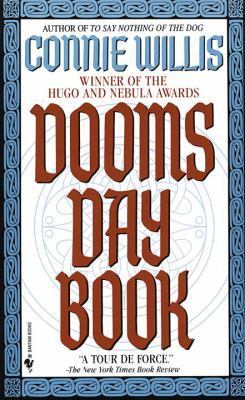
Reread #3 Doomsday Book

Doomsday Book. Connie Willis. 1992. Random House. 592 pages.  [Source: Book I Bought]

Mr. Dunworthy opened the door to the laboratory and his spectacles promptly steamed up.
"Am I too late?" he said, yanking them off and squinting at Mary.
"Shut the door," she said. "I can't hear you over the sound of those ghastly carols."
Dunworthy closed the door, but it didn't completely shut out the sound of "O Come, All Ye Faithful" wafting in from the quad. "Am I too late?" he said again. 

I first read and reviewed Doomsday Book in October 2010. I reread it in December of 2011. Yes, this is my third time to read Connie Willis' award-winning novel, Doomsday Book. (It won the Hugo and Nebula!) Quite simply Doomsday Book is one of my favorite, favorite, favorite books. It combines my love of history (the measly middle ages!) and my love of science fiction (time travel!!!). It is set--in the future and the past--during the Advent-Christmas-Epiphany season.

Kivrin has a dream. She'll be the first time traveler historian to go to the fourteenth century. If all goes well, and why wouldn't it boasts Gilchrist, then she'll spend two or three weeks in 1320 before returning. But Mr. Dunworthy (and subsequently Badri, the tech guy) aren't as confident that things will go smoothly. Dunworthy is sure that something will go wrong. Even if something doesn't go wrong with the time travel aspect (she lands in the right time, the right place), he's worried that something will happen to her in the past (she'll get beaten up, she'll get raped,  she'll be mistaken for a witch, she'll get sick, she'll die).

From the start, there is something wrong with the drop. It starts with the technician, Badri, becoming ill. Soon the whole area is quarantined. Cases start coming in--and soon medical staff are overwhelmed. What is this disease--this illness? How is it spread? Where did it come from? Is it fatal? Is there a cure? Did he have a chance to pass this on to Kivrin before she went through the Net? What was Badri trying to communicate to Dunworthy at the last minute?

Willis does a great job building the past--the fourteenth century--and the "present" which is a time-traveling future. (The story alternates between past and present.) She blends mystery, science fiction, and historical fiction--and blends them well! Readers meet dozens of characters in both centuries as this mystery unfolds. And while it is serious--dramatic--and emotional--people will die--it's not without its lighter moments of wit. There are personalities. The characters are oh-so-human.


Favorite quotes:
"I've just thought who you remind me of," Mary said, setting down her plate and a napkin. "William Gaddson's mother."
That was a truly unfair remark. William Gaddson was one of his first-year students. His mother had been up six times this term, the first time to bring William a pair of earmuffs. (23)
"Your tech seems to have done a passable job," Gilchrist said, turning to Dunworthy. "Medieval would like to arrange to borrow him on our next drop. We'll be sending Ms. Engle to 1355 to observe the effects of the Black Death. Contemporary accounts are completely unreliable, particularly in the area of mortality rates. The accepted figure of fifty million deaths is clearly inaccurate, and estimates that it killed one third to one half of Europe are obvious exaggerations. I'm eager to have Ms. Engle make trained observations."
"Aren't you being rather premature?" Dunworthy said. "Perhaps you should wait to see if Kivrin manages to survive this drop or at the very least gets through to 1320 safely."
Gilchrist's face took on its pinched look. "It strikes me as somewhat unjust that you constantly assume Medieval is incapable of carrying out a successful drop," he said. "I assure you we have carefully thought out its every aspect. The method of Kivrin's arrival has been researched in every detail. Probability puts the frequency of travelers on the Oxford-Bath road as one every 1.6 hours, and it indicates a 92 percent chance of her story of an assault being believed, due to the frequency of such assaults. A wayfarer in Oxfordshire had a 42.5 percent chance of being robbed in winter, 58.6 percent in summer. That's an average of course. The chances were greatly increased in parts of Otmoor and the Wychwood and on the smaller roads."
Dunworthy wondered how on earth Probability had arrived at those figures. The Domesday Book didn't list thieves, with the possible exception of the king's census takers, who sometimes took more than the census, and the cutthroats of the time surely hadn't kept records of whom they had robbed and murdered, the locations marked neatly on a map. Proofs of deaths away from home had been entirely de facto: the person had failed to come back. And how many bodies had lain in the woods, undiscovered and unmarked by anyone? (29)
"Mr. Dunworthy, I've been looking for you everywhere," Finch said. "The most dreadful thing's happened."
"What is it?" Dunworthy said. He glanced at his digital. It was ten o'clock. Too early for someone to have come down with the virus if the incubation period was twelve hours. "Is someone ill?"
"No sir. It's worse than that. It's Mrs. Gaddson. She's in Oxford. She got through the quarantine perimeter somehow."
"I know. The last train. She made them hold the doors."
"Yes, well, she called from hospital. She insists on staying at Balliol..."
"Tell her we haven't any room. Tell her the dormitories are being sterilized."
"I did, sir, but she said in that case she would room with William. I don't like to do that to him, sir."
"No," Dunworthy said. "There are some things one shouldn't have to endure, even in an epidemic." (117)
"I thought there'd be more going on," Colin said, sounding disappointed. "Sirens and all that."
"And dead-carts going through the streets, calling 'Bring out your dead'?" Dunworthy said. "You should have gone with Kivrin. Quarantines in the Middle Ages were far more exciting than this one's likely to be...(191)
19 December 1320 (Old Style). I'm feeling better. I can go three or four careful breaths at a time without coughing, and I was actually hungry this morning, though not for the greasy porridge Maisry brought me. I would kill for a plate of bacon and eggs. And a bath. I am absolutely filthy. Nothing's been washed since I got here except my forehead, and the last two days Lady Imeyne has glued poultices made of strips of linen covered with a disgusting-smelling paste to my chest. Between that, the intermittent sweats that I'm still having, and the bed (which hasn't been changed since the 1200s), I positively reek, and my hair, short as it is, is crawling. I'm the cleanest person here. (200)
Finch went to the door and then turned back. "About Mrs. Gaddson, sir. She's behaving dreadfully, criticizing the college and demanding that she be moved in with her son. She's completely undermining morale."
"I'll say," Colin said dumping the muffins on the table. "The Gallstone told me hot breads were bad for my immune system."
"Isn't there some sort of volunteer work she could do at Infirmary or something?" Finch asked. "To keep her out of college?"
"We can hardly inflict her on poor helpless flu victims. It might kill them. What about asking the vicar? He was looking for volunteers to run errands."
"The vicar?" Colin said. "Have a heart, Mr. Dunworthy. I'm working for the vicar."
"The priest from Holy Re-Formed then," Dunworthy said. "He's fond of reciting the Mass in Time of Pestilence for morale. They should get along swimmingly. (264)
© 2014 Becky Laney of Becky's Book Reviews

Saturday, November 03, 2012

The Shadow Rising

The Shadow Rising. (Wheel of Time #4) Robert Jordan. 944 pages.

The Shadow Rising is the fourth in Robert Jordan's Wheel of Time series. It's a series I've come to LOVE. I'd definitely say this series is addictive! Each book leaves you wanting--needing--the next book. But not in a mean way. Not really.  So much happens in this one. Each character (almost) has a major story, and each story matters. It's not unusual for me to get annoyed with books with multiple points of view because they can be uneven. But for me, it works so well with Wheel of Time. 

One of the things I loved about The Shadow Rising was how big a role Perrin plays in this one. Readers get to spend a LOT of time with Perrin and Faile and Loial back in Two Rivers as they fight to protect their homes and land. I just LOVE, LOVE, LOVE Perrin.

I also enjoyed revisiting Tar Valon in this book. Min has returned just in time, it seems, to be of great use to the Amyrlin Seat (Siuan Sanche), and it's a time when she finds herself out of friends and out of luck--minus an Aes Sedai named Leane.

And two of our heroines (Elayne and Nynaeve) are still in search of the Black Ajah...

But most of the action does occur directly around Rand and Egwene. Probably my new favorite character was Aviendha.

This one had plenty of world building. I loved getting to know the different cultures in this one--revisiting a few of them, getting introduced to a few new ones. I thought Aiel culture to be very interesting. I liked learning more about the Wise Ones and the Maidens of the Spear. But it also had plenty of action.

Read The Shadow Rising
  • If you have enjoyed previous books in the Wheel of Time series
  • If you're a fan of fantasy series
  • If you're a fan of character-driven, highly-detailed fantasy series focused on the fight between good and evil

© 2012 Becky Laney of Becky's Book Reviews

Thursday, December 15, 2011

(Revisiting) Doomsday Book

Doomsday Book. Connie Willis. 1992. Random House. 592 pages.

Mr. Dunworthy opened the door to the laboratory and his spectacles promptly steamed up.
"Am I too late?" he said, yanking them off and squinting at Mary.

I first read Connie Willis' Doomsday Book last October. (You can read my first review.)  It was a book I knew I HAD to reread soon. In fact, I was tempted to reread it that very year. But. I also wanted to save it for this December because it is--in a way--a holiday book. It's not so Christmas-y that you couldn't read it in July or February. But. It feels just right to cozy up with it next to the Christmas tree.

What did you like most about the novel? (Or what did you like least...)

I loved just about everything in Doomsday Book. I liked the writing--the narrative. I liked the setting, the world-building. I liked the premise--I love reading about time travel!!! I loved the history--again, I love historical fiction. It's just a COMPELLING read with characters that I just loved. I liked how it was very serious, very dramatic. Yet it wasn't without humor or lightness.


Which storyline did you prefer? The past or the present?


I loved both stories. The one set in the 21rst century (2050s I believe) and the one set in the 14th century.
I thought both centuries were peopled with interesting characters. I thought both stories were important in telling the whole story. One story wasn't 'better' than another.

Which characters did you like best? 

Mr. Dunworthy, Kivrin, and Colin were probably my favorite characters. Although Dr. Mary Ahrens, Agnes, and Father Roche aren't too far behind. I really thought so many characters were developed well.

Where there any characters that you hated?


I wanted to boo and hiss every time Gilchrist spoke. Seriously. I HATED him so much. I did really enjoy seeing the other characters hate him too. Mrs. Gaddson is another that comes to mind. Though I didn't really hate her at all. I mean she was so good at being 'a character' that drives everyone around them crazy, so good at being a pest, that I actually liked her scenes because they provided comic relief. Like some of the characters Austen created. You wouldn't want to spend time with them yourself, but, they're fun to laugh at all the same.

Do you think the novel is more plot-driven or character-driven?


Both I think. I mean it was, for me, a fast-paced novel. It was emotional; it was compelling. Near impossible to put down. You might think that since it is a reread, there wouldn't be this urgency to it. That I could take my time. But no. I got caught up in the story and have to keep reading. I think the time-travel element--the premise--is important in a way. It will appeal to a certain type of reader. But. I also think the characters add so much to it. I mean these are very human characters. The situations in the novel are very intense, and it's hard not to CARE about them. And I think the characters are memorable.

Is this a novel you'd recommend to others? 

Yes! I still think it's a great, great book. Rereading it only helped me realize how MUCH I do love this one!!!


If you read this one with me, please leave your thoughts in the comments, or leave a link to your review. I'd love to know what you thought!

© 2011 Becky Laney of Becky's Book Reviews

Saturday, October 30, 2010

Doomsday Book

Doomsday Book. Connie Willis. 1992. Random House. 592 pages.

Mr. Dunworthy opened the door to the laboratory and his spectacles promptly steamed up.
"Am I too late?" he said, yanking them off and squinting at Mary.

I loved Connie Willis' To Say Nothing of the Dog. I just LOVED it. But I think I loved Doomsday Book a little bit more. It was incredibly compelling. It was intense, emotional, and impossible to put down.

The writing was as great as I expected. Willis does a wonderful job with her characters. They feel very real--very human. The setting--the world building--is also amazing. She does a great job building the past--the fourteenth century--and the "present" which is a time-traveling future. (The story alternates between past and present.) She blends mystery, science fiction, and historical fiction--and blends them well!

Doomsday Book is dramatic. Kivrin--our heroine--is a historian traveling to the Middle Ages--to 1320 to be exact. The fourteenth century has just been opened up to historians. And this is a dream come true for Kivrin. While, certain years will most likely remain "too dangerous" to visit--like the year 1348--the year the Black Death was first recorded in England--there is much to learn, to explore. And Kivrin is excited--thrilled--to be the one to go. She'll be spending two weeks in the past--in a small village--during Advent. Mr. Dunworthy, however, has his doubts. And he's not afraid to voice them. Kivrin thinks he's being too cautious. That he's just being silly, ridiculous. Of course, she'll take all the necessary precautions--like her vaccinations and such--but she's an educated woman capable of taking care of herself--no matter the century.

But. From the start, there is something wrong with the drop. It starts with the technician, Badri, becoming ill. Soon the whole area is quarantined. Cases start coming in--and soon medical staff are overwhelmed. What is this disease--this illness? How is it spread? Where did it come from? Is it fatal? Is there a cure? Is Badri the first case? Did he have a chance to pass this on to Kivrin before she went through the Net? What was Badri trying to communicate to Dunworthy at the last minute?

Readers meet dozens of characters in both centuries as this mystery unfolds. And while it is serious--dramatic--and emotional--people will die--it's not without its lighter moments of wit. I loved the narrative. I loved the way this story was told. This one I'll definitely be recommending!

© Becky Laney of Becky's Book Reviews