Showing posts with label Orson Scott Card. Show all posts

Tuesday, July 22, 2025

80. Ender's Game


80. Ender's Game. Orson Scott Card. 1985. 324 pages. [Source: Library]

First sentence: "I've watched through his eyes, I've listened through his ears, and I tell you he's the one. Or at least as close as we're going to get."

ETA: My most recent 'read' of the book is July 2025. I listened on audio. I wanted to reread this one after rewatching the film a few weeks ago. I did like it more than I did in 2020, but less than I have in the past. I think the older I get the more I see how much harm and damage they caused Ender and am more outraged on his behalf. I see less 'cool adventure' and more this is so incredibly wrong.

Premise/plot: Andrew Wiggin, aka "Ender," is six years old and potentially the earth's savior. Two wars have been fought and barely won against the aliens known to readers as Buggers. The third war will take much preparation--decades worth of the International Fleet training up children to be commanders and soldiers.

Ender is one such student or trainee. His older brother, Peter, and older sister, Valentine, didn't make it so far as Battle School in space. Ender's life is wearisome and burdensome. He doesn't make friends easily and his biggest fear is being just as violent and out of control as his brother, Peter. He is prone to self-reflection and self-loathing. But in terms of military genius, strategizing, leadership...he excels.

When the time comes to fight the war, will he be ready?

My thoughts: For a decade I would have considered this one of my favorite, favorite books. Now that it's been almost twenty years or so since I first read it--well, my thoughts and impressions have changed some. I love the last fourth of the novel. That hasn't changed. But the first fourth of the novel, well, it's DISTURBING, uncomfortable, awkward, a bit off. I did NOT remember the use of the n word. I did not remember the jokesy approach to different races (or ethnicities). I did not remember the chokehold scene where Peter is trying to kill his brother. I did not remember some of the crudeness.

One thing that bothers me is Peter. Peter is a psychopath in my opinion. He is cruel to his brother and sister. He is cruel to small animals. He is a bully. He is manipulative. He is egocentric and a narcissist. He dreams of world domination. He is just a sick, sick, sick individual. And I think what readers are outright told about him is just the tip of the iceberg. If Valentine is to be believed about the files and records she's been keeping of her brother. Chances are he might have done even more than she knew about. There was one line that disturbed me where she is telling Ender that you don't know what I had to do to keep Peter from hurting you. Of course, we don't know--she doesn't say. But Card later seems to redeem the character of Peter and seeks to make him sympathetic.

Card does do flawed humans well. I will give him that. Are any of the characters in this one not flawed?!?! I think the most likable characters may be Bean and Petra.


© 2025 Becky Laney of Becky's Book Reviews

Tuesday, April 08, 2025

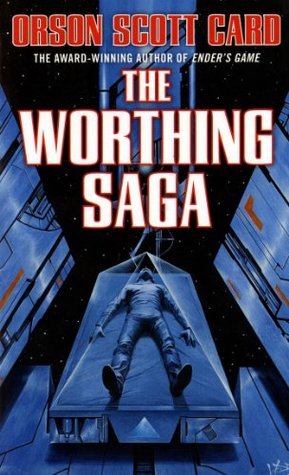
37. The Worthing Saga


37. The Worthing Saga. Orson Scott Card. 1990. Tor. 465 pages. [Source: Library] [5 stars, adult science fiction, short stories, framework stories]

First sentence: In many places in the Peopled Worlds, the pain came suddenly in the midst of the day's labor. It was as if an ancient and comfortable presence left them, one that they had never noticed until it was gone, and no one knew what to make of it at first, though all knew at once that something had changed deep at the heart of the world.   

ETA: I think this is the fourth time I've reviewed it for Becky's Book Reviews. I listened on audio book this time around. IT was mostly great. I absolutely love the first half--the framework stories. The short stories are hit and miss. I like some of them a LOT...and I detest/loathe others. The book as a whole is one that sticks with me vividly.

 Premise/plot: Imagine living in a world where there is no pain, no suffering, no grief, no fear, no anger, no violence, no injury. Wrong actions, in a sense, have ceased to have consequences. If a person were to hurt himself/herself chopping wood or tending the fires, then there would be instant--almost magical--healing. Even morally wrong actions are prevented, on this world there are no children out of wedlock; and the child is always the husband's never the lover's if you're an adulteress. Yes, there is an occasional death, but never for the very young, never for the able-bodied. It is hard to imagine for us this life of easy contentment. A life with no struggles? A life truly worry-free? A world where fire doesn't burn you and ice doesn't freeze you? Surely there must be a catch, right? Some reason why this world isn't a perfect paradise...

The change came in the middle of the night. Imagine going to bed with everything being quite all right, and waking up to find that life is not what you thought it was. Pain. Grief. Suffering. Worry. Fear. Anger. And it wasn't just emotional, as the village learned. It was physical, too. As one accident after another occurred, the villagers soon realized that they could not only be hurt, but they could also DIE. With the whole village (and indeed the whole world) in confusion, no one knows quite what to think. Is God dead? If God is still watching over them, why then is there suffering? Why suffering after all these centuries of watchful care? Folks are going along muttering that God doesn't look out for them anymore.

The old clerk trembled and nodded and his voice quivered as he spoke. 'I have read the books of ancient times,' he began, and all eyes turned to him. 'I have read the books of ancient times, and in them the old ones spoke of wounds that bleed like slaughtered cattle, and great griefs when the living suddenly are dead, and anger that turns to blows among people. But that was long, long ago, when men were still animals, and God was young and inexperienced. (5-6)

Yes, no one understands this Day of Pain. Least of all, Lared, our young hero. But it is Lared who will become the chosen speaker that will write the story and tell the tales that will explain this Day and give it meaning. Two strangers come to the inn, the inn that Lared's parents own, and it is Lared and his sister, Sala, who befriend them. Jason. Justice. A man and woman. The two are mysterious, no doubt about it, and more than one person suspects that they're coming is linked with the Day of Pain.

The two share their stories mostly through dreams and waking visions. Jason will occasionally share one the old-fashioned way, but most are transmitted directly into Lared's mind. Lared doesn't know what to think. He doesn't like the dreams. He doesn't like the uneasy feelings they leave him with...but he also knows that he has been called, chosen, if you will, to write this down. To record them. It is not his place to understand everything, just to write it down as it's been given to him.

Lared and his village provide the framework for the stories that Jason and Justice share. It is a story of two men, one empire, and one powerful drug.

Abner Doon. A name that still strikes fear in people thousands of years after his death. Some even say that he was the devil himself. But was he really? His name is associated with death and destruction, and in some ways, it is easy to understand why. He caused the death and destruction of the EMPIRE. The very arrogant, often corrupt, very stagnant empire. But was the fall of the empire really that bad? Wasn't it better for humanity in general? Jason Worthing certainly thinks so.

Jason Worthing. Another name that people fear to speak aloud. Why? It is a name of reverence. Many people feel that Jason Worthing is God. The creator of life. The sustainer of the universe, even. But was he really? Yes, he had a hand in establishing life and building civilization, at least on one planet, but the creator of all life? No. Just an ordinary man with unusual psychic powers who came from a technologically advanced society.

The empire. It's not that the empire was completely evil. Sure the empire had its fair share of corrupt and power-hungry politicians. More than its fair share. Every branch of the empire had its corrupt officials. And there was nothing that couldn't be bought--as long as you had money. But that wasn't the real crime of the empire. The real crime was that humanity was being robbed of its very soul, its very essence. They had lost the point of living. They were corrupting the very nature of our existence.

Somec. Perhaps the most powerful drug the empire had ever known. What did it do? It put the user into a deep sleep, a coma, if you will. First, the user would have his/her memories downloaded or recorded, if you will, onto a tape or into a bubble. I forget quite how they did it. I just know that there was a way of downloading and uploading memory. Then the assistant would inject somec. It wasn't a pretty picture. It burned. It hurt. It caused severe physical problems--sweating, discomfort, pain--but the user would forever be unaware of it because the memories would never include this part of the experience. Who was it for? At first, it was just for starship pilots. Their skills would be needed throughout a long voyage. And if a trip took hundreds or perhaps thousands of years, then they'd need Somec to function. The computer would always be able to wake them up in case of an emergency. But they'd arrive at their destination intact. So for colonization vessels, it really couldn't be any better. A ship would carry three hundred or so passengers and all the supplies needed to create and establish a civilization on another planet. So there were a few valid uses of the drug, I suppose. But the real corruption began when somec became a common necessity for the people.

Imagine the possibility of immortality. Somec offered immortality. The wealthy. The elite. The powerful. The brilliant minds of society were all given the chance for immortality. The more valuable society deemed you, the longer you would sleep between waking cycles. The common people lived and died naturally enough. But a good portion of society, became obsessed with immortality. But is living a thousand years natural if you spend 70% of it or so asleep? What does it accomplish really? You're not able to have friendships with others unless you're on the same sleep cycle. You're not able to maintain family relationships either. People could theoretically outlive their great-great-great-great-great-grandchildren. Love becomes to a certain extent irrelevant. Most things become irrelevant. No time for the finer things in life. Love. Romance. Music. Art. For not only do most people spend most of their times asleep, what little time they're awake they're obsessed with power, money, fame, greed, control. They always want more, more, more. Never content. There is no longer any joy in living life. But really too few people notice what they're missing. Except for one. The aforementioned Abner Doon.

Abner "rescues" Jason, if you will, and offers him a chance to become a part of something great. Jason becomes a starship pilot, a very famous starship pilot, and he eventually leads a colonization ship. Abner's big plan--besides the fall of the Empire--is to recreate life as it used to be. His plan? To spread humanity throughout the galaxy. To have human civilizations sprout up on thousands of planets. He knows that with the fall of the Empire, with the fall of technology, it will be thousands upon thousands of years before ANY civilization becomes advanced enough for star flight. He sees this as a way for humanity to wipe the slate clean and begin anew.

The Worthing Saga is the story of Jason's planet. How Jason "fathered" or "created" that world. And what happened to its inhabitants. What happened to his descendants. All these stories--and there are many--span thousands of years. Everything is leading the reader back to Lared. Back to the Day of Pain.

The Worthing Saga contains the previously published The Worthing Chronicle and nine short stories.

My Thoughts: Worthing Saga is one of my favorite, favorite books. And my FAVORITE Card novel. (Though I love Ender's Game and Speaker for the Dead.) The Worthing Saga is about the meaning of life. It is about what it means to be human. It asks important questions. It goes where few novels do. It asks what the meaning of pain and suffering is. It asks what the meaning of struggles are. It is ethical in nature. It asks the hard questions. But it is philosophical as well.

I love the world-building. I find the three settings within the book to be fascinating. (There is Lared's home planet which is the present-day setting; there is Capital, the planet from Jason Worthing's memory and stories, Capital becomes "real" to Lared as he experiences Worthing's memories through dreams; there is Worthing, the planet that Jason colonized with a handful of colonists thousands of years before the novel opens, again this planet becomes "real" to Lared as he experiences other people's memories through Justice, Jason's descendant.) Readers get a taste of all these societies and communities. Capital is decadent and immoral and corrupt. It is obsessed with the notion of eternity--of living forever. It "lives forever" by drug use. Somec. You might be under Somec--asleep--for anywhere from one year to ten years, and then awake for anywhere from one day (like the Empress) to three years. But somec disrupts EVERYTHING good and natural about life. An example of the decadence and immorality can be seen in the "lifeloops." People filming/recording their "real" lives for everyone to watch. Most--if not all lifeloops--are graphic in nature. It's hard not to be disgusted by the depiction. (For example, one actress complaining to her agent that he better not hire any seven year old boys for her next film.) Closely connected to the world-building, is the mythology of it. How Abner Doon's name lives on. He IS the devil. How Jason Worthing's name lives on. How people see him as being GOD. Both men are very much human, having strengths and weaknesses, being oh-so-fallible. But they have become collectively so much more than that. They've lost their humanity. Truth has been shaped and reshaped too many times to allow for them to be just human.

I love the characterization. I love getting to know Lared, Sala, Jason, and Justice. Not to mention all the men and women from the memories and stories. (I have a soft spot for Hoom.) I love the storytelling. I love the dialogue. I love how everything is layered together. How the story all comes together. How Lared slowly but surely pieces things together and comes to understand--if understand is the right word--the world. Card's characters are so very human, so vulnerable, so fallible. Readers see humans at their best and at their absolute worst within The Worthing Saga. Moments of compassion and redemption make it so worth while.


I love the ideas. I love the depth and substance. That is not to say that I agree absolutely with every single philosophical idea within the book. But it goes places most fiction doesn't. It asks real questions, tough questions. It explores ideas. One also sees the consequences (or possible consequences) of ideas. But it encourages you to think about deep things, to explore questions like why is there pain? why is there suffering? would the world be a better place without pain, without suffering? Is pain a necessary evil? Do we only feel joy and happiness because we know about pain and sorrow? what makes life beautiful? do we become better people through our struggles with life?


I do enjoy the framework. The Worthing Chronicle (1982) makes up half of The Worthing Saga. This is THE story with Lared being visited by Jason and Justice shortly after the day of pain disrupts his community. (It really is a haunting opening.) The second half of the book consists of short stories. Most of these short stories were written years before The Worthing Chronicle and were previously published. Tales of Capitol (1979): "Skipping Stones," "Second Chance," "Lifeloop," "Breaking the Game," "Killing Children," and "What Will We Do Tomorrow." Tales from the Forest of Waters (1990, 1980): "Worthing Farm," "Worthing Inn," and "The Tinker." Of these stories, I find Skipping Stones, Second Chance, and Breaking the Game to be most memorable. After you've read these stories, you almost need to go back and reread the first section. I'm not sure you can fully appreciate the book without rereading it a few times and absorbing it. Most of the stories--but certainly not all of them--are emotional. I love that the book is a book to be EXPERIENCED. 

ETA: YET I do have to say that I don't absolutely love everything. Some of the stories are EXTREMELY graphic and disturbing...one might even say disgusting. Not all of the stories. Not even most of the stories. And they are there to show the corruption and sickness of what humanity has become...so I guess they somewhat serve a purpose. Yet this one is distasteful in places.

© 2025 Becky Laney of Becky's Book Reviews

Monday, December 18, 2023

192. Zanna's Gift


Zanna's Gift. Orson Scott Card. 2020. [November] Originally published in 2004? 250 pages. [Source: Review copy]

First sentence: There are many ways to lose a child, and none of them is merciful. But like all unbearable things it can be borne, and in the weeks before Christmas 1938, the Pullmans were learning how.

Premise/plot: Zanna's Gift is a LOVELY Christmas novel. Zanna, the youngest of the Pullman family, has a special way to memorialize her older brother, Ernest, after his unexpected death at fifteen.

The best way to read Zanna's Gift is without knowing a thing about it. I promise you. I'm doing you a favor by NOT summarizing the plot and sharing what Zanna's GIFT was and how it was a gift that kept giving and giving. 

My thoughts: LOVE. I loved this one absolutely and completely from start to finish. It was one of those perfectly perfect EXPERIENCES. It feels like more than just a book, a story, a fictional work. THESE CHARACTERS ARE REAL. How it hasn't been adapted into a movie if it was truly published originally in 2004 is beyond me. It would make an excellent movie. 

I would recommend this one to people who aren't necessarily readers. Of course I recommend it to readers who read anything and everything. But for those who are reluctant to pick up books, please consider reading this wonderful amazing book. 

If you LOVE Christmas, this is an absolute must. I could easily see it becoming a book that you feel you HAVE to read each and every year.

 ETA: I've read this one three times? four times? I love this book so much.


© 2023 Becky Laney of Becky's Book Reviews

Tuesday, October 25, 2022

137. Ender's Game


Ender's Game. Orson Scott Card. 1985. 324 pages. [Source: Bought]

First sentence: "I've watched through his eyes, I've listened through his ears, and I tell you he's the one. Or at least as close as we're going to get."

Premise/plot: Andrew Wiggin, aka "Ender," is six years old and potentially the earth's savior. Two wars have been fought and barely won against the aliens known to readers as Buggers. The third war will take much preparation--decades worth of the International Fleet training up children to be commanders and soldiers.

Ender is one such student or trainee. His older brother, Peter, and older sister, Valentine, didn't make it so far as Battle School in space. Ender's life is wearisome and burdensome. He doesn't make friends easily and his biggest fear is being just as violent and out of control as his brother, Peter. He is prone to self-reflection and self-loathing. But in terms of military genius, strategizing, leadership...he excels.

When the time comes to fight the war, will he be ready?

My thoughts: There was a time I loved, loved, loved, loved, loved this novel. The past few times I've revisited the novel, that has lessened a bit. I still love elements of this one. But there are definitely elements about it I do not like at all. The first fourth of the novel, well, it's DISTURBING, uncomfortable, awkward, a bit off. I did NOT remember the use of the n word. I did not remember the jokesy approach to different races (or ethnicities). I did not remember the chokehold scene where Peter is trying to kill his brother. I did not remember some of the crudeness.

One thing that bothers me is Peter. Peter is a psychopath in my opinion. He is cruel to his brother and sister. He is cruel to small animals. He is a bully. He is manipulative. He is egocentric and a narcissist. He dreams of world domination. He is just a sick, sick, sick individual. And I think what readers are outright told about him is just the tip of the iceberg. If Valentine is to be believed about the files and records she's been keeping of her brother. Chances are he might have done even more than she knew about. There was one line that disturbed me where she is telling Ender that you don't know what I had to do to keep Peter from hurting you. Of course, we don't know--she doesn't say. But Card later seems to redeem the character of Peter and seeks to make him sympathetic.

Card does do flawed humans well. I will give him that. Are any of the characters in this one not flawed?!?! I think the most likable characters may be Bean and Petra.


© 2022 Becky Laney of Becky's Book Reviews

Saturday, November 07, 2020

138. Zanna's Gift


Zanna's Gift. Orson Scott Card. 2020. [November] Originally published in 2004? 250 pages. [Source: Review copy]

First sentence: There are many ways to lose a child, and none of them is merciful. But like all unbearable things it can be borne, and in the weeks before Christmas 1938, the Pullmans were learning how.

Premise/plot: Zanna's Gift is a LOVELY Christmas novel. Zanna, the youngest of the Pullman family, has a special way to memorialize her older brother, Ernest, after his unexpected death at fifteen.

The best way to read Zanna's Gift is without knowing a thing about it. I promise you. I'm doing you a favor by NOT summarizing the plot and sharing what Zanna's GIFT was and how it was a gift that kept giving and giving. 

My thoughts: LOVE. I loved this one absolutely and completely from start to finish. It was one of those perfectly perfect EXPERIENCES. It feels like more than just a book, a story, a fictional work. THESE CHARACTERS ARE REAL. How it hasn't been adapted into a movie if it was truly published originally in 2004 is beyond me. It would make an excellent movie. 

I would recommend this one to people who aren't necessarily readers. Of course I recommend it to readers who read anything and everything. But for those who are reluctant to pick up books, please consider reading this wonderful amazing book. 

If you LOVE Christmas, this is an absolute must. I could easily see it becoming a book that you feel you HAVE to read each and every year.

© 2020 Becky Laney of Becky's Book Reviews

Wednesday, June 24, 2020

88. Ender's Game

Ender's Game. Orson Scott Card. 1985. 324 pages. [Source: Library]

First sentence: "I've watched through his eyes, I've listened through his ears, and I tell you he's the one. Or at least as close as we're going to get."

Premise/plot: Andrew Wiggin, aka "Ender," is six years old and potentially the earth's savior. Two wars have been fought and barely won against the aliens known to readers as Buggers. The third war will take much preparation--decades worth of the International Fleet training up children to be commanders and soldiers.

Ender is one such student or trainee. His older brother, Peter, and older sister, Valentine, didn't make it so far as Battle School in space. Ender's life is wearisome and burdensome. He doesn't make friends easily and his biggest fear is being just as violent and out of control as his brother, Peter. He is prone to self-reflection and self-loathing. But in terms of military genius, strategizing, leadership...he excels.

When the time comes to fight the war, will he be ready?

My thoughts: For a decade I would have considered this one of my favorite, favorite books. Now that it's been almost twenty years or so since I first read it--well, my thoughts and impressions have changed some. I love the last fourth of the novel. That hasn't changed. But the first fourth of the novel, well, it's DISTURBING, uncomfortable, awkward, a bit off. I did NOT remember the use of the n word. I did not remember the jokesy approach to different races (or ethnicities). I did not remember the chokehold scene where Peter is trying to kill his brother. I did not remember some of the crudeness.

One thing that bothers me is Peter. Peter is a psychopath in my opinion. He is cruel to his brother and sister. He is cruel to small animals. He is a bully. He is manipulative. He is egocentric and a narcissist. He dreams of world domination. He is just a sick, sick, sick individual. And I think what readers are outright told about him is just the tip of the iceberg. If Valentine is to be believed about the files and records she's been keeping of her brother. Chances are he might have done even more than she knew about. There was one line that disturbed me where she is telling Ender that you don't know what I had to do to keep Peter from hurting you. Of course, we don't know--she doesn't say. But Card later seems to redeem the character of Peter and seeks to make him sympathetic.

Card does do flawed humans well. I will give him that. Are any of the characters in this one not flawed?!?! I think the most likable characters may be Bean and Petra.


© 2020 Becky Laney of Becky's Book Reviews

Friday, February 10, 2017

Worthing Saga

The Worthing Saga. Orson Scott Card. 1992. Tor. 463 pages. [Source: Bought]

First sentence: In many places in the Peopled Worlds, the pain came suddenly in the midst of the day's labor. It was as if an ancient and comfortable presence left them, one that they had never noticed until it was gone, and no one knew what to make of it at first, though all knew at once that something had changed deep at the heart of the world.

Premise/plot: Imagine living in a world where there is no pain, no suffering, no grief, no fear, no anger, no violence, no injury. Wrong actions, in a sense, have ceased to have consequences. If a person were to hurt himself/herself chopping wood or tending the fires, then there would be instant--almost magical--healing. Even morally wrong actions are prevented, on this world there are no children out of wedlock; and the child is always the husband's never the lover's if you're an adulteress. Yes, there is an occasional death, but never for the very young, never for the able-bodied. It is hard to imagine for us this life of easy contentment. A life with no struggles? A life truly worry-free? A world where fire doesn't burn you and ice doesn't freeze you? Surely there must be a catch, right? Some reason why this world isn't a perfect paradise...

The change came in the middle of the night. Imagine going to bed with everything being quite all right, and waking up to find that life is not what you thought it was. Pain. Grief. Suffering. Worry. Fear. Anger. And it wasn't just emotional, as the village learned. It was physical, too. As one accident after another occurred, the villagers soon realized that they could not only be hurt, but they could also DIE. With the whole village (and indeed the whole world) in confusion, no one knows quite what to think. Is God dead? If God is still watching over them, why then is there suffering? Why suffering after all these centuries of watchful care? Folks are going along muttering that God doesn't look out for them anymore.
The old clerk trembled and nodded and his voice quivered as he spoke. 'I have read the books of ancient times,' he began, and all eyes turned to him. 'I have read the books of ancient times, and in them the old ones spoke of wounds that bleed like slaughtered cattle, and great griefs when the living suddenly are dead, and anger that turns to blows among people. But that was long, long ago, when men were still animals, and God was young and inexperienced. (5-6)
Yes, no one understands this Day of Pain. Least of all, Lared, our young hero. But it is Lared who will become the chosen speaker that will write the story and tell the tales that will explain this Day and give it meaning. Two strangers come to the inn, the inn that Lared's parents own, and it is Lared and his sister, Sala, who befriend them. Jason. Justice. A man and woman. The two are mysterious, no doubt about it, and more than one person suspects that they're coming is linked with the Day of Pain.

The two share their stories mostly through dreams and waking visions. Jason will occasionally share one the old-fashioned way, but most are transmitted directly into Lared's mind. Lared doesn't know what to think. He doesn't like the dreams. He doesn't like the uneasy feelings they leave him with...but he also knows that he has been called, chosen, if you will, to write this down. To record them. It is not his place to understand everything, just to write it down as it's been given to him.

Lared and his village provide the framework for the stories that Jason and Justice share. It is a story of two men, one empire, and one powerful drug.

Abner Doon. A name that still strikes fear in people thousands of years after his death. Some even say that he was the devil himself. But was he really? His name is associated with death and destruction, and in some ways, it is easy to understand why. He caused the death and destruction of the EMPIRE. The very arrogant, often corrupt, very stagnant empire. But was the fall of the empire really that bad? Wasn't it better for humanity in general? Jason Worthing certainly thinks so.

Jason Worthing. Another name that people fear to speak aloud. Why? It is a name of reverence. Many people feel that Jason Worthing is God. The creator of life. The sustainer of the universe, even. But was he really? Yes, he had a hand in establishing life and building civilization, at least on one planet, but the creator of all life? No. Just an ordinary man with unusual psychic powers who came from a technologically advanced society.

The empire. It's not that the empire was completely evil. Sure the empire had its fair share of corrupt and power-hungry politicians. More than its fair share. Every branch of the empire had its corrupt officials. And there was nothing that couldn't be bought--as long as you had money. But that wasn't the real crime of the empire. The real crime was that humanity was being robbed of its very soul, its very essence. They had lost the point of living. They were corrupting the very nature of our existence.

Somec. Perhaps the most powerful drug the empire had ever known. What did it do? It put the user into a deep sleep, a coma, if you will. First, the user would have his/her memories downloaded or recorded, if you will, onto a tape or into a bubble. I forget quite how they did it. I just know that there was a way of downloading and uploading memory. Then the assistant would inject somec. It wasn't a pretty picture. It burned. It hurt. It caused severe physical problems--sweating, discomfort, pain--but the user would forever be unaware of it because the memories would never include this part of the experience. Who was it for? At first, it was just for starship pilots. Their skills would be needed throughout a long voyage. And if a trip took hundreds or perhaps thousands of years, then they'd need Somec to function. The computer would always be able to wake them up in case of an emergency. But they'd arrive at their destination intact. So for colonization vessels, it really couldn't be any better. A ship would carry three hundred or so passengers and all the supplies needed to create and establish a civilization on another planet. So there were a few valid uses of the drug, I suppose. But the real corruption began when somec became a common necessity for the people.

Imagine the possibility of immortality. Somec offered immortality. The wealthy. The elite. The powerful. The brilliant minds of society were all given the chance for immortality. The more valuable society deemed you, the longer you would sleep between waking cycles. The common people lived and died naturally enough. But a good portion of society, became obsessed with immortality. But is living a thousand years natural if you spend 70% of it or so asleep? What does it accomplish really? You're not able to have friendships with others unless you're on the same sleep cycle. You're not able to maintain family relationships either. People could theoretically outlive their great-great-great-great-great-grandchildren. Love becomes to a certain extent irrelevant. Most things become irrelevant. No time for the finer things in life. Love. Romance. Music. Art. For not only do most people spend most of their times asleep, what little time they're awake they're obsessed with power, money, fame, greed, control. They always want more, more, more. Never content. There is no longer any joy in living life. But really too few people notice what they're missing. Except for one. The aforementioned Abner Doon.

Abner "rescues" Jason, if you will, and offers him a chance to become a part of something great. Jason becomes a starship pilot, a very famous starship pilot, and he eventually leads a colonization ship. Abner's big plan--besides the fall of the Empire--is to recreate life as it used to be. His plan? To spread humanity throughout the galaxy. To have human civilizations sprout up on thousands of planets. He knows that with the fall of the Empire, with the fall of technology, it will be thousands upon thousands of years before ANY civilization becomes advanced enough for star flight. He sees this as a way for humanity to wipe the slate clean and begin anew.

The Worthing Saga is the story of Jason's planet. How Jason "fathered" or "created" that world. And what happened to its inhabitants. What happened to his descendants. All these stories--and there are many--span thousands of years. Everything is leading the reader back to Lared. Back to the Day of Pain.

The Worthing Saga contains the previously published The Worthing Chronicle and nine short stories.

My thoughts: The Worthing Saga is about the meaning of life. It is about what it means to be human. It asks important questions. It goes where few novels do. It asks what the meaning of pain and suffering is. It asks what the meaning of struggles are. It is ethical in nature. It asks the hard questions. But it is philosophical as well.

I love the world-building. I find the three settings within the book to be fascinating. (There is Lared's home planet which is the present-day setting; there is Capital, the planet from Jason Worthing's memory and stories, Capital becomes "real" to Lared as he experiences Worthing's memories through dreams; there is Worthing, the planet that Jason colonized with a handful of colonists thousands of years before the novel opens, again this planet becomes "real" to Lared as he experiences other people's memories through Justice, Jason's descendent.) Readers get a taste of all these societies and communities.

I love the characterization. I love getting to know Lared, Sala, Jason, and Justice. Not to mention all the men and women from the memories and stories. (I have a soft spot for Hoom.) I love the storytelling. I love the dialogue. I love how everything is layered together. How the story all comes together. How Lared slowly but surely pieces things together and comes to understand--if understand is the right word--the world. Card's characters are so very human, so vulnerable, so fallible. Readers see humans at their best and at their absolute worst within The Worthing Saga. Moments of compassion and redemption make it so worth while.

I love the ideas. I love the depth and substance. That is not to say that I agree absolutely with every single philosophical idea within the book. But it goes places most fiction doesn't. It asks real questions, tough questions. It explores ideas. One also sees the consequences (or possible consequences) of ideas.


© 2017 Becky Laney of Becky's Book Reviews

Sunday, January 25, 2015

Revisiting Worthing Saga

The Worthing Saga. Orson Scott Card. 1990. Tor. 465 pages. [Source: Bought]

In many places in the Peopled Worlds, the pain came suddenly in the midst of the day's labor. It was as if an ancient and comfortable presence left them, one that they had never noticed until it was gone, and no one knew what to make of it at first, though all knew at once that something had changed deep at the heart of the world.  

This will be my third blog review for Orson Scott Card's The Worthing Saga. I reviewed this one in 2007 and 2012. It is one of my favorite, favorite books. And my FAVORITE Card novel. (Though I love Ender's Game and Speaker for the Dead.)

I love the world-building. I find the three settings within the book to be fascinating. (There is Lared's home planet which is the present-day setting; there is Capital, the planet from Jason Worthing's memory and stories, Capital becomes "real" to Lared as he experiences Worthing's memories through dreams; there is Worthing, the planet that Jason colonized with a handful of colonists thousands of years before the novel opens, again this planet becomes "real" to Lared as he experiences other people's memories through Justice, Jason's descendent.) Readers get a taste of all these societies and communities. Capital is decadent and immoral and corrupt. It is obsessed with the notion of eternity--of living forever. It "lives forever" by drug use. Somec. You might be under Somec--asleep--for anywhere from one year to ten years, and then awake for anywhere from one day (like the Empress) to three years. But somec disrupts EVERYTHING good and natural about life. An example of the decadence and immorality can be seen in the "lifeloops." People filming/recording their "real" lives for everyone to watch. Most--if not all lifeloops--are graphic in nature. It's hard not to be disgusted by the depiction. (For example, one actress complaining to her agent that he better not hire any seven year old boys for her next film.) Closely connected to the world-building, is the mythology of it. How Abner Doon's name lives on. He IS the devil. How Jason Worthing's name lives on. How people see him as being GOD. Both men are very much human, having strengths and weaknesses, being oh-so-fallible. But they have become collectively so much more than that. They've lost their humanity. Truth has been shaped and reshaped too many times to allow for them to be just human.

I love the characterization. I love getting to know Lared, Sala, Jason, and Justice. Not to mention all the men and women from the memories and stories. (I have a soft spot for Hoom.) I love the storytelling. I love the dialogue. I love how everything is layered together. How the story all comes together. How Lared slowly but surely pieces things together and comes to understand--if understand is the right word--the world. Card's characters are so very human, so vulnerable, so fallible. Readers see humans at their best and at their absolute worst within The Worthing Saga. Moments of compassion and redemption make it so worth while.

I love the ideas. I love the depth and substance. That is not to say that I agree absolutely with every single philosophical idea within the book. But it goes places most fiction doesn't. It asks real questions, tough questions. It explores ideas. One also sees the consequences (or possible consequences) of ideas. But it encourages you to think about deep things, to explore questions like why is there pain? why is there suffering? would the world be a better place without pain, without suffering? Is pain a necessary evil? Do we only feel joy and happiness because we know about pain and sorrow? what makes life beautiful? do we become better people through our struggles with life?


I do enjoy the framework. The Worthing Chronicle (1982) makes up half of The Worthing Saga. This is THE story with Lared being visited by Jason and Justice shortly after the day of pain disrupts his community. (It really is a haunting opening.) The second half of the book consists of short stories. Most of these short stories were written years before The Worthing Chronicle and were previously published. Tales of Capitol (1979): "Skipping Stones," "Second Chance," "Lifeloop," "Breaking the Game," "Killing Children," and "What Will We Do Tomorrow." Tales from the Forest of Waters (1990, 1980): "Worthing Farm," "Worthing Inn," and "The Tinker." Of these stories, I find Skipping Stones, Second Chance, and Breaking the Game to be most memorable. After you've read these stories, you almost need to go back and reread the first section. I'm not sure you can fully appreciate the book without rereading it a few times and absorbing it. Most of the stories--but certainly not all of them--are emotional. I love that the book is a book to be EXPERIENCED.

© 2015 Becky Laney of Becky's Book Reviews

Thursday, August 07, 2014

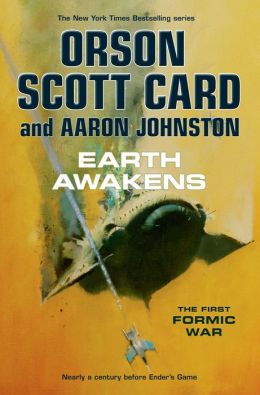
Earth Awakens (2014)

Earth Awakens. Orson Scott Card and Aaron Johnston. 2014. Tor. 400 pages. [Source: Library]

I enjoyed reading Earth Awakens the third in a new series by Orson Scott Card. At first, I had a hard time reconnecting to all the characters because it's been a year since the last book. There are many characters to keep up with after all. But by the time I was halfway through this one, I was hooked once more. I liked the characters. I didn't always like how they acted. But Card can write flawed characters that I actually like.

In this third book, all the characters are trying to fight the Formics. Some are working together officially to defeat the aliens. Others are more on their own with their own plan. For example, some characters are fighting them on earth; other characters are fighting them in space. But by the end of this one, all the characters stories have merged into one which is probably for the best.

Series books are always so difficult to review because to talk about plot reveals spoilers from the other books. But essentially I liked this one. Maybe not love, love, love but a good, solid like.

© 2014 Becky Laney of Becky's Book Reviews

Friday, January 24, 2014

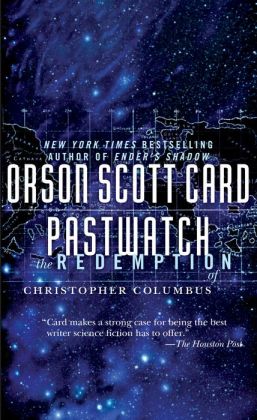
Reread #4 Pastwatch The Redemption of Christopher Columbus

Pastwatch The Redemption of Christopher Columbus. Orson Scott Card. 1996. Tor.  351 pages. [Source: Book I Bought]

I first reviewed Pastwatch for the blog in November 2007, but that was certainly not my first time to read it. I discovered Orson Scott Card's work in a library science class in the fall of 2000. I read everything I could find of his over the next year. It was my first venture into science fiction. It was LOVE.

Semi-Apocalyptic fiction. Alternate histories. Time Travel. Need I say more?! For anyone who enjoys dystopias or apocalyptic fiction, I'd say that Pastwatch was a must read! The same is true for anyone who loves reading time travel stories. The premise and plot is enough to keep one reading. But the characterization is wonderfully done as well.

In the world of Pastwatch, history can be viewed on the big screen. In the early stages, this technology could only watch vast regions--note climate changes and social changes--the building of communities and sometimes their collapses. But as this technology is developed further, it becomes possible to watch history in greater detail, minute detail. Scientists, historians, researchers (whatever you want to call them) can do studies on communities, societies, or individuals. What's the point of watching the past? To learn. To understand. To answer impossible questions. But a few historians hope for more. What if watching the past could change the past? Each historian researcher has his/her own speciality. Sometimes they work on something personally, other times they come together into various teams. Readers meet a handful of researchers--probably six or seven and learn of their lives, of their studies.

How is Christopher Columbus involved? Well, he's one of our narrators for one thing. But secondly, he becomes the subject of interest for most of our other narrators. It is HIS life that is being dissected and held up for study. What our researchers learn is that at some point in time, future scientists, interfered or manipulated the past that turned Christopher Columbus' interest to sailing west. Their quest to figure out how and why of this manipulation will lead them on a journey with massive consequences. For they're debating whether or not they should do something along the same lines...

It is a science fiction novel. And like many science fiction novels, it deals with aspects of playing God. One of the thought-provoking subjects in Pastwatch is suffering. The historian-researchers perhaps feel they can do a better job at writing or rewriting history. That they can do a better job at alleviating suffering and establishing peace and goodwill across the globe. The future-historians take on the role of God, manipulating people in the past making them believe that they are God or God's messengers. Pain and suffering was also a big, big subject in the Worthing Saga, another Card novel.

Quotes:
Though Tagiri did not put her own body back in time, it is still true to say that she was the one who stranded Christopher Columbus on the island of Hispaniola and changed the face of history forever. Though she was born seven centuries after Columbus's voyage and never left her birth continent of Africa, she found a way to reach back and sabotage the European conquest of America. It was not an act of malice. Some said that it was correcting a painful hernia in a brain damaged child: In the end, the child would still be severely limited, but it would not suffer as much along the way. But Tagiri saw it differently.
"History is not prelude," she said once. "We don't justify the suffering of people in the past because everything turned out well enough by the time we came along. Their suffering counts just as much as our peace and happiness. We look out of our golden windows and feel pity for the scenes of blood and blades, of plagues and famines that are played out in the surrounding country. When we believed that we could not go back in time and make changes, then we could be excused for shedding a tear for them and then going on about our happy lives. But once we know that it is in our power to help them, then, if we turn away and let their suffering go on, it is no golden age we live in, and we poison our own happiness. Good people do not let others suffer needlessly." What she asked was a hard thing, but some agreed with her. Not all, but in the end, enough. (25-6)
Till now, all the story-seekers in Pastwatch had devoted their careers to recording the stories of great, or at least influential men and women of the past. But Tagiri would study the slaves, not the owners; she would search throughout history, not to record the choices of the powerful, but to find the stories of those who had lost all choice. To remember the forgotten people, the ones whose dreams were murdered and whose bodies were stolen from themselves, so that they were not even featured players in their own autobiographies. The ones whose faces showed that they never forgot for one instant that they did not belong to themselves, and that there was no lasting joy possible in life because of that. (35)
 "It can be done," she said, blurting it out at once. "We can change it. We can stop--something. Something terrible, we can make it go away. We can reach back and make it better."
He said nothing. He waited.
"I know what you're thinking, Hassan. We might also make it worse."
"Do you think I haven't been going through this in my mind tonight?" said Hassan. "Over and over. Look at the world around us, Tagiri. Humanity is finally at peace. There are no plagues. No children die hungry or live untaught. The world is healing. That was not inevitable. It might have ended up far worse. What change could we possibly make in the past that would be worth the risk of creating a history without this resurrection of the world?"
"I'll tell you what change would be worth it," she said. "The world would not have needed resurrecting if it had never been killed."
"What, do you imagine that there's some change we could make that would improve human nature? Undo the rivalry of nations? Teach people that sharing is better than greed?"
"Has human nature changed even now?" asked Tagiri. "I think not. We still have as much greed, as much power-lust, as much pride and anger as we ever had. The only difference now is that we know the consequences and we fear them. We control ourselves. We have become, at long last, civilized."
"So you think that we can civilize our ancestors?"
"I think," said Tagiri, "that if we can find some way to do it, some sure way to stop the world from tearing itself to pieces as it did, then we must do it. To reach into the past and prevent the disease is better than to take the patient at the point of death and slowly, slowly bring her back to health. To create a world in which the destroyers did not triumph."
"If I know you at all, Tagiri," said Hassan, "you would not have come here tonight if you didn't know already what the change must be."
"Columbus," she said."
"One sailor? Caused the destruction of the world?" (50-1)
"I'm finding the place where the smallest, simplest change would save the world from the most suffering. That would cause the fewest cultures to be lost, the fewest people to be enslaved, the fewest species to fall extinct, the fewest resources to be exhausted. It comes together at the point where Columbus returns to Europe with his tales of gold and slaves and nations to be converted into Christian subjects of the king and queen." (52)
© 2014 Becky Laney of Becky's Book Reviews

Wednesday, July 03, 2013

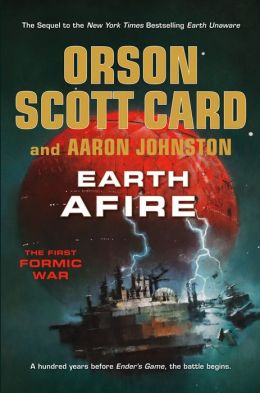
Earth Afire (2013)

Earth Afire. Orson Scott Card and Aaron Johnston. (The First Formic War) 2013. Tor. 400 pages. [Source: Library]

Earth Afire is the sequel to Earth Unaware. I described the first book as something to be experienced instead of (merely) read. The second book is similar. It almost is too much of an experience to be considered enjoyable. It is so intense and so raw.

It is told from multiple view points: Bingwen (a young, intelligent Chinese boy who BELIEVES the vids posted about the aliens are real), Mazer (who is transferred along with his team from New Zealand to China), Victor (who risked it all to reach Luna in time to warn Earth and has sadly been disbelieved for the most part) Rena (Victor's mother who is tasked with keeping the women and children of El Calvador together no matter what), and Lem Jukes (who has changed so much since book one; he's now on a mission to stop the aliens). The aliens are coming--coming quickly. A handful of people know the truth, know the danger, it is just a matter of convincing people that it IS true and that SOMETHING should be done. Sound easy? It's not. For there are so many people--politicians, business men, and military leaders--who do NOT want to face reality that they will do anything to stop the truth from being believed and acted upon.

By the halfway point, the aliens are undeniably here and hostile. What will Earth do? Will there be a fractured effort to stop the aliens? Will the governments on Earth ever learn to work together? Can the aliens even be stopped?

I definitely felt this one. I cared about the characters and the story. My favorite new character was definitely Bingwen, those sections were something. I loved getting the chance to know Mazer Rackham better.

© 2013 Becky Laney of Becky's Book Reviews

Friday, July 20, 2012

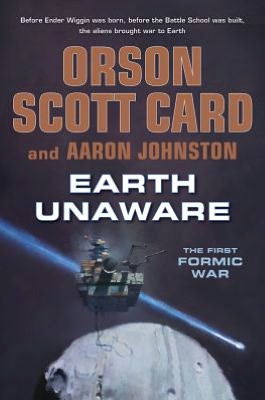
Earth Unaware: The First Formic War

Earth Unaware. Orson Scott Card and Aaron Johnston. The First Formic War. 2012.  Tor. 368 pages.

Victor didn't go to the airlock to see Alejandra leave the family forever, to marry into the Italian clan.

Earth Unaware is an experience. Orson Scott Card is as wonderful as always. In fact, I'd say this may just be my most favorite Card novel of recent years. His characters are so incredibly human, so very, very flawed. Because of their complex relationships with one another, there is a genuineness to them. That doesn't mean readers will connect with each and every character. In fact, this novel has a character I loathe more than any other Card creation: Lem Jukes. Since this novel rotates narrators (or main characters), every Jukes chapter was painful. I was just SO VERY VERY VERY ANGRY at him. I reacted very strongly to him. But that isn't really a big surprise. I reacted strongly to so many characters in this one. Major and minor characters that I just CARED for. Which made almost every loss something to be FELT.

There are essentially "three" big stories being told in Earth Unaware. Two of the stories happen in space. El Calvador is an asteroid mining ship--a family-owned free mining ship. Victor's story, for the most part, occurs on El Calvador. This is the ship that first spots the Formics; well, they are the first to notice that an alien ship is heading towards Earth at faster than light speed. Lem Jukes is captain of a corporation ship. His interest in asteroids isn't quite like El Calvador's. Jukes is working on an invention with a lot of potential--something having to do with a gravity laser. After a successful test or two, he's ready to try the glaser on a bigger object. The object he has in mind happens to be the asteroid that El Calvador is mining at the moment. He decides to "bump" them--destroying their laserline communications--long range communicator--in the process.

The third story is, in a way, the lesser of the three stories. It is set on Earth and involves the military. It centers on a man, Wit O'Toole, forming a special military unit, Mobile Operations Police. One of the recruits is Mazer Rackham. But this isn't his story just yet. He's still undergoing testing, at this point. And the war has not begun. So while he will be very important in the other books in this series, this isn't his time just yet.

Earth Unaware is an exciting, suspenseful science fiction novel. I found the pacing to be just right. (True, some of the chapters seemed like a bit of an interruption, especially close to the end, but for the most part, the book was incredibly INTENSE, painfully INTENSE.) Readers learn about the ship who first spotted the Formic ship--the alien ship. Readers witness the destruction of the first encounter between humans and Formics. And anxiously readers wait and hope that one of the ships who know about the coming aliens will be able to send news to Earth.

This was an incredible reading experience--very emotional. It's a novel to be felt as well as read. The characterization was great. The storytelling and pacing was great too. I just loved it. This is one I'll definitely want to reread. 

Read Earth Unaware
  • If you're a fan of Orson Scott Card
  • If you're a fan of Ender's Game--even if you're not a fan of the other books in the series
  • If you enjoy science fiction
© 2012 Becky Laney of Becky's Book Reviews
Friday, October 31, 2008

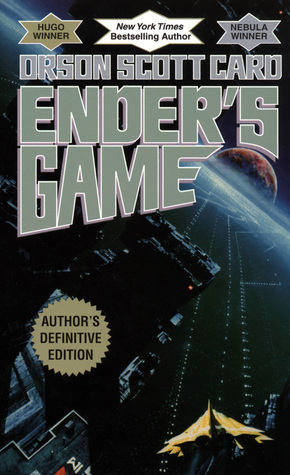
Ender in Exile


Card, Orson Scott. 2008. Ender in Exile.

Ender in Exile is the "new direct sequel" to Ender's Game. And in a way, that's true enough. The novel begins with Ender on Eros. His brother, Peter, and sister, Valentine, are on Earth. One lobbying for his return, the other arguing that he should not be allowed to come home. At all. Ever. If Ender was sent home, so the argument goes, he'd be a pawn for governments and militaries to fight over. He'd be targeted by power-hungry individuals for the rest of his life. Right? Those that have read the Shadow books (Ender's Shadow, Shadow of the Hegemon, Shadow Puppets, Shadow of the Giant) know that is exactly what happened to other Battle School children--including Petra, Bean, and Alai--when they returned. With the return of the children come wars and rumors of wars. Valentine--a.k.a. Demosthenes--wants better than that for her brother. Valentine loves her brother. If he can't come to her, she'll go to him. She decides to join her brother in space in his exile.

Admiral Ender will soon become Governor Wiggin when he's sent (along with Valentine) with one of the first (I think it is the very first) colonization vessels. At thirteen, he doesn't feel ready for the job no matter what anyone on Eros or Earth has to say about his legendary hero status. And there is at least one man on board--a fellow Admiral--who is captain of the ship--Quincy Morgan--who feels that Ender is a sham of a man. He glories himself to be the better man for the job. And he plans accordingly.

This journey will take a little over forty years give or take a month or two. But for Ender--and for the others that remain awake for this flight--it will be just two years. Who would choose to stay awake when they had the option of sleeping and not aging? You might be surprised at how many. Ender chooses because he wants those two years desperately to make him "mature" into a man that a colony of strangers would respect. Valentine chooses because it will give her time with Ender...and it will give her time to write. She's got plans for writing about Battle School and the Formic Wars. The reader is also introduced to two others that choose to remain awake: Dorabella and Alessandra Toscano. Dorabella is a strange woman living in a fantasy world and dreaming big dreams. Here is a feisty woman with ambition. Alessandra is the much shyer, much quieter, mostly-obedient daughter who's afraid to stand up to her mother.

Where are they going? Colony 1. But this colony is soon given a name: Shakespeare. And Ender begins communicating with the governor even before they've left Eros. He wants to know everything about the planet, everything about the people, he wants to make these vital connections, and it's not because he has to. The reader is introduced to some of these colonists throughout. (None will be familiar except Abra.)

A lot can happen in forty or fifty years. And Andrew and Valentine are not cut off completely from Earth. Not exactly. So we do hear about Peter becoming Hegemon. About the wars on Earth. About Bean and Petra and the others whose adventures we followed in the Shadow books.

At some point in the book, Andrew learns about another colony-in-the-making that will be governed by a Battle School graduate named Virlomi. And on that ship is a child that Graff feels is the missing ninth child of Bean and Petra. He wants Andrew--if he's able--to go to this new Colony if he gets the chance to find out for sure. The colony in question is Ganges. On this ship and on this colony are several people whom the reader first met in one or more of the Shadow books.

So Ender in Exile is also the direct sequel to Shadow of the Giant. It follows a handful of the characters into space. And we also follow in a limited capacity those left behind--Peter, Petra, Graff, etc.

Almost everything that happens (but not all of what happens) was hinted at in the final chapter of Ender's Game. There aren't any BIG surprises along the way. The Ender of Ender in Exile is a boy in transition. He's not yet a man. He's not the wise-beyond-his-years Speaker For the Dead. He's a guilt-ridden boy who is burdened by what he's done--the deaths of those two boys, the annihilation of the Buggers--and he is anxious to make amends. He's a good-natured, boy who is seeking answers, always seeking.

How does Ender in Exile compare to others in the series? I enjoyed it. While it could never take the place in my heart for Ender's Game and Speaker for the Dead, it certainly belongs there with the others. We've got a good mix of old characters and new characters. The characterization--like always--is great. The plot was as exciting (in a way) and well paced as others. This one wasn't as bogged down with politics and strategies. Nor was it bogged down with philosophy. I'm not picking on the other sequels--I happen to enjoy them all--but I also acknowledge that some fans of Ender's Game are turned off by the sequels.

I've never been sure how to order these books. I read them Ender's Game, Speaker for the Dead, Xenocide, Children of the Mind, Ender's Shadow, Shadow of the Hegemon, Shadow Puppets, Shadow of the Giant, Ender in Exile. But chronologically, they're all over the place. All of Ender in Exile occurs within the final chapter of Ender's Game and before Speaker of the Dead opens. But there are events discussed or mentioned in Ender in Exile from the Shadow books. There are characters introduced in the Shadow books that are a part of the action in Ender In Exile. So I'm not sure what order to recommend them anymore. I think they can be enjoyed in any order perhaps.

© Becky Laney of Becky's Book Reviews

Revisiting Ender


In celebration of the release of Ender in Exile, I decided to reread Ender's Game. Though I admit it doesn't take much for me to find a good reason to revisit an old friend like Ender. There are times I wonder why I keep going back again and again and again. What is it about Ender and his friends that I just can't get enough of? I don't have the answer to that. But I do know that each time with Ender is just as magical as the previous times. I never get tired of reading Ender's Game no matter how many times I reread it. And there aren't that many books I can say that about.

First sentence: "I've watched through his eyes, I've listened through his ears, and I tell you he's the one. Or at least as close as we're going to get."

Ender's Game is a story about children who don't act like children. Set several hundred years in the future after the first and second wars with the Buggers (or formics), the military-powers-that-be take the most promising children and send them into space to attend Battle School. There they are raised to be soldiers and officers and commanders. No kindness or compassion allowed. Our hero, Andrew Wiggin, is just six when he's taken to Battle School. His nickname is Ender, and he's one-of-a-kind almost from the very beginning. He's the child that shows the most potential, the most promise. But to get him to commander-stage, he'll have to be treated harshly. Even more harshly than his fellow launchies. Do the end results justify the means? You'll have to read and see for yourself.

For my more extensive review of Ender's Game, see this review.

© Becky Laney of Becky's Book Reviews