Showing posts with label 2004. Show all posts

Monday, December 18, 2023

192. Zanna's Gift


Zanna's Gift. Orson Scott Card. 2020. [November] Originally published in 2004? 250 pages. [Source: Review copy]

First sentence: There are many ways to lose a child, and none of them is merciful. But like all unbearable things it can be borne, and in the weeks before Christmas 1938, the Pullmans were learning how.

Premise/plot: Zanna's Gift is a LOVELY Christmas novel. Zanna, the youngest of the Pullman family, has a special way to memorialize her older brother, Ernest, after his unexpected death at fifteen.

The best way to read Zanna's Gift is without knowing a thing about it. I promise you. I'm doing you a favor by NOT summarizing the plot and sharing what Zanna's GIFT was and how it was a gift that kept giving and giving. 

My thoughts: LOVE. I loved this one absolutely and completely from start to finish. It was one of those perfectly perfect EXPERIENCES. It feels like more than just a book, a story, a fictional work. THESE CHARACTERS ARE REAL. How it hasn't been adapted into a movie if it was truly published originally in 2004 is beyond me. It would make an excellent movie. 

I would recommend this one to people who aren't necessarily readers. Of course I recommend it to readers who read anything and everything. But for those who are reluctant to pick up books, please consider reading this wonderful amazing book. 

If you LOVE Christmas, this is an absolute must. I could easily see it becoming a book that you feel you HAVE to read each and every year.

 ETA: I've read this one three times? four times? I love this book so much.


© 2023 Becky Laney of Becky's Book Reviews

Wednesday, May 10, 2023

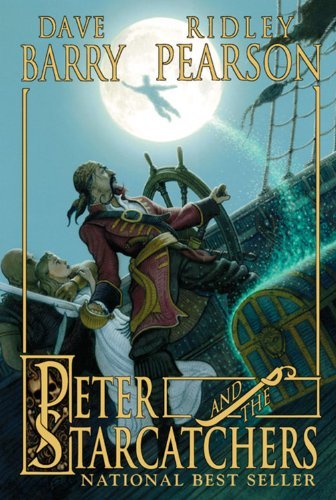
96. Peter and the Starcatchers


Peter and the Starcatchers (Peter and the Starcatchers #1) Dave Barry and Ridley Pearson. Illustrated by Greg Call. 2004. 452 pages. [Source: Library]

First sentence: The tired old carriage, pulled by two tired old horses, rumbled onto the wharf, its creaky wheels bumpety-bumping on the uneven planks, waking Peter from his restless slumber. The carriage interior, hot and stuffy, smelled of five smallish boys and one largish man, none of whom was keen on bathing. Peter was the leader of the boys, because he was the oldest. Or maybe he wasn't. Peter had no idea how old he really was, so he gave himself whatever age suited him, and it suited him to always be one year older than the oldest of his mates. 

Premise/plot: Peter and the Starcatchers is the first in a prequel series to Peter Pan. This first one establishes many of the origin stories associated with Peter Pan, Captain Hook (aka Black Stache in this one), and Never Land (a ship in this one). In addition to Peter and other orphans (soon to be Lost Boys by the conclusion of this one), we have Molly Aster, who is a spunky girl who knows what's what. And what's what is a treasure of stardust (starstuff???) that has great power. It's incredibly dangerous to possess. In very small doses it can heal or transform. In larger doses, it's more lethal. There are pirates after this treasure--but the pirates don't know which of two British ships is carrying the treasure. 

My thoughts: This one slowly builds until secrets are revealed connecting this story to Peter Pan. (Not that it was a big secret.) I first read this one nearly twenty years ago. I loved it in 2004. I don't know that I love it just as much all these years later. But I still really enjoy it/like it. I'm not sure that I'm ready to commit to rereading the whole series. (I may. I may not.) 

I recommend this one to those that like long fantasy books.


© 2023 Becky Laney of Becky's Book Reviews

Monday, December 12, 2022

175. When Christmas Comes


When Christmas Comes. Debbie Macomber. 2004. 256 pages. [Source: Library]

First sentence: What do you mean you won't be home for Christmas?

Premise/plot: Emily Springer wants more than anything to spend Christmas with her college-age daughter. [The daughter wants NOT to spend Christmas with her mother.] Charles Brewster wants to avoid his mother this Christmas [at the very least]. He's tired of getting pressured by his mother to find a nice girl and settle down. [His brother, Ray, also gets pressured by their mother.] These two meet up at some sort of trading spaces site. They decide to switch homes for the holiday. He'll go to Leavenworth. She'll go to Boston. Both will be in for a couple of big surprises over Christmas vacation.

My thoughts: This one was vaguely familiar to me. I then realized that it was because I'd seen the movie based on this book. [Trading Christmas] This sweet holiday read [mostly clean or at the very least off screen only] features several couples falling in love over Christmas.

I liked this one. It was cute.


© 2022 Becky Laney of Becky's Book Reviews

Saturday, March 19, 2022

36. The Last Kingdom


The Last Kingdom. (The Last Kingdom #1) Bernard Cornwell. 2004. 351 pages. [Source: Library]

First sentence: My name is Uhtred. I am the son of Uhtred, who was the son of Uhtred and his father was also called Uhtred. My father's clerk, a priest called Beocca, spelt it Utred. I do not know if that was how my father would have written it, for he could neither read nor write, but I can do both and sometimes I take the old parchments from their wooden chest and I see the name spelled Uhtred or Utred or Ughtred or Ootred.

Premise/plot: The Last Kingdom opens in 866 in England--or what would eventually become England. The Last Kingdom in some ways about one man's vision of a united England. That man isn't the main character, Uhtred, by the way, but (King) Alfred (the Great). In his own words, "This is the tale of a blood feud. It is a tale of how I will take from my enemy what the law says is mine. And it is the tale of a woman and of her father, a king. He was my king and all that I have I owe to him. The food that I eat, the hall where I live, and the swords of my men, all came from Alfred, my king, who hated me."

This first book, however, sets the scene for what is coming, what is inevitable--after all destiny is all, so we're told as readers over and over and over again. 

The story starts with a YOUNG boy, a young boy of Bebbanburg, a second son renamed (and rebaptized) after his older brother's death. It begins with his being ripped away "from his destiny" and having his life turned upside down. He witnesses the death of his father and the defeat of his father's men. He's captured by the Danes (aka Vikings) and enslaved. But his "slavery" comes to feel over time--weeks, months, years--more like adoption. He loves and is loved by his new family...

But this isn't a happily ever after story.

My thoughts: I watched the television series first. It was compelling. I don't know that every viewer feels the need to binge-watch the show, but I certainly did. But the show goes a million times faster than the book. For better or worse. Uhtred's childhood and teenage years are a complete blur in the show. Blink and you miss it. They rush ahead. The book definitely and decidedly are BETTER than the show in that regards. It's good for building and establishing the world; it's great for CHARACTER development. 

So much is abridged on the show. So much is left out completely. For example, Uhtred going to visit his MERCIAN relatives. (His mother's family were from Mercia. He has living relatives in Mercia. He goes first to MERCIA. He doesn't seek out Wessex and Alfred.) It also gives a much fuller view of Alfred and Uhtred and how these two relate to one another. These two met several different times--perhaps even half a dozen times--when both were boys/young teens. The book also does a great job with Father Beocca.

Definitely I recommend the book. 

Quote: This was what life had led to, a shield wall, and if I survived this then I would be a warrior.


© 2022 Becky Laney of Becky's Book Reviews

Sunday, July 18, 2021

62. New Spring


New Spring. (Wheel of Time Prequel) Robert Jordan. 2004. 334 pages. [Source: Bought]

First sentence: A cold wind gusted through the night, across the snow-covered land where men had been killing one another for the past three days.

Premise/plot: New Spring is a prequel to the Wheel of Time. It was published after the tenth book Crossroads of Twilight. It provides readers with an origin story--or back story--of Lan, Moiraine, and Siuan. Lan is a soldier without a country--a soldier-king. But the without a country bit matters. Moiraine and Siuan are Accepted and studying at Tar Valon (or the White Tower). They are on their way to becoming Aes Sedai. When we first catch a glimpse of them, we witness a foretelling and a death--a CHILD has just been born who will be the Dragon Reborn. Gitara, the Aes Sedai who prophesied his birth, promptly dies. Only a few witnessed this. It is super top secret classified. But Siuan and Moiriane are among the few--and most likely the youngest--who have seen and heard. Both think that the baby should be found, taken, brought up, raised, guided. Surely this matter is of the utmost importance, right?! But not all the Ajahs are the same. The two fear that the rumors of Black Ajah are true...

My thoughts: When trying to decide WHEN to read this prequel I researched a lot of opinions on the internet. Essentially no one recommends reading this book first. I'd agree with that. A few mentioned that it would be good any time after The Dragon Reborn (book three). A few suggested after The Shadow Rising (book four). Daniel Greene (author and YouTuber) at one point (he may have changed his mind since then) suggested reading it after book five (The Fires of Heaven). I remember one review mentioned that it would be a good fit after The Lord of Chaos (book six). But most fell into one of two camps: read it after Crossroads of Twilight (book ten) OR read it after all fourteen books in the series the last being Memory of Light. I chose to read it after book five. 

I wish they'd been a glossary like his other books. Sometimes he'd use his fancy fantasy made up words and I'd be like am I supposed to remember what this means or is it new to this story. I didn't realize how often I flip to the glossary until there wasn't one. 

There were a handful of scenes that were EXCELLENT. They truly fit into the series and added depth. It was a joy to discover these bits. BUT. I got to say that most of the book stays in the nice-but-not-particularly-wonderful category. It was nice to read about Moiraine and Siuan training in the White Tower, catch a glimpse of their deep friendship. It was more than nice to spend some time with Lan. 

What was good was really good. What wasn't so good was so skimmable/skippable. (Some parts were just CREEPY/GROSS/NASTY.) But I didn't really feel that this Moiraine was *the* Moiraine I had come to know through the other books in the series. She was super immature and petty. I don't know how anyone put up with her really.

© 2021 Becky Laney of Becky's Book Reviews

Saturday, November 07, 2020

138. Zanna's Gift


Zanna's Gift. Orson Scott Card. 2020. [November] Originally published in 2004? 250 pages. [Source: Review copy]

First sentence: There are many ways to lose a child, and none of them is merciful. But like all unbearable things it can be borne, and in the weeks before Christmas 1938, the Pullmans were learning how.

Premise/plot: Zanna's Gift is a LOVELY Christmas novel. Zanna, the youngest of the Pullman family, has a special way to memorialize her older brother, Ernest, after his unexpected death at fifteen.

The best way to read Zanna's Gift is without knowing a thing about it. I promise you. I'm doing you a favor by NOT summarizing the plot and sharing what Zanna's GIFT was and how it was a gift that kept giving and giving. 

My thoughts: LOVE. I loved this one absolutely and completely from start to finish. It was one of those perfectly perfect EXPERIENCES. It feels like more than just a book, a story, a fictional work. THESE CHARACTERS ARE REAL. How it hasn't been adapted into a movie if it was truly published originally in 2004 is beyond me. It would make an excellent movie. 

I would recommend this one to people who aren't necessarily readers. Of course I recommend it to readers who read anything and everything. But for those who are reluctant to pick up books, please consider reading this wonderful amazing book. 

If you LOVE Christmas, this is an absolute must. I could easily see it becoming a book that you feel you HAVE to read each and every year.

© 2020 Becky Laney of Becky's Book Reviews

Monday, January 27, 2020

16. Messenger

Messenger. (Giver #3) Lois Lowry. 2004. 169 pages. [Source: Library] [Speculative Fiction; Dystopia; Fantasy; Children's Book]

First sentence: Matty was impatient to have the supper preparations over and done with.

Premise/plot: Matty, a character whom we first met in Lois Lowry’s Gathering Blue, now lives in the Village, a near perfect utopia—it seems. The Village has a long, long history of welcoming all refugees: the abused, the downhearted, the broken, and imperfect. Matty has been living with The Seer (aka Christopher, Kira’s father). But in the past few months, changes have been happening. People are less welcoming, less kind, less helpful, less compassionate, less empathetic and are becoming increasingly ruder and more selfish and self-absorbed. There is even talk of closing Village to outsiders (refugees) and building a wall. Matty has come of age since Gathering Blue and he is definitely the hero of this one.

The Messenger introduces readers to The Leader of Village. Readers will recognize him and the book where we first met him...

Of the three books in the series, this one is the most supernatural. While technically still post-apocalyptic, it is definitely magical in the supernatural sense.

My thoughts: Lest you conclude that this is a politically driven novel in response to a certain president, it was published in 2004. I had forgotten much of the plot, but I couldn’t help but see how relevant it is to the times.

Perhaps I unintentionally block the plot of this one?! It has a very Giving Tree feel to it. It is decidedly sad.

I do wonder if Matty was intended to be a Christ figure?! This story does not end with resurrection just a substitutionary atonement of sorts. I don’t want to read too much into it, but don’t want to ignore the obvious either. 


© 2020 Becky Laney of Becky's Book Reviews

Tuesday, January 29, 2019

The Children's Blizzard

The Children's Blizzard. David Laskin. 2004. 307 pages. [Source: Library]

First sentence from the prologue: On January 12, 1888, a blizzrd broke over the center of the North American continent.

First sentence from chapter one: Land, freedom, and hope.

Premise/plot: The Children's Blizzard is a nonfiction account of the 'Children's Blizzard' of 1888. (There were many long, hard winters--each has a nickname of its own in the history books. In 1888, there was a blizzard that took everyone by surprise and proved devastating.) Laskin's approach is compelling. It is an account of the pioneer families from multiple states; it is an account of the weather forecasters (aka indication officers) working/observing at the time; it is an account of the storm itself; it is an account of what happens to the body when exposed to cold and snow. (Perhaps the part that was the most uncomfortable to read was the account of what happens to your cells and organs--your body--as they freeze.)

The first two chapters introduce readers to the PEOPLE, the pioneers, we'll be following. Some he traces from Europe--Norway, Ukraine, etc.--all the way to the midwest. These seventy-five pages are key I think to having a personal touch to the story.

The third chapter, "Disturbance" is all science-y and weather-related. What causes cold fronts? What causes blizzards?

The fourth and fifth chapter focuses on the forecasters--or indication officers--the men responsible for observing the weather and passing along messages and warnings from one station to another. Readers learn about Thomas Mayhew Woodruff. We'll be spending a good bit of time with him in the upcoming chapters.

Chapters six through nine cover the storm--often from the perspective of those who were caught up in it. Though not always--sometimes we follow those who are WAITING for a loved one and worried about their safety. This storm was COSTLY, deadly even.

Chapters ten through twelve are about the aftermath of the storm.

My thoughts: I found this one to be a super compelling read. It was INTENSE. It was dramatic. I believe it to be well-researched. There are many, many sources listed--and the sources are listed for each chapter. I found the personal touches to this one to be fascinating--history is more alive--more "real" when there are names attached to stories and events. It's impossible not to care. The book is packed with information. I am THANKFUL for the modern advancements made in meteorology.


© 2019 Becky Laney of Becky's Book Reviews

Thursday, January 17, 2019

The Plot Against America

The Plot Against America. Philip Roth. 2004. 391 pages. [Source: Library]

First sentence: Fear presides over these memories, a perpetual fear. Of course no childhood is without its terrors, yet I wonder if I would have been a less frightened boy if Lindbergh hadn't been president or if I hadn't been the offspring of Jews.  

Premise/plot: What if Charles Lindbergh had been elected the President of the United States of America in 1940 instead of FDR? What if America had never joined the Allied Forces and entered the war? What if we were in fact allied--through peace treaties-- with Germany and Japan? What compromises would such peace treaties call for?

The Plot Against America is a FICTIONAL memoir of Philip Roth that imagines such a time. The book chronicles the non-war years of 1940 through 1942. Philip witnesses the adults in his life respond differently to the politics of the day. His father is angry, worried, afraid, outspoken. But his aunt and her soon-to-be-husband get all comfy-cozy with the new President and his wife even dining at the White House. His cousin runs away to Canada and joins the army though so he can fight Hitler. And that's just a few...

The book examines the potential destructiveness of ideas and philosophies...

My thoughts: I found this a mostly compelling read. I would have finished it sooner if the chapters had been shorter. In fact that's probably my biggest complaint against the book. The chapters are so long that it's impossible, in my opinion, to read more than one a day. Perhaps this is intentional. There's no rushing through this one so that the book has more time to resonate with you. And resonate it does.

The book itself is premise-driven. But oh what a premise it has! It had me soon thinking of other what ifs I'd love to have explored in fiction.

I do try to read mainly clean books--books free from profanity and blasphemy. This one has both. But the premise was so strong and my curiosity to know where Roth was going with this one so high that I made an exception. Perhaps with the politics involved it would be impossible to tell this one without such language.

© 2019 Becky Laney of Becky's Book Reviews

Monday, September 10, 2018

So B. It

So B. It. Sarah Weeks. 2004. 288 pages. [Source: Library]
First sentence: If truth was a crayon and it was up to me to put a wrapper around it and name its color, I know just what I would call it--dinosaur skin. I used to think, without really thinking about it, that I knew what color that was. But that was a long time ago, before I knew what I know now about both dinosaur skin and the truth.

Premise/plot: Heidi It is the narrator of Sarah Weeks' So B. It. Heidi is on a mission for the truth. She's looking for clues about her mother's past. Specifically she'd love to know what SOOF means. Her mother has a vocabulary of only twenty-three words. Most of the words, Heidi, and her next door neighbor, Bernadette, know. But SOOF is elusive. Bernadette is content not knowing. Heidi is not. The way I see it, not knowing SOOF is just the last straw for her.

Heidi follows clues found on an old roll of film. Those clues will lead her on a road trip--a bus trip--across the country. Bernadette couldn't accompany her even if she wanted to (and she doesn't). Bernadette doesn't leave her own apartment. Will Heidi's quest give her the answers she needs?

My thoughts: So B. It is beautifully written but definitely bittersweet. I loved, loved, loved Heidi. I thought she was well developed. Whether Heidi was talking with Bernadette, her mother, or a stranger on the bus, I just wanted to reach into the book and give her a hug. There is a hopeful innocence combined with incredible resilience in Heidi.

I reread So B. It because Sarah Weeks has recently published a companion book SOOF.

© 2018 Becky Laney of Becky's Book Reviews

Tuesday, August 21, 2018

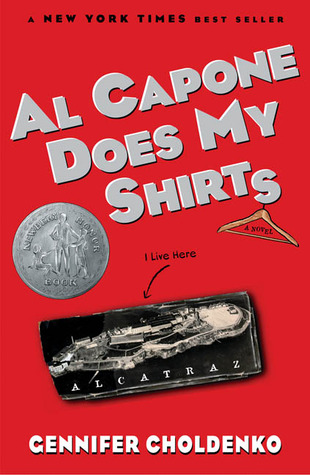
Al Capone Does My Shirts

Al Capone Does My Shirts. Gennifer Choldenko. 2004. 225 pages. [Source: Bought]

First sentence: Today I moved to a twelve-acre rock covered with cement, topped with bird turd and surrounded by water. Alcatraz sits smack in the middle of the bay--so close to the city of San Francisco, I can hear them call the score on a baseball game on Marina Green. Okay, not that close. But still.

Premise/plot: Moose Flanagan, our narrator, has just moved with his family to Alcatraz. His father is an electrician and part-time prison guard. The year is 1935, and there is a certain trendiness or "coolness" about big crime bosses. Al Capone is the most famous resident at the time. Other kids from the island--notably Piper--try to cash in on the situation.

As for Moose, he's more concerned about his sister, Natalie, and BASEBALL. Natalie IS a concern for the whole family because she's autistic at a time when no one knew what it was and everyone was clueless as to how to best help. Moose's mother spends 98% of her time deep in worry about Natalie. There is nothing she won't try in an effort to fix her daughter. Moose's father spends his time working, working, working trying to support the family. Moose has a complex relationship with Natalie. His big sister has become his litter sister. And instead of her watching over him, her bossing him around, he is the one who is on Natalie duty when he's not at school. He hates that this responsibility seems to be falling completely on him. (His mother has started working too.) His island friends seem to be okay with Natalie tagging along--most of the time. On a few occasions, they are even more patient with her than Moose. But it's a huge responsibility and one that he cannot manage on his own.

Baseball. Moose is a kid at heart. He loves, loves, loves playing--and playing baseball tops his list. He would love nothing more than to be involved in a good baseball game a couple of times a week. His dream friends may all be boys his own age, boys equally obsessed with baseball. But his actual friends that he makes on the island--the children of those who work for the prison--turn out to be good friends indeed.

My thoughts: Al Capone Does My Shirts is a great read. It is a perfect blend of light and dark. It can be laugh out loud funny. But it can also be intense and serious. I love, love, love the characters. I do. I can't believe it took me nine years to reread this one. I'm hoping to reread the whole series this year because there is a new book!


© 2018 Becky Laney of Becky's Book Reviews

Thursday, May 10, 2018

Queen of Scots

Queen of Scots: The True Life of Mary Stuart. John Guy. 2004. 608 pages. [Source: Library]

From the prologue: Around eight o'clock in the morning on Wednesday, February 8, 1587, when it was light enough to see without candles, Sir Thomas Andrews, sheriff of the county of Northamptonshire, knocked on a door.

From chapter one: Mary Stuart was born in the coldest of winters.

Premise/plot: Queen of Scots: The True Life of Mary Stuart is a biography. Given that Mary, Queen of Scots' motto was 'In my end is my beginning,' it is fitting that it opens (and closes) with her last day. Chances are readers will come to the book with some idea about Mary's guilt or innocence; come with some idea about what kind of person Mary was. Will Guy's biography change your mind? Perhaps.

Was Mary guilty? Yes. Definitely. Guilty of marrying foolishly, recklessly. Guilty of making more than a few stupid decisions that would cost her her life. It is easy to look back on her life and pinpoint exactly where Mary made mistakes, ultimately fatal mistakes. It is easy to shout at Mary, DON'T DO IT. STOP. YOU'RE RUINING YOUR LIFE. THERE HAS TO BE ANOTHER WAY. But that's because we're far removed from the situation. We know the consequences. We can't walk in her shoes. We can't know what it was like to carry that weight, that burden, that responsibility.

But was Mary guilty of scheming and plotting her husband's death? That is much less certain. In fact, Guy spends more than a few chapters showing how all the so-called evidence against her was fabricated. The "casket letters" were manufactured "evidence" assembled by her enemies, assembled by men who were likely guilty themselves. At best, Guy shows that Mary was innocent of the worst charges against her: that she was in on the plot to kill her husband Darnley and that she was in on the plot to be abducted by Bothwell. At worst, Guy shows that there was no hard evidence, no real evidence, no persuasive evidence that PROVED beyond a shadow of a doubt that she was guilty.

For the record, you probably shouldn't marry someone who likely killed your husband and who definitely kidnapped you and raped you. It's likely that the marriage won't be a happy one. And it might even cost you your life.

Again, it is easy to judge Mary's decisions from afar. Her life is often seen in extremes. She's either an innocent pawn who was essentially powerless--in the hands of the power players around her either in France, Scotland, and England. OR she's seen as a guilty power-hungry whore who wanted--lusted--for more, more, more. Insert evil laugh here. She was always scheming and conniving and using her sexuality to make men do what she wanted. Guy's Mary is neither extreme. She's human.

My thoughts: I picked up Queen of Scots: The True Life of Mary Stuart because I was watching Reign. (I don't recommend it overall.) One thing I knew for sure: the show was getting everything wrong. Not just a little wrong, not just a few liberties here and there, but every little thing and every big thing. It wasn't just the details they were getting wrong, but, I feared the personalities were wrong, wrong, super-wrong as well. (They were.)

I read reviews of several biographies. Many reviewers would point out the biases of the biographer. This person loves Mary and thinks she can do no wrong. This person hates Mary and thinks she can do no right. In all the descriptions of Mary none of them felt authentically human.

In his opinion, Mary's nemesis, her rival was NOT Queen Elizabeth, not directly. Instead her biggest enemy was William Cecil. (Cecil didn't even make it into the show Reign.)

I appreciate the work that went into this biography. He gives readers primary source material letting Mary speak in her own words. Letting those around Mary speak in their own words as well. He gives readers the ability to make their own minds up, to judge for themselves. And there are some areas of her life where we just don't know what she did or didn't know, or what she did or didn't feel. He doesn't force things into a neat and tidy little narrative.

The last chapter of the book is the epilogue where he talks about what happened after her death. He argues that even though Mary lost her life, she "won" the war in the end. It is HER son who ruled England. It is through Mary that all the monarchs have descended.

© 2018 Becky Laney of Becky's Book Reviews

Thursday, December 07, 2017

Among the Brave

Among the Brave. (Shadow Children #5) Margaret Peterson Haddix. 2004. 256 pages. [Source: Library]

First sentence: Great, Trey thought. I do one brave thing in my entire life, and now it's like, 'Got anything dangerous to do? Send Trey. He can handle it.' Doesn't anyone remember that Cowardice is my middle name?

Premise/plot: Among the Brave is the fifth book in Margaret Pertson Haddix's Shadow Children series. Trey, the narrator, faces great challenges in this one. For Trey, going outside is an act of bravery. So when all of his friends disappear, and the trustworthy adults in his life disappear as well, he's at a loss. He teams up for a while with Luke's brother, Mark. But Mark is CAPTURED leaving Trey on his own to brainstorm a rescue plan. Can Trey find a way to save everyone?

My thoughts: The world Haddix created is turned upside down by revolution. But it's a revolution that won't do third children any favors. Freedom still seems to be an impossible dream. I don't know how Haddix manages to pack so much ACTION into her novels. Usually the more action a book has, the less important character development is. That's so far from the case in this series. The books remain thoughtful--contemplative. Yet there's so much going on! Danger abounds.

© 2017 Becky Laney of Becky's Book Reviews

Thursday, February 02, 2017

The Quilting Bee

The Quilting Bee. Gail Gibbons. 2004. 32 pages. [Source: Library]

First sentence: A group of quilt makers have come together to share their time and many talents piecing together a beautiful quilt.

Premise/plot: The Quilting Bee is a nonfiction picture book by Gail Gibbons. This book seeks to introduce the subject of quilts to young readers. It covers the basics as to what quilts are, how they are made, who makes them and reasons why people might make them, etc. We're talking basic. "A quilt is a warm bed covering made up of three layers. There's the top layer that usually has a colorful design, the cotton padding in between, and the quilt's backing."

My thoughts: My mom quilts. I always preferred sewing doll clothes because of instant gratification. I could finish a doll outfit within an hour or maybe two hours. A whole quilt takes much, much, much longer. But I think my mom would argue that they are MORE satisfying to make because of the investment. The planning, the preparation of cutting blocks, laying them out, sewing them together, sewing blocks into rows, sewing rows together, laying everything out at last and quilting. This book covers the basics. The text isn't thrilling necessarily, but, it's packed with basic information.

Text: 3 out of 5
Illustrations: 2 out of 5
Total: 5 out of 10

© 2017 Becky Laney of Becky's Book Reviews
Wednesday, December 21, 2016

Christmas Visitor

A Christmas Visitor. Anne Perry. 2004. 199 pages. [Source: Library]

First sentence: "There, Mr. Rathbone, sir, are yer right?" the old man asked solicitously.

Premise/plot: Henry Rathbone (Oliver's father) is visiting his goddaughter for the Christmas holidays. Her husband has literally just died. And Henry ends up being the one who meets each returning child (all adults) about the death. As the story gets told and retold, questions arise. Was Judah Dreghorn murdered? Who murdered him? Why? Can anyone prove it was murder and not an accident?

My thoughts: For such a short book, it was a surprisingly slow read. Its two hundred pages felt like four hundred. I think it would have been very helpful to break this one into chapters. The book is divided into "parts" and not chapters. One of the key reasons a book feels quick and enjoyable are short-to-medium length chapters. When you come to the end of the chapter, you flip the pages. And let's say the next chapter is four to ten pages in length, it's I HAVE TIME FOR ONE MORE CHAPTER. You can read just "one more chapter" for a good hundred pages or so. But when there are no natural stopping places for seventy-to-eighty pages, then you don't want to read it. You make excuses, I don't have the time now. Authors, pay attention, have chapters work to your benefit.

That being said, I adore the character Henry Rathbone. I got super-attached to him reading the William Monk series. And so I wanted to LOVE this one like crazy. I still think he's a good character. And the characters were more interesting than the ones in A Christmas Journey. There is no comparison between the books. This one is a lot better!!! But it just doesn't compare to her other novels.

© 2016 Becky Laney of Becky's Book Reviews

Sunday, December 06, 2015

Meet Beatrix Potter

The Tale of Hill Top Farm. Susan Wittig Albert. 2004. 286 pages. [Source: Bought]

Did I enjoy reading Susan Wittig Albert's The Tale of Hill Top Farm? Yes. It is one of the reasons I decided to host the Edwardian Reading Challenge. (Not the only reason, mind you, but one reason.) What did I love about it? There were quite a few things that I actually really loved about it.

First, it's a cozy mystery.

Second, it's a cozy mystery set in England, at the turn of the century. It opens circa 1905.

Third, it stars Beatrix Potter, and, is very loosely based on her time in the country. (Not that I would ever mistake it for nonfiction. It is clearly fiction!)I like the rural village setting. I like the community focus. Plenty of quirky characters.

Fourth, it's a happy-cozy blend of human and animal narration. Readers meet animals of all sorts--big and small. Cats. Dogs. Sheep. Badgers. Guinea pigs. Mice. Rabbits.

The fifth reason? Do I really need a fifth reason to convince you to give it a try? Perhaps not, but I've got one anyway! I like multiple mysteries per book. Not every "mystery" is a murder mystery.

I would definitely recommend this book. I am looking forward to reading on in the series.

© 2015 Becky Laney of Becky's Book Reviews

Monday, March 16, 2015

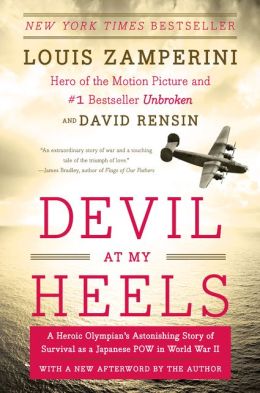
Devil at My Heels (2004)

Devil at My Heels. Louis Zamperini and David Rensin. 1956/2004. Harper Perennial. 292 pages. [Source: Library]

I loved reading Unbroken. As soon as I found out that Louis Zamperini had written an autobiography, I NEEDED to read it. I hoped that it would be equally compelling and just as fascinating. It was. It really was. I honestly don't know if I could pick which one was "better." His story is worth reading no matter the book you choose.

Devil At My Heels is Zamperini's autobiography. In this book, readers learn about his growing up, his delinquent years, how his brother persuaded him to try running track, his early races and training days, how running 'saved' his life and put him on the right track, his 1936 Olympic experience, his college years, his joining the army air force, his war experiences, his surviving a horrible plane crash, how he survived almost fifty days at sea in a raft, his 'resue' from sea by the Japanese, his time in a Japanese POW camp, his return to the U.S, his popularity, his inner struggles, his marriage, his conversion experiences, his days as a speaker, how it was 'easy' for him to forgive the Japanese, how he tried to meet all his former prison guards, etc.

This one fascinates from cover to cover. I liked hearing the story in his own words. Both books are packed with detail, but, the focus isn't always in the same places.


© 2015 Becky Laney of Becky's Book Reviews

Wednesday, February 04, 2015

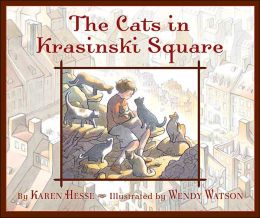
The Cats in Krasinski Square

The Cats in Krasinski Square. Karen Hesse. Illustrated by Wendy Watson. 2004. Scholastic. 32 pages. [Source: Library]

The cats come from the cracks in the Wall, the dark corners, the openings in the rubble.

The Cats in Krasinski Square is an incredible read: a picture book written in verse about the Warsaw ghetto in World War II. Readers meet a young girl, a Jewish girl, who escaped the ghetto and is trying to survive by passing as Polish.
I look like any child
playing with cats
in the daylight
in Warsaw,
my Jewish armband
burned with the rags I wore
when I escaped the Ghetto.
I wear my Polish look,
I walk my Polish walk.
Polish words float from my lips
and I am almost safe,
almost invisible,
moving through Krasinski Square
past the dizzy girls riding the merry-go-round.
But she can't forget--won't forget the Jews still "living" in the ghetto. She wants to do her part to help them. She hears through an older sister, I believe, about a project to smuggle food into the ghetto. But the Nazi's have also heard something. It might take a miracle for the food to reach the Jews now...or it might take hundreds of CATS.

I loved the story, loved the storytelling. The illustrations are great.

© 2015 Becky Laney of Becky's Book Reviews

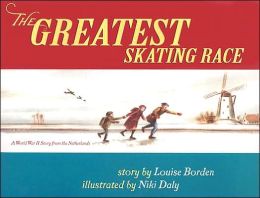
The Greatest Skating Race

The Greatest Skating Race: A World War II Story from the Netherlands. Louise Borden. 2004. Illustrated by Niki Daly. Simon & Schuster. 48 pages. [Source: Library]

I enjoyed reading Louise Borden's The Greatest Skating Race. Though the book has been out for ten years, I'd not come across it before. It is a wonderful picture book for older readers. I've only read a handful of picture books with a World War II setting. I'm on the look out for more. So if you know of some, please let me know in the comments! I'll try my best to review them.

Readers meet Piet, a young Dutch boy, in The Greatest Skating Race. He loves, loves, loves to skate. It would be odd if he didn't love to skate. He loves to dream about competing in the Elfstedentocht--a famous skating race, the "Eleven Towns Race."  Readers learn details about the race throughout the text. But the race itself is not what this one is about. It is about the German occupation, and the ever-increasing threat to Jews.

One day, Piet's grandfather gives him a big, big task to accompany two Jewish children across the border and to their aunt's house.
Today you must be the best skater that you can be.
You must be as brave as your father...wherever he is.
You must be as brave as Pim Mulier!
You must skate the main canal to Brugge,
straight as an arrow to its mark.
And you will need to race against today's sun
to get there before dark.
I want you to skate as fast as you can,
but you must look like an unimportant schoolboy.
You will take Johanna and Joop Winkelman
and help them find their Aunt Ingrid's house.
We think this is the safest way to escape from those
who may wish these friends of ours harm. (16)
It will be a demanding journey--physically and mentally--and perhaps a dangerous one as well. There will be soldiers and checkpoints. And they'll have to find their way to the aunt's house--a place they've never been before. So they'll have to remember the directions carefully, and not let fear confuse them.

The book is good! I'd definitely recommend it.


© 2015 Becky Laney of Becky's Book Reviews

Friday, May 16, 2014

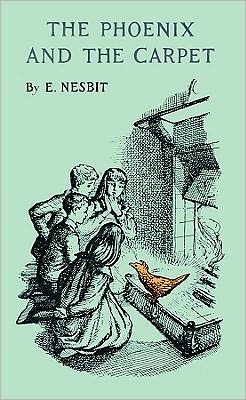
Reread #20 The Phoenix and the Carpet

The Phoenix and the Carpet. E. Nesbit. 1904. 224 pages. [Source: Bought]

I've read The Phoenix and the Carpet three times now, and, I think I've decided I love it even more than Five Children and It. (It wasn't an easy decision. But. I think I'm ready to admit the truth.) (The first review was June 2010; the second review was August 2011.)

The Phoenix and the Carpet is the sequel to Five Children and It. Readers can continue to read about the adventures and misadventures of five delightful-but-not-always-obedient children: Cyril, Robert, Anthea, Jane, and Lamb. (I like how Anthea is nicknamed "Panther" and how Lamb is always referred to by his nickname, "Lamb" because Baa was his first word. It is little details that charm me best perhaps.)

More wishes. More magic. More mischief. It's everything I loved about the first book, and then some!

So how do they meet the Phoenix? How do they get a magic carpet? Well, it all starts when the children decide that it would be a very good idea, a very fun idea, to try out their fireworks--to make sure they work properly--INSIDE the house, inside the nursery to be precise. And when one of the fireworks seems to not be lighting, one of the children pours paraffin on it while another lights it again. While the results are not horribly tragic, the nursery must be repainted/repaired, and a new carpet is a must. The carpet that replaces the old is magical, of course. And inside this roll of carpet is an egg. But not an ordinary egg. Though of course, they don't know that until it accidentally falls into the fire in their nursery. And the Phoenix emerges....

I loved the adventures. I loved seeing them get in and out of trouble. And most of all I love the writing. I love E. Nesbit. I do!!!

Favorite quotes:
It has been said that all roads lead to Rome; this may be true, but at any rate, in early youth I am quite sure that many roads lead to BED, and stop there — or YOU do.
‘We’re very much luckier than any one else, as it is,’ said Jane. ‘Why, no one else ever found a Psammead. We ought to be grateful.’ ‘Why shouldn’t we GO ON being, though?’ Cyril asked—’lucky, I mean, not grateful. Why’s it all got to stop?’ ‘Perhaps something will happen,’ said Anthea, comfortably. ‘Do you know, sometimes I think we are the sort of people that things DO happen to.’
‘Well,’ said the Phoenix, seeming on the whole rather flattered, ‘to cut about seventy long stories short (though I had to listen to them all — but to be sure in the wilderness there is plenty of time), this prince and princess were so fond of each other that they did not want any one else, and the enchanter — don’t be alarmed, I won’t go into his history — had given them a magic carpet (you’ve heard of a magic carpet?), and they had just sat on it and told it to take them right away from every one — and it had brought them to the wilderness. And as they meant to stay there they had no further use for the carpet, so they gave it to me. That was indeed the chance of a lifetime!’
You can always keep the Lamb good and happy for quite a long time if you play the Noah’s Ark game with him. It is quite simple. He just sits on your lap and tells you what animal he is, and then you say the little poetry piece about whatever animal he chooses to be. Of course, some of the animals, like the zebra and the tiger, haven’t got any poetry, because they are so difficult to rhyme to. The Lamb knows quite well which are the poetry animals. ‘I’m a baby bear!’ said the Lamb, snugging down; and Anthea began: ‘I love my little baby bear, I love his nose and toes and hair; I like to hold him in my arm, And keep him VERY safe and warm.’ And when she said ‘very’, of course there was a real bear’s hug. Then came the eel, and the Lamb was tickled till he wriggled exactly like a real one: ‘I love my little baby eel, He is so squidglety to feel; He’ll be an eel when he is big — But now he’s just — a — tiny SNIG!’ Perhaps you didn’t know that a snig was a baby eel? It is, though, and the Lamb knew it. ‘Hedgehog now-!’ he said; and Anthea went on: ‘My baby hedgehog, how I like ye, Though your back’s so prickly-spiky; Your front is very soft, I’ve found, So I must love you front ways round!’ And then she loved him front ways round, while he squealed with pleasure. It is a very baby game, and, of course, the rhymes are only meant for very, very small people — not for people who are old enough to read books, so I won’t tell you any more of them.
‘If you wanted me you should have recited the ode of invocation; it’s seven thousand lines long, and written in very pure and beautiful Greek.’
‘He says,’ the Phoenix remarked after some time, ‘that they wish to engage your cook permanently.’ ‘Without a character?’ asked Anthea, who had heard her mother speak of such things. ‘They do not wish to engage her as cook, but as queen; and queens need not have characters.’ There was a breathless pause. ‘WELL,’ said Cyril, ‘of all the choices! But there’s no accounting for tastes.’
Mother was really a great dear. She was pretty and she was loving, and most frightfully good when you were ill, and always kind, and almost always just. That is, she was just when she understood things. But of course she did not always understand things. No one understands everything, and mothers are not angels, though a good many of them come pretty near it. The children knew that mother always WANTED to do what was best for them, even if she was not clever enough to know exactly what was the best.
Every one was a little cross — some days are like that, usually Mondays, by the way. And this was a Monday.
‘My hat!’ Cyril remarked. ‘I never thought about its being a PERSIAN carpet.’ Yet it was now plain that it was so, for the beautiful objects which it had brought back were cats — Persian cats, grey Persian cats, and there were, as I have said, 199 of them, and they were sitting on the carpet as close as they could get to each other. But the moment the children entered the room the cats rose and stretched, and spread and overflowed from the carpet to the floor, and in an instant the floor was a sea of moving, mewing pussishness, and the children with one accord climbed to the table, and gathered up their legs, and the people next door knocked on the wall — and, indeed, no wonder, for the mews were Persian and piercing. ‘This is pretty poor sport,’ said Cyril. ‘What’s the matter with the bounders?’ ‘I imagine that they are hungry,’ said the Phoenix. ‘If you were to feed them—’ ‘We haven’t anything to feed them with,’ said Anthea in despair, and she stroked the nearest Persian back. ‘Oh, pussies, do be quiet — we can’t hear ourselves think.’ She had to shout this entreaty, for the mews were growing deafening, ‘and it would take pounds’ and pounds’ worth of cat’s-meat.’ ‘Let’s ask the carpet to take them away,’ said Robert. But the girls said ‘No.’ ‘They are so soft and pussy,’ said Jane. ‘And valuable,’ said Anthea, hastily. ‘We can sell them for lots and lots of money.’ ‘Why not send the carpet to get food for them?’ suggested the Phoenix, and its golden voice came harsh and cracked with the effort it had to be make to be heard above the increasing fierceness of the Persian mews. So it was written that the carpet should bring food for 199 Persian cats, and the paper was pinned to the carpet as before. The carpet seemed to gather itself together, and the cats dropped off it, as raindrops do from your mackintosh when you shake it. And the carpet disappeared. Unless you have had one-hundred and ninety-nine well-grown Persian cats in one small room, all hungry, and all saying so in unmistakable mews, you can form but a poor idea of the noise that now deafened the children and the Phoenix. The cats did not seem to have been at all properly brought up. They seemed to have no idea of its being a mistake in manners to ask for meals in a strange house — let alone to howl for them — and they mewed, and they mewed, and they mewed, and they mewed, till the children poked their fingers into their ears and waited in silent agony, wondering why the whole of Camden Town did not come knocking at the door to ask what was the matter, and only hoping that the food for the cats would come before the neighbours did — and before all the secret of the carpet and the Phoenix had to be given away beyond recall to an indignant neighbourhood. The cats mewed and mewed and twisted their Persian forms in and out and unfolded their Persian tails, and the children and the Phoenix huddled together on the table.
The Lamb was very glad to have his brothers and sisters to play with him. He had not forgotten them a bit, and he made them play all the old exhausting games: ‘Whirling Worlds’, where you swing the baby round and round by his hands; and ‘Leg and Wing’, where you swing him from side to side by one ankle and one wrist. There was also climbing Vesuvius. In this game the baby walks up you, and when he is standing on your shoulders, you shout as loud as you can, which is the rumbling of the burning mountain, and then tumble him gently on to the floor, and roll him there, which is the destruction of Pompeii.
© 2014 Becky Laney of Becky's Book Reviews