Showing posts with label 2008. Show all posts

Saturday, August 01, 2026

50. Knife of Never Letting Go


50. The Knife of Never Letting Go. (Chaos Walking #1) Patrick Ness. 2008. 512 pages. [Source: Library]

First sentence: The first thing you find out when yer dog learns to talk is that dogs don’t got nothing much to say. About anything.

The Knife of Never Letting Go is a science fiction novel for young adults. (What kind of science fiction? It's the colonizing other planets sort. Also the trying to survive sort. And the encountering alien sort.)

Here are a few things you should know before picking it up.

1) It is science fiction. It is set on another planet, aka "New World." The planet has a handful of small settlements, including Prentisstown, the hometown of our narrator/hero. The planet's biggest settlement is Haven.

2) Todd is our narrator. He is a few weeks away from his thirteenth birthday. He "becomes a Man" on his thirteenth birthday. He is an orphan being raised by two men, Cillian and Ben.

3) There are NO WOMEN in Prentisstown. Todd has been taught all his life that there was a plague or virus that killed all the women of the settlement.

4) A virus (perhaps the same virus that allegedly killed all the women?) has made it so that all the men can hear one another's thoughts all the time. This is called NOISE. It isn't just men, though, they can hear thoughts of animals too. Manchee is Todd's dog. And he's a bit too forthright to say the least!

5) The book is thriller-esque. It's essentially one big action-sequence from cover to cover. Well, perhaps it takes three or four chapters to get him on his way. But once he gets started...he stays going. It's an intense, action-packed book.

6) He doesn't go alone. Manchee, his faithful dog that he once didn't even want, is with him....but more importantly he meets Viola.

7) Viola basically "dropped from the sky" and right into his path. Viola is the sole survivor of the settler's scout ship. Her parents died in the crash. The ships with thousands of more settlers is about seven or so months behind the scout ship. Todd cannot hear Viola's noise. Viola is the first female he can remember seeing--apart from reading the memories of the men in his settlement--which is not the same thing I think you'll agree.

8) Both Viola and Todd are in GREAT DANGER. Why?????? Well, it has to do with SECRETS and SCHEMES and PLOTS. The mayor of Prentisstown is ambitious and manipulative....to pick two of his tamer qualities.

9) Todd has some internal conflict going on inside....he cannot bring himself to kill. So while I might have spent a good deal of time emphasizing the ACTION, ACTION, ACTION aspect of this one, that doesn't mean it is without characterization and complexity.

10) Be warned it doesn't really have an ending.

11) It has profanity. A good deal of profanity. For some people it may be off-putting enough to pass on the book. For others that might be a big non-issue.

12) Poor grammar is part of the world-building. This may or may not bother readers!  

The first time I read it, I was meh. I was bothered by the poor grammar and the profanity. The second time I read it, I definitely liked it much better. The third time I read it, I loved it. I was fully engaged and absorbing the world-making and the depths of the characters. I was paying attention to the relationships, the conversations, all the feels. Things that were both spoken and unspoken. 

I have been listening to a lot of Preacher Boys on YouTube. His podcast deals a lot with abuse in the Independent Fundamental Baptist denomination. Or "denomination" as the case may be since technically each church is independent and there is no infrastructure binding the churches together. As I was reading The Knife Of Never Letting Go, I couldn't help thinking that one or two of the settlements might portray a what if--what if an IFB church decided to colonize space and set up their own theocracy?!

So that was one thing running through my mind this time around, but also I thought of all the changes we've gone through the past few decades--in particular the internet, social media, and media itself. All the bits about NOISE felt like it could be talking about our society--in some ways.

This third read was definitely more thoughtful and philosophical. I found myself making lots of notes.

Quotes:

  • The loud is a different kind of loud, because swamp loud is just curiosity, creachers figuring out who you are and if yer a threat. Whereas the town knows all about you already and wants to know more and wants to beat you with what it knows till how can you have any of yerself left at all?
  • Men lie, and they lie to theirselves worst of all.
  • Noise ain’t truth, Noise is what men want to be true, and there’s a difference twixt those two things so big that it could ruddy well kill you if you don’t watch out.
  • The Church is why we’re all here on New World in the first place, of course, and pretty much every Sunday you can hear Aaron preaching about why we left behind the corrupshun and sin of Old World and about how we’d aimed to start a new life of purity and brotherhood in a whole new Eden. That worked out well, huh?
  • Praying Noise comes from inside, it’s got a special feel to it, a special purply sick feel like men are bleeding it out, even tho it’s always the same stuff but the purply blood just keeps on coming. Help us, save us, forgive us, help us, save us, forgive us, get us outta here, please, God, please, God, please, God, tho as far as I know no one’s never heard no Noise back from this God fella.
  • Noise is like grey fire behind him and you can’t pick out anything in it and he might be up to something, mightn’t he? The sermon might be covering for something and I’m beginning to wonder if I know what that something is.
  • Men’s minds are messy places and Noise is like the active, breathing face of that mess. It’s what’s true and what’s believed and what’s imagined and what’s fantasized and it says one thing and a completely opposite thing at the same time and even tho the truth is definitely in there, how can you tell what’s true and what’s not when yer getting everything?
  • The Noise is a man unfiltered, and without a filter, a man is just chaos walking.
  • But a knife ain’t just a thing, is it? It’s a choice, it’s something you do. A knife says yes or no, cut or not, die or don’t. A knife takes a decision out of your hand and puts it in the world and it never goes back again.
  • “History ain’t so important when yer just trying to survive,” I say, spitting it out under my breath. “That’s actually when it’s most important,” Hildy says, standing at the end of the table.
  • “Men’s thoughts, Todd,” she says. “Men. And you notice he said he was going to ask the eldermen to come seek out your advice?” I get a horrible thought. “Did the women all die here, too?” “Oh, there’s women,” she says, fiddling with a butter knife. “They clean and they cook and they make babies and they all live in a big dormitory outside of town where they can’t interfere in men’s business.”
  • He shakes his head. “What d’you think’s been driving you on? What d’you think’s got you this far?” “Fear,” Viola says. “Desperayshun,” I say. “No,” he says, taking us both in. “No, no, no. You’ve come farther than most people on this planet will do in their lifetimes. You’ve overcome obstacles and dangers and things that should’ve killed you. You’ve outrun an army and a madman and deadly illness and seen things most people will never see. How do you think you could have possibly come this far if you didn’t have hope?”
  • “Everything on this planet talks to each other,” he says. “Everything. That’s what New World is. Informayshun, all the time, never stopping, whether you want it or not. The Spackle knew it, evolved to live with it, but we weren’t equipped for it. Not even close.
  • And too much informayshun can drive a man mad. Too much informayshun becomes just Noise. And it never, never stops.
  • “War is a monster,” he says, almost to himself. “War is the devil. It starts and it consumes and it grows and grows and grows.” He’s looking at me now. “And otherwise normal men become monsters, too.”
  • Doing what’s right should be easy. It shouldn’t be just another big mess like everything else.
  • She hurts. I know all this. I know it’s true. Cuz I can read her. I can read her Noise even tho she ain’t got none. I know who she is. I know Viola Eade. And I look at her sitting there and she looks across the river and we wait as the dawn fully arrives, each of us knowing. Each of us knowing the other.
  • Hope may be the thing that pulls you forward, may be the thing that keeps you going, but that it’s dangerous, too, that it’s painful and risky, that it’s making a dare to the world and when has the world ever let us win a dare?
  • “God works thru men,” Aaron says. “So does evil,” Viola says.


© 2026 Becky Laney of Becky's Book Reviews

Monday, July 15, 2024

55. The Hunger Games

The Hunger Games #1 Suzanne Collins. 2008. 374 pages. [Source: Library]

First sentence: When I wake up, the other side of the bed is cold.

I have seen the movie more than I've read the book. I *believe* that this is my third time to read the novel. And it appears that the last time I actually read the book was October of 2012! I'm surprised by that. 

This has been 'the year' for me revisiting this series. I've reread The Ballad of Songbirds and Snakes. I've seen that movie adaptation twice. I've binged my way through the original movie trilogy. I've been intending to actually read the books themselves again. There is another 'prequel' coming next year, I think. 

As I said, I've watched the movie so many times since 2012, it was so refreshing to discover--rediscover--the DEPTH and substance of the book itself. There are so many layers. Especially when you add in what you've learned from the prequel. One thing that may be super-super-super obvious is that Katniss (our heroine) is BROKEN and traumatized from the moment we meet her. She is strong and resilient and a bit hardened. But the death of her father, the failing of her mother to be an adult, a parent, the HARSH realities of the district, these have made the Katniss we know. She's a provider, a survivor. The Games definitely contributed to her PTSD, her trauma-induced mental and emotional distress, but it wasn't only the games. Life in district 12 is hard--difficult. Raising yourself and your sister is difficult. 

I also was detail focused as I was rereading trying to observe things about all the districts and the characters--no matter how small--themselves. Again, so many layers if you've mainly spent time with the movies.

I do plan on reading the other books in this series. Rereading that is. 2012 may feel like a few years ago, but it's over ten.


© 2024 Becky Laney of Becky's Book Reviews

Thursday, October 27, 2022

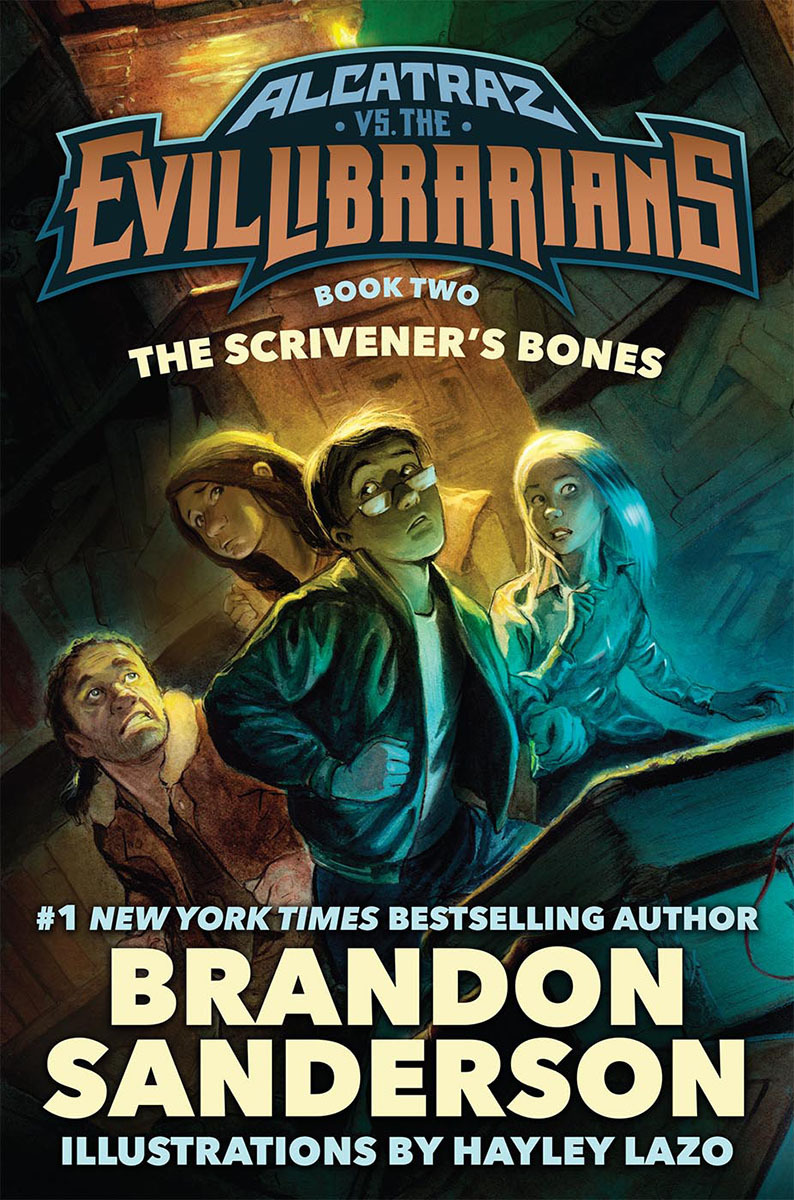
138. Alcatraz Vs. The Evil Librarians: The Scrivener's Bones


The Scrivener's Bones( Alcatraz Versus The Evil Librarians #2) Brandon Sanderson. 2008. 322 pages. [Source: Library]

First sentence: So, there I was, slumped in my chair, waiting in a drab airport terminal, munching absently on a bag of stale potato chips. Not the beginning you expected, is it? You likely thought that I would start this book with something exciting. A scene involving evil Librarians, perhaps -- something with altars, Alivened, or at least some machine guns. I'm sorry to disappoint you. It won't be the first time I do that. However, it's for your own good.

Premise/plot: This is the sequel to Alcatraz Versus the Evil Librarians. Alcatraz Smedry is back for his second adventure. And oh how he loves to manipulate his readers, tease them, taunt them. It's mean and I love it. If you haven't read the first book, you should. Trust me on that. It's funny and clever. And the best entertainment to be had between the covers of a book.

I'd like to make something clear. I have been unfair to you. That is to be expected, liar that I am.
In the first book of this series, I made some sweeping generalizations about librarians, many of which are completely true.
I need to come clean. There are several kinds of librarians. There are the ones I talked about in my last book -- the Librarians, with a capital L. We also call them the Librarians of Biblioden, or the Scrivener's Librarians. Most of what I said about that particular group is, indeed, factual.
However, I didn't take the time to explain that they're not the only kind of librarians. You may, therefore, have assumed that all librarians are evil cultists who want to take over the world, enslave humanity, and sacrifice people on their altars.
This is completely untrue. Not all librarians are evil cultists. Some librarians are instead vengeful undead who want to suck your soul.
I'm glad we cleared that up. (44-45)


In this second adventure, we have Alcatraz and Bastille teaming up with others--new characters, new talents--on a quest trying to track down Grandpa Smedry and Attica Smedry. (Attica being the long-lost-and-often-presumed-dead father of our hero, Alcatraz.) Alcatraz believes that both can be found in the Library of Alexandria. It is here in this ancient library, that they come across the worst sort of librarian: the kind that can take your soul if you take a book. (If you sign a contract to lose your soul, you have ten hours before the dreaded soul-taking takes place. If you don't sign a contract but happen to pick up a book, then you've got ten seconds.) These librarians taunt and tease. Urging you to read this and that. Good news if you give in: You get to read all the books in the library. And we're not just talking ancient scrolls and the like. New books--American books--are being sent over all the time. (Every book ever written.) Bad news: You're doomed to spend eternity there with no hope of ever leaving. And as a curator, you yourself will join their numbers trying to steal other people's souls.

Can Alcatraz find his father and grandfather and escape this threatening-but-oh-so-tempting library with his soul intact? Will his friends? There's danger. There's threats--new and old. There are traps, traps, and more traps. There are daring rescues (or rescue attempts I should say). There are more than a few surprises. It's great fun. You should try it.

My thoughts: I really LOVE revisiting this series. I don't know why I've never taken the time to reread these books. I definitely loved them the first time around and I'm loving them this time around as well. I am so glad a new book in the series is releasing so I can revisit this wonderful series. I do think the narrative style is super appealing to readers of all ages.

© 2022 Becky Laney of Becky's Book Reviews

Sunday, September 11, 2022

110. I.Q.: Independence Hall (Book #1)


I.Q., Independence Hall (Book one in I.Q series). Roland Smith. 2008. 293 pages. [Source: Library]

 First sentence: From a window across the street, Eben Lavi watched the couple and the two children leave their loft and climb into the back of a white limousine. It pulled away from teh curb and started down the street.

Premise/plot: I.Q. is an action packed spy thriller starring two kids. Angela (whose mom was a secret service agent) and Quest are step-siblings. Their parents have literally just gotten married. Together they are MATCH a newly formed (relatively newly formed?) musical group who have gone viral. Their honeymoon will take place (with kids) on the tour bus as they make their way to Philadelphia. The tour is coming and will be HUGE. The kids will be out of school--well, school, school. They will be homeschooling on the bus for the tour. And getting to know each other...and as it turns out...fighting to survive.

My thoughts: Mysteries. Secrets. Politics. Action. This one has a little bit of everything. And it all unfolds in a satisfying way. Not too fast. Not too slow. The pacing was just about right. It was just the kind of book I was needing. I was reading this at the same time as Map of Flames. Unfortunately, I think my impressions of Map of Flames suffered a bit because this one was so very good. Both are action-packed. This is an older title. I'm not even sure it's still in print? 


© 2022 Becky Laney of Becky's Book Reviews

Tuesday, August 02, 2022

93. The Battle of the Labyrinth


The Battle of the Labyrinth. (Percy Jackson and the Olympians #4) Rick Riordan. 2008. 361 pages. [Source: Library]

First sentence: The last thing I wanted to do on my summer break was blow up another school.

Premise/plot: Camp Half-blood is in trouble again. To be fair, it's more like destroying Camp Half-blood is step one on the bad guy's to do list. [I suppose you could argue that it isn't a bad guy so much as bad god.] Annabeth, Tyson, Percy, and Grover are teaming up again on a quest. They'll be going underground into the labyrinth. It's super-super dangerous. Those that do manage to come out again are rarely the same. The last person to come out has gone mad--they aren't quite sure how to cure him. But the world's only hope [so we're led to believe] is hidden within the labyrinth. It's a race--who will discover it, acquire it, use it...first. 

My thoughts: All the books are so closely connected. It is definitely best to read them all together. The tension does keep building and building. There is rarely a satisfying moment in the book in terms of suspense and tension. None of the books have that YES moment of success and completion. All the books are leading to the ultimate showdown. Book four still doesn't take readers to that final, ultimate BIG battle between good and evil. I would say book four offers less humor and more intensity. Looking back, The Lightning Thief now has such low stakes--but oh at the time, it felt like such a big quest. 

I do recommend the series. I am rereading the series this summer. 

© 2022 Becky Laney of Becky's Book Reviews

Tuesday, October 12, 2021

129. The Case of the Peculiar Pink Fan


The Case of the Peculiar Pink Fan. (Enola Holmes #4) Nancy Springer. 2008. 183 pages. [Source: Library]

First sentence: So far, my only clients as "Dr. Ragostin, Scientific Perditorian" had been a stout, elderly widow anxious to find her lost lapdog; a frightened lady who could not locate a valuable heart-shaped ruby which had been given to her by her husband; and an army general whose most cherished souvenir of the Crimean War had disappeared, namely, his bullet-riddled leg-bone signed by the field doctor who had amputated it.

Premise/plot: Enola Holmes (aka "Miss Ivy Meshle") bumps into a former acquaintance--the young lady gone missing in a previous book. The young lady carries a PECULIAR pink fan and the fan language she is using to communicate with Enola, well, it signals trouble for her and a potential case for Enola. Turns out, she's being forced into marriage. The idea of her father--not her mother.

My favorite aspect of this one is that while she's investigating this case--trying to find her so that she can rescue her--she learns that SHERLOCK HOLMES has been hired by the mother for the same reason. So this one actually has these two somewhat working together. Their scenes together were quite entertaining.

My thoughts: This so far has been my favorite of the series. I haven't always appreciated the light, fluffiness of these mysteries. They've seemed light on history, light on mystery, and light on character development. I liked this one because of the scenes with Enola and Sherlock together.


© 2021 Becky Laney of Becky's Book Reviews

Sunday, September 26, 2021

122. The Case of the Bizarre Bouquet


The Case of the Bizarre Bouquet. Enola Holmes #3. Nancy Springer. 2008. 170 pages. [Source: Library]

First sentence: It is difficult to choose a new name for oneself.

Premise/plot: Enola Holmes is the younger sister of Mycroft and Sherlock Holmes. Since the disappearance of her mother, Enola Holmes has faced life...alone...by her choice, mostly. Her brothers haven't a clue where she's staying and how she's getting by. And that's just how she likes it.

In this third installment of the series, Enola Holmes (posing as Viola Everseau) seeks to find the whereabouts of the MISSING Dr. John Watson. He has vanished and even Sherlock Holmes hasn't been able to track him down.

Can Enola Holmes succeed where her brother has failed?

My thoughts: I wanted to like this one more than I actually liked it. I always find myself liking the build up of the mystery but then being a little let down in how the mystery is ultimately solved and resolved. Such was the case in this one. It seems that Enola Holmes just happens to always be in the right place at the right time to observe just the thing needed to put the pieces together. Yes, she's observant and she does put the pieces together. But it doesn't seem intentional on her part. (In my opinion.)

I like the series okay.


© 2021 Becky Laney of Becky's Book Reviews

Monday, July 12, 2021

60. The Knife of Never Letting Go


The Knife of Never Letting Go. (Chaos Walking #1) Patrick Ness. 2008. 512 pages. [Source: Bought]

First sentence: The first thing you find out when yer dog learns to talk is that dogs don’t got nothing much to say. About anything.

The Knife of Never Letting Go is a science fiction novel for young adults. (What kind of science fiction? It's the colonizing other planets sort. Also the trying to survive sort. And the encountering alien sort.)

Here are a few things you should know before picking it up.

1) It is science fiction. It is set on another planet, aka "New World." The planet has a handful of small settlements, including Prentisstown, the hometown of our narrator/hero. The planet's biggest settlement is Haven.

2) Todd is our narrator. He is a few weeks away from his thirteenth birthday. He "becomes a Man" on his thirteenth birthday. He is an orphan being raised by two men, Cillian and Ben.

3) There are NO WOMEN in Prentisstown. Todd has been taught all his life that there was a plague or virus that killed all the women of the settlement.

4) A virus (perhaps the same virus that allegedly killed all the women?) has made it so that all the men can hear one another's thoughts all the time. This is called NOISE. It isn't just men, though, they can hear thoughts of animals too. Manchee is Todd's dog. And he's a bit too forthright to say the least!

5) The book is thriller-esque. It's essentially one big action-sequence from cover to cover. Well, perhaps it takes three or four chapters to get him on his way. But once he gets started...he stays going. It's an intense, action-packed book.

6) He doesn't go alone. Manchee, his faithful dog that he once didn't even want, is with him....but more importantly he meets Viola.

7) Viola basically "dropped from the sky" and right into his path. Viola is the sole survivor of the settler's scout ship. Her parents died in the crash. The ships with thousands of more settlers is about seven or so months behind the scout ship. Todd cannot hear Viola's noise. Viola is the first female he can remember seeing--apart from reading the memories of the men in his settlement--which is not the same thing I think you'll agree.

8) Both Viola and Todd are in GREAT DANGER. Why?????? Well, it has to do with SECRETS and SCHEMES and PLOTS. The mayor of Prentisstown is ambitious and manipulative....to pick two of his tamer qualities.

9) Todd has some internal conflict going on inside....he cannot bring himself to kill. So while I might have spent a good deal of time emphasizing the ACTION, ACTION, ACTION aspect of this one, that doesn't mean it is without characterization and complexity.

10) Be warned it doesn't really have an ending.

11) It has profanity. A good deal of profanity. For some people it may be off-putting enough to pass on the book. For others that might be a big non-issue.

12) Poor grammar is part of the world-building. This may or may not bother readers!  

The first time I read it, I was meh. I was bothered by the poor grammar and the profanity. The second time I read it, I definitely liked it much better. The third time I read it, I loved it. I was fully engaged and absorbing the world-making and the depths of the characters. I was paying attention to the relationships, the conversations, all the feels. Things that were both spoken and unspoken. 

I have been listening to a lot of Preacher Boys on YouTube. His podcast deals a lot with abuse in the Independent Fundamental Baptist denomination. Or "denomination" as the case may be since technically each church is independent and there is no infrastructure binding the churches together. As I was reading The Knife Of Never Letting Go, I couldn't help thinking that one or two of the settlements might portray a what if--what if an IFB church decided to colonize space and set up their own theocracy?!

So that was one thing running through my mind this time around, but also I thought of all the changes we've gone through the past few decades--in particular the internet, social media, and media itself. All the bits about NOISE felt like it could be talking about our society--in some ways.

This third read was definitely more thoughtful and philosophical. I found myself making lots of notes.

Quotes:

  • The loud is a different kind of loud, because swamp loud is just curiosity, creachers figuring out who you are and if yer a threat. Whereas the town knows all about you already and wants to know more and wants to beat you with what it knows till how can you have any of yerself left at all?
  • Men lie, and they lie to theirselves worst of all.
  • Noise ain’t truth, Noise is what men want to be true, and there’s a difference twixt those two things so big that it could ruddy well kill you if you don’t watch out.
  • The Church is why we’re all here on New World in the first place, of course, and pretty much every Sunday you can hear Aaron preaching about why we left behind the corrupshun and sin of Old World and about how we’d aimed to start a new life of purity and brotherhood in a whole new Eden. That worked out well, huh?
  • Praying Noise comes from inside, it’s got a special feel to it, a special purply sick feel like men are bleeding it out, even tho it’s always the same stuff but the purply blood just keeps on coming. Help us, save us, forgive us, help us, save us, forgive us, get us outta here, please, God, please, God, please, God, tho as far as I know no one’s never heard no Noise back from this God fella.
  • Noise is like grey fire behind him and you can’t pick out anything in it and he might be up to something, mightn’t he? The sermon might be covering for something and I’m beginning to wonder if I know what that something is.
  • Men’s minds are messy places and Noise is like the active, breathing face of that mess. It’s what’s true and what’s believed and what’s imagined and what’s fantasized and it says one thing and a completely opposite thing at the same time and even tho the truth is definitely in there, how can you tell what’s true and what’s not when yer getting everything?
  • The Noise is a man unfiltered, and without a filter, a man is just chaos walking.
  • But a knife ain’t just a thing, is it? It’s a choice, it’s something you do. A knife says yes or no, cut or not, die or don’t. A knife takes a decision out of your hand and puts it in the world and it never goes back again.
  • “History ain’t so important when yer just trying to survive,” I say, spitting it out under my breath. “That’s actually when it’s most important,” Hildy says, standing at the end of the table.
  • “Men’s thoughts, Todd,” she says. “Men. And you notice he said he was going to ask the eldermen to come seek out your advice?” I get a horrible thought. “Did the women all die here, too?” “Oh, there’s women,” she says, fiddling with a butter knife. “They clean and they cook and they make babies and they all live in a big dormitory outside of town where they can’t interfere in men’s business.”
  • He shakes his head. “What d’you think’s been driving you on? What d’you think’s got you this far?” “Fear,” Viola says. “Desperayshun,” I say. “No,” he says, taking us both in. “No, no, no. You’ve come farther than most people on this planet will do in their lifetimes. You’ve overcome obstacles and dangers and things that should’ve killed you. You’ve outrun an army and a madman and deadly illness and seen things most people will never see. How do you think you could have possibly come this far if you didn’t have hope?”
  • “Everything on this planet talks to each other,” he says. “Everything. That’s what New World is. Informayshun, all the time, never stopping, whether you want it or not. The Spackle knew it, evolved to live with it, but we weren’t equipped for it. Not even close.
  • And too much informayshun can drive a man mad. Too much informayshun becomes just Noise. And it never, never stops.
  • “War is a monster,” he says, almost to himself. “War is the devil. It starts and it consumes and it grows and grows and grows.” He’s looking at me now. “And otherwise normal men become monsters, too.”
  • Doing what’s right should be easy. It shouldn’t be just another big mess like everything else.
  • She hurts. I know all this. I know it’s true. Cuz I can read her. I can read her Noise even tho she ain’t got none. I know who she is. I know Viola Eade. And I look at her sitting there and she looks across the river and we wait as the dawn fully arrives, each of us knowing. Each of us knowing the other.
  • Hope may be the thing that pulls you forward, may be the thing that keeps you going, but that it’s dangerous, too, that it’s painful and risky, that it’s making a dare to the world and when has the world ever let us win a dare?
  • “God works thru men,” Aaron says. “So does evil,” Viola says.


© 2021 Becky Laney of Becky's Book Reviews

Wednesday, October 07, 2020

120. The Guernsey Literary and Potato Peel Pie Society


The Guernsey Literary and Potato Peel Pie Society. Mary Ann Shaffer and Annie Barrows. 2008. Random House. 274 pages.  [Souce: Bought]

First sentence: Dear Sidney, Susan Scott is a wonder. We sold over forty copies of the book, which was very pleasant, but much more thrilling from my standpoint was the food. 

Premise/plot: The Guernsey Literary and Potato Peel Pie Society is an epistolary novel. I would say it consists almost entirely of letters centering around a young author, Julia Ashton, as she sets out on her next project. The book opens with her on tour for her last writing project--written under a pseudonym--concerning the war. She is seeking inspiration for her new project. And this inspiration comes from an unlikely source, perhaps, a letter she receives in the mail from a stranger concerning Charles Lamb.

When Dawsey Adams writes Julia Ashton he little expects what unfolds. He's seeking other books by Charles Lamb--does she know a London bookseller?--and a biography of Charles Lamb. He's writing to her--a stranger--because her name and address was in the second hand book he picked up--a selection of Lamb's works. He mentions oh-so-briefly a roast pig, a literary society, and how much reading helped during the war. 

His letter left her wanting more, more, more! Surely there is a good story worth investigating. So begins a friendship carried out through letters. She writes not only Mr. Dawsey Adams but the other members--men and women, young and old--who were a part of the literary society during the occupation during the second world war. 

(She asks for their input into an upcoming article--they consent.) After providing character references, they willingly share and share and share and share. It becomes obvious to one and all that Julia Ashton belongs. So she goes to visit all her friends to meet them face to face for the first time. She'll be staying in Elizabeth's little cottage...

One of her closest new friends is a little girl, Kit, a war orphan--Elizabeth's daughter fathered by a German soldier. Juliet loves Kit. Kit loves Juliet. Juliet begins daydreaming of adopting Kit as her very own daughter. 

I mention all this because the movie gets 80% of the details completely and totally wrong in telling the story.

My thoughts: I love the book. I crazy love the book. I think this is the third time I've read it. But it's been years and years--six years to be precise, it was 2014--since I read it. When I watched the movie it was such a distant memory that all the differences didn't jump out at me. Watching the movie wasn't a nails on the chalkboard experience for me because I wasn't aware that practically everything was different from the book. 

I started this book last week and watched the movie on Saturday night. All I could see were the big, big differences between the two. The movie really goes out of its way to provide tension and drama. 

In the movie, Juliet goes to the island uninvited and unannounced. She's never corresponded with any of the other members. 

In the movie, Juliet is met with skepticism and kept at a distant. No one really wants to talk about Elizabeth, about the war, about the society, about anything. They don't trust her. 

In the movie, Juliet stays at a hotel or inn. She is not renting Elizabeth's cottage.

In the movie, Juliet is ENGAGED to a man she's been dating about six months. In the book, she's been seeing him about TWO months. When he proposes--over dinner--she says NO, it's way, way, way too soon. I couldn't possibly say yes without giving it a lot of thought. The more she thinks about it, the more she's leaning towards NO WAY. In the book, he shows his jerky-jerk-jerk ways very early on. Warning flags are being waved all about, Juliet notices them all and says NO. 

In the movie, Juliet leaves the island...only to return to tell Dawsey she loves him. In the book, she never leaves. Never. She writes on the island. And she writes with full permission from all concerned. There is nothing secret or underhand about her being on the island. 

In the movie, very few characters are really explored. In the book, there are dozens of people on the island whom we hear from--through letters mostly. 

In the movie, Elizabeth's death is handled in a very tacked on way. In the book, they receive a letter. Dawsey and maybe another person go to Europe to talk to the Jewish woman who was Elizabeth's friend...and who witnessed Elizabeth's death. They bring her back to the island. She is very much a part of the action.

In the book, there's a super-sweet relationship between Juliet and Isola. One of my favorite scenes is when Isola is chastising Juliet for not telling her about Jane Austen sooner! How could you let me think that Heathcliff is the ideal when all along there is Mr. Darcy?!?!?! Isola's grandmother's letters is also one of the highlights of the book.

There is so much depth and substance, heart and soul in the book. The movie is so....lacking in that department. It chose to add some drama--tension between Amelia and Juliet, for example. The Juliet from the book would have never gone uninvited and pushed and pursued a story without full permission. 

 Favorite quotes:

I don't want to be married just to be married. I can't think of anything lonelier than spending the rest of my life with someone I can't talk to, or worse, someone I can't be silent with.
That's what I love about reading: one tiny thing will interest you in a book, and that tiny thing will lead you to another book, and another bit there will lead you onto a third book. It's geometrically progressive - all with no end in sight, and for no other reason than sheer enjoyment.
Reading good books ruins you for enjoying bad books.
Perhaps there is some secret sort of homing instinct in books that brings them to their perfect readers. How delightful if that were true.
I love seeing the bookshops and meeting the booksellers-- booksellers really are a special breed. No one in their right mind would take up clerking in a bookstore for the salary, and no one in his right mind would want to own one-- the margin of profit is too small. So, it has to be a love of readers and reading that makes them do it-- along with first dibs on the new books.
Isola doesn't approve of small talk and believes in breaking the ice by stomping on it.

It was amazing to me then, and still is, that so many people who wander into bookshops don't really know what they're after--they only want to look around and hope to see a book that will strike their fancy. And then, being bright enough not to trust the publisher's blurb, they will ask the book clerk the three questions: (1) What is it about? (2) Have you read it? (3) Was it any good?
Will Thisbee gave me The Beginner's Cook-Book for Girl Guides. It was just the thing; the writer assumes you know nothing about cookery and writes useful hints - "When adding eggs, break the shells first.”
“What on earth did you say to Isola? She stopped in on her way to pick up Pride and Prejudice and to berate me for never telling her about Elizabeth Bennet and Mr. Darcy. Why hadn't she known there were better love stories around? Stories not riddled with ill-adjusted men, anguish, death and graveyards!”
The first rule of snooping is to come at it sideways--when you began writing me dizzy letters about Alexander, I didn't ask if you were in love with him, I asked what his favorite animal was. And your answer told me everything I needed to know about him--how many men would admit that they loved ducks?

© 2020 Becky Laney of Becky's Book Reviews

Wednesday, July 10, 2019

World at War: Climbing the Stairs

Climbing the Stairs. Padma Venkatraman. 2008. 256 pages. [Source: Bought]

First sentence: I still remember the day we celebrated Krishna Jayanthi, the festival of Lord Krishna's birth, at our home in Bombay.

Premise/plot: Set in India during the early years of World War II, Climbing the Stairs is narrated by a charming young woman, 15, Vidya, who dreams of nothing more than going to college and continuing her education. She has an older brother, Kitta, a best friend, Rifka. When the novel begins, Vidya seems to have everything she wants within her grasp. Her parents have agreed that she won't be put on the marriage market quite yet unlike her cousin, Malati. And on a special father-daughter bonding trip, her father even agrees that she should go to college. And then....and then tragedy strikes.

Vidya's life isn't easy. It's in just as much turmoil--it seems--as India itself. There is within India a movement, a freedom movement, to create an independent India free from British rule and oppression. But there is also a call from the British to rise up and join the British ranks--British soldiers--on the field fighting the Axis powers. Yet Vidya's family at least--and presumably many others as well--believe in nonviolence. Affirm that all killing, all war is wrong. It doesn't matter who you're opposing, to take up arms is in itself wrong.


Climbing the Stairs. What does that mean exactly? Well, her grandfather and his family--his large extended family--live in a house. The men live upstairs. The women live downstairs. Women are not allowed in the men's domain. The library--technically speaking--should be off limits to her simply because of her sex, her gender. Women are not valued, not respected. Young women, girls, are seen merely as future wives, future mothers. They have no value except what value is placed on them by the men in their lives--father, brother, husband.

My thoughts: Vidya makes for a charming narrator for many reasons. But one of the reasons that I fell so in love with her as a narrator is the fact that she loves to read, loves to learn. When tragedy forces the family to move from their own home to her paternal grandfather's home, she doesn't give up hope, not completely. Life is very, very different. Very, very unpleasant. And yet, she always finds something to hold onto. And one of her greatest resources is her grandfather's library.

I absolutely loved this historical fiction novel. Definitely recommended.

This was my second time to read this one. It was just as good as I remembered.

© 2019 Becky Laney of Becky's Book Reviews

Wednesday, May 22, 2019

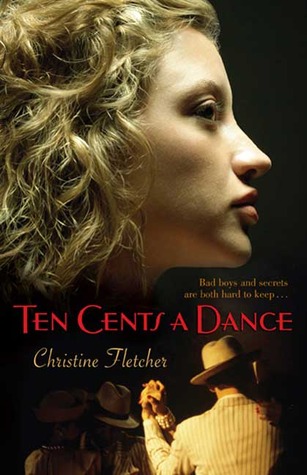
World at War: Ten Cents A Dance

Ten Cents A Dance. Christine Fletcher. 2008. Bloomsbury. 356 pages. [Source: Review copy]

First sentence: We heard the music even before we got to Union Hall.

Premise/plot: The year is 1941, the place Chicago. Ruby Jacinski hates her job--bottling pig feet. Though just sixteen she is the family's sole source of income. (Her mother can no longer work at the packinghouse, and she's in no condition physically to find a job elsewhere.) What does Ruby love? She loves to DANCE. So when someone--a cute, dashing older boy--mentions that she could get a job as a taxi dancer and potentially make $50 a week...well, she's intrigued.

What does a taxi dancer do? She dances or socializes with the customers. A ticket costs ten cents. It's a ticket a dance/song. Five cents is for the dance hall (Starlight in this case). Five cents is hers to keep. Any tip is hers to keep. The customer is nearly, always right. She's to make herself agreeable--to a certain degree. If she goes too far at the dance hall, she's in danger of losing her job. A customer can clock a girl out early with enough money and take her someplace else--another club, a restaurant, etc. Ruby learns that this is even better than dancing.

She has to look her best to appeal to customers. This costs money, of course, for dresses, stockings, shoes, jewelry, accessories, makeup, perfume. But even with these added costs, she is now able to pay the back rent on their place, pay off their debts with the shops, and keep food--even meat--on the table. But she learns there is a secret cost to pay, one that she never considered: the secrets and lies.

Ruby cannot tell her mother the truth about where she works and how she gets the money. She invents a job--telephone operator--a salary--$18 a week--and coworkers. At first the lies come relatively easy to her, but there comes a point in time where it is much too much to juggle.

And then there's that cute, dashing older boy, the one who told her about the job to begin with. His name is Paulie. And he's got a well-earned bad reputation. Some might even call him a mad dog. He's got plans of his own for Ruby, and though adult readers may see where this 'relationship' is going...Ruby's just naive enough to think differently.

How will the war change her future?

My thoughts: This is my third time to read Ten Cents a Dance. I first read it in 2008, and then again in 2014. I really do think this would make an excellent movie. I think the characterization is excellent. It's a compelling read.

© 2019 Becky Laney of Becky's Book Reviews

Monday, January 21, 2019

Odd and the Frost Giants

Odd and the Frost Giants. Neil Gaiman. Illustrated by Brett Helquist. 2008. 117 pages. [Source: Review copy]

First sentence: There was a boy called Odd, and there was nothing strange or unusual about that, not in that time or place. Odd meant the tip of a blade, and it was a lucky name. He was odd, though. At least, the other villagers thought so. But if there was one thing that he wasn't, it was lucky.

Premise/plot: Odd has a marvelous--though unexpected--adventure one winter. Out of all the Viking boys in his village, Odd might be the one voted least likely to have an adventure. His adventure begins, in a way, with his encounter with a fox, eagle, and a bear. Looks can be deceiving, for this isn't an ordinary fox, eagle, or bear. These are Norse gods...and they need a little help defeating their enemy.

My thoughts: DELIGHTFUL. I loved every minute of this one. I loved the story, the characters, the pacing, the writing. It was just a joy to read this little fantasy novel.

Original audience born circa 1996 to 2000.

© 2019 Becky Laney of Becky's Book Reviews

Friday, May 11, 2018

The Penderwicks on Gardam Street

The Penderwicks on Gardam Street. Jeanne Birdsall. 2008. 308 pages. [Source: Library]

First sentence from the prologue: Their mother had been here in the hospital with the new baby for almost a week.

First sentence from chapter one: Four years and four months later.

Premise/plot: The Penderwicks are back home from summer vacation. School has started again. And life is settling down. Or is it?! Aunt Claire comes with presents and a surprise. The surprise? A letter to Mr. Penderwick from his dead wife; she is pleading with him to start dating again, to love again, to be happy. Aunt Claire is insistent that he goes on FOUR dates. After four dates, she'll leave him again in peace. The Penderwick sisters come up with a Save-Daddy plan: a plan that sets him up with four horrible women so that their dad can get the dating over and done with. What the Penderwick sisters don't count on is the next door neighbor. She's a widow with a young son--a baby named Ben. She's a professor too.

Speaking of next door neighbors....can Rosalind and the boy next door be falling in love?

What will be the consequences when Jane and Skye do each other's homework assignments?

Will Hound make a new friend?

My thoughts: I enjoyed the first book in the series. But I LOVE, LOVE, LOVE this second book. I love that Mr. Penderwick starts dating Marianne Dashwood. I love spending time with all four sisters. I don't know that I have a favorite. Rosalind, Skye, Jane, and Batty. They are just WONDERFUL girls to spend time with. 

One of my favorite scenes is when Batty stows away on her father's "date" with Marianne.
"Daddy, it's me!"
"What a lovely surprise," he said, not at all angry, or much surprised, either.
"Hound is here, too, on the floor." She threw aside his blanket, too.
"Of course he is, for whither you go, there he usually is, too. Let's go get some pizza."
...
"How did you know I was in your car?"
"There was no other logical reason for a large mound of blankets to appear in the backseat."
Batty was disappointed. Her hiding skills were not as great as she'd hoped. (197)

© 2018 Becky Laney of Becky's Book Reviews

Thursday, January 25, 2018

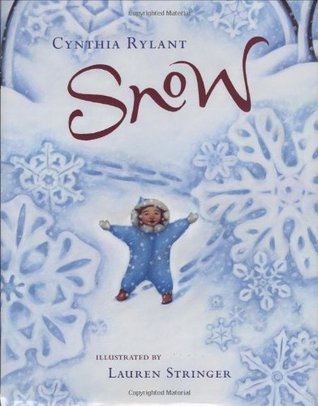
Snow

Snow. Cynthia Rylant. Illustrated by Lauren Stringer. 2008. Houghton Mifflin Harcourt. 40 pages. [Source: Review copy]

First sentence: The best snow is the snow that comes softly in the night, like a shy friend afraid to knock, so she thinks she'll just wait in the yard until you see her. This is the snow that brings you peace.

Premise/plot: In Rylant's poetic picture book, snow--in all its varieties--is celebrated.
Children love snow better than anyone does, and they never complain as they pull on their red boots and mittens and make plans to catch wet flakes on their tongues and roll their small bodies to the bottom of a hill. The snow loves them back. It gives them angels and new friends.
My thoughts: I wasn't expecting to love this one, but I did. I loved the writing. I found it lyrical, descriptive, beautiful. One of my favorite sentences is, "And the snow, while it is here, reminds us of this: that nothing lasts forever except memories." I also loved the illustrations. I found them beautiful, enchanting. In many spreads, readers see a young girl and her grandmother. The text tells us nothing about them personally, but the illustrations communicate so much. (The illustrations also reveal they have a cat.)

Text: 5 out of 5
Illustrations: 5 out of 5
Total: 10 out of 10


© 2018 Becky Laney of Becky's Book Reviews

Tuesday, August 29, 2017

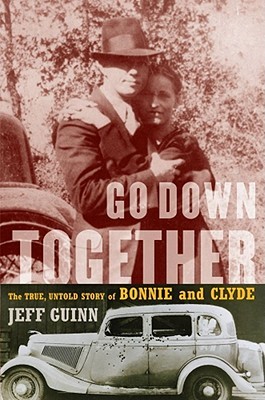
Go Down Together

Go Down Together. Jeff Guinn. 2008. 468 pages. [Source: Library]

First sentence: Clyde Barrow's father, Henry, never had much luck in life, and the hard times started for him right out of the womb.

Premise/plot: The subtitle of Jeff Guinn's Go Down Together sums the premise of the book up perfectly: the true, untold story of Bonnie and Clyde. It is a fascinating story of the Barrows, the Parkers, West Dallas, the Great Depression, the last days of Prohibition, the Dust Bowl, and the justice system of the 1920s and 1930s.

My thoughts: It was interesting to read Go Down Together at the same time I was reading Victor Hugo's Les Miserables. What both books have in common is an up-close-and-personal look at extreme poverty and some of the injustices of the prison system.
Destroy the mine of Ignorance, and you destroy the underminer, Crime. To put in a few words some of what we have been writing about: the only social peril is darkness. Humanity is of one kind. All men are of the same clay. With no difference, here below at least, in their predetermined fate. The same obscurity before, the same flesh during, the same dust afterwards. But ignorance mingled with the stuff of humankind blackens it. This incurable blackness spreads inside man and there becomes Evil. Victor Hugo
Go Down Together is by no means great literature, but, it does ask some thought-provoking questions; questions that perhaps Victor Hugo would have had a ready answer for.

It is a very HUMAN book. I get the idea that the author was not seeking to make great heroes or great villains out of Bonnie or Clyde. When they were alive, these two inspired outlandish stories. "True crime" stories were incredibly popular back in the day; criminals were the vampires and werewolves of the thirties perhaps! Newspapers depended on ENTERTAINING stories to sell copies; it was more important to sell copies than to tell the whole truth and nothing but the truth. After their deaths, the stories continued. Books and movies flourished. It didn't matter how much truth there was to be found--so long as the public bought it and kept coming back for more, more, more. What was selling was the idea of Bonnie and Clyde.

Who was Bonnie Parker? Who was Clyde Barrow? What was the Barrow family like? What was the Parker family like? What were their lives like? What was important to them? What did they want out of life? How did it all go so wrong? What were their options?

The author is CLEAR that while their stories are sad, and pitiful, crime was not the best option or the only option. Clyde was not the only young man who was living in extreme poverty, facing class discrimination, struggling to find a decent job, struggling to have a good life--a home, food to eat, clothes to wear. Bonnie was not the only young woman who felt TRAPPED by poverty. Both, I would imagine, felt trapped by a system they didn't like or trust, a system holding them down, holding them back. Poverty and class and injustice.

For example, as a young man long before his crime spree started, Clyde felt picked on by the police. Any time, or every time, a crime was committed he was hauled in for questioning. Most of the time there was no evidence linking him to the crime in question, he was just a "general suspect." The book mentions how Clyde would hold down a job for a couple days or a week or two, but, inevitably the police would come and get him while he was working, and he'd be fired. The few jobs he got, he lost--Clyde blamed the police, "the laws." Now, Clyde was not innocent. He did grow up stealing--along with at least one brother, maybe two--small things. The small things got bigger and bigger and bigger as he grew. And when he was convicted of theft, he was guilty. And he did get sent to prison. But prison made him a thousand times worse than he was before. And that might be an understatement. If the prison system--to be specific, the prison system in Texas in the late 1920s to early 1930s--had been better--more just, less corrupt would BONNIE AND CLYDE and their infamous Barrow Gang have come to be at all? The details of the prison system were difficult to read about.

The book was fascinating and packed with details. I loved the focus on family. I think it was fitting as well. One thing that might have led to their ultimate downfall was the fact that FAMILY CAME FIRST to both Bonnie and Clyde. No matter what these two always, always, always, always came back to visit their families. And the more stressed they were, the more hunted they were, the more important it was to them to see their family "one more time."

Bonnie enjoyed writing poetry. She gave her mother a poem a few weeks, I believe, before the two died. I'll quote the beginning and the end of "The End of the Line".
You've read the story of Jesse James--
Of how he lived and died;
If you're still in need
Of something to read
Here's the story of Bonnie and Clyde.
Now Bonnie and Clyde are the Barrow gang.
I'm sure you all have read
How they rob and steal
And those who squeal
Are usually found dying or dead.
There's lots of untruths to those write-ups;
They're not so ruthless as that;
Their nature is raw;
They hate the law--
The stool pigeons, spotters, and rats.
They don't think they're too smart or desperate,
They know the law always wins;
They've been shot at before,
But they do not ignore
That death is the wages of sin.
Some day they'll go down together;
And they'll bury them side by side,
To a few it'll be grief--
To the law a relief--
But it's death for Bonnie and Clyde.
It was also interesting to read Go Down Together right after seeing a WONDERFUL production of the musical. The musical doesn't do as great a job as Guinn's book at context. It does tend to keep things on the glamorous side, a bit. It also leaves out a LOT of information. For example, Bonnie's injury as a result of a car crash that left her crippled. Clyde had to carry her EVERYWHERE for the last year. But the music was WONDERFUL. And the humor in the dialogue was just about perfect. I had no idea the show would have me laughing.


© 2017 Becky Laney of Becky's Book Reviews

Monday, February 13, 2017

The Roar

The Roar. Emma Clayton. 2008. Scholastic. 496 pages. [Source: Review copy]

First sentence: The sun was setting over the Atlantic, and as it ran like molten gold into the waves a girl in a Pod Fighter ripped through the scene like graffiti sprayed across a landscape painting.

Premise/plot: You can trust the news to tell you the truth, right? The news would never lie to you and try to manipulate you, right? In Emma Clayton's The Roar, Readers meet inhabitants of a future London living behind a wall. Life is dismal and bleak. The rich have built up and up and up. The poor well they live below, living in fold-out apartments, eating fake food, and trying to survive the effects of mold.

Mika is the only one in his family that believes his sister Ellie is still alive. The government said she died, that she drowned, but he knows she is still alive. He still feels connected to his twin especially when he's asleep. Readers know she's alive too for the first few chapters are from her point of view.

Mika is one of the few skeptics, he doesn't trust many people. So when officials show up at his school with free sandwiches and other so-called treats including a new powdered drink that will be a requirement for ALL children to drink daily, he thinks the worst. Why do people suddenly care about the children? Why are they making such a big deal about a brand new game for them to play? Shouldn't arcade games be voluntary?!

Soon a competition is announced, six children will be chosen, and if you're one of the lucky ones, your life and the lives of your family members will improve dramatically in quality. An apartment above in the Golden Turrets, real food, a hover car, these are just a few of the perks. But the game is more dangerous than anyone knows.

Readers are teased with a big secret, and this one is action packed as well.

My thoughts: This is a quick, compelling read. I definitely enjoyed it. I liked the world building especially.

© 2017 Becky Laney of Becky's Book Reviews

Tuesday, September 06, 2016

Alcatraz Versus the Scrivener's Bones

Alcatraz Versus the Scrivener's Bones. Brandon Sanderson. 2008. Scholastic. 322 pages. [Source: Library]

First sentence: So, there I was, slumped in my chair, waiting in a drab airport terminal, munching absently on a bag of stale potato chips.

Premise/plot: This is the second book in the fantasy series. Alcatraz has had several months to get used to the truth. (The Hushlands (including the U.S.) are ruled by EVIL LIBRARIANS who control all information and manipulate and manufacture things their own way.) Smedry was raised in the Hushlands, but his 'real' place is with the Free Kingdomers. He's a SMEDRY. His family is one of the oldest and most powerful. He comes from a line of Oculators, for one thing, and each Smedry has their own unique talent. His grandfather's talent is arriving late. His own talent is for breaking things.

This is his second adventure...Bastille is present, but, readers meet many new sidekicks in this one. The mission this time is to find Alcatraz's GRANDFATHER and possibly his FATHER who have gone missing. They are believed to be in the Library of Alexandria. Kaz is an uncle. Australia is another relation, possibly a cousin? Also there is Bastille's mother--also a knight. The novel is definitely action-packed. Perhaps even more so than the first book.

My thoughts: Definitely like this series very much. I know I've read all four books before, but, it's been so long it was like reading them again for the very first time.

© 2016 Becky Laney of Becky's Book Reviews

Saturday, July 02, 2016

Audio Book: Cyrano de Bergerac

BBC Radio 3's Cyrano de Bergerac by Edmond Rostand, translated by Anthony Burgess. Adapted for radio by John Tydeman. First aired 2008.

Cyrano... Kenneth Branagh
Christian... Tom Hiddleston
Roxane... Jodhi May
De Guiche... John Shrapnel
Rageuneau... Jimmy Yuill
Le Bret... Gerard Horan
and others....

After watching the movie and reading the play, I was DELIGHTED to find a radio drama of what is fast becoming my favorite play!

Cyrano is played by Kenneth Branagh. He does a great job with the role as he did a great job with Benedick in Much Ado About Nothing!

Christian is played by Tom Hiddleston. I can easily imagine him as a perfect Christian!

All the actors did a GREAT job bringing this drama to life. It's a great production. It's just a little over two hours long.

Premise/plot: Cyrano, our hero, is madly in love with his cousin, Roxane. Judging himself too ugly to stand a chance with her--or with any woman--he is content to love her from afar. Roxane contacts him, through a maid, letting him know that they must meet. For a few hours he dreams that maybe just maybe he has a small chance with her. But she is meeting him to tell him that she is desperately in love with a young cadet (soon to join his regiment) named Christian. Will he befriend Christian and help them to be together?!?! Christian is "in love" with Roxane too. They've never spoken to each other. They've only seen each other a time or two. And yet both know it's LOVE. Cyrano questions her. What if he turns out to be less than her ideal??? She'll DIE she responds.
Cyrano does as she asks...and more. He turns Christian into the man of her dreams...by giving him the words to speak to win her heart.

There is a third man in Roxane's life, Count De Guiche. He loves her, but, is married. He adds drama and conflict to this French romance....

I would definitely recommend giving this one a listen if you can.


© 2016 Becky Laney of Becky's Book Reviews
Friday, July 01, 2016

Duel!

Duel: Burr and Hamilton's Deadly War of Words. Dennis Brindell Fradin. Illustrated by Larry Day. 2008. Walker. 40 pages. [Source: Library]

First sentence: The two enemies had much in common, starting with difficult childhoods.

Premise/plot: A picture book biography focusing on the lives of two founding fathers, Aaron Burr and Alexander Hamilton. The book slowly but surely builds its way towards the DUEL between the two men; the duel that will end the life of one and ruin the career of the other. As part of the context for understanding the duel, a little bit of American history is unpacked for readers, highlighting the roles both men had during American's war for independence and the turbulent decades afterwards as the United States of America came into existence. The book illustrates that politics always involves DRAMA.

My thoughts: I liked this one. I really do. I think it is definitely a picture book for older readers though. Not all picture books are intended as fun readalouds for preschoolers and kindergartners. The text keeps the story moving--it's quite lively at times. The author notes that both men were to blame for the duel.

I definitely liked the illustrations by Larry Day.

Text: 4 out of 5
Illustrations: 4 out of 5
Total: 8 out of 10

© 2016 Becky Laney of Becky's Book Reviews

Tuesday, May 17, 2016

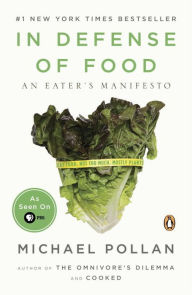
In Defense of Food

In Defense of Food. Michael Pollan. 2008. Penguin. 205 pages. [Source: Library]

After watching the documentary In Defense of Food, I sought out the book. The documentary was released several years after the book, and, it may be a little more up-to-date, in my opinion. It also benefits from the video format. It is engaging, fascinating, and fun. The documentary is able to use photographs, print ads, and commercials throughout. That being said, there is something to be said for the book itself. One can read it at your own pace, slowly digesting the information within, and rereading if necessary to make sure you've truly gotten what you needed.

The book is divided into three sections: "The Age of Nutritionism," "The Western Diet and the Diseases of Civilization," and "Getting Over Nutritionism."

So. The book is an "eater's manifesto," and it begins with seven glorious words: Eat food. Not too much. Mostly plants. Pollan explains those seven words in the final section of the book. Also in the introduction.

The book explores the question: what should I eat? what should I eat to be healthy? He points out that there is something unnatural about even having to ask--a sign that our culture and society has been damaged or upset. Until recently, people everywhere have known what to eat, and relied upon culture and tradition and common sense. It is only in the past century that this question has been taken over by so-called experts--scientists, doctors, politicians, food marketers, etc. Or perhaps I should say it's only in the past century that the majority have people have decided to follow so-called expert advice.

Other questions addressed in the book:
  • What is the Western diet? How did it come to be? What role has technology and new science played in food production?
  • What diseases are linked to the Western diet?
  • What health risks exist in the present and the future for those on the Western diet?
  • What are the alternatives to the Western diet? In other words, how, does one escape eating the Western diet?
  • What is nutritionism? How does it differ from nutrition or nutrition science?
  • How does one know who to trust and what to eat?
  • Can common sense save you after all?
  • What is food? How does "food" differ from "edible-foodlike substances" that you find in grocery stores and restaurants?
  • What should you be buying? What should you be eating?
  • Is it easy to eat healthy? Or difficult?

The book is a true must-read. Or. Perhaps the documentary is the true must?! I haven't made up my mind which is best. What I love is embracing common sense and grounding everything in reality. It isn't snarky or pessimistic. It is encouraging and inspiring.

From the introduction:
My aim in this book is to help us reclaim our health and happiness as eaters. To do this requires an exercise that might at first blush seem unnecessary, if not absurd: to offer a defense of food and the eating thereof... I contend that most of what we're consuming today is no longer, strictly speaking, food at all, and how we're consuming it--in the car, in front of the TV, and increasingly, alone--is not really eating, at least not in the sense that civilization has long understood the term. (7)
That eating should be foremost about bodily health is a relatively new and, I think, destructive idea--destructive not just of the pleasure of eating, which would be bad enough, but paradoxically of our health as well. Indeed, no people on earth worry more about the health consequences of their food choices than we Americans do--and no people suffer from as many diet-related health problems. We are becoming a nation of orthorexics: people with an unhealthy obessession with healthy eating. (9)
From part one:
The first thing to understand about nutritionism is that it is not the same thing as nutrition. As the "-ism" suggests, it is not a scientific subject but an ideology...A reigning ideology is a little like the weather--all pervasive and so virtually impossible to escape. Still we can try. In the case of nutritionism, the widely shared but unexamined assumption is that the key to understanding food is indeed the nutrient. Put another way: Foods are essentially the sum of their nutrient parts. From this basic premise flow several others. Since nutrients, as compared with foods, are invisible and therefore slightly mysterious, it falls to the scientists (and to the journalists through whom the scientists reach the public) to explain the hidden reality of foods to us. In form this is a quasireligious idea, suggesting the visible world is not the one that really matters, which implies the need for a priesthood. For to enter a world where your dietary salvation depends on unseen nutrients, you need plenty of expert help. (28).

We eaters, alas, don't reap nearly as much benefit from nutritionism as food producers. Beyond providing a license to eat more of the latest approved foodlike substance, which we surely do appreciate, nutritionism tends to foster a great deal of anxiety around the experience of shopping for food and eating it. (53)
From part two:
A diet based on quantity rather than quality has ushered a new creature onto the world stage: the human being who manages to be both overfed and undernourished, two characteristics seldom found in the same body in the long natural history of our species. (122)
From part three:
Don't eat anything your great-grandmother wouldn't recognize as food. (148)
Avoid food products that make healthy claims. (154)
Shop the peripheries of the supermarket and stay out of the middle. (157)
Eat meals (188).
Do all your eating from a table (192).


© 2016 Becky Laney of Becky's Book Reviews