Showing posts with label Paris in July. Show all posts

Sunday, July 30, 2017

The Novel of the Century

The Novel of the Century. David Bellos. 2017. 320 pages. [Source: Library]

First sentence from chapter one: Victor-Marie Hugo was born in 1802 in the garrison twon of Besancon, where his father was stationed.

Premise/plot: The Novel of the Century tells the story of Les Miserables. It seeks to do two things, really: 1) It tells how Victor Hugo came to write, edit, and publish Les Miserables; 2) It discusses the impact of the novel since its publication to the present day. It is a book for literature majors and/or history majors, especially. It is simply packed with information.

Did you know that...
  • Victor Hugo lived in exile for decades; France's most popular, much-beloved writer was exiled with the new regime that came into power in the mid 1840s.
  • Victor Hugo started the novel in the 1840s, but, it wasn't finished and published until the 1860s.
  • Worried that the book might be banned and/or destroyed, NO review copies were sent out before its publication, and the contents of the book were kept very secret. Still the book needed to be promoted, so they used BILLBOARDS of some of the interior illustrations to advertise.
  • The book was released in five parts of two volumes each, I believe.
My thoughts: I am so happy and so thankful that I got a chance to review this. Les Miserables has been one of my favorite books since I first read it in 1997. I had not heard the often dramatic story of how the novel came to be. This one isn't so much a biography of Victor Hugo's whole life or career as it is finely focused on his years writing, editing, publishing this one novel of his. The chapters vary between an entertaining narrative style that just about anyone can understand and appreciate and a more technical, scholarly style which may or may not hold every reader's interest. I really found many of the 'interludes' to be fascinating.

For example, "Reading novels as historical resources is not a way of paying attention to what the author meant to say, but a matter of identifying what was once so obvious that it didn't need to be said."


© 2017 Becky Laney of Becky's Book Reviews

Wednesday, July 26, 2017

Ninotchka

Ninotchka. Directed by Ernst Lubitsch. 1939. 110 minutes. [Source: Library]

Three Russian 'comrades' come to Paris with the purpose to sell the imperial jewels. The Grand Duchess, who is living in exile in Paris, feels the jewels are rightly hers and begins a tedious legal action to try to stall the sell. The three Russians become carried away by the good life in Paris--with a little help from the Duchess' boyfriend, Count Leon d'Algout. Another Russian is sent to get the job done right. Enter Greta Garbo in the role of Ninotchka. She's devoted to the communist cause, stern, serious, always on-task, always putting others before herself.

First and foremost, this is a ROMANCE. It's a charming, thoughtful, beautiful ROMANCE. I loved it almost start to finish. I'll be honest, the first part of the movie was a little slow. But when Ninotchka meets Count Leon, I became hooked. I didn't find Camille to be a particularly good movie. It was okay. But not gush-worthy. This on the other hand was LOVELY. I enjoyed the characters very much. And I really, really, really LOVED the ending. I liked Iranoff, Buljanoff, and Kopalski so much by the end of the movie!


© 2017 Becky Laney of Becky's Book Reviews

Thursday, July 20, 2017

Movie Review: Camille (1984)

Camille. Directed by Desmond Davis. 1984. 100 minutes. [Source: Library]

Marguerite Gautier is played by Greta Scacchi. Armand Duval is played by Colin Firth. Duval (Armand's father) is played by Ben Kingsley. Prudence is played by Billie Whitelaw. Count de Noilly is played by Denholm Elliott. Gaston is played by Patrick Ryecart.

This was a made-for-television adaptation of Alexandre Dumas fils' novel/play Camille. There's a great line of dialogue in this one: "Love me less, or understand me better." It's something that Marguerite is saying to Armand. That simple phrase says so much about this story.

The movie opens with a plea of sorts: a dying Marguerite is writing in her journal, confessing everything to Armand, pleading with him to understand her.

One of the first scenes of the movie shows Marguerite with her abusive father. At the very least he is verbally abusive, but, I lean more towards physical abuse as well. Regardless the movie opens with a very young Marguerite deciding to LEAVE HOME--for better or worse. She makes her way to Paris with just the clothes on her back. No money, no food, no place to stay, no plan on how to survive. She's desperate. Perhaps sensing her desperation, an older man, an Impressionist painter, offers to pay for a meal if she'll sit and pose for him. She eagerly accepts. In fact, she devours the food as if she hasn't eaten in days. But the painter has more than a sketch in mind. To be blunt--and this takes place offscreen fortunately--he rapes her. At first she scorns the idea of staying with him, she looks at him with hatred and disgust. But she realizes that her body is her commodity. With it, she has a way to get food, wine, clothes, jewelry, a place to stay. She still doesn't like him--but she realizes that they can use each other for a while. She'll hopefully find someone richer, someone better to take his place. She's definitely on the look out. She's "discovered" by the Duke de Charles. He finds that she looks like his now-deceased daughter. He is looking for her to take the place of his daughter. He wants her off the street; he wants her cleaned up; he wants her to stop selling herself to men. He's willing to treat her like a princess, gifts of money and jewels, an unlimited amount of credit it seems. But there are strings attached. She's to be a good girl.

Armand Duval is introduced early in this adaptation. Viewers first see him with his father and his sister celebrating life. His father seems to be encouraging his son to be YOUNG and to LIVE IT UP in Paris while he can. Armand becomes close friends with the wealthy Gaston. And the two seem to like women and booze. Like might not be a strong enough word. Let's just say the two are lusty young men.

So how do these two meet in this adaptation? Prudence spots Gaston at the theatre. Gaston tells Armand that Prudence was his first lover, that as an older, much-experienced woman she was a great teacher. Gaston and Armand go home with Prudence that night. Prudence is Marguerite's neighbor. When Marguerite invites Prudence over, she says she has two guests. Marguerite says COME WITH YOUR GUESTS AND RESCUE ME FROM THIS SUPREME BORE, the Count. For Armand, if you believe in such things, it's love at first sight. For Marguerite, however, she's not wanting to fall in love with any young man. Especially a poor one.

The rest of the story follows the other adaptations for the most part. Though Armand seems very much a jerk in this one. For example, his father tells him: do you know that by being with her you are ruining your sister's chance for marriage? Do you know that her wedding could be called off? And he's like MY SISTER LOVES ME AND I'M SURE SHE'D RATHER SEE ME BE HAPPY. Also, there were a few times at least when Armand crossed the line into abuse--in my humble opinion. He tells her IT'S ONLY BECAUSE I LOVE YOU SO MUCH THAT I ACT THIS WAY. And her response is: LOVE ME LESS OR UNDERSTAND ME BETTER. I think those are wise words indeed under the circumstances.

The characters are oh-so-human in this adaptation. Neither comes across as a saint.

Overall, I am definitely glad I watched this one. It is more of an interpretation of Dumas' work than an adaptation of it.

© 2017 Becky Laney of Becky's Book Reviews

Wednesday, July 19, 2017

Les Miserables 10th Anniversary Concert

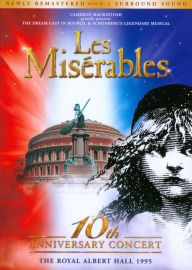
Les Miserables: 10 Anniversary Concert at London's Royal Albert Hall. Directed by John Caird and Gavin Taylor. 148 minutes. [Source: Library]

Features Colm Wilkinson as Jean Valjean, Philip Quast as Javert, Ruthie Henshall as Fantine, Jenny Galloway as Madame Thenardier, Alun Armstrong as Thenardier, Lea Salonga as Eponine, Michael Ball as Marius, Judy Kuhn as Cosette, Michael Maguire as Enjolras....

Premise/plot: This film is not a production of the musical itself but a concert featuring the music from the musical. One disc is the concert. The other disc is the special features. The special features include two documentaries that are well worth watching.

My thoughts: I have seen the 2012 film adaptation of the musical. I have very mixed feelings about the film. I really do. I think it is almost torturous to watch in places. It definitely is not a film that I'd ever say "again, again, again" after viewing.

I LOVE the book. It's one of my FAVORITE books of all time. I think the musical only makes sense if you've read the book OR if you've watched a better film adaptation.

So what did I think of this concert? Well, I found myself liking it much more than I thought I would. I liked the concert aspect of it--especially seeing the orchestra behind them and the ensemble cast. The ensemble cast wore Les Miserables t-shirts. The main characters were in costume.  (Probably two dozen or so were in costume.) Valjean and Eponine were my FAVORITES.

I though the singing was EXCELLENT for the most part. I also love watching orchestras.

My favorite songs:

I Dreamed a Dream, Fantine
Who Am I, Valjean
Fantine's Death, Fantine and Valjean
One Day More, Valjean, Marius, Cosette, Eponine, Enjolras
On My Own, Eponine
Bring Him Home, Valjean
Epilogue (Finale), Valjean, Fantine, Cosette and Marius, Ensemble


© 2017 Becky Laney of Becky's Book Reviews

Monday, July 17, 2017

Camille: A Play in Five Acts

Camille: A Play in Five Acts. Alexandre Dumas, fils. Translated by Matilda Heron. 1852. 72 pages. [Source: Library]

First sentence: Some one has rung the bell.

Premiseplot: Alexandre Dumas fils adapted his novel, Camille, into a five act play. There are just eleven characters: Armand Duval, Camille, Count de Varville, Nichette, Gustave, Olimpe, Gaston, Prudence, Nanine, and Monsieur Duval (Armand's father).

How does the play differ from the novel? The play removes the framework. The novel begins after Camille, our heroine, has died. Readers of the novel first meet a grief-stricken lover, Armand, who only slowly reveals the details of their romance. The play begins by introducing Camille's close circle of friends. Are all the people in this play her friends? Maybe, maybe not. Certainly most of them are. But a few do seem to be using Camille to their own advantage. Prudence, for example, stands out as someone taking full advantage of Camille. Olimpe is a rival of hers, so their friendship is more "friendship." Readers--viewers--watch the romance blossom, grow, mature in the play. Quite a difference emotionally, I believe.

 My thoughts: I really loved the play. I enjoyed the novel very much. I didn't think the story could be improved upon. But I'm glad that Dumas also gave us the play version. By simplifying the story, I feel we get a better impression of who the characters are.

Quotes:
Armand: Will you be loved?
Camille: For how long?
Armand: For eternity!
Camille: Alas! my life may yet be happy--it cannot be long--and short as it may be, it may outlive your promise.
Armand: Now, who is melancholy?
Camille: Not I. The weight that chained me to her throne's removed, and all around breathes ecstasy! But it grows late, and you must away.
Armand: When shall I see you again?
Camille: [Giving him a Camelia] When this little flower is faded, bring it to me again.
Armand: Ah, Camille, you have made me blessed.
Camille: It is a strange flower, Armand--pale, scentless, cold; but sensitive as purity itself. Cherish it, and its beauty will excel the loveliest flower that grows; but wound it with a single touch, you never can recall its bloom, or wipe away the stain. Take it, and remember me. Now go.
Armand: Adieu! (19)

© 2017 Becky Laney of Becky's Book Reviews

Sunday, July 16, 2017

Camille and Moulin Rouge

Camille. Directed by George Cukor. 1936. 109 minutes. [Source: Library]

Camille is based on the play/novel by Alexandre Dumas, fils. This adaptation was released in the 1930s. (There have been other adaptations.)

Greta Garbo plays Camille and Robert Taylor plays Armand Duval. These two are destined to come together and be torn apart. She's a Parisian courtesan who--for better or worse--falls in love for the first time. Her true love isn't exactly penniless, but, he's not wealthy either. He loves her, he claims, no matter her past. He swears that his jealousy will not get the better of him and drive him mad. But is he capable of keeping that promise?

These two have three lovely months in the country together. But at the end of that time, choices must be made. I will just say that the movie is DIFFERENT from the novel and play. In both the movie and the novel, Duval's father pleads with her to "do the right thing." But the novel and play give a different reason, perhaps a better reason, for his pleading. The movie, despite setting up things nicely to go in the same direction, gives a much weaker excuse. Camille's sacrifice, therefore, doesn't seem as noble perhaps.

Love is anything but easy and comfortable in this black and white classic film.... I will say that this movie stars Laura Hope Crews as Prudence. I recognized her as dear old 'Aunt' Pittypat' from Gone With the Wind.

Moulin Rouge. Directed by Baz Luhrmann. 2001. 127 minutes. [Source: Own]

Like Camille, Moulin Rouge is about a Parisian courtesan falling in love for the first time. Another similarity is their tragic endings: both Camille and Satine die of consumption minutes after being reunited with their one true loves.

But the two films have little else in common. Moulin Rouge makes no apologies and doesn't pretty up the situation to make it classy or tasteful. Nothing subtle in this one....for better or worse.

Christian is the young man--the young writer--who falls in love with Satine quite by accident. These two do have their moments of pure happiness as they prepare for the big show. (She's the lead actress; he's the writer.) But fate intervenes in their happily ever after. The Duke is paying for the show and for HER. She is to be his exclusively. But more importantly, she is dying of consumption. Before Christian ever sings her one line, she is dying. Of course, she may not realize how short her time is. But the clues are there from the start.

What sets Moulin Rouge apart is its music. It is a musical. It is a one-of-a-kind musical in a way. I adore Ewan McGregor.

Is Moulin Rouge based on Dumas' Camille? Yes and no. It is based on Verdi's opera La Traviata. La Traviata is based on Dumas' Camille.

© 2017 Becky Laney of Becky's Book Reviews

Thursday, July 13, 2017

DVD Review: Vincent Van Gogh A New Way of Seeing

Exhibition on Screen: Vincent Van Gogh. Directed by David Bickerstaff. 2015. 90 minutes. [Source: Library]

I recently watched a documentary on Vincent Van Gogh. It was great. I loved the balance. It focused both on the art and the artist. Viewers got the chance to see his works, an overview of most of what he painted and drew. But perhaps more importantly, viewers got a chance to know the artist--the man--behind those works. It was the story of his life--from childhood to death, essentially. Viewers learned of the relationships that mattered most to him--particularly his brother, Theo, but also to some extent his friends and fellow artists. It followed the journey of his life. How did he come to be an artist? Was he ever passionate about anything else? I found his story both fascinating and heartbreaking, in a way. Without a doubt, some of his works are beautiful, amazing even. But his personal life was very troubled, disturbed. Emotionally, mentally, even physically, he was a mess. This is one of the best documentaries I've seen this year.

© 2017 Becky Laney of Becky's Book Reviews

Monday, July 10, 2017

DVD Review: The Impressionists: The Other French Revolution

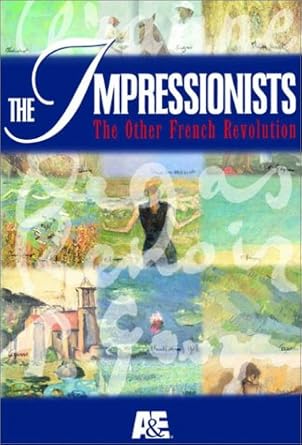
The Impressionists: The Other French Revolution. Bruce Alfred (director, producer, writer). 2001. 200 minutes. [Source: Library]

What should you know? It's a documentary. There are two episodes. Each episode is about ninety minutes or so. (90 minutes of documentary not counting the credits.) The documentary focuses on the lives of five artists: Claude Monet, Auguste Renoir, Edgar Degas, Camille Pissarro, Berthe Morisot. But in reality, it focuses on more than just those five. So many artists, so many pieces of art, are discussed/presented. (For example, Edouard Manet, Mary Cassatt, and Georges Seurat just to name a few.) Also viewers learn about their wives, mistresses, models, patrons, supporters, doubters, haters. The whole film really gives you a big-picture context for the movement. 

The first documentary tells of the beginnings of the artists. The 'revolutionary' aspects of their art that made them unique but unsuccessful. How they chose different subjects for their works. How they chose different color palettes. How their brushstrokes were different, and how their works tended to look unpolished or half-done. Their non-stop financial struggles. Their difficulties getting their works in the salon. How they were viewed as REBELS. 

The second documentary starts in the early 1870s. The Impressionists had decided to come together as a group and have their own gallery or exhibit since their work wasn't "accepted" by the established salon. It wasn't that things were automatically easier from this time on, but, things had turned a corner. Some were now selling pieces at least some of the time. And they'd gotten a new supporter (or two or three) on their side. (For example, Durand-Ruel.) This second episode follows each artist to the very end of their lives. (Morisot was the first of the five to die. Monet the last in 1926.)

I loved seeing all the art. I loved learning more about each artist. Also the soundtrack to this one is lovely! Definitely recommended!

© 2017 Becky Laney of Becky's Book Reviews

Saturday, July 08, 2017

Camille: The Lady of the Camellias

Camille. Alexandre Dumas, fils. 1848. Translated by Edmund Gosse. 254 pages. [Source: Library]

First sentence: In my opinion, it is impossible to create characters until one has spent a long time studying men, as it is impossible to speak a language until it has been seriously acquired.

Premise/plot: The narrator learns of the death of a famous Parisian courtesan, Marguerite Gautier, and decides to attend her estate sale where he purchases a book with a personal dedication. Some time later, he meets a young man named Armand Duval, Marguerite's lover, who asks for the book back. The narrator is happy to comply, and the two become friends. The narrator learns the whole story of their passionate but tragic love story directly from him.

My thoughts: I really enjoyed this one very much. If one can "enjoy" a tragic love story. It reminded me very much of the musical Moulin Rouge. (Except I think it was a lot less flashy.) The heroine was based on a real person who died about a year before this book was published. The author, I believe, was one of the men madly in love with this celebrity courtesan. (Her name was changed for the book. The name of the real courtesan was Marie Duplessis.) This heroine has been the subject of plays, movies, and operas. Verdi was inspired by Dumas' play and book to write La traviata.

Favorite quotes:
I must tell you the whole story; you will make a book out of it; no one will believe it, but it will perhaps be interesting to do.
How many ways does the heart take, how many reasons does it invent for itself, in order to arrive at what it wants.
The story of Marguerite is an exception, I repeat had it not been an exception, it would not have been worth the trouble of writing it.
© 2017 Becky Laney of Becky's Book Reviews
Prickly Jenny

Prickly Jenny. Sibylle Delacroix. 2015. 32 pages. [Source: Library]

First sentence: Jenny doesn't say good morning because, really, what's so good about it? Jenny doesn't want her new polka-dotted dress. She wants to wear her old T-shirt, and that's that.

Premise/plot: Jenny's mood is less than ideal in this picture book. As the title says, Jenny is prickly. Each page reveals that Jenny is still upset about something. In fact, it's EVERYTHING that's wrong.
Jenny says, "Leave me alone!" But she cries when Mommy goes away.
My thoughts: I like it. There are some illustrations that I really love. (Like when it's nap-time and Jenny is standing on her head!) The book isn't horribly unique. Finn Throws a Fit comes to mind, for example. And in my opinion, Finn is probably the better book. But there is something to be said for the simplicity of this one. It's less showy, less dramatic, more realistic than Finn perhaps.

Text: 4 out of 5
Illustrations: 4 out of 5
Total: 8 out of 10

© 2017 Becky Laney of Becky's Book Reviews

Wednesday, July 05, 2017

Vincent and Theo: The Van Gogh Brothers

Vincent and Theo: The Van Gogh Brothers. Deborah Heiligman. 2017. 464 pages. [Source: Library]

First sentence: Theo's brother Vincent has been living with him for just over a year, and Theo cannot take it anymore.

Premise/plot: Love historical fiction? Love art? Love France? Consider reading Deborah Heiligman's new novel, Vincent and Theo: The Van Gogh Brothers. She tells their story in a compelling way, I think. But it isn't just the story of Vincent and Theo of their dependence on one another. It's also the story of Theo's wife, Jo. Without his sister-in-law's continual effort to keep Vincent's work alive after his death--to keep his work in front of the public, to make his name, his work KNOWN, would the world really have Vincent Van Gogh?!

My thoughts: I really enjoyed reading this one. If enjoyed is the right word. It's emotional, dramatic, and well-researched. The first few chapters begin near the end. But for the most part, the book is arranged chronologically. Each chapter leaves readers with a strong impression; each captures a moment in time. Oh the tension! There's drama, frustration, confusion, heartache, disappointment, loneliness, despair, love, and passion. There's a definite feeling of lost-ness hanging over the novel. Both brothers suffer from mental health issues--among other things.

The book is strongly influenced by his art. There are certain works that really impact how the story is told and arranged. For example, Vincent's picture of the Windmill became a symbol of the bond between the brothers. She states in the author's note that finding this work and realizing its significance was THE moment she found her book.
This walk in the rain seals their friendship, deepens it. Later both brothers will refer to it as a meeting of the minds, of the time they made a pledge to each other. They will always remember this day. Theo will use the walk in argument. So will Vincent. The brothers will come back to it again and again. It is an anchor, a promise of the future, a touchstone. (49)


I would recommend that readers also pick up a copy of Impressionism: 13 Artists Children Should Know by Florian Heine. It does NOT include Vincent Van Gogh, but, it does include many of his contemporaries. He knew several of these artists well; his work was exhibited alongside theirs.

© 2017 Becky Laney of Becky's Book Reviews

Friday, July 29, 2016

The Journey That Saved Curious George

The Journey That Saved Curious George. Louise Borden. 2016. HMH. 96 pages. [Source: Review copy]

First sentence: For many years, I was intrigued by the story of Margret and H.A. Rey's flight from Paris on bicycles in June 1940.

Premise/plot: This children's nonfiction book is just right for elementary readers. It begins by providing background and context for young readers. Hans Augusto Reyersbach and Margarete Waldstein grew up in Germany. Both were Jewish. At some point in the 1920s, he moves to Rio de Janeiro. She follows a little while after. They meet again there, and fall in love. Paris is one of the stops on their honeymoon--they are Brazilian citizens now--and Paris is where they decide to remain. They work many happy years together in Paris. But their work--and their lives--are threatened when World War II goes from being something you read about in the papers--to something happening a few miles outside the city limits.

As Jews, they are at great risk if they remain in Paris and Paris is captured by the Nazis. But. For better or worse. They waited a little too long to leave the city...in an easy way. The last rush sees them desperate to find two bicycles. I believe the book says he had to build the bicycles himself from parts. But it isn't just a story about saving the authors' lives, it's a book celebrating the manuscript that would become Curious George. That was one of the possessions that they took with them--on their bikes. Of course what you may not know is that "George" wasn't George just yet. The monkey was originally called Fifi. And publishers had already agreed to publish the book before they made their flight...

The book focuses on H.A. and Margret Rey, their work as writers, and how the war effected their lives.

My thoughts: This is a very enjoyable read. I loved how the author was able to reconstruct their lives and give readers a behind-the-scenes look into the writing and illustrating of books. The book felt personal, but, always appropriate.

I would definitely recommend this one.

© 2016 Becky Laney of Becky's Book Reviews

Friday, July 22, 2016

Paris in July Playlist

Maurice Jarre
I have definitely enjoyed participating in the Paris in July blog event. Today, I thought I would share my top three French composers.

3. Maurice Jarre (1924-2009) was a composer who did a LOT of movie scores. Most likely, you are familiar with his scores for Lawrence of Arabia, Doctor Zhivago, Witness, Dead Poets Society, and Ghost. Also he did Passage to India, Is Paris Burning?, The Man Who Would Be King, Jesus of Nazareth, and A Walk in the Clouds.

His biggest hit, of course, was "Lara's Theme."

2. Camille Saint-Saëns (1835-1921) is a popular choice for figure skaters. I'll be honest. That's how I came to know his music.

I'm sharing with you today:
Danse Macabre
Carnival of Animals
From the Carnival, but for the impatient sort, The Swan
Samson and Delilah, and, for the impatient sort, Bacchanale
Introduction & Rondo Capriccioso
Piano Concerto No 2 in G minor

1.  Georges Bizet (1838-1875) is definitely my FAVORITE, FAVORITE French composer. He is perhaps best known for Carmen, the opera. And I do love that. Though I prefer instrumental versions for easy-listening. But I really ADORE L'Arlésienne.

I'm curious if anyone will see the connection between these pieces of music and a certain children's television program. Bizet must be a big favorite of the LITTLE EINSTEIN folks.


Carmen Suite #1 and #2 Playlist


L'Arlésienne Suite No. 1 & Suite No. 2


© 2016 Becky Laney of Becky's Book Reviews

Tuesday, July 12, 2016

The Grand Mosque of Paris

The Grand Mosque of Paris: A Story of How Muslims Saved Jews During the Holocaust. Karen Gray Ruelle. Illustrated by Deborah Durland DeSaix. 2009. Holiday House. 40 pages. [Source: Library]

First sentence: In 1940 war came to Paris, and life was turned upside down.

Premise/plot: Quite simply this is a picture book for older readers. Dare I say it's even a picture book primarily for adults?! This picture book is definitely text-heavy, and the subject is a heavy one. The book brings to light something you may not know: the North African Muslims of Paris rescued a lot of Jews during World War II. (Others were part of the French Resistance.)

This is not a well-documented, well-known part of history. Rescuing Jews (hiding Jews, creating new identity papers, forging documents, smuggling them out of France) was deadly dangerous. So it makes sense that it was not well-documented, that they did not leave a paper trail to show how many hundreds or thousands they rescued during the war. This is a story of what we do know--a handful of cases, examples, of men, women, and children rescued by Muslims.

My thoughts: This one is packed with information, most of it all new-to-me. Because I am interested in the subject, I found it fascinating. It isn't a storytelling narrative. The text doesn't thrill you with its beauty. But it is dense with information that you probably can't find elsewhere. I can guess why they went with a picture book format. The illustrations are LOVELY and truly complement the text.

Text: 3 out of 5
Illustrations: 4 out of 5
Total: 7 out of 10

© 2016 Becky Laney of Becky's Book Reviews
Sunday, July 10, 2016

My thoughts on Cyrano de Bergerac


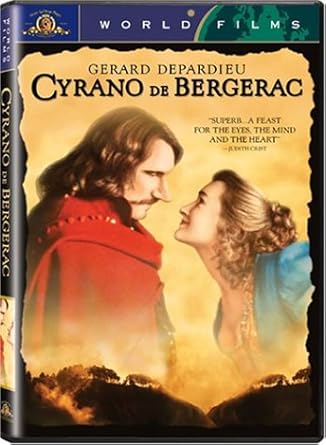
For Paris in July, I watched Cyrano de Bergerac in French with English subtitles. I cannot gush about it enough. It is all kinds of wonderful. And deserves to be watched and rewatched dozens of times at least.

The film was released in 1990. It stars Gerard Depardieu in the lead role of Cyrano de Bergerac. He is PERFECTLY perfect in this role. Anne Brochet stars as Roxane. Vincent Perez stars as Christian de Neuvillette.

Is it faithful to the play? Yes and no. I would say YES because it is true to the spirit of the play/book. Nothing has been changed about the characters themselves. The script-writing keeps to the integrity of the original. I would say NO because a few things were changed. For example, in the play, Roxane is able to ride through the enemy armies unopposed and unchallenged. If questioned, she just spills her heart and speaks of her desperate need to see her husband. She does arrive the day of the big, decisive battle. In the movie, Christian "saves" her from the enemy army and her arrival is far from unopposed. Christian is given something MANLY to do to prove himself.

I would also say that the movie misses an opportunity when it cuts one of the best, best lines from the play. What is that line? Roxane saying I've loved only one man, and I've lost him twice

Cyrano de Bergerac is a serious, dramatic, ROMANTIC play with some very comic lines. But it isn't a comedy or at least not a ha-ha comedy as my friend would say. This production captures the tone of the play exceedingly well. I did try to watch another production, a filming of a stage production from recent years, and it was over-the-top too-much. Every line (of the first forty or so minutes) acted for a belly laugh. Which is, I suppose, okay for Cyrano de Bergerac's confrontation with the actor and all. But how can you connect with Cyrano and see his soul if you're just laughing AT him?

I LOVE, LOVE, LOVE, LOVE the soundtrack to the movie. It is one of my favorite film scores. The music was composed by Jean Claude Petit.


The soundtrack opens with a track called 'Cyrano'


I would definitely recommend this soundtrack. I think it's great music to have on in the background. It is great to read to, for example. It's just hauntingly beautiful.

© 2016 Becky Laney of Becky's Book Reviews

Wednesday, July 06, 2016

Cyrano de Bergerac

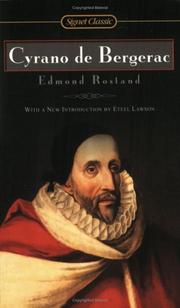
Cyrano de Bergerac. Edmond Rostand. Translated by Lowell Blair. 1897. 240 pages. [Source: Library]

First sentence: Stop! You haven't paid your fifteen sols!

Premise/plot: Cyrano de Bergerac is in love with his cousin, Roxane. The problem? He lacks the courage to tell her so because he feels his nose--his hideous, ugliness--will prevent her from ever loving him in return. Also standing in his way is the fact that Roxane declares herself head over heels in love with oh-so-handsome Christian de Neuvillette. How does Christian feel about Roxane? He loves her of course. Why? Because she's beautiful. (At least Cyrano knows Roxane, and, his love isn't based on her beauty alone.) Roxane asks Cyrano to watch over Christian and be his friend. (Christian has just joined the same regiment.) Cyrano tells Christian that Roxane does love him, but, instead of that being the end of it...it is just the start. For Roxane is determined that the man she loves will be brilliant and exceptionally well-spoken. He must win her heart through his words. The problem? Christian's idea of wooing is to say "I love you" and go in for a kiss. NOT WHAT ROXANE WANTS AT ALL. The solution is for Cyrano to give Christian the words to speak to win her heart for once and all. But is that a real solution?! Is a happily ever after possible in this love triangle?!

Cyrano de Bergerac is a five act (French) play by Edmond Rostand written/performed in 1897. It is set in seventeenth century France around the same time as The Three Musketeers. And like The Three Musketeers, it has sword fighting. Lots and lots of sword fighting.

My thoughts: I LOVE it. I really, really, really love it. I think I first saw the 1990 French film with English subtitles. I found it swoon-worthy then. I am not sure when I first read it, probably in high school or college. I don't think I read it more than once, however, so it was like rediscovering a forgotten friend to reread it after all these years.

I do think (like most plays) it is best read in one sitting if at all possible. (I do allow for intermissions! After all, if you were to see it performed live, they'd certainly be at least one break!)

Act five is certainly the most dramatic perhaps, but, it is also for me a wonderfully bittersweet way to end the play. THAT ENDING gets me every time.

I think this play is beautifully written. I adore the character of Cyrano de Bergerac. I love his integrity, his wit, his passion, his dashing courage.

Have you read Cyrano de Bergerac? What did you think?

Favorite quotes:
Cyrano: I have a different idea of elegance. I don't dress like a fop, it's true, but my moral grooming is impeccable. I never appear in public with a soiled conscience, a tarnished honor, threadbare scruples or an insult that I haven't washed away. I'm always immaculately clean, adorned with independence and frankness. I may not cut a stylish figure, but I hold my soul erect. I wear my deeds as ribbons, my wit is sharper than the finest mustache, and when I walk among men I make truths ring like spurs. (40)
Cyrano: Look at me and tell me what hope this protuberance might leave me! I have no illusions. Sometimes, in the blue shadows of evening, I give way to tender feelings. I go into a garden, smelling the fragrance of spring with my poor monstrous nose, and watch a man and a woman strolling together in the moonlight. I think how much I, too, would like to be walking arm in arm with a woman, under the moon. I let myself be carried away, I forget myself--and then I suddenly see the shadow of my profile on the garden wall. (50)
Ragueneau: How can you treat poetry with such disrespect?
Lise: I'll treat poetry however I please!
Ragueneau: I shudder to think of what you might do with prose! (62)
Cyrano: I'll now put down on paper the love letter that I've already written within myself a hundred times. I have only to look into my soul and copy the words inscribed in it. (66)
Cyrano: My poor girl, you're so fond of fine words and gracious wit--what if he should prove to be an uncultured savage?
Roxane: Impossible. He has the hair of one of d'Urfe's heroes!
Cyrano: His speech may be as crude as his hair is elegant.
Roxane: No, there's delicacy in everything he says. I feel it.
Cyrano: Yes, all words are delicate when they come from lips adorned with a shapely mustache...But what if he's a fool?
Roxane: [stamping her foot] Then I'll die! There, are you satisfied? (78)
Cyrano: Shall we complete each other? We'll walk together: you in the light, I in the shadow. I'll make you eloquent, you'll make me handsome. (102)
Roxane: Your words are hesitant tonight. Why?
Cyrano (pretending to be Christian): Because of the darkness, they must grope their way to your ears.
Roxane: My words have no such difficulty.
Cyrano: They go straight to my heart, a goal too large to miss, whereas your ears are small. And your words travel swiftly because they fall, while mine must slowly climb.
Roxane: But they seem to be climbing better now.
Cyrano: They've finally become accustomed to that exercise.
Roxane: It's true that I'm speaking from high above you.
Cyrano: Yes, and it would kill me if you let a harsh word fall on my heart from that height. (126)
Cyrano: After all, what is a kiss? A vow made at closer range, a more precise promise, a confession that contains its own proof, a seal placed on a pact that has already been signed; it's a secret told to the mouth rather than to the ear, a fleeting moment filled with the hush of eternity, a communion that has the fragrance of a flower, a way of living by the beat of another heart, and tasting another soul on one's lips! (133)
Roxane: I've adored you since the evening when under my window, you began to reveal your soul to me in a voice I'd never heard you use before, and when I read your letters it was like hearing that same voice. I could feel its tenderness enveloping me! Finally I had to come to you, no matter what the danger! Penelope wouldn't have calmly stayed home with her weaving if Ulysses had written to her as you've written to me! She would have become as ardent as Helen of Troy, thrown her work aside, and gone off to join him! (184)
Roxane: Ah, how many things have died, and how many have now been born! Why were you silent for fourteen years, knowing that he hadn't written that letter, and that the tears on it were yours?
Cyrano: The blood was his. (218)
© 2016 Becky Laney of Becky's Book Reviews

Saturday, July 02, 2016

Audio Book: Cyrano de Bergerac

BBC Radio 3's Cyrano de Bergerac by Edmond Rostand, translated by Anthony Burgess. Adapted for radio by John Tydeman. First aired 2008.

Cyrano... Kenneth Branagh
Christian... Tom Hiddleston
Roxane... Jodhi May
De Guiche... John Shrapnel
Rageuneau... Jimmy Yuill
Le Bret... Gerard Horan
and others....

After watching the movie and reading the play, I was DELIGHTED to find a radio drama of what is fast becoming my favorite play!

Cyrano is played by Kenneth Branagh. He does a great job with the role as he did a great job with Benedick in Much Ado About Nothing!

Christian is played by Tom Hiddleston. I can easily imagine him as a perfect Christian!

All the actors did a GREAT job bringing this drama to life. It's a great production. It's just a little over two hours long.

Premise/plot: Cyrano, our hero, is madly in love with his cousin, Roxane. Judging himself too ugly to stand a chance with her--or with any woman--he is content to love her from afar. Roxane contacts him, through a maid, letting him know that they must meet. For a few hours he dreams that maybe just maybe he has a small chance with her. But she is meeting him to tell him that she is desperately in love with a young cadet (soon to join his regiment) named Christian. Will he befriend Christian and help them to be together?!?! Christian is "in love" with Roxane too. They've never spoken to each other. They've only seen each other a time or two. And yet both know it's LOVE. Cyrano questions her. What if he turns out to be less than her ideal??? She'll DIE she responds.
Cyrano does as she asks...and more. He turns Christian into the man of her dreams...by giving him the words to speak to win her heart.

There is a third man in Roxane's life, Count De Guiche. He loves her, but, is married. He adds drama and conflict to this French romance....

I would definitely recommend giving this one a listen if you can.


© 2016 Becky Laney of Becky's Book Reviews