Showing posts with label book I own. Show all posts

Friday, December 27, 2024

109. Doomsday Book

109. Doomsday Book. Connie Willis. 1992. Random House. 592 pages.  [Source: Book I Bought]

First sentence: Mr. Dunworthy opened the door to the laboratory and his spectacles promptly steamed up.
"Am I too late?" he said, yanking them off and squinting at Mary.
"Shut the door," she said. "I can't hear you over the sound of those ghastly carols."
Dunworthy closed the door, but it didn't completely shut out the sound of "O Come, All Ye Faithful" wafting in from the quad. "Am I too late?" he said again.  

 Premise/plot: In a world where historians learn their subject firsthand by time travel, Kivrin, our heroine--one of them--is sent to the middle ages to learn just "how exaggerated" (according to her professor/advisor Gilchrist) the accounts of the Black Death were. That's spinning it a bit. Kivrin is there to LEARN and OBSERVE and ABSORB. Technically, she's to be sent to 1320--the Advent/Christmas/Epiphany season in OXFORD. But that's if all goes according to plan and there are no mix-ups or mistakes. 

Mr. Dunworthy, our hero, has a bad feeling that those in charge of the project are incapable and incompetent and imbeciles. The book opens moments before she is sent back in time....it isn't long before Dunworthy has reason to panic...But this book isn't about one man's panic--his helicopter teaching, if you will. It is about TWO pandemics. One is set in the present of 2054. This pandemic requires a quarantine, contact tracing, mask-wearing, and safety protocols. With it comes toilet paper shortages--along with soap! The present story line is full of mystery and action. The other is set in the past--the Black Death. There is a theme of helplessness in both.

My thoughts: Doomsday Book by Connie Willis is one of my favorite, favorite, favorite, favorite, favorite books. This is my seventh? time to read and review it. I last reviewed it in 2023. I love and adore this book so much. It is set during Christmas/Epiphany. It's just a book that calls out to me every year to reread. I am surprised it has never been adapted into a film. The world needs more action Christmas movies.


© 2024 Becky Laney of Becky's Book Reviews

Saturday, February 04, 2023

21. To Dream in the City of Sorrows


To Dream in the City of Sorrows. (Babylon 5: Book #9). Kathryn M. Drennan. Based on the series by J. Michael Straczynski. 1997. Random House. 352 pages.  [Source: Bought]

From the prologue: Marcus Cole walked with a limp, a fact that did not go unnoticed by the young Minbari acolyte as Marcus entered the small temple. Marcus didn't recognize the rather chubby Minbari and briefly wondered where Sech Turval was, but as he was not in the mood for conversation, he simply made a note to seek out the venerable Minbari teacher at a later time.

From chapter one: "Alpha 7 to Alpha Leader, I'm hit!" 

Premise/plot: So the framework of To Dream In The City of Sorrows--the prologue and epilogue--take place shortly after season three's "Grey 17 is Missing," and are narrated by Marcus Cole. (I just LOVE, LOVE, LOVE Marcus Cole!) But most of the book focuses on what was happening with Jeffrey Sinclair after he left Babylon 5. (The gap between the last episode of season one, "Chrysalis," and the incredibly intense two-part episode "War Without End" of season three.)

IN the first episode of season two, viewers learn that Jeffrey Sinclair has been suddenly removed from his position on Babylon 5 and reassigned to Minbar. Officially he is the "ambassador from Earth" on Minbar. The FIRST human ambassador to Minbar. Unofficially, well, he's out of favor with Earth Alliance. But that may just prove to everyone's advantage.   

In the introduction, J. Michael Straczynski writes, "What you hold in your hand is an official, authorized chapter in the Babylon 5 story line. This is the definitive answer to the Sinclair question, and should be considered as authentic as any episode in the regular series."

My thoughts: This is my fourth time to reread To Dream in the City of Sorrows. (2011, 2012, 2015, and 2023). I love it so much. Every time I start a rewatch of the show Babylon 5, I always make plans to reread this one. It is a "must" to include in the timeline of the overall show.

Read To Dream in the City of Sorrows

  • If you want to know what Sinclair was doing in season two and three
  • If you want to know what became of Catherine Sakai, to learn if these two were able to make their troubled relationship work...with the added drama of Shadows and Rangers
  • If you want to know more even more about the Shadows' movements during this time
  • If you want to learn about how Sinclair became Ranger One and re-energized the Rangers (first started by Valen)
  • If you want to learn more about Minbari prophecies (also their culture and caste system)
  • If you want to learn more about the Vorlons; in particular readers are introduced to Ulkesh. (Loved Sinclair's first impression of him! And his insights about the Vorlons in general. How Kosh may not be the most representative of his race.)
  • If you want to learn more about Marcus. Readers meet William Cole AND Marcus Cole. Two brothers with an imperfect relationship. William is an eager ranger-in-training trying to get Marcus to join him, but, things don't always go as planned.


© 2023 Becky Laney of Becky's Book Reviews

Thursday, April 12, 2018

Amanda

Amanda. (Sunfire #1) Candice Ransom. 1984. Scholastic. 368 pages. [Source: Library book sale]
First sentence: It had been raining forever, endless rain that dripped down the windowpanes. Amanda Bentley could not stand the cramped hotel room another minute.

Dear Scholastic:
If I thought begging would do any good, I would plead with you to republish the Sunfire romance series originally published in the 1980s. The "name" books were my favorite-and-best books from my middle years--my first introduction to the wonderful genre of historical romance. It's a love that's still going strong, by the way. I know the Sunfire books don't contain vampires, werewolves, fairies, or demons. But why should romance novels contain such in the first place. If they were worth publishing in the first place--which they so clearly were--they are worth republishing.

I have given it a lot of thought. I have. And I think it would be wonderful if the books were republished as e-books for the same price as the original paperback books were released. Granted, I would love to see PRINT copies as well. But I imagine that they would cost more than the lovely $2.95 of the originals! But for an e-book, the thought is IT'S WORTH EVERY PENNY.

Becky

Dear Candice Ransom:

Thank you a million times for being the awesome writer that you are. (Thank you for being awesome in general!) I will forever be a fan of yours--your picture books, your early readers and chapter books, and your novels. My first introduction to your work was through the Sunfire romance series. They were--they are--some of my favorite books ever. You gave me a glorious gift--a love of reading.

I still get giddy thinking about the fact that you know who I am. That in 2009 Winchester came to visit me for a few days.

As long as you keep writing, I'll keep reading.

Becky

Premise/plot: Amanda's hopes and dreams are thwarted by her father's gambling ways and big dreams. He decides to steal away from Boston--with her--and start again. On their journey south, he gets a fever to go WEST, to go to Oregon. Amanda does NOT want to go, yet, she finds herself heading west in a wagon, in a wagon train, all the same. It will be the most challenging time in her life, but will the journey change her for the better?

My thoughts: Is Amanda my favorite Sunfire romance?! Maybe. Perhaps my favorite Sunfire romance is the one I've read most recently. Though I will say Amanda is probably always in my top five.

I enjoy a good wagon train story. Why can't wagon train stories become trendy again?!

Amanda brings to mind the only western that I love. You see, I am allergic to westerns in general. The western that is an exception to the rule is WESTWARD THE WOMEN (1951). 

© 2018 Becky Laney of Becky's Book Reviews

Thursday, April 05, 2018

Zucchini

Zucchini. Barbara Dana. 1982. 160 pages. [Source: Childhood Copy]

First sentence: Zucchini was born in the rodent house at the Bronx Zoo. When he was six weeks old, the rodent man put him in a cage of his own, separating him from his mother. It was time for him to be independent.

Premise/plot: Zucchini is a black-footed ferret who longs for freedom and a home of his own choosing. Will he get his happily ever after? Billy is a young boy, a shy boy, who needs to find his own place to belong.

My thoughts: I have a love/hate relationship with animal fantasy. I was hoping that Zucchini would not be another Stuart Little. I wanted--needed--a good, solid ending that had a point. I was satisfied with both stories.
Billy had always been shy. At least that's the way it had been for as long as he could remember. Sometimes, when he had nothing better to do, he would try and figure out what it was that had started the shyness, or when it was that it started, but he couldn't remember. His teachers at school said it was because Billy's parents were divorced. They had been divorced two years, and Billy lived with his mother and stepfather. His real father was an actor in Los Angeles, California, and Billy didn't get to see him very much.
It's hard getting used to a stepfather," Billy's teachers would say. "That's why William is withdrawn."
Billy didn't like being called William, and he didn't think his teachers were right, not completely right anyway. He remembered always liking to be quiet. Even as a tiny boy there was so much to look at and listen to, so much to understand. Too much talking got in the way. (42)
I love how Billy's love for Zucchini pushes him out of his comfort zone and he learns that he can be okay, that he can talk to strangers, that he can speak up and speak out. I love how friendship changes Zucchini and he realizes that some things are more important than independence. 

© 2018 Becky Laney of Becky's Book Reviews

Wednesday, December 10, 2014

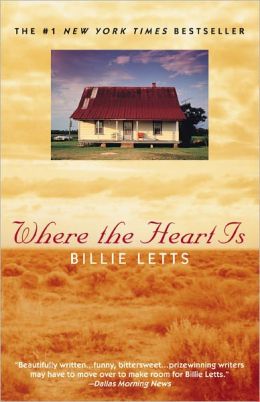
Where The Heart Is (1995)

Where The Heart Is. Billie Letts. 1995. 376 pages. [Source: Bought]

The novel opens circa 1985. Novalee Nation, the heroine, is seven months pregnant. She is with her boyfriend, and they're both heading west. He's a man without integrity, to say the least. He does reluctantly give her a ten dollar bill so she can go buy some shoes when her own shoes are lost through the hole in the floor of his car. But he expects a good bit of change back. Or does he? Was he planning to abandon her at the Walmart all along? Or did he just get tired of waiting? Does it matter? The truth is that Novalee Nation is left at a Walmart in a small town in Oklahoma with only $7.77. She has no family to call, no friends either. So Novalee settles down in Walmart for the rest of her pregnancy, hiding when need be, so no one knows that she is living there. She ventures out during the day and meets people, meets the librarian, for example. By the end of her pregnancy, she's made a few friends. Now these new friends of hers don't know the truth exactly. But they're not the type of people who would care overly much about the truth. Novalee happens to find herself among the least judgmental folks she's ever met. The book spans seven years worth of drama. If the book has a theme it is one of 'home' and 'belonging' and 'family.'

Where the Heart Is was not a good match for me. I wanted a different book, perhaps. A book that kept the "down-to-earth" quirky characters perhaps, but, lost much of the smut. It isn't that Where the Heart Is is your traditional smutty romance--it isn't, far from it. But I thought there were certainly plenty of details that were tasteless. Why did readers need to follow Willy Jack's story at all???? Every chapter that focused on Willy Jack seemed tasteless and pointless. Why do we need to know about his time in prison? If the story had centered exclusively on Novalee Nation, would I have liked it a bit more? I think I would have. At least I wouldn't have hated it. Eliminating Willy Jack wouldn't have solved all the problems, one scene that was too much to take, and rightly so, was the child rape. The scene had every right to be disturbing. It was a horrible awful situation. Still. The details were too much. The profanity--the blasphemy--was also too much. 


© 2014 Becky Laney of Becky's Book Reviews

Friday, December 05, 2014

Reread #49 Tale of Despereaux

The Tale of Despereaux. Kate DiCamillo. 2003. Candlewick Press. 272 pages. [Source: Bought]

There are so few rereads left in the year, yet, I couldn't miss rereading Kate DiCamillo's The Tale of Despereaux. (I first reviewed this one in September 2007). I've also made a point of rereading Because of Winn Dixie and The Miraculous Journey of Edward Tulane.

I tend to like talking-mice books. I tend to like animal fantasy when it's well done. And in The Tale of Despereaux it is very well done. DiCamillo is a GREAT author. She is. She has a way with words, with phrasing things just so that happens to appeal to me. She's a good, solid storyteller. Her characters are always unique and memorable. That is definitely the case with The Tale of Despereaux.

Do you have a favorite Kate DiCamillo book?

Quotes:
“Stories are light. Light is precious in a world so dark. Begin at the beginning. Tell Gregory a story. Make some light.”
“There are those hearts, reader, that never mend again once they are broken. Or if they do mend, they heal themselves in a crooked and lopsided way, as if sewn together by a careless craftsman. Such was the fate of Chiaroscuro. His heart was broken. Picking up the spoon and placing it on his head, speaking of revenge, these things helped him to put his heart together again. But it was, alas, put together wrong.”
“Reader, you must know that an interesting fate (sometimes involving rats, sometimes not) awaits almost everyone, mouse or man, who does not conform.”
“Once upon a time," he said out loud to the darkness. He said these words because they were the best, the most powerful words that he knew and just the saying of them comforted him.”
“Despereaux looked at his father, at his grey-streaked fur and trembling whiskers and his front paws clasped together in front of his heart, and he felt suddenly as if his own heart would break in two. His father looked so small, so sad.
"Forgive me," said Lester again.
Forgiveness, reader, is, I think, something very much like hope and love - a powerful, wonderful thing.
And a ridiculous thing, too.
Isn't it ridiculous, after all, to think that a son could forgive his father for beating the drum that sent him to his death? Isn't it ridiculous to think that a mouse ever could forgive anyone for such perfidy?
But still, here are the words Despereaux Tilling spoke to his father. He said, "I forgive you, Pa."
And he said those words because he sensed it was the only way to save his own heart, to stop it from breaking in two. Despereaux, reader, spoke those words to save himself.”

© 2014 Becky Laney of Becky's Book Reviews

Friday, October 31, 2014

Reread #44 Frankenstein

Frankenstein. Mary Shelley. 1818/1831. Oxford World's Classics. 250 pages. [Source: Bought]

Almost every time I read it, I focus on something new, something that I might have missed, something that I hadn't considered before. I thought I would share my observations with you instead of a traditional review.

Stories. Frankenstein is a story within a story. But it's more than that. It's a text that utilizes stories and storytelling even within that framework. The first story, of course, is the one Robert Walton is communicating to his sister, Margaret, through letters. After the first few letters, Walton stops being so introspective and focuses on telling someone else's story. Victor Frankenstein's story. This is written in the letters in first person, as if Victor himself were telling the story--sharing it. Within that big story, are dozens of little stories. The story of how his parents met. The story of his birth and childhood. The story of how Elizabeth was adopted. The story of how he became interested in science. The story of his mother's death. The story of his going away to university. The story of his madness--his obsession--and how he came to create life. The story of his sickness and recovery. The story of his learning about his brother's death/murder. The story of Justine. You get the idea. Each story is crafted and shaped. These stories are how he sees himself and the world, his place in it. Some of the stories are personal and a vital part of the plot. Other stories are more like asides. But this isn't Victor's story alone. Midway through the book, readers learn the creature's story. Even though this is written in first person though the eyes of the creature--the monster--the words are for better or worse being filtered through Victor Frankenstein's memory. He's telling what the monster said. He's telling what the monster heard. And Robert Walton is then passing along Frankenstein's story of the events and conversations. The creature is a storyteller as well. He recalls his life, his memories, his desires and needs. But he also focuses in particular on one family, one French family living in exile. This section has multiple stories. Including one focusing on a young woman. Though it may seem like an aside to readers, the stories matter very much to the narrator, the creature. The stories are providing for him a framework of the world, of how it works, of what life and love are all about. The stories resonate with the creature. He has seen love. He has seen family. He has seen fellowship and community. Because he has seen this, he feels the lack of it in his own life. But it isn't just the unfolding story that he personally witnesses. He is also shaped by the stories--the words--in the books he oh-so-conveniently is able to read. Words and stories matter. The stories we tell ourselves about ourselves, the stories we share with others, they all matter. For example, I think the story the creature told himself over and over and over again was it is all Victor's fault. He made me. He gave me life. He made me this ugly, this revolting. He made me this large and strong. He left me--he abandoned me. He didn't love me. He never loved me. He rejected me. He made it so everyone would reject me. Why does everyone reject me? It's his fault. It's all his fault. He made me have killing-hands. He made me have killing-thoughts. He didn't show me a better way. He didn't teach me. He didn't raise me. I had to learn everything all by myself. It is his fault. I'm not responsible. Why would I be? It is his fault! If it wasn't for him, I wouldn't be so miserable, so alone, so full of angst. I wouldn't feel pain or hunger or thirst. I wouldn't feel at all. The monster has his Job moments. One last thing, Victor Frankenstein speaks of the power of words, of persuasion. He warns that the creature has a way with words, that he can manipulate people by his persuasiveness. He warns Walton not to let himself be manipulated by the creature's story--his words and pleas. Is there any truth to this? Is the creature trying to masquerade himself as an angel of light? His actions say one thing: he's a killer, a murderer, he premeditates at least some of his crimes. His words say another: no one loves me, everyone runs from me, it's all HIS fault.

Questions. It's hard to read Frankenstein without questions. Who is the real monster? Who should be held responsible? Is there anyone who shouldn't be held responsible? Why is human life valued so little by ego-obsessed people? Why does Walton idolize Frankenstein?

Victor Frankenstein, Robert Walton, and the creature share a few things in common. They are introspective, moody, obsessed, and lonely. True, there are differences in their obsessions. Robert Walton is obsessed with glory, with adventure, with discovering the Northwest Passage. Walton has spent years if not decades obsessed with the North Pole, with the arctic regions. This started as a boy with books, with stories and words. His dream shifted slightly for a brief period of time when he wanted to be a poet, but, ultimately he came back to his first love. He didn't give up his poetic personality/nature however. Victor Frankenstein is first obsessed with science, with electricity, with creating life. This playing God leads to no good--it leads to madness and murder. I believe the madness started long before he was successful. I have never understood how he could piece together this creature--this eight-foot creature--and it is only when he is alive that he realizes that it is monstrous and ugly and unnatural and threatening. Why make it eight-feet? Why make it so unhuman? Regardless, having created life, he then becomes obsessed with destroying it--with murdering his demon-creation, his monster. His only reason to live is to track down and kill the monster. The monster's obsession? Well, he's driven by anger and pain. He wants to HURT Frankenstein. He is acting out, having murderous temper-tantrums all to get the attention of the one who gave him life, his father, his creator. He wants what he can't have. He wants love and acceptance. He wants to belong. He wants companionship and family. He wants to be happy. He wants to be treated fairly and humanely. He doesn't want to be judged based on appearances. He taunts and haunts his creator. He wants Frankenstein to be just as miserable and desperate as he is.

Quotes:

Robert Walton meets Victor Frankenstein:
In the morning, however, as soon as it was light, I went upon deck and found all the sailors busy on one side of the vessel, apparently talking to someone in the sea. It was, in fact, a sledge, like that we had seen before, which had drifted towards us in the night on a large fragment of ice. Only one dog remained alive; but there was a human being within it whom the sailors were persuading to enter the vessel. He was not, as the other traveller seemed to be, a savage inhabitant of some undiscovered island, but a European. When I appeared on deck the master said, "Here is our captain, and he will not allow you to perish on the open sea." On perceiving me, the stranger addressed me in English, although with a foreign accent. "Before I come on board your vessel," said he, "will you have the kindness to inform me whither you are bound?" You may conceive my astonishment on hearing such a question addressed to me from a man on the brink of destruction and to whom I should have supposed that my vessel would have been a resource which he would not have exchanged for the most precious wealth the earth can afford. I replied, however, that we were on a voyage of discovery towards the northern pole. Upon hearing this he appeared satisfied and consented to come on board. Good God! Margaret, if you had seen the man who thus capitulated for his safety, your surprise would have been boundless. His limbs were nearly frozen, and his body dreadfully emaciated by fatigue and suffering. I never saw a man in so wretched a condition. We attempted to carry him into the cabin, but as soon as he had quitted the fresh air he fainted. We accordingly brought him back to the deck and restored him to animation by rubbing him with brandy and forcing him to swallow a small quantity. As soon as he showed signs of life we wrapped him up in blankets and placed him near the chimney of the kitchen stove. By slow degrees he recovered and ate a little soup, which restored him wonderfully. Two days passed in this manner before he was able to speak, and I often feared that his sufferings had deprived him of understanding. When he had in some measure recovered, I removed him to my own cabin and attended on him as much as my duty would permit. I never saw a more interesting creature: his eyes have generally an expression of wildness, and even madness, but there are moments when, if anyone performs an act of kindness towards him or does him any the most trifling service, his whole countenance is lighted up, as it were, with a beam of benevolence and sweetness that I never saw equalled. But he is generally melancholy and despairing, and sometimes he gnashes his teeth, as if impatient of the weight of woes that oppresses him.
 Robert shares his big, big dream with Victor:
I was easily led by the sympathy which he evinced to use the language of my heart, to give utterance to the burning ardour of my soul and to say, with all the fervour that warmed me, how gladly I would sacrifice my fortune, my existence, my every hope, to the furtherance of my enterprise. One man's life or death were but a small price to pay for the acquirement of the knowledge which I sought, for the dominion I should acquire and transmit over the elemental foes of our race. At first I perceived that he tried to suppress his emotion; he placed his hands before his eyes, and my voice quivered and failed me as I beheld tears trickle fast from between his fingers; a groan burst from his heaving breast. I paused; at length he spoke, in broken accents: "Unhappy man! Do you share my madness? Have you drunk also of the intoxicating draught? Hear me; let me reveal my tale, and you will dash the cup from your lips!"

And so it begins...
Yesterday the stranger said to me, "You may easily perceive, Captain Walton, that I have suffered great and unparalleled misfortunes. I had determined at one time that the memory of these evils should die with me, but you have won me to alter my determination. You seek for knowledge and wisdom, as I once did; and I ardently hope that the gratification of your wishes may not be a serpent to sting you, as mine has been. I do not know that the relation of my disasters will be useful to you; yet, when I reflect that you are pursuing the same course, exposing yourself to the same dangers which have rendered me what I am, I imagine that you may deduce an apt moral from my tale, one that may direct you if you succeed in your undertaking and console you in case of failure. He then told me that he would commence his narrative the next day when I should be at leisure. This promise drew from me the warmest thanks. I have resolved every night, when I am not imperatively occupied by my duties, to record, as nearly as possible in his own words, what he has related during the day. If I should be engaged, I will at least make notes. This manuscript will doubtless afford you the greatest pleasure; but to me, who know him, and who hear it from his own lips—with what interest and sympathy shall I read it in some future day! Even now, as I commence my task, his full-toned voice swells in my ears; his lustrous eyes dwell on me with all their melancholy sweetness; I see his thin hand raised in animation, while the lineaments of his face are irradiated by the soul within. Strange and harrowing must be his story, frightful the storm which embraced the gallant vessel on its course and wrecked it—thus!
I've reviewed Frankenstein several times in the past. 2007. 2009. 2010. 2011

© 2014 Becky Laney of Becky's Book Reviews

Wednesday, August 13, 2014

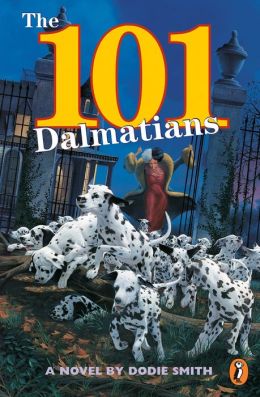
101 Dalmatians (1956)

The 101 Dalmatians. Dodie Smith. 1956/1989 Penguin. 192 pages. [Source: Owned Since Childhood]

I have been meaning to read this one for decades. The Disney adaptation is one of my favorites. It is. I love and adore it. Kanine krunchies can't be beat they make each meal a special treat. It's just a satisfying movie that is practically perfect in every way.

So. What did I think of the book? Well. It's different that's for sure. Missis and Pongo are the lovely dalmatian couple with fifteen adorable puppies. The human couple, Mr. and Mrs. Dearly, seeks out another dalmatian wet nurse, if you will. The vet says that no dog can successfully nurse fifteen puppies and have them all thrive. So seven of the pups become Perdita's to raise. The three dogs become quite close friends. The happy couple pities Perdita for she lost her love, Prince, and her own puppies. (Mr. Dearly does NOT write songs. He's an accountant or something along those lines. The book merely says he's a financial wizard who did something or other for the government.)

Cruella de Vil and her HUSBAND are social acquaintances of Mr. and Mrs. Dearly. She wears fur year-round. Her husband is a furrier, and, she doesn't hide the fact that she married him because of it.

The basics of the story are the same. Cruella de Vil wants the puppies and hires someone to steal the puppies. True, there are two nannies tending to the puppies instead of just one. But, the end result is the same. The puppies are gone. Pongo and Missis do the twilight bark, eventually they hear back that the puppies are found.

I liked this one.

© 2014 Becky Laney of Becky's Book Reviews

Sunday, March 02, 2014

Two Picture Books Turning Ten

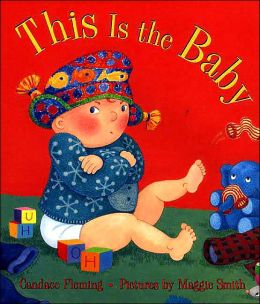
This is The Baby. Candace Fleming. Illustrated by Maggie Smith. 2004. FSG. 40 pages. [Source: Book I Own]

This is the baby who hates to be dressed.
"No! No! Nooo!"
This is the diaper, often a mess, that goes on the baby who hates to be dressed.
"No! No! Nooo!"
This is the T-shirt, wrinkled a lot, that snaps over the diaper, often a mess, that goes on the baby who hates to be dressed.
"No! No! Nooo!"
This is the sweater, itchy and hot, that covers the T-shirt, wrinkled a lot, that snaps over the diaper, often a mess, that goes on the baby who hates to be dressed.
"No! No! Nooo!"
These are the jeans, stiff in the knee....

I love this one. I do. I like true picture books. Stories that reflect every day situations and struggles, stories that look at life realistically. The book is also fun and playful. I also like picture books that are repetitive or that have refrains, making it easy for little ones to join in during the reading.

In This is the Baby, readers meet one stubborn mother and one just-as-stubborn baby. Who will win the battle?!

This one has a good twist on it, a bit predictable perhaps, but still fun! I would definitely recommend this one to parents who have little ones who like to wiggle and giggle free and undressed...

Text: 5 out of 5
Illustrations: 4 out of 5
Total: 9 out of 10

Dig! Andrea Zimmerman and David Clemesha. Illustrated by Marc Rosenthal. 2004. Harcourt. 32 pages. [Source: Book I Own]

Mr. Rally drives a big yellow backhoe. It has a scooper and a pusher. Mr. Rally loves to dig in the dirt. So does his dog, Lightning. Mr. Rally buckles his overalls and pulls on his boots. He has five big digging jobs to do today. He counts them. One. Two. Three. Four. Five. Job #1 up ahead. One is a bridge on the ridge. 

Dig is a fun picture book that I really enjoy. Readers meet Mr. Rally and his dog, Lightning.

Readers see the two get excited about digging in the dirt. This one has a repeating refrain: "Dig up rock and dig up clay! Dig up dirt and dig all day!" This refrain is repeated at all five jobs, as is the congratulating refrain of "Good job, Mr. Rally! Good job, Lighting!" 

After a long day of work, you might think Mr. Rally would want to go home and relax. And he does, in his own way, I suppose. But at the end of his day, Mr. Rally can still be found digging alongside Lightning. He loves to dig for work and play, of course. He loves to dig at home in his garden.

Text: 4 out of 5
Illustrations: 4 out of 5
Total: 8 out of 10

© 2014 Becky Laney of Becky's Book Reviews

Tuesday, September 24, 2013

Iola Leroy (1892)

Iola Leroy. Frances Ellen Watkins Harper. 1892. 256 pages. [Source: Bought]

I've been meaning to read Iola Leroy for several years now. Iola Leroy is one of the first novels written by an African American woman. The novel isn't arranged chronologically. It starts during the Civil War. Readers meet a handful of slaves who are deciding whether or not to leave their plantations and join the Union army or to stay on their plantations and continue to serve. A chapter or two keeps us with the army, following a few soldiers. The character of Iola Leroy is then introduced. She's a young woman who could easily pass as a white woman--if she wanted; one doctor with the army, a Dr. Gresham falls madly in love with Iola Leroy. He knows "the truth" about her ethnicity, her background, and it doesn't make the slightest bit of difference to him. She is THE ONE for him; he knows it. But can he convince her that his love is the real thing?

After briefly meeting Iola Leroy and Dr. Gresham and a handful of others, the novel then takes us back several decades in time. Readers meet Iola's mother, Marie (a slave), and her father, Eugene (a slave-owner). This portion of the novel feels forced, scripted, a bit unnatural. It begins with a conversation between Eugene Leroy and Alfred Lorraine. He is telling Lorraine of his intentions to free Marie, marry her, and bring her back to the plantation as his wife, his hopes to raise his family in the south.
"You never saw Marie?"
"No; and I don't want to."
"She is very beautiful. In the North no one would suspect that she has one drop of negro blood in her veins, but here, where I am known, to marry her is to lose caste. I could live with her, and not incur much if any social opprobrium. Society would wink at the transgression, even if after she had become the mother of my children I should cast her off and send her and them to the auction block."
"Men," replied Lorraine, "would merely shrug their shoulders; women would say you had been sowing your wild oats. Your money, like charity, would cover a multitude of faults."
"But if I make her my lawful wife and recognize her children as my legitimate heirs, I subject myself to social ostracism and a senseless persecution. We Americans boast of freedom, and yet here is a woman whom I love as I never loved any other human being, but both law and public opinion debar me from following the inclination of my heart. She is beautiful, faithful, and pure, and yet all that society will tolerate is what I would scorn to do."
"But has not society the right to guard the purity of its blood by the rigid exclusion of an alien race?"
"Excluding it! How?" asked Eugene.
"By debarring it from social intercourse."
"Perhaps it has," continued Eugene, "but should not society have a greater ban for those who, by consorting with an alien race, rob their offspring of a right to their names and to an inheritance in their property, and who fix their social status among an enslaved and outcast race? Don't eye me so curiously; I am not losing my senses."
"I think you have done that already," said Lorraine. "Don't you know that if she is as fair as a lily, beautiful as a houri, and chaste as ice, that still she is a negro?"
"Oh, come now; she isn't much of a negro."
"It doesn't matter, however. One drop of negro blood in her veins curses all the rest."
"I know it," said Eugene, sadly, "but I have weighed the consequences, and am prepared to take them."
"Well, Eugene, your course is so singular! I do wish that you would tell me why you take this unprecedented step?"
Eugene laid aside his cigar, looked thoughtfully at Lorraine, and said, "Well, Alfred, as we are kinsmen and life-long friends, I will not resent your asking my reason for doing that which seems to you the climax of absurdity, and if you will have the patience to listen I will tell you."
"Proceed, I am all attention."
"My father died," said Eugene, "as you know, when I was too young to know his loss or feel his care and, being an only child, I was petted and spoiled. I grew up to be wayward, self-indulgent, proud, and imperious. I went from home and made many friends both at college and in foreign lands. I was well supplied with money and, never having been forced to earn it, was ignorant of its value and careless of its use. My lavish expenditures and liberal benefactions attracted to me a number of parasites, and men older than myself led me into the paths of vice, and taught me how to gather the flowers of sin which blossom around the borders of hell. In a word, I left my home unwarned and unarmed against the seductions of vice. I returned an initiated devotee to debasing pleasures. Years of my life were passed in foreign lands; years in which my soul slumbered and seemed pervaded with a moral paralysis; years, the memory of which fills my soul with sorrow and shame. I went to the capitals of the old world to see life, but in seeing life I became acquainted with death, the death of true manliness and self-respect. You look astonished; but I tell you, Alf, there is many a poor clod-hopper, on whom are the dust and grime of unremitting toil, who feels more self-respect and true manliness than many of us with our family prestige, social position, and proud ancestral halls. After I had lived abroad for years, I returned a broken-down young man, prematurely old, my constitution a perfect wreck. A life of folly and dissipation was telling fearfully upon me. My friends shrank from me in dismay. I was sick nigh unto death, and had it not been for Marie's care I am certain that I should have died. She followed me down to the borders of the grave, and won me back to life and health. I was slow in recovering and, during the time, I had ample space for reflection, and the past unrolled itself before me. I resolved, over the wreck and ruin of my past life, to build a better and brighter future. Marie had a voice of remarkable sweetness, although it lacked culture. Often when I was nervous and restless I would have her sing some of those weird and plaintive melodies which she had learned from the plantation negroes. Sometimes I encouraged her to talk, and I was surprised at the native vigor of her intellect. By degrees I became acquainted with her history. She was all alone in the world. She had no recollection of her father, but remembered being torn from her mother while clinging to her dress. The trader who bought her mother did not wish to buy her. She remembered having a brother, with whom she used to play, but she had been separated from him also, and since then had lost all trace of them. After she was sold from her mother she became the property of an excellent old lady, who seems to have been very careful to imbue her mind with good principles; a woman who loved purity, not only for her own daughters, but also for the defenseless girls in her home. I believe it was the lady's intention to have freed Marie at her death, but she died suddenly, and, the estate being involved, she was sold with it and fell into the hands of my agent. I became deeply interested in her when I heard her story, and began to pity her."
"And I suppose love sprang from pity."
"I not only pitied her, but I learned to respect her. I had met with beautiful women in the halls of wealth and fashion, both at home and abroad, but there was something in her different from all my experience of womanhood."
"I should think so," said Lorraine, with a sneer; "but I should like to know what it was."
"It was something such as I have seen in old cathedrals, lighting up the beauty of a saintly face. A light which the poet tells was never seen on land or sea. I thought of this beautiful and defenseless girl adrift in the power of a reckless man, who, with all the advantages of wealth and education, had trailed his manhood in the dust, and she, with simple, childlike faith in the Unseen, seemed to be so good and pure that she commanded my respect and won my heart. In her presence every base and unholy passion died, subdued by the supremacy of her virtue."
"Why, Eugene, what has come over you? Talking of the virtue of these quadroon girls! You have lived so long in the North and abroad, that you seem to have lost the cue of our Southern life. Don't you know that these beautiful girls have been the curse of our homes? You have no idea of the hearts which are wrung by their presence."
"But, Alfred, suppose it is so. Are they to blame for it? What can any woman do when she is placed in the hands of an irresponsible master; when she knows that resistance is vain? Yes, Alfred, I agree with you, these women are the bane of our Southern civilization; but they are the victims and we are the criminals."
"I think from the airs that some of them put on when they get a chance, that they are very willing victims."
"So much the worse for our institution. If it is cruel to debase a hapless victim, it is an increase of cruelty to make her contented with her degradation. Let me tell you, Alf, you cannot wrong or degrade a woman without wronging or degrading yourself."
"What is the matter with you, Eugene? Are you thinking of taking priest's orders?"
"No, Alf," said Eugene, rising and rapidly pacing the floor, "you may defend the system as much as you please, but you cannot deny that the circumstances it creates, and the temptations it affords, are sapping our strength and undermining our character."
"That may be true," said Lorraine, somewhat irritably, "but you had better be careful how you air your Northern notions in public."
"Why so?"
"Because public opinion is too sensitive to tolerate any such discussions."
"And is not that a proof that we are at fault with respect to our institutions?"
"I don't know. I only know we are living in the midst of a magazine of powder, and it is not safe to enter it with a lighted candle."
Eugene does exactly as he plans. Marie is freed; the two are married; they have three children. But his plans are set aside after his death. Alfred Lorraine, his closest white relative, insists that Marie is a slave, and that her three children are slaves too. He gets his way. Iola is tricked into coming home, but her brother is safe at school in the North. (The youngest child dies.)

Most of the novel focuses on life AFTER the war is over, AFTER the slaves are freed, during the messy period of Reconstruction. Iola Leroy and her uncle (whom she just happens to meet) are searching desperately for their families. There are plenty of happy reunion moments in between the social commentary. There's also a romance squeezed in for Iola Leroy. (It is NOT Dr. Gresham.)

The narrative falls into two types: dialect and lecture. I found the dialect to be more interesting and more enjoyable. The narrative style in the 'lecture' sections reminded me of A Pilgrim's Progress.
© 2013 Becky Laney of Becky's Book Reviews

Sunday, September 15, 2013

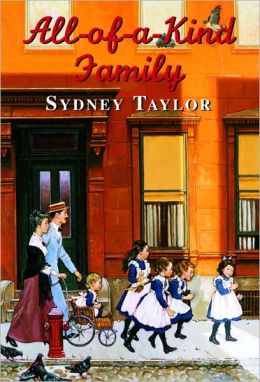
Sunday Salon: Reading All-of-a-Kind-Family (1951)

All-of-a-Kind-Family. Sydney Taylor. 1951. 190 pages. [Source: Bought]

I enjoyed rereading All-of-a-Kind Family by Sydney Taylor. This historical fiction novel is set in New York City around 1912. When the novel opens, there are five sisters: Ella, Henrietta (Henny), Sarah, Charlotte, and Gertie. They are a "steps-and-stairs" family according to the oh-so-friendly librarian Miss Allen. (Yes, the librarian plays a good role in this one!) The chapters are episodic, occurring over the course of a year. The chapters detail what life was like in a Jewish household during the early years of the new century. Some chapters are about everyday things like shopping, cleaning, going to the library, eating in bed, picky-eating at the table, etc. Other chapters are about holidays or vacations: Purim, Passover, 4th of July, visiting Coney Island, etc. My least favorite chapter remains the same: the hiding of buttons to motivate the sisters into cleaning.

I liked this one. I like it because it is old-fashioned and simple and just good. I like it because it captures a special time and place in American history.

Have you read this one? What did you think?

© 2013 Becky Laney of Becky's Book Reviews

Tuesday, July 02, 2013

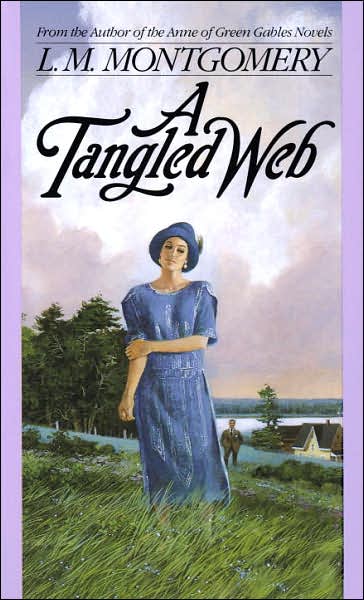
Tangled Web (1931)

A Tangled Web. L.M. Montgomery. 1931. 257 pages. [Source: Bought]

A dozen stories have been told about the old Dark jug. This is the true one.

A Tangled Web is certainly different from L.M. Montgomery's other novels. There isn't one main character or even one main story. Though I suppose one could argue that the two family clans putting on a show--acting their absolute best, just in case--over the "old Dark jug" might be the "big story." (While Aunt Becky left a will concerning all of her possessions, the new owner of the "old Dark jug" will not be revealed until a year has passed from her death.)

Tangled Web is ALL about relationships. It's about a family. A dysfunctional family. A large clan of somewhat eccentric, wonderfully flawed characters. The Darks and the Penhallows. The matriarch of the clan is Aunt Becky. (Becky Dark, nee Penhallow). She's an old woman (85), a character if ever there was one. A lady who speaks her mind. The kind of character you love reading about.

The book opens with Aunt Becky deciding to hold a "levee." A clannish get together--minus the food and drinks--to discuss her will. At the party everyone will learn who gets what. All of them--young and old, married and single--want the old Dark jug, the "priceless" family heirloom dating back a hundred years or so. The book examines so many characters, so many relationships, that it is easy to see why the title "A Tangled Web" is appropriate. But it is also one of the reasons that I love it. It's complex and clever and memorable.

Unlike some of L.M. Montgomery's other books, this one was a contemporary novel. Published in 1931, it was set within that time frame, the modern era. It's told in six parts or sections: "Aunt Becky's Levee," "Wheels Within Wheels," "Midsummer Madness," "The Moving Finger," "Blindly Wise," and "Finally, Brethren." It follows individuals within the family through the course of a year as everyone waits and sees who will be the one to get the jug. Some of the characters include: Gay Penhallow, Noel Gibson, Nan Penhallow, Dr. Roger Penhallow, Donna Dark, Peter Penhallow, Joscelyn and Hugh Dark, Big Sam Dark, Little Sam Dark, and Margaret Penhallow.

L.M. Montgomery was wonderful with characters. She was an amazing storyteller. I love her characterization, her descriptions, her dialogue, her stories. A Tangled Web is a very enjoyable read!


© 2013 Becky Laney of Becky's Book Reviews
Sunday, June 09, 2013

Sunday Salon: Reading Emily's Quest (1927)

Emily's Quest. L.M. Montgomery. 1927. 228 pages.

Emily's Quest is the sequel to Emily Climbs. (The first book is Emily of New Moon). Of the three Emily books, this one is my least favorite. Emily seems more distant, more strange in this attempt at a romance novel. As a romance novel, I felt it was weak. Emily's emotions were messy, at best. Sometimes feeling depression and despair because a certain someone (Teddy) didn't appear to care for her in that way. Sometimes feeling extremely giddy--almost ecstatic--because she found a new love that was oh-so-perfect for her. Sometimes feeling at peace with herself precisely because she's decided to be done with love for once and all. Emily's love life, for better or worse, is the focus of this last novel. And Emily understands herself and her wants and her needs least of anyone.

There is Emily's relationship with Dean Priest. In some ways, readers *know* him even better than Teddy. He definitely gets more scenes and more dialogue in all the books. Now more time doesn't necessarily mean readers appreciate him more. Readers can decide for themselves if Dean's love for Emily is true and pure and good. Or if Dean is a manipulator. (I think they're both using each other, in a way.)

While the first two books emphasized Emily's writing, this one didn't focus on her writing or her writing career as much. In fact, Emily decides that writing is something she could give up after all. Though she returns to it after a while. My favorite chapter comes with Emily's publication of a novel. It is chapter 22 when the reviews of her books start coming in! The quotes are so much fun! My favorite might just be, "The general impression left by the book is that it might be much worse."

While Emily was surrounded by friends and family in previous books. In this last book, readers mainly get a lonely, confused Emily. Almost all of Emily's former friends have left her behind and started their lives, their new beginnings. So a moody at-times hypocritical Emily is what readers get most of the time. An Emily who isn't always honest with herself is likewise dishonest with those closest to her. Which is why Teddy ends up almost marrying the wrong girl. (There are so many wrong things in this one!)

Have you read the Emily books? Which one is your favorite?

Favorite quotes:
Don't let a three-o'clock-at-night feeling fog your soul.
"I want you to promise me," said Emily,"that whenever you see that star you'll remember that I am believing in you--hard."
"Will you promise me that whenever you look at that star you'll think of me?" said Teddy. "Or rather, let us promise each other that whenever we see that star we think of each other--always. Everywhere and as long as we live." 
 Oh, I don't wonder babies always cry when they wake up in the night. So often I want to do it too.
There is always such a fascinating expectancy and uncertainty about the mail.
Emily decided that she liked a man whose eyes said more than his lips. But he told her she looked like "the moonbeam of a blue summer night" in that gown. I think it was that phrase that finished Emily--shot her clean through the heart--like the unfortunate little duck of the nursery rhyme. Emily was helpless before the charm of a well-turned phrase. Before the evening was over Emily, for the first time in her life, had fallen wildly and romantically into the wildest and most romantic kind of love--"the love the poets dreamed of," as she wrote in her diary. The young man--I believe his beautiful and romantic name was Aylmer Vincent--was quite as madly in love as she. He literally haunted New Moon. He wooed beautifully. His way of saying "dear lady" charmed her. When he told her that "a beautiful hand was one of the chief charms of a beautiful woman" and looked adoringly at hers Emily kissed her hands when she went to her room that night because his eyes had caressed them. When he called her raptly "a creature of mist and flame" she misted and flamed about dim old New Moon until Aunt Elizabeth unthinkingly quenched her by asking her to fry up a batch of doughnuts for Cousin Jimmy. When he told her she was like an opal--milk-white outside but with a heart of fire and crimson, she wondered if life would always be like this. "And to think I once imagined I cared for Teddy Kent," she thought in amazement at herself. She neglected her writing and asked Aunt Elizabeth if she could have the old blue box in the attic for a hope chest. Aunt Elizabeth graciously acceded. The record of the new suitor had been investigated and found impeccable. Good family--good social position--good business. All the omens were auspicious.
A house isn't a home without the ineffable contentment of a cat with its tail folded about its feet. A cat gives mystery, charm, suggestion.
Yet the Dunbars were at least a respectable family; but what was to be said of Larry Dix--one of the "notorious Priest Pond Dixes"--whose father had once pastured his cows in the graveyard and whose uncle was more than suspected of having thrown a dead cat down a neighbour's well for spite? To be sure, Larry himself was doing well as a dentist and was such a deadly-serious, solemn-in-earnest young man that nothing much could be urged against him, if one could only swallow the fact that he was a Dix. Nevertheless, Aunt Elizabeth was much relieved when Emily turned him adrift. "Such presumption," said Aunt Laura, meaning for a Dix to aspire to a Murray. "It wasn't because of his presumption I packed him off," said Emily. "It was because of the way he made love. He made a thing ugly that should have been beautiful." "I suppose you wouldn't have him because he didn't propose romantically," said Aunt Elizabeth contemptuously. "No. I think my real reason was that I felt sure he was the kind of man who would give his wife a vacuum cleaner for a Christmas present," vowed Emily.
"Jasper Frost has been coming out here from Shrewsbury of late. I don't think he will come any more--after our conversation of last night. He told me he loved me with a love 'that would last through eternity.' But I thought an eternity with Jasper would be rather long. Aunt Elizabeth will be a little disappointed, poor dear. She likes Jasper and the Frosts are 'a good family.' I like him, too, but he is too prim and bandboxy. "'Would you like a slovenly beau?' demanded Aunt Elizabeth. "This posed me. Because I wouldn't. "'Surely there's a happy medium,' I protested. "'A girl shouldn't be too particular when she is'--I feel sure Aunt Elizabeth was going to say 'nearly twenty-four.' But she changed it to 'not entirely perfect herself.' "I wish Mr. Carpenter had been alive to hear Aunt Elizabeth's italics. They were killing."

© 2013 Becky Laney of Becky's Book Reviews

Friday, June 07, 2013

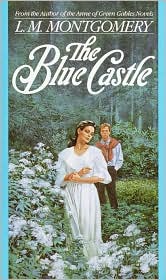
Blue Castle (1926)

The Blue Castle. L.M. Montgomery. 1926. 218 pages.

If it had not rained on a certain May morning Valancy Stirling's whole life would have been entirely different. She would have gone, with the rest of her clan, to Aunt Wellington's engagement picnic and Dr. Trent would have gone to Montreal. But it did rain and you shall hear what happened because of it.

The Blue Castle is a giddy-making romance by one of my favorite authors, L.M. Montgomery. I LOVE so many of Montgomery's books, but this one is one of my favorite favorites. One of those perfectly perfect books. For readers who don't appreciate old-fashioned, sweet romances, it may not be exceptional. But for me, it is near perfect! 

Valancy Stirling is the heroine. An uncomfortable birthday is approaching, and she's never been in love, never even come close to falling in love. She hates the teasing she receives from her family because of her unmarried status. Hates it not only because it's rude, but because she longs for love, and aches for a happily ever after. She hates how everyone takes her for granted, how no one ever shows her any real consideration.

So one day Valancy decides to go to a doctor--a man who was not the official family doctor--with her symptoms of heart pain and palpitations. A family emergency calls the doctor away before he can share his diagnosis with her, but a letter arrives in the mail a few days letter, a letter with shocking news. SHE IS DYING. There are two things Valancy decides: 1) she will never, ever tell her family the news and 2) she will make all her own decisions and will start LIVING each day as if it were her very last.

The change in Valancy is oh-so-sudden and oh-so-shocking. The new Valancy has a voice, a loud voice, and a rebellious spirit. She will do things her way from now on. One of the first decisions she makes is that she will nurse a dying relative, Cissy, who is in disgrace with the family. She will keep house for "Roaring Abel." It is in her new position that she first meets Barney Snaith. And it is LOVE. The old Valancy would never have met him, would never have dared talk to him, but the new Valancy? Well, she has NOTHING to lose! So the two become friends--good friends. After Cissy's death, Valancy decides to take a big risk:
"I thought I'd run down and ask if there was anything I could do for you," said Barney.
Valancy took it with a canter.
"Yes, there is something you can do for me," she said, evenly and distinctly. "Will you marry me?"
For a moment Barney was silent. There was no particular expression on his face. Then he gave an odd laugh.
"Come, now! I knew luck was just waiting around the corner for me. All the signs have been pointing that way today."
"Wait." Valancy lifted her hand. "I'm in earnest--but I want to get my breath after that question. Of course, with my bringing up, I realize perfectly well that this is one of the things 'a lady should not do.'"
"But why--why?"
"For two reasons." Valancy was still a little breathless, but she looked Barney straight in the eyes while all the dead Stirlings revolved rapidly in their graves and the living ones did nothing because they did not know that Valancy was at that moment proposing lawful marriage to the notorious Barney Snaith. "The first reason is, I--I"--Valancy tried to say "I love you" but could not. She had to take refuge in a pretended flippancy. "I'm crazy about you. the second is--this."
She handed him Dr. Trent's letter.
Barney opened it with the air of a man thankful to find some safe, sane thing to do. As he read it his face changed. He understood--perhaps more than Valancy wanted him to.
"Are you sure nothing can be done for you?"
Valancy did not misunderstand the question.
"Yes. You know Dr. Trent's reputation in regard to heart disease. I haven't long to live--perhaps only a few months--a few weeks. I want to live them. I can't go back to Deerwood--you know what my life was like there. And"--she managed it this time--"I love you. I want to spend the rest of my life with you. That's all." (127, 128)
Will Barney say yes?! Will Valancy have her one happy year of real living, of JOY?

I adore this book! I love the romance. I love the characterization. I love the descriptive writing!

Favorite quotes:
Valancy never persisted. She was afraid to.
They never knew that Valancy had two homes--the ugly red brick box of a home, on Elm Street, and the Blue Castle in Spain. Valancy had lived spiritually in the Blue Castle ever since she could remember...
Reality pressed on her too hardly, barking at her heels like a maddening little dog.
Dr. Trent was over seventy and there had been rumours that he meant to retire soon. None of the Stirling clan had ever gone to him since he had told Cousin Gladys, ten years before, that her neuritis was all imaginary and that she enjoyed it. You couldn't patronise a doctor who insulted your first-cousin-once-removed like that--not to mention that he was a Presbyterian when all the Stirlings went to the Anglican church. But Valancy, between the devil of disloyalty to clan and the deep sea of fuss and clatter and advice, thought she would take a chance with the devil.
Fear--fear--fear--she could never escape from it. It bound her and enmeshed her like a spider's web of steel.
"Fear is the original sin," wrote John Foster. "Almost all the evil in the world has its origin in the fact that some one is afraid of something. It is a cold, slimy serpent coiling about you. It is horrible to live with fear; and it is of all things degrading."
"'If you can sit in silence with a person for half an hour and yet be entirely comfortable, you and that person can be friends. If you cannot, friends you'll never be and you need not waste time in trying.'"

© 2013 Becky Laney of Becky's Book Reviews

Tuesday, April 16, 2013

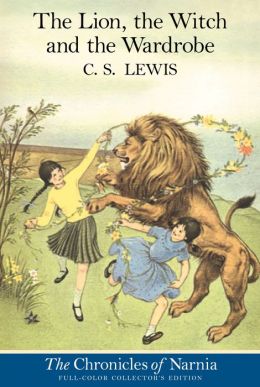
The Lion, The Witch, and The Wardrobe (1950)

The Lion, The Witch, and The Wardrobe. C.S. Lewis. 1950. HarperCollins. 224 pages.

Once there were four children whose names were Peter, Susan, Edmund, and Lucy. This story is about something that happened to them when they were sent away from London during the war because of the air-raids.

The Lion, The Witch, and the Wardrobe is one of my favorite, favorite children's books. Lucy Pevensie is one of my favorite, favorite heroines. And I love and adore this oh-so-delightful fantasy-adventure novel.

It is THE FIRST book in the Chronicles of Narnia series. It is the only book worthy of being considered as THE FIRST book in the series.

In The Lion, the Witch, and The Wardrobe, four children are sent into the country during World War II. Peter, Susan, Lucy, and Edmund are just beginning to settle into their new home when Lucy stumbles into the magical world of Narnia. At first, Lucy is the only one. But Edmund also comes into Narnia before the others. And while there he is fooled by the "Queen" of Narnia. But Narnia soon sees all four children.

Narnia is not a land at peace. Not at all. For the land is under a spell--an enchantment--the White Witch--the supposed Queen of the land--has made it always winter and never Christmas. And the lives of the children--all four children--are in grave danger when they're in Narnia. For there is a prophecy that four humans--two sons of Adam and two daughters of Eve--will come to rule the land as Kings and Queens and restore peace and order to the kingdom. The children's journey to Narnia, their quest to meet Aslan at the Stone Table, and their battle to save Narnia and their brother from the grasp of the evil and wicked witch....are unforgettable adventures that deserve to be experienced again and again by readers of all ages. You're never too old to experience the magic of Narnia.

While the movie depicts them as being doubtful and regretting setting foot in Narnia and shows them wanting to go home all the time and leave the fighting for others to do, the book tells a different story.
The children are mostly welcoming to the adventure before them. The book perhaps has less drama, the adventure seems to go smoother at times. The movie adds SO MUCH INTENSITY whenever possible. Dramatic scenes are added throughout, sometimes keeping in full spirit with the book, other times not so much. There are things that I absolutely LOVE AND ADORE about the film. (One of my favorite, favorite scenes, for example, is the meeting between Lucy and Mr. Tumnus. The film gets it so right!!!) I LOVE AND ADORE the entrance to Narnia and the first impressions of this strange-but-lovely world. And there are so many things about the movie that are just charming and just about perfect. (I think the soundtrack is just about perfect!!!) The movie doesn't just add drama, humor is added as well, especially with Mr. and Mrs. Beaver. The film deviates from the book in places so that it can be a good movie. Lewis did not waste time spend time writing battle scenes or strong confrontations. The focus is on the characters and the ultimate outcome, and not necessarily how every little thing worked towards that end.

I love The Lion, The Witch, and The Wardrobe for the characters, for the writing, and for the world-building. Narnia is not always a safe place to be, but I always found it beautiful and inviting, always memorable. I always found Aslan to be quite interesting as a character! I loved hearing the other characters talk about him and interact with him. I especially love seeing Lucy with Aslan! Their relationship is perhaps the strongest or deepest. Perhaps I feel that way because Lucy is the one who gets the most time with him throughout the whole series.

I had read the book dozens of times before seeing the movie, but I'm curious if the book would make the same impression, resonate the same way, if one watched the movie first?

Favorite quotes:
And now a very curious thing happened. None of the children knew who Aslan was any more than you do; but the moment the Beaver had spoken these words everyone felt quite different. Perhaps it has sometimes happened to you in a dream that someone says something which you don't understand but in the dream it feels as if it has some enormous meaning--either a terrifying one which turns the whole dream into a nightmare or else a lovely meaning too lovely to put into words, which makes the dream so beautiful that you remember it all your life and are always wishing you could get into that dream again. It was like that now. At the name of Aslan each one of the children felt something jump in its inside. Edmund felt a sensation of mysterious horror. Peter felt suddenly brave and adventurous. Susan felt as if some delicious smell or some delightful strain of music had just floated by her. And Lucy got the feeling you have when you wake up in the morning and realize that it is the beginning of the holidays or the beginning of summer.
“Safe?” said Mr. Beaver; “don’t you hear what Mrs. Beaver tells you? Who said anything about safe? ‘Course he isn’t safe. But he’s good. He’s the King, I tell you.”
“If there's anyone who can appear before Aslan without their knees knocking, they're either braver than most, or else just silly.”

© 2013 Becky Laney of Becky's Book Reviews
Thursday, April 11, 2013

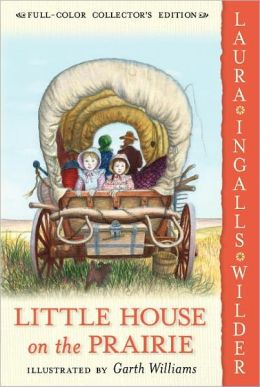
Little House on the Prairie (1935)

Little House on the Prairie. Laura Ingalls Wilder. 1935. 335 pages.

 Little House on the Prairie is such a dramatic read, especially when compared with the first in the series, Little House in the Big Woods. The first half of the novel focuses on the Ingalls family journeying to Kansas (Indian Territory). It's a trip filled with MANY dangers. (When Jack becomes lost in the river and the worst is feared, well, it's hard to handle.) Even after they settle into their new place, things stay messy. At one point, the whole family becomes horribly ill, all at the same time. If not for kind neighbors (distant neighbors) checking on them because the illness is widespread, then they might all have died.

Their new home doesn't ever quite feel like home, doesn't feel right. And as tensions between white settlers and the Native Americans increase with each chapter, it's upsetting. It's quite a relief, in a way, to see them [the Ingalls] go.

If I were to judge the entire series by this one book, I'm not sure the series would be among my favorites. While there was a happy peacefulness to the first novel, this book is anxious, dramatic, full of tension and uncertainty. There isn't the assurance that everything will always work out well. (Though that could be Laura as the narrator growing up a little.) I think the novel does a good job showing Laura's unease. Laura is thoughtful and curious--at times--always observant. That doesn't mean Laura is wise or always right. (In one instance, if Laura had done what she felt to be right, things would have gone very, very wrong.) 

Of course one of the main conflicts of the book is the tension between the white settlers and the Native Americans. The way that it is presented while historically accurate and socially acceptable for the times (both the 1870s and the 1930s) can prove problematic for modern readers. My first review covers this aspect of the novel. Little House on the Prairie is not the only problem novel from the time period. Not all books in the series are equally offensive.

© 2013 Becky Laney of Becky's Book Reviews
Wednesday, April 10, 2013

Little House in the Big Woods (1932)

Little House in the Big Woods. Laura Ingalls Wilder. 1932. 238 pages.

It's been almost five years since I last read the Little House books by Laura Ingalls Wilder. These are pure comfort reads. Though not every single book in the series is equally satisfying. I've never finished Farmer Boy, for example.

Little House in the Big Woods is an enjoyable, nostalgic read celebrating "the good life" of a young family. It is a way of life being celebrated or remembered. The focus is just on much on how Ma and Pa used to do things, as it is on the characters themselves.

Attention and detail given to preparing for all seasons of the year, washing, cleaning, cooking, baking, hunting, storing and saving for winter months, celebrating with family and extended family, etc. In the first chapter alone, the reader learns the joys of smoking venison and playing with a pigs' bladder not to mention the how-to's of making head cheese. Each episode, each observation offers the reader a window into the past. Some things have changed--and changed a lot--other things have remained the same. One of the things that resonates in this book--in this series is the love and joy of family life. Pa. Ma. Mary. Laura. Carrie. Each are part of the family. Each are important, valued, loved. The relationship of Laura with her parents and Laura with her sisters and Laura with her beloved dog, Jack, are timeless.

© 2013 Becky Laney of Becky's Book Reviews