Wednesday, January 21, 2026
9. The Running Man
9. The Running Man. Stephen King (writing as Richard Bachman). 1982. 317 pages. [Source: Library]
First sentence: She was squinting at the thermometer in the white light coming through the window. Beyond her, in the drizzle, the other highrises in the Co-Op City rose like the gray turrets of a penitentiary.
Premise/plot: Ben Richards enters the games out of desperation. His young daughter is sick and the family who is already struggling to pay for the barest of bare necessities cannot afford to get her medical help. He may not be of much worth to his family as he is, but if he entered the games then there's a chance his death may help his family just enough. And, of course, he may beat all odds--unlikely--and bring home money as well. It's an option that he feels is his one and only option.
The book is set in the bleakest of bleak dystopian worlds. The games on Free-Vee offer entertainment amidst the bleakity-bleakness of life. BUT they are anything but fun.
Ben Richards agrees to the rules of the game. He'll send in TEN MINUTES OF VIDEO FOOTAGE per day while being hunted by those professionals IN the game and those outside the game. There's a reward for ANY person reporting his whereabouts. There is no continual surveillance. There is not a studio where this game is filmed. He can literally GO anywhere in the world--so long as he can manage his own way around.
This is a game of strategy and some luck.
My thoughts: I saw the movie from the 1980s recently. This book is absolutely NOTHING at all like it--not even a little bit. Two or three names are the same, perhaps. Do not expect the book to be like the movie.
I didn't love the movie, so I was happy to see the differences. That being said, the first two-thirds of this one was a bit on the slow side. I joked with my best friend that it was 80% hiding and 20% running. And I wasn't wrong--at that point in the book. The ending IS fast-paced. You reach a point where it is ALL thriller-action-intensity.
© 2026 Becky Laney of Becky's Book Reviews
Wednesday, December 09, 2020
149. Fire Watch
Fire Watch. Connie Willis. 1982. 26 pages. [Source: Online]
Fire Watch was first published in a magazine-- Isaac Asimov's Science Fiction Magazine, Feb 1982, and is reprinted in the collection Fire Watch (first published by St Martin's Press in 1985), and won the 1982 Nebula and 1983 Hugo awards for best novelette. It can be read online.
My review of Fire Watch--the short story collection--was posted in 2012.
First sentence: September 20 - Of course the first thing I looked for was the fire watch stone. And of course it wasn't there yet. It wasn't dedicated until 1951, accompanying speech by the Very Reverend Dean Walter Matthews, and this is only 1940. I knew that. I went to see the fire watch stone only yesterday, with some kind of misplaced notion that seeing the scene of the crime would somehow help. It didn't.
Premise/plot: Mr. Bartholomew, a student historian, is sent to St. Paul's to serve in the Fire Watch at St. Paul's in 1940. His practicum was supposed to have him traveling with St. Paul--not visiting St. Paul's during the Blitz. His roommate, Kivrin, has been there, done that. Her practicum didn't go as planned either. But she urges him to give Dunworthy a chance--not to hate his guts just because of a mix up.
Initially he struggles A LOT with his time travel assignment. It is hard work--harder when you are out of your element and unprepared for the culture shock and how to go about fitting in with the locals. But soon he finds himself CARING deeply and passionately about St. Paul's--determined to protect the cathedral from going up in flames because of bombs--and the people he's meeting. The past becomes all too real for him--way more than just statistics, numbers, facts.
My thoughts: I believe this technically is the first work within Willis' futuristic world where historians LEARN the past first hand--up close and oh-so-personal--via time travel. The character of Kivrin is revisited in 1992's Doomsday Book. Her story may occur before this novella. But the world has developed-grown-shifted a bit when her story is revisited. Kivrin's character isn't developed all that deeply in Fire Watch. Mr. Dunworthy has evolved as well.
The page numbers for the quote below come from the paperback edition I reviewed previously. As I mentioned I read it this time online.
There are no guidelines for historians, and no restrictions either. I could tell everyone I'm from the future if I thought they would believe me. I could murder Hitler if I could get to Germany. Or could I? Time paradox talk abounds in the history department, and the graduate students back from their practica don't say a word one way or the other. Is there a tough, immutable past? Or is there a new past every day and do we, the historians, make it? And what are the consequences of what we do, if there are consequences? And how do we dare do anything without knowing them? Must we interfere boldly, hoping we do not bring about all our downfalls? Or must we do nothing at all, not interfere, stand by and watch St. Paul's burn to the ground if need be so that we don't change the future? All those are fine questions for a late-night study session. They do not matter here. I could no more let St. Paul's burn down than I could kill Hitler. No, that is not true. I found that out yesterday in the Whispering Gallery. I could kill Hitler if I caught him setting fire to St. Paul's. (12-13)
I am looking forward to rereading all the time travel adventures. I am over halfway through a reread of The Doomsday Book.
© 2020 Becky Laney of Becky's Book Reviews
Wednesday, August 29, 2018
The Day They Came To Arrest The Book
First sentence: "He's going to be right inside the door," Luke said to Barney as they neared the entrance to George Mason High School. "He's going to be standing there with that big phony smile and that chocolate voice."
Premise/plot: When a history teacher assigns The Adventures of Huckleberry Finn to her class to read, the book is challenged by angry parents. Will the book "be arrested" and removed from the reading list AND the school library? Or will the book remain available to students freely and without restrictions? Whose side is the principal on?
My thoughts: The Day They Came To Arrest The Book is a thousand and one times better than The Property of the Rebel Librarian. Primarily because it is more believable--both characters and situations. It is also more thought-provoking.
I appreciated the diverse opinions expressed in The Day They Came to Arrest The Book. The opinions cover a wide spectrum of thought. Perhaps with the exception of the unprincipled principal there are no villains, no bad guys. There are differences of opinion, yes, but no "good" guys and no "bad" guys. Not all opinions are informed opinions. But many are. That is, many people with strong opinions who are speaking up--on both sides--have actually read the book in question in its entirety. A few people have strong opinions and loud voices but haven't actually read the book--just bits and pieces. I think it's important to see that two good people can have differences of opinion.
What makes the principal so unprincipled? He's a sneaky guy. He does not want to fill out forms and paperwork. He doesn't want to go through the proper channels when it comes to book challenges. He'd rather pressure the teacher or the librarian into voluntarily removing the book with no fuss and no publicity. Because of his powerful position, because they fear losing their job, many go along with his "suggestions" that aren't really suggestions. But not this history teacher and not this librarian. The guidelines are in place and they will be followed...this time at least.
The book offers much food for thought--not only about banned books and censorship but also intellectual freedom in general. One of the arguments in the book is that it should be up to educators to choose wisely what to make available to their students. What to teach in their classrooms. What to have available in their libraries. Just because a book is published doesn't mean that it belongs in a school. The opposition claims that this 'choosing wisely' is a form of censorship. That to 'choose wisely' is limiting the student body's freedom to choose.
Personally, I think it makes the most sense. So long as school budgets are limited, it just makes the most sense to spend wisely and thoughtfully. I'll clarify that a tiny bit. Audience is key. Knowing your specific audience. A school librarian should have some idea on what students need, what students want, what teachers need, what teachers want. They should know which authors are popular and stay in circulation. They should know which genres circulate best. They should also read widely themselves. Quality should matter. That is what I mean by spending wisely. Making the most of each dollar. I don't mean that librarians should only buy books that they personally love, love, love and are custom-fit to their tastes and preferences.
One of the examples in the book is the hypothetical question: should a school library buy books written from the perspective that the holocaust never happened? Or should a library keep such 'trash' out of the library. Yes, such books exist--and others like them. But should a school library spend money on books like that because students should have the freedom to decide for themselves what is true and what is a lie?
I would classify this one as a YA book. Readers should know that it does use the n-word a lot in the context of discussing The Adventures of Huckleberry Finn. There are many times when Twain's novel is quoted. The novel also contains blasphemy--taking the Lord's name in vain. In terms of profanity it reminds me of Fahrenheit 451. The book is well worth reading in my opinion.
Quotes:
Show me a book that offends no one, and I will show you a book that no one, in the whole history of the world, has ever willingly read. (34)
You know, it's never the book that's really on trial. It's the author, even if he's dead. Remember that, Barney. Every time this sort of thing happens, it's a person who's being tried. For his ideas, his feelings, his memories, his fantasies, his yearnings, his language, which is his very self. To tell you the truth, I don't care what the book is. I hate to see words on trial. (83)
Once you give people, any group of people, the power to censor books, you're opening up quite a can of worms. And sooner or later, they can turn on you. (107)
© 2018 Becky Laney of Becky's Book Reviews
Thursday, April 05, 2018
Zucchini
First sentence: Zucchini was born in the rodent house at the Bronx Zoo. When he was six weeks old, the rodent man put him in a cage of his own, separating him from his mother. It was time for him to be independent.
Premise/plot: Zucchini is a black-footed ferret who longs for freedom and a home of his own choosing. Will he get his happily ever after? Billy is a young boy, a shy boy, who needs to find his own place to belong.
My thoughts: I have a love/hate relationship with animal fantasy. I was hoping that Zucchini would not be another Stuart Little. I wanted--needed--a good, solid ending that had a point. I was satisfied with both stories.
Billy had always been shy. At least that's the way it had been for as long as he could remember. Sometimes, when he had nothing better to do, he would try and figure out what it was that had started the shyness, or when it was that it started, but he couldn't remember. His teachers at school said it was because Billy's parents were divorced. They had been divorced two years, and Billy lived with his mother and stepfather. His real father was an actor in Los Angeles, California, and Billy didn't get to see him very much.I love how Billy's love for Zucchini pushes him out of his comfort zone and he learns that he can be okay, that he can talk to strangers, that he can speak up and speak out. I love how friendship changes Zucchini and he realizes that some things are more important than independence.
It's hard getting used to a stepfather," Billy's teachers would say. "That's why William is withdrawn."
Billy didn't like being called William, and he didn't think his teachers were right, not completely right anyway. He remembered always liking to be quiet. Even as a tiny boy there was so much to look at and listen to, so much to understand. Too much talking got in the way. (42)
© 2018 Becky Laney of Becky's Book Reviews
Sunday, December 11, 2016
Merry Christmas Mom and Dad
First sentence: I wanted to make Christmas very special, just for you, so I made a Christmas wreath. I wanted to decorate some Christmas cookies just for you, but I couldn't stop tasting them. I wanted to find a Christmas present just for you, but there were too many toys to look at.
Premise/plot: Little Critter tries really hard to make Christmas really, truly special for his Mom and Dad. But, as you'd expect, things don't always go according to plan. Is it the thought that counts?!
My thoughts: I love and adore Little Critter. I loved this one cover to cover. My favorite: "I wanted to wrap the baby's present just for you, but the tape was too sticky." It is a fact, by the way, that I was banned from using tape!
Text: 5 out of 5
Illustrations: 4 out of 5
Total: 9 out of 10
© 2016 Becky Laney of Becky's Book Reviews
Monday, June 13, 2016
The BFG
First sentence: Sophie couldn't sleep.
Premise/plot: Sophie, an orphan, is "kidnapped" one night by a giant--a Big Friendly Giant. He's not interested in eating her, though there are nine other giants who love, love, love to munch and crunch on human beans. He has taken her with him because she has seen him, and he doesn't want any human beans to know that giants are real. He disapproves of the other giants, but, wants the existence of giants to be kept secret. Will Sophie help him see things differently?
My thoughts: I really, really enjoyed this one. I also liked the dream gathering and dream giving aspect of this one. The BFG was just so much fun to spend time with. I can see how mood might play a big role in this one. If you're not in the right mood to enjoy the silly craziness, then the giant's horrible grammar might be much too much for you to tolerate. It does have a lot of made up words in it. Personally, it worked for me!
Here's a quote: "Here is the repulsant snozzcumber!" cried the BFG, waving it about. "I squoggle it! I mispise it! I dispunge it! But because I is refusing to gobble up human beans like the other giants, I must spend my life guzzling up icky-poo snozzcumbers instead. If I don't, I will be nothing but skin and groans." (45)
© 2016 Becky Laney of Becky's Book Reviews
Saturday, March 12, 2016
Skinnybones
Did I enjoy reading Barbara Park's Skinnybones, a middle grade novel originally published in 1982? Yes and no. First, as is obvious, I am not the target audience for this one. I am not in elementary school. I am not a boy. My sense of humor isn't that of a sixth grade boy. Also, I have absolutely no interest in baseball, or, in reading books about baseball. I didn't exactly want to like Alex Frankovitch, the hero nicknamed Skinnybones. But. At times I found myself liking him despite his obnoxious, attention-seeking ways.
Here are a few things you should know about Alex:
1) He has played little league for a good many years, but, he is horrible, absolutely horrible at baseball. I'm not sure *why* he keeps playing baseball when he's so bad at it. Perhaps he *likes* playing baseball, or, maybe he likes being part of a team. Perhaps his parents make him stay in baseball. Maybe he's afraid that by not playing baseball the other boys will think him strange, different, etc.
2) He loves, loves, loves attention. If he can focus the attention in on himself and make others laugh, then, he'll do it--no matter the situation. He can be very inappropriate, very loud, very annoying. The kids sometime laugh, usually laugh, his teachers and parents--hardly ever.
3) He hates one of his classmates and is in fierce competition with him. This is the focus of 90% of this book. The other kid, of course, is BRILLIANT at baseball.
I am glad there are books like Skinnybones being published--or republished. I am happy to recommend books like this to their target audience!
© 2016 Becky Laney of Becky's Book Reviews
Saturday, November 07, 2015
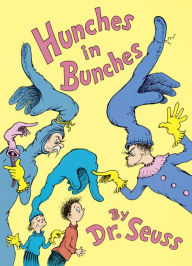
Seuss on Saturday #45
First sentence: Do you ever sit and fidget when you don't know what to do...? Everybody gets the fidgets. Even me and even you.
Premise/plot: A young boy has a terrible time deciding how to spend his time that day. Readers meet dozens of creatures called hunches. One hunch, for example, might be telling him to PLAY OUTSIDE while another hunch is telling him he should do his homework, while yet another hunch is telling him to go to the bathroom. Every few minutes readers meet ANOTHER hunch with another suggestion of what James should be or could be doing with his time.
My thoughts: I like the idea of this one better than the actual book. Some days are like that, in my opinion. And the book is easy to relate to in a few places. (Like the nowhere hunch who has him walking in circles.) But overall, it wasn't a satisfying, enjoyable read. I liked it okay. But it didn't wow me.
Have you read Hunches in Bunches? Did you like it? love it? hate it? I'd love to know what you thought of it!
If you'd like to join me in reading or rereading Dr. Seuss (chronologically) I'd love to have you join me! The next book I'll be reviewing is The Butter Battle Book.
© 2015 Becky Laney of Becky's Book Reviews
Sunday, June 07, 2015
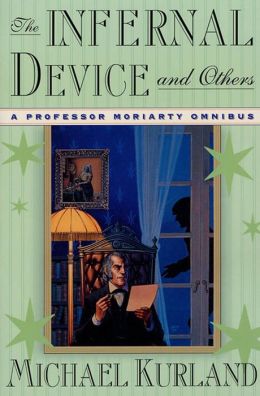
Meet Professor Moriarty
I'm caught up on watching Sherlock, but, far from caught up on reading Sherlock--original Sherlock especially. Still when I saw that Moriarty had his own series, well, I had to check it out from the library. In The Infernal Device readers meet Professor Moriarty and his journalist employee, Barnett. (Moriarty having recently "rescued" Barnett from an Eastern prison and certain death--he was framed for murder--he's in Moriarty's debt--or employ--for two years.) How does Barnett like Professor James Moriarty? He admires him, respects him, enjoys his company. Does Barnett see the "real" Moriarty? Or is Moriarty keeping his darker side from his new friend and employee? Certainly Moriarty is aware that there are a handful of people--namely Sherlock Holmes--who thinks Moriarty is pure evil. But convinced, Barnett is not! Holmes does make a handful of appearances in this one. In fact, to solve the mystery, they may have to join together temporarily to save the monarchy.
Readers spend time with both men as the mystery unfolds. The Infernal Device is a mystery with plenty of politics and action. Did I love it? Well, if I didn't love, love, love it, I certainly LIKED it well enough.
Death by Gaslight. Michael Kurland. 1982. 279 pages. [Source: Library]
I also enjoyed reading the second in the series, Death by Gaslight. While I didn't rush through it like I did Infernal Device, I found it mostly compelling. It is set two years after The Infernal Device. Barnett has finished--just finished--his "required" time working for him, but, he has no thoughts of leaving Moriarty's service. He's enjoying himself much too much. Life is rarely boring, and, he's even had time to fall in love...
Can Moriarty catch a serial killer? Someone is killing aristocratic gentleman--in their homes, in locked rooms. With only a few clues, can he solve the mystery, find the killer, and see that justice is done? Can he do a better job than the police? a better job than Sherlock Holmes? Perhaps. Especially since Holmes spends nearly the entire book absolutely convinced that Moriarty is behind each and every murder.
I enjoyed this one too. I look forward to reading more books in this series at some point.
© 2015 Becky Laney of Becky's Book Reviews
Wednesday, March 04, 2015
The Last Jews in Berlin
The Last Jews in Berlin was a good read. It was oh-so-close to being a great read every now and then. What I loved about this one were the personal stories. These stories were the heart of the book. Readers get to meet dozens of people and follow their stories. As you can imagine, these stories can be intense.
Instead of telling each person's story one at a time, one after the other, the book takes a more chronological approach. The book is told in alternating viewpoints. Is this for the best? On the one hand, I can see why this approach makes it more difficult for readers to follow individuals, to keep track of each person's story. Just when you get good and attached to a certain person's narrative, it changes. It takes a page or two perhaps before you reconnect with the next narrator and get invested in that unfolding story. On the other hand, telling the story like this sets a certain tone, increases tension and suspense, and avoids repetition. So I can see why it makes sense. The method of storytelling didn't bother me.
Probably the one thing I learned from reading this is that there were Jews working with the Nazis and turning other Jews in. That there were Jews betraying one another trying to survive. One simply didn't know who to trust.
At the same time, the book shares stories of people who were trustworthy, people who were willing to risk their own lives to help Jews. Life was hard for everyone: but some were willing to share their food and open up their homes at great risk. The book did show that not every person supported the Nazis and their philosophy. There were people who disagreed and were willing to do the right thing.
It's an emotional book, very intense in places.
© 2015 Becky Laney of Becky's Book Reviews
Wednesday, December 26, 2012
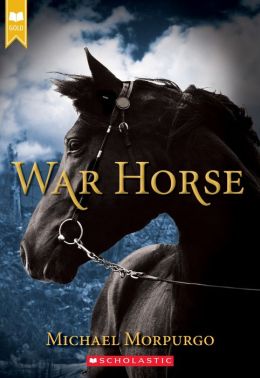
War Horse (MG/YA)
This one surprised me. I didn't expect it to be so good, so compelling. After all, I don't "like" horse books. But. This little book is narrated by a horse named Joey. We get a glimpse of his life before--before he became a war horse, sent to Europe as part of a cavalry unit of British soldiers. We meet the son of his first owner, Albert, a boy who LOVES him oh-so-much, a boy who would do just about anything and everything for "his" horse. Joey is sold to the army because of the family's need for money. Albert is distressed, and Joey has to adapt for better or worse. But life does go on...readers get a glimpse of World War I as seen through the eyes of a horse. And it is an ugly, ugly mess. But the book, as a whole, is not as depressing as it might have been. That's not to say it's a cheerful book, but, it has many redeeming qualities. I love Joey's resilience; I love Albert's determination. There are some sad, brutal moments, but, it felt genuine and authentic--not manipulative.
Read War Horse
- If you like horse books
- If you don't like horse books
- If you like historical fiction set around World War I
© 2012 Becky Laney of Becky's Book Reviews
Thursday, September 27, 2012
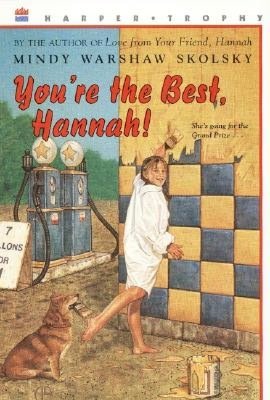
Hannah and the Best Father of Route 9W (MG)
Hannah sat in her secret place at the top of the mountain and looked down at the Hudson River. Her dog Skippy sat beside her.
I have not read Mindy Warshaw Skolsky's Hannah series in order, but that hasn't stopped me from enjoying each and every one. My favorite is still Love From Your Friend, Hannah. I've also read Hannah Is A Palindrome. My most recent read is Hannah and the Best Father of Route 9W.
I love Hannah, I do. In this book, Hannah and her Dad are in similar situations. Her Dad is super-excited but still quite anxious. He has spent a lot of time repainting the Grand View restaurant. He's spent a lot of time painting shingles blue and yellow. He's got a whole theme going, and he's really hoping that the judges will love it too. For he wants to win the most attractive restaurant on Route 9W certificate. Sure, he's happy to have been awarded the cleanest restaurant last year, but this year he wants to win in the category he wants to win in. Hannah's just as excited and anxious as her father is about the judging, but, she's also excited about a dog show at the local movie theater. When things don't go as planned for this father and daughter, well, life lessons are learned and ice cream is eaten!
This book also features a visiting Aunt Becky who has brought her knitting needles and guess-whats for the entire family! Readers also learn that Aunt Becky loves opera. Hannah's father loves it too--but not in quite the same way. Hannah is NOT a fan, she'd rather listen to Let's Pretend on the radio.
Curious about Let's Pretend, you can listen online to some of the programs! The episode in this novel is 12 Dancing Princesses. Having listened to it, I can see why it is her favorite episode!
I loved Hannah. I loved her parents. I loved Aunt Becky. I loved how the book shows how each family member deals with stress, frustration, anxiety, and disappointment. The characterization is great in these books. I also love the historical detail.
Read Hannah and the Best Father of Route 9W
- If you are looking for a great heroine to love; read any of the Hannah books
- If you are a fan of Mindy Warshaw Skolsky
- If you like historical children's books set in the early-to-mid 1930s
© 2012 Becky Laney of Becky's Book Reviews
Monday, November 14, 2011
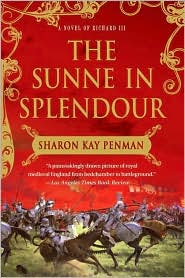
The Sunne in Splendour
First sentence: Richard did not become frightened until darkness began to settle over the woods.
The Sunne in Splendour is one of the best books I read all year. I started it in July and finished in October: I loved almost every minute of it. This historical novel is just a wonderful, wonderful read. Is it for every reader? At over 900 pages? Probably not. But ANY reader who loves historical fiction, this book is a true must read.
So this novel is about the man who became Richard III. The novel follows him through the decades of his life. And it was quite a dangerous life because of who he was, who his family was. He was of the House of York. And Richard lost many, many family members during the war- for the throne. His brother was Edward IV--and he fought more than once for the throne, for the kingdom. And Richard was always loyal to his brother. Even when he thought his brother was making a few too many mistakes. Still, the two were surrounded by enough traitors, enough men who were ambitious and unwise.
If you're looking for historical romance--and ONLY historical romance--then The Sunne in Splendour might not be the best match for you. If you like historical fiction that has it all--a little politics, a little action, a little romance, a little mystery, a little drama--in other words a lot of life--than The Sunne in Splendour may just be for you.
I loved just about everything in The Sunne in Splendour. I thought the characterization was excellent. Penman did a great job in bringing these historical figures to life. And while there were many, many characters to follow, I wasn't overwhelmed. Same with the descriptions. Yes, the book is detailed, and yes, the book is descriptive, but I wasn't bored. The story, the characters, were just fascinating. Which is saying something since the ending won't be surprise to many! I loved seeing the different perspectives as well. This isn't only Richard's story. Though it is definitely told sympathetically towards Richard.
The Sunne in Splendour was one of those books I finished and knew that I would want to reread again (and again).
© 2011 Becky Laney of Becky's Book Reviews