Showing posts with label 2002. Show all posts

Monday, August 03, 2026

52. Prey


52. Prey. Michael Crichton. 2002. 507 pages. [Source: Library] [audio book, 5 stars, adult science fiction, adult thriller]

First sentence: Things never turn out the way you think they will.

Premise/plot: Jack Forman, our protagonist, is a stay at home dad. (Three kids, if my memory is correct). After losing his job because he was a whistleblower--or trying to be--he's been unable to get another job in his field. (He reported something unethical and dangerous not knowing the person he was reporting to was IN on the shady shady side of things). His wife, Julia, well she's SOMETHING. Perhaps she wasn't always so something. Maybe there was a time when she was loving, supportive, and a great mother. But we never see that side of her--not really.

Jack Forman finds himself at the center of a GREAT mystery. And it starts soon after a terribly horrible health scare with his youngest. Soon he's being asked by the people who fired him to "help out" and trouble shoot with code that he developed. BUT he soon finds that what they are NOT telling him could feel all the libraries in the world. And his creepy wife is at the center of it--for better or worse.

A science experiment has gone terribly, terribly, terribly wrong! And Jack Forman finds himself almost completely alone in trying to save the world.

My thoughts: Prey is my fourth Michael Crichton novel that I've read. I LOVED, LOVED, LOVED, LOVED IT. I listened to the audio narrated by Robert Sean Leonard. It was FABULOUS. I have a feeling I would have loved the story either way--in print or on audio. I COULD not stop reading this one.


© 2026 Becky Laney of Becky's Book Reviews

Friday, June 07, 2019

Death of Riley

Death of Riley. (Molly Murphy #2) Rhys Bowen. 2002. 336 pages. [Source: Library]

First sentence: "You want me to do what?" I demanded so loudly that a delicate young female walking ahead of us glanced back in horror and had to reach for her smelling salts. I burst out laughing.

Premise/plot: Molly Murphy, our heroine, is still determined to become a private investigator. True, she's never been trained or apprenticed. True, she lacks actual experience as a detective. True, she doesn't have money to start her own detective agency. But don't try to stop her from pursuing her dreams.

Miss Murphy DOES find a private investigator, a Mr. Riley. He agrees oh-so-reluctantly to hire her. Not because he believes she'll make a good actual assistant. But because his business is a complete and total disaster. She can help keep things clean and organized. She can make his job--his life--easier by doing so. If she happens to pick up a few little lessons on how things work here and there, that's okay by him.

But a few weeks later, Mr. Riley is found MURDERED. She's the one who finds his body in the office. Who could have killed him? Was he killed because of one of his open cases? Can Molly Murphy finish his few open cases? Can she more importantly still SOLVE THE MYSTERY OF WHO MURDERED HIM?!

She does find a new place to live in this one...and new characters are introduced...some old characters reappear.

My thoughts: This one was good but a bit silly. I mean I guess the first book had its silly moments too. But I was swept up so thoroughly in the first book that I never stopped to think about is this realistic? is this true to history? is this true to human nature? does this make sense?

I say that it's silly but that didn't mean I didn't enjoy it. I have every intention of going on with this series!


© 2019 Becky Laney of Becky's Book Reviews

Monday, February 18, 2019

Ruled Britannia

Ruled Brittania. Harry Turtledove. 2002. 576 pages. [Source: Library]

First sentence: Two Spanish soldiers swaggered up Tower Street toward William Shakespeare. Their boots squelched in the mud. One wore a rusty corselet with his high-crowned morion, the other a similar helmet with a jacket of quilted cotton. Rapiers swung at their hips.

Premise/plot: What if the English navy had not defeated the Spanish Armada in 1588? What if instead of Queen Elizabeth reigning in the year 1597 she was instead locked away in the Tower? Turtledove gives us alternate history in his novel Ruled Britannia. It is told primarily from two perspectives: William Shakespeare and Lope de Vega.

Shakespeare has a choice to make. Should he commit treason against Spain and write a play that could potentially help overthrow Spain's rule and restore Elizabeth to the throne? Or should he play it safe and write a play memorializing King Philip II of Spain? Perhaps he'll be crafty and do both....but which one will get performed upon the King's death?!

Lope de Vega is in awe of William Shakespeare. He can nearly always be found watching his plays, watching the actors on and off stage, hanging around and conversing. He's a soldier on a mission: be on the lookout for any treason, any subversive meanings in the plays he watches. Some higher ups are suspicious of Shakespeare--but not de Vega, not really. Shakespeare doesn't care who rules so long as he can write, right?!

My thoughts: I imagine that Ruled Brittania was an absolute joy to write. Turtledove claims--and I have no reason to doubt--that he repurposed many, many lines from actual Shakespeare plays into "new" Shakespeare plays in this alternate history. In addition to Shakespeare, he used other contemporary playwrights from the time to craft his new plays and dramas. He obviously felt it was important to bring Shakespeare to life--and so he relied on Shakespeare's own words to flesh out his character and his dialogue. Like William Shakespeare, Lope de Vega is a real historical figure--a Spanish playwright from this time period who--at least according to the author's note--sailed on the Spanish Armada and returned to Spain to have a successful career.

Did I enjoy reading it as much as Turtledove enjoyed writing it? Probably not. In fact, I found it MUCH too long--tedious even. I was interested in the bare bones of this one. I wanted to know WHAT happened overall--would Shakespeare's play about Boudica (alternate spellings Boudicca, Boadicea, Boudicea) rebelling against the Roman Empire happen? Would it be successful? Would Elizabeth reign once more?

There were dozens of characters that peopled this novel that I just did not care about at all--not even slightly. I imagine that some--perhaps many--were actual historical figures. I just didn't care. Perhaps if the author's note was placed FIRST, I might have tried to care harder. Perhaps if there was a list of characters--noting which were historical and which were fictional. Perhaps if there were footnotes indicating which lines came from which actual Shakespeare plays or noting the other sources used?

One thing I know without a doubt...the chapters were unreasonably LONG...insufferably long. "Short" chapters were around thirty-five pages long. WHY TORTURE READERS?! You take a perfectly good premise--an entertaining one--and practically do everything possible to drain all the enjoyment of actually reading it?!

© 2019 Becky Laney of Becky's Book Reviews

Friday, June 08, 2018

Bubba and Beau, Best Friends

Bubba and Beau, Best Friends. Kathi Appelt. Illustrated by Arthur Howard. 2002. Harcourt. 32 pages. [Source: Bought]

First sentence: Meet Bubba. Bubba is the son of Big Bubba and Mama Pearl. Right after Bubba was born, Mama Pearl wrapped him in his soft pink blankie and whispered into both of his soft pink ears, "I love you, Bubba Junior." She sighed. He was the perfect little Bubba.

Premise/plot: Bubba (the baby) and Beau (the puppy) are BEST friends. This picture book is written in small chapters. Each chapter written to perfection to highlight the awesomeness of Bubba, Beau, and their blanket. There are many good and happy days in Bubbaville, but this picture book chooses to include a very SAD day in Bubbaville as well. What will happen when Mama Pearl dares to WASH the blanket?!?!

My thoughts: Bubba and Beau, Best Friends has to be one of my absolute favorite, favorite, favorite picture books. It is perfectly perfect I tell you. I love the setting. (It is set in Texas.) I love the characters. I love the illustrations. (Now when I see Arthur Howard I think Mr. Putter and Tabby.) But most of all I love the words--the narrative flavor and flow.

One of my favorite quotes:
It didn't take long for Bubba and Beau to become best friends. For one thing, they both went around on all fours. They were both keen on chewing. Neither one was house-trained. And they could howl to beat the band. They also had a mutual affection for MUD. And a mutual disdain for soap. Sister, those two got along.
Honestly, I could quote the whole book. That's how much I love it. The best books become part of the fabric of our lives, become a part of ourselves. Even though I was an adult in 2002--in library school to be exact--this book is part of me.

Text: 5 out of 5
Illustrations: 5 out of 5
Total: 10 out of 10
 

© 2018 Becky Laney of Becky's Book Reviews

Wednesday, October 25, 2017

Among the Betrayed

Among the Betrayed. (Shadow Children #3) Margaret Peterson Haddix. 2002. 160 pages. [Source: Library]

First sentence: You were supposed to wake up from nightmares.

Premise/plot: Among the Betrayed is the third book in the fast-paced, action series by Margaret Peterson Haddix. This Shadow Children's novel doesn't focus on Luke--or Lee. The narrative shifts to a girl we met in the second book, Nina. What do we know about Nina from the last book? Well, she attends a girls school close to the school that Lee Grant attends. Nina is good friends with Jason. Lee overhears Jason talking about how he and Nina are getting ready to betray the students who are illegal and trying to pass using fake ids. Lee calls Mr. Talbot and tries to let him know what's going on without saying it in an obvious way. Among the Betrayed is Nina's story.

Nina is being held prisoner; but does she belong in prison? Is she guilty of a crime? Or has she been framed? Nina's loyalty is put to the test.

My thoughts: I am rereading this series. At first I didn't remember this narrative shift. You'd think I remembered that one whole book is narrated by someone else, but, I didn't. Then again, that isn't a big shock. I read a lot of books! I did like Nina. Within a few chapters, I was completely hooked to this one and enjoying it just as much as the previous two novels in the series.

© 2017 Becky Laney of Becky's Book Reviews

Friday, June 23, 2017

Piggy's Pancake Parlor

Piggy's Pancake Parlor. David McPhail. 2002. 48 pages. [Source: Library]

First sentence: Piggy grew up on a small farm just below the hilltop village of West Wee. He was the runt of a large litter of pigs. The farm was owned by Mr. and Mrs. Farmer Todd, who took Piggy in because he was weak and underfed.

Premise/plot: Piggy, a runt raised by a farmer and his wife, learns the family's secret recipe for making the BEST PANCAKES EVER. He goes into business with Fox and starts a pancake parlor. These two friends learn many, many things together as the business grows and their customers keep coming back for MORE, MORE, MORE.

My thoughts: I really enjoyed this one. It is an early chapter book: 48 pages in length, but nine chapters in total. It is illustrated. I love that the Fox--whom readers first meet IN a hen house stealing eggs--is not the automatic villain. I love that Piggy and his human parents are compassionate and generous. But my favorite FAVORITE aspect of this one was how they use Piggy's interest in TOY TRAINS in the restaurant--with mixed results!!! I loved the story, the characters, the writing.
© 2017 Becky Laney of Becky's Book Reviews

Saturday, May 06, 2017

Minerva Louise and the Red Truck

Minerva Louise and the Red Truck. Janet Morgan Stoeke. 2002. 32 pages. [Source: Library]

First sentence: Minerva Louise loved the red truck. It was one of her favorite places to play.

Premise/plot: Minerva goes on a ride and sees a lot of trucks at work as the world speeds by. Will her favorite truck remain her farmers' red truck?

My thoughts: I enjoyed this one. Minerva gets in the back of the truck, spots the toy box, table and chairs, and has herself a grand old time. The toy box is a tool box, the table and chairs a couple of clay pots. This one is a joy to read. Pure silliness at work.

Text: 4 out of 5
Illustrations: 4 out of 5
Total: 8 out of 10


© 2017 Becky Laney of Becky's Book Reviews

Thursday, April 27, 2017

Can You Guess My Name?

Can You Guess My Name? Traditional Tales Around the World. Judy Sierra. Illustrated by Stefano Vitale. 2002. 128 pages. [Source: Library]

First sentence from the introduction: Many of the world's folktales resemble one another in surprising ways, as anyone who hears them or reads them soon discovers.

Premise/plot: Judy Sierra has collected fifteen folktales from around the world. There are five sections (with three stories apiece): "I'll Blow Your House In!" "Just the Right Friends," "Can You Guess My Name?" "I Married a Frog," and "The Scary House in The Woods."

My thoughts: I enjoyed reading this book very much. While I can't say that I loved each story and each section equally, what I loved I really LOVED. My favorite story, without a doubt, was "The Three Geese" (Italy). IN a way, it reads like The Three Little Pigs, but, it stars geese not pigs. And it ends with a fabulous line: "and there they ate macaroni and lived happily." Another story I enjoyed was "Medio Pollito" (Argentina).
© 2017 Becky Laney of Becky's Book Reviews

Sunday, February 05, 2017

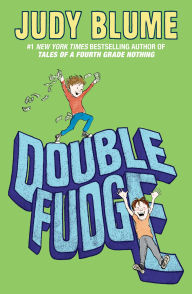
Double Fudge

Double Fudge. Judy Blume. 2002. 224 pages. [Source: Library]

First sentence: When my brother Fudge was five, he discovered money in a big way.

Premise/plot: Double Fudge is the fifth book in the Fudge series by Judy Blume. Peter's younger brother, Fudge, is OBSESSED with money in this one. And that love of money is fueling his selfishness, his greed, and his rudeness. (Not that he was super polite and selfless BEFORE discovering the green stuff. He wasn't. I'm not a reader who finds Fudge's misbehavior cute or charming or funny.) Peter is embarrassed by his brother. (That isn't new either. Peter has always tried to distance himself from Fudge.) So why is this one Double Fudge? Well, it turns out that Farley Hatcher isn't the only Farley! Peter's dad's cousin and his family are introduced in this one. And one of their children shares Fudge's first, middle, and last name. They are looking to "steal" Fudge's nickname. Peter calls this other Farley, "Mini." They meet their cousins on a trip in Washington D.C., the cousins then invite themselves to STAY with them in New York City. This family is something else. Think the Flanders' family perhaps from the Simpsons? Peter also starts seventh grade in this one....

My thoughts: Plenty happens in this one. (There's at least one chapter focused on Halloween.) And I did like it. But I'm not sure the series as a whole is so wonderful that it's a must-read. A little Fudge goes a long way. Also this one might be more for actual children than adults who read children's books. In other words, adults might see Fudge for who he is....and think about how the book in terms of good and bad parenting. Children might just laugh off Fudge and see him as comic relief.

© 2017 Becky Laney of Becky's Book Reviews

Sunday, January 22, 2017

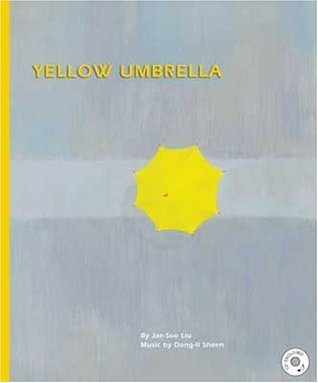
Yellow Umbrella

Yellow Umbrella. Jae-Soo Liu. Music composed by Dong II Sheen. 2002. Kane/Miller. 36 pages. [Source: Review copy]

Yellow Umbrella is a wordless picture book by Jae-Soo Liu that was first published in Korea. One umbrella becomes many, many umbrellas on a rainy day.

The message of the book, according to the author, is "whether they were boys or girls, fat or skinny, short or tall...under their colorful umbrellas, all those physical differences disappeared...It seemed to me that these children were claiming that they were all equal in spite of their physical differences." Readers can find their own meanings in this wordless book, however.

For me, when I "read" this one, what I get is a sense of JOY. The book seems to capture the love of life, the love of play.

The book includes a CD filled with music. The first track is seven minutes, and this is the intended soundtrack for the book. Track two, "Underneath the Sky," is the only music piece with lyrics included.
Everyone hold up your umbrella
Standing underneath the sky
Everyone -- with your umbrella
Listen to the rain
Tracks three through fifteen are expanded versions of the themes or segments from the main track.

If you enjoy piano music, art, or rainy days, this one is too fun to miss.

Music: 4.5 out of 5
Illustrations: 4.5 out of 5
Total: 9 out of 10


© 2017 Becky Laney of Becky's Book Reviews

Tuesday, July 26, 2016

The Hotel Mystery

The Hotel Mystery. (Whodunit Detective Agency #2) Martin Widmark. Illustrated by Helena Willis. 2002/2014. 80 pages. [Source: Library]

First sentence: Every year, on the day before Christmas Eve, nearly everyone in the little town of Pleasant Valley does the same thing: They all head to the holiday buffet at the town's hotel, where they find turkey, ham, roasted carrots, and mashed potatoes and gravy, all served on big platters in the beautiful dining room.

Premise/plot: Jerry and Maya are friends and classmates who formed the Whodunit Detective Agency. Over Christmas vacation, these two are working at the town's hotel. (Jerry's uncle works there.) The hotel is in great excitement because the hotel's best and most expensive suite has been rented out to a family, the Braeburn family. Making the new guests HAPPY is to be their top priority. But their stay is not uneventful, and before the book ends, Jerry and Maya will need to solve a crime.

My thoughts: This is the second book in the Whodunit Detective Agency series. It is an early chapter book with a lot of colorful illustrations. These mysteries are simple and straightforward. The characters aren't exactly complex and intriguing. But. I think for the intended age group, these mysteries are fine reading material.

© 2016 Becky Laney of Becky's Book Reviews

Monday, July 25, 2016

The Diamond Mystery

Diamond Mystery (The Whodunit Detective Agency #1). Martin Widmark. Illustrated by Helena Willis. 2002/2014. 80 pages. [Source: Library]

First sentence: The streets were empty in the little town of Pleasant Valley.

Premise/plot: Jerry and Maya are classmates and friends who have opened a detective agency out of Maya's basement. They live in the small, quaint town of Pleasant Valley. The book opens with Mohammed Caret hiring these two child detectives to find out who is stealing diamonds from his shop. Their cover will be that he has hired these two children to do some light cleaning and run a few errands for him. They meet the three employees that work for him. And after a day of close observation, they are ready to solve the case.

My thoughts: I liked this one. I did. It's an early chapter book. I'd say just about right for second graders. It's the first in a mystery series for children. It has been translated into English from the Swedish.

© 2016 Becky Laney of Becky's Book Reviews

Friday, January 29, 2016

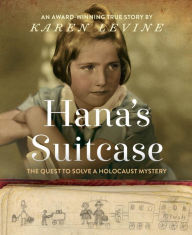
Hana's Suitcase

Hana's Suitcase. Karen Levine. 2002/2016. Crown Books. 144 pages. [Source: Review copy]

Would I recommend Hana's Suitcase by Karen Levine? Yes, yes, a thousand times yes. This would be a great introduction to the subject of the Holocaust for elementary students. (My first "Holocaust book" was The Hiding Place by Corrie ten Boom. Do you remember your first Holocaust book?) One reason why I think it would be a good fit for young readers is the way the subject is approached. It is unusual and unique. It is a story about children learning about the Holocaust for the first time. It is about the learning process--the research process as well.

Chapters alternate between the present and the past. The "present" story begins with an empty suitcase, "Hana's" suitcase. This is an object found in a Japanese Holocaust museum. The children--and the director--are eager to know WHO IS HANA? They know her birth date, that she was Jewish, that she ended up in a Nazi concentration camp. But who was she? what did she look like? what was her family like? what was her childhood like? What happened to her? Did she survive? Did she die?

The present chapters narrate this learning-process, this investigation. I love that it illustrates history-coming-to-life, how fun and exciting history can be, even how relevant and important it can be to ask questions, to be persistent, to follow leads, etc.

There are also chapters set in the past that tell Hana's story, and tell it almost from her point of view. Readers ultimately learn that much of this information came from her brother who did survive the war. Because the chapters alternate, readers will get the answers to some questions before the people in the book.

I liked how these two stories come together. This one is worth reading.

© 2016 Becky Laney of Becky's Book Reviews

Friday, November 20, 2015

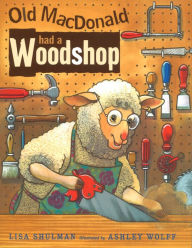
Old MacDonald Had A Woodshop

Old MacDonald Had A Woodshop. 2002. Penguin. 32 pages. [Source: Library]

First sentence: Old MacDonald had a shop, e-i-e-i-o! And in her shop she had a saw, e-i-e-i-o! With a zztt zztt here and a zztt zztt there, here a zztt, there a zztt, everywhere a zztt zztt. Old MacDonald had a shop, e-i-e-i-o.

Premise/plot: Old MacDonald and other animals from the farm are building something, and they are using lots of different tools. But what are they building? Can you guess before the big reveal?

My thoughts: Loved this one from the very beginning, and I do mean the beginning. The endpapers of this one are very fun! Readers see all HER tools hanging up in the shop. Each one clearly labeled. Some may be familiar to children, others may not be. Regardless, it sets a great mood for the book. Instead of celebrating animal sounds, this book, this song, if you will, celebrates the sounds that tools make, and celebrates the act of building and designing.

Text: 4 out of 5
Illustrations: 4 out of 5
Total: 8 out of 10
© 2015 Becky Laney of Becky's Book Reviews

Monday, March 09, 2015

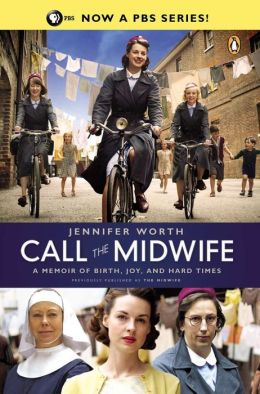
Call the Midwife (2002)

Call the Midwife: A Memoir of Birth, Joy, and Hard Times. Jennifer Worth. 2002/2009. Penguin. 340 pages. [Source: Library]

I have now read all three of Jennifer Worth's memoirs. Yes, I read the first book in the series last because that's how the library fated it. This actually worked out okay because I was familiar enough with the television adaptation. First, I want to mention that I loved, loved, loved, LOVED the tv show. Did I enjoy the books as much, did I enjoy them equally well? Probably not. I loved the show more, I did. I'll be honest about that from the start.

But did I enjoy the books? Yes. I definitely did. But was the first book my favorite? I can't say that it was. There were things I liked/loved about all three books. And. There were things I didn't quite like about all three books.

What didn't I enjoy? Well. In this first book, for example, there are several chapters where the focus is on prostitution, the focus shifts in the narrative because Jenny Lee has met a pregnant prostitute, Mary, who's trying to escape her pimp and find somewhere (relatively) safe to keep her baby. As you might expect, it's a dark, ugly, nightmarish world she's describing. I don't fault her for being realistic and matter of fact. But the amount of detail involved in the telling is a bit much at times. I think it could have been retold with a little less detail and still conveyed the same impact.

What did I enjoy? Well, there was plenty to enjoy! Most of the chapters were enjoyable enough. Many of these chapters have been adapted as episodes for the show--though not all, I believe. And in some cases, the book presents a much fuller picture.

As far as the trilogy goes, there is in some ways a lot less focus on romance when compared to the adaptation. (Jane's romance being an exception in the second book.) But the trilogy is worth reading, maybe not for ALL fans, but for many fans. (I will say that the book is more graphic in description than the tv show.)

© 2015 Becky Laney of Becky's Book Reviews

Wednesday, April 17, 2013

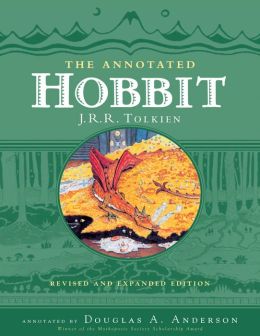
The Annotated Hobbit (2002)

The Annotated Hobbit. Revised and Expanded Edition. J.R.R. Tolkien. Annotated by Douglas A. Anderson. 2002. (1937, original Hobbit pub. date). Houghton Mifflin Harcourt. 416 pages.

The Hobbit is one of my favorite books even though I didn't discover it until I was an adult. It's a children's book that I've read several times as an adult. One of those feel-good books that you can happily, joyfully read each and every year without tiring of it. The Annotated Hobbit makes a lovely present for people who can't get enough of The Hobbit!

After viewing The Hobbit: The Unexpected Journey, I picked up The Annotated Hobbit. It was just what I needed! The film "covers" the first six chapters of the novel: "An Unexpected Party," "Roast Mutton," "A Short Rest," "Over Hill and Under Hill," "Riddles in the Dark," and "Out of the Frying-Pan Into the Fire." The most significant chapter in this annotated edition may just be "Riddles in the Dark." Fans most likely know already that the story of Bilbo's ring varies greatly from the original publication in 1937 and the later editions published after Tolkien wrote The Lord in the Rings, the variations even becoming a part of the story in a way. But this was the first time I was able to read the full, original ending to the story. (This is found in the notes on pages 128-131 and page 134.)

I came to the text needing to "check" the "faithfulness" of the film to the movie. True, I wanted to spend time with the characters, and, of course, I wanted to read it (again) because it's a great story. But. I wanted to see if the movie got it "wrong" or "right." While that was my original intention, I didn't always keep to it. I found the characters and story so irresistible. I was reminded once again of all the lovely little things that I just ADORE about the book. Things that didn't always translate as faithfully as I would have liked in the movie. Of course, some of what I ADORED about the book made it into the film, sometimes very faithful both in tone and detail.

There were some things that are technically "from the book" but taken completely out of proportion and focus, things that were made BIG AND SIGNIFICANT that barely got more than a sentence or two at most in the novel. The thing that stands out, for example, is how the party is HUNTED in the movie. Almost from the start, the journey is perilous because of a specific threat. And every single stage of the journey is equally dangerous and life-threatening. There is a purposeful, intentional darkness (evil) beginning to move in Middle Earth. In the novel, this isn't the case. The party faces danger, yes, sometimes a little danger, sometimes a lot of danger. But it isn't of an intentional hunted sort of danger. More of a being in the wrong place at the wrong time danger. They stumble almost on the trolls. (They also stumble upon the meeting place of the wolves or wargs.) And they face danger from rock slides and bad storms--but this is a natural threat. And yes, the stone giants exist but not so absurdly as in the movie:
There they were sheltering under a hanging rock for the night, and he lay beneath a blanket and shook from head to toe. When he peeped out in the lightning-flashes, he saw that across the valley the stone-giants were out, and were hurling rocks at one another for a game, and catching them, and tossing them down into the darkness where they smashed among the trees far below, or splintered into little bits with a bang. Then came a wind and a rain, and the wind whipped the rain and the hail about in every direction, so that an overhanging rock was no protection at all. Soon they were getting drenched and their ponies were standing with their heads down and their tails between their legs, and some of them were whinnying with fright. They could hear the giants guffawing and shouting all over the mountainsides.
"This won't do at all!" said Thorin. "If we don't get blown off, or drowned, or struck by lightning, we shall be picked up by some giant and kicked sky-high for a football."
"Well, if you know of anywhere better, take us there!" said Gandalf, who was feeling very grumpy, and was far from happy about the giants himself. (104)
The book doesn't exactly stay focused on the danger in any particularly threatening situation. The focus is on the adventure, the quest, the journey. There are plenty of in-between moments in the book. Moments where they might not be physically in danger from an enemy (goblins, trolls, angry elves, giant spiders), but might be facing discouragement, doubt, depression. Not to mention hunger, thirst, and exhaustion!!! 

There were isolated scenes that were especially faithful to the book and lovely to watch! But there were plenty of scenes that were pure interpretation. For better or worse. The film shows that there is more than one way to "read" a book or story.

Reading The Annotated Hobbit was beneficial. It reminded me of the creative process involved in writing and storytelling. Reading the annotations showed me that Tolkien never stopped creating this story. It was NOT "the end" of the story when it was published in 1937. The story kept changing and transforming and evolving through the decades. Tolkien stayed involved in the story. If Tolkien himself kept changing the story as his fantasy world kept growing and expanding, then it only makes sense that the film would be free to do the same.

I personally enjoyed reading almost all of the annotations. Some notes are mainly textual revision notes, letting readers know the differences between the different editions of the text (1937, 1951, 1966, etc.) Other notes tend to be scholarly and focused on literature. But some provide insights on The Hobbit or Middle Earth. (I liked notes about authors that influenced Tolkien.)


© 2013 Becky Laney of Becky's Book Reviews

Tuesday, September 25, 2012

Two Early Readers Starring Joe

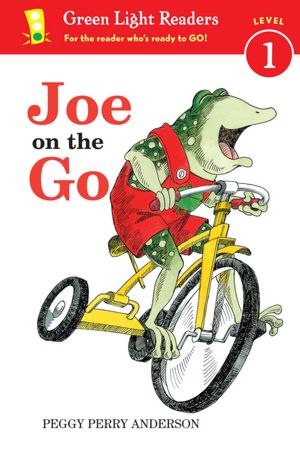
Joe on the Go. (Green Light Readers, Level 1) Peggy Perry Anderson. 2012. Houghton Mifflin Harcourt. 32 pages.

"Let's go!" said Joe to Mother dear.
"Sorry, Joe, I am busy here."
"Let's go!" said Joe. Dad said, "No way. Today is family meeting day."
Then came cousins, uncles, and aunts. They came to visit, eat, and dance.


Joe is a very energetic little frog. But no one at the frog family reunion wants to play with him. Each has a reason or excuse. Each tells him no and sends him away. But Joe keeps trying, surely, someone wants to play with him. He meets that someone....in Grandma.

The text, as you might expect, is repetitive and predictable making it just about right for young readers beginning to read on their own. And it could be a read aloud, as well, for parents to read to little ones.

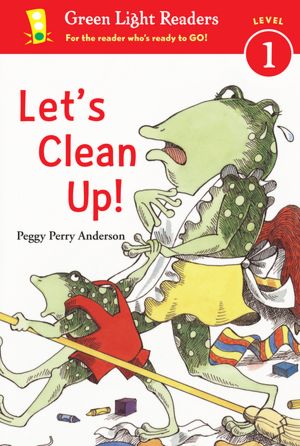
Let's Clean Up. (Green Light Readers, Level 1) Peggy Perry Anderson. 2012. Houghton Mifflin Harcourt. 32 pages.

Mother said, "I have the broom. Let's clean up this messy room." Mother cleaned high. Mother cleaned low. Mother cleaned the room for Joe. 

Another Joe adventure. Joe has an extremely messy room. His mom cleans the room, Joe is happy to see his floor again. He's eager to "rediscover" all his toys again. He makes his room a big, big mess. His mom is not happy that minutes later her son's room is out of control...again. The illustrations show her close to tears. But Joe has a way to make his mom happy again. He'll clean his room all by himself. And he'll do it much, much quicker. And, as long as his mom doesn't look in the yard, things should go well. 

In October, two more early readers will be released: Time for Bed, the Babysitter Said and To The Tub

Read Joe on the Go and Let's Clean Up
  • If you're looking for early readers to share with young beginning readers
  • If your little one likes frogs

© 2012 Becky Laney of Becky's Book Reviews

Tuesday, August 28, 2012

Two Mr. and Mrs. Green Adventures

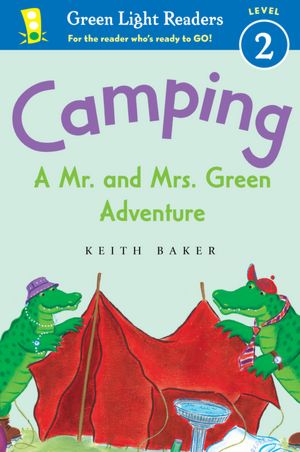
Camping: A Mr. and Mrs. Green Adventure. Keith Baker. Green Light Readers: Level 2. Houghton Mifflin Harcourt. 2002/2012. 24 pages. 

It was Saturday morning. It was sunny, and it was hot. "Let's go camping," said Mrs. Green. Mr. Green had never been camping. He was excited. Life with Mrs. Green was full of adventure.

I really, really enjoyed this Mr. and Mrs. Green adventure. The two are preparing for a camping trip. They have a long, long list of things that they "need" to take. Both are excited--very excited to have an adventure. But as the adventure gets started, Mr. Green shows some signs of uneasiness. He doesn't want to camp too far away from home, it seems. Mrs. Green has just the thing!

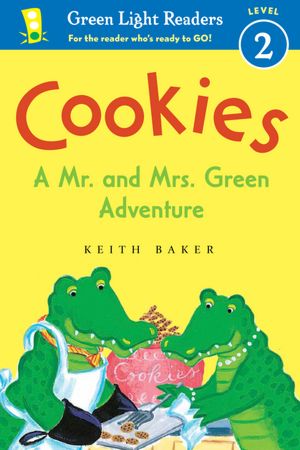
Cookies: A Mr. and Mrs. Green Adventure. Keith Baker. Green Light Readers: Level 2. 2002/2012. 24 pages.

Mr. Green woke up from his nap. He smelled cookies, freshly baked cookies. He followed his nose. (He had a big nose--it was easy to follow.)

I just loved, loved, loved Keith Baker's Cookies starring Mr. and Mrs. Green. One day when Mrs. Green is out shopping, Mr. Green discovers a note and some cookies. The note reads, "These are terri-ble! Do not eat." The cookies look good. The cookies smell good. And Mrs. Green always, always makes delicious cookies, so why are these cookies so terri-ble. He decides to eat them one by one by one by one to see if he can find out why. The cookies ARE great. He LOVES the cookies--they're absolutely perfect. Mrs. Green arrives at home to explain the mix-up! He only read half the note!!!

This is a super-fun book that I just loved and adored!

These two Mr. and Mrs. Green early readers were published in early August 2012. Two more early reader adventures will be published in October 2012! The Talent Show: A Mr. and Mrs. Green Adventure and Fishing: A Mr. and Mrs. Green Adventure.

Read Mr. and Mrs. Green
  • If you enjoy funny early readers (like Frog & Toad and Elephant and Piggie)
  • If you like alligators!
  • If you like cookies OR camping 

© 2012 Becky Laney of Becky's Book Reviews

Friday, March 30, 2012

Six Days in October

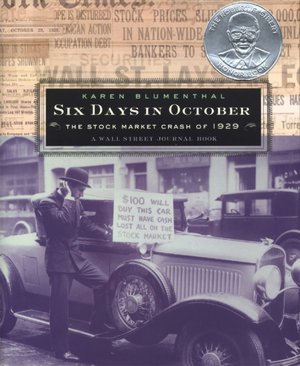
Six Days In October: The Stock Market Crash of 1929. Karen Blumenthal. 2002. Simon & Schuster. 160 pages.

From the introduction: The years after the First World War were a golden age for many Americans. The 1920s didn't just sing with the rhythms of jazz, or swing with the dancing of the Charleston; they roared with the confidence and optimism of a prosperous era. 

While I've read plenty of historical fiction set within the Great Depression time period, this is the first nonfiction book I've read (at least that I can remember) that details the Stock Market crash itself. In great detail--fascinating detail--Blumenthal traces these six days beginning with October 24, 1929. Each chapter focuses on an individual or two which adds a great deal to the human interest factor. Make these economic facts relate to people, real people, and you've got my attention. Some of the people she discusses were truly despicable people--at least when it came to business.

I definitely enjoyed reading this one. I found it very interesting! It did win Sibert Honor in 2003.

Read Six Days in October
  • If you're interested in history, in this historical time period.
  • If you want a greater background in understanding the Depression
  • If you're interested in the human side of economics
© 2012 Becky Laney of Becky's Book Reviews

Friday, February 24, 2012

Left for Dead

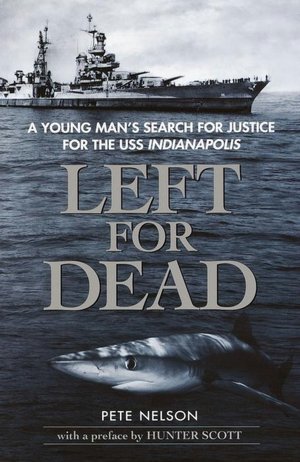
Left for Dead: A Young Man's Search for Justice for the USS Indianapolis. Pete Nelson. With a preface by Hunter Scott. 2002. Random House. 224 pages.

From the preface: I was standing in front of my history fair project, surrounded by a cluster of men in their mid-seventies and eighties. Their families, children, and grandchildren were also gathered around. These men had one thing in common: They were all survivors of the USS Indianapolis. I had developed a special appreciation for these men and what they had done in World War II. I had learned to appreciate these veterans who had sacrificed so much to ensure that a generation that had not been alive when they served could enjoy liberty.

From chapter one: The sailor finds himself swimming in the open ocean, wondering in shock how it came to this so suddenly. 

I am so glad I went outside my comfort zone and read this book!!! It was so compelling, so addicting. It wasn't always an easy (emotional) read. Especially chapter seven which details the time--at least four days--the men spent in shark-infested water, in the ocean, waiting, hoping, praying for rescue. But the book is so very good at detailing everything--the events leading up to the tragedy, the sinking of the ship itself, the time the survivors spent in the water, the rescue, the return back home to the United States, the court-martial of the ship's captain, etc. Probably half the book is devoted to Hunter Scott's mission for justice, to see the ship captain's name and reputation restored, to "prove" that the court martial against him was absurd and unjust. There are several chapters discussing how he got important people to pay attention to the new facts and work together to bring this before the House and Senate and pass legislation that would help restore the truth.

I enjoyed this one. It was just a fascinating read!

Read Left for Dead
  • If you're interested in history; if you're looking for proof that historical research is important
  • If you're looking to read a good human-interest story
  • If you're interested in World War II
  • If you're looking for a compelling nonfiction read

© 2012 Becky Laney of Becky's Book Reviews