Showing posts with label William Shakespeare. Show all posts

Monday, August 30, 2021

103. William Shakespeare's The Taming of the Clueless


William Shakespeare's Taming of the Clueless. Ian Doescher. 2020. [April] 192 pages. [Source: Library]

First sentence:
Jane: Cher--handsome, clever, rich--who had a home
Most comfortable, a happy disposition,
Seem'd to unite, wherever she did roam,
The blessings of existence's condition.

Premise/plot: Ian Doescher has adapted the movie Clueless for his Pop Shakespeare series. It is adaptation of an adaption. In the afterword, he noted that he read Emma and watched Clueless before beginning his work. He also noted that he thinks that the plot of Clueless comes closest to something William Shakespeare would have written--in comparison with the other titles he's written/adapted.

So if you've seen the movie Clueless, you know the premise and plot of this one. Balthasar appears throughout singing the movie's soundtrack!

Behold, beyond the window,
'neath the sky,
The rushing carriages do pass thee by,
Whilst I do sit, to loneliness resign'd,
And ponder wherefore questions fill
my mind.
'Tis Friday night! I feel the soothing
heat
And search this filthy city for a beat--
Downtown, the young ones go,
hey nonny non,
Downtown, the young ones grow,
hey nonny hey!
We are the children of America,
The children we of new America.

and

Where didst thou go? Where didst thou go?
Mine emptiness doth grow.
Where didst thou go? Where didst thou go?
I'm lost, and fain would know.

You can expect to find all the most memorable, iconic lines from the movie...


DIONNE: Didst see? Thou pass'd a sign that bid thee stop--
'Twas large and red, octagonally shap'd--
Yet thou drove on like thou wert being chas'd.
CHER: A pause complete I register'd therein.


TRAVIS
—Unexpected!
No speech prepar’d I for this honor.
These few words, though, I’d gladly utter:
The tardy life’s the work of many—
My tardiness by many people
Created was. Yea, I am grateful
Unto my parents, ne’er rides giving,
The drivers of the L. A. buses
Who took a chance upon an unknown.
Last—not the least—the wonderful crew
At old McDonalds Inn, that spendeth
Their hours at cooking Egg McMuffins,
Sans which I never might be tardy.


CHER
Full well I know th’exhaustion of thy heart.
Still, though, I’ll warrant sport shall do us good—
Of late my body feels most heiferlike,
All weight and hips and udders ev’rywhere,
Like I had stomachs four that I must fill.
Today I had two bowls of Special K,
Three pieces of delightful turkey bacon,
A full hand’s worth of popp’d corn most delicious,
Five peanut butter M and Ms—

CHER
Though I’d not be a traitor to my age,
No turncoat to my generation bold—
I do confess confusion and dismay.
The way lads dress is nothing short of odd,
As if they fell, like apples, from their beds,
Adorn’d themselves in poorly fitting pants—
More like broad bags than pantaloons, in troth—
Then cover greasy hair with filthy caps,
Which they wear backward and proclaim it style.
In public they appear array’d as such,
And should we women swoon to see them so?
Nay, I think not, and never shall be sway’d!
To search for lads in high school is a quest
As useless as the hunt for meaning in
The dramas of the actor Pauly Shore—
The nation’s jester: a most dull fool he,
And none but libertines delight in him.

CHER
Eureka, I have fall’n in love with Josh!
Josh, he whom I have known since I was small,
Who tickles me and jabs me when nearby,
Who gives me cause to smile when I am sad,
Whose presence is a comfort in itself,
Who help’d me learn to drive my carriage well,
Whom I do dearly love to torment so,
Who, all these years, hath been a friend to me—
By heaven, it is he I love, none other!
Completely, totally, and majorly
My heart doth move toward him utterly!

My thoughts: I thought this was a super-fun read. It was fun, silly, enjoyable. A great way to spend a weekend. 


© 2021 Becky Laney of Becky's Book Reviews

Wednesday, May 01, 2019

The Tempest

The Tempest. William Shakespeare. 1623. 127 pages. [Source: Bought]
Master: Boatswain!
Boatswain: Here, master: what cheer?
Master: Good, speak to the mariners: fall to't, yarely, or we run ourselves aground: bestir, bestir.
Premise/plot: Miranda has grown up on an island only knowing her father, Prospero, and Caliban, an unpleasant fellow, the son of a witch. She's in for quite a surprise when a shipwreck brings more people to the island. The shipwreck is no accident; it is the work of her sorcerer father, Prospero, aided by ARIEL. Prospero has a complex, master plan.

Miranda falls MADLY, DEEPLY in love with the first man she sees, Ferdinand. Fortunately, I suppose, he likewise falls in love with her. This union might be phase two of her father's master plan...

My thoughts: I really enjoyed reading William Shakespeare's The Tempest. It was a new-to-me Shakespeare play. (There are still a good many in this category). I found the play to be compelling and easy to follow--relatively. Yes, it has POLITICS and SCHEMING. But this is all handled in a back-story or info dump. (This info dump actually puts Miranda to sleep.)

There are a few characters in The Tempest that seem like they are unnecessary or superfluous--Caliban and the two drunkards--but perhaps these are solely for comedic effect which doesn't translate well when it is just read and not performed.

Quotes:
MIRANDA If by your art, my dearest father, you have Put the wild waters in this roar, allay them.
[Enter ARIEL.] ARIEL All hail, great Master! grave sir, hail! 
I come To answer thy best pleasure; be’t to fly, To swim, to dive into the fire, to ride On the curl’d clouds; to thy strong bidding task Ariel and all his quality.
MIRANDA I might call him A thing divine; for nothing natural I ever saw so noble.
MIRANDA Why speaks my father so ungently?
This Is the third man that e’er I saw; the first
That e’er I sigh’d for; pity move my father
To be inclined my way!
PROSPERO Soft, sir! one word more.
[Aside.] They are both in either’s powers: but this swift business
I must uneasy make, lest too light winning
Make the prize light.
MIRANDA There’s nothing ill can dwell in such a temple: 
If the ill spirit have so fair a house,
Good things will strive to dwell with’t.
SEBASTIAN He receives comfort like cold porridge.
GONZALO It is foul weather in us all, good sir,
When you are cloudy. 
SEBASTIAN I do: and surely
It is a sleepy language, and thou speak’st
Out of thy sleep.
What is it thou didst say?
This is a strange repose, to be asleep
With eyes wide open; standing, speaking, moving,
And yet so fast asleep.
SEBASTIAN Do so: to ebb, Hereditary sloth instructs me.
MIRANDA I am a fool
To weep at what I am glad of.
 PROSPERO Our revels now are ended.
These our actors,
As I foretold you, were all spirits, and
Are melted into air, into thin air:
And, like the baseless fabric of this vision, 
The cloud-capp’d towers, the gorgeous palaces,
The solemn temples, the great globe itself, 
Yea, all which it inherit, shall dissolve 
And, like this insubstantial pageant faded, 
Leave not a rack behind.
We are such stuff 
As dreams are made on, and our little life 
Is rounded with a sleep.  

MIRANDA O, wonder!
How many goodly creatures are there here!
How beauteous mankind is!
O brave new world
That has such people in’t!


© 2019 Becky Laney of Becky's Book Reviews

Monday, February 18, 2019

Ruled Britannia

Ruled Brittania. Harry Turtledove. 2002. 576 pages. [Source: Library]

First sentence: Two Spanish soldiers swaggered up Tower Street toward William Shakespeare. Their boots squelched in the mud. One wore a rusty corselet with his high-crowned morion, the other a similar helmet with a jacket of quilted cotton. Rapiers swung at their hips.

Premise/plot: What if the English navy had not defeated the Spanish Armada in 1588? What if instead of Queen Elizabeth reigning in the year 1597 she was instead locked away in the Tower? Turtledove gives us alternate history in his novel Ruled Britannia. It is told primarily from two perspectives: William Shakespeare and Lope de Vega.

Shakespeare has a choice to make. Should he commit treason against Spain and write a play that could potentially help overthrow Spain's rule and restore Elizabeth to the throne? Or should he play it safe and write a play memorializing King Philip II of Spain? Perhaps he'll be crafty and do both....but which one will get performed upon the King's death?!

Lope de Vega is in awe of William Shakespeare. He can nearly always be found watching his plays, watching the actors on and off stage, hanging around and conversing. He's a soldier on a mission: be on the lookout for any treason, any subversive meanings in the plays he watches. Some higher ups are suspicious of Shakespeare--but not de Vega, not really. Shakespeare doesn't care who rules so long as he can write, right?!

My thoughts: I imagine that Ruled Brittania was an absolute joy to write. Turtledove claims--and I have no reason to doubt--that he repurposed many, many lines from actual Shakespeare plays into "new" Shakespeare plays in this alternate history. In addition to Shakespeare, he used other contemporary playwrights from the time to craft his new plays and dramas. He obviously felt it was important to bring Shakespeare to life--and so he relied on Shakespeare's own words to flesh out his character and his dialogue. Like William Shakespeare, Lope de Vega is a real historical figure--a Spanish playwright from this time period who--at least according to the author's note--sailed on the Spanish Armada and returned to Spain to have a successful career.

Did I enjoy reading it as much as Turtledove enjoyed writing it? Probably not. In fact, I found it MUCH too long--tedious even. I was interested in the bare bones of this one. I wanted to know WHAT happened overall--would Shakespeare's play about Boudica (alternate spellings Boudicca, Boadicea, Boudicea) rebelling against the Roman Empire happen? Would it be successful? Would Elizabeth reign once more?

There were dozens of characters that peopled this novel that I just did not care about at all--not even slightly. I imagine that some--perhaps many--were actual historical figures. I just didn't care. Perhaps if the author's note was placed FIRST, I might have tried to care harder. Perhaps if there was a list of characters--noting which were historical and which were fictional. Perhaps if there were footnotes indicating which lines came from which actual Shakespeare plays or noting the other sources used?

One thing I know without a doubt...the chapters were unreasonably LONG...insufferably long. "Short" chapters were around thirty-five pages long. WHY TORTURE READERS?! You take a perfectly good premise--an entertaining one--and practically do everything possible to drain all the enjoyment of actually reading it?!

© 2019 Becky Laney of Becky's Book Reviews
Thursday, December 22, 2016

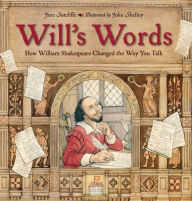
Will's Words

Will's Words: How William Shakespeare Changed The Way You Talk. Jane Sutcliffe. Illustrated by John Shelley. 2016. Charlesbridge. 40 pages. [Source: Library]

First sentence: Dear Reader: We have to talk. I have failed you. I set out to write a book about the Globe Theatre and its great storyteller, William Shakespeare. About how the man was an absolute genius with words and wove those words into the most brilliant and moving plays ever written. But that's just the trouble. You see, I wanted to tell you the story in my own words. But Will Shakespeare's words are there, too, popping up all over the place. It's not my fault. Really. Will's words are everywhere. They're bumping into our words all the time, and we don't even know it.

Premise/plot: Sutcliffe's picture book for older readers does a great job introducing readers to the sixteenth century theatre. And her emphasis on "Will's Words" shows the relevance Shakespeare still has in today's world. It is part narrative. But on each spread, she focuses on words--phrases--Shakespeare either invented himself (coined) OR kept alive (sustained) through the longevity of his plays. She uses the word or phrase in her narrative, and then explains it. Each word is explained and/or defined. Sometimes this includes "what it meant then, what it means now." But she also always includes: WHERE it came from--which play, which act, which scene.

Words include:

  • for goodness' sake
  • what's done is done
  • too much of a good thing
  • outbreak
  • excitement
  • of a sudden
  • wild goose chase
  • fashionable
  • money's worth
  • hurry
  • with bated breath
  • a sorry sight
  • heart's content
  • well behaved
  • send him packing
  • good riddance
  • love letter
  • laugh oneself into stitches
  • foul play
  • make your hair stand on end
  • cold-blooded
  • hot-blooded
  • bloodstained
  • dead as a doornail
  • seen better days
  • into thin air
  • amazement
  • the short and long of it
  • not budge an inch
  • eaten out of house and home
  • green-eyed monster
  • household words

My thoughts: I really loved this one. It is for older readers. I don't think the typical preschooler is going to care about the word origin of the phrase "dead as a doornail." But for older students (mid-to-upper elementary on up) what a treat!!! Be sure to watch the Horrible Histories music video about Shakespeare!


© 2016 Becky Laney of Becky's Book Reviews

Thursday, May 12, 2016

A Midsummer Night's Dream

A Midsummer Night's Dream. William Shakespeare. 1596. 181 pages. [Source: Library]

A Midsummer Night's Dream by William Shakespeare is one of those dependably enjoyable rereads. True, I don't love, love, love it as I love Much Ado About Nothing. I don't think any of the couples within are giddy-making and perfectly suited to one another. But the play is fun in its own way, in part because all the fairy action: Oberon, Titania, and Puck (Robin Goodfellow).

The play opens with a countdown of sorts towards the marriage between Theseus and Hippolyta. Egeus, the father of Hermia, goes to Theseus with his dilemma. His daughter, Hermia, is in love with Lysander and wants to marry him. Egeus wants his daughter to instead marry Demetrius. Helena, Hermia's close friend, is truly, madly, deeply in love with Demetrius. Who does Demetrius love? Well, it depends on the day, I suppose. Though perhaps that's not fair. When the play opens, he is hoping to marry Hermia.

Hermia is given an ultimatum: marry Demetrius OR else join a nunnery OR die. The lovers come up with a fourth option--an unapproved option--run away together and not get caught. For better or worse, Hermia tells Helena her plan. For whatever reason, Helena decides to betray her friend's trust and tell Demetrius. All four end up together in the woods--or forest--in a roundabout chasing that lasts most of the night.

Viewing all this 'madness' of sorts are a handful of fairies. Oberon, who is out of sorts with his wife Titania, truly pities Helena and wants her to get a happily ever after ending. So he tells Puck to use a love potion (something from a special flower) on the eyes of the young man. Perhaps not realizing that there are two young men from Athens in the woods, Puck makes a mistake and doses Lysander instead. Lysander switches his devotion just like that to Helena. Oberon does eventually have Puck correct this mistake. Demetrius declares his passion and love for Helena by the time the night is over...and Lysander's love for Helena vanishes just as quickly as it appeared...though not before Hermia and Helena get into a fight.

But there's more. Several men from the village--amateurs for sure--are rehearsing a play to perform for the marriage/wedding celebration of Theseus and Hippolyta. They are absolutely, over-the-top ridiculous. And Nick Bottom is more ridiculous than all the others combined. Puck uses Nick Bottom horribly in a way. But all will be well...

This play is fun and silly.

© 2016 Becky Laney of Becky's Book Reviews