Pig & Goose and the First Day of Spring. Rebecca Bond. 2017. Charlesbridge. 48 pages. [Source: Library]
First sentence: It was spring at last. Pig was in a good mood. "The sun is shining!" said Pig. "The sky is blue!" said Pig. "Goody gumdrops!" said Pig. "I am going to have a picnic by the pond."
Premise/plot: Pig & Goose and the First Day of Spring is an early chapter book. (It has three chapters: "A Spring Morning," "A Picnic Lunch," and "The Party.") The book focuses on the friendship of Pig and Goose. In chapter one, Pig--while on her way to a picnic--sees Goose returning. These two are very happy to see each other. Pig wants Goose to teach HER how to fly. That doesn't happen. But Goose does get invited to the picnic. In chapter two, Pig and Goose enjoy the picnic together. While Pig falls asleep and has a lovely dream, Goose enjoys a swim on the lake. At the end of the chapter, Goose is invited to Pig's house for a party later that night. In chapter three, Pig throws a GREAT party. Many friends--new and old--have come to celebrate. Pig and Goose make plans to see each other the next day.
My thoughts: I really like this one. Pig and Goose are fun characters. The illustrations are lovely.
© 2017 Becky Laney of Becky's Book Reviews
Showing posts with label Charlesbridge. Show all posts
Tuesday, April 04, 2017
Saturday, February 04, 2017
Language of Angels
Language of Angels. Richard Michelson. 2017. Charlesbridge. 32 pages. [Source: Review copy]
First sentence: Once there was a child without a friend. Two boys his age lived nearby, but they spoke Yiddish. In the morning they said "guten tog" to each other.
Premise/plot: Set in Jerusalem in the late nineteenth century, Language of Angels is a picture book about the reinvention of an ancient language: Hebrew. Ben-Zion's father Eliezer wanted his son to only speak Hebrew. The problem was no one spoke it as a living language, a common, everyday language. What Hebrew was known were the formal holy prayers that had been passed down for ages. Eliezer Ben-Yehuda zealously sought to bring back a language starting in his own home and then spreading elsewhere. It was a big dream, but this is a happy story! Teachers can be incredibly passionate and determined!
Readers see how Hebrew grew as a living language once more. Since new words had not been added in almost eighteen hundred years, it had some catching up to do! But this process was thoughtful, deliberate, and logical. I also imagine it was fun! The book says children helped him in this process.
Also of note, it was children not adults he was interested in teaching!
My thoughts: I really loved this picture book for older readers. The book is well researched; it includes an author's note providing much more information. The story has a personal touch. The family was fascinating in my opinion! There are enough details to make it interesting and compelling, but not in a dreary, fact heavy way.
Text: 5 out of 5
Illustrations: 4 out of 5
Total: 9 out of 10
© 2017 Becky Laney of Becky's Book Reviews
First sentence: Once there was a child without a friend. Two boys his age lived nearby, but they spoke Yiddish. In the morning they said "guten tog" to each other.
Premise/plot: Set in Jerusalem in the late nineteenth century, Language of Angels is a picture book about the reinvention of an ancient language: Hebrew. Ben-Zion's father Eliezer wanted his son to only speak Hebrew. The problem was no one spoke it as a living language, a common, everyday language. What Hebrew was known were the formal holy prayers that had been passed down for ages. Eliezer Ben-Yehuda zealously sought to bring back a language starting in his own home and then spreading elsewhere. It was a big dream, but this is a happy story! Teachers can be incredibly passionate and determined!
Readers see how Hebrew grew as a living language once more. Since new words had not been added in almost eighteen hundred years, it had some catching up to do! But this process was thoughtful, deliberate, and logical. I also imagine it was fun! The book says children helped him in this process.
Also of note, it was children not adults he was interested in teaching!
My thoughts: I really loved this picture book for older readers. The book is well researched; it includes an author's note providing much more information. The story has a personal touch. The family was fascinating in my opinion! There are enough details to make it interesting and compelling, but not in a dreary, fact heavy way.
Text: 5 out of 5
Illustrations: 4 out of 5
Total: 9 out of 10
© 2017 Becky Laney of Becky's Book Reviews
Sunday, January 22, 2017
Mountain Chef
Mountain Chef: How One Man Lost His Groceries, Changed His Plans, and Helped Cook Up the National Park Service. Annette Bay Pimentel. 2016. Charlesbridge. 40 pages. [Source: Library]
First sentence: Tie Sing was a frontier baby, born high in the mountains in Virginia City, Nevada. Growing up, he breathed crisp Sierra air and scuffed through sagebrush. He learned to write in both English and Chinese.
Premise/plot: A picture book biography of Tie Sing. Who was Tie Sing? The chef hired by Stephen Mather, a millionaire with a big plan for America, a plan to create a National Park system and preserve some of America's greatest treasures. The book quotes Mather saying, "Give a man a poor breakfast after he has had a bad night's sleep, and he will not care how fine your scenery is." Mather was leading thirty men on a ten-day camping trip. And he wanted--no needed--Tie Sing as his trail cook; he had a reputation for being the BEST.
The book is about the ten-day camping trip--this was in 1915.
My thoughts: This one was so beautifully written. The narration is great.
© 2017 Becky Laney of Becky's Book Reviews
First sentence: Tie Sing was a frontier baby, born high in the mountains in Virginia City, Nevada. Growing up, he breathed crisp Sierra air and scuffed through sagebrush. He learned to write in both English and Chinese.
Premise/plot: A picture book biography of Tie Sing. Who was Tie Sing? The chef hired by Stephen Mather, a millionaire with a big plan for America, a plan to create a National Park system and preserve some of America's greatest treasures. The book quotes Mather saying, "Give a man a poor breakfast after he has had a bad night's sleep, and he will not care how fine your scenery is." Mather was leading thirty men on a ten-day camping trip. And he wanted--no needed--Tie Sing as his trail cook; he had a reputation for being the BEST.
The book is about the ten-day camping trip--this was in 1915.
My thoughts: This one was so beautifully written. The narration is great.
With sky for his ceiling and sequoias for his walls, he stirred silky sauces, broiled succulent steaks, and tossed crisp salads. In his sheet-metal oven, he baked sourdough rolls as light as the clouds drifting above the peaks. (5)This one is easy to recommend.
© 2017 Becky Laney of Becky's Book Reviews
Thursday, December 22, 2016
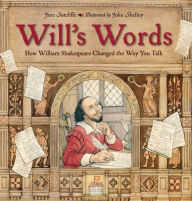
Will's Words
Will's Words: How William Shakespeare Changed The Way You Talk. Jane Sutcliffe. Illustrated by John Shelley. 2016. Charlesbridge. 40 pages. [Source: Library]
First sentence: Dear Reader: We have to talk. I have failed you. I set out to write a book about the Globe Theatre and its great storyteller, William Shakespeare. About how the man was an absolute genius with words and wove those words into the most brilliant and moving plays ever written. But that's just the trouble. You see, I wanted to tell you the story in my own words. But Will Shakespeare's words are there, too, popping up all over the place. It's not my fault. Really. Will's words are everywhere. They're bumping into our words all the time, and we don't even know it.
Premise/plot: Sutcliffe's picture book for older readers does a great job introducing readers to the sixteenth century theatre. And her emphasis on "Will's Words" shows the relevance Shakespeare still has in today's world. It is part narrative. But on each spread, she focuses on words--phrases--Shakespeare either invented himself (coined) OR kept alive (sustained) through the longevity of his plays. She uses the word or phrase in her narrative, and then explains it. Each word is explained and/or defined. Sometimes this includes "what it meant then, what it means now." But she also always includes: WHERE it came from--which play, which act, which scene.
Words include:
My thoughts: I really loved this one. It is for older readers. I don't think the typical preschooler is going to care about the word origin of the phrase "dead as a doornail." But for older students (mid-to-upper elementary on up) what a treat!!! Be sure to watch the Horrible Histories music video about Shakespeare!
© 2016 Becky Laney of Becky's Book Reviews
First sentence: Dear Reader: We have to talk. I have failed you. I set out to write a book about the Globe Theatre and its great storyteller, William Shakespeare. About how the man was an absolute genius with words and wove those words into the most brilliant and moving plays ever written. But that's just the trouble. You see, I wanted to tell you the story in my own words. But Will Shakespeare's words are there, too, popping up all over the place. It's not my fault. Really. Will's words are everywhere. They're bumping into our words all the time, and we don't even know it.
Premise/plot: Sutcliffe's picture book for older readers does a great job introducing readers to the sixteenth century theatre. And her emphasis on "Will's Words" shows the relevance Shakespeare still has in today's world. It is part narrative. But on each spread, she focuses on words--phrases--Shakespeare either invented himself (coined) OR kept alive (sustained) through the longevity of his plays. She uses the word or phrase in her narrative, and then explains it. Each word is explained and/or defined. Sometimes this includes "what it meant then, what it means now." But she also always includes: WHERE it came from--which play, which act, which scene.
Words include:
- for goodness' sake
- what's done is done
- too much of a good thing
- outbreak
- excitement
- of a sudden
- wild goose chase
- fashionable
- money's worth
- hurry
- with bated breath
- a sorry sight
- heart's content
- well behaved
- send him packing
- good riddance
- love letter
- laugh oneself into stitches
- foul play
- make your hair stand on end
- cold-blooded
- hot-blooded
- bloodstained
- dead as a doornail
- seen better days
- into thin air
- amazement
- the short and long of it
- not budge an inch
- eaten out of house and home
- green-eyed monster
- household words
My thoughts: I really loved this one. It is for older readers. I don't think the typical preschooler is going to care about the word origin of the phrase "dead as a doornail." But for older students (mid-to-upper elementary on up) what a treat!!! Be sure to watch the Horrible Histories music video about Shakespeare!
© 2016 Becky Laney of Becky's Book Reviews
Friday, May 27, 2016
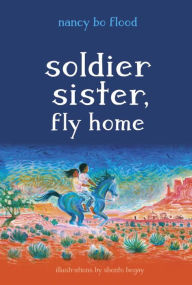
Soldier Sister, Fly Home
Soldier Sister, Fly Home. Nancy Bo Flood. 2016. [August] Charlesbridge. 176 pages. [Source: Review copy]
Did I enjoy reading Soldier Sister, Fly Home by Nancy Bo Flood? Yes, mostly. But not completely. I can see how there are certain scenes in this one that would greatly upset readers.
I'll start with what I did love. I loved the main character, Tess. She's a complex character, and this is her coming-of-age story. She's struggling to answer the "Who am I?" question. She's half Navajo, half-white; she doesn't feel comfortable anywhere. (When she's attending a mostly-white school, she feels out of place, she feels like she has been labeled as "Indian" as "other." And when she's at home on the reservation, she again feels out of place, like she isn't "Indian" enough.)
But she isn't completely clueless. Here are a few truths she knows to be true: 1) she LOVES to run. 2) she LOVES her family. 3) She doesn't understand how her older sister, Gaby, could join the army and go fight a war in Iraq. 4) She misses her sister terribly, and worries that something horrible might happen to her sister. She doesn't want to pretend that she's proud of her sister and happy to have a warrior sister. 5) She is scared of horses, particularly her sister's stallion, Blue. But scared as Tess is, she promised her sister, Gaby, that she'd take care of Blue while she was away.
The novel opens with the community coming together to mourn or memorialize a fallen soldier--the first Native American woman to die in combat: Lori Piestewa. Soon afterwards, her sister comes home supposedly for a two week leave. Tess is thrilled; she's got plans to spend as much time as possible with her sister. But that isn't to be: her sister will be leaving for Iraq in just a day or two.
In addition to focusing on the relationship between sisters, this one also focuses on Tess' relationship with her grandparents--particularly her grandmother. This relationship was lovely to see developed.
What didn't I love? There were a few scenes that were rough if you're an animal lover. For example, one scene has Tess slaughtering in great, graphic detail a sheep. It is a scene that comes at the end of a very emotional climax. And perhaps it is supposed to be scene as celebratory and significant. But to me, it was way too much. I won't mention the second scene because that would spoil the novel, something I wouldn't want to do.
Is it "fast" or "slow"? I don't know that it's fair to phrase it just like that. I know that some readers are ALL about the action: fast-paced, action-packed, adventure-filled DRAMA. But I know that other readers--myself included--focus more on characters: character development, exploring relationships between characters through dialogue, building authentic, believable settings, etc. I'd say that Soldier Sister, Fly Home is character-driven with a handful of intense scenes.
© 2016 Becky Laney of Becky's Book Reviews
Did I enjoy reading Soldier Sister, Fly Home by Nancy Bo Flood? Yes, mostly. But not completely. I can see how there are certain scenes in this one that would greatly upset readers.
I'll start with what I did love. I loved the main character, Tess. She's a complex character, and this is her coming-of-age story. She's struggling to answer the "Who am I?" question. She's half Navajo, half-white; she doesn't feel comfortable anywhere. (When she's attending a mostly-white school, she feels out of place, she feels like she has been labeled as "Indian" as "other." And when she's at home on the reservation, she again feels out of place, like she isn't "Indian" enough.)
But she isn't completely clueless. Here are a few truths she knows to be true: 1) she LOVES to run. 2) she LOVES her family. 3) She doesn't understand how her older sister, Gaby, could join the army and go fight a war in Iraq. 4) She misses her sister terribly, and worries that something horrible might happen to her sister. She doesn't want to pretend that she's proud of her sister and happy to have a warrior sister. 5) She is scared of horses, particularly her sister's stallion, Blue. But scared as Tess is, she promised her sister, Gaby, that she'd take care of Blue while she was away.
The novel opens with the community coming together to mourn or memorialize a fallen soldier--the first Native American woman to die in combat: Lori Piestewa. Soon afterwards, her sister comes home supposedly for a two week leave. Tess is thrilled; she's got plans to spend as much time as possible with her sister. But that isn't to be: her sister will be leaving for Iraq in just a day or two.
In addition to focusing on the relationship between sisters, this one also focuses on Tess' relationship with her grandparents--particularly her grandmother. This relationship was lovely to see developed.
What didn't I love? There were a few scenes that were rough if you're an animal lover. For example, one scene has Tess slaughtering in great, graphic detail a sheep. It is a scene that comes at the end of a very emotional climax. And perhaps it is supposed to be scene as celebratory and significant. But to me, it was way too much. I won't mention the second scene because that would spoil the novel, something I wouldn't want to do.
Is it "fast" or "slow"? I don't know that it's fair to phrase it just like that. I know that some readers are ALL about the action: fast-paced, action-packed, adventure-filled DRAMA. But I know that other readers--myself included--focus more on characters: character development, exploring relationships between characters through dialogue, building authentic, believable settings, etc. I'd say that Soldier Sister, Fly Home is character-driven with a handful of intense scenes.
© 2016 Becky Laney of Becky's Book Reviews
Tuesday, April 05, 2016
War Dogs
War Dogs. Kathryn Selbert. 2016. [April 2016] Charlesbridge. 48 pages. [Source: Library]
First sentence: Rufus's best friend, Winston Churchill, is a busy man, but most days Rufus and Winston share a walk.
Premise/plot: Essentially, War Dogs is a picture book biography of Winston Churchill during the Second World War told from the point of view of his poodle, Rufus. The book has plenty of Churchill quotes throughout. These are set apart from the main text, and are easily identifiable. One of the quotes is:
I love the text. I love the illustrations. I love how each quote is sourced. Not all picture book biographies show their work when it comes to research. This one does! (Can you tell that I tend to love research myself!)
Text: 5 out of 5
Illustrations: 4 out of 5
Total: 9 out of 10
© 2016 Becky Laney of Becky's Book Reviews
First sentence: Rufus's best friend, Winston Churchill, is a busy man, but most days Rufus and Winston share a walk.
Premise/plot: Essentially, War Dogs is a picture book biography of Winston Churchill during the Second World War told from the point of view of his poodle, Rufus. The book has plenty of Churchill quotes throughout. These are set apart from the main text, and are easily identifiable. One of the quotes is:
The road to victory may not be so long as we we expect. But we have no right to count upon this. Be it long or short, rough or smooth, we mean to reach our journey's end. August 1940My thoughts: I loved, loved, loved, LOVED this one. War Dogs would definitely be more of a picture book for older readers than a story you'd share aloud with preschoolers. But. I think picture books for older readers are important and necessary, and can be quite LOVELY. I do think that picture books can be for everyone--people for all ages. So I'd definitely recommend this one. It would be a great introduction--picture book introduction--to the Second World War, and to Winston Churchill in particular. So if you're a history lover or a dog lover, you should definitely consider picking this one up!!!
I love the text. I love the illustrations. I love how each quote is sourced. Not all picture book biographies show their work when it comes to research. This one does! (Can you tell that I tend to love research myself!)
Text: 5 out of 5
Illustrations: 4 out of 5
Total: 9 out of 10
© 2016 Becky Laney of Becky's Book Reviews
Monday, November 23, 2015
Reading Picture Books With Children
Reading Picture Books With Children: How to Shake Up Storytime and Get Kids Talking About What They See. Megan Dowd Lambert. 2015. Charlesbridge. 176 pages. [Source: Review copy]
In Reading Picture Books WITH Children, Megan Dowd Lambert introduces readers (presumably adult readers) to the whole book approach of reading picture books with children. The whole book approach pays attention to the whole book. Not just the text. Not even just the text and the illustrations. But to the whole book:
Each chapter focuses on a different aspect of a picture book. Each chapter includes multiple examples and shares practical advice. Readers see what types of questions Lambert has in mind. Questions like: "What's going on in this picture? What do you see that makes you say that? What more can we find?" She does include a chapter on sample questions. Here are just a few as an example:
© 2015 Becky Laney of Becky's Book Reviews
In Reading Picture Books WITH Children, Megan Dowd Lambert introduces readers (presumably adult readers) to the whole book approach of reading picture books with children. The whole book approach pays attention to the whole book. Not just the text. Not even just the text and the illustrations. But to the whole book:
- the size of the book--is it big, is it small; is it in landscape or portrait orientation;
- the design of the book--what font(s) are used, what size font(s) are used, how does the font appear on the page, etc;
- the appearance of the book jacket (front, back, spine); the appearance of the book cover underneath the book jacket; is it the same as the book jacket or different? what materials were used on the cover; how was it bound, etc.
- the endpapers; are the endpapers the same in the back as they are in the front; what do they add to the story, etc.
- the front matter; does the story begin before the 'first page' of the text; does it contribute anything to the story;
- the arrangement of the text and illustrations; how much white space is used on a page, are the illustrations on a two-page spread connected or separate; are the illustrations small or big; are the illustrations framed; do they take up the whole page, etc.
- the text itself; what it says, the story, the characters, etc.)
- the illustrations; the style, the technique, the details, the art and craft of it all, etc.
Each chapter focuses on a different aspect of a picture book. Each chapter includes multiple examples and shares practical advice. Readers see what types of questions Lambert has in mind. Questions like: "What's going on in this picture? What do you see that makes you say that? What more can we find?" She does include a chapter on sample questions. Here are just a few as an example:
- How does the jacket seem like a poster for the book, pulling us in as readers? What grabs your attention here?
- What information does the jacket give us about the story?
- How does the way the words look tell us how to read the words aloud?
- Does anyone else have a different idea about this picture?
© 2015 Becky Laney of Becky's Book Reviews
Friday, November 13, 2015
Eat Your U.S. History Homework
Eat Your U.S. History Homework. Ann McCallum. 2015. Charlesbridge. 48 pages. [Source: Review copy]
I love the premise behind Ann McCallum's Eat Your U.S. History Homework. I think it is a clever idea to write a cookbook with American History in mind.
The book only covers early American history. The first recipe--around the times of the Pilgrims settling America--is "Thanksgiving Succotash." The last recipe--around the time of the American Revolution--is for "Independence Ice Cream." There are six recipes in all.
The topics or subjects these recipes are supposed to supplement: Pilgrims at Plymoth, 1620; The Thirteen Original Colonies, 1607-1776; The French and Indian War, 1754-1763; Slaves and the Southern Planation, 1619-1863; The American Revolution, 1775-1783; The Declaration of Independence, 1776.
Some recipes you might recognize under another name. For example: "Revolutionary Honey-Jumble Cookies" and "Lost Bread" are snickerdoodles and french toast.
I like the focus on food. I like the historical tidbits. I like everything but the illustrations.
© 2015 Becky Laney of Becky's Book Reviews
I love the premise behind Ann McCallum's Eat Your U.S. History Homework. I think it is a clever idea to write a cookbook with American History in mind.
The book only covers early American history. The first recipe--around the times of the Pilgrims settling America--is "Thanksgiving Succotash." The last recipe--around the time of the American Revolution--is for "Independence Ice Cream." There are six recipes in all.
The topics or subjects these recipes are supposed to supplement: Pilgrims at Plymoth, 1620; The Thirteen Original Colonies, 1607-1776; The French and Indian War, 1754-1763; Slaves and the Southern Planation, 1619-1863; The American Revolution, 1775-1783; The Declaration of Independence, 1776.
Some recipes you might recognize under another name. For example: "Revolutionary Honey-Jumble Cookies" and "Lost Bread" are snickerdoodles and french toast.
I like the focus on food. I like the historical tidbits. I like everything but the illustrations.
© 2015 Becky Laney of Becky's Book Reviews
Thursday, July 16, 2015
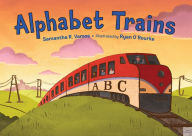
Alphabet Trains
Alphabet Trains. Samantha R. Vamos. Illustrated by Ryan O'Rourke. 2015. Charlesbridge. 32 pages. [Source: Review copy]
First sentence: Tear the ticket. Load the freight. Sound the whistle. Raise the gate. Clank! Chug-chug! Whoosh! Alphabet trains.
Premise/plots: Alphabet Trains is a train-themed alphabet book for young readers. An author's note at the back of book provides more information on each train. A few trains are just types of trains, but other trains are specific trains. I like learning which trains are real, and where each train is located. For example, "K is for Komet, traveling through the night. L is for Leonardo Express--a trip to Rome postflight." The note reveals, "The Komet runs overnight between Germany and Switzerland. Like a comet in the sky, the train travels at high speed. The Leonardo Express travels back and forth from the airport in Rome, Italy, to the central train station in the city. The trip is just 30 minutes."
My thoughts: I like this one. I like reading and reviewing train books, because I think train books will always have an audience. Little ones like trains. Some really, really, really love trains. Do you have a favorite train book?
Text: 4 out of 5
Illustrations: 3 out of 5
Total: 7 out of 10
© 2015 Becky Laney of Becky's Book Reviews
First sentence: Tear the ticket. Load the freight. Sound the whistle. Raise the gate. Clank! Chug-chug! Whoosh! Alphabet trains.
Premise/plots: Alphabet Trains is a train-themed alphabet book for young readers. An author's note at the back of book provides more information on each train. A few trains are just types of trains, but other trains are specific trains. I like learning which trains are real, and where each train is located. For example, "K is for Komet, traveling through the night. L is for Leonardo Express--a trip to Rome postflight." The note reveals, "The Komet runs overnight between Germany and Switzerland. Like a comet in the sky, the train travels at high speed. The Leonardo Express travels back and forth from the airport in Rome, Italy, to the central train station in the city. The trip is just 30 minutes."
My thoughts: I like this one. I like reading and reviewing train books, because I think train books will always have an audience. Little ones like trains. Some really, really, really love trains. Do you have a favorite train book?
Text: 4 out of 5
Illustrations: 3 out of 5
Total: 7 out of 10
© 2015 Becky Laney of Becky's Book Reviews
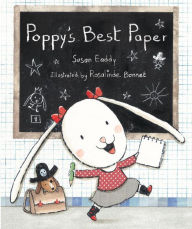
Poppy's Best Paper
Poppy's Best Paper. Susan Eaddy. Illustrated by Rosalinde Bonnet. 2015. Charlesbridge. 40 pages. [Source: Review copy]
First sentence: Poppy loved books. "I might be a writer when I grow up," she told her best friend, Lavender.
Premise/plot: Poppy loves to read and write. She has even almost decided to be a writer when she grows up. So when Mrs. Rose, her teacher, assigns a few writing assignments to the class, Poppy is super-excited. She KNOWS that whatever the assignment, she'll be the best at it because it involves writing. She KNOWS that her teacher will praise her work and read her writing as an example for the class. So Poppy is disappointed and frustrated and ANGRY when other students' work is picked instead. Will Poppy have a chance to shine?
My thoughts: I really liked this one. I liked Poppy. She's a character easy to relate to. We see her at school and at home. We see her "doing" her homework. We see the writing process. This one is easily about writing and school. But it is also about emotions and feelings and learning to deal with them appropriately.
Text: 3.5 out of 5
Illustrations 4.5 out of 5
Total: 8 out of 10
© 2015 Becky Laney of Becky's Book Reviews
First sentence: Poppy loved books. "I might be a writer when I grow up," she told her best friend, Lavender.
Premise/plot: Poppy loves to read and write. She has even almost decided to be a writer when she grows up. So when Mrs. Rose, her teacher, assigns a few writing assignments to the class, Poppy is super-excited. She KNOWS that whatever the assignment, she'll be the best at it because it involves writing. She KNOWS that her teacher will praise her work and read her writing as an example for the class. So Poppy is disappointed and frustrated and ANGRY when other students' work is picked instead. Will Poppy have a chance to shine?
My thoughts: I really liked this one. I liked Poppy. She's a character easy to relate to. We see her at school and at home. We see her "doing" her homework. We see the writing process. This one is easily about writing and school. But it is also about emotions and feelings and learning to deal with them appropriately.
Text: 3.5 out of 5
Illustrations 4.5 out of 5
Total: 8 out of 10
© 2015 Becky Laney of Becky's Book Reviews
Tuesday, December 16, 2014
Golden Dreydl
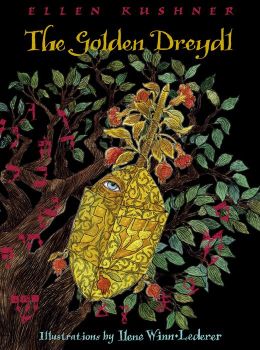
The Golden Dreydl. Ellen Kushner. Illustrated by Ilene Winn-Lederer. 2007. Charlesbridge. 126 pages. [Source: Review copy]
The Golden Dreydl is an interesting Chanukah themed fantasy novel for children. There is an album that goes along with it. The book and album put a Jewish twist on the Nutcracker story.
Sara, the heroine, of The Golden Dreydl has quite the bad attitude about "having" to celebrate Chanukah and "not getting to" celebrate Christmas like all her friends. But to the family gathering she will go--no matter the fuss. (Sara has an older brother, Seth).
Readers briefly meet Sara, Seth, and their many, many cousins. The "kids" of the family are playing dreydl. Sara is still in a mood. A mood that isn't exactly improved when Tante Miriam shows up with presents for one and all. It's not her fault, mind you, Sara even seems a little inclined to like her present: a golden dreydl. But Seth and her get into a bit of a fight. The dreydl ends up flying through the air and hitting the TV and breaking it. That puts most everyone in a mood.
Readers next join Sara later that evening, for a fantasy adventure. She follows a young girl--a girl claiming to be the Golden Dreydl--through the hole in the TV, I believe. They arrive in a fantasy land, of sorts, with demons, peacocks, a fool, and King Solomon and the Queen of Sheba. There is also much talk of a Tree of Life.
Sara is given a quest, of sorts, to save the girl from the demons/demon king. She has the Fool to help her. A few riddle games are played. First, between Sara and the Fool, and, then later between the Demon King and Sara and the Fool.
For those readers who enjoy fantasy novels, going to different worlds, doing quests, this one is enjoyable enough. If you get a chance to listen to the music, it will probably help you 'enjoy' it even more.
© 2014 Becky Laney of Becky's Book Reviews
The Golden Dreydl is an interesting Chanukah themed fantasy novel for children. There is an album that goes along with it. The book and album put a Jewish twist on the Nutcracker story.
Sara, the heroine, of The Golden Dreydl has quite the bad attitude about "having" to celebrate Chanukah and "not getting to" celebrate Christmas like all her friends. But to the family gathering she will go--no matter the fuss. (Sara has an older brother, Seth).
Readers next join Sara later that evening, for a fantasy adventure. She follows a young girl--a girl claiming to be the Golden Dreydl--through the hole in the TV, I believe. They arrive in a fantasy land, of sorts, with demons, peacocks, a fool, and King Solomon and the Queen of Sheba. There is also much talk of a Tree of Life.
Sara is given a quest, of sorts, to save the girl from the demons/demon king. She has the Fool to help her. A few riddle games are played. First, between Sara and the Fool, and, then later between the Demon King and Sara and the Fool.
For those readers who enjoy fantasy novels, going to different worlds, doing quests, this one is enjoyable enough. If you get a chance to listen to the music, it will probably help you 'enjoy' it even more.
© 2014 Becky Laney of Becky's Book Reviews
Saturday, January 14, 2012
Duke Ellington's Nutcracker Suite
Duke Ellington's Nutcracker Suite. Anna Harwell Celenza. Illustrated by Don Tate. 2011. Charlesbridge. 32 pages.
In Duke Ellington's Nutcracker Suite, Anna Harwell Celenza shares with young people the story behind this jazz legend's recording of the Nutcracker Suite. The book is set in 1960, and it follows the story of 'the nutcracker suite' from just an idea all the way to the recording studios. It is the story of how Duke Ellington and Billy Strayhorn make the Nutcracker their own. Much of the story takes place in the recording studio as Ellington introduces his band to the music. Emphasis is on the new song titles and their inspiration.
- Overture
- Toot Toot Tootie Toot (Dance of the Reed-Pipes)
- Peanut Brittle Brigade (March)
- Sugar Rum Cherry (Dance of the Sugar Plum Fairies)
- Entr'acte
- The Volga Vouty (Russian Dance)
- Chinoiserie (Chinese Dance)
- Danse of the Floreadores (Waltz of the Flowers)
- Arabesque Cookie
Read Duke Ellington's Nutcracker Suite:
- If you like the Nutcracker Suite and are curious about how it can be jazzed up for new audiences
- If you like jazz music, if you like Duke Ellington
- If you like picture books based on true events
Labels:
2011,
Books Reviewed in 2012,
Charlesbridge,
jazz,
music,
picture books,
review copy
Monday, November 29, 2010
Nonfiction Monday: Candy Bomber
Candy Bomber: The Story of The Berlin Airlift's "Chocolate Pilot". Michael O. Tunnell. 2010. Charlesbridge. 120 pages.
When I was a boy I would watch beautiful silver airplanes fly high in the sky, going to faraway places with strange-sounding names. I didn't know then that when I grew up I would fly one of those silver birds myself. I never imagined I would fly food to boys and girls so they would not starve.
Candy Bomber is a thoroughly satisfying read. Should a nonfiction book be charming and satisfying? Should a nonfiction book make you feel good? Why not! it's a good story--a true story--of how one man started "Operation Little Vittles" during the Berlin Air Lift. The story of how Gail S. Halvorsen became inspired to drop chocolates, candy, and gum--via handkerchief parachutes--to the children of West Berlin. (All the while delivering more nourishing food--as he and many others did each and every day.)
I loved this one, I did. I loved learning about the Berlin Airlift. I loved learning about "Operation Little Vittles" and "Uncle Wiggly Wings." I loved seeing how the project grew through the months. How this "little" project grew in support--with volunteers providing candy, gum, chocolate, and, yes, even handkerchiefs. But more than anything--perhaps--I loved hearing how this program impacted the children. The book quotes from some of the many letters he received and even shares some of the artwork he received from kids.
I would definitely recommend this one. It has so much heart and substance.
© Becky Laney of Becky's Book Reviews
When I was a boy I would watch beautiful silver airplanes fly high in the sky, going to faraway places with strange-sounding names. I didn't know then that when I grew up I would fly one of those silver birds myself. I never imagined I would fly food to boys and girls so they would not starve.
Candy Bomber is a thoroughly satisfying read. Should a nonfiction book be charming and satisfying? Should a nonfiction book make you feel good? Why not! it's a good story--a true story--of how one man started "Operation Little Vittles" during the Berlin Air Lift. The story of how Gail S. Halvorsen became inspired to drop chocolates, candy, and gum--via handkerchief parachutes--to the children of West Berlin. (All the while delivering more nourishing food--as he and many others did each and every day.)
I loved this one, I did. I loved learning about the Berlin Airlift. I loved learning about "Operation Little Vittles" and "Uncle Wiggly Wings." I loved seeing how the project grew through the months. How this "little" project grew in support--with volunteers providing candy, gum, chocolate, and, yes, even handkerchiefs. But more than anything--perhaps--I loved hearing how this program impacted the children. The book quotes from some of the many letters he received and even shares some of the artwork he received from kids.
I would definitely recommend this one. It has so much heart and substance.
© Becky Laney of Becky's Book Reviews
Labels:
2010,
biography,
borrowed book,
Charlesbridge,
j nonfiction
Wednesday, July 21, 2010
Bamboo People (MG/YA)
Bamboo People. Mitali Perkins. 2010. July 2010. Charlesbridge. 272 pages.
Teachers wanted. Applicants must take examination in person.
Bamboo People has two narrators; each on a different side of the war; each closer to childhood than adulthood.
Chiko, who narrates the first half of the novel, is tricked into joining the Burmese army. His father, a doctor, is in prison for "resisting" the government. His mother is worried about her son. Worried that her son will be taken away from her. But she reluctantly agrees that her son should answer the ad for teachers. Her son is smart, and he would make an excellent teacher. Is it a trap? Neither know for sure. But Chiko feels he's failing his father. He feels he isn't being a man. That he's not doing a good job of providing for the family. That a real man wouldn't stay indoors and hide hoping that the trouble will pass him by. Tai is another child, another boy, taken the same time as Chiko. These two become good friends. Chiko even takes time to teach him how to read and write. Neither wants to be in the army. Neither wants to see war.
Tu Reh, our second narrator, is living in the Karenni refugee camp. He has every reason to hate the Burmese. And like so many of the others he's been taught to hate his enemy. But one day he discovers a dying soldier--someone he sees as a mere boy, a child. His first instinct is to kill. Yet something stops him from killing. Something even prompts him to pick the boy up and carry him to a healer. It isn't easy for Tu Reh, it's a decision he questions again and again. Yet he can't regret saving a life. He can't regret seeing this child-soldier as a fellow human. There is something remarkable about Tu Reh.
I loved both narrators. I loved seeing the human side of war. I think Bamboo People is a very compelling read.
It is set in contemporary times.
© Becky Laney of Becky's Book Reviews
Labels:
2010,
borrowed book,
Charlesbridge,
family,
friendship,
Survival,
war,
YA Fiction
Subscribe to:
Posts (Atom)


