Showing posts with label 1906. Show all posts

Sunday, January 25, 2015

L.M Montgomery Short Stories 1905-1906

Lucy Maud Montgomery Short Stories: 1905-1906. Dodo Press. 260 pages. [Source: Bought]

There are thirty-one short stories in this L.M. Montgomery collection. There are some great stories within this collection. There are some not-so-great stories within this collection. The quality definitely varies story to story. But if you already love L.M. Montgomery, it's well worth reading. If you're never read her, however, this may not be the best introduction. True, you'd probably find something to like, to enjoy, maybe even love. But would it persuade you to seek out EVERYTHING she's ever written because she's oh-so-amazing?! Probably not. It's good to keep in mind that these short stories were published several years before her novels. (Anne of Green Gables was published in 1908).

There are two stories that are tied for being my favorite-favorite in this collection: "Aunt Susanna's Birthday Celebration" and "The Understanding of Sister Sara." Both stories are about lovers' quarrels being resolved with a little outside help.

Previous short story collections I've reviewed:
  1. L.M. Montgomery Short Stories, 1896-1901. L.M. Montgomery. 142 pages.
  2. Lucy Maud Montgomery Short Stories, 1902-1903. L.M. Montgomery. 216 pages.
  3. L.M. Montgomery Short Stories, 1904. L.M. Montgomery. Dodo Press. 144 pages.
These stories are included in Lucy Maud Montgomery Short Stories: 1905-1906
  • A Correspondence and a Climax
  • An Adventure On Island Rock
  • At Five O'Clock in the Morning
  • Aunt Susanna's Birthday Celebration
  • Bertie's New Year
  • Between the Hill and the Valley
  • Clorinda's Gifts
  • Cyrilla's Inspiration
  • Dorinda's Desperate Deed
  • Her Own People
  • Ida's New Year Cake
  • In the Old Valley
  • Jane Lavinia
  • Mackereling Out in the Gulf
  • Millicent's Double
  • The Blue North Room
  • The Christmas Surprise at Enderly Road
  • The Dissipation of Miss Ponsonby
  • The Falsoms' Christmas Dinner
  • The Fraser Scholarship
  • The Girl at the Gate
  • The Light on the Big Dipper
  • The Prodigal Brother
  • The Redemption of John Churchill
  • The Schoolmaster's Letters
  • The Understanding of Sister Sara
  • The Unforgotten One
  • The Wooing of Bessy
  • Their Girl Josie
  • When Jack and Jill Took a Hand 
If you're looking for a good short story to perhaps read on its own, I'd recommend:
© 2015 Becky Laney of Becky's Book Reviews

Friday, July 18, 2014

Reread #29 Railway Children

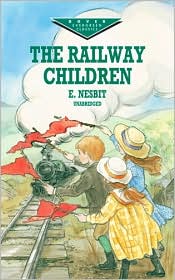
The Railway Children. E. Nesbit. 1906/2011. Penguin. 304 pages.  [Source: Bought]

I found The Railway Children to be a very pleasant read. I can't say that I loved, loved, loved it. Or that it is my favorite Nesbit read of all time. It isn't. But it was quite enjoyable. The Railway Children is not a children's fantasy book. Plenty of Nesbit's books are, but this one isn't. It is realistic fiction. Three siblings: Roberta, Peter, Phyllis star in this one. The family is having some hard times. Their father has been put into jail. (He's innocent, of course.) The mother is supporting the family by writing stories. She's a very good writer, but, she's kept very busy and very worried. The children may feel pressure to be strong and good, to do nothing that might in any way worry their mother, but, reality is that they are kids and they act like kids. They have their good days and bad days. And sometimes things just happen, adventures just happen. The children meet a LOT of people. This one has a strong community feel. It's just a lovely read.

I first reviewed this one in August 2011.

Favorite quotes:
“I suppose I shall HAVE to be married some day,” said Peter, “but it will be an awful bother having her round all the time. I’d like to marry a lady who had trances, and only woke up once or twice a year.”
“Just to say you were the light of her life and then go to sleep again. Yes. That wouldn’t be bad,” said Bobbie. “When I get married,” said Phyllis, “I shall want him to want me to be awake all the time, so that I can hear him say how nice I am.”

Peter sowed vegetable seeds in his — carrots and onions and turnips. The seed was given to him by the farmer who lived in the nice black-and-white, wood-and-plaster house just beyond the bridge. He kept turkeys and guinea fowls, and was a most amiable man. But Peter’s vegetables never had much of a chance, because he liked to use the earth of his garden for digging canals, and making forts and earthworks for his toy soldiers. And the seeds of vegetables rarely come to much in a soil that is constantly disturbed for the purposes of war and irrigation.

“There’s no end to this tunnel,” said Phyllis — and indeed it did seem very very long. “Stick to it,” said Peter; “everything has an end, and you get to it if you only keep all on.” Which is quite true, if you come to think of it, and a useful thing to remember in seasons of trouble — such as measles, arithmetic, impositions, and those times when you are in disgrace, and feel as though no one would ever love you again, and you could never — never again — love anybody.

© 2014 Becky Laney of Becky's Book Reviews

Friday, June 13, 2014

Reread #24 The Story of the Amulet

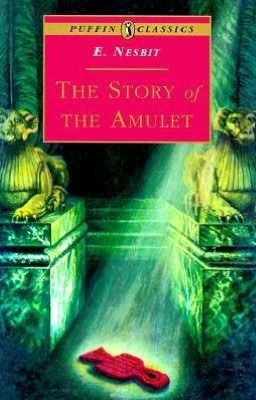
The Story of the Amulet. E. Nesbit. 1906/1996. Puffin. 292 pages. [Source: Bought]

Apparently, I was not in the mood to enjoy the third novel in this series. I don't remember hating it the first time I read it. But this time. Well. I kept forcing myself to read it so I could finish it and move on to the next E. Nesbit novel.

The Story of the Amulet read very clumsily for me. I still like the four children (Lamb isn't in this one at all). How could I stop loving them after reading the first two books? But all the joy and fun seem to have vanished. There is a heaviness, a messiness to this fantasy novel. The children under the advice of the Sand Fairy buy an amulet from a shop. They've been told it has magical properties, but this magic is limited because half of it is missing. If the two could be brought back together, the magic would be extraordinarily powerful. Like it could somehow make it so their parents would come home and pay attention to them. So the children go on a quest to make this happen. They travel to the past and the future.

Their time-traveling adventures are hit and miss. One or two of them were enjoyable for me. Some of them I thought were awfully clumsy and awkward. The last third of the novel felt so horribly forced to me. Like the author had lost focus and was trying to figure out how in the world she was going to have the children find the two pieces of the amulet. It was just painful to read the resolution of this one. I mean, of course, they end up getting their heart's desire, but, in terms of the plot actually working, it didn't.

I originally reviewed this one in July 2011. I gave it four stars too!

© 2014 Becky Laney of Becky's Book Reviews

Thursday, December 26, 2013

I Will Repay (1906)

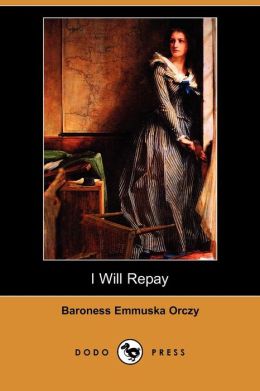
I Will Repay. Baroness Orczy. 1906. 220 pages. [Source: Book I Bought]

As much as I love, love, love The Scarlet Pimpernel movie adaptations, I didn't quite love the novel. I wasn't quite sure if I wanted to read the sequels. I procrastinated a very long time. But once I decided to actually read I Will Repay, it was a quick read: two days!

What you should know: First, the Scarlet Pimpernel does make an appearance, but, you have to be really, really patient because he is a long time in coming. Second, it is a romantic adventure set during the French Revolution, emphasis on the romance. If you HATE romance, if you hate the drama and dialogue found in romance novels, then this one might not be for you. But. If you do, you're in for a real treat!

The prologue starts ten years or so before the French Revolution. It begins with a "fair" duel between two men. The hero, Paul Déroulède, is a reluctant participant. But the other guy, Vicomte de Marny is not backing down at all, is determined to make the fight to the death, if you will. He dies. His father makes his young daughter promise to get revenge on her brother's murderer. Her name is Juliette de Marny.
"Repeat the words after me, my child." "Yes, father." "Before the face of Almighty God, who sees and hears me ..." "Before the face of Almighty God, who sees and hears me," repeated Juliette firmly. "I swear that I will seek out Paul Déroulède." "I swear that I will seek out Paul Déroulède." "And in any manner which God may dictate to me encompass his death, his ruin or dishonour, in revenge for my brother's death." "And in any manner which God may dictate to me encompass his death, his ruin or dishonour, in revenge for my brother's death," said Juliette solemnly. "May my brother's soul remain in torment until the final Judgment Day if I should break my oath, but may it rest in eternal peace the day on which his death is fitly avenged." "May my brother's soul remain in torment until the final Judgment Day if I should break my oath, but may it rest in eternal peace the day on which his death is fitly avenged."
Ten years later, Juliette has finally found him, found a way to get close to him. He "saves" her from an angry mob, invites her into his home, introduces her to his family. She remains with him, getting close, for a bit. She begins to develop her plan. Meanwhile, of course, he is falling madly in love with her...
"Gratitude? What have I done?" "You committed a foolish, thoughtless act outside my door, and gave me the chance of easing my conscience of a heavy load." "In what way?" "I had never hoped that the Fates would be so kind as to allow me to render a member of your family a slight service."
"I always meant to tell you," he continued somewhat hurriedly; "for it almost seemed to me that I have been cheating you, these last few days. I don't suppose that you can quite realise what it means to me to tell you this just now; but I owe it to you, I think. In later years you might find out, and then regret the days you spent under my roof. I called you childish a moment ago, you must forgive me; I know that you are a woman, and hope therefore that you will understand me. I killed your brother in fair fight. He provoked me as no man was ever provoked before ..."
Not everyone is charmed by this young woman. And the Scarlet Pimpernel has some advice for our hero...
"You are a mad idealist, my dear Déroulède!" "How can I help it? I have lived under the same roof with her for three weeks now. I have begun to understand what a saint is like." "And 'twill be when you understand that your idol has feet of clay that you'll learn the real lesson of love," said Blakeney earnestly. "Is it love to worship a saint in heaven, whom you dare not touch, who hovers above you like a cloud, which floats away from you even as you gaze? To love is to feel one being in the world at one with us, our equal in sin as well as in virtue. To love, for us men, is to clasp one woman with our arms, feeling that she lives and breathes just as we do, suffers as we do, thinks with us, loves with us, and, above all, sins with us. Your mock saint who stands in a niche is not a woman if she have not suffered, still less a woman if she have not sinned. Fall at the feet of your idol an you wish, but drag her down to your level after that—the only level she should ever reach, that of your heart."
I will admit there is drama. But. I enjoyed every moment of it.
Love, the great, the strong, the conquering god—Love that subdues a world, and rides roughshod over principle, virtue, tradition, over home, kindred, and religion—what cares he for the easy conquest of the pathetic being, who appeals to his sympathy? Love means equality—the same height of heroism or of sin. When Love stoops to pity, he has ceased to soar in the boundless space, that rarefied atmosphere wherein man feels himself made at last truly in the image of God.

She would have stilled, an she could, the beating of her heart, which went out to him at last with all the passionate intensity of her great, pent-up love. Every word he spoke had its echo within her very soul, and she tried not to hear his tender appeal, not to see his dark head bending in worship before her. She tried to forget his presence, not to know that he was there—he, the man whom she had betrayed to serve her own miserable vengeance, whom in her mad, exalted rage she had thought that she hated, but whom she now knew that she loved better than her life, better than her soul, her traditions, or her oath. Now, at this moment, she made every effort to conjure up the vision of her brother brought home dead upon a stretcher, of her father's declining years, rendered hideous by the mind unhinged through the great sorrow.

They were all alone these two in the mad and beautiful world, which man has created for himself—the world of romance—that world more wonderful than any heaven, where only those may enter who have learned the sweet lesson of love.
The god of love may be blind, tradition has so decreed it, but the demon of jealousy has a hundred eyes, more keen than those of the lynx.
What neither fear nor remorse, sorrow nor joy, could do, that the great and mighty Shadow accomplished in a trice. Juliette, looking death bravely in the face, held out her hand, and sought that of the man she loved. There was not one word spoken between them, not even a murmur. Déroulède, with the unerring instinct of his own unselfish passion, understood all that the tiny hand wished to convey to him. In a moment everything was forgotten save the joy of this touch. Death, or the fear of death, had ceased to exist. Life was beautiful, and in the soul of these two human creatures there was perfect peace, almost perfect happiness.
I loved this one. I did. It was a perfectly satisfying read. 

© 2013 Becky Laney of Becky's Book Reviews

Monday, January 14, 2013

The Racketty-Packetty House (1906)

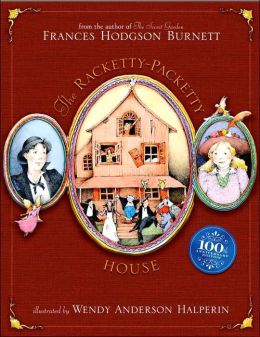
The Racketty-Packetty House. Frances Hodgson Burnett. Illustrated by Wendy Anderson Halperin. 1906/2006. Simon & Schuster. 96 pages.

Now this is the story about the doll family I liked and the doll family I didn't. When you read it you are to remember something I am going to tell you. This is it: If you think dolls never do anything you don't see them do, you are very much mistaken. When people are not looking at them they can do anything they choose. They can dance and sing and play on the piano and have all sorts of fun. But they can only move about and talk when people turn their backs and are not looking. If anyone looks, they just stop. Fairies know this and of course Fairies visit in all the dolls' houses where the dolls are agreeable.

The Racketty Packetty House tells the story of how a fairy, Queen Crosspatch, saved a family of dolls and their house. Cynthia is the disagreeable little girl who wants her old dolls and dollhouse burned when she is given a brand new dollhouse and dolls. Racketty-Packetty house is first saved by neglect. The nurse puts the dollhouse behind the door and places an armchair nearby which keeps the dollhouse out of the little girl's view. You might think the dolls would be upset or hurt by their displacement. They've been rejected by Cynthia, and they've heard the worst: she thinks they're only fit for the fire. But. These are joyful, optimistic dolls who are never gloomy. No matter the situation, they will find something to rejoice about. Perhaps their good-nature is one reason why the fairies love to visit this doll family so very much. The fairies are always watching out for them and are prepared to do what they can to save them...

I really enjoyed this delightful children's story. It has fairies AND dolls, not to mention a couple of good morals mixed in. I think my favorite part was when Peter Piper, one of the old dolls falls in love with Lady Patsy, one of the new dolls. He woos her and is successful! It was also interesting to catch a glimpse of their play. One day Cynthia pretends everyone in her new dollhouse is dreadfully ill with scarlet fever. She keeps playing that they're getting worse and worse, etc. And then very suddenly she stops playing, leaves the room 'leaving the dolls to their fate'. The old dolls decide to go and 'nurse' the new dolls back to health. There were plenty of scenes to delight.

If you're interested in reading this one with its illustrations, it can be found online here

Read The Racketty-Packetty House
  • If you like children's classics
  • If you like dolls and dollhouses
  • If you like fairies and fantasy literature
  • If you enjoy the work of Frances Hodgson Burnett

© 2013 Becky Laney of Becky's Book Reviews

Friday, May 04, 2012

Lady Baltimore

Lady Baltimore. Owen Wister. 1906. 272 pages.

Like Adam, our first conspicuous ancestor, I must begin, and lay the blame upon a woman; I am glad to recognize that I differ from the father of my sex in no important particular, being as manlike as most of his sons. Therefore it is the woman, my Aunt Carola, who must bear the whole reproach of the folly which I shall forthwith confess to you, since she it was who put it into my head; and, as it was only to make Eve happy that her husband ever consented to eat the disastrous apple, so I, save to please my relative, had never aspired to become a Selected Salic Scion. I rejoice now that I did so, that I yielded to her temptation. Ours is a wide country, and most of us know but our own corner of it, while, thanks to my Aunt, I have been able to add another corner. This, among many other enlightenments of navel and education, do I owe her; she stands on the threshold of all that is to come; therefore I were lacking in deference did I pass her and her Scions by without due mention,—employing no English but such as fits a theme so stately. Although she never left the threshold, nor went to Kings Port with me, nor saw the boy, or the girl, or any part of what befell them, she knew quite well who the boy was. When I wrote her about him, she remembered one of his grandmothers whom she had visited during her own girlhood, long before the war, both in Kings Port and at the family plantation; and this old memory led her to express a kindly interest in him. How odd and far away that interest seems, now that it has been turned to cold displeasure! 

Last year I read Owen Wister's The Virginian and just loved it. Surprisingly loved it since I am NOT by any stretch of the imagination a fan of westerns. I knew I wanted to read a second book by Owen Wister this year, and I chose Lady Baltimore. Trying to compare Lady Baltimore and The Virginian would be a mistake because they are two entirely different books. Different styles, different genres.

Lady Baltimore is one part social commentary, one part romance, one part comedy. Set in South Carolina at the turn of the century, it dramatically and comically shows the tension of a town and ultimately a nation. What kind of tension? Well, tensions between generations, regions, races, and social classes.

(We see domineering aunts, for example, from both North and South, who want to "rule" over their nephews and nieces.) There is a generation (probably those fifty and up) who CANNOT for one minute put the Civil War behind them, and there is a generation (especially those in their twenties and late teens) who don't quite understand why it still has to be such a big deal, who'd like to see some change or progress at least. There's definitely still tension between North and South as well. Our narrator is a "Yankee" visiting a Southern town. His "Yankee" aunt warns him throughout not to be too influenced by the Southerners. She doesn't want him to like or love his travels too much. And the people of the town, especially the Somebodies of the town, find it hard to open up with any Yankee no matter how seemingly charming. From the narrator's viewpoint, readers see the tension between these two sides is still very much alive. Race. This is a BIG, BIG, BIG issue in the novel. For better or worse. On one hand, it could always allow for discussion and critical thinking on the part of the reader. But on the other hand, it might make some very uncomfortable in the process. Because whether the "racism" is just racism by condescension or racism by pure ugliness and hatred, it is still very present in this novel. (Let's just say that the narrator and almost every single person in the novel does NOT believe in equality of the races, and most certainly does not believe that they should have the right to vote or hold any sort of political office.) Social class also plays a role in this one. We've got the tension between people who once had money but now only have class, manners, and pride. And the newly rich who many view as having NO class, and low morals.

Augustus is our young narrator. He is visiting King's Port, South Carolina, at the request of his Aunt Carola. (She is, in fact, paying for his trip. He's supposed to be diligently researching genealogies and records to see if he can find the "proof" he needs to join her oh-so-exclusive club. Those men and women supposedly descended from royalty. Does he stay on task? What do you think?!) While there, he becomes entangled in a love affair. I'll clarify. He joins a gossip-y group of women who are focusing their attention on John Mayrant. Augustus first impression of John Mayrant is quite interesting. (It is readers' first impression as well.) He is ordering his own wedding cake, a Lady Baltimore cake. He is a bit anxious, a bit shy, a bit nervous. He even forgets to tell the woman at the counter, the baker, the date of his wedding, the date he needs the cake. He has to run back to tell her. Just as she is running to catch him to tell him he's forgotten. As you might guess, as you might imagine, readers see some potential here! The woman is Eliza La Heu. His fiance, Hortense Rieppe, is seen as less than desirable. She's not from the right kind of people, and if she has any money of her own, it's the wrong sort of money. She mixes with the wrong crowds, vacations the wrong places, and smokes! Is this young couple in love? Well, that's the big question, I suppose. And it seems to be everybody's business. Even with this newcomer Augustus getting in the middle of it. Should the engagement be broken? How should it be broken? When should it be broken? Would everyone be better off if it was broken?

So Lady Baltimore is just as much about the break up of a relationship (though readers may have a hard time believing it was love) as it is the start of a new relationship (Eliza and John).

There were many things I found enjoyable in Lady Baltimore. The writing was delightful-and-pleasant. For the most part. When the narrator is discussing race, well, it would be difficult to find charm in that...at all...but when the focus is on society, on social issues, on manners and traditions, courtship, etc., then it is a great way to spend a week. (When it comes to observation and characterization, think Austen or Trollope.)

I was always happy to pick this one back up, yet, there are not any scenes in particular that I can say I loved or loved, loved, loved. (I can still think of some from The Virginian.)


Read The Lady Baltimore
  • If you're looking for fiction set in the South at the turn of the century
  • If you're looking for a little social commentary with your romance
  • If you enjoy slower paced novels with some charm; this one is NOT full of action; it's mostly dialogue. So it might not be for everyone.
  • If you loved The Virginian, yet, are willing to give the author a chance to write a completely different kind of book.

© 2012 Becky Laney of Becky's Book Reviews

Saturday, August 20, 2011

The Railway Children (MG)

The Railway Children. E. Nesbit. 1906/2011. Penguin. 304 pages. 

They were not railway children to begin with.

I loved this one. I did. I don't know how I'd ever choose a favorite, favorite E. Nesbit because all of her books are oh-so-good. The Railway Children stars three siblings: Roberta (Bobbie), Peter, and Phyllis. This one features a strong mother figure, an involved parent. (Or at least the most involved parent I've encountered in Nesbit's fiction.)

This family is under stress. The father disappears quite suddenly from his children's lives. The mother won't explain just why their father has to go away, and why the family has to move to a little place in the country. The children just know that everything is changing--little things and big things. For example, they now must choose between jam or butter for their toast--they can't afford to have both.

But while many things are changing, not all of the changes are bad. For the children discover a new way of living life. And they become involved in their new community! For better or worse! Not every person is instantly charmed by these three children, but, it's hard to resist them for long.

There were many things I enjoyed about this one. I enjoyed the children. I enjoyed their mother. I loved that she was a writer, that she was supporting her family by writing stories. I enjoyed their community, I loved meeting the different characters. It was just a satisfying story with a lot of heart.

© 2011 Becky Laney of Becky's Book Reviews

Friday, July 15, 2011

The Story of the Amulet (MG)

The Story of the Amulet. E. Nesbit. 1906. 228 pages.

First Sentence: There were once four children who spent their summer holidays in a white house, happily situated between a sandpit and a chalkpit. 

I believe that this is the final adventure of Cyril, Robert, Anthea, and Jane. The first adventure, Five Children and It, and the second adventure, The Phoenix and the Carpet, were both delightful. The novel has a sad beginning. Their father is off to Manchuria to be a war correspondent, and their mother and Lamb are recovering their health in Madeira. (Their mother has been sick, Lamb has not.) They have been left in the care of Nurse, they have been left in London.

One of the children has the idea that if they leave the house and go explore the city--on their own, with proper permission, of course--that it would cheer everyone up. And that works, in a way. For in their exploring they discover an old, old friend of theirs. Someone that they'd not seen since that oh-so-magical summer. Yes, the four children happen to find Psammead caged up and for sale in a shop. Of course, they have to rescue him. And he is thankful--to a certain extent. But though he may be grateful to be out of the shop, out of the cage, he does NOT want to become a toy for the children, a wish-granter. But not wanting to be completely mean and unsociable, he tells them of an amulet with magical powers. This amulet is also for sale, and if the children purchase it, well, they can have their heart's desire.

Sound too good to be true? Well, if they want their heart's desire they are going to have to prove themselves worthy--or clever. For the amulet they buy is only half of the magical charm. They'll have to find the second half of the charm and the pin that binds these two together in order for this charm to grant their heart's desire. What good is half a charm? Well, it's still plenty powerful! Especially if you like to travel through time! For this amulet--when magical words are spoken, when held in a certain way, in a certain direction, becomes a doorway to the past. The children can step through the amulet to the past on their quest to find the missing half.

And these time travel adventures are fun! They go to Babylon, Egypt, Tyre, Atlantis, etc. Will they ever find the missing half? Will their amulet ever be whole? While the four children may have slightly different ideas on how to go about the quest, they agree on what their wish will be, they know their heart's desire.

I enjoyed this one. I've enjoyed all three of the books very much. I'm so glad that I decided to read E. Nesbit!!!

 © 2011 Becky Laney of Becky's Book Reviews