Showing posts with label romance. Show all posts

Thursday, December 12, 2024

102. Christmas Eve Love Story

Christmas Eve love Story. Ginny Baird. 2024. 416 pages. [Source: Library] [3 stars] [adult romance, mostly clean romance, holiday, Christmas, time loops, fantasy]

First sentence: Annie Jones hurried out of the snow and in through the employee entrance at Lawson's Finest in her red knitted pom-pom hat and peacoat, clocking in on her department store app, and---ahh!--almost mowing down Santa.

Premise/plot: Annie Jones is entering the twilight zone. Mostly. This holiday romance features a time loop [on Christmas Eve] where the heroine has twelve chances to make a good 'first impression' on security guard, Braden Tate. Of course, that isn't the only thing she must get right to make it to Christmas morning. There are twelve cycles of Christmas Eves. Some things change. Some things are inevitable. 

My thoughts: I enjoyed this one. I did. Did it *need* to be 416 pages? Probably not. Honestly I think it would have been better at about 350-ish pages. However, the repetitiveness helped me at times get caught back up of the story. The truth is, I started this one in mid-November, it got moved in the library stack, I forgot about it completely, then picked it up yesterday and read the rest of the book. So I read the first half of the book in one sitting and the last half of the book in one sitting--but three weeks in between. Again, I enjoyed this one. If this was a movie, no doubt, I'd watch it--probably again and again depending on how well it's done.


© 2024 Becky Laney of Becky's Book Reviews

Tuesday, October 26, 2021

133. A Christmas Waltz


A Christmas Waltz. Josi S. Kilpack. 2020. [November] 130 pages. [Source: Library]

First sentence: The dark-haired man with the red satin waistcoat began walking toward her from the other side of the ballroom.

Premise/plot: Marta, our heroine, comes to look forward to waltzing with David every year at her family's Yuletide Ball. Their first waltz occurs when she's newly 'out' and just sixteen. She's yet to experience the season in London, and this first dance fills her with all the feels. The two seem to have a connection. Emphasis on seem. For while the dance is oh-so-wonderful, that's all it remains--a memory of a dance. When given opportunities through the years to take the relationship further, deeper, he passes. Content, at least temporarily, to keep it just a nice, cozy memory to pull out now and then. Every single Christmas, these two waltzes. Years pass. Circumstances change. Yet one thing never changes. No matter where they find themselves in their lives, they make their way to each other on the dance floor every Christmas.

My thoughts: A Christmas Waltz is a bittersweet historical novella. On the one hand, it is sweet how these two find joy and comfort in each other's company year after year. A few minutes together each year to share one's private thoughts and dreams. 

On the other hand, because Marta is almost romanticizing and idealizing this relationship with David, she's making her life more bitter the rest of the year. Because her husband doesn't stand a chance against this perfect, idealized, dreamy, swoony connection. Granted, from what Marta tells David about her husband, he doesn't care...at all. He doesn't care if his wife is happy or unhappy. He is not physically present--all that often--and emotionally there's no connection at all. Still there are plenty of romance novels out there where wives and husbands fall in love with each other after the fact, putting aside previous loves and daydreams, working through misunderstandings, finding common ground and building a future together despite not having all the feels when they say I do.  

The book definitely reminded me of Storybook Love:

We've got a storybook love and that's all and that's all
A fantasy world where we love one another
A storybook love and that's all and that's all
A boy and a girl who hardly know each other
But I feel you lookin at me
And in your eyes it's plain to see
One day soon we both will be much more than friends
But until then
It's a storybook love
And that's all and that's all
A fantasy world where we love one another
A storybook love and that's all and that's all
A boy and a girl who hardly know each other
But I already know
How much I'm gonna love you so
I feel it inside me even though it hasn't happened yet
So all we get
Is a storybook love and that's all and that's all
A fantasy world where we love one another
A storybook world and that's all and that's all
A boy and a girl who hardly know each other

© 2021 Becky Laney of Becky's Book Reviews

Monday, November 23, 2020

145. The Little Christmas Shop on Nutcracker Lane


The Little Christmas Shop on Nutcracker Lane. Jaimie Admans. 2020. 311 pages. [Source: Review copy]

First sentence: My phone beeps with a text message and I look up from the nutcracker bunting I’m painting. Hopefully the guy I’m seeing telling me he’s missing me and he’s sorry I’ve got to work late again. It’s not serious yet, but maybe it could be one day. 

Premise/plot: Nia Maddison, the heroine, is super-super thrilled to be opening her Christmas shop on Nutcracker Lane. She's been working towards this dream for years--if not decades. Nutcracker Lane is MAGICAL at Christmas time--well, it used to be years and years ago. Her best friend, Stacey, makes jewelry and she makes Christmas-y knick knacks. Together they are setting up shop. But this first year might be the last year because a 'Scrooge' business owner is threatening to get rid of Nutcracker Lane altogether. He's been cutting the budget and changing practices for quite a few years now--but could this year really be the last year???

Nia makes a wish on a GIANT nutcracker at the opening of the story...and when she meets another shop owner, James, could it be her wish come to life???? Maybe. Maybe not. Does she believe in magic really???

James, our hero, HATES, HATES, HATES Christmas. But he's falling hard and fast for Nia and her enthusiasm for Christmas might be just the medicine he needs to cure his ills and worries. But will she be a willing teacher? Can he be un-Scrooged? Will Nia do the work of four ghosts/spirits???

My thoughts: I really enjoyed this one!!! It was just a delight to read. It would make a LOVELY movie. I could easily add such a movie to my yearly traditions. I just have a weakness for Christmas-y romantic comedies. Even if romantic comedy isn't my normal "thing" the rest of the year. Somehow all the sappy predictability is just perfect in a Christmas read. Is the book predictable? YES, a thousand times yes. Did I mind? Not one little bit. I wouldn't have it any other way. 

I really LOVED that it was a clean read.   


© 2020 Becky Laney of Becky's Book Reviews

Saturday, November 14, 2020

141. All I Want for Christmas

All I Want for Christmas. Wendy Loggia. 2020. 240 pages. [Source: Review copy]

First sentence: I should realize it’s a bad sign when I trip hard over the entry to Winslow’s Bookshop. “Whaaaaa!” I yelp as I give the typically sticky front door my customary push … and go unexpectedly flying into the store, the shop’s brass bell announcing my unceremonious entrance.

Premise/plot: All I Want for Christmas is a clean YA romance set during the holidays. Bailey Briggs, our heroine, LOVES, LOVES, LOVES Christmas. In her daydreams she's starring in a Hallmark Christmas movie. What she'd love for Christmas this year is a magical kiss underneath the mistletoe--preferably by someone who truly thinks she's amazing. 

She's always looking for that potential someone. Will it be the athletic classmate who is always making everyone--even the adults--laugh and smile? Or will it be the super-mysterious guy with a British accent? Jacob Marley or Charlie? 

As she gets to know both guys--or tries to--her heart is trying to tell her whom to choose....

My thoughts: I liked this one. I did. It was cute. It was sweet. It was only slightly predictable. (I guessed the mystery surrounding Charlie relatively early on--but I didn't mind reading on.) Overall, I think it would be an easy recommendation to readers--mainly younger teens maybe???--for readers who want some Christmas cheer with a large dose of sweet sugary romance. 

I am always looking for a CLEAN read, so this one worked for me. 


© 2020 Becky Laney of Becky's Book Reviews

Friday, August 28, 2020

107. Otherwise Engaged

Otherwise Engaged. Joanna Barker. 2020. 262 pages. [Source: Review copy]

First sentence: Of the many things that could be depended upon to make a young lady swoon, a love letter certainly made the list. I perched on a low rock in the center of the quiet meadow, one knee tucked to my chest, the skirts of my riding habit spread about me.

Premise/plot: Rebecca Rowley has returned home engaged--secretly. Her fiancé, Edward Bainbridge, is the son of her father's former business partner. And that partnership didn't end well. Both families are extremely bitter and unforgiving towards the other. Each, of course, finding the other family at fault. It's been fifteen years--or so--since the partnership ended. But will another partnership--a romantic one--ever be allowed to take place? Not if those two mamas are ever given a say. So her engagement is a secret--for now.

When this Regency romance opens our un-traditional heroine is riding bareback. She loves, loves, loves the freedom of "flying" that running wild and free gives her. As she's riding, she happens to come to the rescue of a young girl, Olivia, who's drowning. She jumps in and saves her...in moments Olivia's brother, a Lieutenant Nicholas Avery, has arrived on the scene. Their introduction is memorable...as are most of their subsequent encounters.

My thoughts: Otherwise Engaged is giddy-making and swoon-worthy. The romance remains clean, for the most part. (Depending on your definition of clean, I suppose. It has a few steamy-steamy kisses. But nothing progressing beyond those kisses. True, at the time in 1822, getting caught in such a steamy kiss--or even an un-steamy kiss???--might have damaged one's reputation. So as I said, it depends on your definition of clean.) What I loved was the romantic build-up between the hero and heroine. And part of that build-up of course depends on the CHARACTERIZATION of both and the surrounding cast of characters. The very fact that the novel feels fully peopled--with well developed characters in abundance--makes it stand out above the rest in the genre. And a part also depends on the DIALOGUE between the hero and heroine. And lastly it depends on the narrative voice. This one remains solely with Rebecca Rowley. And it was a JOY to spend time with her and her thoughts.

I also loved the relationship between Rebecca and Olivia (Nicholas' younger sister). Olivia added so much to the story overall!!! She never really felt like a plot device--a weak, pitiful excuse for the meeting between Nicholas and Rebecca. She always felt like a real person.

As you might have gathered, I really LOVED and ADORED this one. It was a WONDERFUL read and one that I could see myself reading and rereading again and again and again.

If I didn't already love Regency romances this would make me a fan.

“All right, then. Let us play this game. What do I want in a wife? She must be intelligent, first of all.” “Naturally,” I agreed, suddenly not certain I wanted to play, judging by that gleam. “She must be kind and compassionate,” he went on. “Someone to help me care for Olivia.” “Yes, of course.” Nicholas moved closer, dropping his arms as his gaze fixed on mine. “Good humor is important as well.” I swallowed. “The value of laughter cannot be underestimated.” He took another step forward, only a pace away from me now. Why was he so close? “I would not complain terribly much if she were beautiful,” he said softly as his eyes followed every curve of my face.


via GIPHY

© 2020 Becky Laney of Becky's Book Reviews

Wednesday, June 12, 2019

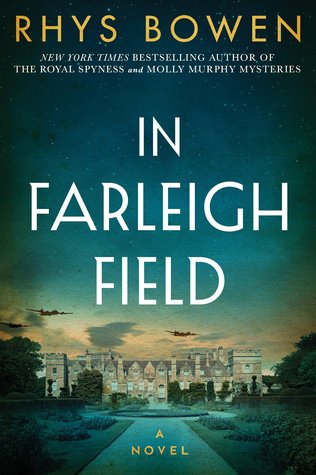
World at War: In Farleigh Field

In Farleigh Field. Rhys Bowen. 2017. Lake Union. 397 pages. [Source: Review copy]

First sentence: It had been unusually hot all summer.

Premise/plot: In Farleigh Field is a stand-alone mystery/suspense novel set in England during the second world war. It has multiple narrators. It follows the lives of the aristocratic Sutton family and their neighbors. There are five daughters--no sons. Olivia (aka Livvy), Margaret (aka Margot), Pamela (aka Pamma), Diana (aka Dido), and Phoebe (aka Feebs).

Before the war, Pamela was head over heels in love with a neighbor, Jeremy Prescott, who joined the RAF. While she was making heart eyes at Jeremy, Ben Cresswell, the vicar's son, was making heart eyes at her. Almost three years later and little has changed. Well. Both Ben and Pamela are working for secret government agencies. (MI5 and Bletchley Park). But Ben still hasn't come any closer to getting the girl to notice him in that way. Pamela still daydreams that if Jeremy returns alive from the war that they may get married and live happily ever after one day.

At the Farleigh estate a dead man in uniform is found--his parachute did not open. Who was this man? Was he British? Was he German? Why parachute there? Was he on a mission to talk to someone who lived at Farleigh or nearby? What was his mission? what was his message? Does his death mean that the threat is over? Or does danger still lurk?

Phoebe and Alfie (a boy evacuated from London and living with the groundskeeper) team up on the sly to try to solve the mystery.

Ben has official orders to investigate--undercover of course. He's to go back home and see what he can uncover. Everyone should be willing to talk to the vicar's son, after all. And he may be better able to uncover the truth than a stranger would.

My thoughts: I found this an incredibly suspenseful read. Perhaps a bit predictable here and there but in a satisfying way. When it went the way I predicted, I wasn't disappointed but elated.

I typically don't like novels with alternating narrators, multiple narrators. But this one worked well for me. I loved the changing perspectives. It was nice not only to get the perspectives of Ben and Pamela but the others as well. In particular, I liked spending time with the other Sutton sisters--Dido, Phoebe, and Margot. With Margot, we got a behind-the-scenes glimpse of life in occupied Paris.

I read this one in one sitting. It was GOOD.


© 2019 Becky Laney of Becky's Book Reviews

Thursday, June 06, 2019

The Lady of the Lakes

The Lady of the Lakes: The True Love Story of Sir Walter Scott. Josi S. Kilpack. 2017. Shadow Mountain. 336 pages. [Source: Library]

First sentence from the prologue: I believe in God and Christ and long-suffering, but I do not feel that all three must be so densely mashed together as they are for a Calvinist Sunday sermon.

First sentence from chapter one: Walter did not try to hide the fact that he watched the door with focused attention. Mina--his muse and his future--would be entering at any moment, and he was determined to be the first set of eyes she saw.

Premise/plot: This historical romance novel stars SIR WALTER SCOTT. The prologue is set in 1791 when Sir Walter Scott first meets the lovely Mina. The first chapter is set four years later, 1795.

For Walter Scott, it was LOVE at first sight. He wooed the young Miss Stuart with words, words, and more words. Their meetings were infrequent--private meetings especially--but his letters to her, well, they were something special. Was it love at first sight for Mina? Decidedly not. She fell for his words and perhaps not his person. After all, he couldn't dance. And Mina, well, she loved to be the belle of the ball. She loved to dance every dance. But his words, well, they captivated her....at least until they didn't.

Charlotte Carpenter is a French immigrant, an orphan, a spinster. She's "on the shelf" or "over the hill" at age twenty-five. She's under the care of a kind guardian--but kindness only goes so far when his wife is pressuring him to find her a match or else. Miss Carpenter rejects--perhaps rightfully so--the one match that is arranged for her. What she would like is to be an independent woman who has her own house/household, manages her own money/budget. She's not exactly penniless, but she's far from an heiress. No man is going to be hunting her down and marrying her for her fortune.

Charlotte and Walter Scott meet in 1797, one year after his heart has been crushed, obliterated by Mina. He is NOT looking for love. I repeat, he is NOT looking for love. Scott is convinced that LOVE has done him wrong. That he'll go down to the grave loving Mina and only Mina. That chapter in his life is over and done with. Woe to the friend, the companion, the brother that tries to "fix" or "mend" his heart. BEWARE. But Charlotte is unlike any woman he's ever met before. She's honest, genuine, forthright...true to herself. She isn't wearing a mask. Scott is CLUELESS, ABSOLUTELY CLUELESS, that he feels anything until the day she's set to leave town--her vacation being ended.

Scott follows her--of course, he does. But what he proposes next...well...it's a bit unconventional.

Will Walter and Charlotte make a match of it and get married?

My thoughts: I LOVED, LOVED, LOVED, LOVED this one. I tolerated Mina, I suppose. But I never saw Mina through Walter's eyes--never saw her as being the dazzling, oh-so-perfect, only-one-in-the-world-worth-having woman. I loved Charlotte. From the moment Charlotte is introduced in this one--and it's several years before they meet--I loved her. I loved her character and her sense. I loved her spirit or attitude. The scenes with Walter and Charlotte were my absolute favorite. I adored the last half of this one. It was enjoyable and satisfying.

I would definitely recommend this one. It is a clean read being in the "proper romance" publishing line. Though there is quite a steamy hand-holding scene when he removes a glove while they're listening to a musical concert.

© 2019 Becky Laney of Becky's Book Reviews

Tuesday, May 14, 2019

Daisies and Devotion

Daisies and Devotion (Mayfield Family #2) Josi S. Kilpack. 2019. Shadow Mountain. 304 pages. [Source: Review copy]

First sentence: After two minutes of sitting, Timothy was on his feet, walking the perimeter of the drawing room and looking over each of the excellent paintings on the wall. He'd never been one to sit still very long.

Premise/plot: Timothy Mayfield fears that circumstances will force him to marry an heiress or not at all. He admits his such to Miss Maryann Morrington when she asks if he's courting her because of her money. His honesty is refreshing--except for when it isn't.

Miss Morrington fears that every single suitor is after her money. Before it became known that she was an heiress, she had few--if any. She's a little too old to be having her first season in London. If she doesn't receive a proposal this year--will she ever?

When Timothy's circumstances change--thanks to his uncle's promise--will he keep Maryann in mind now that he's looking for someone tall, blonde, thin, graceful, musical, fluent in two or three languages, etc.? (His exact list is too long to quote!)

My thoughts: I loved, loved, loved, LOVED this one. I think I loved this one even more than the first book in the series, Promises and Primroses. (I honestly didn't think that was possible since I absolutely loved it.) If you like your romances to be giddy-making, I'd definitely recommend this one. I love the characters, the dialogue, the relationships, the pacing, the setting. (I love Regency romances). There isn't anything I didn't love about this one.


© 2019 Becky Laney of Becky's Book Reviews

Tuesday, April 16, 2019

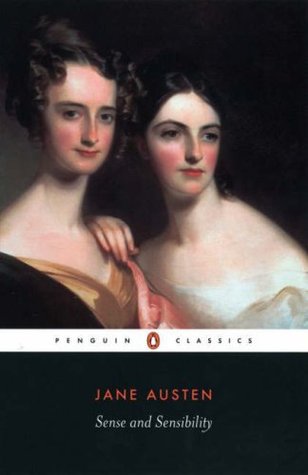
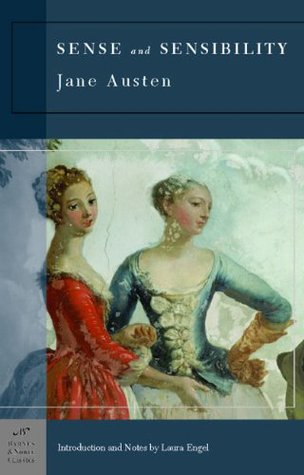
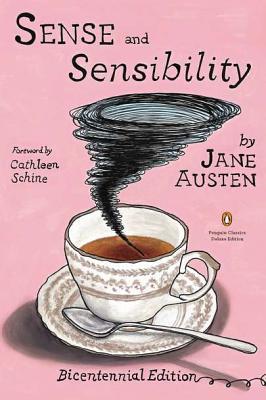
Sense and Sensibility

Sense and Sensibility. Jane Austen. 1811. 409 pages. [Source: Bought]

First sentence: The family of Dashwood had long been settled in Sussex.


Premise/plot: When Mr. Dashwood dies his second family is left wanting--not from lack of love on his part, but lack of compassion and honesty on the part of his eldest son, Mr. John Dashwood. Though I suppose one could argue that it wasn't lack of compassion and honesty but lack of backbone. Mr. John Dashwood does not 'wear the pants' in his household. His wife, Fanny, is a fierce force. She despises her step-mother-in-law and her sisters-in-law. She treats them with the thinnest layer of civility, but make no mistake she hates them. It not being enough for her to hate alone, she makes sure that her husband does as well.

The heroines of Sense and Sensibility are two of the three Dashwood sisters: Elinor and Marianne. (The youngest daughter is Margaret.)

Can these two beat the odds and overcome the obstacles that stand in the way of their happily ever afters? Elinor loves--prudently and with discretion--Mr. Edward Ferrars. Edward is the brother of Mrs. Fanny Dashwood. Edward is 'defying' his sister in the fact that he actually likes Mrs. Dashwood and her three daughters. He enjoys their company; perhaps he even loves their company. Marianne loves--wholeheartedly and without discretion--a Mr. John Willoughby. On the surface these two make an excellent match. They like and dislike the exact same things with the exact same intensity. (Is this a coincidence?) But Marianne is not his first woman to pursue, to woo. And his past may just come back to torment him....

Meanwhile, there is Colonel Brandon with a wisdom to match his years that quietly, persistently loves from afar. But who is it that he loves?! Mr. John Dashwood imagines that it is Elinor. And he's not alone, Mrs. Jennings inexplicably reaches this conclusion late in the novel. (And she should definitely know better!) Though to be fair, Mrs. Jennings is not overly discerning and John so rarely thinks about anyone besides himself that that isn't a big surprise that he'd be confused.

In some ways--many ways--the novel provides a contrast of wisdom and folly.

My thoughts: In the hands of an author like Jane Austen, Marianne and Elinor are safe. If Thomas Hardy had been writing Sense and Sensibility, I imagine that Marianne would have borne a child out of wedlock, brought shame and scandal to her family, and ultimately died for her foolish, ill-placed love. Because goodness knows if a woman loves foolishly, there are no second chances--she must be made an example of.

Would Hardy have allowed Elinor a happy ending? I'm not as certain that he wouldn't. After all, Lucy Steele would probably still be a gold-digger and switch her love and devotion to the other brother, Robert. Edward would still be free to return to
Elinor. Edward would probably not cast blame on Elinor for her sister's indiscretions. So Elinor and Edward would probably be allowed a relatively happy ending--unless Hardy added a postscript where one or the other died. 

I think Trollope would have been more forgiving than Hardy; more forgiving in the sense of being sympathetic. The Small House at Allington is so very, very similar to Sense and Sensibility, one could easily imagine Marianne's fate to be the same as Lily. Lily never 'got over' or 'moved on' from her first love. She would remain a 'spinster' living with her mother for the rest of her life. No matter how worthy John Eames was, he didn't stand a chance. (I still want a happy ending for these two. Why couldn't John and Lily get together?!?!?!)

Austen, however, has just the right touch. I love Jane Austen. I do.

Quotes:
Elinor, this eldest daughter, whose advice was so effectual, possessed a strength of understanding, and coolness of judgment...She had an excellent heart; her disposition was affectionate, and her feelings were strong; but she knew how to govern them: it was a knowledge which her mother had yet to learn; and which one of her sisters had resolved never to be taught. 
Marianne was sensible and clever; but eager in everything: her sorrows, her joys, could have no moderation. She was generous, amiable, interesting: she was everything but prudent.
I could not be happy with a man whose taste did not in every point coincide with my own. ~ Marianne
She knew that what Marianne and her mother conjectured one moment, they believed the next — that with them, to wish was to hope, and to hope was to expect.
A gentleman carrying a gun, with two pointers playing round him, was passing up the hill and within a few yards of Marianne, when her accident happened. The gentleman offered his services; and perceiving that her modesty declined what her situation rendered necessary, took her up in his arms without farther delay, and carried her down the hill.
His person and air were equal to what her fancy had ever drawn for the hero of a favourite story;
Her imagination was busy, her reflections were pleasant, and the pain of a sprained ankle was disregarded.
Men are very safe with us, let them be ever so rich.
Lady Middleton was more agreeable than her mother only in being more silent.
It is not time or opportunity that is to determine intimacy; it is disposition alone. Seven years would be insufficient to make some people acquainted with each other, and seven days are more than enough for others.
“It is not every one,” said Elinor, “who has your passion for dead leaves.” “No; my feelings are not often shared, not often understood. But sometimes they are.”
I wish as well as every body else to be perfectly happy; but, like every body else it must be in my own way.
Sometimes one is guided by what they say of themselves, and very frequently by what other people say of them, without giving oneself time to deliberate and judge. I never wish to offend, but I am so foolishly shy, that I often seem negligent, when I am only kept back by my natural awkwardness.
How few people know what comfort is!
Lady Middleton resigned herself to the idea of it, with all the philosophy of a well-bred woman, contenting herself with merely giving her husband a gentle reprimand on the subject five or six times every day.
Marianne was silent; it was impossible for her to say what she did not feel, however trivial the occasion; and upon Elinor therefore the whole task of telling lies when politeness required it, always fell.
Lady Middleton looked as if she thanked heaven that she had never made so rude a speech.
It was every day implied, but never professedly declared. Sometimes I thought it had been — but it never was.
Her kindness is not sympathy; her good-nature is not tenderness. All that she wants is gossip, and she only likes me now because I supply it.
Marianne, who had the knack of finding her way in every house to the library, however it might be avoided by the family in general, soon procured herself a book.
  
© 2019 Becky Laney of Becky's Book Reviews

Friday, March 15, 2019

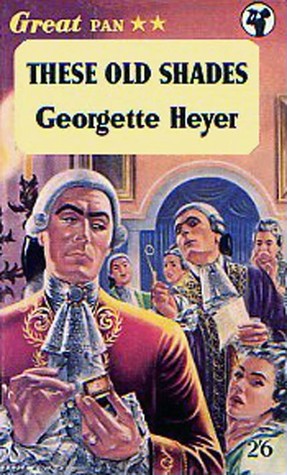
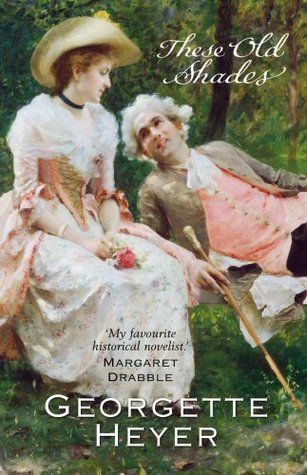
These Old Shades

These Old Shades. Georgette Heyer. 1926/2008. Harlequin. 384 pages. [Source: Bought]

First sentence: A gentleman was strolling down a side street in Paris, on his way back from the house of one Madame de Verchoureux.

Premise/plot: These Old Shades has a lively, impulsive, honest heroine in Leonie.  The hero, Justin Alistair, is equally unforgettable, a man with a horrid reputation with the ladies. (Among other things, he's even KIDNAPPED a lady in an attempt to get her to marry him.) He's not called 'devil' for nothing. But try telling Leonie that Justin is anything but an absolute angel! You see, he rescued her from her mean brother, he bought her. Of course, even that isn't quite what it appears to be. For Leonie was then posing as, Leon, a young man. (She'd been living as a boy since she'd turned twelve.) So Avon first meets Leon, likes the red hair and dark eyebrows, and decides the boy would be a good page. It would be useful to him to have the boy in his household...

There are also hints of villainy throughout These Old Shades as Justin prepares to use Leonie as a weapon against one of his own enemies...


My thoughts: These Old Shades has an intriguing opening and a marvelous conclusion. (The last seventy-five pages or so are just wonderful!) There are some lively conversations in between, of course. As Leon is taken to England and transforms into Leonie. As Avon tries through two women (his sister, his cousin) to teach her how to be a lady, how to dress, how to walk, how to talk, what to say, and most importantly what NOT to say. Readers are introduced to Justin's family: his sister, his brother-in-law, his brother, his neighbors, etc. Rupert, Justin's brother, becomes a playmate of sorts for Leonie. Both being immature, teasing, silly.

These Old Shades is my mother's favorite novel by Georgette Heyer. It isn't necessarily my favorite. But I do enjoy rereading it very much.

There is a connection--a connection in my opinion that has to be intentional--between The Black Moth and These Old Shades. I do wish that the names matched since These Old Shades is essentially a sequel set four years later. Lavinia has been renamed Fanny; Richard has been renamed Edward; Jack has been renamed Anthony Merivale; Diana has been renamed Jennifer; Tracy has been renamed Justin.


I found out yesterday that Mom has NEVER read The Black Moth. I was a bit shocked because I thought she'd read every Heyer novel! I am curious to see if she makes the connections between These Old Shades and The Black Moth and if she reaches the same conclusion I did.

Quotes:
"Vengeance?" Hugh leaned forward. "I thought you disliked melodrama, my friend?"
"I do; but I have a veritable passion for justice."
"You've nourished thoughts of--vengeance--for twenty years?"
"My dear Hugh, if you imagine that the lust of vengeance has been my dominating emotion for twenty years, permit me to correct the illusion."
"Has it not grown cold?" Hugh asked, disregarding.
"Very cold, my dear, but none the less dangerous."
"And all this time not one opportunity has presented itself?"
"You see, I wish it to be thorough," apologized the Duke.
"Are you nearer success now than you were--twenty years ago?"
A soundless laugh shook Justin.
"We shall see. Rest assured that when it comes, it will be--so!" Very slowly he clenched his hand on his snuff-box, and opened his fingers to show the thin gold crushed.
Hugh gave a little shiver.
"My God, Justin, do you know just how vile you can be?"
"Naturally: Do they not call me Satanas?" The mocking smile came; the eyes glittered. (27)

"Remind me one day to teach you how to achieve a sneer, Hugh. Yours is too pronounced, and thus is but a grimace. It should be but a faint curl of the lips." (88)

"It is always wise to believe the worst of me, Fanny."
"I confess I don't understand you, Justin. 'Tis most provoking."
"It must be," he agreed.
She drew nearer, coaxing him.
"Justin, I do wish that you would tell me what is in your mind!"
He took a pinch of snuff, and shut the box with a snap.
"You must learn, my dear Fanny, to curb your curiosity. Suffice it that I am as a grandfather to that child. It should suffice." (122)

"Did you think we had eloped?" Rupert inquired.
"That explanation did present itself to me," admitted his Grace.
"Eloped?" Leonie echoed. "With Rupert? Ah, bah, I would as soon elope with the old goat in the field!"
"If if comes to that, I'd as soon elope with a tigress!" retorted Rupert. "Sooner, by Gad!"
"When this interchange of civilities is over," said his Grace languidly, "I will continue. But do not let me interrupt you." (196)


© 2019 Becky Laney of Becky's Book Reviews

Tuesday, February 12, 2019

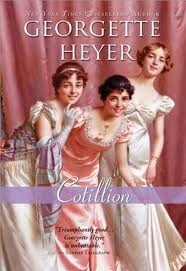
Cotillion

Cotillion. Georgette Heyer. 1953/2007. Sourcebooks. 355 pages. [Source: Review copy]

 First sentence: The saloon, like every other room in Arnside House, was large and lofty, and had been furnished, possibly some twenty years earlier, in what had then been the first style of elegance.

Premise/plot: Kitty, our heroine, will inherit a LOT of money if only she'll marry one of her cousins. Technically they're not blood relatives, she's been raised by her guardian. These "cousins" are his great-nephews. There are four single cousins to choose from...but this situation is far from ideal for everyone concerned. Kitty wants to live life a little and see what there is to see--namely go to London for the first time and mingle with society. She knows that her guardian will never allow such a thing. But if she was engaged...if she was taken under the wing of her fiance's family...then she could get what she wants. What she doesn't account for is her wants changing. She had no inkling that her sham engagement would prove to be real deal. That her ridiculous cousin, Freddy, would be her soul mate....

My thoughts: This is the third time I've read Cotillion. I will admit that it has a slow beginning. The first half of the novel moves so slow and there seems to be little reward for the effort. However, the second half is quick-paced. The characters are enjoyable--at last. The situations are comical. The dialogue turns witty. There is something about it that is very satisfying.

© 2019 Becky Laney of Becky's Book Reviews

Monday, January 16, 2017

The Kellys and the O'Kellys

The Kellys and the O'Kellys. Anthony Trollope. 1848. 537 pages. [Source: Bought]

First sentence: During the first two months of the year 1844, the greatest possible excitement existed in Dublin respecting the State Trials, in which Mr O’Connell, his son, the Editors of three different repeal newspapers, Tom Steele, the Rev. Mr Tierney — a priest who had taken a somewhat prominent part in the Repeal Movement — and Mr Ray, the Secretary to the Repeal Association, were indicted for conspiracy.

Premise/plot: Anthony Trollope's second novel, The Kellys and the O'Kellys, chronicles the romances of two men, a Mr. Martin Kelly, and Frank O'Kelly (aka Lord Ballindine). Like Trollope's first novel, it is set in Ireland. Though from different social classes, there is a friendship, of sorts, between the two men. At various times, for various reasons, they seek out one another's company.

In fact, the novel opens with Mr. Martin Kelly going to Lord Ballindine for advice. He wants to marry Anty Lynch. He thinks she's say yes. But there's an obstacle: her brother, Barry. Neither thinks Barry will consent to the marriage. Martin doesn't know if he should try to get her to elope with him and deal with the brother after the fact, or, if he should try to get the brother's consent and risk losing Anty. One thing is clear, he doesn't want anyone thinking that he's trying to take advantage of Anty and manipulate her into marriage. Why? Because she is richer than him, she's recently benefited from her father's will. Barry has issues. Issues is an understatement. He's bitter, angry, and drunk ninety percent of the time. Angry and bitter that their father's will provided for Anty; angry and bitter that he didn't get it all. In truth, he begrudges Anty the air she breathes.

Barry finds out that Anty and Mr. Martin might marry, that there is some talk of a marriage between the two. Barry decides to beat up his sister--remember he has two states 'drunk' and 'asleep.' She's savagely attacked by him, and threatened. He'd rather see her dead than married. A brave servant girl slips out of the house the next morning to go and tell Mrs. Kelly--Martin's mother--what's happened. Mrs. Kelly comes and fetches the girl--while Barry's asleep--to her own home. Martin's mother and sisters will care for her and protect her--as best they can--from Barry. Mrs. Kelly is an awesome defender who can hold her own.

Martin Kelly returns from his visit to see Lord Ballandine and learns all that is happened.

Meanwhile, Lord Ballindine is entertaining the idea of marriage himself. He's in fact engaged to marry a Miss Fanny Wyndham. Soon after the novel opens, he hears from an acquaintance, that HIS match has been broken off. The marriage isn't to be after all. He rushes to Grey Abbey--where she is staying with her aunt and uncle, her guardians--and is confronted with all kinds of unpleasantness. Lord Cashel, the uncle, has changed his mind entirely, and, has persuaded Fanny that it's in her best interest to call off the engagement. The truth is UGLY. Fanny's brother has died; Fanny went from being moderately wealthy to ridiculously wealthy. Lord Cashel wants his own son, Lord Kilcullen, to marry Fanny. He needs Ballindine out of the way. Lord Cashel won't let him see her, and forbids him to come to the house or write.

Lord Ballandine loves Fanny and is determined to marry her. He won't be easily dissuaded.

The book alternates back and forth between these two dramatic love stories.

My thoughts: This one is DRAMATIC but good. Trollope created some memorable characters in this one. I really loved getting to spend time with Fanny especially! I liked Anty well enough, I suppose, but she spent a lot of time in bed almost dying. Anty is one of those good--practically saintly--characters. Imagine someone apologizing for still breathing, and you've got the right idea. Anty's biggest flaw is that she wants every single person to be happy and get what they want. And that's just not possible. Fanny was a strong character, for the most part. Yes, she was persuaded--for a day, maybe two, to follow her uncle's advice, but she remains true to her heart, and VOCAL about what she wants. Martin Kelly and Lord Ballandine (Frank) were GREAT heroes. I really enjoyed spending time with these two. I didn't prefer one story to the other really. Both were compelling.

I really enjoyed Trollope's writing. He sketches scenes and characters very well! Here's a description of Sally, one of Mrs. Kelly's servants.
Mrs. Kelly kept two ordinary in-door servants to assist in the work of the house; one, an antiquated female named Sally, who was more devoted to her tea-pot than ever was any bacchanalian to his glass. Were there four different teas in the inn in one evening, she would have drained the pot after each, though she burst in the effort. Sally was, in all, an honest woman, and certainly a religious one; — she never neglected her devotional duties, confessed with most scrupulous accuracy the various peccadillos of which she might consider herself guilty; and it was thought, with reason, by those who knew her best, that all the extra prayers she said, — and they were very many, — were in atonement for commissions of continual petty larceny with regard to sugar.
On this subject did her old mistress quarrel with her, her young mistress ridicule her; of this sin did her fellow-servant accuse her; and, doubtless, for this sin did her Priest continually reprove her; but in vain. Though she would not own it, there was always sugar in her pocket, and though she declared that she usually drank her tea unsweetened, those who had come upon her unawares had seen her extracting the pinches of moist brown saccharine from the huge slit in her petticoat, and could not believe her.
Favorite quotes:
Time and the hour run through the longest day.
It’s difficult to make an Irishman handy, but it’s the very devil to make him quiet.
“But the great trial in this world is to behave well and becomingly in spite of oppressive thoughts: and it always takes a struggle to do that, and that struggle you’ve made. I hope it may lead you to feel that you may be contented and in comfort without having everything which you think necessary to your happiness. I’m sure I looked forward to this week as one of unmixed trouble and torment; but I was very wrong to do so. It has given me a great deal of unmixed satisfaction.”
I tell you plainly, Selina, I will not forget myself, nor will I be forgotten. Nor will I submit to whatever fate cold, unfeeling people may doom me, merely because I am a woman and alone. I will not give up Lord Ballindine, if I have to walk to his door and tell him so. And were I to do so, I should never think that I had forgotten myself.” “Listen to me, Fanny,” said Selina. “Wait a moment,” continued Fanny, “I have listened enough: it is my turn to speak now. For one thing I have to thank you: you have dispelled the idea that I could look for help to anyone in this family.
© 2017 Becky Laney of Becky's Book Reviews

Sunday, October 12, 2014

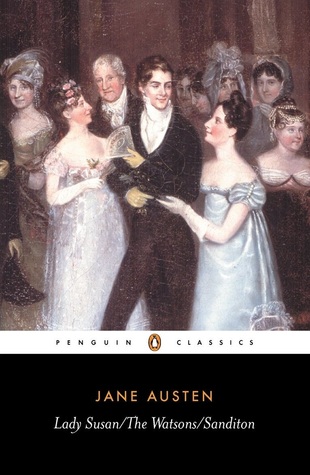
My Year with Jane: Lady Susan, Watsons, Sandition

Lady Susan, The Watsons, Sandition. Jane Austen. 1975. Penguin. 211 pages. [Source: Bought]

Lady Susan. I've read Lady Susan several times now. This is a quick, enjoyable read. I always forget how playful it is until I'm rereading it. I do have a tendency to dismiss it. The story, the drama, is told almost exclusively through letters. The epilogue being the exception. While I'm glad that readers do learn what happens next, how happily ever after is achieved for certain characters, it doesn't quite feel like it belongs either.

In the novel, readers meet Lady Susan and her daughter. She has invited herself to stay with a brother-in-law, I believe, and his family. Catherine is one of the main characters. She HATES Lady Susan and wishes she could politely throw her out of her home. She LOVES Lady Susan's daughter, however. One of Lady Susan's biggest fans is Reginald, Catherine's brother. Lady Susan can do no wrong in his eyes. His journey to the truth is interesting but frustrating.

The characters in this one are certainly different. Lady Susan reminds me of Mary Crawford in a way, with Mary Crawford being the tamer. Lady Susan is SOMETHING. She belongs on a soap opera perhaps.
Where there is a disposition to dislike, a motive will never be wanting.
In short, when a person is always to deceive, it is impossible to be consistent.
Facts are such horrid things!
The Watsons. This was my first time to read this incomplete novel. I would have loved it if Austen had finished it, I'm sure. It has so much potential. It had me from hello. Unfortunately, it is too brief to be truly satisfying. But in just a few short chapters, I found everything I love about Austen to be present.   
Miss Emma Watson, who was very recently returned to her family from the care of an aunt who had brought her up, was to make her first public appearance in the neighbourhood, and her eldest sister, whose delight in a ball was not lessened by a ten years’ enjoyment, had some merit in cheerfully undertaking to drive her and all her finery in the old chair to D. on the important morning.
Sandition. This was also my first time to read this incomplete novel. I think I liked the beginning of The Watsons more than I liked Sandition. (Even though Sandition is longer. Even though I found Sandition more quotable.) I am glad I read it...once. It was certainly enjoyable enough for what it was.
Sanditon was a second wife and four children to him, hardly less dear, and certainly more engrossing. He could talk of it forever. lt had indeed the highest claims; not only those of birthplace, property and home; it was his mine, his lottery, his speculation and his hobby horse; his occupation, his hope and his futurity.
EVERY NEIGHBOURHOOD should have a great lady. The great lady of Sanditon was Lady Denham; and in their journey from Willingden to the coast, Mr. Parker gave Charlotte a more detailed account of her than had been called for before. She had been necessarily often mentioned at Willingden -- for being his colleague in speculation, Sanditon itself could not be talked of long without the introduction of Lady Denham. That she was a very rich old lady, who had buried two husbands, who knew the value of money, and was very much looked up to and had a poor cousin living with her, were facts already known; but some further particulars of her history and her character served to lighten the tediousness of a long hill, or a heavy bit of road, and to give the visiting young lady a suitable knowledge of the person with whom she might now expect to be daily associating.
She took up a book; it happened to be a volume of Camilla. She had not Camilla’s youth, and had no intention of having her distress; so she turned from the drawers of rings and brooches, repressed further solicitation and paid for what she had bought.
 
© 2014 Becky Laney of Becky's Book Reviews

Thursday, June 20, 2013

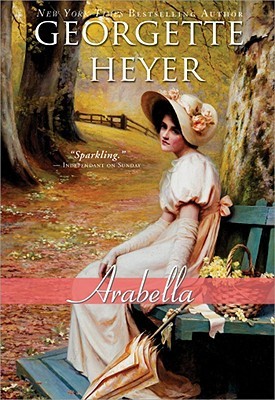
Arabella (1949)

Arabella. Georgette Heyer. 1949/2009. Sourcebooks. 312 pages.

I definitely enjoyed rereading Arabella by Georgette Heyer. Arabella is being treated to a season in London by her godmother. On her way, she runs into a little difficulty. She accidentally meets one of society's most eligible but oh-so-impossible-to-catch bachelors--wealthy of course--Mr. Robert Beaumaris. When she overhears a conversation not to her liking, she impulsively tells a few big lies. She's wealthy too. She understands what it is like to be chased for one's money. She hates all the fuss, too. Of course, at the time she had no idea who he was or how "important" he was in society. She just thought he was arrogant and insufferable! But when her godmother makes much of him, invites him to her debut party, well, Arabella begins to grasp the situation better!

Arabella is enjoyable as a heroine. I also really liked Mr. Beaumaris. I loved getting his point of view! It was fun to see him chase her!


© 2013 Becky Laney of Becky's Book Reviews

Thursday, May 16, 2013

Kept in the Dark (1882)

Kept in the Dark. Anthony Trollope. 1882. 512 pages.

I love, love, love Anthony Trollope. Kept in the Dark is a novel about relationships. Cecilia Holt, our heroine, when we first meet her is engaged to be married to Sir Francis Geraldine. While she was madly in love with him for a few brief weeks, she soon begins to see that he is not the one for her. There is something not quite right about him, something that worries her. So. She tells him that she's changed her mind. She will not be marrying him. His vanity is wounded, so he goes and boasts that he changed HIS mind. She doesn't care that much at the time; after all, the important thing is that the engagement is over. Even Cecilia's three closest friends don't know what to believe in the matter. Cecilia chooses not to gossip, not to add to the rumors. A few months later Cecilia and her mother are traveling around in Europe. She meets a man just a few years younger than Sir Francis. (Sir Francis was quite a bit older than Cecilia). He tells her after a brief acquaintance that he's suffering from a broken heart. A young woman, a beautiful woman, (a SILLY woman) has broken their engagement; she's fallen in love with a younger man, a Captain Geraldine. Cecilia's only known George Western a week! He's opened up his life to her, sharing his thoughts and cares, but how should she respond? She's certainly not brokenhearted herself, and except for the fact that there was not another man, her case superficially resembles his. She did "jilt" an older man. So she remains silent. As time goes by and they meet again and again in their travels, the two fall in love. Cecilia has an idea that she should tell him about her former engagement, but, the time doesn't seem right. To interrupt during the proposal would be awkward at best. She at first plans to tell him before the wedding, but, then her determination weakens. In a matter of months, the two are wed and her husband is still being "kept in the dark."

Most of the novel focuses on her husband's reaction to the news. For those that have read He Knew He Was Right, George Western does not do a Louis Trevelyan. Not quite. He leaves her quite suddenly, and he does insist on a permanent separation. But he offers her the country house, his home, and all the money she wants. She refuses these "kindnesses" which seem so cruel. She returns to her mother's house...but that is not the end of the story!

Unlike previous Trollope novels, readers only meet a few characters. The other two characters we spend time with are Sir Francis Geraldine and Francesca Altifiorla. Miss Altiforla was a "dear friend" to Cecilia Holt at the start of the novel; but she is VICIOUS. We also get a quick glimpse or two of Lady Grant, George's sister. I really loved this minor character!

I enjoyed this one. I really did. 

Quotes:
People are taken and must be taken in the position they frame for themselves. (6)
"Do you measure the one thing by the other," said Lady Grant; "a man's desires by a woman's, a man's sense of honour by what a woman is supposed to feel? Though a man keep such secrets deep in his bosom through long years of married life, the woman is not supposed to be injured. She may know, or may not know, and may hear the tale at any period of her married life, and no harm will follow. But a man expects to see every thought in the breast of the woman to whose love he trusts, as though it were all written there for him in the clear light, but written in letters which no one else shall read." (55)
"Lies are a sort of thing which are very commonly told, and are ordinarily ascribed to the world at large. The world never quarrels with the accusation. The world has told most infernal lies to this man about his wife. (124)

© 2013 Becky Laney of Becky's Book Reviews

Saturday, January 12, 2013

Brentwood (1937)

Brentwood. Grace Livingston Hill. 1937. 315 pages.

Marjorie Wetherill had always known she was an adopted child. She had been told when she was so young that it meant nothing at all to her. And as the years went by and she was surrounded by love and luxury, she thought little of it.

After the death of her adoptive parents, Marjorie discovers a letter written by her (adoptive) mother; a letter revealing some dark(er) truths about her adoption. Her biological mother wanted her very much--loved her dearly. But her father was sick, in desperate need of medical treatment, as was her twin sister. Mr. Wetherill promised to pay for everything the family would need, to see to everything in exchange for the healthy baby girl. He was very persuasive and she was at her weakest, perhaps. The deal was made; the adoption a reality. The letter later revealed how the birth mother came years later to try to see her, came with the money they'd received only to be turned away, dismissed without a thought. The letter was repentant, begging Marjorie's forgiveness. With that letter came her mother's name and address. And so Marjorie's journey to "her own people" began...

There was one man, Evan, who did NOT want her to go. A man worthy of being booed and hissed. For in his addressing his "darling," his "poor child," his "little girl" he reveals his true colors. He seeks only to possess her so he can control her. Readers are "treated" with his perspective revealing how he wants to "train" her and "mold" her to his liking, how when she is his wife, he'll set her straight and train the foolish notion of independence right out of her. One of the first things he wants to train out of her is her conscience. He doesn't like that she thinks of others--the world at large, the world outside his narrow perception of society. He wants her to be kind and compassionate--but only so that she can put him first and be perfectly obedient to him.

But Marjorie does leave her comfortable life in Chicago. And she finds her family just in time. Her mother and father are both sick. As is one of her younger sisters. They are about to lose their apartment; they have no coal for a fire or gas for a stove; they have no food to cook. They have pawned almost everything they owned. She's there now--for better or worse. And she's going to see to all their needs no matter what the fuss. She is their sister like it or not.

The novel chronicles their first few weeks together as a reunited family. It is Christmas time. And she's determined it will be the BEST Christmas ever...

While the family is large, readers mainly get to know Marjorie, Betty (Marjorie's twin), and Ted. Ted invites Marjorie to go to church with him. His sister, Betty, will not go to church. Marjorie is impressed with the preacher and the sermon. She's full of questions, and through asking those questions and receiving answers, she comes to Christ and realizes her eternal security. She is then most eager to keep company with the young preacher, Gabriel.

Throughout these weeks, Marjorie is trying to decide what is best for herself and her family...where does she belong?!

I enjoyed Brentwood. It definitely had some Christian lessons in it. It clearly had a couple of gospel presentations in it, conversations where characters discuss what it means to be saved, what it means to be born again, how you can know if you're going to heaven or hell, how being good isn't good enough, how trusting in being good enough is anti-gospel. But what I appreciated even more than the obvious lessons where the quieter lessons.

Read Brentwood
  • If you enjoy christian romance novels, clean romance novels
  • If you enjoy historical fiction; though it was written as a contemporary romance--would have been read by its original audience as contemporary. Set in 1930s America
  • If you enjoy adoption stories 
© 2013 Becky Laney of Becky's Book Reviews

Thursday, January 03, 2013

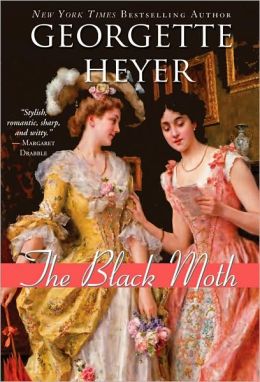
The Black Moth (1921)

The Black Moth. Georgette Heyer. 1921/2009. Sourcebooks. 355 pages.

One of my goals for 2013 is to read through Georgette Heyer's romance novels chronologically. Her first romance, her first novel, is The Black Moth. I definitely enjoyed The Black Moth. I enjoyed the characters, the dialogue, the plot, the richness of the details.

The Black Moth is the story of two brothers. John Carstares (sometimes called Jack Carstares OR Anthony Ferndale, also Earl of Wyndam) took the blame when his younger brother, Richard, cheated at cards. The older brother left the country in disgrace, the younger brother took his place in the family and in society. He married and had a son. But is Richard happy knowing that his "happy" life is founded on a lie? Is he happy with his oh-so-beautiful wife, Lady Lavinia? He certainly doesn't like her family depending on him all the time to save them from debt and disgrace. (Why does her family like to spend so much money, to gamble, etc?! Why is the whole family so me-me-me?!) The Black Moth follows the personal lives of BOTH brothers.

John, meanwhile, has returned to England and has become a highwayman. He is extremely particular in who he robs, mind you. And though he might appear a villain, anyone who spends more than a few minutes in his company will think him a good gentleman. His true identity is uncovered by one of his closest friends (from the past), Sir Miles O'Hara; I love Miles and his wife, Molly. Carstares is given plenty of time to appear heroic in the novel. For he saves a young woman from true harm, from being kidnapped...he's wounded in the process. And as he's recuperating in her family's home, the two fall in love with one another. But that love isn't without complications, of course, for his true name would bring disgrace and perhaps ruin her reputation. Unless his name was cleared first...but he couldn't ask his brother after all these years....

I enjoyed reading about both brothers. Poor Richard has quite a wife!!! One can't help enjoying reading about Lady Lavinia. She's so dramatic and selfish and silly. Her scenes with her two brothers and her scenes with Harry Lovelace offer something certainly! And one of Lavinia's brothers is certainly a CHARACTER. His 'real' name, I suppose, is Tracy. But he, like our hero, likes to have plenty of names to match any and every situation. He is John's rival for the affections of Diana.

This one has drama, romance, and some action...

A scene between Lavinia and her brother, Tracy, (Duke of Andover)
She stamped angrily. 'Oh, where's the good in being flippant?'
'My dear Lavinia, where's the good in being anything else? The situation strikes me as rather amusing. To think of the worthy Richard so neatly overturning all my plans!'
'If it had not been for you, I might never have married him. Why did you throw them both in my way? Why did I ever set eyes on either?'
'It should have been a good match, my dear, and, if I remember rightly, no one was more alive to that fact than yourself.'
'Still,' he continued reflectively, 'I admit that for the smart lot we are, we do seem rather to have bungled the affair.' (63)
A scene between Lavinia and her husband, Richard...
'Richard, I was coming in search of you! Tracy has invited me to Andover for a week--he purposes to ask several people to stay, and there will be parties--and entertainment! You will let me go? Say yet, Dicky--say yes, quickly!'
Carstares bowed to his Grace, who stood watching them from the stairs. The bow was returned with exaggerated flourish. Carstares looked down at his wife.
'So soon, Lavinia?' he remonstrated, and indicated her mourning. She shook his hand off impatiently.
'Oh, Dicky, does it matter? What can it signify? I do not ask you to come--'
'No,' he said half-sadly, half-amusedly. 'I notice that, my dear.'
'No, no! I did not mean to be unkind--you must not think that! You don't think it, do you, Dick?'
'Oh, no,' he sighed.
'Good Dicky!' She patted his cheek coaxingly. 'Then you will allow me to go--ah, but yes, yes, you must listen! You know how dull I am, and how silly--'tis because I need change, and I want to go to Andover. I want to go!'
'Yes, dear, I know. But my father is not yet dead six  weeks and I cannot think it seemly--'
'Please, Dick, please! Please do not say no! Twill make me so unhappy! Oh you will not be so unkind? You will not forbid me to go!'
'I ask you not to, Lavinia. If you need a change, I will take you quietly to Bath, or where you will. Do not pain me by going to Andover just now.'
'Bath! Bath! What do I want with Bath at this time of the year? Oh, 'tis kind in you to offer, but I want to go to Andover and I want to see all the old friends again. And I want to get away from everything here--'tis all so gloomy--after--after my lord's death!'
'Dearest, of course you shall go away--but if only you would remember that you are in mourning--'
'But 'tis what I wish to forget! Oh, Dicky, don't don't, don't be unkind.'
'Very well, dear. If you must go--go.'
She clapped her hands joyfully.
'Oh thank you, Dicky! And you are not angry with me?'
'No, dear, of course not.' (66-7)
 Read The Black Moth
  • If you enjoy historical romances (this one is set in the Georgian period)
  • If you enjoy clean historical romance
  • If you're a fan of Georgette Heyer
© 2013 Becky Laney of Becky's Book Reviews
Wednesday, June 13, 2012

Short-Straw Bride

Short-Straw Bride. Karen Witemeyer. 2012. Bethany House. 368 pages.

From the prologue: Ten-year-old Meredith Hayes balled her hands into fists as she faced her tormentor, "Hiram Ellis! Give me back my lunch bucket this instant!"

From chapter one: "I don't think I can do it, Cass." Meredith peered up at her cousin through the reflection in the vanity mirror. Cassandra pulled the hairpin from her mouth and secured another section of Meredith's braided chignon. "Do what?" "Marry a man who wants me only for the land I can bring him." 

This isn't my first Karen Witemeyer book; however, it is the first Karen Witemeyer book that I absolutely LOVED, LOVED, LOVED. Short-Straw Bride is a Christian historical romance; it is set in Palestine, Texas in the 1880s.

In the prologue, Travis Archer saves the then-ten-year-old Meredith, her leg having gotten trapped in a hunting trap. The incident stays with her, as you might imagine. First, because she can't forget Travis Archer, he is forever her hero, the stuff of her dreams, despite the fact that that isolated incident is the only time she's seen him. Second, because it left a scar on her leg and the damage to the bone prevented it from growing as it should; one leg being slightly longer than the other.

The novel opens with Meredith all grown up and living with her aunt and uncle who are her guardians. They have arranged a marriage for her with an up-and-coming businessman, Roy Mitchell. Meredith prays for a sign, an indication one way or another if she should marry the man her guardians have chosen for her, or, if she should be stubborn and refuse their choice. And the sign, when it comes, is definite: she not only overhears him calling her a cripple, she overhears him making unethical arrangements to acquire land. He WANTS the Archer land, and since the Archer brothers won't sell, won't negotiate, won't budge, he's decided that if he burns their barn down, it will be a good first step to getting what he wants.

So what's a woman to do? Well, she does try going to the sheriff--or the deputy?--but when she's not taken seriously, when she's instead ridiculed for being a silly woman with a vivid imagination, she does what she must: she rides out to the Archer land herself to warn them. The problem? She doesn't have the time to ride out there and back before nightfall. And she wasn't counting on her cousin giving into the pressure of revealing her whereabouts. So her heroic ride to warn them just in time turns into a compromising reputation-killer. Her uncle demanding that one of the four Archer brothers step forward to marry her....

I admit this one could sound a bit silly to some readers, but, oh how I loved it!!!! I loved Meredith! I loved Travis! I loved their relationship, their marriage, their courtship-coming-after-marriage. I loved seeing how Meredith's presence on the Archer farm transforms the place, transforms the brothers. I loved just about everything in this one!!! There were quite a few giddy-making scenes!

Will Short-Straw Bride appeal to every reader? I doubt it. It's definitely for those that love Christian fiction, those that love Christian historical romance. I could see it having some appeal to non-Christians who love and seek out clean romance novels (smut-free romance novels).

Read Short-Straw Bride
  • If you enjoy Christian fiction
  • If you enjoy Christian historical romance
  • If you enjoy clean romance novels
  • If you are looking for historical romance set in Texas
© 2012 Becky Laney of Becky's Book Reviews

Wednesday, October 19, 2011

Wonderland Creek

Wonderland Creek. Lynn Austin. 2011. Bethany House. 400 pages.

If my life were a book, no one would read it. People would say it was too boring, too predictable. A story told a million times. But I was perfectly content with my life--that is, until the pages of my story were ripped out before I had a chance to live happily ever after.

Our heroine, Alice Grace Ripley, has spent most of her life in Illinois taking things for granted. Things like her job at the library, even though it's the middle of the Depression, Alice assumes that work at the library will continue on. After all, don't people need to read more than ever? And she completely takes her boyfriend, Gordon, for granted. Assuming that he will always be by her side--even though the two have little in common. She's not interested in his work--he's an undertaker, or at the very least he works in the funeral home business. And he's definitely not interested in her work, the number of books she's read that week, the characters in those books, plot elements and twists, etc. So when Gordon discovers her reading a book at a funeral, well, he makes the decision that their relationship would never work. Soon after this disappointment, she learns that the library will have to change its hours and let go of their newest hire; yes, that would be Alice.

Her parents--her father in particular--are big on lists. So Alice won't be allowed time at home to be depressed. So when her Aunt and Uncle mention a trip to a spa--a trip that will take them through Kentucky, well, she asks--almost begs--to join them. For there is a small town (a mountain town) in Kentucky in need of books. Alice has been having a book drive for them, and she's got five boxes of books. She'd love to deliver them herself.

What Alice couldn't predict was her welcome in that town. And how VERY different this rural life would be from everything she's ever known. The librarian, Leslie MacDougal (Mack), isn't all that thrilled with her when she arrives. Where will she stay? Where will she sleep? There isn't exactly a hotel or boarding room about?! And Alice is shocked to discover that the librarian is a man! Which definitely complicates things!

But soon SOMETHING happens that changes everything, it seems that God had a very clear purpose for Alice coming to stay just when she did...

Will her friends and family ever believe her story?!

Wonderland Creek is a great book. Alice is a librarian, a book lover. Though her life in Kentucky does not offer much opportunity to read. The book is a fascinating look at packhorse librarians. Librarians who deliver books to their patrons--by horse. And, of course, it's an interesting look at Appalachian life as well.

If you enjoy historical fiction--set in the 1930s--or mysteries, or romance, then you should try Wonderland Creek. I loved the setting. (It reminded me--in a good way, of course--of Christy.) I loved the characters. And the story.

© 2011 Becky Laney of Becky's Book Reviews

Monday, October 17, 2011

Love on the Line

Love on the Line. Deeanne Gist. 2011. Bethany House. 365 pages.

"Everybody off the train."

Love on the Line had me hooked from the start. Texas Ranger, Lucius Landrum, is trying his best to catch a gang of train robbers, a gang led by Frank Comer. His quest leads him on an undercover job. He'll be coming to the small Texas town as Luke Palmer, a troubleman for the phone company. He'll be putting up new lines for the company, repairing lines, trying to get new customers, etc. The town has a phone operator, Georgie Gail, who's VERY independent and a bit unsure about Luke--at least in the beginning.

Luke is trying to catch the bad guys, but he's undercover, so he has to go about it in a certain way. He has to become very friendly with all sorts of different people in the town. Including Miss Gail.

Miss Gail is trying to fight injustice in her own way. The milliner in town infuriates her by his use--his over-use--of bird parts on his hats and accessories. She thinks ANY use of a dead bird is over use. And she's appalled that fashion is so out of control that it is threatening the bird populations. She LOVES birds and wants to see a change. So she's out to organize the women and children in the community.

I enjoyed both characters very much. Loved how the story came together.

The novel is set at the turn of the century.

© 2011 Becky Laney of Becky's Book Reviews