Showing posts with label 1871. Show all posts

Thursday, February 05, 2026

14. Alice's Adventures in Wonderland and Through the Looking Glass


14. Alice's Adventures in Wonderland. Lewis Carroll. Illustrated by John Tenniel. 1865/1871. 247 pages. [Source: Bought]

ETA: I listened to these two books on audio narrated by Christopher Plummer. The first book was AMAZING, AMAZING, AMAZING. The second book had some characters that were very obnoxious to hear narrated. I am not saying Plummer did poorly, just, that it is easier to take obnoxious characters when you don't have to hear them.

First sentence: Alice was beginning to get very tired of sitting by her sister on the bank, and of having nothing to do: once or twice she had peeped into the book her sister was reading, but it had no pictures or conversations in it, ‘and what is the use of a book,’ thought Alice, ‘without pictures or conversations?’

Premise/plot: Alice follows a white rabbit down a rabbit hole and has several fantastical seemingly impossible adventures before waking.  
 
First sentence: One thing was certain, that the white kitten had nothing to do with it – it was the black kitten’s fault entirely. For the white kitten had been having its face washed by the old cat for the last quarter of an hour (and bearing it pretty well, considering): so you see that it couldn’t have had any hand in the mischief.

Premise/plot: Alice doesn't follow a rabbit on her second adventure; no, she crawls through the looking glass into the looking glass house. Just as she always imagined, life is very different on the other side of the mirror. (For one thing, the chess pieces are alive.) Readers follow Alice's adventures as a pawn as she journeys towards being queened. Like the first book, this one is full of fantastical impossibilities.

My thoughts: I love, love, LOVE Lewis Carroll's Alice's Adventures in Wonderland. I couldn't begin to tell you how many times I've read it in my life. It's a magical read filled with silly characters--quite a few I'd deem unforgettable. What stands out to me--even more than the characters--is the writing. There is just something quotable and ever-relevant about the narrative.

Favorite quotes from Alice in Wonderland:
‘Do cats eat bats? Do cats eat bats?’ and sometimes ‘Do bats eat cats?’, for, you see, as she couldn’t answer either question, it didn’t much matter which way she put it. She felt that she was dozing off, and had just begun to dream that she was walking hand in hand with Dinah, and was saying to her, very earnestly, ‘Now, Dinah, tell me the truth: did you ever eat a bat?’, when suddenly, thump! thump! down she came upon a heap of sticks and dry leaves, and the fall was over.
Oh, how I wish I could shut up like a telescope! I think I could, if I only knew how to begin.’ For, you see, so many out-of-the-way things had happened lately, that Alice had begun to think that very few things indeed were really impossible.
She generally gave herself very good advice (though she very seldom followed it), and sometimes she scolded herself so severely as to bring tears into her eyes; and once she remembered trying to box her own ears for having cheated herself in a game of croquet she was playing against herself, for this curious child was very fond of pretending to be two people. ‘But it’s no use now,’ thought poor Alice, ‘to pretend to be two people! Why, there’s hardly enough of me left to make one respectable person!’
Let me think: was I the same when I got up this morning? I almost think I can remember feeling a little different. But if I’m not the same, the next question is “Who in the world am I?” Ah, that’s the great puzzle!’
‘Perhaps it doesn’t understand English,’ thought Alice. ‘I daresay it’s a French mouse, come over with William the Conqueror.’ (For, with all her knowledge of history, Alice had no very clear notion how long ago anything had happened.) So she began again: ‘Où est ma chatte?’, which was the first sentence in her French lesson-book. The Mouse gave a sudden leap out of the water, and seemed to quiver all over with fright. ‘Oh, I beg your pardon!’ cried Alice hastily, afraid that she had hurt the poor animal’s feelings. ‘I quite forgot you didn’t like cats.’
‘It was much pleasanter at home,’ thought poor Alice, ‘when one wasn’t always growing larger and smaller, and being ordered about by mice and rabbits. I almost wish I hadn’t gone down that rabbit-hole – and yet – and yet – it’s rather curious, you know, this sort of life! I do wonder what can have happened to me! When I used to read fairy tales, I fancied that kind of thing never happened, and now here I am in the middle of one! There ought to be a book written about me, that there ought! And when I grow up, I’ll write one – but I’m grown up now,’ she added in a sorrowful tone: ‘at least there’s no room to grow up any more here.’
‘It’s really dreadful,’ she muttered to herself, ’the way all the creatures argue. It’s enough to drive one crazy!’
‘I didn’t know that Cheshire-Cats always grinned; in fact, I didn’t know that cats could grin.’
‘They all can,’ said the Duchess; ‘and most of ’em do.’ ‘I don’t know of any that do,’ Alice said very politely, feeling quite pleased to have got into a conversation. ‘You don’t know much,’ said the Duchess; ‘and that’s a fact.’
‘If it had grown up,’ she said to herself, ‘it would have made a dreadfully ugly child: but it makes rather a handsome pig, I think.’ And she began thinking over other children she knew, who might do very well as pigs, and was just saying to herself ‘if one only knew the right way to change them –’ when she was a little startled by seeing the Cheshire-Cat sitting on a bough of a tree a few yards off.
 ‘Would you tell me, please, which way I ought to go from here?’ ‘That depends a good deal on where you want to get to,’ said the Cat. ‘I don’t much care where –’ said Alice. ‘Then it doesn’t matter which way you go,’ said the Cat. ‘– so long as I get somewhere,’ Alice added as an explanation. ‘Oh, you’re sure to do that,’ said the Cat, ‘if only you walk long enough.’
‘In that direction,’ the Cat said, waving its right paw round, ‘lives a Hatter: and in that direction,’ waving the other paw, ‘lives a March Hare. Visit either you like: they’re both mad.’ ‘But I don’t want to go among mad people,’ Alice remarked. ‘Oh, you ca’n’t help that,’ said the Cat: ‘we’re all mad here. I’m mad. You’re mad.’
‘How do you know I’m mad?’ said Alice. ‘You must be,’ said the Cat, ‘or you wouldn’t have come here.’
‘Then you should say what you mean,’ the March Hare went on. ‘I do,’ Alice hastily replied; ‘at least – at least I mean what I say – that’s the same thing, you know.’ ‘Not the same thing a bit!’ said the Hatter. ‘Why, you might just as well say that “I see what I eat” is the same thing as “I eat what I see”!’
‘You might just as well say,’ added the Dormouse, which seemed to be talking in its sleep, ‘that “I breathe when I sleep” is the same thing as “I sleep when I breathe”!’
Alice thought she had never seen such a curious croquet-ground in her life: it was all ridges and furrows: the croquet balls were live hedgehogs, and the mallets live flamingoes, and the soldiers had to double themselves up and stand on their hands and feet, to make the arches.
The players all played at once, without waiting for turns, quarreling all the while, and fighting for the hedgehogs; and in a very short time the Queen was in a furious passion, and went stamping about, and shouting ‘Off with his head!’ or ‘Off with her head!’ about once in a minute.
“Never imagine yourself not to be otherwise than what it might appear to others that what you were or might have been was not otherwise than what you had been would have appeared to them to be otherwise.” ’ ‘I think I should understand that better,’ Alice said very politely, ‘if I had it written down: but I ca’n’t quite follow it as you say it.’ ‘That’s nothing to what I could say if I chose,’ the Duchess replied, in a pleased tone.
‘I make you a present of everything I’ve said as yet.’
‘A cheap sort of present!’ thought Alice. ‘I’m glad people don’t give birthday-presents like that!’
‘He taught Laughing and Grief, they used to say.’ ‘So he did, so he did,’ said the Gryphon, sighing in his turn; and both creatures hid their faces in their paws. ‘And how many hours a day did you do lessons?’ said Alice, in a hurry to change the subject. ‘Ten hours the first day,’ said the Mock Turtle: ‘nine the next, and so on.’ ‘What a curious plan!’ exclaimed Alice. ‘That’s the reason they’re called lessons,’ the Gryphon remarked: ‘because they lessen from day to day.’
Favorite quotes from Through the Looking Glass:
‘Kitty, can you play chess? Now, don’t smile, my dear, I’m asking it seriously. Because, when we were playing just now, you watched just as if you understood it: and when I said “Check!” you purred! Well, it was a nice check, Kitty, and really I might have won, if it hadn’t been for that nasty Knight, that came wriggling down among my pieces. Kitty, dear, let’s pretend –’ And here I wish I could tell you half the things Alice used to say, beginning with her favourite phrase ‘Let’s pretend.’
Oh, Kitty, how nice it would be if we could only get through into Looking glass House! I’m sure it’s got, oh! such beautiful things in it! Let’s pretend there’s a way of getting through into it, somehow, Kitty. Let’s pretend the glass has got all soft like gauze, so that we can get through. Why, it’s turning into a sort of mist now, I declare! It’ll be easy enough to get through—’ She was up on the chimney-piece while she said this, though she hardly knew how she had got there. And certainly the glass was beginning to melt away, just like a bright silvery mist.
She was out of the room in a moment, and ran down stairs – or, at least, it wasn’t exactly running, but a new invention for getting down stairs quickly and easily, as Alice said to herself. She just kept the tips of her fingers on the hand-rail, and floated gently down without even touching the stairs with her feet: then she floated on through the hall, and would have gone straight out at the door in the same way, if she hadn’t caught hold of the door-post. She was getting a little giddy with so much floating in the air, and was rather glad to find herself walking again in the natural way.
‘It’s a great huge game of chess that’s being played – all over the world – if this is the world at all, you know. Oh, what fun it is! How I wish I was one of them! I wouldn’t mind being a Pawn, if only I might join – though of course I should like to be a Queen, best.’
‘Well, in our country,’ said Alice, still panting a little, ‘you’d generally get to somewhere else – if you ran very fast for a long time as we’ve been doing.’ ‘A slow sort of country!’ said the Queen. ‘Now, here, you see, it takes all the running you can do, to keep in the same place. If you want to get somewhere else, you must run at least twice as fast as that!’ ‘I’d rather not try, please!’ said Alice.
‘He’s dreaming now,’ said Tweedledee: ‘and what do you think he’s dreaming about?’ Alice said ‘Nobody can guess that.’ ‘Why, about you!’ Tweedledee exclaimed, clapping his hands triumphantly. ‘And if he left off dreaming about you, where do you suppose you’d be?’ ‘Where I am now, of course,’ said Alice. ‘Not you!’ Tweedledee retorted contemptuously. ‘You’d be nowhere. Why, you’re only a sort of thing in his dream!’
‘Well, it’s no use your talking about waking him,’ said Tweedledum, ‘when you’re only one of the things in his dream. You know very well you’re not real.’ ‘I am real!’ said Alice, and began to cry. ‘You wo’n’t make yourself a bit realler by crying,’ Tweedledee remarked: ‘there’s nothing to cry about.’ ‘If I wasn’t real,’ Alice said – half-laughing through her tears, it all seemed so ridiculous – ‘I shouldn’t be able to cry.’ ‘I hope you don’t suppose those are real tears?’ Tweedledum interrupted in a tone of great contempt. ‘I know they’re talking nonsense,’ Alice thought to herself: ‘and it’s foolish to cry about it.’
‘The rule is, jam to-morrow and jam yesterday – but never jam to-day.’
‘It must come sometimes to “jam to-day”, ’ Alice objected. ‘No, it ca’n’t,’ said the Queen. ‘It’s jam every other day: to-day isn’t any other day, you know.’ ‘I don’t understand you,’ said Alice. ‘It’s dreadfully confusing!’ ‘That’s the effect of living backwards,’ the Queen said kindly: ‘it always makes one a little giddy at first –’ ‘Living backwards!’ Alice repeated in great astonishment. ‘I never heard of such a thing!’ ‘– but there’s one great advantage in it, that one’s memory works both ways.’
‘Consider what a great girl you are. Consider what a long way you’ve come to-day. Consider what o-clock it is. Consider anything, only don’t cry!’
‘Can you keep from crying by considering things?’ she asked. ‘That’s the way it’s done,’ the Queen said with great decision: ‘nobody can do two things at once, you know.
Why, sometimes I’ve believed as many as six impossible things before breakfast.
‘I never ask advice about growing,’ Alice said indignantly. ‘Too proud?’ the other enquired. Alice felt even more indignant at this suggestion. ‘I mean,’ she said, ‘that one ca’n’t help growing older.’ ‘One ca’n’t, perhaps,’ said Humpty Dumpty; ‘but two can. With proper assistance, you might have left off at seven.’
‘they gave it me – for an un-birthday present.’ ‘I beg your pardon?’ Alice said with a puzzled air. ‘I’m not offended,’ said Humpty Dumpty. ‘I mean, what is an un-birthday present?’ ‘A present given when it isn’t your birthday, of course.’ Alice considered a little. ‘I like birthday presents best,’ she said at last. ‘You don’t know what you’re talking about!’ cried Humpty Dumpty. ‘How many days are there in a year?’ ‘Three hundred and sixty-five,’ said Alice. ‘And how many birthdays have you?’ ‘One.’ ‘And if you take one from three hundred and sixty-five, what remains?’ ‘Three hundred and sixty-four, of course.’
‘When I use a word,’ Humpty Dumpty said, in rather a scornful tone, ‘it means just what I choose it to mean – neither more nor less.’
‘The question is,’ said Alice, ‘whether you can make words mean so many different things.’ ‘The question is,’ said Humpty Dumpty, ‘which is to be master – that’s all.’
‘I can repeat poetry as well as other folk, if it comes to that –’ ‘Oh, it needn’t come to that!’ Alice hastily said, hoping to keep him from beginning.
‘I see nobody on the road,’ said Alice. ‘I only wish I had such eyes,’ the King remarked in a fretful tone. ‘To be able to see Nobody! And at that distance too! Why, it’s as much as I can do to see real people, by this light!’
‘Who did you pass on the road?’ the King went on, holding out his hand to the Messenger for some more hay. ‘Nobody,’ said the Messenger. ‘Quite right,’ said the King: ‘this young lady saw him too. So of course Nobody walks slower than you.’ ‘I do my best,’ the Messenger said in a sullen tone. ‘I’m sure nobody walks much faster than I do!’ ‘He ca’n’t do that,’ said the King, ‘or else he’d have been here first. However, now you’ve got your breath, you may tell us what’s happened in the town.’
‘I was wondering what the mouse-trap was for,’ said Alice. ‘It isn’t very likely there would be any mice on the horse’s back.’ ‘Not very likely, perhaps,’ said the Knight; ‘but, if they do come, I don’t choose to have them running all about.’
‘Always speak the truth – think before you speak – and write it down afterwards.’
 What do you suppose is the use of a child without any meaning? Even a joke should have some meaning – and a child’s more important than a joke, I hope. You couldn’t deny that, even if you tried with both hands.’ ‘I don’t deny things with my hands,’ Alice objected. ‘Nobody said you did,’ said the Red Queen. ‘I said you couldn’t if you tried.’ ‘She’s in that state of mind,’ said the White Queen, ‘that she wants to deny something – only she doesn’t know what to deny!’ ‘A nasty, vicious temper,’ the Red Queen remarked;
‘It’s too late to correct it,’ said the Red Queen: ‘when you’ve once said a thing, that fixes it, and you must take the consequences.’
 It is a very inconvenient habit of kittens (Alice had once made the remark) that, whatever you say to them, they always purr. ‘If they would only purr for “yes”, and mew for “no”, or any rule of that sort,’ she had said, ‘so that one could keep up a conversation! But how can you talk with a person if they always say the same thing?’


© 2026 Becky Laney of Becky's Book Reviews

Saturday, October 06, 2018

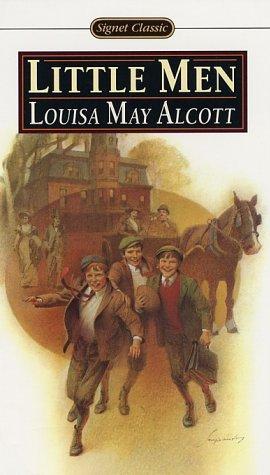
Little Men

Little Men. Louisa May Alcott. 1871. 329 pages. [Source: Bought]
First sentence: "Please, sir, is this Plumfield?" asked a ragged boy of the man who opened the great gate at which the omnibus left him.
Premise/plot: Little Men is the sequel to Louisa May Alcott's Little Women. Jo has married her Professor Bhaer. They've started their own family AND a school. "Mother Bhaer" is much beloved by one and all. The school mostly consists of young boys with a few girls in attendance. Two of the students are her niece and nephew--Daisy and Demi Brooke. 
My thoughts: Little Men doesn't really have a plot. It has plenty of characters. It has plenty of lessons--morals. Not so much on plots and subplots unless you consider "boys will learn lessons--sometimes the hard way" a plot. I liked it okay. I did. I didn't dislike it. But there were so many characters, and none of the characters felt fully fleshed out. I did not have this problem with Little Women. Meg, Jo, Beth, Amy, Marmee, Laurie, etc. These are characters that stick with you; they live. 
Perhaps the teaching philosophies of the Bhaers would have been radical or unconventional at the time this one was published? 

I do still plan on reading Jo's Boys. Mom says it's her favorite. Maybe it will be my favorite too.

Quotes:
  • Latin, Greek, and mathematics were all very well, but in Professor Bhaer's opinion, self knowledge, self-help, and self-control were more important, and he tried to teach them carefully.
  • "Yes, I know many people think boys are a nuisance, but that is because they don't understand them. I do; and I never saw the boy yet whom I could not get on capitally with after I had once found the soft spot in his heart.
  • Sympathy is a sweet thing, and it worked wonders here, for each boy knew that Father Bhaer was interested in him, and some were readier to open their hearts to him than to a woman, especially the older ones, who liked to talk over their hopes and plans, man to man.
  • "I shall devote the whole of my plot to the largest crop of patience I can get, for that is what I need most," said Mrs. Jo, so soberly that the lads fell to thinking in good earnest what they should say when their turns came, and some among them felt a twinge of remorse, that they had helped to use up Mother Bhaer's stock of patience so fast.
  • "We will plant self-denial, and hoe it and water it, and make it grow so well that next Christmas no one will get ill by eating too much dinner. If you exercise your mind, George, it will get hungry just as your body does, and you will love books almost as much as my philosopher here," said Mr. Bhaer;
  • It takes so little to make a child happy that it is a pity, in a world so full of sunshine and pleasant things, that there should be any wistful faces, empty hands, or lonely little hearts.
  • I regret to say that Nat sometimes told lies. Not very black ones, seldom getting deeper than gray, and often the mildest of white fibs; but that did not matter, a lie is a lie, and though we all tell many polite untruths in this queer world of ours, it is not right, and everybody knows it.
  • "Salt is like good-humor, and nearly every thing is better for a pinch of it, Posy," and Uncle Fritz stopped as he passed, hammer in hand, to drive up two or three nails for Sally's little pans to hang on.
  • "You mustn't; it's wicked to say 'Damn!'" cried Tommy, who had followed his leader so far. "Oh, hang! don't you preach, but play away; it's part of the fun to swear." "I'd rather say 'thunder turtles,'" said Tommy, who had composed this interesting exclamation and was very proud of it.
  • Dear me, half the science of teaching is knowing how much children do for one another, and when to mix them.
  • Kindness in looks and words and ways is true politeness, and any one can have it if they only try to treat other people as they like to be treated themselves.
  • "Happy is the man who can put temptation in his pocket and learn self-denial from so sweet a little teacher!" added Mr. Bhaer.
  • Money is the root of all evil, and yet it is such a useful root that we cannot get on without it any more than we can without potatoes.
  • Daisy knew nothing about women's rights; she quietly took all she wanted, and no one denied her claim, because she did not undertake what she could not carry out, but unconsciously used the all-powerful right of her own influence to win from others any privilege for which she had proved her fitness.
  • Nan attempted all sorts of things, undaunted by direful failures, and clamored fiercely to be allowed to do every thing that the boys did. They laughed at her, hustled her out of the way, and protested against her meddling with their affairs. But she would not be quenched and she would be heard, for her will was strong, and she had the spirit of a rampant reformer.
  • "You must put swearing away in your fault-drawer, and lock it up; that's the way I do with my badness."
  • "I play that my mind is a round room, and my soul is a little sort of creature with wings that lives in it. The walls are full of shelves and drawers, and in them I keep my thoughts, and my goodness and badness, and all sorts of things. The goods I keep where I can see them, and the bads I lock up tight, but they get out, and I have to keep putting them in and squeezing them down, they are so strong."
  • It is never too early to try and plant them [good principles] in a child, and never too late to cultivate them in the most neglected person.
  • You are a sort of Berserker, Dan, and something to tussle with is as necessary to you as music is to Nat," said Mr. Bhaer, who knew all about the conversation between the boy and Mrs. Jo.
  • "He wasn't rich, was he?" asked Jack. "No." "He never did any thing to make a stir in the world, did he?" "No." "He was only good?" "That's all;" and Franz found himself wishing that Uncle John had done something to boast of, for it was evident that Jack was disappointed by his replies. "Only good. That is all and every thing," said Mr. Bhaer, who had overheard the last few words, and guessed what was going on the minds of the lads.
  •  Simple, generous goodness is the best capital to found the business of this life upon. It lasts when fame and money fail, and is the only riches we can take out of this world with us.
  • "Kindness is always better than force. Try it and see," answered Mr. Bhaer, rising.  Too many tales are as bad as too many bonbons. I have paid my forfeit and I go," and Mr. Bhaer ran for his life, with the whole flock in full pursuit.
  •  "I thought you must eat as much as ever you could on Thanksgiving. But Franz says you mustn't even then;" and Stuffy looked as if he had received bad news.
  • "I'll be careful; but everybody does eat lots, and I like it better than being moderate," said Stuffy, who leaned to the popular belief that Thanksgiving must be kept by coming as near apoplexy as possible, and escaping with merely a fit of indigestion or a headache.
  • Dear me! if men and women would only trust, understand, and help one another as my children do, what a capital place the world would be!
  • For love is a flower that grows in any soil, works its sweet miracles undaunted by autumn frost or winter snow, blooming fair and fragrant all the year, and blessing those who give and those who receive.
© 2018 Becky Laney of Becky's Book Reviews
Wednesday, January 10, 2018

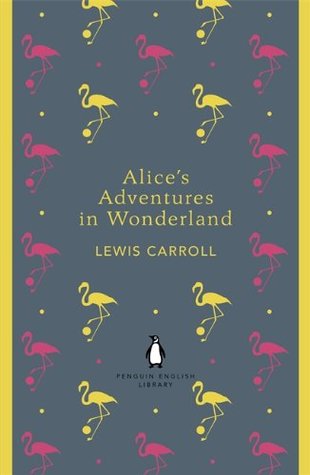
Alice's Adventures in Wonderland

Alice's Adventures in Wonderland. Lewis Carroll. Illustrated by John Tenniel. 1865/1871. 247 pages. [Source: Bought]

First sentence: Alice was beginning to get very tired of sitting by her sister on the bank, and of having nothing to do: once or twice she had peeped into the book her sister was reading, but it had no pictures or conversations in it, ‘and what is the use of a book,’ thought Alice, ‘without pictures or conversations?’

Premise/plot: Alice follows a white rabbit down a rabbit hole and has several fantastical seemingly impossible adventures before waking.  
 
First sentence: One thing was certain, that the white kitten had nothing to do with it – it was the black kitten’s fault entirely. For the white kitten had been having its face washed by the old cat for the last quarter of an hour (and bearing it pretty well, considering): so you see that it couldn’t have had any hand in the mischief.

Premise/plot: Alice doesn't follow a rabbit on her second adventure; no, she crawls through the looking glass into the looking glass house. Just as she always imagined, life is very different on the other side of the mirror. (For one thing, the chess pieces are alive.) Readers follow Alice's adventures as a pawn as she journeys towards being queened. Like the first book, this one is full of fantastical impossibilities.

My thoughts: I love, love, LOVE Lewis Carroll's Alice's Adventures in Wonderland. I couldn't begin to tell you how many times I've read it in my life. It's a magical read filled with silly characters--quite a few I'd deem unforgettable. What stands out to me--even more than the characters--is the writing. There is just something quotable and ever-relevant about the narrative.

Favorite quotes from Alice in Wonderland:
‘Do cats eat bats? Do cats eat bats?’ and sometimes ‘Do bats eat cats?’, for, you see, as she couldn’t answer either question, it didn’t much matter which way she put it. She felt that she was dozing off, and had just begun to dream that she was walking hand in hand with Dinah, and was saying to her, very earnestly, ‘Now, Dinah, tell me the truth: did you ever eat a bat?’, when suddenly, thump! thump! down she came upon a heap of sticks and dry leaves, and the fall was over.
Oh, how I wish I could shut up like a telescope! I think I could, if I only knew how to begin.’ For, you see, so many out-of-the-way things had happened lately, that Alice had begun to think that very few things indeed were really impossible.
She generally gave herself very good advice (though she very seldom followed it), and sometimes she scolded herself so severely as to bring tears into her eyes; and once she remembered trying to box her own ears for having cheated herself in a game of croquet she was playing against herself, for this curious child was very fond of pretending to be two people. ‘But it’s no use now,’ thought poor Alice, ‘to pretend to be two people! Why, there’s hardly enough of me left to make one respectable person!’
Let me think: was I the same when I got up this morning? I almost think I can remember feeling a little different. But if I’m not the same, the next question is “Who in the world am I?” Ah, that’s the great puzzle!’
‘Perhaps it doesn’t understand English,’ thought Alice. ‘I daresay it’s a French mouse, come over with William the Conqueror.’ (For, with all her knowledge of history, Alice had no very clear notion how long ago anything had happened.) So she began again: ‘Où est ma chatte?’, which was the first sentence in her French lesson-book. The Mouse gave a sudden leap out of the water, and seemed to quiver all over with fright. ‘Oh, I beg your pardon!’ cried Alice hastily, afraid that she had hurt the poor animal’s feelings. ‘I quite forgot you didn’t like cats.’
‘It was much pleasanter at home,’ thought poor Alice, ‘when one wasn’t always growing larger and smaller, and being ordered about by mice and rabbits. I almost wish I hadn’t gone down that rabbit-hole – and yet – and yet – it’s rather curious, you know, this sort of life! I do wonder what can have happened to me! When I used to read fairy tales, I fancied that kind of thing never happened, and now here I am in the middle of one! There ought to be a book written about me, that there ought! And when I grow up, I’ll write one – but I’m grown up now,’ she added in a sorrowful tone: ‘at least there’s no room to grow up any more here.’
‘It’s really dreadful,’ she muttered to herself, ’the way all the creatures argue. It’s enough to drive one crazy!’
‘I didn’t know that Cheshire-Cats always grinned; in fact, I didn’t know that cats could grin.’
‘They all can,’ said the Duchess; ‘and most of ’em do.’ ‘I don’t know of any that do,’ Alice said very politely, feeling quite pleased to have got into a conversation. ‘You don’t know much,’ said the Duchess; ‘and that’s a fact.’
‘If it had grown up,’ she said to herself, ‘it would have made a dreadfully ugly child: but it makes rather a handsome pig, I think.’ And she began thinking over other children she knew, who might do very well as pigs, and was just saying to herself ‘if one only knew the right way to change them –’ when she was a little startled by seeing the Cheshire-Cat sitting on a bough of a tree a few yards off.
 ‘Would you tell me, please, which way I ought to go from here?’ ‘That depends a good deal on where you want to get to,’ said the Cat. ‘I don’t much care where –’ said Alice. ‘Then it doesn’t matter which way you go,’ said the Cat. ‘– so long as I get somewhere,’ Alice added as an explanation. ‘Oh, you’re sure to do that,’ said the Cat, ‘if only you walk long enough.’
‘In that direction,’ the Cat said, waving its right paw round, ‘lives a Hatter: and in that direction,’ waving the other paw, ‘lives a March Hare. Visit either you like: they’re both mad.’ ‘But I don’t want to go among mad people,’ Alice remarked. ‘Oh, you ca’n’t help that,’ said the Cat: ‘we’re all mad here. I’m mad. You’re mad.’
‘How do you know I’m mad?’ said Alice. ‘You must be,’ said the Cat, ‘or you wouldn’t have come here.’
‘Then you should say what you mean,’ the March Hare went on. ‘I do,’ Alice hastily replied; ‘at least – at least I mean what I say – that’s the same thing, you know.’ ‘Not the same thing a bit!’ said the Hatter. ‘Why, you might just as well say that “I see what I eat” is the same thing as “I eat what I see”!’
‘You might just as well say,’ added the Dormouse, which seemed to be talking in its sleep, ‘that “I breathe when I sleep” is the same thing as “I sleep when I breathe”!’
Alice thought she had never seen such a curious croquet-ground in her life: it was all ridges and furrows: the croquet balls were live hedgehogs, and the mallets live flamingoes, and the soldiers had to double themselves up and stand on their hands and feet, to make the arches.
The players all played at once, without waiting for turns, quarreling all the while, and fighting for the hedgehogs; and in a very short time the Queen was in a furious passion, and went stamping about, and shouting ‘Off with his head!’ or ‘Off with her head!’ about once in a minute.
“Never imagine yourself not to be otherwise than what it might appear to others that what you were or might have been was not otherwise than what you had been would have appeared to them to be otherwise.” ’ ‘I think I should understand that better,’ Alice said very politely, ‘if I had it written down: but I ca’n’t quite follow it as you say it.’ ‘That’s nothing to what I could say if I chose,’ the Duchess replied, in a pleased tone.
‘I make you a present of everything I’ve said as yet.’
‘A cheap sort of present!’ thought Alice. ‘I’m glad people don’t give birthday-presents like that!’
‘He taught Laughing and Grief, they used to say.’ ‘So he did, so he did,’ said the Gryphon, sighing in his turn; and both creatures hid their faces in their paws. ‘And how many hours a day did you do lessons?’ said Alice, in a hurry to change the subject. ‘Ten hours the first day,’ said the Mock Turtle: ‘nine the next, and so on.’ ‘What a curious plan!’ exclaimed Alice. ‘That’s the reason they’re called lessons,’ the Gryphon remarked: ‘because they lessen from day to day.’
Favorite quotes from Through the Looking Glass:
‘Kitty, can you play chess? Now, don’t smile, my dear, I’m asking it seriously. Because, when we were playing just now, you watched just as if you understood it: and when I said “Check!” you purred! Well, it was a nice check, Kitty, and really I might have won, if it hadn’t been for that nasty Knight, that came wriggling down among my pieces. Kitty, dear, let’s pretend –’ And here I wish I could tell you half the things Alice used to say, beginning with her favourite phrase ‘Let’s pretend.’
Oh, Kitty, how nice it would be if we could only get through into Looking glass House! I’m sure it’s got, oh! such beautiful things in it! Let’s pretend there’s a way of getting through into it, somehow, Kitty. Let’s pretend the glass has got all soft like gauze, so that we can get through. Why, it’s turning into a sort of mist now, I declare! It’ll be easy enough to get through—’ She was up on the chimney-piece while she said this, though she hardly knew how she had got there. And certainly the glass was beginning to melt away, just like a bright silvery mist.
She was out of the room in a moment, and ran down stairs – or, at least, it wasn’t exactly running, but a new invention for getting down stairs quickly and easily, as Alice said to herself. She just kept the tips of her fingers on the hand-rail, and floated gently down without even touching the stairs with her feet: then she floated on through the hall, and would have gone straight out at the door in the same way, if she hadn’t caught hold of the door-post. She was getting a little giddy with so much floating in the air, and was rather glad to find herself walking again in the natural way.
‘It’s a great huge game of chess that’s being played – all over the world – if this is the world at all, you know. Oh, what fun it is! How I wish I was one of them! I wouldn’t mind being a Pawn, if only I might join – though of course I should like to be a Queen, best.’
‘Well, in our country,’ said Alice, still panting a little, ‘you’d generally get to somewhere else – if you ran very fast for a long time as we’ve been doing.’ ‘A slow sort of country!’ said the Queen. ‘Now, here, you see, it takes all the running you can do, to keep in the same place. If you want to get somewhere else, you must run at least twice as fast as that!’ ‘I’d rather not try, please!’ said Alice.
‘He’s dreaming now,’ said Tweedledee: ‘and what do you think he’s dreaming about?’ Alice said ‘Nobody can guess that.’ ‘Why, about you!’ Tweedledee exclaimed, clapping his hands triumphantly. ‘And if he left off dreaming about you, where do you suppose you’d be?’ ‘Where I am now, of course,’ said Alice. ‘Not you!’ Tweedledee retorted contemptuously. ‘You’d be nowhere. Why, you’re only a sort of thing in his dream!’
‘Well, it’s no use your talking about waking him,’ said Tweedledum, ‘when you’re only one of the things in his dream. You know very well you’re not real.’ ‘I am real!’ said Alice, and began to cry. ‘You wo’n’t make yourself a bit realler by crying,’ Tweedledee remarked: ‘there’s nothing to cry about.’ ‘If I wasn’t real,’ Alice said – half-laughing through her tears, it all seemed so ridiculous – ‘I shouldn’t be able to cry.’ ‘I hope you don’t suppose those are real tears?’ Tweedledum interrupted in a tone of great contempt. ‘I know they’re talking nonsense,’ Alice thought to herself: ‘and it’s foolish to cry about it.’
‘The rule is, jam to-morrow and jam yesterday – but never jam to-day.’
‘It must come sometimes to “jam to-day”, ’ Alice objected. ‘No, it ca’n’t,’ said the Queen. ‘It’s jam every other day: to-day isn’t any other day, you know.’ ‘I don’t understand you,’ said Alice. ‘It’s dreadfully confusing!’ ‘That’s the effect of living backwards,’ the Queen said kindly: ‘it always makes one a little giddy at first –’ ‘Living backwards!’ Alice repeated in great astonishment. ‘I never heard of such a thing!’ ‘– but there’s one great advantage in it, that one’s memory works both ways.’
‘Consider what a great girl you are. Consider what a long way you’ve come to-day. Consider what o-clock it is. Consider anything, only don’t cry!’
‘Can you keep from crying by considering things?’ she asked. ‘That’s the way it’s done,’ the Queen said with great decision: ‘nobody can do two things at once, you know.
Why, sometimes I’ve believed as many as six impossible things before breakfast.
‘I never ask advice about growing,’ Alice said indignantly. ‘Too proud?’ the other enquired. Alice felt even more indignant at this suggestion. ‘I mean,’ she said, ‘that one ca’n’t help growing older.’ ‘One ca’n’t, perhaps,’ said Humpty Dumpty; ‘but two can. With proper assistance, you might have left off at seven.’
‘they gave it me – for an un-birthday present.’ ‘I beg your pardon?’ Alice said with a puzzled air. ‘I’m not offended,’ said Humpty Dumpty. ‘I mean, what is an un-birthday present?’ ‘A present given when it isn’t your birthday, of course.’ Alice considered a little. ‘I like birthday presents best,’ she said at last. ‘You don’t know what you’re talking about!’ cried Humpty Dumpty. ‘How many days are there in a year?’ ‘Three hundred and sixty-five,’ said Alice. ‘And how many birthdays have you?’ ‘One.’ ‘And if you take one from three hundred and sixty-five, what remains?’ ‘Three hundred and sixty-four, of course.’
‘When I use a word,’ Humpty Dumpty said, in rather a scornful tone, ‘it means just what I choose it to mean – neither more nor less.’
‘The question is,’ said Alice, ‘whether you can make words mean so many different things.’ ‘The question is,’ said Humpty Dumpty, ‘which is to be master – that’s all.’
‘I can repeat poetry as well as other folk, if it comes to that –’ ‘Oh, it needn’t come to that!’ Alice hastily said, hoping to keep him from beginning.
‘I see nobody on the road,’ said Alice. ‘I only wish I had such eyes,’ the King remarked in a fretful tone. ‘To be able to see Nobody! And at that distance too! Why, it’s as much as I can do to see real people, by this light!’
‘Who did you pass on the road?’ the King went on, holding out his hand to the Messenger for some more hay. ‘Nobody,’ said the Messenger. ‘Quite right,’ said the King: ‘this young lady saw him too. So of course Nobody walks slower than you.’ ‘I do my best,’ the Messenger said in a sullen tone. ‘I’m sure nobody walks much faster than I do!’ ‘He ca’n’t do that,’ said the King, ‘or else he’d have been here first. However, now you’ve got your breath, you may tell us what’s happened in the town.’
‘I was wondering what the mouse-trap was for,’ said Alice. ‘It isn’t very likely there would be any mice on the horse’s back.’ ‘Not very likely, perhaps,’ said the Knight; ‘but, if they do come, I don’t choose to have them running all about.’
‘Always speak the truth – think before you speak – and write it down afterwards.’
 What do you suppose is the use of a child without any meaning? Even a joke should have some meaning – and a child’s more important than a joke, I hope. You couldn’t deny that, even if you tried with both hands.’ ‘I don’t deny things with my hands,’ Alice objected. ‘Nobody said you did,’ said the Red Queen. ‘I said you couldn’t if you tried.’ ‘She’s in that state of mind,’ said the White Queen, ‘that she wants to deny something – only she doesn’t know what to deny!’ ‘A nasty, vicious temper,’ the Red Queen remarked;
‘It’s too late to correct it,’ said the Red Queen: ‘when you’ve once said a thing, that fixes it, and you must take the consequences.’
 It is a very inconvenient habit of kittens (Alice had once made the remark) that, whatever you say to them, they always purr. ‘If they would only purr for “yes”, and mew for “no”, or any rule of that sort,’ she had said, ‘so that one could keep up a conversation! But how can you talk with a person if they always say the same thing?’

© 2018 Becky Laney of Becky's Book Reviews
Saturday, January 07, 2017

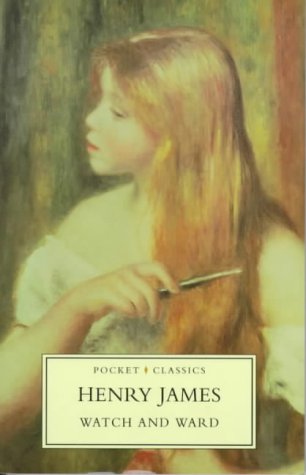
Watch and Ward

Watch and Ward. Henry James. 1871. 128 pages. [Source: Bought]

 First sentence: ROGER LAWRENCE had come to town for the express purpose of doing a certain act, but as the hour for action approached he felt his ardor rapidly ebbing away.

Premise/plot: Roger Lawrence, 29, adopts a young girl, Nora, aged 12, with the intention to marry her when she's old enough. That is what Watch and Ward is about essentially, a man raising a young girl to be the kind of woman he wants his future wife to be. In Roger's own words:
Pray for me more than ever. I have begun at the beginning; it will be my own fault if I haven’t a perfect wife.
Tragedy brings Nora into Roger's life. Roger happens upon a very depressed man in a hotel lobby. The man approaches Roger and begs for money. Roger offers him ten dollars, I believe, but the man rejects that as being not enough to make life worth living. Later that night, Roger hears a gunshot...or maybe two. The man--the stranger who approached him--tried to kill his daughter, Nora, before taking his own life. Roger meets Nora, and, decides to unofficially adopt her and raise her. He's an unmarried bachelor with no experience raising kids, but, he does have all sorts of ideas about how he wants her to turn out. And many of those ideas involve her education and the society she'll keep. 

Is there a love triangle? Yes, no, maybe. George Fenton is a cousin or half-cousin who meets her and finds her charming when she's nearly grown up. Also there is Hubert Lawrence, a cousin of Roger's, who enjoys flirting with her. 

My thoughts: I first heard of Watch and Ward by Henry James while reading How To Create The Perfect Wife by Wendy Moore. That book chronicles the misadventures of Thomas Day's love life. Here was a man who truly tried this experiment in his own life.

Watch and Ward was DISOWNED by Henry James later in life. He refused to recognize it as his first novel, and, must have thought it was awful. 

I did not think it was awful. I mean, sure the premise is strange to modern readers. But having been raised with My Fair Lady, it wasn't a horribly strange premise. The novel rushes through her twelve to sixteen years very, very quickly. So that by the time he starts talking about his hopes that she'll say yes to his proposal isn't as revolting as it could have been. 

Is the ending happy or sad? For me, it was a bit of both. I didn't love Roger exactly. But in comparison with George and Hubert, he appeared a saint. I do think--no matter his method--that he actually cared about Nora as a person. I do think that he would have respected her "no" and let her marry someone else if the someone else had been sincere and decent. Nora's options reveal the times. Her choices were very narrow indeed. Roger represented literally the only safe and comfortable and potentially happy option she had open to her. Her very brief time away from him--time that revealed the 'true' natures of George and Hubert--showed her how little she knew about men, how little she knew about the world, and how her idea of making her own place in the world and supporting herself was practically impossible posing risks she'd not fathomed days before. Roger was not a rascal--like Wickham or Willoughby. He was certainly no Louis Trevelyan. But. I can't like him either. He occasionally said really, really stupid things like, "If I were only a good old Catholic, that I might shut her up in a convent and keep her childish and stupid and contented!" 

Watch and Ward was my first experience reading Henry James. And I really enjoyed myself. I found the plot moved quickly, and the writing was good. My favorite line: "When once the gate is opened to self-torture, the whole army of fiends files in." OR possibly this one, "When I read a novel my imagination starts off at a gallop and leaves the narrator hidden in a cloud of dust; I have to come jogging twenty miles back to the denouement."

Quotes:
He had been born a marrying man, with a conscious desire for progeny.
He had made a woman a goddess, and she had made him a fool.

Lawrence felt the tears rising to his eyes; he felt in his heart the tumult of a new emotion. Was it the inexpugnable instinct of paternity? Was it the restless ghost of his buried hope? He thought of his angry vow the night before to live only for himself and turn the key on his heart. Before twenty-four hours had elapsed a child’s fingers were fumbling with the key. He felt deliciously contradicted; he was after all but a lame egotist. Was he to believe, then, that he couldn’t live without love, and that he must take it where he found it?
His philosophy in this as in all things was extremely simple, — to make her happy, that she might be good. Meanwhile, as he cunningly devised her happiness, his own seemed securely established. 
He determined to drive in the first nail with his own hands, to lay the first smooth foundation-stones of her culture, to teach her to read and write and cipher, to associate himself largely with the growth of her primal sense of things. Behold him thus converted into a gentle pedagogue, wooing with mild inflections the timid ventures of her thought. 
Roger had no wish to cultivate in his young companion any expression of formal gratitude; for it was the very key-stone of his plan that their relation should ripen into a perfect matter of course; but he watched patiently, like a wandering botanist for the first woodland violets for the year, for the shy field-flower of spontaneous affection.
He aimed at nothing more or less than to inspire the child with a passion.
When they parted, he gave his hopes to her keeping in a long, long kiss. She kissed him too, but this time with smiles, not with tears. She neither suspected nor could she have understood the thought which, during this interview, had blossomed in her friend’s mind. 
The ground might be gently tickled to receive his own sowing; the petals of the young girl’s nature, playfully forced apart, would leave the golden heart of the flower but the more accessible to his own vertical rays. 
“You decline?” he cried, almost defiantly. “ `Decline’ isn’t the word. A man doesn’t decline an insult.”
“Well,” he said, coolly, “why don’t you marry her?” “It’s not so simple as that!” “She’ll not have you?” Roger frowned impatiently. “Reflect a moment. You pretend to be a man of delicacy.” “You mean she’s too young? Nonsense. If you are sure of her, the younger the better.” “Hubert,” cried Roger, “for my unutterable misery, I have a conscience. I wish to leave her free, and take the risk. I wish to be just, and let the matter work itself out. You may think me absurd, but I wish to be loved for myself, as other men are loved.”
I have heard many a young unmarried lady exclaim with a bold sweep of conception, “Ah me! I wish I were a widow!” Mrs. Keith was precisely the widow that young unmarried ladies wish to be. With her diamonds in her dressing-case and her carriage in her stable, and without a feather’s weight of encumbrance, she offered a finished example of satisfied ambition.
“I’ll piously gather up the crumbs of your feasts and make a meal of them,” said Nora. “I’ll let you know how they taste.”
You’re like a picture; you ought to be enclosed in a gilt frame and stand against the wall.
People are free to find out the best and the worst of me!
He couldn’t turn her away. Let her come, at her risk! For angels there is a special providence. “Don’t think me worse than I am,” he said, “but don’t think me better! I shall love Roger well until I begin to fancy that you love him too well. Then — it’s absurd perhaps, but I feel it will be so — I shall be jealous.”

Later they came to speak of a novel which lay on the table, and which Nora had been reading. “It’s very silly,” she said, “but I go on with it in spite of myself. I’m afraid I’m too easily pleased; no novel is so silly I can’t read it. I recommend you this, by the way. The hero is a young clergyman endowed with every grace, who falls in love with a fair Papist. She is wedded to her faith, and though she loves the young man after a fashion, she loves her religion better. To win his suit he comes near going over to Rome; but he pulls up short and determines the mountain shall come to Mahomet. He sets bravely to work, converts the young lady, baptizes her with his own hands one week, and marries her the next.”

I very seldom read a novel, but when I glance into one, I’m sure to find some such stuff as that! Nothing irritates me so as the flatness of people’s imagination.
When I read a novel my imagination starts off at a gallop and leaves the narrator hidden in a cloud of dust; I have to come jogging twenty miles back to the denouement. 
“True admiration,” said Mrs. Keith, “is one half respect and the other half self-denial.” 
“I didn’t believe you! I ought to have believed you. But it isn’t only that. It is that, years ago, he adopted me with that view. He brought me up for that purpose. He has done everything for me on that condition. I was to pay my debt and be his wife! I never dreamed of it. And now at last that I’m a woman grown and he makes his demand, I can’t, I can’t!” “You can’t, eh? So you’ve left him!” “Of course I’ve left him. It was the only thing to do. It was give and take. I can’t give what he wants, nor can I give back all I have received. But I can refuse to take more.” 
When once the gate is opened to self-torture, the whole army of fiends files in. 

© 2017 Becky Laney of Becky's Book Reviews

Sunday, July 19, 2015

At The Back of the North Wind (1871)

At The Back of the North Wind. George MacDonald. 1871. 346 pages. [Source: Bought]

I HAVE been asked to tell you about the back of the north wind.

Do you enjoy reading children's classics? Or enjoy reading children's fantasy novels? There's a chance that you may love George MacDonald's At The Back of the North Wind. I won't lie. It is a good, old-fashioned story packed with morals and symbolism. So maybe it won't satisfy every single reader. Still there is something about it, even if it is is too wholesome for some.

At The Back of the North Wind is Diamond's story. Diamond is a young boy who is completely good and rather odd because of it. He is a bit of an angel, always doing the right thing, always saying the right thing. His intentions are always as pure as can be. But he isn't smug or arrogant. And he does genuinely care for others. So I do not personally see him as being self-righteous or obnoxious. One of Diamond's friends is the North Wind. The first half of the book focuses on this dream-like relationship. At night, he sometimes accompanies her on her journeys. Eventually, he does find his way to the back of the North Wind. The second half of the book focuses on Diamond's family and his personal relationships with his family and friends. The family situation definitely changes throughout the novel. And Diamond's life isn't an easy one. He is an optimist, a dreamer. But the family's struggle is very real and a definite concern to him.

One of Diamond's friends is the kind-hearted Mr. Raymond. Mr. Raymond has a heart for children, especially for poor ones, and he does what he can to help everyone. He is also a story-teller. I LOVED, LOVED, LOVED Mr. Raymond's story called "Little Daylight." Even if you're not interested in reading the whole novel, even if it doesn't sound like your kind of book, you should make time to read this one stand-alone chapter. Especially if you LOVE fairy tales. (And who doesn't love fairy tales?!) I think Little Daylight would make a lovely picture book adaptation.

So I definitely enjoyed this one. Perhaps not as much as The Light Princess. But at least as much as the two Princess books (Princess and the Curdie, Princess and the Goblin).

 Quotes:
At the same moment, a peal of thunder which shook Diamond's heart against the sides of his bosom hurtled out of the heavens: I cannot say out of the sky, for there was no sky. Diamond had not seen the lightning, for he had been intent on finding the face of North Wind. Every moment the folds of her garment would sweep across his eyes and blind him, but between, he could just persuade himself that he saw great glories of woman's eyes looking down through rifts in the mountainous clouds over his head.
He trembled so at the thunder, that his knees failed him, and he sunk down at North Wind's feet, and clasped her round the column of her ankle. She instantly stooped, lifted him from the roof—up—up into her bosom, and held him there, saying, as if to an inconsolable child—
"Diamond, dear, this will never do."
"Oh yes, it will," answered Diamond. "I am all right now—quite comfortable, I assure you, dear North Wind. If you will only let me stay here, I shall be all right indeed."
"But you will feel the wind here, Diamond."
"I don't mind that a bit, so long as I feel your arms through it," answered Diamond, nestling closer to her grand bosom.
"Brave boy!" returned North Wind, pressing him closer.
"No," said Diamond, "I don't see that. It's not courage at all, so long as I feel you there."
"But hadn't you better get into my hair? Then you would not feel the wind; you will here."
"Ah, but, dear North Wind, you don't know how nice it is to feel your arms about me. It is a thousand times better to have them and the wind together, than to have only your hair and the back of your neck and no wind at all."
"But it is surely more comfortable there?"
"Well, perhaps; but I begin to think there are better things than being comfortable."
"Yes, indeed there are. Well, I will keep you in front of me. You will feel the wind, but not too much. I shall only want one arm to take care of you; the other will be quite enough to sink the ship."


"You never made that song, Diamond," said his mother.
"No, mother. I wish I had. No, I don't. That would be to take it from somebody else. But it's mine for all that."
"What makes it yours?"
"I love it so."
"Does loving a thing make it yours?"
"I think so, mother—at least more than anything else can. If I didn't love baby (which couldn't be, you know) she wouldn't be mine a bit. But I do love baby, and baby is my very own Dulcimer."
"The baby's mine, Diamond."
"That makes her the more mine, mother."
"How do you make that out?"
"Because you're mine, mother."
"Is that because you love me?"
"Yes, just because. Love makes the only myness," said Diamond.
"What are you reading?" I said, and spoke suddenly, with the hope of seeing a startled little face look round at me. Diamond turned his head as quietly as if he were only obeying his mother's voice, and the calmness of his face rebuked my unkind desire and made me ashamed of it.
"I am reading the story of the Little Lady and the Goblin Prince," said Diamond.
"I am sorry I don't know the story," I returned. "Who is it by?"
"Mr. Raymond made it."
"Is he your uncle?" I asked at a guess.
"No. He's my master."
"What do you do for him?" I asked respectfully.
"Anything he wishes me to do," he answered. "I am busy for him now. He gave me this story to read. He wants my opinion upon it."
"Don't you find it rather hard to make up your mind?"
"Oh dear no! Any story always tells me itself what I'm to think about it. Mr. Raymond doesn't want me to say whether it is a clever story or not, but whether I like it, and why I like it. I never can tell what they call clever from what they call silly, but I always know whether I like a story or not."
"And can you always tell why you like it or not?" "No. Very often I can't at all. Sometimes I can. I always know, but I can't always tell why.

© 2015 Becky Laney of Becky's Book Reviews

Sunday, October 27, 2013

Sunday Salon: Reading Through the Looking Glass

Through the Looking Glass. Lewis Carroll. 1871. 228 pages. [Source: Bought]

I love, love, love Through the Looking Glass. I think I might even love it more than Alice's Adventures in Wonderland. Together they are just a JOY to read. The thing I love the most about Through the Looking Glass is the language, the writing, the style. The book is just so very quotable!!! The scenes are fun, playful, and memorable.

Here are a few of my favorite quotes:
The rule is, jam tomorrow and jam yesterday--but never jam today.
Why, sometimes I've believed as many as six impossible things before breakfast.
They gave it to me--for an un-birthday present.
I beg your pardon? Alice said with a puzzled air.
I'm not offended said Humpty Dumpty.
I mean, what is an un-birthday present?
A present given when it isn't your birthday, of course.
Alice considered a little. I like birthday presents best, she said at last.
You don't know what you're talking about cried Humpty Dumpty. How many days are there in a year?
Three hundred and sixty-five said Alice.
And how many birthdays have you?
One.
And if you take one from three hundred and sixty-five, what remains?
Three hundred and sixty-four of course.
When I use a word, Humpty Dumpty said, in rather a scornful tone, it means just what I choose it to mean--neither more nor less.
The question is, said Alice, whether you can make words mean so many different things.
The question is, said Humpty Dumpty, which is to be master--that's all.
I see nobody on the road said Alice.
I only wish I had such eyes, the King remarked in a fretful tone. To be able to see Nobody! And at that distance too! Why, it's as much as I can do to see real people, by this light!
Always speak the truth -- think before you speak -- and write it down afterwards.
© 2013 Becky Laney of Becky's Book Reviews
Thursday, August 02, 2012

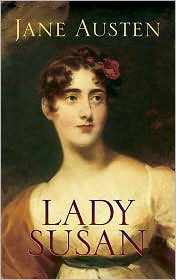
Lady Susan

Lady Susan. Jane Austen 1794?/1871. 64 pages.

I recently reread Jane Austen's Lady Susan. I remembered it as being a quick, light read full of gossip and scandal. Lady Susan Vernon is not a "nice" woman; she's a still-quite-beautiful widow with a near-grown daughter, Frederica, who sometimes forgets her place. After creating a mess--or scandal--she invites herself to her brother-in-law's estate. Of course, she's not completely honest about it--not admitting that it is her last resort and that she really has no interest in his company or the company of his wife, Catherine Vernon. If readers get an honest glimpse of the woman at all, it is in her letters to Alicia Johnson, but, even then I think she's not being completely honest all of the time.

Lady Susan is a tricky, manipulative woman who likes to keep her options open. The other women that readers get to know in this little novel are Catherine and Frederica. Catherine would find it difficult to say anything positive about her sister-in-law, Lady Susan. Though she could probably admit that Lady Susan is quite beautiful and charming--when she wants to be. Catherine thinks Lady Susan is a horrible mother--and she is. And Catherine thinks she is PLOTTING to get her brother, Reginald De Courcy--and she is. Reginald starts strong, but, within a day or two he's convinced that Lady Susan is THE ONE. In other words, he becomes horribly stupid. Frederica, Catherine's daughter, also falls for Reginald. Lady Susan is all about DRAMA. Gossip. Scandal. Lies. Manipulation. Tension. Lady Susan is a divisive woman--breaking apart families, the cause of endless quarrels. 

Lady Susan isn't really like Austen's other novels. Lady Susan, Catherine, and Frederica aren't really like Jane Austen's other heroines. And that is definitely true with the heroes as well. Reginald is not like Tilney, Darcy, Wentworth, or Knightley. Lady Susan is not a swoon-worthy romance. It is fun, lively, gossipy. 

Here's my first review.

My favorite quotes:
Where there is a disposition to dislike, a motive will never be wanting. (7)
In short, when a person is always to deceive, it is impossible to be consistent. (27)
Facts are such horrid things! (54)

Read Lady Susan
  • If you are looking for a classic that is a quick, lively read
  • If you like stories where what is not being said is just as important as what is being said
  • If you like not-so-nice heroines; true Lady Susan is no Moll Flanders, but, she's no Fanny Price either! She just really, really likes it when men--single or married--fall in love with her.
  • If you like Jane Austen

© 2012 Becky Laney of Becky's Book Reviews
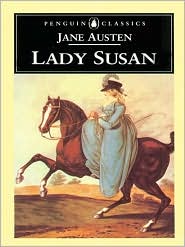
Friday, September 11, 2009

Lady Susan


Austen, Jane. 1871* Lady Susan. (Around 80 pages.)

Think Austen is all about being prim and proper? Think Austen is boring? Well, just you read Lady Susan. Lady Susan has several things going for it. It's short for one thing. Just 41 little letters. (Yes, this is one of those books told through letters.) Just the right length for one or two afternoons. But perhaps even more importantly, it's different from what you might expect. It's fun. It's lively. It's snappy.
Sometimes what is not being said is half the fun. What's going on between the lines.

Here is one of my favorite lines: "Where there is a disposition to dislike, a motive will never be wanting."

Lady Susan Vernon. The woman every woman loves to hate. And not without reason! She'll come to visit and try to steal your husband and your daughter's beau** all in the same trip. Just ask Mrs. Mainwaring. When this novel opens, Lady Susan is making a hasty retreat. She'd been staying--along with her daughter, Frederica, with the Mainwarings. But Mrs. Mainwaring has had just about enough of her. What with Lady Susan encouraging Mr. Mainwaring and Mr. James Martin. She's telling everyone who will listen to beware. So Lady Susan writes a letter to her dear brother. She'd just love to come and stay with him and his wife, Catherine, at Churchill.

When gossip arrives just ahead of her visit, why she'll come up with every excuse in the book as to why everyone else has got it wrong. She flirting with Mr. James Martin? And her only a few months a widow? Well, she was just trying to secure him for her daughter. And Mr. Mainwaring? Well, that's just a lie. Would she be receiving letters from Mrs. Mainwaring if the rumors were true?*** Fortunately, for the reader--and to the great entertainment of all--Lady Susan tells the truth to her dear friend, Alicia Johnson.

Catherine Vernon. The sister-in-law of Lady Susan. She can't stand "Lady" Susan. At all. She writes to her family--her mother mainly--the de Courcys. (We're also privy to the mother's letters--Lady de Courcy.) Catherine is really regretting the fact that Catherine's visit happens to coincide with her brother's visit. Reginald De Courcy is dumb, dumb, dumb when it comes to women.

Alicia Johnson. A kindred spirit to Lady Susan. Or so we're led to believe. She loves to flirt and carry on as much as her friend, or does she? (She's a married woman. So technically, she shouldn't be acting like a wild woman.) Is there enough room in the world for these two sillies?

As Reginald begins to seek Lady Susan--he feels himself truly, madly, deeply in love--will Lady Susan's past come back to haunt her? Is there anything hidden (or not so hidden) in her life that will dampen Reginald's affections?

While men enter into the story--quite passively in a way--this one is all about women. There aren't any Henry Tilneys, Fitzwilliam Darcys, Colonel Brandons, or Captain Wentworths around for female readers to swoon over. This isn't a traditional romance. This isn't a oh-love-is-wonderful, let's-all-live-happily-ever-after piece. If Pride and Prejudice can be likened to Much Ado About Nothing, I'd say Lady Susan is more like A Midsummer Night's Dream. Where love is more lust, and where men and women are more foolish than wise.

So why would I recommend this one? Well, I think it's fun. I think the very fact that it is so short and yet so lively and entertaining works in its favor. I think it's a lot less intimidating than her other books.

*Written in the 1790s, possibly 1794. But not published until 1871.
**Or is that Miss Mainwaring a niece not a daughter? I can't remember and since they share the same last name, it's difficult to remember.
***The letters are in fact from Mr. Mainwaring. Whenever she receives a letter from him, she proclaims it from his wife. I don't think she's reading these aloud and passing them around.

© Becky Laney of Becky's Book Reviews