Showing posts with label 1878. Show all posts

Saturday, February 18, 2017

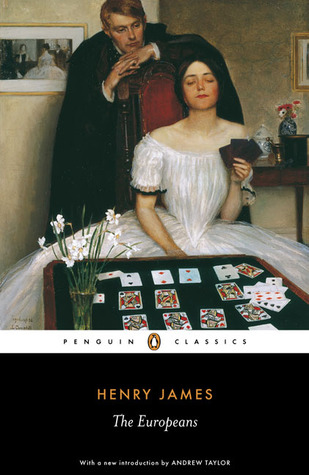
The Europeans

The Europeans. Henry James. 1878. 192 pages. [Source: Bought]

First sentence: A narrow grave-yard in the heart of a bustling, indifferent city, seen from the windows of a gloomy-looking inn, is at no time an object of enlivening suggestion; and the spectacle is not at its best when the mouldy tombstones and funereal umbrage have received the ineffectual refreshment of a dull, moist snow-fall.

 Premise/plot: Eugenia (Baroness Munster) and her brother, Felix Young, have come to America to visit their American cousins. She is separated from her husband, but it's a morganatic marriage. She has papers to sign--or not sign--that will determine her future. 

The cousins they visit are: Gertrude, Charlotte, and Clifford Wentworth. A few others play an important role in the novel: a brother and sister, Robert and Lizzie Acton; and a Mr. Brand.  

Eugenia is very different from Gertrude and Charlotte and Lizzie. She is a puzzle to Clifford and Robert. Both men pursue her, perhaps not with the intent to marry her and change her, but, pursue her because she's so different, mysterious, evasive, elusive. Neither Clifford or Robert are a good match--an equal match--for Eugenia. Robert may be rich, but, five minutes alone with him is four minutes too long. He's a BORE quite simple. Her act of deciding to leave America and turn down his marriage proposal might be called selfless if she'd not disliked him so much!!!

Gertrude is 'the troubled' one of her family. Her father and her sister keep trying their best to mold her, to train her, to conform her, to tame her, to control her. Gertrude doesn't really like their continued efforts--though she puts up with a great deal. They ideally want her to marry Mr. Brand. They think he's suited to this difficult task of fixing Gertrude. But Gertrude doesn't want to be fixed: she wants to be free to be herself, free to think her own thoughts. Felix is the first person, I gather, that accepts Gertrude for Gertrude, and finds her a wonderful WONDER. He doesn't feel the need--at least before the marriage vows--to put Gertrude in a box. 

I definitely liked Felix. I would never assume that Felix is a perfect person, that he's an ideal hero. But. I do think Gertrude's chances of happiness are greater paired with Felix than with Mr. Brand. 

My thoughts: This was a quick read. I think the characters were purposefully kept distant from the reader. It is less melodramatic and emotional than The American definitely!!! 

Favorite quotes:
Not to recognize one’s mistakes — that would be happiness in life,” the lady went on, still looking at her pretty foot.
“I don’t count upon their being clever or friendly — at first — or elegant or interesting. But I assure you I insist upon their being rich.”
“I can easily be French, if that will please you.” “You are a foreigner of some sort,” said Gertrude. “Of some sort — yes; I suppose so. But who can say of what sort? I don’t think we have ever had occasion to settle the question. You know there are people like that. About their country, their religion, their profession, they can’t tell.”
“Well,” she said, “I didn’t think we should ever see you again.” “And pray what did you think would become of me?” “I don’t know. I thought you would melt away.” “That‘s a compliment to my solidity! I melt very often,” said Felix, “but there is always something left of me.” “I came and waited for you by the door, because the others did,” Gertrude went on. “But if you had never appeared I should not have been surprised.”
There are a thousand different ways of being good company.
“Do you think us good company?” asked Gertrude. “Company for a king!” Gertrude was silent a moment; and then, “There must be a thousand different ways of being dreary,” she said; “and sometimes I think we make use of them all.” Felix stood up quickly, holding up his hand. “If you could only keep that look on your face for half an hour — while I catch it!” he said. “It is uncommonly handsome.”
“My dear uncle,” said Felix, “excuse me if your question makes me smile a little. To begin with, I have never entertained an idea. Ideas often entertain me; but I am afraid I have never seriously made a plan. I know what you are going to say; or rather, I know what you think, for I don’t think you will say it — that this is very frivolous and loose-minded on my part. So it is; but I am made like that; I take things as they come, and somehow there is always some new thing to follow the last. 
“No time is lost in which one has been happy!” said Felix, with a bright sententiousness which may well have been a little irritating.
“You have lost an illusion!” said Felix. “What do you call an illusion?” “The belief that you really know — that you have ever really known — Gertrude Wentworth. Depend upon that,” pursued Felix. “I don’t know her yet; but I have no illusions; I don’t pretend to.”

© 2017 Becky Laney of Becky's Book Reviews

Sunday, November 16, 2014

Is He Popenjoy? (1878)

Is He Popenjoy? Anthony Trollope. 1878/1993. Penguin. 632 pages. [Source: Bought]

Like so many of Anthony Trollope's novels, Is He Popenjoy? is a novel essentially about marriage and relationships. Just because it's about marriage and relationships doesn't mean it is about love and romance and happily ever after.

Lord George and Mary Germain are newly married. Mary Lovelace was not exactly his first choice for a bride. (His first choice was in fact a woman named Adelaide. She too is recently married. She is Mrs. Houghton now.) The two are in the getting-to-know each other stage. Yes, they are married. But they weren't madly in love with each other before they married. Only time will tell if they will fall in love with each other afterwards. She is thoughtfully examining herself for signs of love, and she's looking closely at her husband as well. Do I love him yet? How about now?

The couple lives with his family, with his mother, with two of his older sisters. George is content with the arrangement. After all, most of the adjustment falls to Mary as it now stands. Mary is the one who has to come into a house with three older, opinionated, slightly critical women. Mary is the one under examination, under trial, not George.

But. One of the conditions for marrying Mary was arranged by her father. George must be willing to get a house in London and they must reside there several months each year. This puts George very much out of his comfort zone. It thrills Mary, of course, as her father knew it would. In London, Mary has the freedom to relax and be herself.

Complications. Mary is introduced to Adelaide Houghton's cousin, Jack de Baron. Adelaide is hoping that Jack will flirt with Mary. That Mary will flirt right back. Mary and Jack do become friends, good friends. But it is friendship, nothing more, nothing less. Adelaide. What can I really say about her?! She infuriated me. She throws herself at Lord George time and time and time and time again. She is desperately in love with him now and not a bit discreet about it. She must tell him explicitly how much she NEEDS him and how he was always, always the one she wanted most of all. It's a pitiful sight when all is said and done. George. Well. George listens again and again and again and again. He's always open to hearing her declarations. Even if he's embarrassed and ashamed afterwards. As he walks away from and her and heads back to his wife, he's left feeling icky. Yet. For some reason, he sees it as his job as a gentlemen to remain friends with Mrs. Houghton, that he is being kind when he visits her at her request. He doesn't want to be RUDE to her after all.

More complications. George's family is completely dysfunctional. His older brother is a twisted mess. He's got no manners, no heart, no conscience. He's spent almost all his adult life living abroad in Italy. After learning of his younger brother's marriage, he writes to let his family know that they have to leave HIS house, and that under no terms are they to remain in the neighborhood or community because he doesn't want to see them. He has decided to come back. He is bringing a wife. A wife and a son, an heir. Never mind that he never communicated to his family or his lawyers that he married or had a son. True, he is the heir and the house is technically his to do with as he sees fit. But who throws their own family out without at least making some assistance towards finding them another place? The family manage to stay in the neighborhood against his wishes. And their brief encounters together are super awkward and humiliating. He wants nothing to do with anybody. Not his family. Not his former friends. Not his neighbors. Not the clergy in the area. NO person is welcome in his house. Mary's father advocates that something is obviously wrong here. Perhaps his brother has some secrets he wants to keep hidden. Perhaps his brother's son is not legitimate? Perhaps his wife is not really his wife?

Taking sides. Relationships get ugly and messy and twisted in this one. Accusations for just about everything abound. Ultimatums are given. All relationships will be tested. Can love bloom between two stressed individuals in these horrible conditions?

I didn't love this one. I didn't hate it, mind you. I didn't even dislike it exactly. It's just that there were more characters that I hated than characters that I liked in this one.

© 2014 Becky Laney of Becky's Book Reviews

Thursday, February 21, 2013

The Leavenworth Case (1878)

The Leavenworth Case. Anna Katharine Green. 1878. 439 pages.

The Leavenworth Case (1878) is the first mystery novel by Anna Katherine Green. It is definitely a detective story. It's told in first person from the point of view of a young man (a lawyer) who becomes fascinated in a murder case. He's on the scene, supposedly, to comfort the grieved nieces (Mary, Eleanore) of the victim, Horatio Leavenworth. The details of the crime are reviewed and presented early in the novel. One of the ladies becomes the main suspect in the murder, but the narrator feels certain of the young lady's innocence. He begins working closely with the detective on the case, Ebenezer Gryce. He follows his own instincts in a way, but he also follows clues provided by Gryce. He stumbles upon even more clues. But even though his efforts are proving worthwhile, the truth is slow in coming.

I enjoyed this one. I didn't LOVE it, but, it certainly was an interesting read! I would have liked to know more about the narrator, however. I'm not really used to reading mysteries with first person narratives.


Quotes:
"The murderer? Whom do you suspect?" I whispered. He looked impassively at the ring on my finger. "Every one and nobody. It is not for me to suspect, but to detect."
No conclusion is valuable which is not preceded by a full and complete investigation.
It is not enough to look for evidence where you expect to find it. You must sometimes search for it where you don't. 

Read The Leavenworth Case
  • If you enjoy mystery or detective stories
  • If you enjoy Victorian literature, classics
  • If you enjoy amateur detective stories
© 2013 Becky Laney of Becky's Book Reviews