Showing posts with label 1894. Show all posts

Saturday, January 12, 2019

The Jungle Book

The Jungle Book. Rudyard Kipling. 1893/1894. 138 pages. [Source: Bought]

First sentence: It was seven o’clock of a very warm evening in the Seeonee hills when Father Wolf woke up from his day’s rest, scratched himself, yawned, and spread out his paws one after the other to get rid of the sleepy feeling in their tips.


Premise/plot: The Jungle Book is a collection of seven short stories and seven poems by Rudyard Kipling. The stories are: "Mowgli's Brothers," "Kaa's Hunting," "Tiger, Tiger," "The White Seal," "Rikki-Tikki-Tavi," "Toomai of the Elephants," and "Her Majesty's Servants." The poems are: "Hunting Song of the Seeonee Pack," "Road Song of the Bandar-Log," "Mowgli's Song," "Lukannon," "Darzee's Chaunt," "Shiv and the Grasshopper," and "Parade Song of the Camp Animals."

A few of the stories do go together. These are probably the stories you'll remember as being THE JUNGLE BOOK. Stories featuring Mowgli, Bagheera, Baloo, Kaa, Shere Khan, etc. But these stories are just a fraction of the book.

The best non-connected story is Rikki-Tikki-Tavi, a story about a brave mongoose's showdown with cobra snakes.

My thoughts: I really did enjoy the stories featuring Mowgli and friends. If ALL the stories were about these characters, no doubt I would want to reread it every few years and spend more time with my friends. But the Mowgli stories only make up THREE out of the seven. (Rikki-Tikki-Tavi is EXCELLENT. So that makes FOUR out of the seven worth reading.) The other stories range from boring to extremely boring. I got no pleasure, no joy, from reading the other stories. If I do ever reread this one, I will know to SKIP, SKIP, SKIP.

Quotes:
  • Lie still, little frog. O thou Mowgli — for Mowgli the Frog I will call thee — the time will come when thou wilt hunt Shere Khan as he has hunted thee.
  • I speak for the man’s cub. There is no harm in a man’s cub. I have no gift of words, but I speak the truth. Let him run with the Pack, and be entered with the others. I myself will teach him.
  • Now you must be content to skip ten or eleven whole years, and only guess at all the wonderful life that Mowgli led among the wolves, because if it were written out it would fill ever so many books.
  • “All the jungle is thine,” said Bagheera, “and thou canst kill everything that thou art strong enough to kill; but for the sake of the bull that bought thee thou must never kill or eat any cattle young or old. That is the Law of the Jungle.” Mowgli obeyed faithfully.
  • And he grew and grew strong as a boy must grow who does not know that he is learning any lessons, and who has nothing in the world to think of except things to eat.
  • “I was born in the jungle. I have obeyed the Law of the Jungle, and there is no wolf of ours from whose paws I have not pulled a thorn. Surely they are my brothers!”
  • By Red Flower Bagheera meant fire, only no creature in the jungle will call fire by its proper name. Every beast lives in deadly fear of it, and invents a hundred ways of describing it.
  • The boy could climb almost as well as he could swim, and swim almost as well as he could run.
  • “Is there anything in the jungle too little to be killed? No. That is why I teach him these things, and that is why I hit him, very softly, when he forgets.”
  • Kaa was not a poison snake — in fact he rather despised the poison snakes as cowards — but his strength lay in his hug, and when he had once lapped his huge coils round anybody there was no more to be said.
  • “We are great. We are free. We are wonderful. We are the most wonderful people in all the jungle! We all say so, and so it must be true,” they shouted.
  • One of the beauties of Jungle Law is that punishment settles all scores. There is no nagging afterward.
  • It is the hardest thing in the world to frighten a mongoose, because he is eaten up from nose to tail with curiosity.
  • The motto of all the mongoose family is “Run and find out,” and Rikki-tikki was a true mongoose.
        
© 2019 Becky Laney of Becky's Book Reviews

Monday, December 26, 2016

Tom Sawyer Abroad

Tom Sawyer Abroad. Mark Twain. 1894. 108 pages.

First sentence: DO you reckon Tom Sawyer was satisfied after all them adventures? I mean the adventures we had down the river, and the time we set the darky Jim free and Tom got shot in the leg. No, he wasn’t. It only just p’isoned him for more. That was all the effect it had.

Premise/plot: Tom Sawyer, Huckleberry Finn, and Jim (now free) accidentally have an adventure together--in a hot air balloon--that takes them halfway across the world to Africa. The trip has its dangers certainly. But Tom is so smug and obnoxious that one of the biggest dangers is the size of his ego. The book's biggest weakness perhaps is its sudden and abrupt ending. I can almost imagine Mark Twain going, well, it was fun and interesting when it started...but I've got a new idea for a book now and I just don't care about this anymore. So let's type THE END and send it off to be published.

My thoughts: If the ending had been an actual ending, perhaps this one would have been worth my time--and your time. As it is, I can't really recommend it! Was it easier to get published back then? Was Mark Twain under contract? Did his editor not care either? Did he even have an editor? Instead of improving as it goes along, it does the opposite. Each chapter shows Twain's growing lack of interest in what happens on this balloon ride.

I don't think the fault is solely in the premise. I think it's just that when you start a book you should see it through to the end...or else not publish it.

© 2016 Becky Laney of Becky's Book Reviews
Sunday, June 23, 2013

Sunday Salon: Reading The Jungle Book (1894/95)

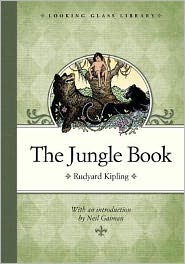
The Jungle Book. Rudyard Kipling. 1894/1895/2012. Random House. 320 pages. 

The Looking Glass Edition published by Random House in 2012 and featuring an introduction by Neil Gaiman includes the following stories and poems in its edition of The Jungle Book: Mowgli's Brothers, Hunting Song of the Seeonee Pack, Kaa's Hunting, Road Song of the Bandar-Log, How Fear Came, The Law of the Jungle, Tiger-Tiger!, Mowgli's Song, Letting in the Jungle, Mowgli's Song Against People, The King's Ankus, The Song of the Little Hunter, Red Dog, Chil's Song, The Spring Running, The Outsong, Rikki-Tikki-Tavi, and Darzee's Chant. Essentially readers get nine stories and nine poems that were originally published in the Jungle Book and the Second Jungle Book. These stories were published in 1894 and 1895.

For better or worse, this publication excludes The White Seal, Lukannon, Toomai of the Elephants, Shiv and the Grasshopper, Her Majesty's Servants, Parade Song of the Camp Animals, The Miracle of Purun Bhagat, A Song of Kabir, The Undertakers, A Ripple Song, Quiquern, and Angutivaun Taina. These stories and poems were also included in the original publications of the Jungle Book and the Second Jungle Book. I haven't read the excluded stories, so perhaps the editors did choose the best of the best to represent Rudyard Kipling's The Jungle Book.

If I had to choose just one word to describe the Jungle Book, it would be DIFFERENT. It is an adventure story, and adventure stories are not uncommon. But even in its writing--the language, the sentence structure, the flow, etc.--it is different, or, unique. Almost all of the stories in this newly published edition are about Mowgli, a young boy raised by a pack of wolves in the Indian jungle. He was accepted into the wolf pack and two other animals had a hand (so to speak) in bringing him up: Bagheera, a black panther, and Baloo, a bear. Many stories stand on their own as separate adventures. Some stories focus on the dangers within the jungle that Mowgli faces--the monkey, the tiger Shere Khan, the cobra king, the dhole, etc. Some stories focus on the dangers Mowgli faces from outside the jungle, mainly the nearby villagers led by Buldeo.

The main animals readers get to know are: Bagheera, Baloo, Kaa, Hathi, and Akela.

The Jungle Book isn't exactly my kind of book. These are not the kind of stories that excite me.

© 2013 Becky Laney of Becky's Book Reviews