Showing posts with label 1945. Show all posts

Friday, March 31, 2017

Rooster Crows

The Rooster Crows. Maud and Miska Petersham. 1945. (Caldecott Medal) 64 pages. [Source: Library]

First sentence: Here is part of America's heritage--gay verses beautifully illustrated by famous artists.

Premise/plot: The Rooster Crows is a Caldecott award-winner from the 1940s. It is a collection of poetry really. Rhymes and Jingles. Finger Games. Rope Skipping Rhymes. Counting-Out Rhymes. Games. Yankee Doodle.
I asked my mother for fifty cents
To see the elephant jump the fence.
He jumped so high
He reached the sky
And never came back till the Fourth of July.
Mary had a little lamb,
Its fleece was black as tar.
And everywhere that Mary went
They thought it was a b-a-a-r.
I eat my peas with honey,
I've done it all my life.
It makes the peas taste funny,
But it keeps them on my knife.
My thoughts: It was a pleasant enough read. Some of the illustrations were absolutely amazing. I really enjoyed looking this one through. Some rhymes were more enjoyable than others. But overall I liked it.

Text: 3 out of 5
Illustrations: 4 out of 5
Total: 7 out of 10

© 2017 Becky Laney of Becky's Book Reviews

Friday, March 03, 2017

Stuart Little

Stuart Little. E.B. White. Illustrated by Garth Williams. 1945. 131 pages. [Source: Library]

First sentence: When Mrs. Frederick C. Little's second son arrived, everybody noticed that he was not much bigger than a mouse.

Premise/plot: Stuart Little acts more like a mouse than a son--for better or worse--in E.B. White's first novel. In the first few chapters he proves himself mostly of use around the house: getting things out of the drain, unsticking piano keys, etc. But for most of the book he is emotionally disconnected from his parents and his brother, George. At first this is running around New York City on his own and having adventures that a 'normal' child could never have. But as the novel progresses,he leaves home without thinking twice about it, with no regrets, with no plans to return. He leaves in search of a bird that has flown away after receiving a warning note that her life was in danger. Stuart knows nothing of the note just that his new friend is gone. Little visits a doctor and borrows a toy car that apparently has a real engine and runs on real gas. The doctor apparently sees him not as a child of a couple he knows well, but an adult mouse. The book ends with him no closer to finding his friend.

My thoughts: I should have listened to my mother. She told me that it was disappointing and strange, and that it had no real ending. I agree. This animal fantasy was odd start to finish. I would have preferred either a story of a small mouse-child that acted like a child, loved his parents, loved his brother, went to school, etc. OR a story of a mouse that acted like a little man: dressed in clothes, drove a car, had a job, etc.

The chapter where the school superintendent was so desperate for a substitute teacher that he hires a mouse off the street was peculiar and strangely entertaining.

Quotes:
Law is much more solemn than advice (93)
Summertime is important. It's like a shaft of sunlight. Or a note in music...or the way the back of a baby's neck smells if its mother keeps it tidy... Never forget your summertimes, my dears. (98)

© 2017 Becky Laney of Becky's Book Reviews

Wednesday, July 08, 2015

Ross Poldark

Ross Poldark. (Poldark #1) Winston Graham. 1945/2015. Sourcebooks. 400 pages. [Source: Review copy]

It was windy. The pale afternoon sky was shredded with clouds; the road, grown dustier and more uneven in the past hour, was scattered with blown and rustling leaves.

The novel opens* with the book's hero, Ross Poldark, returning to Cornwall in the fall of 1783. He's returning from war, learning that his father is dead--and that his father hasn't left him much money to work his estate (Nampara) with--also that the woman he thought was his one true love is engaged to another man--Ross' cousin, Francis. But Ross Poldark is resilient--stubborn--someone who knows what he wants and has the gumption to fight for what he wants. Mainly, he will not give up on his home and his mine to try to find a life elsewhere. He may be tempted to want to "fight for" Elizabeth. But mainly the battle is internal: more of a fighting to get her out of his mind and heart.

Is the novel a romance? Yes and no. Yes. Ross Poldark thinks he's madly in love with Elizabeth. And yes, the novel does chronicle his romance with Demelza towards the end. But in many ways, it is not a romance novel. Readers meet dozens of characters from all social classes, and, we follow their stories. For example, the dramatic relationship of Jinny and Jim Carter or Verity and Captain Blamey. Readers spend a lot of time with the lower classes, seeing the effects of poverty up close. And there is a sense of injustice at times at how they're treated and the very lack of opportunities that keep them trapped right where they are. At times--in certain situations--Ross is understanding and becomes something of their champion. (Not that this becomes his full-time job, righting the wrongs, fighting injustice, giving voice to those without. It doesn't. But he is a hard worker; he does dirty his own hands and work alongside others.) The more he "becomes one of them" the less his own class wants to do with him--or so it seems. There are always exceptions!

Ross can be impulsive in his wanting to do the right thing. For example, when he brings home a thirteen-year-old Demelza to be his servant. Does the girl desperately want to escape her own miserable home life where she's often beaten? Yes. Very much. Once Ross sees the scars on her back and learns her story, he wants to protect her. So he offers a job. But how will everyone else respond? Will her father let her go without a fight? without trouble? Not likely! And what will his own class think of this decision? They find it strange and unusual!

Readers get to spend a lot of time with Demelza, Jud, and Prudie. (And I was pleasantly surprised to find that Prudie and Jud actually like Demelza in the book and aren't trying to rid themselves of her every five minutes.)

(The novel closes in December of 1787). 

Do I have favorite characters? Yes. I really LOVE Verity. And, of course, Ross and Demelza come to mind as well. If I didn't care about them, then I couldn't like the book overall. And I definitely liked it. I loved, loved, loved some scenes of this one. I didn't love every single scene, every single chapter equally. But there were places I just adored this story.

*The first chapter opens with Ross Poldark returning. Technically, the book has a prologue which introduces readers to Joshua Poldark, Ross' father, who is dying.

© 2015 Becky Laney of Becky's Book Reviews

Friday, January 04, 2013

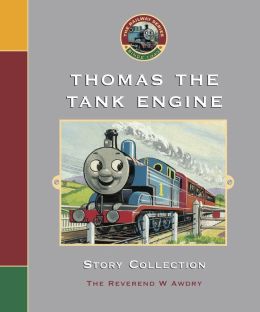
Thomas the Tank Engine Collection (1945-1960)

Thomas The Tank Engine Story Collection. The Reverend W. Awdry. (The Railway Series Since 1945). Based On the Railway Series by the Reverend W. Awdry. 2005. Random House. 512 pages.

This story book collection contains fourteen previously published books starring Thomas and his friends. The titles included in the collection: The Three Railway Engines (1945), Thomas the Tank Engine (1946), James the Red Engine (1948), Tank Engine Thomas Again (1949), Troublesome Engines (1950), Henry the Green Engine (1951), Toby the Tram Engine (1952), Gordon the Big Engine (1953), Edward the Blue Engine (1954), Four Little Engines (1955), Percy the Small Engine (1956), The Eight Famous Engines (1957), Duck and the Diesel Engine (1958), The Twin Engines (1960). These were all originally published in the UK.

Each book contains a handful of stories. For example, Gordon the Big Engine contains four stories: "Off the Rails," "Leaves," "Down the Mine," and "Paint Pots and Queens." Henry The Green Engine contains five stories: "Coal," "The Flying Kipper," "Gordon's Whistle," "Percy and the Trousers," and "Henry's Sneeze." Tank Engine Thomas Again contains four stories: "Thomas and the Guard," "Thomas Goes Fishing," "Thomas, Terence, and the Snow," and "Thomas and Bertie."

There were certainly plenty of stories to choose from in this collection. It would have been nice to have an index to each and every story instead of just an index of the picture books. I began the book enthusiastically, appreciating the stories and the little details. By the end of the book, however, I was a bit tired of trains. I liked the writing, for the most part. There were very rhythmic places in the text that felt just right.

A conversation between Thomas, Annie, and Clarabel:
"Why don't you go fast? Why don't you go fast?" called Annie and Clarabel anxiously.
"Wait and see, wait and see," hissed Thomas.
"He's a long way ahead, a long way ahead," they wailed, but Thomas didn't mind. He remembered the crossing. (139)
These stories may have been updated since their initial publication. I've heard that in the original stories, Sir Topham Hatt is just called "The Fat Controller." There is a "complete collection" of Thomas stories now out of print that may be be closer to the original. (It has all twenty-six picture books.)

From "Off the Rails"
 A family of toads croaked crossly at Gordon as he lay in the mud. On the other side of the ditch, some little boys were chattering.
"Gee! Doesn't he look silly!" "They'll never get him out." They began to sing: Silly old Gordon fell in a ditch,
fell in a ditch,
fell in a ditch.
Silly old Gordon fell in a ditch,
all on a Monday morning. (266)
From "Gordon's Whistle"
Gordon was cross.
"Why should Henry have a new shape?" he grumbled. "A shape good enough for me is good enough for him. He goes gallivanting off to Crewe, leaving us to do his work. It's disgraceful!"
"And there's another thing. Henry whistles too much. No respectable engine ever whistles loudly at stations. It isn't wrong," said Gordon, "but we just don't do it." (202-3)
Read Thomas the Tank Engine Story Collection
  • If you have a little one who LOVES Thomas and friends
  • If you have a little train-lover
  • If you are interested in reading classic or vintage picture books
© 2013 Becky Laney of Becky's Book Reviews

Saturday, May 14, 2011

Kinfolk

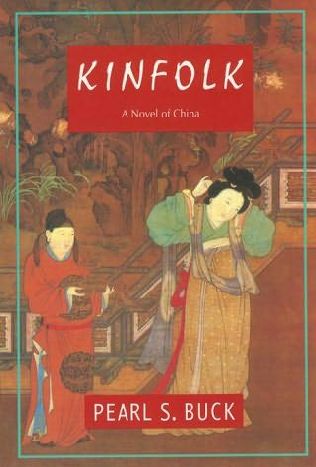
Kinfolk. Pearl S. Buck. 1945/2004. Moyer Bell. 408 pages. 

The theater in Chinatown was crowded to the doors. Every night actors brought from Canton played and sang the old Chinese operas. If Billy Pan, the manager, announced a deficit at the end of the lunar year, businessmen contributed money to cover it. The theater was a bulwark of home for them. Their children went to American schools, spoke the American language, acted like American children. The fathers and mothers were not highly educated people and they could not express to the children what China was, except that it was their own country, which must not be forgotten. But in the theater the children could see for themselves what China was. Here history was played again and ancient heroes came to life before their eyes. It was the only place in Chinatown which could compete with the movies. Parents brought their children early and stayed late. They talked with friends and neighbors, exchanged sweetmeats and gossip, and sat spellbound and dreaming when the curtain went up to show the figures who were contemporary with their ancestors.

As much as I just loved and adored East Wind: West Wind--my very first Pearl S. Buck novel--I just LOVED, LOVED, LOVED Kinfolk. It is so very different from The Good Earth and Sons. While I struggled to find anyone sympathetic in The Good Earth and Sons, I could name half a dozen characters (if not more) that I liked, loved, respected, or admired in Kinfolk. And here's the thing, even the characters that I didn't necessarily "like", I found them to be well-developed, complex. Unlike the often nameless one-dimensional characters in The Good Earth and Sons. And the language, the style. It wowed me. It really did! So much to love and appreciate.

Kinfolk is about the Liang family. Dr. Liang, the father, is a scholar who fled China because it was getting to be too harsh, too ugly, too dangerous, too uncertain. He's a scholar, a teacher, a thinker, a philosopher. He needs peace and quiet and rest. He needs to be surrounded by people who appreciate his intellect, his superiority. (And does he ever think he's superior to just about anyone who's ever lived.) His wife, well, she "appreciates" him as best she can. Knowing that he can be oh-so-difficult to live with. But knowing that it is her place to bring out the best in him. To calm him when he gets furious or frustrated. But this isn't always easy since he doesn't respect her or see her as someone worthy of love and respect. She's the mother of his children. But. That's about it. He doesn't feel like she's intellectually or emotionally his soul mate. And he doesn't see any need to treat her as if she was the love of his life. It's her job to appreciate him, not the other way round.

So the Liangs have four children--two of the children were born in China, two of the children were born in America--James and Mary are the oldest, Peter and Louise are the youngest. James and Mary have a deep longing to return to China, to make their home, their future in China. They know it won't be easy. They know it will require sacrifice and hard work. But neither James or Mary would want to live anywhere else. They wouldn't trade the hardships, the uncertainties for anything because they feel like China is where they belong. James is already having to sacrifice his first love, Lili, because she doesn't share his dream, his vision. She wants to be American, a rich American. James, a doctor, is the first to make the trip. He'll be working in Peking in a hospital. While James knew that Mary was planning on coming to China herself--at some point. He never expected to be joined by Mary and Peter and Louise. But Louise, unfortunately, has a love affair with an American. A love affair which her father found out about. (Louise and Peter are--at least in their parents' opinion--too American.) So Mary, Louise, and Peter are sent away--Louise in disgrace, Mary because that is where she most wants to be, and Peter because his father is afraid of any of his children becoming too American that they begin to lose who they are or who they are supposed to be. Their morals, their values. (It's fine for Americans to act that way, they're American, what do you expect? But you--you shouldn't be acting like that.)

Each responds differently to their new lives in China. Mary loves it but wants even more--she wants to return to their family's ancestral village, she wants to be among the people--the commoners, the peasants, the people that live on the land, work the land, depend on the land for life itself. She wants to bring change, she wants to bring education, she wants to teach them to read and write. Louise is absolutely miserable. Doesn't see any reason why she should have to be in China when she could be living the good life in America if her parents weren't so unreasonable and old-fashioned. But she becomes hopeful when she meets an American man! Could this be her big chance? Peter. Well. Peter sees China and is shocked. The real China is so very far-removed from anything his father has ever told him, taught him, he can only see his father as a big liar, a man out of touch with reality, a man living in his own little dream world. So the real China makes him angry at his father, angry at himself, angry with the whole world. Nothing is as it should be. And he's going to be angry about it for a long, long, long time.

And James, our hero, the man who may just be the most important in Kinfolk, well, he loves China. He shares his sister's dream of returning to their ancestral village, and living with their Uncle Tao and his family. He knows it won't be easy to convince these villagers, these peasants, these farmers that Western medicine is good. That he can heal them, cure them, give them a chance to live life well and healthy. And Uncle Tao may be the one that needs the most convincing. Since James knows that his uncle needs surgery to remove a tumor. But. He knows that China is where he belongs. That China is his destiny, his future. For better or worse. For richer or poorer. James is going to be with the people of China.

We also meet Chen, a fellow doctor, a man who becomes very close with the Liang family. (He's a character that I found so easy to love!) And then there's Young Wang, another man James meets when he's new-to-China. A man that becomes a servant but so much more than a servant. A true friend and guardian to the family. 

Much of Kinfolk is set in China. But. We never quite lose touch with the parents in New York. Even separated by all those miles, there's tension between the parents and children.

I absolutely loved James and Mary and Chen and Young Wang. I just LOVED them. And even the characters that I didn't love, I found them to be well-developed and human. I think they could even be studied perhaps. (Kinfolk was one of the novels that I read it and found myself thinking, I could write a dozen papers about this one. It's just that good, that rich, that well-written, that interesting.) It was compelling. It was thought-provoking. It was a marvelous book.

So if the only Pearl S. Buck you've ever read was The Good Earth, I'd urge you to please pick up one of her other books. A book like Kinfolk or East Wind: West Wind. Because you need to give her another try.

Favorite quotes:

James on why he needs to return to China now:

He had never said even to Mary that in some deeply repressed corner of his being he grieved that his own father had chosen to live in exile during the years of the their country's hardship. He knew all the arguments, that a scholar could not work in the midst of turmoil and war. He believed these arguments were true. He knew that his father's delicately balanced mind needed safety and quiet and security in order to do its work. But he had long ago determined that he would work where he was most needed, in the midst of turmoil, even in war. He would not allow his mind to be delicate nor his heart remote. (40)

James trying to convince Lili to join him in China:

"Try to understand how I feel. Our people are good--our people are wonderful. China is great. She is not really weak. She is only in distress. All the great strength is simply waiting until we come to her help. She has lived in an old, old world and she needs to be born into the new one. I am a doctor and I think naturally in terms of birth--of bringing forth life--" (44)

James trying to decide if he's ready to make the leap:

The city was full of such brawls. There were too many starving people, and policemen treated them as criminals. Perhaps they were. There was no line between starvation and crime. He felt himself torn in the division of reality. The world, the whole world, was divided into two parts, the island of the rich and the ocean of the poor. Where would he live? He still had his feet on the island, but he was facing the rough dark waters. He must go back--or else he must leap. (65)

James speaking to Louise about her disappointing love affair:

"All this," he said after a moment, "is because you have let yourself fall in love with an American. At your age love shapes the universe."
She continued to sob, and he went on gently. "I know, too, what it is to love someone. I think I loved Lili with all my heart. Even now when I know we shall never marry, when I think of her, or someone speaks her name, the world trembles. But it does not crash about me. I know there is a life that must be lived happily without Lili. (166)
On differences between the generations, the 'war' between old and new:
There was a world of difference between themselves and these kinfolk, centuries of difference, space and time crowded into a single generation. (209)

Dr. Liang (the father) on the necessity of having peasants:

People, he reflected, must live at these different levels. Some must work with the hands, some with the mind. The peasants should not be lifted from their places as workers with the hands, or the higher ones would starve. He himself would, if he lived in China, be quite helpless without the peasants. Even here, he supposed, there were the workers with hands, men on American farms who had to do the crude work of producing food. Such persons must not be taught falsely that they could or should do other work. (228)

And this is just one of the reasons why he can't understand his children, and why his children can't understand him.

One of the reasons why I loved Chen:

"It takes a certain kind of person to live in China now," Chen mused.
"What kind of person?" Mary asked.
"Someone who can see true meanings, someone who does not only want the world better but believes it can be made better, and gets angry because it is not done, someone who is not willing to hide himself in one of the few good places left in the world--someone who is tough!" (251)

Dr. Liang reflecting on the past:

But he had wanted the children to understand the glory of China, the honor, the dignity of an ancient race and country. He himself purposefully dwelled upon these things. It was necessary to do this in order to have a perspective upon the disagreeable present. The present was always transient. It faded away. Only the past and future were eternal. Therefore he had done well to teach his children of their people's greatness. It was what Confucius himself had taught. Confucius too had lived in troubled and divided times, and he had not allowed himself to be troubled or divided. Instead he had gathered together all the greatness of the ancients and he had put this greatness into a book which had lived through the ages. (303)

James and Mary and Chen reflecting together:

The weight of their country, vast and old, lay heavy upon them all, and they were of such conscience that they could not escape.
"What Peter could not see," James said at last, "was that destruction does not heal. For what can be destroyed except people? Yet the people are the treasure store of the nation."
"And our people are good," Chen said.
"I tell you ours are the best people in the world..." (315)


© 2011 Becky Laney of Becky's Book Reviews

Monday, February 15, 2010

Cannery Row


Cannery Row. John Steinbeck. 1945. Penguin. 208 pages.

Cannery Row in Monterey in California is a poem, a stink, a grating noise, a quality of light, a tone, a habit, a nostalgia, a dream. Cannery Row is the gathered and scattered, tin and iron and rust and splintered wood, chipped pavement and weedy lots and junk heaps, sardine canneries of corrugated iron, honky tonks, restaurants and whore houses, and little crowded groceries, and laboratories and flophouses. Its inhabitants are, as the man once said, "whores, pimps, gamblers, and sons of bitches," by which he meant Everybody. Had the man looked through another peephole he might have said "Saints and angels and martyrs and holy men," and he would have meant the same thing.

I enjoyed this John Steinbeck novel. Steinbeck certainly has a way with words, details, and images. Even if what he is describing is more ugly than beautiful. He has a way of saying it so that it matters. So that you, the reader, care. It does help that this one has a good deal of humor. Not that humor is quite the way I'd put it. (Since early on, we see a suicide or two. But still. It's Steinbeck.)

Lee Chong's grocery, while not a model of neatness, was a miracle of supply. It was small and crowded but within its single room a man could find everything he needed or wanted to live and to be happy--clothes, food, both fresh and canned, liquor, tobacco, fishing equipment, machinery, boats, cordage, caps, pork chops. You could buy at Lee Chong's a pair of slippers, a silk kimono, a quarter pint of whiskey and a cigar. You could work out combinations to fit almost any mood. The one commodity Lee Chong did not keep could be had across the lot at Dora's.
What is Cannery Row about? It's about a surprise party gone wrong. And the men (and women) who come together to make everything right again in the end. Mack and a few of his friends want to do something nice for Doc, one of the town's favorite guys. They think the best way to say that they appreciate him is by throwing him a surprise party. But since they're always down on their luck (in other words low on cash, and not trustworthy enough to extend credit to) they're a bit stumped as to how to go about it. What plan will they come up with?


© Becky Laney of Becky's Book Reviews