Showing posts with label 1988. Show all posts

Saturday, April 15, 2023

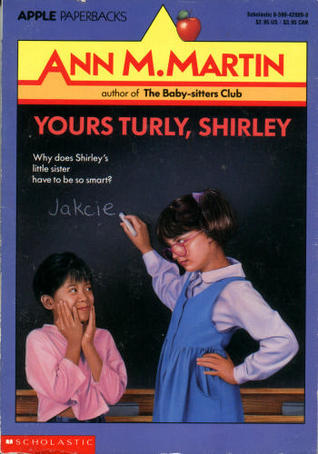
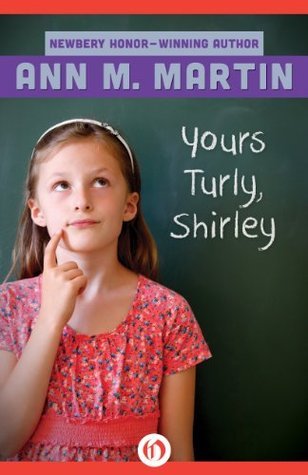
78. Yours Turly, Shirley


Yours Turly, Shirley. Ann M. Martin. 1988. 128 pages. [Source: Library]

First sentence: Bzzzz! Shirley Basini's alarm clock went off and Shirley rolled over, grabbed it, and threw it at the wall. Shirley's clock looked like a baseball and you were supposed to throw it at the wall. That was the only way to turn it off.

Premise/plot: Shirley Basini, our protagonist, has dyslexia and is in fourth grade. She knows her diagnosis. Her parents know. Her teacher(s) know. Everyone knows. But knowing isn't exactly the same as understanding. She's been warned that if she doesn't improve throughout the year, she'll be held back to repeat fourth grade. She knows this from day one. Yours Turly, Shirley, is in part, Shirley's experiences in fourth grade--her ongoing struggle to improve academically and learn to manage/cope with her dyslexia.

The novel is also Shirley's new little sister. The family has decided to adopt a child from Vietnam. At first, they think they'll be receiving/adopting a three year old baby boy. As the date to pick him up from the airport draws closer, however, they learn surprise surprise that it will be an eight year old girl. They decide to rename her Jackie. 

Jackie is super-smart, super-intuitive, super savvy. She starts the school year in first grade, speed runs learning English (and other subjects presumably?). By the middle of the year, they [the powers that be at school] decide to move her to third grade to be with her peers [children her own age]. Jackie loves, loves, loves to read. And the library is her favorite place.

All isn't perfectly, perfect for Jackie, however. The students--even her own big sister--tease her for pronouncing her "r's" as "l's." Granted, her big sister doesn't do it nearly so often as everyone else. But the one time she does it is in front of a lot of people--at a spelling bee. Besides being teased for talking different/weird, she's teased for being "yellow" or "slope eyes." (These words come straight from the book. I'm just mentioning what the book says). Shirley who was halfway to hating her little sister for being smarter and better, now swoops in to save her. (But does Jackie need saving? Maybe. Maybe not. The two girls take a stand together--and speak up loudly about the teasing.) 

Each chapter is a month of the school year. 

Ann M. Martin wrote this during the same time she was writing The Babysitter's Club books. This one is not a series book but a standalone. 

My thoughts: I am conflicted. I am. It is dated. I wasn't in fourth grade in 1988/89. But I was in elementary school. I don't think if I'd read it as a child I would have questioned the representation of those with learning differences (aka dyslexia) OR being Vietnamese-American. I don't know how realistically or authentically either comes across as...now...or perhaps even then. I don't know that there is ever only one "right" way to depict something. Jackie is a gifted, super-smart, people-pleaser. Shirley is a class clown who makes other students laugh and teachers groan. The book is told from Shirley's point of view exclusively. 

I do not have dyslexia. I can't judge if the "skills" and "techniques" being shown in this one were generally helpful or not so much. I use quotes because really the only thing she learns from the resource teacher is that if you love the content of what's in books, you will do anything to keep reading. You will teach yourself the skills needed so that you can find out what happens next. The resource teacher begins by reading aloud book after book after book. She reads aloud a little here or there. Taking on the part of one character in the book and reading that one character's dialogue. Soon, he [the teacher] has her reading books all on her own. She now has a long list of authors whom she loves and adores. She's now eager to read books for fun, to read all the books in series, to keep finding new authors, new series, etc. 

As a reader, I loved all the name-dropping. Even more so since I was in elementary school at this time. These books, these authors, these series...were the ones I myself was reading at the time. So it was a treat to see this aspect of the book.


© 2023 Becky Laney of Becky's Book Reviews

Monday, May 01, 2017

Minerva Louise

Minerva Louise. Janet Morgan Stoeke. 1988. 24 pages. [Source: Library]

First sentence: Minerva Louise loved the house with the red curtains.

Premise/plot: Minerva Louise explores the house with the red curtains in this picture book. It is the first in a series starring this lovable hen. She may not be the smartest chicken, but, she may be the funniest. For example, "a comfortable chair...and friendly cows." The chair is a flower pot. The 'friendly cow' is a kitten.

My thoughts: I like this one very much. I don't know if I love, love, love Minerva Louise yet. But. I am curious about this CURIOUS chicken. I want to see what other types of adventures she has. Will definitely be returning to the library for more!

Text: 4 out of 5
Illustrations: 5 out of 5
Total: 9 out of 10

© 2017 Becky Laney of Becky's Book Reviews

Friday, June 17, 2016

Matilda

Matilda. Roald Dahl. Illustrated by Quentin Blake. 1988. 240 pages. [Source: Library]

First sentence: It's a funny thing about mothers and fathers. Even when their own child is the most disgusting little blister you could ever imagine, they still think that he or she is wonderful.

Premise/plot: Matilda, our heroine, is an absolute genius. (She's taught herself to read and to do times tables). But her parents are terrible human beings. Mr. Wormwood is a used car salesman who is really dishonest. Mrs. Wormwood, well, maybe her greatest fault is neglecting her children? Both Mr. and Mrs. Wormwood are addicted to television and abhor the written word. Hate isn't too strong a word for how they feel about their daughter. Matilda escapes from her home most every day to visit the local public library. (She's read every book in the children's section and is now making her way through the adult section with a little guidance from Mrs. Phelps.) Another escape soon becomes school. The good news is that Miss Honey, the teacher, LOVES AND ADORES her genius pupil. The bad news is that the headmistress is evil, cruel, abusive. (Was Dahl inspired by Jane Eyre!) Matilda's reaction to injustice is naughtiness and cleverness. How can she use her brains to get revenge on those she sees as being unjust or in the wrong???

My thoughts: I like this one. I do. I more than like it actually. Perhaps because Matilda LOVES, LOVES, LOVES to read and there is a lot of dropping of book titles and authors names. Perhaps because Matilda finds the library to be such a wonderful place. Perhaps because two of the nicest people in the book are a librarian and a teacher. Regardless this one is definitely worth reading.


© 2016 Becky Laney of Becky's Book Reviews

Wednesday, April 29, 2015

The Devil's Arithmetic

The Devil's Arithmetic. Jane Yolen. 1988. Penguin. 170 pages. [Source: Bought]

The Devil's Arithmetic is a captivating book. It is a story within a story. I'm not sure why it works so brilliantly, I just know it does.

The outside frame of the story is set in modern times. Hannah, the heroine, is, along with her family, preparing to celebrate the Passover Seder at another family member's home. To Hannah, this "celebration" or "observance" is a waste of time and energy. She just does not get it at all or understand why it's so important to other members of her family. It's something she has to do that she can't talk her way out of. But something happens to Hannah when she opens the front door to 'welcome Elijah.'

She opens the door to the past and walks right through. She finds herself in a Polish village in 1942! It's not Passover in 1942, but, there is a celebration going on just the same. A wedding in the village! But tragically, this wedding never occurs. The Nazis take everyone away; everyone is relocated. Hannah (Chaya) makes new friends, and fights to survive. It won't be easy. This new life, this 1942 life, becomes oh-so-painfully real to her. She knows what's coming. She knows about the death camps. She knows about how many Jews were killed, how many never came out of the camps, how many families were torn apart. She knows and can do nothing to prevent it from happening. She's powerless, but, her words still have power. Her words can shape stories that give hope and courage and strength to her fellow sufferers.

The story ends beautifully in my opinion. It may be an intense read, but, it's worth it.

© 2015 Becky Laney of Becky's Book Reviews