Showing posts with label Josephine Tey. Show all posts

Monday, March 05, 2018

Daughter of Time

The Daughter of Time. Josephine Tey. 1951/1995. Simon & Schuster. 208 pages. [Source: Bought]

First sentence: Grant lay on his high white cot and stared at the ceiling. Stared at it with loathing. He knew by heart every last minute crack on its nice clean surface. He had made maps of the ceiling and gone exploring on them; rivers, islands, and continents. He had made guessing games of it and discovered hidden objects; faces, birds, and fishes. He had made mathematical calculations of it and rediscovered his childhood; theorems, angles, and triangles. There was practically nothing else he could do but look at it.

Premise/plot: What is a police inspector to do when he's stuck in a hospital bed with a broken leg? Uninterested in solving any recent cold cases, he turns to the past for inspiration. He sets out to solve the mystery of who killed the two princes in the tower. He begins his investigation by looking at the so-called prime suspect: King Richard III. But he's troubled by what he's discovered. All the evidence "against" Richard is faulty, weak, unsubstantiated; in short in a modern case, everything would be inadmissible. The evidence feels contrived--pieced together decades after the boys disappeared. More importantly, it feels politically motivated all being written during the Tudor dynasty--in the reigns of Henry VII and Henry VIII. But if Alan Grant has pardoned Richard III--eliminated him as a suspect--who does he think committed the crime? And did the crime occur when everyone thinks it did? Could the boys have been alive when Henry VII defeated Richard III at Bosworth Field?!

My thoughts: I love, love, love, LOVE this mystery novel by Josephine Tey. It was the first mystery novel that I LOVED. (My very first mystery novel was also by Tey. But I didn't "love" it.) I found the writing to be enjoyable and quite quotable!!! That is rarely the case in a mystery novel where it is all about who did it.

Alan Grant on popular fiction authors:

The Sweat and the Furrow was Silas Weekley being earthly and spade-conscious all over seven hundred pages. The situation, to judge from the first paragraph, had not materially changed since Silas's last book: mother lying-in with her eleventh upstairs, father laid-out after his ninth downstairs, eldest son lying to the Government in the cow-shed, eldest daughter lying with her lover in the the hayloft, everyone else lying low in the barn. The rain dripped from the thatch, and the manure steamed in the midden. Silas never omitted the manure. It was not Silas's fault that its steam provided the only uprising element in the picture. If Silas could have discovered a brand of steam that steamed downwards, Silas would have introduced it. (13)
Did no one, any more, no one in all this wide world, change their record now and then? Was everyone nowadays thirled to a formula? Authors today wrote so much to a pattern that their public expected it. The public talked about "a new Silas Weekley" or "a new Lavinia Fitch" exactly as they talked about "a new brick" or a "new hairbrush." They never said "a new book by" whoever it might be. Their interest was not in the book but in its newness. They knew quite well what the book would be like. (14)
The Rose of Raby proved to be fiction, but at least easier to hold than Tanner's Constitutional History of England. It was, moreover, the almost-respectable form of historical fiction which is merely history-with-conversation, so to speak. An imaginative biography rather than an imagined story. Evelyn Payne-Ellis, whoever she might be, had provided portraits and a family tree, and had made no attempt, it seemed, to what he and his cousin Laura used to call in their childhood "write forsoothly." There were no "by our Ladys," no "nathelesses" or "varlets." It was an honest affair according to its lights. And its lights were more illuminating than Mr. Tanner. Much more illuminating. It was Grant's belief that if you could not find out about a man, the next best way to arrive at an estimate of him was to find out about his mother. (59)
Alan Grant on Sir Thomas More
He came to the surface an hour later, vaguely puzzled and ill at ease. It was not that the matter surprised him, the facts were very much what he had expected them to be. It was that this was not how he had expected Sir Thomas to write. "He took ill rest at nights, lay long waking and musing; sore wearied with care and watch, he slumbered rather than slept. So was his restless heart continually tossed and tumbled with the tedious impression and stormy remembrance of his most abominable deeds." That was all right. But when he added that "this he had from such as were secret with his chamberers" one was suddenly repelled. An aroma of back-stair gossip and servants' spying came off the page. So that one's sympathy tilted before one was aware of it from the smug commentator to the tortured creature sleeping on his bed. The murderer seemed of greater stature than the man who was writing of him. Which was all wrong. Grant was conscious too of the same unease that filled him when he listened to a witness telling a perfect story that he knew to be flawed somewhere... (71)
He was five. When that dramatic council scene had taken place at the Tower, Thomas More had been five years old. He had been only eight when Richard died at Bosworth. Everything in that history had been hearsay. And if there was one word that a policeman loathed more than another it was hearsay. Especially when applied to evidence. He was so disgusted that he flung the precious book on to the floor before he remembered that it was the property of a Public Library and his only by grace and for fourteen days. More had never known Richard III at all. He had indeed grown up under a Tudor administration. That book was the Bible of the whole historical world on the subject of Richard III--and it was from that account that Holinshed had taken his material, and from that Shakespeare had written his--and except that More believed what he wrote to be true it was of no more value than what the soldier said.... Grant had dealt too long with the human intelligence to accept as truth someone's report of someone's report of what that someone remembered to have seen or been told. (81)
Other favorite quotes:
"One would expect boredom to be a great yawning emotion, but it isn't, of course. It's a small niggling thing." (16)
"I'm feeling like a policeman. I'm thinking like a policeman. I'm asking myself the question that every policeman asks in every case of murder: Who benefits? And for the first time it occurs to me that the glib theory that Richard got rid of the boys to make himself safer on the throne is so much nonsense. Supposing that he had got rid of the boys. There were still the boys' five sisters between him and the throne. To say nothing of George's toy: the boy and girl. George's son and daughter were barred by their father's attainder; but I take it that an attainder can be reversed, or annulled, or something. If Richard's claim was shaky, all those lives stood between him and safety."
"And did they all survive him?"
"I don't know. But I shall make it my business to find out. The boys' eldest sister certainly did because she became Queen of England as Henry's wife." (105)
It was brought home to him for the first time not only what a useless thing the murder of the boys would have been, but what a silly thing. And if there was anything that Richard of Gloucester was not, beyond a shadow of a doubt, it was silly. (137)
"Of course I'm only a policeman," Grant said. "Perhaps I never moved in the right circles. It may be that I've met only nice people. Where would one have to go to meet a woman who became matey with the murderer of her two boys?"
"Greece, I should think," Marta said. "Ancient Greece."
"I can't remember a sample even there."
"Or a lunatic asylum, perhaps. Was there any sign of idiocy about Elizabeth Woodville?"
"Not that anyone ever noticed. And she was Queen for twenty years or so."
...
"Yes of course. It's the height of absurdity. It belongs to Ruthless Rhymes, not to sober history. That is why historians surprise me. They seem to have no talent for the likeliness of any situation. They see history like a peepshow; with two-dimensional figures against a distant background."
"Perhaps when you are grubbing about with tattered records you haven't time to learn about people. I don't mean about the people in the records, but just about People. Flesh and blood. And how they react to circumstances." (151)
The spectacle of Dr. Gairdner trying to make his facts fit his theory was the most entertaining thing in gymnastics that Grant had witnessed for some time... As a contortionist Dr. Gairdner was the original boneless wonder. More than ever Grant wondered with what part of their brains historians reasoned. It was certainly by no process of reasoning known to ordinary mortals that they arrived at their conclusions. (173)
 Historians should be compelled to take a course in psychology before they are allowed to write. (201) 

© 2018 Becky Laney of Becky's Book Reviews

Wednesday, January 17, 2018

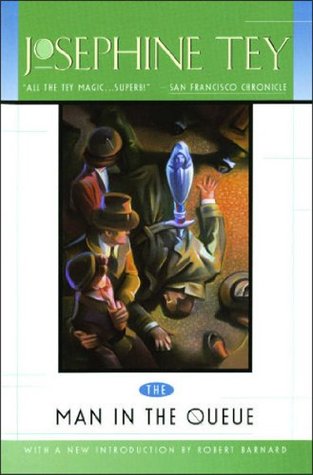
The Man in the Queue

The Man in the Queue (Inspector Alan Grant #1) Josephine Tey. 1929. 255 pages. [Source: Bought]

First sentence: IT was between seven and eight o'clock on a March evening, and all over London the bars were being drawn back from pit and gallery doors. Bang, thud, and clank. Grim sounds to preface an evening's amusement.

Premise/plot: Some murder mysteries make you wait for the murder to occur. That is not the case with Josephine Tey's The Man in the Queue. In the first chapter, the body is discovered. As the line--the queue--moves forward, a man collapses to the ground: he's dead. He was murdered--stabbed--while in line. Inspector Grant faces days of frustration before a few clues come to light. How could a man be murdered in public--with dozens of possible witnesses--and no one notice a thing?!

This mystery introduces the detective Inspector Alan Grant.

My thoughts: The Man in the Queue was the very first mystery novel I ever read. I enjoyed it well enough to become enthusiastic about a new-to-me genre. I have since read all the Inspector Grant books in the series. The Daughter of Time is my favorite and best. Not just my favorite and best Grant novel, but my favorite mystery of all time. (Those that have read it may question the appeal since this mystery takes place while Grant is in the hospital, and the mystery is centuries old. But I stand by my choice.) I would recommend The Man in the Queue.

Favorite quotes:
"Are you hurt?" Grant asked.
"Only my ribs," said Struwwelpeter. "The abnormal excitation of the intercostal muscles has nearly broken them." He struggled to his feet.
"Well, that's twenty minutes wasted," said Grant, "but I had to satisfy myself." He followed the hobbling artist through the dark passage again.
"No time is wasted that earns such a wealth of gratitude as I feel for you," said Struwwelpeter. "I was in the depths when you arrived. I can never paint on Monday mornings. There should be no such thing. Monday mornings should be burnt out of the calendar with prussic acid. And you have made a Monday morning actually memorable! It is a great achievement. Sometime when you are not too busy breaking the law, come back, and I'll paint your portrait. You have a charming head."
A thought occurred to Grant. "I suppose you couldn't draw Sorrell from memory?"
His heart did not jump—that would be doing him an injustice; C.I.D. hearts are guaranteed not to jump, tremble, or otherwise misbehave even when the owner is looking down the uncompromising opening of a gun-barrel—but it certainly was guilty of unauthorized movement. It may have been resentment at his own weakness in being taken aback by a photograph, but Grant's eyes were very hard as he looked at the smiling face—that famous, indeterminate smile. And though his mouth may have curved, he was not smiling as he read the many captions: "Miss Ray Marcable, a studio photograph"; "Miss Marcable as Dodo in Didn't You Know?"; "Miss Marcable in the Row"; and lastly, occupying half the centre page, "Miss Marcable departs from Waterloo en route for Southampton"; and there was Ray, one dainty foot on the step of the Pullman, and her arms full of flowers.
 "Well, Inspector," he said, "how are you getting on? Do you know, you and dentists must be the most unhappy people in the world. No one sees you without remembering unpleasant things."
"Tut, tut, Grant, you've been at the Yard for I don't know how many years, and you're looking at this late stage for reasonable murders. 
© 2018 Becky Laney of Becky's Book Reviews

Tuesday, July 21, 2015

Daughter of Time

The Daughter of Time. Josephine Tey. 1951/1995. Simon & Schuster. 208 pages. [Source: Bought]

Grant lay on his high white cot and stared at the ceiling. Stared at it with loathing. He knew by heart every last minute crack on its nice clean surface. He had made maps of the ceiling and gone exploring on them; rivers, islands, and continents. He had made guessing games of it and discovered hidden objects; faces, birds, and fishes. He had made mathematical calculations of it and rediscovered his childhood; theorems, angles, and triangles. There was practically nothing else he could do but look at it.

Is The Daughter of Time my favorite mystery? I've read it five times, the most recent being in August 2014. At the very least it is my favorite mystery by Josephine Tey. And also one of my favorite books about Richard III. So it's a definite favorite. Unfortunately, the actual clip of the Richard III song from Horrible Histories has been removed, but this one in remains. And here is a live version of it.

Inspector Alan Grant has broken his leg and is hospitalized. In his boredom, he resorts to solving one of history's unsolvable cases. He becomes quite interested in Richard III and in figuring out if he was a cruel murdering tyrant. Is he responsible for the deaths of the two princes in the tower? Or was he framed to take the blame by the conquering Tudors? Readers get a behind-the-scenes glimpse at Grant's thought process as he seeks to solve the mystery.

The book is so well-written. It's unique. It's funny--in places. I loved the narrative voice. I loved the subject as well. I think everyone should give it a try.

Alan Grant on popular fiction authors:

The Sweat and the Furrow was Silas Weekley being earthly and spade-conscious all over seven hundred pages. The situation, to judge from the first paragraph, had not materially changed since Silas's last book: mother lying-in with her eleventh upstairs, father laid-out after his ninth downstairs, eldest son lying to the Government in the cow-shed, eldest daughter lying with her lover in the the hayloft, everyone else lying low in the barn. The rain dripped from the thatch, and the manure steamed in the midden. Silas never omitted the manure. It was not Silas's fault that its steam provided the only uprising element in the picture. If Silas could have discovered a brand of steam that steamed downwards, Silas would have introduced it. (13)
Did no one, any more, no one in all this wide world, change their record now and then? Was everyone nowadays thirled to a formula? Authors today wrote so much to a pattern that their public expected it. The public talked about "a new Silas Weekley" or "a new Lavinia Fitch" exactly as they talked about "a new brick" or a "new hairbrush." They never said "a new book by" whoever it might be. Their interest was not in the book but in its newness. They knew quite well what the book would be like. (14)
The Rose of Raby proved to be fiction, but at least easier to hold than Tanner's Constitutional History of England. It was, moreover, the almost-respectable form of historical fiction which is merely history-with-conversation, so to speak. An imaginative biography rather than an imagined story. Evelyn Payne-Ellis, whoever she might be, had provided portraits and a family tree, and had made no attempt, it seemed, to what he and his cousin Laura used to call in their childhood "write forsoothly." There were no "by our Ladys," no "nathelesses" or "varlets." It was an honest affair according to its lights. And its lights were more illuminating than Mr. Tanner. Much more illuminating. It was Grant's belief that if you could not find out about a man, the next best way to arrive at an estimate of him was to find out about his mother. (59)
Alan Grant on Sir Thomas More
He came to the surface an hour later, vaguely puzzled and ill at ease. It was not that the matter surprised him, the facts were very much what he had expected them to be. It was that this was not how he had expected Sir Thomas to write. "He took ill rest at nights, lay long waking and musing; sore wearied with care and watch, he slumbered rather than slept. So was his restless heart continually tossed and tumbled with the tedious impression and stormy remembrance of his most abominable deeds." That was all right. But when he added that "this he had from such as were secret with his chamberers" one was suddenly repelled. An aroma of back-stair gossip and servants' spying came off the page. So that one's sympathy tilted before one was aware of it from the smug commentator to the tortured creature sleeping on his bed. The murderer seemed of greater stature than the man who was writing of him. Which was all wrong. Grant was conscious too of the same unease that filled him when he listened to a witness telling a perfect story that he knew to be flawed somewhere... (71)
He was five. When that dramatic council scene had taken place at the Tower, Thomas More had been five years old. He had been only eight when Richard died at Bosworth. Everything in that history had been hearsay. And if there was one word that a policeman loathed more than another it was hearsay. Especially when applied to evidence. He was so disgusted that he flung the precious book on to the floor before he remembered that it was the property of a Public Library and his only by grace and for fourteen days. More had never known Richard III at all. He had indeed grown up under a Tudor administration. That book was the Bible of the whole historical world on the subject of Richard III--and it was from that account that Holinshed had taken his material, and from that Shakespeare had written his--and except that More believed what he wrote to be true it was of no more value than what the soldier said.... Grant had dealt too long with the human intelligence to accept as truth someone's report of someone's report of what that someone remembered to have seen or been told. (81)
Other favorite quotes:
"One would expect boredom to be a great yawning emotion, but it isn't, of course. It's a small niggling thing." (16)
"I'm feeling like a policeman. I'm thinking like a policeman. I'm asking myself the question that every policeman asks in every case of murder: Who benefits? And for the first time it occurs to me that the glib theory that Richard got rid of the boys to make himself safer on the throne is so much nonsense. Supposing that he had got rid of the boys. There were still the boys' five sisters between him and the throne. To say nothing of George's toy: the boy and girl. George's son and daughter were barred by their father's attainder; but I take it that an attainder can be reversed, or annulled, or something. If Richard's claim was shaky, all those lives stood between him and safety."
"And did they all survive him?"
"I don't know. But I shall make it my business to find out. The boys' eldest sister certainly did because she became Queen of England as Henry's wife." (105)
It was brought home to him for the first time not only what a useless thing the murder of the boys would have been, but what a silly thing. And if there was anything that Richard of Gloucester was not, beyond a shadow of a doubt, it was silly. (137)
"Of course I'm only a policeman," Grant said. "Perhaps I never moved in the right circles. It may be that I've met only nice people. Where would one have to go to meet a woman who became matey with the murderer of her two boys?"
"Greece, I should think," Marta said. "Ancient Greece."
"I can't remember a sample even there."
"Or a lunatic asylum, perhaps. Was there any sign of idiocy about Elizabeth Woodville?"
"Not that anyone ever noticed. And she was Queen for twenty years or so."
...
"Yes of course. It's the height of absurdity. It belongs to Ruthless Rhymes, not to sober history. That is why historians surprise me. They seem to have no talent for the likeliness of any situation. They see history like a peepshow; with two-dimensional figures against a distant background."
"Perhaps when you are grubbing about with tattered records you haven't time to learn about people. I don't mean about the people in the records, but just about People. Flesh and blood. And how they react to circumstances." (151)

© 2015 Becky Laney of Becky's Book Reviews

Sunday, July 27, 2014

To Love And Be Wise (1951)

To Love And Be Wise. (Inspector Grant #4) Josephine Tey. 1951. Simon & Schuster. 208 pages. [Source: Bought]

I definitely liked To Love And Be Wise. It is an Inspector Grant mystery. Some of the Grant series I've loved, others, not quite so much.

Inspector Grant is at a party with a friend, Marta Hallard, the event is to celebrate the release of a new Lavinia Fitch novel. While there he happens to see an oh-so-beautiful young man. People's gaze just seems to follow him, he's that beautiful. He talks to Grant and asks him to point out Lavinia Fitch. He claims he wants an introduction to Fitch's nephew, Walter Whitmore. The young man's name is Leslie Searle. Introductions are made, and Leslie is even invited into their country home--indefinitely.

Several weeks later, Mr. Grant is called down to investigate a crime or potential crime. Mr. Searle has gone missing. He was working on a project with Walter Whitmore. (Walter Whitmore is apparently a radio celebrity and Searle is a famous photographer.) He hasn't been seen in a day or two. There is no body, though they have dragged the river repeatedly. Searle had definitely argued with several in town, including Walter. Could he have been murdered?

I liked this one. I did. I liked the community in which it was set. I liked meeting Silas Weekley and Lavinia Fitch, for example, mainly because they're referenced in my favorite, favorite, favorite book Daughter of Time.

By the way, isn't this a horrible cover?!

Favorite quotes:
"Why do you listen to him?" [him = Walter Whitmore]
"Well, there's a dreadful fascination about it, you know. One thinks: Well, that's the absolute sky-limit of awfulness, than which nothing could be worse. And so next week you listen to see if it really can be worse. It's a snare. It's so awful that you can't even switch off. You wait fascinated for the next piece of awfulness, and the next. And you are still there when he signs off." (12)
"Perhaps the old saying is true and it is not possible to love and be wise." (42)
"I suppose you don't read Lavinia Fitch?"
"No, but Nora does."
Nora was Mrs. Williams, and the mother of Angela and Leonard.
"Does she like them?"
"Loves them. She says three things make her feel cosy in advance. A hot-water bottle, a quarter-pound of chocolates, and a new Lavinia Fitch."
"If Miss Fitch did not exist, it seems, it would be necessary to invent her," Grant said. (73)
"You really ought, just for once, to try those pickles, sir," Williams said. "They're wonderful."
"For the five hundred and seventh time, I do not eat pickles. I have a palate, Williams. A precious possession. And I have no intention of prostituting it to pickles." (92)
Silas has his own success, his family, the books he is going to write in the future (even if they are just the same old ones over again in different words). (136)
"I was just thinking how shocked the writers of slick detective stories would be if they could witness two police inspectors sitting on a willow tree swapping poems." (151)
© 2014 Becky Laney of Becky's Book Reviews

Sunday, June 22, 2014

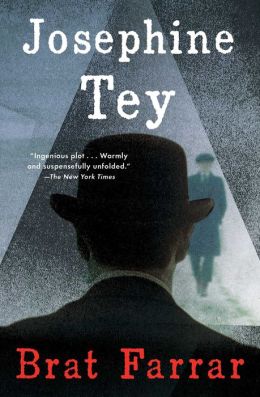
Brat Farrar (1949)

Brat Farrar. Josephine Tey. 1949/1997. 288 pages. [Source: Bought]

I definitely enjoyed reading Brat Farrar. Was it my favorite-favorite Tey novel? Probably not. But I enjoyed it so much more than Miss Pym Disposes and A Shilling for Candles.

In Brat Farrar, the reader is in on the secret. Brat Farrar is impersonating Patrick Ashby. Alec Loding "discovers" Brat Farrar's resemblance to the Ashby family. There were twin brothers Patrick and Simon. Patrick vanished when he was twelve or thirteen, and he was presumed dead. The note he conveniently left behind led everyone to believe it was suicide. Even though Patrick didn't seem the sort. Then again, Patrick would not have been the sort to run away for eight years either. Alec Loding is encouraging his new friend, Brat, to invent such a tale. BE Patrick. Inherit the family estate. He tempts him with horses. If there is one thing our hero can't resist, it's horses. His oh-so-special way with horses gives his life meaning. On the one hand, Brat is essentially a moral guy. He knows right from wrong. He is not the sort to be reckless and cruel for the fun of it. On the other hand, ALL THOSE HORSES. So he allows Loding to coach him, teach him, anything and everything he needs to know to BE PATRICK. (How does Alec know all these details? Sure, a family friend might know some stuff, but everything from the age of three or four on up?! Everything???)

So Patrick Ashby returns from the dead. He takes his place with his family. Everything seems to be off to a good start, but, Brat can't help wondering WHY Simon is so SMUG. Like Brat, readers pick up some clues...not firm, exact clues perhaps...but strong feelings that Simon is, well, the more evil twin.

I liked this one. It was a very quick read.

© 2014 Becky Laney of Becky's Book Reviews

Sunday, May 25, 2014

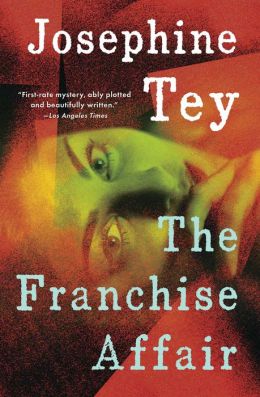
The Franchise Affair (1948)

The Franchise Affair. Josephine Tey. 1948. 304 pages. [Source: Book I bought]

Robert Blair is a lawyer. He lives a boring life; nothing terribly exciting or thrilling ever happens. And. He doesn't seem to mind that his life is mostly predictable. But then one day he receives a call from Marion Sharpe. She is in need of a lawyer; she needs one as soon as possible. Yes, she knows that his firm doesn't specialize in criminal law; yes, she knows he's never handled any case quite like hers before. Yes, she'd be willing to find another lawyer if necessary--if charges are brought against her and if the case were to go to trial. But can he come NOW! He agrees. He rushes to The Francise. He meets Marion and her mother. He meets Inspector Grant. He hears what these two ladies are being accused of. He meets the young woman, Betty Kane, accusing them. He's left a bit speechless. Kane's story: I was waiting for the bus, these two "old" ladies offered me a ride, I accepted, they took me to their home, wouldn't let me leave, locked me in the attic, denied me food unless I worked for them doing some mending, they beat me too! After four weeks I managed to escape! Grant and Blair are speechless as are the women. The story seems weird and unrealistic. Grant's instincts are telling him that the Kane girl is a crazy attention-seeker who is a liar through and through. Blair also thinks the Kane girl is a liar. He also thinks she's immoral. There HAS to be a man involved. Kane had to have met a guy over vacation and run off with him and made up this horrible story when that love affair fell apart. Both Blair and Grant are relying on instincts and making quick judgments. Grant, at the start of the novel, does not want to make a case of this. He does not believe there has been an actual crime.

But. The story will not go away. Kane will tell her story, keep her story alive in the papers. The community will turn against the Sharpe women at the Francise. Things will get uncomfortable and dangerous.

Blair is determined that the best defense is to prove that Betty Kane is a terrible, horrible mess of a girl. She's far from good and honest and respectable. He wants to expose this girl, show her that she can't go around accusing good, honest women like the Sharpes of horrible crimes. She shouldn't be allowed to get away with it.

Grant, Tey's detective, is barely in this one. He is in a few scenes, but, for the most part this is Robert Blair's story, his chance to have an exciting life, to play hero.

The Franchise Affair is not my favorite Tey novel, but, it was a pleasant read.

© 2014 Becky Laney of Becky's Book Reviews
Sunday, April 27, 2014

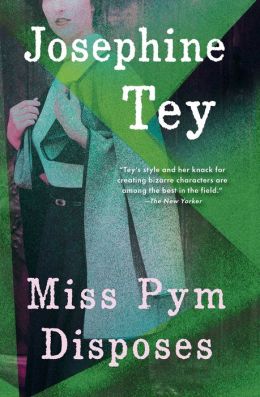
Miss Pym Disposes

Miss Pym Disposes. Josephine Tey. 1946. 238 pages. [Source: Book I Bought]

Miss Lucy Pym is visiting an 'old friend' who is now a principal at a physical training college. The occasion for her visit is her successful bestselling status as an author of a popular psychology book. Her book is the new "it" book of the moment, Miss Pym gives guest lectures. The students of this college, particularly the juniors and seniors, take a real liking to her. They beg and plead and urge her to stay. So she postpones leaving. (I'm not sure her old college friend is as enthusiastic about keeping her around for the last few weeks of the semester until graduation or not. I'm sure by the end she's thinking: why oh why did I think it would be a good idea to ask her to visit!) It's a super busy time for all. One class is preparing to graduate; there is stress and distress as they prepare for finals and critiques. Some students will be placed in a new job before graduation, others will have to make their own applications after graduation. A really ideal job opportunity arises, and, for some reason this causes great rumbles on the staff and among students. One student is chosen over another. Almost everyone disagrees with the decision. Even Miss Pym is argumentative and opinionated. As graduation approaches the inevitable happens. Inevitable ONLY because it's a mystery book and there is the expectation that at some point a crime, probably murder, but at the very least attempted murder, will occur. This happens extraordinarily late in the novel. One of the graduating seniors has an "accident" that ultimately leads to her death. Miss Pym knows the accident was no accident, and she has proof. But will her proof ever be turned over to the authorities?! Will Miss Pym play god and decided that she has no ethical obligation to turn in the murderer--the girl she's convinced is guilty?!

Miss Pym Disposes is a strange little mystery. I found the academic setting interesting, at least in the beginning. But overall, I was not impressed with this one.

© 2014 Becky Laney of Becky's Book Reviews