Showing posts with label Susan Beth Pfeffer. Show all posts

Monday, October 07, 2024

80. The Dead and the Gone

The Dead and the Gone. Susan Beth Pfeffer. 2008. 336 pages. [Source: Library] [4 stars] [YA dystopian; YA Science fiction; YA Fiction]


First sentence: At the moment when life as he had known it changed forever, Alex Morales was behind the counter at Joey's Pizza, slicing a spinach pesto pie into eight roughly equal pieces.

The dead & the gone is the companion novel to Susan Beth Pfeffer's Life As We Knew It. While Miranda's story--set in Pennsylvania--chronicles her life from May through March of that decisive year, Alex's story--set in New York City--chronicles his life from May through December. Both are family-oriented. Miranda's life being closely tied to her mom and two brothers; Alex's life being closely tied to his two younger sisters, Brianna and Julie. But Alex's story is stronger in many ways. For Alex is the head of the family--for better or worse. Alex is the one making life-and-death decisions. His mom vanished on May 18th--the day the asteroid struck the moon. His dad may or may not have survived the first terrible week. Having been in Puerto Rico for a funeral, he's unable to make contact with his family. And, well, the coasts were hit hard--again and again. So even surviving the first tsunamis might not mean much in the long term. His older brother, Carlos, is in the Marines. He was far from home when it happened, and while he's able to send word--by phone or mail--a few times throughout the book. He's not the one in charge. He's not the one responsible for making the tough decisions on how to best survive. So while Miranda has to grow-up, it is a gradual growing into adulthood. She still has her relaxed moments. There is never one moment for Alex to relax. He carries a heavy weight day and night.

I enjoyed rereading Life As We Knew It and the dead & the gone back to back. There are things I love about both books. Things I appreciate about both books. One thing that makes the dead & the gone a very different story is the focus on faith and community. The dead & the gone is faith-oriented. Alex and his family are Catholics. They all attend Catholic school. They all regularly attend mass. They take their faith, their spirituality, their religion very seriously. The words mean something. The faith means something to them. Something real. Something personal. While each of the siblings has their own reaction--response--to the crisis, none loses their faith, none lose hope completely. I loved seeing this Catholic community in action. I loved seeing the Catholic church reaching out in love and compassion--with great hope and faith--to their community, to their parishioners. There were so many great scenes of this faith-in-action. Where people were responding with their hearts in faith as opposed to acting out of fear and anxiety. It's courageous and wonderful.

The dead & the gone has a broader outlook as well. While the electricity isn't reliable on a day-by-day basis in the dead & the gone, it is certainly more stable than in Life As We Knew It. Alex is connected to the larger world. He hears--for better or worse--more about the world at large. He is more aware of what is going on in other states. While Miranda and her family may go weeks or months without contact to other survivors, Alex is out of the house most days--at least before the flu epidemic comes. He's not as isolated as Miranda. Does not being so isolated help him cope? Maybe. But every day, every week is a struggle. Alex does things he'd NEVER thought he'd be doing.

Is Alex more of a hero than Miranda? I'm not sure that is exactly fair. Miranda has her courageous moments too. (I'm thinking of the woodstove mishap.) But. Alex's story has power no doubt about it.
I would definitely recommend both books.

"Give the scientists some time and they'll figure out what to do."
"This is too big for the scientists," Lorraine said. "Only God can save us now."
"Then He will," Alex said. (13)

God save their souls, Alex prayed. God save ours. It was the only prayer he could think of, no matter how inadequate it might be. It offered him no comfort, but he repeated it unceasingly. As long as he prayed he didn't have to think. He didn't have to remember. He didn't have to decide. He didn't have to acknowledge he was entering a world where no one had laid out the rules for him to follow, a world where there might not be any rules left for any of them to follow. (65)

"She says you've been having bad dreams."
"Aren't you?" Julie asked. "Isn't everyone?"
Alex burst out laughing. "Only sane people," he said. "Okay, maybe not Bri. But everyone else is."
"Are things going to get better?" Julie asked. "Is that why you listen to the news all the time, because someday things are going to get better?"
Alex shook his head. "That's not why I listen," he replied. "That's why I pray but not why I listen."
"Do you think God listens?" she asked.
"Bri thinks so," Alex said. "Father Franco thinks so." (81)

It was hard being alone in the apartment staring at an unringing phone, haunted by the food in the kitchen, which he wouldn't allow himself to touch, haunted even more by the image of his mother drowning in the subway that very first night. He tried reading. He tried praying. He tried push-ups. He tried counting the cans of soup. He listened to the radio, using up the twenty-dollar batteries. The world was coming to an end. Well, that was nothing new. (123)

"And what's so special about you that you deserve compassion?" Father Mulrooney said. "You have shelter. You have food. You have family and friends. I'm supposed to feel pity for you because of a cut cheek?"
"You don't understand at all," Alex said. "I have shelter for as long as no one thinks about it. Once they do, once they realize my father is gone, they can throw us out. I have food only if I get lunch here. We're down to almost nothing at home, and I have to make sure my kid sister eats. She is my family right now, because my parents are both gone and my older brother is in the Marines somewhere and I sent my other sister to live at a convent with strangers. My cheek was cut because I got caught in a food riot, with my kid sister, and we ended up with no food anyway. I'm not asking you to pity me. I pity me enough for the two of us. But when one of your students asks you for food, you shouldn't say no and feel righteous about it. That's not what Christ would have done, and you know it." (133)

"What do you have planned for tomorrow?"
Alex shrugged. "The usual," he said. "Checking on the elderly, studying theology, fighting for survival. Same old, same old." (151)

"I know it's wrong to feel that way about God and I know it's wrong to not feel anything. I hate it. I don't hate God. I hate not loving Him." (184)


© 2024 Becky Laney of Becky's Book Reviews

Tuesday, March 15, 2011

Life As We Knew It (YA)

Life As We Knew It. Susan Beth Pfeffer. 2006. Houghton Mifflin Harcourt. 352 pages.


Lisa is pregnant. 

Life As We Knew It by Susan Beth Pfeffer is one of my favorite books. It's one of the few young adult books that I reread regularly. I believe--counting the audio book--that this was my fifth time to read this bleak book. (The only other book I reread with that much regularity is Mary Shelley's Frankenstein.)

It stars Miranda and her family (a mom and two brothers--Matt, the older, Jonny, the younger). Miranda's world is turned upside down one May--and it isn't just her world--when an asteroid crashes into the moon bringing it closer to Earth; nature turns violent, extreme, deadly. No one--at that point--knows how bleak it will be, how many lives will be lost. Not just from tsunamis, floods, earthquakes, and volcanoes, but from disease and malnutrition too.

They are dealing with the loss of modern conveniences-- extremely limited amounts of natural gas and oil, and no electricity. (It's rare to have electricity.)

So how does one survive? Where do you find food? How can you ever have enough when you don't know how long this crisis will last? How long it will be before food supplies reach your town? What if no relief ever comes? How do you find water? How do you cook your food if you have a gas-stove or electric stove? How do you heat your homes without gas, oil, or electricity? How do you keep things sanitary and hygienic? How do you stay healthy? How do you stay smart?     

Miranda is one of the fortunate ones. She has a quick thinking mom who at the first opportunity rushes to the grocery store and buys close to a dozen carts of food and other necessities before the shelves are emptied completely. And they do live in a wooded area and happen to have a wood-burning stove. And miraculously enough they have magic well water that works without an electric pump. (That one still boggles.) But this struggle to survive is very personal, very compelling.

I enjoy Miranda and her family. I enjoy reading Miranda's journal. Is Miranda perfect? No! Is her family perfect? No! They argue. They fight. They get on each other's nerves. They love each other very, very much. And they are all dealing with harsh conditions, bleak situations. There is fear and tension and anxiety. But there's also love and hope.

My favorite quotes:

“Sometimes when Mom is getting ready to write a book she says she doesn’t know where to start, that the ending is so clear to her that the beginning doesn’t seem important anymore. I feel that way now only I don’t know what the ending is, not even what the ending is tonight” (16).

“For a moment I thought about all the people throughout history who saw Halley’s Comet and didn’t know what it was, just that it was there and frightening and awe inspiring. For the briefest flick of a second, I could have been a 16 year old in the Middle Ages looking up at the sky, marveling at its mysteries, or an Aztec or an Apache. For that tiny instant, I was every 16 year old in history, not knowing what the skies foretold about my future.” (18)

“And then it hit. Even though we knew it was going to, we were still shocked when the asteroid actually made contact with the moon. With our moon. At that second, I think we all realized that it was Our Moon and if it was attacked, then we were attacked.” (18-19)
“What about desserts?” I asked. “If the world comes to an end, I’m going to want cookies.” “We’re all going to want cookies if the world comes to an end,” Mrs. Nesbitt agreed. “And chips and pretzels. If the world is coming to an end, why should I care about my blood pressure?” “Okay, we’ll die fat,” Mom said. “Grab what you can grab and ram it into your wagons. But remember if we actually need this stuff, we’re going to be a lot more grateful for a can of soup than for a box of stale cookies.” “Speak for yourself,” Mrs. Nesbitt said. (34)
 “I guess I always felt even if the world came to an end, McDonald’s would still be open.” (46)
“Lately I’ve been trying not to know what’s going on. At least that’s the excuse I’ve been giving myself for not caring about all the stuff that’s happening outside of my little section of Pennsylvania. Who cares about earthquakes in India or Peru or even Alaska?
Okay that’s not fair. I know who cares. Matt cares and Mom cares and if there were any baseball involved, Jonny would care, too. Knowing Dad, he cares. Mrs. Nesbitt, too.
I’m the one not caring. I’m the one pretending the earth isn’t shattering all around me because I don’t want it to be. I don’t want to know there was an earthquake in Missouri. I don’t want to know the Midwest can die, also, that what’s going on isn’t just tides and tsunamis. I don’t want to have anything more to be afraid of.
I didn’t start this diary for it to be a record of death.” (70-71)
“We have clean sheets to sleep on, a clean house, clean clothes, clean dishes. We spent the evening laughing. It wasn’t 90 degrees in the house when we went to bed. We weren’t hungry. We’re not worried about Dad. I know what it feels like to be kissed by a boy. If I could, I would relive this day over and over. I can’t imagine a more perfect one.” (95-96)
“I can’t decide which is worse, no electricity or unreliable electricity. I wonder if I’ll ever have to decide which is worse, life as we’re living or no life at all.” (119)
“Here’s the funny thing about the world coming to an end. Once it gets going, it doesn’t seem to stop.” (120)
“I told Mom I was doing history (she never would have believed me if I said math) and stayed in bed all morning.” (191)

“I know I’m going to have to be strong for the next couple of weeks. No more whining. No more picking fights. I’ll have to do whatever Mom asks me and not protest and not complain. I know I can do it. But for that one moment I felt so weak, so helpless. I felt nothing but fear and despair and the most awful need to be anyplace else. I told myself it was hunger, but I knew that was a lie.
As long as Mom was all right, I could fool myself into thinking we’d all be all right.” (206)
“It’s funny how sorry I feel for Jon these days. I’m 2 1/2 years older than him and I feel like got those 2 1/2 years to go to school and swim and have friends and he got cheated out of them. And maybe he’ll live 2 1/2 years longer than me, or 20 years or 50, but he’ll still never have those 2 1/2 years of normal life.

Every day when I go to sleep I think what a jerk I was to have felt sorry for myself the day before. My Wednesdays are worse than my Tuesdays, my Tuesdays way worse than my Tuesday of a week before. Which means every tomorrow is going to be worse than every today. Why feel sorry for myself today when tomorrow’s bound to be worse?
It’s a hell of a philosophy, but it’s all I’ve got.” (275)


“But I hope when I get closer to death, however old I might be, that I can face it with courage and good sense the way Mrs. Nesbitt does.” (234)

“A while ago Jonny asked me why I was still keeping a journal, who I was writing it for. I’ve asked myself that a lot, especially in the really bad times.
Sometimes I’ve thought I was keeping it for people 200 years from now, so they can see what our lives were like.
Sometimes I’ve thought I’m keeping it for that day when people no longer exist but butterflies can read.
But today, when I am 17 and warm and well fed, I’m keeping this journal for myself so I can always remember life as we knew it, life as we know it, for a time when I am no longer in the sunroom.” (337)


© 2011 Becky Laney of Becky's Book Reviews

Saturday, December 05, 2009

This World We Live In (YA)

Pfeffer, Susan Beth. 2010. (April 2010). This World We Live In. Harcourt. 256 pages.

I'm shivering, and I can't tell if it's because something strange is going on or because of the dream I had or just because I'm in the kitchen, away from the warmth of the woodstove. It's 1:15 AM, the electricity is on, and I'm writing in my diary for the first time in weeks.

This World We Live In is the sequel to both Life As We Knew It and the dead and the gone. How would I describe this oh-so-anticipated sequel? Intense and bleak. There's bleakity-bleak and bleakity-bleak. This is definitely as bleak as they come.

Miranda opens up her diary--after a month off give or take a week or two--by recounting some of her nightmares. And who could blame her really for having trouble sleeping? What with life as she knew it forever gone and so many unanswered questions and so many uncertainties burdening her. What hope does a month full (or year full) of tomorrows hold for her?

I haven't written in my diary in a month. I used to write all the time. I stopped because I felt like things were as good as they were ever going to get, that nothing was going to change again.

Only now it's raining.
Something's changed.
And I'm writing again. (4)

Soon the rain isn't the only change in her life--in their lives. Matt and Jon have the brilliant idea to go off fishing, to see what they can catch now that the ice is beginning to melt as spring continues to thaw the ashy world. Matt returns with a wife, Syl--and a couple of garbage bags of fish to be salted and preserved. (Jon returns too.) Soon after, there's another knock at the door. Surprise! Dad and Lisa and company have arrived. Gabriel, a baby boy, brings joy to their lives again. But Dad's also brought three others: Julie and Alex (whom we met in the dead and the gone) and an older man, Charlie. These six teamed up traveling East and have become such good friends that they're family now. But though in some ways Miranda's world is expanding more than she ever thought possible, in some ways her world is just as bleak as before. More people to love means more people to worry about. More people struggling to survive with limited resources.

While the world Pfeffer has created here is dark and bleak--more the stuff of nightmares--I couldn't help but be drawn back into Miranda's story. It was one of those instances where you hated to read on yet couldn't help it. I had to keep reading until the very end. It was intense.

ARC provided by the publisher at request of the author. All quotes are subject to change.

© Becky Laney of Becky's Book Reviews
Sunday, November 05, 2006

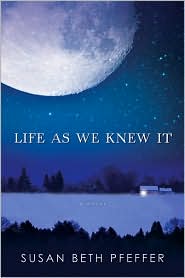
Life As We Knew It


Imagine waking up one day to find that everything had changed practically over night. All over the world massive destruction due to one natural disaster after another. And what if there was no way to turn back the clock. To wake up knowing that each day will be worse than the one before. No electricity. No phone service. No gas or oil. Limited food supplies. What is there left to hope for? How would you live your last days?

Meet Miranda your personal guide through this terrifying adventure.

Pfeffer, Susan Beth. 2006. Life As We Knew It.

When we first meet Miranda she is a happy, practically care-free young girl with so much to look forward to. It's May of her sophomore year. She's sixteen and dealing with ordinary problems. Friends. Boys. Schoolwork. But less than one week after our narrative opens, Miranda's world is about to change and she doesn't even know it. When they first hear that astronomers are predicting that a meteor will hit the moon, it's a time of light-hearted celebration. Teachers assign students moon-based assignments. After all, wasn't meteors hitting the moon how the moon got all those craters to begin with? What's the big deal? But what astronomers failed to predict--or failed to announce--is that this would be the largest meteor to ever hit the moon. Still families make plans to sit out on the lawn, some even baking cookies or popping popcorn to celebrate this once-in-a-lifetime event, to watch history in the making. Miranda and her family witness the meteor hitting, but what no one could have predicted is that they are witnessing the destruction of life as we know it. The meteor hits the moon setting it not only off-tilt but bringing it dangerously close to Earth. Scary to witness, but Miranda has no idea what it has set into motion. Tsunamis, earthquakes, floods, volcanoes, wild fires. And that is just the beginning.

Journey with Miranda through these terrifying months (May-March) as everyone struggles to survive.

Susan Beth Pfeffer has created a very exciting novel sure to leave an impact on her readers. Writing since 1970, she has written over sixty books for children and young adults.

Randomhouse's Author spotlight