Showing posts with label adult western. Show all posts

Wednesday, July 08, 2020

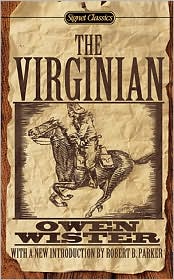
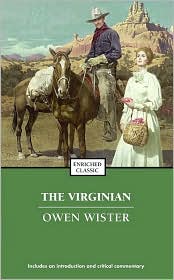
91. The Virginian

The Virginian. Owen Wister. 1902. Penguin Classics. 370 pages. [Source: Bought]

First sentence: Some notable sight was drawing the passengers, both men and women, to the window; and therefore I rose and crossed the car to see what it was. I saw near the track an enclosure, and round it some laughing men, and inside it some whirling dust, and amid the dust some horses, plunging, huddling, and dodging.

Premise/plot: The Virginian is a collection of interconnected stories. Some are more "connected" than others. Some of the stories are told through a first person account, a first person narrator, whom we come to know simply as Tenderfoot or The Tenderfoot. He's an Eastern man that has come west to Wyoming territory. And The Virginian, our real hero, is his protector as this newbie is learning his way. But other stories are told in third person. Through a series of adventures, we get to know The Virginian; we get to know the people close to The Virginian. The men he works with and respects. The men he works with and doesn't respect. His friends. His enemies. My favorite of these may just be the woman, the "school teacher spinster" whom he falls in love with, Miss Molly Wood. 


My thoughts: It was dramatic. It was suspenseful. It was humorous. It was emotional. It was romantic--in places. Some of my favorite scenes were the ones between The Virginian and Miss Molly Wood. I loved their courtship. How steady he was, how stubborn she was. How he took the time to read *most* of the books she loaned him. How he was fond of a good book--Shakespeare especially. But how he really didn't get why she loved Jane Austen so much! I liked their conversations on the books he read. I liked his conversations with her in general.

But The Virginian isn't just a romance. I mean there is a happily ever after at the end. But in between all the courting scenes--and there are really only a handful--The Virginian is busy working and riding and managing the Judge's ranch--he's foreman--and generally seeing that justice is done. (Because there are cattle thieves about!) So there is plenty of action and adventure and humor. There's plenty of good fun in this one. But it's not without its darker moments, its life-and-death moments.

Quotes:
We cannot see ourselves as other see us, or I should know what appearance I cut at hearing this from the tall man. I said nothing, feeling uncertain. "I reckon I am looking for you, seh," he repeated politely. "I am looking for Judge Henry," I now replied. He walked toward me, and I saw that in inches he was not a giant. He was not more than six feet. It was Uncle Hughey that had made him seem to tower. But in his eye, in his face, in his step, in the whole man, there dominated a something potent to be felt, I should think, by man or woman.
  "It's two hundred and sixty-three miles," said the Virginian...Yes, I was dazed. How did they count distance in this country? You spoke in a neighborly fashion about driving over to town, and it meant—I did not know yet how many days. And what would be meant by the term "dropping in," I wondered. And how many miles would be considered really far?
By reason of something,—my clothes, my hat, my pronunciation, whatever it might be, I possessed the secret of estranging people at sight.
Upon the grocery side there stood a cheese too large and strong to sleep near comfortably, and I therefore chose the dry-goods side. Here thick quilts were unrolled for me, to make it soft; and no condition was placed upon me, further than that I should remove my boots, because the quilts were new, and clean, and for sale.
 Sardines were called for, and potted chicken, and devilled ham: a sophisticated nourishment, at first sight, for these sons of the sage-brush. But portable ready-made food plays of necessity a great part in the opening of a new country. These picnic pots and cans were the first of her trophies that Civilization dropped upon Wyoming's virgin soil.
I was soon at the wash trough. It was only half-past six, but many had been before me,—one glance at the roller-towel told me that. I was afraid to ask the landlady for a clean one, and so I found a fresh handkerchief, and accomplished a sparing toilet. In the midst of this the drummers joined me, one by one, and they used the degraded towel without hesitation. In a way they had the best of me; filth was nothing to them.
Thieves are presumed innocent until proved guilty, but a starched collar is condemned at once.
 "I reckon," said he, "you're feelin' about halfway between 'Oh, Lord!' and 'Thank God!'"
 "We are taking steps," said Mr. Taylor. "Bear Creek ain't going to be hasty about a schoolmarm." "Sure," assented the Virginian. "The children wouldn't want yu' to hurry."
 Has any botanist set down what the seed of love is? Has it anywhere been set down in how many ways this seed may be sown? In what various vessels of gossamer it can float across wide spaces? Or upon what different soils it can fall, and live unknown, and bide its time for blooming?
 I was not called by my name after the first feeble etiquette due to a stranger in his first few hours had died away. I was known simply as "the tenderfoot." I was introduced to the neighborhood (a circle of eighty miles) as "the tenderfoot."
 "I fear she has not," said I. "Mighty hon'ble intentions," he observed. "If she can't make out to lay anything, she wants to hatch somethin', and be a mother anyways." "I wonder what relation the law considers that a hen is to the chicken she hatched but did not lay?" I inquired.
Em'ly scratched and clucked, and the puppies ran to her, pawed her with their fat limp little legs, and retreated beneath her feathers in their games of hide and seek. Conceive, if you can, what confusion must have reigned in their infant minds as to who the setter was!
 There always have been such people, I suppose, because the world must always have a rubbish heap.
 Molly Wood was regarding him saucily. "I don't think I like you," said she. "That's all square enough. You're goin' to love me before we get through. I wish yu'd come a-ridin, ma'am."
For this journey she had provided him with Sir Walter Scott's Kenilworth. Shakespeare he had returned to her. He had bought Shakespeare for himself. "As soon as I got used to readin' it," he had told her, "I knowed for certain that I liked readin' for enjoyment."
 There can be no doubt of this:— All America is divided into two classes,—the quality and the equality. The latter will always recognize the former when mistaken for it. Both will be with us until our women bear nothing but kings.
"It's mighty hard to do what your neighbors ain't doin'," pursued the Virginian. 
 "Do you think there ought to be fifteen varieties of good people?" His voice, while it now had an edge that could cut anything it came against, was still not raised. "There ain't fifteen. There ain't two.
There's one kind. And when I meet it, I respect it. It is not praying nor preaching that has ever caught me and made me ashamed of myself, but one or two people I have knowed that never said a superior word to me. They thought more o' me than I deserved, and that made me behave better than I naturally wanted to.
But I'll tell yu' this: a middlin' doctor is a pore thing, and a middlin' lawyer is a pore thing; but keep me from a middlin' man of God."
 If words were meant to conceal our thoughts, melody is perhaps a still thicker veil for them.
"Oh, no! The wild man you're taming brought you Kenilworth safe back." She was smooth. "Oh, as for taming him! But don't you find him intelligent?" Suddenly I somehow knew that she didn't want to tame him. But what did she want to do? The thought of her had made him blush this afternoon. No thought of him made her blush this evening.
 "Science! He doesn't know what Christianity is yet. I've entertained many guests, but none—The whole secret," broke off Judge Henry, "lies in the way you treat people. As soon as you treat men as your brothers, they are ready to acknowledge you—if you deserve it—as their superior. That's the whole bottom of Christianity, and that's what our missionary will never know."
One can look respectfully at a preacher and be internally breaking all the commandments.
We all know what birds of a feather do. And it may be safely surmised that if a bird of any particular feather has been for a long while unable to see other birds of its kind, it will flock with them all the more assiduously when they happen to alight in its vicinity.
"When a man ain't got no ideas of his own," said Scipio, "he'd ought to be kind o' careful who he borrows 'em from." 
But his first message to his lady was scarcely written with ease. It must be classed, I think, among those productions which are styled literary efforts. It was completed in pencil before it was copied in ink; and that first draft of it in pencil was well-nigh illegible with erasures and amendments.
I have read that play Othello. No man should write down such a thing. Do you know if it is true? I have seen one worse affair down in Arizona. He killed his little child as well as his wife but such things should not be put down in fine language for the public. I have read Romeo and Juliet. That is beautiful language but Romeo is no man. I like his friend Mercutio that gets killed. He is a man. If he had got Juliet there would have been no foolishness and trouble.
"if yu' could read me something that was ABOUT something, I—I'd be liable to keep awake." And he smiled with a certain shyness. "Something about something?" queried Molly, at a loss.
 Staring ain't courage; it's trashy curiosity.
 "I expect in many growed-up men you'd call sensible there's a little boy sleepin'—the little kid they onced was—that still keeps his fear of the dark. You mentioned the dark yourself yesterday. Well, this experience has woke up that kid in me, and blamed if I can coax the little cuss to go to sleep again! I keep a-telling him daylight will sure come, but he keeps a-crying and holding on to me."
 I cannot say that I believe in doing evil that good may come. I do not. I think that any man who honestly justifies such course deceives himself. But this I can say: to call any act evil, instantly begs the question. Many an act that man does is right or wrong according to the time and place which form, so to speak, its context; strip it of its surrounding circumstances, and you tear away its meaning.
 
© 2020 Becky Laney of Becky's Book Reviews

Friday, June 29, 2012

Lin McLean

Lin McLean. Owen Wister. 1898/1998. Forge. 230 pages.

In the old days, the happy days, when Wyoming was a Territory with a future instead of a State with a past, and the unfenced cattle grazed upon her ranges by prosperous thousands, young Lin McLean awaked early one morning in cow camp, and lay staring out of his blankets upon the world. 

It helped me tremendously to know that this was Owen Wister's first novel. (I am even tempted to say "novel" just because this book feels more like a short story collection than a cohesive novel.) Unfortunately, I didn't learn that this was his first novel until after I read it and had been disappointed. Last year, I read and LOVED, LOVED, LOVED Owen Wister's novel The Virginian. It was a complete surprise to me because I am allergic to westerns. I wanted to find another Wister novel that compared to The Virginian, and I didn't find it in Lin McLean. (Though the Virginian makes a couple of appearances in the stories within Lin McLean.) But is that fair to expect Lin McLean to be as good, as great as The Virginian? Probably not.

The stories found in Lin McLean are
  • How Lin McLean Went East
  • The Winning of the Biscuit-Shooter
  • Lin McLean's Honey-Moon
  • A Journey In Search of Christmas
  • Separ's Vigilante
  • Destiny at Drybone
  • In the After-Days (a poem, not a story)
If I had to sum up the book, sum up the stories, I would say Lin McLean was about a cowboy who was good at losing his money gambling, a man easily distracted by women and cards and booze, a man who despite his shortcomings found the love of a young boy and a good woman.

My favorite stories were, without a doubt, "Lin McLean's Honey-Moon," "Separ's Vigilante," and "Destiny at Drybone."

Read Lin McLean
  • If you like westerns
  • If you're looking to catch early glimpses of the man who would become THE VIRGINIAN
  • If you like western short stories
© 2012 Becky Laney of Becky's Book Reviews
Friday, June 03, 2011

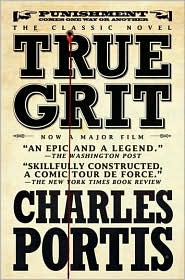
True Grit

True Grit. Charles Portis. 1968. Overlook Press. 224 pages.

People do not give it credence that a fourteen-year-old girl could leave home and go off in the wintertime to avenge her father's blood but it did not seem so strange then, although I will say it did not happen every day. 

Last week I reviewed The Virginian by Owen Wister, this week I'm reviewing True Grit. Could it be that I'm not as allergic to westerns as I thought? Or have I just found two exceptions to the rule?!

What's the word that best describes our heroine, Mattie Ross? Spunky? Stubborn? Strong-willed? No-nonsense? Independent? She's all those things, it's true, but it goes deeper than that perhaps. She does not back down. If Mattie has made up her mind, then there's no changing it. There's no arguing with her...and winning. It just can't be done. She may be a kid--a girl--but she can hold her own in a world of men.

When her father is murdered by Tom Chaney, a man her father had half-way trusted--at least trusted enough to give him a job, a place to live, and a "second" chance at life--then Mattie Ross decides then and there that he will pay for his crime. She'll see that justice is done, even if she has to pay for that justice herself.

Mattie hires a marshal with grit--Rooster Cogburn. The Fort Smith sheriff tells Mattie that Rooster Cogburn "is a pitiless man, double-tough, and fear don't enter into his thinking. He loves to pull a cork" (23). She promises a $100 for a job well done. But she doesn't tell him--at least not at first--that she has every intention in the world of going with him on his search. Yes, this fourteen-year-old girl is going to ride side by side with him on his dangerous mission--hunting outlaws is always dangerous, you know. And then there is the third companion, a Texas Ranger, LaBoeuf. He wants to find Chaney/Chelmsford too. There's money to be find in bringing him to justice. While LaBoeuf's motivation is more monetary, perhaps, for Mattie this is purely personal.

And it was the fact that this was a personal story--though don't expect it to be sentimental or weepy, Mattie is no Elsie Dinsmore--that touched me the most. It is my connection with Mattie that made me love this one. Her character, her personality, her strength as a narrator. I think Mattie is unforgettable.

While I can't say that I loved every scene in this one--especially the one with the poisonous snakes--I have to admit that I did enjoy this one very much. I found it very compelling!

© 2011 Becky Laney of Becky's Book Reviews
Wednesday, May 25, 2011

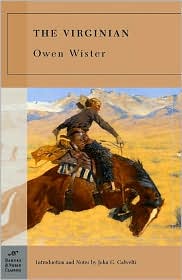
The Virginian

The Virginian. Owen Wister. 1902. Penguin Classics. 370 pages.

Some notable sight was drawing the passengers, both men and women, to the window; and therefore I rose and crossed the car to see what it was. I saw near the track an enclosure, and round it some laughing men, and inside it some whirling dust, and amid the dust some horses, plunging, huddling, and dodging. They were cow ponies in a corral, and one of them would not be caught, no matter who threw the rope.

I do not read many westerns. (If I remember correctly, this is only my second or third western. Depending on if you count These is My Words by Nancy E. Turner. My first western was Riders of the Purple Sage by Zane Grey.) In fact, I have always believed myself to be completely allergic to the genre. Me? Like a western?! Really?! Well, I did more than like this one. I loved it. I maybe even loved, loved, loved it. While I'm not sure that I can echo what Dolce Bellezza said in her review: "It will definitely be in my top ten list for the year, and quite possibly for my life." I definitely agree that it is worth reading. I was very happy to be so surprised!

The Virginian is a collection of interconnected stories. Some are more "connected" than others. Some of the stories are told through a first person account, a first person narrator, whom we come to know simply as Tenderfoot or The Tenderfoot. He's an Eastern man that has come west to Wyoming territory. And The Virginian, our real hero, is his protector as this newbie is learning his way.
When Judge Henry ascertained that nothing could prevent me from losing myself, that it was not uncommon for me to saunter out after breakfast with a gun and in thirty minutes cease to know north from south, he arranged for my protection. He detailed an escort for me; and the escort was once more the trustworthy man! The poor Virginian was taken from his work and his comrades and set to playing nurse for me. And for a while this humiliation ate into his untamed soul. It was his lugubrious lost to accompany me in my rambles, preside over my blunders, and save me from calamitously passing into the next world. He bore it in courteous silence, except when speaking was necessary. He would show me the lower ford, which I could never find for myself, generally mistaking a quicksand for it. He would tie my horse properly. He would recommend me not to shoot my rifle at a white-tailed deer in the particular moment that the outfit wagon was passing behind the animal on the further side of the brush. There was seldom a day that he was not obliged to hasten and save me from sudden death or from ridicule, which is worse. Yet never once did he lose his patience; and his gentle, slow voice, and apparently lazy manner remained the same, whether we were sitting at lunch together, or up in the mountains during a hunt, or whether he was bringing me back my horse, which had run away again because I had again forgotten to throw the reins over his head and let them trail. (45)
But other stories are told in third person. Through a series of adventures, we get to know The Virginian; we get to know the people close to The Virginian. The men he works with and respects. The men he works with and doesn't respect. His friends. His enemies. My favorite of these may just be the woman, the "school teacher spinster" whom he falls in love with, Miss Molly Wood. 

 I found myself enjoying not just the characters, not just the stories, but the writing style itself. After the clumsiness of Zane Grey (at least in Riders of the Purple Sage) I was happy to see a western written by someone who could really write. There was just something about this one that worked for me. It was dramatic. It was suspenseful. It was humorous. It was emotional. It was romantic--in places. Some of my favorite scenes were the ones between The Virginian and Miss Molly Wood. I loved their courtship. How steady he was, how stubborn she was. How he took the time to read *most* of the books she loaned him. How he was fond of a good book--Shakespeare especially. But how he really didn't get why she loved Jane Austen so much! I liked their conversations on the books he read. I liked his conversations with her in general.

But The Virginian isn't just a romance. I mean there is a happily ever after at the end. But in between all the courting scenes--and there are really only a handful--The Virginian is busy working and riding and managing the Judge's ranch--he's foreman--and generally seeing that justice is done. (Because there are cattle thieves about!) So there is plenty of action and adventure and humor. There's plenty of good fun in this one. But it's not without its darker moments, its life-and-death moments.

Favorite quotes:

The Virginian was grave in bearing and of infrequent speech; but he kept a song going--a matter of some seventy-nine verses. Seventy-eight were quite unprintable, and rejoiced his brother cow-punchers monstrously. (62)

No one of her admirers had ever been like this creature. The fringed leathern chaperreros, the cartridge belt, the flannel shirt, the knotted scarf at the neck, these things were now an old story to her. Since her arrival she had seen young men and old in plenty dressed thus. But worn by the man now standing by her door, they seemed to radiate romance. (83)

Molly Wood was regarding him saucily. "I don't think I like you," said she.
"That's all square enough. You're goin' to love me before we get through. I wish yu'd come a-ridin', ma'am."
"Dear, dear, dear! So I'm going to love you? How will you do it? I know men think that they only need to sit and look strong and make chests at a girl--"
"Goodness gracious! I ain't makin' any chests at yu'!" Laughter overcame him for a moment, and Miss Wood liked his laugh very much. "Please come a-ridin," he urged. "It's the prettiest kind of a day."
She looked at him frankly, and there was a pause. "I will take back two things that I said to you," she then answered him. "I believe that I do like you. And I know that if I went riding with you, I should not have an immature protector." (85)

"And now I'll not see you for quite a while. I am going a long way. But I'll be very busy. And bein' busy always keeps me from grievin' too much about you."
Strange is woman! She would rather have heard some other last remark than this.
"Oh, very well!" she said. "I'll not miss you either."
He smiled at her. "I doubt if yu' can help missin' me," he remarked. And he was gone at once, galloping on his Monte horse. Which of the two won a victory this day? (94)

If words were meant to conceal our thoughts, melody is perhaps still thicker veil for them. (142)


© 2011 Becky Laney of Becky's Book Reviews