Showing posts with label 1859. Show all posts

Tuesday, March 16, 2021

26. A Tale of Two Cities


A Tale of Two Cities. Charles Dickens. 1859. 446 pages. [Source: Review copy]

First sentence: It was the best of times, it was the worst of times, it was the age of wisdom, it was the age of foolishness, it was the spring of hope, it was the winter of despair, we had everything before us, we had nothing before us, we were all going direct to Heaven, we were all going direct the other way.

Premise/plot: A Tale of Two Cities is very much a novel of love and sacrifice. But would the sacrifice be necessary if bitterness, rage, anger, hatred, despair, and a thirst for vengeance didn't abound? A Tale of Two Cities begins and ends in France. And not a happy period in French history, one of the darkest perhaps. Charles Darnay, our hero, escapes France once, but, he may not escape it a second time. Same can be said of our heroine, Lucie Manette, and her father, Dr. Alexandre Manette. So why do they return to France and risk it all--knowing the country is uneasy, unsafe, topsy-turvy? Well, duty, honor, and nobleness? Of course it is their very nobleness--one understanding of the word--that leads to everyone wanting them to die.

So the very basics for those not in the know: Lucie Manette loves Charles Darnay; the two are married and have a daughter. They both adore her father who has had a very rough time of it--physically, mentally, emotionally. Lucie Manette is beautiful (of course) and practically perfect in every way (of course). So Charles Darnay is not the only one who is head over heels in love with her. He is the one who has her heart, body, soul. Mr. Sydney Carton was also head over heels in love with her; he loves her still.

The trouble begins when Charles Darnay receives a letter from France and decides to return there to see if he can help. His family follows after him risking all.

My thoughts: I found A Tale of Two Cities to make little sense. Hold on before you start hating on me, perhaps this is intentional. France is a chaotic mess; an upheaval in progress; everything right is now wrong and everything wrong is now right. It is almost as if logic and common sense and decency has been thrown out altogether. The characters--particularly the French ones--seem to be corrupted thoroughly. There is little room for kindness, compassion, the benefit of the doubt. It is like the masses have been given permission to run wild: to be violent, to seek vengeance, to let all the rage out; punishments don't fit the crime--not here, now now. A Tale of Two Cities reflects how HORRIBLE mob mentality is. Violence and mob-rule never lead to lasting peace and justice. In their quest for "justice" all the mob could do was injustice. There is nothing just about any of the mob's actions.


Perhaps fear of sympathizing with those on the wrong side of the mob led to little kindness, sympathy, empathy, compassion, or speaking out for truth and justice. The mob could turn on you; you could be next if you spoke out in defense of the "guilty."

Regardless, I found A Tale of Two Cities to be senseless. But I think it's an intentional senseless that reflects the time. There are no good answers for WHY.

It is in contrast to all this CHAOTIC evil that Sydney Carton enters the picture. 

It is a far, far better thing that I do, than I have ever done; it is a far, far better rest that I go to than I have ever known.
I do appreciate this one more the second time. I found it a brutal read the first time.

Favorite quote: 

A wonderful fact to reflect upon, that every human creature is constituted to be that profound secret and mystery to every other. (11)


© 2021 Becky Laney of Becky's Book Reviews

Saturday, October 28, 2017

Adam Bede

Adam Bede. George Eliot. 1859. 624 pages. [Source: Bought]

First sentence: With a single drop of ink for a mirror, the Egyptian sorcerer undertakes to reveal to any chance comer far-reaching visions of the past.

Adam Bede opens in the summer of 1799 in a rural community that is about to be scandalized.

Adam Bede loves Hetty Sorrel. Seth Bede loves Dinah Morris. Dinah and Hetty are cousins; both orphans, both staying with the same aunt and uncle. The two women couldn't be more different from one another. Hetty is young, beautiful, lives in the clouds instead of down on earth, believes in fairy tales and knights in shining armor. Dinah Morris isn't "old" by any stretch of the imagination, but her wisdom makes her more of an old soul than Hetty could ever be. She's a Methodist--a Methodist preacher. She's loving, compassionate, intelligent, wise, honest and sincere.

The squire's heir, Arthur Donnithorne, falls hard for Hetty. He's a soldier--home visiting just for a short time. He sees her, sees potential danger, rushes ahead anyway. He knows how it will end--just not when. It will end with him leaving her behind forever. Arthur could no more marry Hetty than he could fly to the moon and back. He knows also that Hetty will be crushed when he leaves. He'll also be upset. But he doesn't seem to grasp that he's aware of all the risks and she isn't. Not really. For one thing, she thinks she's as good as engaged. She knows that one day--hopefully soon--they'll be man and wife. All will be made right then.

Readers aren't horribly clear on if Hetty is aware of one HUGE danger. Does Hetty realize that she could get pregnant? Arthur seems aware of this danger; in his goodbye forever letter, he tells Hetty to write to him immediately if a PROBLEM should come up in the next month or so. Hetty doesn't seem to realize Arthur's veiled hints mean: if you should find yourself with child, let me know.

Before Arthur leaves, Dinah reaches out to Hetty. If you should ever find yourself in need of a friend, I'll be there for you no matter what. You are loved--unconditionally. Dinah herself leaves the community much earlier than that. She is being led by the Lord. She rejects Seth's proposal before she leaves.

Adam and Arthur are friends; their friendship is unequal perhaps. Arthur will be squire one day. He's several ranks above what Adam could ever hope to be. Adam is a working man, a hard-working man. He may or may not ever have enough money to marry and have his own place--apart from his brother and mother. But he loves Hetty. He is biding his time. Arthur is speeding up the situation by giving Adam opportunities and advantages in his carpentry business.

Arthur has a conscience, but it's weak. Adam has a conscience, and it's STRONG. Arthur knows right from wrong, but he follows his mind and not his conscience. He feels guilt, but doesn't repent. Part of repenting is turning away from sin, fighting temptation, and changing your behavior. Arthur's guilt doesn't lead him to repentance.

Adam and Arthur have a CONFRONTATION before he leaves. He has caught Arthur and Hetty kissing in the woods. Adam loses respect for Arthur, but not for Hetty. She was a victim; Arthur was taking advantage of her innocence. Arthur should have known better. Hetty wasn't capable of knowing better. As Adam reckons it.

Several weeks after Arthur leaves, Hetty and Adam begin to court. She agrees to marry him. The family is elated. The wedding is planned for around Easter time.

A month or so before the wedding, in February, I believe. Hetty decides to "visit" Dinah. Hetty is in actuality planning on running away--for good. Where is she running? To the last place she knew Arthur to be. Why? Because she's about to give birth to Arthur's child and no one knows.

When does Hetty learn that she's pregnant? Why did she wait so long to run away? Why didn't she write Arthur as he told her to? Does Hetty know she's pregnant? Is she in denial? How do her friends and family not know she's pregnant? When she runs away she is about eight months pregnant. Is Hetty in her right mind when she runs away? At what point does her brain break down? When does Hetty lose the ability--does she lose the ability--to know right from wrong?

Because her excuse was a good one, it takes almost three weeks before her family realizes she is missing. And it takes a good bit of time before Adam tracks down where Hetty went first. Before he puts all the pieces together, he is given a big shock. A woman matching Hetty's description has just been put in JAIL for MURDER. She has murdered her baby. He was found half-buried in the woods and discovered by a farmer.

SCANDAL. The "scandal" of the summer of 1799 might have been a "crazy" woman preacher preaching outside to the masses. The scandal of the spring/summer of 1800 was that one of their own was capable of MURDER (not to mention fornication). Who will be there for Hetty? Will every single man and woman turn their backs on her?

Enter Dinah. Only Dinah embraces Hetty and supports her one hundred percent. Unconditional love is in fact unconditional.

Where does Adam fit in? Well. He doesn't love Hetty anymore. He sees her as forever stained and beyond redemption. Because she is facing death, he digs deep and finds it possible to forgive her. Love, for Adam, was not unconditional but conditional. Now, for the record he blames Arthur almost exclusively. If it were up to Adam, both Hetty and Arthur would be on trial and facing death. Justice demands that Arthur be held accountable too. Of course, that is not how the world works.

The aftermath. Life eventually settles back into a routine of its own, but, some things can't be forgotten completely. Adam does find love again--in the arms of an amazing, wonderful woman: Dinah.

If I had to pick one character to LOVE from Adam Bede, it wouldn't be Adam Bede. It would be DINAH. For a more spiritual/philosophical review read my review at Operation Actually Read Bible.

Favorite quotes:
  • Let evil words die as soon as they're spoken.
  • Weaknesses and errors must be forgiven—alas! they are not alien to us.
  • The vainest woman is never thoroughly conscious of her own beauty till she is loved by the man who sets her own passion vibrating in return.
  • We may determine not to gather any cherries and keep our hands sturdily in our pockets, but we can't prevent our mouths from watering.
  • I don't believe there's anything you can't prevail on people to do with kindness.
  • A man can never do anything at variance with his own nature. He carries within him the germ of his most exceptional action; and if we wise people make eminent fools of ourselves on any particular occasion, we must endure the legitimate conclusion that we carry a few grains of folly to our ounce of wisdom.
  • You must learn to deal with odd and even in life, as well as in figures.
  • And so Adam went to bed comforted, having woven for himself an ingenious web of probabilities—the surest screen a wise man can place between himself and the truth.
  • For there is no hour that has not its births of gladness and despair, no morning brightness that does not bring new sickness to desolation as well as new forces to genius and love. There are so many of us, and our lots are so different, what wonder that Nature's mood is often in harsh contrast with the great crisis of our lives? We are children of a large family, and must learn, as such children do, not to expect that our hurts will be made much of—to be content with little nurture and caressing, and help each other the more.
  • Sleep comes to the perplexed—if the perplexed are only weary enough.
  • Our deeds determine us, as much as we determine our deeds, and until we know what has been or will be the peculiar combination of outward with inward facts, which constitutes a man's critical actions, it will be better not to think ourselves wise about his character.
  • Pity that consequences are determined not by excuses but by actions!)
  • A LONG, lonely journey, with sadness in the heart; away from the familiar to the strange: that is a hard and dreary thing even to the rich, the strong, the instructed; a hard thing, even when we are called by duty, not urged by dread.
  • The beginning of hardship is like the first taste of bitter food—it seems for a moment unbearable; yet, if there is nothing else to satisfy our hunger, we take another bite and find it possible to go on.


© 2017 Becky Laney of Becky's Book Reviews

Friday, June 30, 2017

The Bertrams

The Bertrams. Anthony Trollope. 1859. 496 pages. [Source: Bought]

First sentence:  This is undoubtedly the age of humanity — as far, at least, as England is concerned.

Premise/plot: The Bertrams chronicles the adventures and misadventures of three men: George Bertram, Arthur Wilkinson, and Sir Henry Harcourt. The novel, as a whole, has a feel of a proverb or two--for better or worse.

George Bertram starts off the novel as an academic success. But school is now behind him, his future awaits. And with each month that future seems dimmer not brighter. He doesn't know what to do next. Should he enter the church and become a clergyman? Should he become a lawyer? Whose advice should he take? His rich uncle's advice? his friends? a beautiful woman that he just met? his own heart?

Arthur Wilkinson is disappointed that he didn't do better at school, that the results of his last exams didn't go as well as he hoped. It looks like it will definitely be the church for him, but, he's not hopeful that he'll do well enough to marry. When his father dies, he does get a living, and it's enough to support his mother and sisters. But not his mother, sisters, wife, and future children--should he stop dreaming of his own happiness?

Sir Henry Harcourt is confident. But is he overly confident?! He feels that his bright future is a sure thing. He knows he'll be a big, big, big success. He knows that all his dreams will come true. He knows he'll be a SOMEBODY in this world. He knows that everyone around him will look up to him and respect him and maybe just maybe be a bit jealous of him.

There are two heroines in this novel. Adela Gauntlet is the neighbor and most special friend of Arthur Wilkinson. Any fool could see that she loves him madly, unconditionally. She's his for the taking. But will he ever propose? Will Arthur's stubbornness keep them both miserable? Caroline Waddington is the beautiful woman that George Bertram happens to meet on his travels. The two fall in love in the Middle East. It is her advice he follows. She can't imagine herself marrying a clergy man! So he decides for the law instead. But will these two get their happily ever after? Not if Harcourt has his way. He's super-impressed by his friend's fiancee. He just has to get to know her better! Now Caroline, unlike Adela, has a flaw. And it's a flaw that she shares with her grandfather and with Harcourt. That flaw is a LOVE OF MONEY and a longing to be thought of as GREAT. Will Caroline throw away her chance for happiness because she wants too much?

My thoughts: Normally I don't find Trollope's novels too wordy, in need of great editing, but I might make an exception with The Bertrams. I felt there were whole chapters--whole sections--that didn't really contribute much to the story. Perhaps because I felt such a huge disconnect with the main characters. These were characters that were--with a few exceptions--not that pleasant to spend time with. I didn't find many kindred spirits in this one. And the book was a journey in more than one way. It wasn't just a figurative rambling journey with characters that I didn't care much for. It was a literal journey as well. George goes on two journeys. One journey is at the beginning of the novel. It takes him to the middle east; one of the places he spends a good amount of time in is Jerusalem and its surrounding areas. The second journey is towards the end of the novel. It takes him to Egypt. Trollope weighs down his novel with descriptions of these "exotic" places, tourists attractions, and local curiosities. Let's just say that his descriptions of the local residents are not politically correct.

I also did not like George Bertram's religious views. 

Not everyone in Trollope's novel gets a happy ending. I was okay with this, for the most part.

Favorite quotes:
  • If a fellow mortal be ragged, humanity will subscribe to mend his clothes; but humanity will subscribe nothing to mend his ragged hopes so long as his outside coat shall be whole and decent.
  • Success is the god that we delight to worship.
  • It had always been Bertram’s delight to study in such a manner that men should think he did not study.
  • A long speech is a long bore, and a little speech is a little bore; but bores must be endured.
  • Nine-tenths of the men in the world neither swim nor sink; they just go along with their bows above the wave, but dreadfully water-logged, barely able to carry the burdens thrown on them; but yet not absolutely sinking; fighting a hard fight for little more than mere bread, and forgetting all other desires in their great desire to get that. When such a man does get bread, he can’t be said to sink.
  • The right man is wanted in the right place; but how is a lad of two and twenty to surmise what place will be right for him?
  • God is good to us, and heals those wounds with a rapidity which seems to us impossible when we look forward, but which is regarded with very insufficient wonder when we look backward.
  • Useless regrets are always foolish: we laugh at children who cry for what is quite out of their reach.
  • Success in life is not to be won by writing Greek verses; not though you write ever so many.
  • Who ever heard of setting people down to dinner without potatoes?
  • Love with me cannot be the birth of a moment. 
  • “Never bind yourself wantonly to an expiring policy,” said Mr. Die. “The man who does so has surely to unbind himself; and, to say the least of it, that always takes time.”
  • Infidelity that can make itself successful will, at any rate, bring an income.
  • Conversation will not always go exactly as one would have it.
  • In England, at any rate in the country in England, one is an ogre if one doesn’t go to church. It does not much matter, I believe, what one does when one is there; so long as one is quiet, and lets the parson have his say.
  • “No man thinks there is much ado about nothing when the ado is about himself,” said Bertram, laughing.
  • We are all apt to think when our days are dark that there is no darkness so dark as our own.
  • But now he began to doubt his doubts — to be less certain of his certainty.
  • Constant thoughts will break forth in words.
 
 
© 2017 Becky Laney of Becky's Book Reviews

Sunday, June 28, 2015

The Semi-Detached House (1859)

The Semi-Detached House. Emily Eden. 1859. 172 pages. [Source: Bought]
"THE only fault of the house is that it is semi-detached." "Oh, Aunt Sarah! you don't mean that you expect me to live in a semi-detached house?" "Why not, my dear, if it suits you in other respects?" "Why, because I should hate my semi-detachment, or whatever the occupants of the other half of the house may call themselves." "They call themselves Hopkinson," continued Aunt Sarah coolly.
I very much enjoyed reading Emily Eden's The Semi-Detached House. This Victorian classic is fun, lively romantic comedy. Readers get to know Blanche, the heroine, and her neighbors well. What do we know about Blanche? Well, she's relatively newly wed--she's expecting her first child--and she's a little too imaginative for her own good. She's always worrying about a thousand things that might go wrong. Her husband will be away from her for three months or so--and she's distraught, as you can imagine. (Having her sister, Aileen, live with her will help.) She knows nothing about her neighbors, and, her neighbors know nothing about her. They will suffer through false impressions at first before becoming very close friends. What do we come to learn about their neighbors? Well, it's a mother and her two grown-daughters. (The daughters are Janet and Rose). (The father, I believe, is a sailor so he's often away at sea.) They are also raising a little boy (grandson, nephew). They still are in very close contact with the boy's father (the son-in-law/brother-in-law) who is a widower "lost" in grief. (His name is Mr. Willis). He's one of the comic figures of the book.  Readers also become acquainted with the neighborhood or community...

Quotes:
"Then the girls have won," said John, "for you are certainly going–I promised Arthur that I would bring you." "Oh, John! How could you? I can't dine out, I'm so fat." "Well, my dear, you can hardly expect to be as slim as you were at seventeen, but you are not half the size of your friend the Baroness; and this one dinner, unless you eat very voraciously, will not make you much fatter." This idea threw Mrs. Hopkinson into one of her most comfortable fits of laughter. "
The idea of Willis making the best of anything was so startling, such a very astonishing novelty, that this announcement was received much as the intimation of a great misfortune would have been from anybody else.
The Baroness wore a gown of such very bright yellow that the sun was affronted and went in.

© 2015 Becky Laney of Becky's Book Reviews

Monday, December 24, 2012

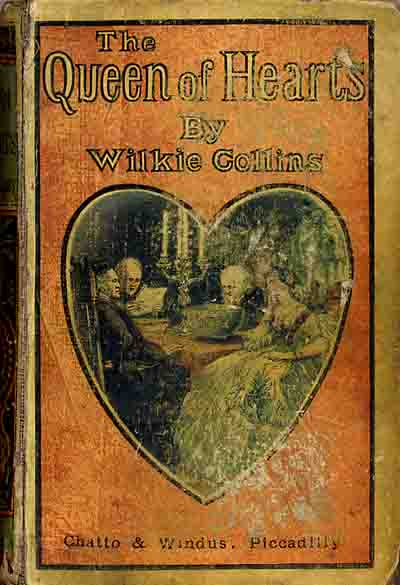
The Queen of Hearts

The Queen of Hearts. Wilkie Collins. 1859. 484 pages.

  Although it took me months to finish reading this collection of short stories by Wilkie Collins, I still found most of it to be delightful. I just LOVED the framework of this book. Three (old) men are entertaining a young lady, Jessie Yelverton. (I believe one of the men is one of her guardians?). As her visit draws to a close, one of the men in hopes of keeping her around just long enough for his son, George, to return home--he would love to have her for a daughter-in-law--proposes that she stay for ten more nights to hear ten stories. The brothers will take turns writing/telling/sharing stories. In between each of the stories, there is narrative linking them all together. The three brothers are Griffith, Owen, and Morgan. The ten stories are: Brother Owen's Story of the Black Cottage, Brother Griffith's Story of the Family Secret, Brother Morgan's Story of The Dream Woman, Brother Griffith's Story of Mad Monkton, Brother Morgan's Story of The Dead Hand, Brother Griffith's Story of the Biter Bit, Brother Owen's Story of the Parson's Scruple, Brother Griffith's Story of A Plot in Private Life, Brother Morgan's Story of Fauntleroy, Brother Owen's Story of Anne Rodway. All of the stories had been previously published in various magazines from 1855 to 1859.

My favorite part of Queen of Hearts was the framework of the narrative. I loved meeting Jessie Yelverton. I loved Griffith, Owen, and Morgan. I loved seeing how she changed their lives for the better. I loved seeing the life she brought back into their lives. And I loved seeing her come to care for these men, too. How much at home she felt with them. She wasn't anxious to depart either. Many of the stories were good; however, some of them were just so long! I felt some of them were definitely long enough to be novellas. 

Read The Queen of Hearts
  • If you enjoy Wilkie Collins
  • If you enjoy short stories
  • If you like mystery, suspense, gothic, or horror
  • If you enjoy romantic comedies

© 2012 Becky Laney of Becky's Book Reviews