Showing posts with label Wilkie Collins. Show all posts

Friday, February 21, 2020

31. Man and Wife

Man and Wife. Wilkie Collins. 1870. 652 pages. [Source: Bought] [Adult classic; Adult romance; Victorian]

First sentence from the prologue: ON a summer’s morning, between thirty and forty years ago, two girls were crying bitterly in the cabin of an East Indian passenger ship, bound outward, from Gravesend to Bombay.
 
First sentence from chapter one: THE OWLS. IN the spring of the year eighteen hundred and sixty-eight there lived, in a certain county of North Britain, two venerable White Owls.
 
Premise/plot: Anne and Blanche are best, best friends. As were the parents--Blanche and Anne. But Anne, both Annes, haven't had the best fortune when it comes to choosing wisely whom to love and trust. One Anne was doomed to die in despair...but will the second Anne suffer the same fate? Or will Blanche and her family prove to be her salvation?!
 
My thoughts: I first read this one in 2009. It was my first novel by Wilkie Collins. I loved, loved, loved it. I still love, love, love it. My favorite character--and probably the eldest book crush I've ever, ever had--perhaps with the exception of Matthew Cuthbert--is Sir Patrick Lundie. Now, I don't want you to think this book is really a ROMANCE with him as the romantic lead. No, he may be a scene-stealer (at least for this reader!!!) but the romantic lead is played by Arnold Brinkworth, a young man madly, deeply in love with Blanche. 
 
 Here is a little love scene between Arnold and Blanche:

[Blanche] could have boxed Arnold on both ears for being so unreasonably afraid of her.
"Well," she said impatiently, "if I did look in your face, what should I see?"
Arnold made another plunge. He answered: "You would see that I want a little encouragement."
"From me?"
"Yes--if you please."

Blanche looked back over her shoulder. The summer-house stood on an eminence, approached by steps. The players on the lawn beneath were audible, but not visible. Any one of them might appear, unexpectedly, at a moment's notice. Blanche listened. There was no sound of approaching footsteps--there was a general hush, and then another bang of the mallet on the ball and then a clapping of hands. Sir Patrick was a privileged person. He had been allowed, in all probability to try again; and he was succeeding at the second effort. This implied a reprieve of some seconds. Blanche looked back again at Arnold.

"Consider yourself encouraged," she whispered and instantly added, with the ineradicable female instinct of self-defense, "within limits!"

Arnold made a last plunge--straight to the bottom, this time.

"Consider yourself loved," he burst out, "without any limits at all."

© 2020 Becky Laney of Becky's Book Reviews

Sunday, August 13, 2017

Hide and Seek

Hide and Seek. Wilkie Collins. 1854. 384 pages. [Source: Bought]

First sentence: At a quarter to one o'clock, on a wet Sunday afternoon, in November 1837, Samuel Snoxell, page to Mr. Zachary Thorpe, of Baregrove Square, London, left the area gate with three umbrellas under his arm, to meet his master and mistress at the church door, on the conclusion of morning service.

Premise/plot: Mr. Valentine Blyth is an artist. While working in the country side--painting portraits of babies and sometimes painting portraits of horses--he sees a deaf/dumb girl named Mary. She's ten or so. He and his wife don't have any children, and, he pities her since she's literally the property of a circus. Mrs. Peckover (the wife of one of the clowns) is raising her as best she can but she agrees that Mr. and Mrs Blyth might make more suitable parents. She tells Mr. Blyth all she knows about Mary's (Madonna's) origins. She gives him a hair bracelet--all that is left of the mother's belongings. Many years later, Mr. Blyth welcomes into his home a Mr. Zack Thorpe. Zack has aspirations for being an artist; at the moment he's a semi bad-boy. He isn't past all hope yet, but, he's certainly not hanging out with the right people and doing as he should--if he wants to be a respectable, honorable gentleman. One day, however, he does a good deed for a stranger, a "wild" man named Mat Grice. Mat swears that he will always, always think of Zack as a brother. The two move in together, and Zack introduces him to Mr. Blyth. While a guest in Blyth's home, he becomes a bit sly and seems very shady. Thus the mystery begins...Who is Madonna's father? Who was her mother? How is Mat connected--if at all--to Madonna? What kind of man is Mat?

My thoughts: Hide and Seek is Wilkie Collins' third novel. I've not read either of his previous novels: Antonina (1850) or Basil (1852). It is his first mystery novel, I believe.

I definitely enjoyed this one. I can't say that I loved, loved, loved it. But I definitely wanted to keep reading. I did not guess everything ahead of time. But I did get a strong sense in the beginning of the novel that the romance between Zack and Madonna was doomed some way, some how. The character that surprised me most was Mat. I really had my doubts about him when he was first introduced. But by the end of the novel, I definitely wanted him to have a happy ending.

s
p
o
i
l
e
r

One word about the plot, I do think it seems a bit ridiculous how Mat pieces EVERYTHING together based on two locks of hair being the EXACT SAME SHADE. Hair color does not equal a DNA test. That is all. 

Quotes:

Our destinies shape the future for us out of strange materials: a traveling circus sufficed them, in the first instance, to shape a new future for Mr. Blyth. (41)
Art wouldn't be the glorious thing it is, if it wasn't all difficulty from beginning to end. (120)


© 2017 Becky Laney of Becky's Book Reviews
Sunday, January 18, 2015

Jezebel's Daughter

Jezebel's Daughter. Wilkie Collins. 1880. 304 pages. [Source: Bought]
In the matter of Jezebel's Daughter, my recollections begin with the deaths of two foreign gentlemen, in two different countries, on the same day of the same year.
They were both men of some importance in their way, and both strangers to each other.
Mr. Ephraim Wagner, merchant (formerly of Frankfort-on-the-Main), died in London on the third day of September, 1828.
Doctor Fontaine—famous in his time for discoveries in experimental chemistry—died at Wurzburg on the third day of September, 1828.
Both the merchant and the doctor left widows. The merchant's widow (an Englishwoman) was childless. The doctor's widow (of a South German family) had a daughter to console her.
At that distant time—I am writing these lines in the year 1878, and looking back through half a century—I was a lad employed in Mr. Wagner's office. Being his wife's nephew, he most kindly received me as a member of his household. What I am now about to relate I saw with my own eyes and heard with my own ears. My memory is to be depended on. Like other old men, I recollect events which happened at the beginning of my career far more clearly than events which happened only two or three years since.
Did I enjoy reading Jezebel's Daughter? Yes!!! I enjoyed it very much! David Glenney, is the nephew of Mrs. Wagner. He is also a clerk in [the family] business. The Wagner family welcomes Fritz Keller, the son of a business partner, into their home. He's been sent away from home because his father doesn't like the woman his son has fallen in love with. Fritz tells David all about his one true love: Minna Fontaine. She's perfect in every way imaginable, at least Fritz thinks so, but, Minna's mother, Madame Fontaine, rubs some people the wrong way. There are some who love and defend her, but, more often than not, most tend to think she's really 'a Jezebel.' Fritz receives a letter from someone sharing good and valid reasons why the mother may be pure evil. Fritz dismisses it, of course, and David doesn't know why it's any of his business when all is said and done! (Soon David will meet Minna and Madame Fontaine and form his own opinions. As will his aunt, Mrs. Wagner).

So. After Mr. Wagner died, he left his wife his business. And she's determined to do a few things. One to employ good and honest women in the business. And. To help rehabilitate a man from bedlam. His name is Jack Straw. And he plays a very big role in the book! Eventually all the characters will come together under one household...and then there's DRAMA and excitement. Jezebel's Daughter could definitely be classified as a sensation novel.

Is Madame Fontaine 'a Jezebel'? Is she evil? Is she a murderess? Is she a schemer? Or has she been falsely accused?

Will Fritz and Minna's romance prove true? Will they be allowed to marry?

Can Jack Straw be rehabilitated and cured of his madness?

© 2015 Becky Laney of Becky's Book Reviews

Sunday, September 21, 2014

No Name (1862)

No Name. Wilkie Collins. 1862/1998. Oxford University Press. 748 pages.

No Name is my third Wilkie Collins novel to read this year. I've also read A Rogue's Life and The Law and the Lady. I don't know if I'll have time to squeeze in another before the year is over or not. But it's looking like No Name will definitely be my favorite. This novel reminded me of why I enjoy reading Wilkie Collins! And sometimes I do need reminding. I have been disappointed before. But when he's good, he tends to be really, really good. No Name is definitely Collins at his best! I enjoyed No Name best when I stopped trying to categorize it.

Magdalen Vanstone is the heroine of No Name. After her parents die within weeks of each other, she learns some startling news that changes everything for herself and her sister. Her father was not legally married to her mother; that is he was not legally married to her until a few months ago. His honorable intentions, unfortunately, have ruined their lives. For his marriage discredits his previous will. If he had NOT gotten married, then the girls would have been in his will and they would have inherited everything. Now his everything goes to an estranged older brother that is mean and cruel. (Collins would like you to boo, hiss now)

Norah, the good sister, the good older sister, accepts this news with grace and courage. She will follow Miss Garth's advice closely. She will become a governess. She will be far from wealthy, but, she'll hold onto as much dignity as she can cling to under the circumstances.

Magdalen, the younger sister, refuses to accept it at all. And she's just as clever and crafty as she is stubborn. Magdalen teams up with a relation of a relation, a con man named Captain Wragge. Both are clever and willing to be a bit immoral in pursuit of what they want most, of what they feel they deserve. Captain Wragge may sound like a villain, but, there's just something about him that I can't help liking. He certainly makes NO NAME an interesting read!!!

Magdalen has a plan, a scheme, for recovering the money that is rightfully hers. She will stop at nothing to get it. What is her plan? Well, it involves her (mean) uncle, Michael Vanstone, and his heir, Noel.

The scheme does not go unnoticed, however. Mrs. Lecount is a servant in the Vanstone household, and she is very controlling and extremely observant. She is always on the lookout for people who might be tempted to take advantage of the family since they are old and/or weak and/or very stupid!

It is a plot-driven novel with plenty of twists and turns. I enjoyed every single one. The book may be over 700 pages, but it's a quick 700 pages!!! It's a surprisingly quick read. Once you become hooked on the story, on learning what happens next, once you start to CARE about the characters, you just have to read on and on!!!

Will Magdalen's scheme succeed?
Will she get her hands on the money?
Will she share the money with Captain Wragge?
Will he find a way of getting his share? Is he really on her side no matter what? Or will he turn traitor?
Will either sister get married? Will either sister live happily ever after?

© 2014 Becky Laney of Becky's Book Reviews
Sunday, June 15, 2014

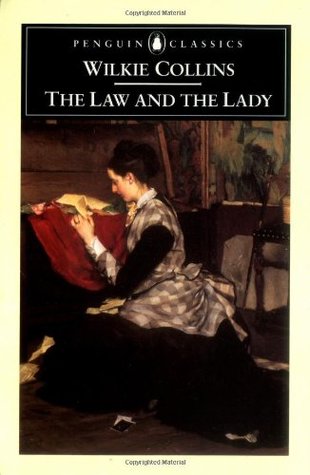
The Law and the Lady (1875)

The Law and the Lady. Wilkie Collins. 1875. 430 pages. [Source: Book I Bought]

The Law and the Lady may not be my favorite Wilkie Collins novel, but, I am glad I finally read this "first" female detective novel. Valeria is our heroine, our amateur detective. Readers meet her on her wedding day. Foreshadowing is abundant. All is not well. Things may never be well for this couple. Within days, Valeria is noticing inconsistencies and becoming super suspicious of her husband. She snoops in his things; she goes to his friends to ask questions, etc. She makes a DISCOVERY.

Her husband was married before. His first wife died. He was tried for murder--suspected of poisoning her by arsenic. The Scottish Verdict was "Not Proven" which essentially means that people, that society, could still choose to look upon him with suspicion as a murderer. He may not be "guilty" but he's not been deemed "innocent."

Once he knows that she knows his past, he leaves her. Valeria while seeming to be full of doubt and hesitation and fear BEFORE she discovered his past, is suddenly completely confident in her husband's innocence AND more in love with him than ever before. It seems her love for her husband has tripled since she read her husband's trial. She is now fiercely determined to prove that her husband is innocent, to take her proof to court.

Over half the novel is focused on Valeria's efforts to prove her husband's innocence. Valeria only has to talk to one or two people to know what's what. Getting proof that her intuition is right may prove slightly more challenging, but Valeria with a little help from others is stubborn enough to see the job through to the end.

Or is she? The Law and the Lady has a not-quite-satisfying ending. For her husband to "receive" justice, it means that someone else will be assigned blame. (That seemed obvious from the beginning.) And in the end, both husband and wife prove reluctant and hesitant to act.

The Law and the Lady is a strange novel with a strong heroine. As a romance, it was extremely weak. Valeria, readers are told, loves, loves, loves her husband. He is her EVERYTHING. But readers never see the husband at his supposed best. Readers just see Valeria in various dramatic scenes supposedly acting on her husband's behalf and with his best interests in mind. Because readers don't necessarily share faith in Valeria's husband or in Valeria's judgment, it could have easily gone the other way. Collins could have written this as a dark, dramatic piece with a less than happy ending. 

© 2014 Becky Laney of Becky's Book Reviews
Sunday, March 16, 2014

A Rogue's Life (1856)

A Rogue's Life. Wilkie Collins. 1856. 159 pages. [Source: Book I bought]

I am going to try if I can't write something about myself. My life has been rather a strange one. It may not seem particularly useful or respectable; but it has been, in some respects, adventurous; and that may give it claims to be read, even in the most prejudiced circles.

 Who is the rogue in Wilkie Collins A Rogue's Life? None other than Frank Softly. He comes from a respectable (though not wealthy) family. He falls OUT of favor with his parents and INTO a good bit of trouble. Debt factoring into this rogue's story quite often. He doesn't really "fit" with any of the "respectable" professions allowed to his class. And I believe his first "profession" is as a caricaturist. He sells his work, has it published, is quite successful using a pseudonym... for a while But. When people match his real identity with his pseudonym...well, that just won't do. That is when his parents make a stand.

A Rogue's Life is a short, pleasant read. It's told in first-person narrative. And the narration is quite lively. His adventures and misadventures are a bit crazy perhaps, making the whole too complex to easily summarize for review. But. It is an easy enough story to follow when you're actually reading it.

Essentially when this 'rogue' falls madly in love--and, of course, it's love AT FIRST SIGHT, with a beautiful yet mysterious young woman, there is NOTHING he won't do to find out who she is...he will woo her no matter what it costs him...

Another 'fun' element (if 'fun' is the right word?) is the speculation involving an inheritance. Frank's sister will inherit a good deal of money from someone (I can't remember who) IF and only IF Frank can outlive the grandmother. So throughout the book, there is all this speculation about the future! The grandmother is very old and determined to live forever, and, of course, Frank's misadventures (including prison time) could lead to his dying young...

It's an odd book in a way. But overall, it was a pleasant way to spend an hour.

© 2014 Becky Laney of Becky's Book Reviews
Friday, September 27, 2013

The Black Robe (1881)

The Black Robe. Wilkie Collins. 1881. 320 pages. [Source: Bought]

The Black Robe is slightly similar to Anthony Trollope's He Knew He Was Right (1869) and Kept in the Dark (1882). All three books deal with the hazards and drama of marriage.

Lewis Romayne travels to France with his friend Major Hynd. While in France, Lewis goes gaming. At a card game, he accuses a man of cheating. The man insists on a duel. For whatever reason, the man is unable but his (grown) son insists on taking his place. This son is rumored to be quite good at shooting. Lewis, for better or worse, fires a "lucky" shot. His opponent dies. Now there is unbeknownst to all, a younger brother on the scene who witnesses his older brothers death. He screams out. These screams haunt Lewis. A good percentage of the novel focuses on how haunted and disturbed Lewis is psychologically. His friends fear the worse, they fear he will become insane. One of his friends thinks that marriage is the answer. If Lewis would only find a wife, surely, he will become suddenly sane. Right?! It makes perfect sense. If Lewis is unstable and unbalanced, of course, he needs a wife. And his friends have just the woman in mind. Fortunately, she fell in love with him at first sight. She's drawn to him precisely because he looks so fragile and vulnerable. Not everyone thinks marriage is the answer, however.

Father Benwell is a Jesuit priest with an agenda. (Well, why wouldn't he have an agenda?!) Romayne has inherited property that centuries before (think Henry VIII) had belonged to the Catholic church. Benwell is determined to have that property (Vange Abbey) back. He has a main plan and several back-up plans just in case his original schemes fail. One of his plans involve another Jesuit priest, Arthur Penrose, Penrose is one of the nicest characters in the book. Penrose has been instructed to convert Lewis, to do whatever it takes to turn him Catholic. Penrose's approach doesn't suit Benwell. But his gentleness and sincerity make a lifelong friend out of Lewis.

Lewis marries Stella Eyrecourt. Benwell needs a good plan B. He decides to see if he can dig up a scandal concerning the wife. If he can separate the couple, surely, he will be weakened and even more vulnerable. He would be eager to turn from his wife to the church. He might love the church so much he voluntarily gives Vange Abbey back! But can Benwell find anything scandalous in Stella's past?!

My favorite character was definitely Bernard Winterfield. The last half of the novel is told through his diary entries.

If you have enjoyed Wilkie Collins in the past, chances are you'll enjoy this novel too. While I didn't love it as much as Armadale or Woman in White, I did find it compelling! There are plenty of secrets!

Quotes:
Art has its trials as well as its triumphs. It is powerless to assert itself against the sordid interests of everyday life. The greatest book ever written, the finest picture ever painted, appeals in vain to minds preoccupied by selfish and secret cares. 
Whether we only express our opinions of pictures or books in the course of conversation or whether we assert them at full length, with all the authority of print, we are really speaking in either case, of what personally pleases or repels us. 
© 2013 Becky Laney of Becky's Book Reviews
Friday, May 10, 2013

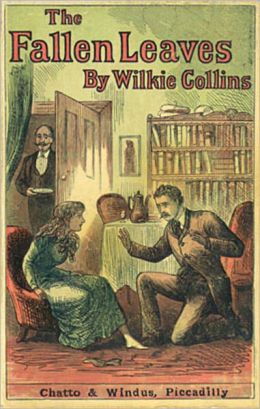
Fallen Leaves (1879)

The Fallen Leaves. Wilkie Collins. 1879. 344 pages.

I have really enjoyed some of the novels I've read by Wilkie Collins. I loved, loved, loved Armadale and The Woman in White. I really enjoyed Man and Wife and The Moonstone. I liked The Fallen Leaves, but, it is not Collins at his best in my opinion.

Claude Amelius Goldenheart is the hero of The Fallen Leaves. He is returning to England at the start of the novel.  (He was born in England, and grew up in the United States. His growing-up-years were spent in a Christian socialist community. He will soon come into an inheritance, but, he discovers that his inheritance isn't big enough for him to take a place in Society. He's introduced to the Farnaby family early in the novel. Mrs. Farnaby is fascinated by him, in a way, and treats him strangely. She pulls him into her confidence, sharing the most intimate secrets in her past. Her excuse? Well, she had a DREAM that he was "the one" who brought her her heart's desire: her missing daughter. (Mrs. Farnaby had a child before she married. When the baby was just a week or possibly two weeks old, it was kidnapped). Because she wants HIM to find her, she feels very strongly that he shouldn't be settling down anywhere and getting married. He definitely shouldn't marry her niece. He needs to be free and independent so he can travel and socialize. But by the time he's discussing this secret with Mrs. Farnaby, he's already incredibly smitten with the niece, Regina. Her father does not approve because Mr. Goldenheart is "poor" in his estimation. If he can increase his annual income by several thousand in the next few years, then he'll consider it. Our hero who has grown up a socialist can't fathom WHY he needs more money to be happy in his marriage. He disagrees significantly with Mr. Farnaby! And the family is hoping that he outgrows his strangeness. They really don't like it when he gives a lecture to the lower classes on "Christian socialism."

There are two big questions in this one: "Will Amelius find Mrs. Farnaby's lost daughter?" and "Will Amelius make a happy marriage?"

I wasn't bored with The Fallen Leaves. But. It certainly wasn't amazing.

Favorite quotes:
'Ah, dear me! Another of the Fallen Leaves!' I knew what he meant. The people who have drawn blanks in the lottery of life--the people who have toiled hard after happiness, and have gathered nothing but disappointment and sorrow; the friendless and the lonely, the wounded and the lost--these are the people whom our good Elder Brother calls The Fallen Leaves. I like the saying myself; it's a tender way of speaking of our poor fellow creatures who are down in the world.
 It is an afternoon concert; and modern German music was largely represented on the programme. The patient English people sat in closely-packed rows, listening to the pretentious instrumental noises which were impudently offered to them as a substitute for melody. 
My sentiments are not altogether favourable to that art [photography]. I delivered a lecture on photographic portraiture at Coolspring; and I described it briefly as justice without mercy.
In less than half an hour he discovered that Hume could do nothing for him. Wisely inspired, he turned to the truer history next, which mean call fiction.
© 2013 Becky Laney of Becky's Book Reviews
Monday, December 24, 2012

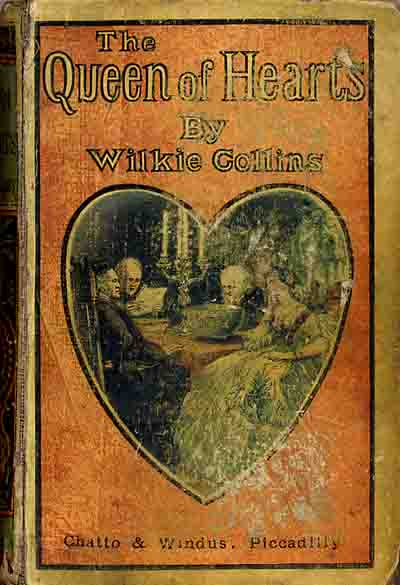
The Queen of Hearts

The Queen of Hearts. Wilkie Collins. 1859. 484 pages.

  Although it took me months to finish reading this collection of short stories by Wilkie Collins, I still found most of it to be delightful. I just LOVED the framework of this book. Three (old) men are entertaining a young lady, Jessie Yelverton. (I believe one of the men is one of her guardians?). As her visit draws to a close, one of the men in hopes of keeping her around just long enough for his son, George, to return home--he would love to have her for a daughter-in-law--proposes that she stay for ten more nights to hear ten stories. The brothers will take turns writing/telling/sharing stories. In between each of the stories, there is narrative linking them all together. The three brothers are Griffith, Owen, and Morgan. The ten stories are: Brother Owen's Story of the Black Cottage, Brother Griffith's Story of the Family Secret, Brother Morgan's Story of The Dream Woman, Brother Griffith's Story of Mad Monkton, Brother Morgan's Story of The Dead Hand, Brother Griffith's Story of the Biter Bit, Brother Owen's Story of the Parson's Scruple, Brother Griffith's Story of A Plot in Private Life, Brother Morgan's Story of Fauntleroy, Brother Owen's Story of Anne Rodway. All of the stories had been previously published in various magazines from 1855 to 1859.

My favorite part of Queen of Hearts was the framework of the narrative. I loved meeting Jessie Yelverton. I loved Griffith, Owen, and Morgan. I loved seeing how she changed their lives for the better. I loved seeing the life she brought back into their lives. And I loved seeing her come to care for these men, too. How much at home she felt with them. She wasn't anxious to depart either. Many of the stories were good; however, some of them were just so long! I felt some of them were definitely long enough to be novellas. 

Read The Queen of Hearts
  • If you enjoy Wilkie Collins
  • If you enjoy short stories
  • If you like mystery, suspense, gothic, or horror
  • If you enjoy romantic comedies

© 2012 Becky Laney of Becky's Book Reviews
Tuesday, July 17, 2012

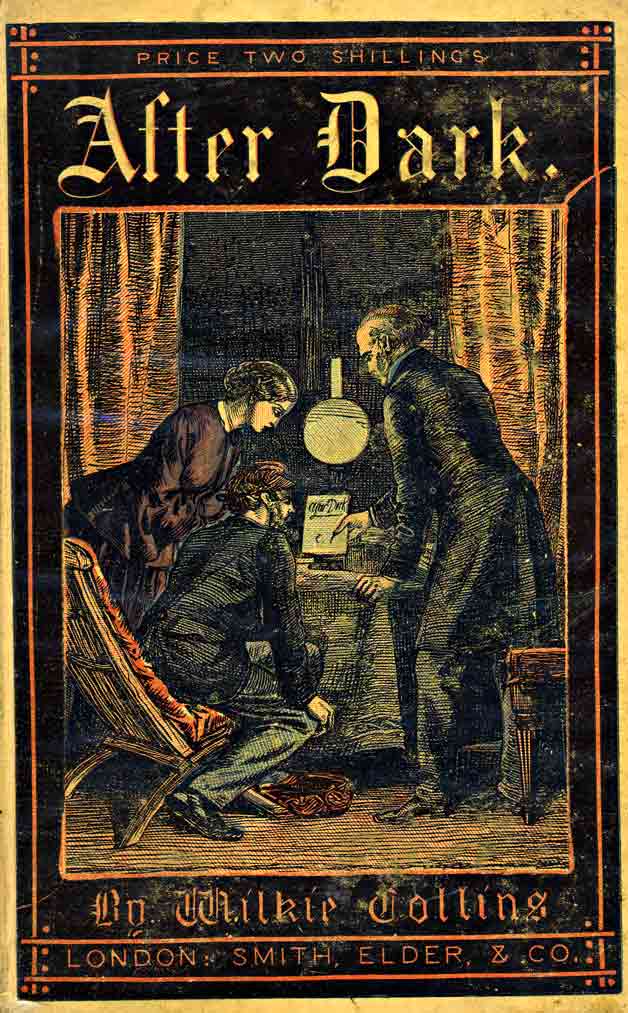
After Dark

After Dark. Wilkie Collins. 1856. 404 pages.

From "Leaves From Leah's Diary"
26th February, 1827.—The doctor has just called for the third time to examine my husband's eyes. Thank God, there is no fear at present of my poor William losing his sight, provided he can be prevailed on to attend rigidly to the medical instructions for preserving it. These instructions, which forbid him to exercise his profession for the next six months at least, are, in our case, very hard to follow. They will but too probably sentence us to poverty, perhaps to actual want; but they must be borne resignedly, and even thankfully, seeing that my husband's forced cessation from work will save him from the dreadful affliction of loss of sight. I think I can answer for my own cheerfulness and endurance, now that we know the worst. Can I answer for our children also? Surely I can, when there are only two of them. It is a sad confession to make, but now, for the first time since my marriage, I feel thankful that we have no more.
I tend to love Wilkie Collins. And I did enjoy his short story collection, After Dark. But I didn't find all six of the short stories equally compelling. And while I *loved* some of the stories in this book, I didn't love them all. I found them all worthwhile, all entertaining.

There's a framework to After Dark. A portrait-painter, William, suffers damage to his eyesight, the doctor tells him he needs LOTS of time to recuperate if he hopes to be able to see again. He can no longer count on his painting to bring in the income and take care of his family, so, the family is forced to come up with plan B. Plan B just happens to be writing and publishing a book of stories. These are stories that have been told to the painter--usually while his subject is being painted--through the years. He will now recollect the best stories he's ever heard and relate them to his wife, Leah, who will write them down each night...after dark. (That is after her long day's work is through.)

The six stories are:

  • The Traveller's Story of a Terribly Strange Bed (1852)
  • The Lawyer's Story of a Stolen Letter (1854)
  • The French Governess's Story of Sister Rose (1855)
  • The Angler's Story of The Lady of Glenwith Grange (new for After Dark)
  • The Nun's Story of Gabriel's Marriage (1853)
  • The Professor's Story of the Yellow Mask (1855)
Five of the six short stories were reprints, only one story was brand new and written especially for this book.

In my opinion, the best, best, best short story in this collection is The French Governess's Story of Sister Rose. This story has DRAMA and action. It is set during the French Revolution. And in my opinion, this story is a MUST read. Not only if you're a fan of Victorian literature OR a fan of Wilkie Collins, but if you're a fan of historical fiction set during the French Revolution, you should really consider reading this novella. (In my opinion, it is closer to a novella than a proper short story. It has parts and chapters.) So Louis Trudaine made a deathbed promise to his mother to always be there for his sister, Rose, and protect her. Rose has fallen in love with a man Louis feels is unworthy of her, a Charles Danville. The marriage does happen, though not without some unpleasant exchanges on the eve of the wedding. But he never feels quite sure of his sister's husband, and so he chooses to remain nearby even if it means passing up a job opportunity. Years pass--we learn from the narrator--and the Revolution comes. And with it danger, drama, action, betrayal, and so much more. This story is so very, very, very good. It's quite intense and I loved every minute of it.

The Traveller's Story of a Terribly Strange Bed is actually Wilkie Collins first published short story. It is quite creepy! It also happens to be set in Paris, by the way, anyway, the narrator is a young man named Faulkner. His good luck at a gambling house almost proves fatal. For a very, very friendly man convinces him that it is much too risky to leave the house at that time of night and wander the streets carrying his winnings. No, no, it would be much much safer to stay there for the night. But is that the truth? Well, his insomnia may just be a lifesaver!

The Nun's Story of Gabriel's Marriage is another story set in France during the French Revolution. While it isn't as good as The French Governess's Story of Sister Rose, in my opinion, it was interesting to get another story set in France--in Brittany--from Collins. The theme of this one is forgiveness and reconciliation. If you want a story with a couple of BIG twists, this one may prove satisfying.

The Angler's Story of The Lady of Glenwith Grange is another story with a BIG, BIG twist. Ida has promised to always, always, always take care of her younger sister, Rosamond. (Their mother died when Rosamond was a baby.) So when Rosamond marries, it's agreed that Ida will always live with them. The marriage, as you might expect, does not exactly exactly go as planned. And readers...along with Ida...learn why.

The Professor's Story of the Yellow Mask is set in Italy, I believe. It has a larger cast of characters than some of the other stories in the collection. And it has its own share of drama. It is a darker story balanced perhaps in a way by a love story with many, many obstacles. It also has lots of twists and turns and such. That being said, I wasn't thrilled with it.

The Lawyer's Story of a Stolen Letter is a detective story. It was a nice enough story, I suppose, but I wasn't wowed by it. Still, it's enjoyable enough. 


Read After Dark
  • If you're a fan of Wilkie Collins
  • If you're a fan of Victorian literature
  • If you're a fan of mystery, suspense, detective, or sensation stories
  • If you like short stories
  • If you like "shocking" stories with plenty of drama and twists and turns
© 2012 Becky Laney of Becky's Book Reviews
Monday, October 10, 2011

The Woman in White

The Woman in White. Wilkie Collins. 1860. 672 pages.

This is the story of what a Woman's patience can endure, and what a Man's resolution can achieve.

I loved this one. I just LOVED, LOVED, LOVED this one by Wilkie Collins. This isn't my first (mystery) novel by Wilkie Collins, and it won't be the last. Each new read makes me want more, more, more. If you're a fan of this bearded Victorian, I'd love to hear from you which of his I should try to read next. (My library has Basil, No Name, and The Dead Secret.)

The first narrator we meet is Walter Hartright. He is a drawing teacher. He is on his way to a new job--new position--in the country when he meets a strange woman on the way to London. It's the middle of the night. The woman appears from nowhere. She's acting a little peculiar. She's dressed all in white. But there is something about her that makes him sympathetic to her cause, even before he knows her story. By pure chance, so it seems, this woman happens to mention the countryside, the house, where he is to begin his new job that autumn. A fact that makes this meeting a little more memorable perhaps. Memorable enough to mention to Miss Marian Halcombe, one of the two young women he'll be teaching. The other young woman is Miss Laura Fairlie. She is oh-so-beautiful. (Miss Marian is not. Though I'd NEVER be as mean about it as Wilkie Collins.) Laura and Walter fall madly in love with another. Though he won't tell her and she won't tell him. Still. Marian sees how these two feel about one another. And she tries her best to tell Walter that that just can't be. Not because Marian is mean and cruel. But because Laura has been engaged for some time to an older man, Sir Percival Glyde. It was one of her father's wishes that the two wed. Before she fell for Walter, Laura was ready to wed without love, without hope of love. But now that she knows what it feels to love someone, she is having some major regrets about her promises. And the doubts will only grow when she's warned anonymously by letter NOT TO MARRY Sir Percival. She's warned that her husband to be is evil and then some. Marian tells Walter of this anonymous letter, and he believes--they both believe--that the woman in white may just be the writer of this one. If only she would say more, give out the reasons why. They want to know the truth, but they have so little to go on. And a gentleman's word that the letter was written by a crazy woman and that of course he's never had an evil thought in his entire life is accepted as gospel truth. Poor Laura!!!

I found it well-written. I found it suspenseful. I loved the details, the descriptions, the characterizations. I loved how the story unfolded. I loved having the story told by so many different people. Some narrators I preferred to others. But. I think they all added a little something to make this one just right.

The Woman in White was one of those books that I just know I will want to reread again and again. It's just that good.

Previous Collins: Man and Wife, Armadale, The Moonstone, Evil Genius.

© 2011 Becky Laney of Becky's Book Reviews
Friday, October 01, 2010

Evil Genius

Evil Genius. Wilkie Collins. 1886. 348 pages.

The gentlemen of the jury retired to consider their verdict.
Their foreman was a person doubly distinguished among his colleagues. He had the clearest head, and the readiest tongue. For once the right man was in the right place.
Of the eleven jurymen, four showed their characters on the surface. They were:
The hungry juryman, who wanted his dinner.
The inattentive juryman, who drew pictures on his blotting paper.
The nervous juryman, who suffered from fidgets.
The silent juryman, who decided the verdict.
Of the seven remaining members, one was a little drowsy man who gave no trouble; one was an irritable invalid who served under protest; and five represented that vast majority of the population -- easily governed, tranquilly happy -- which has no opinion of its own.

While I didn't love The Evil Genius as much as The Moonstone, I did enjoy it. What should you know? Well, it is NOT a mystery. It is a "domestic story." You should also know that it has a forty-page prologue (of sorts) that establishes the background of one of its main characters.

Readers first meet Sydney Westerfield as a child. Her father has died; her mother--at best--is disinterested. Her mom is all about her son. When her mother remarries and moves to America, she leaves her daughter in the care of her sister. Of course, she takes her beloved son. The aunt? Well, she's super-excited because she can use Sydney as a servant and a teacher-in-training. So poor Sydney has not known love in many, many years. Perhaps since her father died.

The novel opens when Herbert Linley seeks a governess for his daughter, Kitty. He brings home the young, the beautiful, the pathetic Sydney. After hearing her story, after seeing her kicked out of her aunt's home, he had to hire her. Mrs. Presty, his mother-in-law, is skeptical. She's been married twice, and she's convinced she knows a thing or two about men. And the fact that Sydney is so young, so beautiful, so innocent, so in need of love and acceptance, so sweet, well, she thinks that it is unwise to have her in their home. (Yes, Mrs. Presty lives with her daughter and son-in-law.) But Mrs. Linley meets Sydney and is enchanted. Her heart is big enough to accept Sydney without doubt, without reservation. And Kitty? Her daugher? Well, Kitty loves, loves, loves her governess! So it looks like Sydney may have found a happy home at last....

But. One late night stroll in the moonlight finds Mr. Linley and Sydney unexpectedly thrown together--they're locked out of the house--and Mr. Linley fancies himself in love with this ever-grateful young woman. He confesses as such. As soon as those words are spoken, both know that they cannot remain in this situation...

The Evil Genius, like Anna Karenina, focuses on marriage, adultery, divorce, and scandal. But it is so VERY different from Anna Karenina! Both Mrs. Linley and Miss Westerfield are sympathetic. And Mrs. Presty is great for comical relief! (Is she "The Evil Genius" of the family that contributes to its downfall?) The Evil Genius is never boring. It's extremely readable. 

I enjoyed it. There were places I loved it.
"Is there any human character, even the noblest, that is always consistently good?"
"One reads of them sometimes," she suggested, "in books."
"Yes," he said. "In the worst books you could possibly read--the only really immoral books written in our time."
"Why are they immoral?"
"For this plain reason, that they deliberately pervert the truth. Clap-trap, you innocent creature, to catch foolish readers! When do these consistently good people appear in the life around us, the life that we all see? Never! Are the best mortals that ever lived above the reach of temptation to do ill, and are they always too good to yield to it? How does the Lord's Prayer instruct humanity? It commands us all, without exception, to pray that we may not be led into temptation. You have been led into temptation. In other words, you are a human being. All that a human being could do you have done--you have repented and confessed." (324)

© Becky Laney of Becky's Book Reviews
Saturday, September 25, 2010

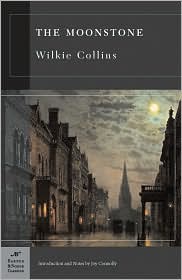
Moonstone

The Moonstone by Wilkie Collins. 1868.

From the prologue: I address these lines -- written in India-- to my relatives in England.

From chapter one: In the first part of Robinson Crusoe, at page one hundred and twenty-nine, you will find it thus written. 'Now I saw, though too late, the Folly of beginning a Work before we count the Cost, and before we judge rightly on our own Strength to go through with it.' Only yesterday, I opened my Robinson Crusoe at that place.

When a cursed diamond is stolen from Miss Rachel Verinder--on the very night it is given--it opens up quite a mystery. Leading the search for the thief is Mr. Franklin Blake, cousin and would-be suitor to the young lady. He calls for the police, a detective, but what he learns--what they all learn after a few weeks search--doesn't quite make sense. What is more surprising is that Miss Rachel doesn't want the thief to be found.

I have come to love Wilkie Collins. (My reviews of Man and Wife and Armadale.) He's a great storyteller. And I love his narration. I do. I really, really love how he tells a story. He's also very good with characters. There were so MANY characters to love in The Moonstone.

Is my favorite narrator Gabriel Betteredge, an elderly house-steward to the Verinder family, a man who is obsessed with Robinson Crusoe? He opens and closes the account--minus the epilogue. Or is my favorite narrator Miss Drusilla Clack,  a young woman obsessed with religion? Her section was definitely the most comical! I don't know how I could ever choose between the two! Of course, those are just two of the narrators--there's also Mr. Bruff, Franklin Blake, Ezra Jennings, Sergeant Cuff, and Mr. Candy.

Here is one of my favorite passages--from Miss Clack's narrative:
As soon as we were alone, my aunt reclined on the sofa, and then alluded, with some appearance of confusion, to the subject of her Will.
'I hope you won't think yourself neglected, Drusilla,' she said. 'I mean to give you your little legacy, my dear, with my own hand.'
Here was a golden opportunity! I seized it on the spot. In other words, I instantly opened my bag, and took out the top publication. It proved to be an early edition--only the twenty-fifth--of the famous anonymous work (believed to be by precious Miss Bellows), entitled The Serpent at Home. The design of the book - with which the worldly reader may not be acquainted - is to show how the Evil One lies in wait for us in all the most apparently innocent actions of our daily lives. The chapters best adapted to female perusal are 'Satan in the Hair Brush'; 'Satan behind the Looking Glass'; 'Satan under the Tea Table'; 'Satan out of the Window' - and many others.
'Give your attention, dear aunt, to this precious book - and you will give me all I ask.' With those words, I handed it to her open, at a marked passage - one continuous burst of burning eloquence! Subject: Satan among the Sofa Cushions.
Poor Lady Verinder (reclining thoughtlessly on her own sofa cushions) glanced at the book, and handed it back to me looking more confused than ever. (202-03)
When this attempt at witnessing proves unsuccessful, Miss Clack decides to hide tracts throughout her aunt's home. When the tracts come back to her, well, she decides to write out her favorite passages from her favorite tracts and send them to her aunt as letters. Concluding that her aunt might be suspicious to receive so many letters from her all at once, well, she has a few friends help her out in her work.

And Lady Verinder (Miss Rachel's mother) is not the only one Miss Clack is anxious to save...

Here is another quote I'd like to share--this time from Franklin Blake.
Some men have a knack for keeping appointments; and other men have a knack of missing them. I am one of the other men. Add to this, that I passed the evening at Portland Place, on the same seat with Rachel, in a room forty feet long, with Mrs. Merridew at the further end of it. Does anybody wonder that I got home at half-past twelve instead of half-past ten? How thoroughly heartless that person must be! And how earnestly I hope I may never make that person's acquaintance. (389)
I really enjoyed The Moonstone. I loved the characters. So many wonderfully quirky characters! And I found the pace--especially towards the end--to be so compelling. It was impossible to put this one down!

© Becky Laney of Becky's Book Reviews
Thursday, June 24, 2010

Armadale

Armadale. Wilkie Collins. 1866. (My edition. Oxford World's Classics.) 880 pages.

On a warm May night, in the year eighteen hundred and fifty-one, the Reverend Decimus Brock--at that time a visitor to the Isle of Man--retired to his bedroom, at Castletown, with a serious personal responsibility in close pursuit of him, and with no distinct idea of the means by which he might relieve himself from the pressure of his present circumstances.

Is it possible to summarize Armadale in a sentence or two? In a paragraph or two? Probably not. Wilkie Collins is all about layers. Who else besides Collins would premise a novel with fifty-eight pages of prologue? A prologue that establishes the background of three of his main characters. A foreshadowing prologue that shapes and reshapes the novel. Two men. One name. One dark secret.

Armadale centers around three characters: Allan Armadale, Ozias Midwinter, and Lydia Gwilt. Armadale and Midwinter are best friends. But this friendship is strained at times because Midwinter knows things Armadale doesn't. He knows the dark connection they share. Midwinter learned these secrets through a letter he received when he came of age. His father warned him to never ever have anything to do with Allan Armadale. His father's letter also warned him of a dangerous woman.

Lydia Gwilt, one of our narrators, also enters into the drama. Both Midwinter and Armadale (not to mention the elderly Bashwood) fall in love with Miss Gwilt. But Gwilt is incapable of honesty, and her lies may spin everything out of control.

Armadale is about the struggle of the human soul between good and evil. A novel that asks the question--should children suffer for the sins of their fathers? A novel that explores the idea of Fate and free will.

This is my second Wilkie Collins novel. Last year, I read and reviewed Man and Wife. Armadale is a stronger novel, a better novel. (But it doesn't have a Sir Patrick.) Did I love Armadale? I certainly enjoyed it. I found it difficult to put down. I found myself smiling at Collins descriptions. He could definitely be witty when he wanted to be! I found Armadale to be complex. The characters are drawn from human nature; each of the main characters is flawed. I liked the multiple narrators as well. I was surprised at how much of this story is told from Gwilt's perspective--through letters and diary entries mainly. I thought the pacing was suspenseful, and the last two hundred pages were intense. I would definitely recommend the novel.

'Excuse me,' said the impenetrable Scotchman. 'I beg to suggest that you are losing the thread of the narrative.'
'Nothing more likely,' returned the doctor, recovering his good humour. 'It is in the habit of my nation to be perpetually losing the thread--and it is evidently in the habit of yours, sir, to be perpetually finding it. What an example here of the order of the universe, and the everlasting fitness of things!' (17)


The object of Allan's humane caution was corpulent elderly woman of the type called 'motherly.' Fourteen stairs were all that separated her from the master of the house: she ascended them with fourteen stoppages and fourteen sighs. Nature, various in all things, is infinitely various in the female sex. There are some women whose personal qualities reveal the Loves and the Graces; and there are other women whose personal qualities suggest the Perquisites and the Grease Pot. This was one of the other women. (203)

A young man who plays his part in society by looking on in green spectacles, and listening with a sickly smile, may be a prodigy of intellect and a mine of virtue, but he is hardly, perhaps, the right sort of man to have at a picnic. An old lady afflicted with deafness, whose one inexhaustible subject of interest is the subject of her son, and who (on the happily rare occasions when that son opens his lips) asks everybody eagerly, 'What does my boy say?' is a person to be pitied in respect of her infirmities, and a person to be admired in respect of her maternal devotedness, but not a person, if the thing could possibly be avoided, to take to a picnic. Such a man, nevertheless, was the Reverend Samuel Pentecost, and such a woman was the Reverend Samuel's mother; and in the dearth of any other producible guests, there they were, engaged to eat, drink, and be merry for the day at Mr. Armadale's pleasure-party to the Norfolk Broads. (292)
The age we live in is an age which finds no human creature inexcusable. (374)
'When you say no to a woman, sir,' remarked Pedgift Senior, 'always say it in one word. If you give her your reasons, she invariably believes that you mean Yes.' (439)
The plain fact was, that the music-master attached to the establishment fell in love with Miss Gwilt. He was a respectable middle-aged man, with a wife and family--and finding the circumstances entirely hopeless, he took a pistol, and rashly assuming that he had brains in his head, tried to blow them out. The doctors saved his life, but not his reason--he ended, where he had better have begun, in an asylum. (635)


Other reviews: Shelf Love, Novel Insights, The Curious Reader, Bibliolatry, Savidge Reads,

© Becky Laney of Becky's Book Reviews
Friday, December 04, 2009

Wilkie Collins: Man and Wife


Collins, Wilkie. 1870. Man and Wife. 688 pages.

On a summer's morning, between thirty and forty years ago, two girls were crying bitterly in the cabin of an East Indian passenger ship, bound outward, from Gravesend to Bombay.

No matter how you look at it, Man and Wife is a strange and often uneven novel. Definitely melodramatic. As complicated as any modern soap opera.

Anne and Blanche are best friends. Their mothers--also named Anne and Blanche--were also best friends. (Though both mothers are dead by the time this story really gets started. Perhaps that is why these two--now of marriageable age--cling to one another so fiercely.) But this friendship is about to be tested. And not just a little bit. Anne, out of necessity or "duty" is about to separate herself (perhaps forever) from her closest friend. Foolishly, Anne gave into temptation with Geoffrey Delamayn, and is now reaping the consequences. She's pregnant. And she's trying to push her lover into marriage. Reminding him of all that he's said and done. How he owes her and his unborn child. The two arrange to meet at an inn and pose as man and wife. She wants--of course--for the marriage to take place soon after. But before Geoffrey can arrive (but after Anne's already run away), he receives notice that his father is ill--perhaps dying. He's needed at home. In London, I believe. So he convinces his friend, Arnold Brinkworth, to go in his place. To deliver a note to Anne. But to do this, he has to tell a few white lies to the landlady. To say he is the young lady's husband. (Arnold, for the record, is newly engaged. He's in love with Blanche.) This makes both uncomfortable. Neither likes the deceit. And both would undo this day if they could. But what's done is done, right?

This book is set in Scotland and England. And it concerns the Scottish marriage laws of the time. (Irregular little marriages including marriage by declaration and marriage by correspondence.) It's an integral part of the plot and much too complex to try to explain here. But these vacationing characters get into quite a mess by the end of it!

I mentioned that the book was strange. Perhaps that's not quite the word for it. The book tackles so many different topics. Scottish marriage laws. Marriage in general. The lack of women's rights. (How if a woman is a wife then she is the property of her husband. It doesn't matter how evil and cruel and drunk and abusive he is. She is his for life to do with as he pleases.) Society itself. The 'dangers' of sports and athleticism. Perhaps it is the attack on sports--the correlation Collins makes between moral depravity and physical fitness--that stands out as most strange. Geoffrey Delamayn is quite an athlete, a sportsman, he prides himself on his physique. He exercises and trains. He does various sports--including running. And Collins argues that all the energy Delamayn is putting into sports is ruining him mind, body, and soul.

The book is definitely didactic in places. And not just about sports. The other causes taken up within the book--particularly marriage and how women should have rights even if they are married--are a bit more welcome to readers though. But before you champion Collins as being completely enlightened and wonderful, you have to wrestle with passages like these:

However persistently the epicene theorists of modern times may deny it, it is nevertheless a truth plainly visible in the whole past history of the sexes that the natural condition of a woman is to find her master in a man. Look in the face of any woman who is in no direct way dependent on a man: and, as certainly as you see the sun in a cloudless sky, you see a woman is not happy. The want of a master is their great unknown want; the possession of a master is--unconsciously to themselves--the only possible completion of their lives. (chapter 31)
Still, you've got to weigh the good with the bad. And there are some places where the writing shines out for its wit, charm, and truth. (It is the nature of Truth to struggle to the light.) ("Our little besetting sins!" she said. "What slaves we are to our little besetting sins!")

Here is a little love scene between Arnold and Blanche:

[Blanche] could have boxed Arnold on both ears for being so unreasonably afraid of her.
"Well," she said impatiently, "if I did look in your face, what should I see?"
Arnold made another plunge. He answered: "You would see that I want a little encouragement."
"From me?"
"Yes--if you please."

Blanche looked back over her shoulder. The summer-house stood on an eminence, approached by steps. The players on the lawn beneath were audible, but not visible. Any one of them might appear, unexpectedly, at a moment's notice. Blanche listened. There was no sound of approaching footsteps--there was a general hush, and then another bang of the mallet on the ball and then a clapping of hands. Sir Patrick was a privileged person. He had been allowed, in all probability to try again; and he was succeeding at the second effort. This implied a reprieve of some seconds. Blanche looked back again at Arnold.

"Consider yourself encouraged," she whispered and instantly added, with the ineradicable female instinct of self-defense, "within limits!"

Arnold made a last plunge--straight to the bottom, this time.

"Consider yourself loved," he burst out, "without any limits at all."
So the book has its strengths and weaknesses. I mentioned some of the weaknesses already, but I'd like to focus on one of the strengths now. Sir Patrick Lundie. Wow. I loved Sir Patrick. I really did. He is the uncle to Blanche, a lawyer, an older man who has a big heart. He was such a stand-out character. He was so kind, so wise, so witty, so funny, so intelligent. He was a good man. The complete opposite of our villain, Geoffrey Delamayn. (Geoffrey made Heathcliff look like good boyfriend material.) I found myself smiling every time Sir Patrick collided (in dialogue) with Lady Lundie, his sister-in-law.

This was my first introduction to Wilkie Collins, and I found this one to be interesting. True, it has flaws. It's a bit long, and it's prone to rambling at times. It's definitely didactic in nature. But at the same time it's complex in a good way. We meet a lot of interesting characters--good and bad--that are well-developed. (We may not love all of the characters. We may want to yell at some and slap a few others.) But the suspenseful pace of the last two hundred pages or so of the novel help to make up for some of the heaviness of the earlier sections. Is it for everyone? Probably not. But I'm very glad I read it.

Tour Dates for Wilkie Collins.
The Classics Circuit

© Becky Laney of Becky's Book Reviews